
 Published on and written by Cyril Jarnias
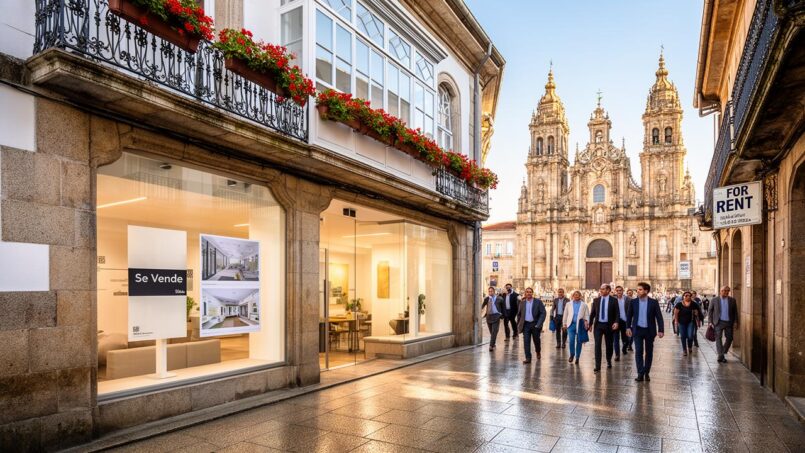
For centuries, Santiago de Compostela has attracted pilgrims from around the world. Today, investors are also converging on the Galician capital, drawn by a dynamic real estate market, prices that remain affordable on a Spanish scale, and rental income driven by tourism and the university. However, investing in Santiago de Compostela should not be taken lightly: price disparities between neighborhoods are significant, tourist pressure weighs on the rental market, and the Spanish legal framework has its own specificities.
Good to Know:
This guide analyzes the foreign real estate market neighborhood by neighborhood. It covers rental yields, acquisition costs, the regulatory framework, and presents different investment strategies suitable for French speakers.
A Dynamic Real Estate Market at the Heart of Galicia
Santiago de Compostela is the capital of the Galicia region in northwestern Spain. An administrative and university city and a major site of the Camino de Santiago, it concentrates political, religious, cultural, and tourist functions that directly impact the real estate market.
The historic center, clustered around the cathedral, is a UNESCO World Heritage Site. This concentration of heritage, combined with a massive influx of visitors, creates a very particular real estate market, where the scarcity of historic properties meets sustained rental demand, both tourist and student-related.
22
Real estate sales in Galicia increased by more than 22% in 2024, one of the highest increases in Spain.
Price Levels: Where Does Santiago Stand in the Region?
On a Galician scale, apartments trade for an average of around €2,048/m² and houses for around €1,204/m². Among the major cities, A Coruña leads with about €2,156/m², while Santiago de Compostela hovers around €1,880/m², ahead of Vigo (€1,795/m²).
More recent data confirms this trend, with a gradual upward momentum:
| Indicator (city) | Indicative Value |
|---|---|
| Overall average price (older data) | ~€1,880/m² |
| 2024 average price (residential) | €1,862/m² |
| Average asking price July 2025 | €1,893/m² |
| Average price February 2026 | €2,120/m² |
| Average price March 2026 (all properties) | €2,386/m² |
| Median apartment price (March 2026) | €2,684/m² |
| Median house price (March 2026) | €1,628/m² |
Apartments are appreciating faster than houses: over five years, their price per square meter has gained about 26.3%, compared to 17.3% for houses. In the last year alone, apartments rose nearly 7.9%, compared to 2.9% for houses. Investment in multi-family housing is clearly the driver of appreciation.
For an investor, this translates into a dual advantage: a price base still lower than that of many major Spanish cities, and a sustained appreciation trajectory, particularly for well-located apartments.
Rental Yields and Profitability: What a Property Yields
One of Santiago de Compostela’s assets is the city’s ability to generate rental income from several demand segments: students, workers, families, pilgrims, cultural tourists… This diversity stabilizes income and limits vacancy risks in the right neighborhoods.
Average Gross Yield and Payback Period
Data converges towards an average gross rental yield of around 4.6% to 4.7% for the entire city. In practice, this means a standard property pays for itself in just over twenty years:
| Overall Indicator (city) | Value |
|---|---|
| Average rental yield | ~4.6% |
| Average monthly rent | ~€950 |
| Average property price | €250,000 – €265,000 |
| Average payback period | 21.9 – 23.2 years |
| Market activity index | 54–55% |
The price-to-rent ratio is around 21–22 years, which remains reasonable for a European market with strong rental demand. This is far from the excesses seen in some capitals where it takes 30 years or more of rent to recoup the purchase price.
Yields by Property Size
Yields vary significantly by property type. To refine a strategy, it is useful to compare prices and rents by category.
| Property Type | Average Price (€) | Average Monthly Rent (€) | Annual Income (€) | Estimated Gross Yield |
|---|---|---|---|---|
| Studio | 110,000 – 145,000 | 700 | 8,400 | 5.79% – 7.64% |
| 1 bedroom | 185,000 – 188,500 | 700 | 8,400 | 4.46% – 4.54% |
| 2 bedrooms | 215,000 – 229,500 | 800 – 900 | 9,600 – 10,800 | 4.47% – 4.71% |
| 3 bedrooms | 255,000 – 260,000 | 990 – 1,000 | 11,880 – 12,000 | 4.59% – 4.66% |
| 4+ bedrooms | 377,500 – 389,000 | 1,310 – 1,400 | 15,720 – 16,800 | 4.04% – 4.45% |
Studios stand out with gross yields that can exceed 7%, driven by student and young professional demand, as well as the possibility of short-term rentals in certain areas. Larger apartments remain profitable, but rising purchase prices compress yields.
1700
Possible difference in annual gross rent between a rental investment in a neighborhood with a 5.5% yield and another with 3.7% for a €150,000 investment.
Traditional and Seasonal Rental Markets
The Santiago de Compostela rental market rests on two structural pillars:
Example:
The city benefits from a dual real estate dynamic. On one hand, the University of Santiago de Compostela (USC), with its many campuses, generates stable rental demand for 10 months a year for studios and small apartments, driven by the student market. On the other hand, cultural and pilgrimage tourism fuels strong demand for seasonal and short-term rentals, particularly concentrated in the historic center.
For short-term rentals, the numbers are telling:
| Short-term Rental Indicator | Value |
|---|---|
| Median annual revenue | €27,000 |
| Median nightly rate | €106 |
| Average occupancy rate | 68% |
| National ranking (yield) | Top 29% |
| Number of active listings | 562 |
A property operated as a well-managed seasonal rental can therefore generate gross revenues far exceeding a traditional long-term lease, provided management, cleaning, platform costs, and increasingly stringent regulatory constraints (especially in the historic center) are taken into account.
Understanding the Price Geography: Neighborhoods and Strategic Axes
Santiago de Compostela exhibits strong price heterogeneity between neighborhoods. To invest effectively, it is crucial to understand the map of values per square meter and rents.
The City’s Major Sectors
Among the most frequently cited areas in market data are:
– Casco Histórico (historic center)
– Ensanche – Sar (modern extension, sometimes called “Zona Nueva”)
– Campus Norte – San Caetano
– Campus Sur – Santa Marta
– Concheiros – Fontiñas
– Conxo – Castiñeiriño
– Cruceiro do Sar – Aríns
– San Lázaro – Meixonfrío
– Marrozos – Eixo
– Nordeste – San Lázaro
July 2025 data provides a useful snapshot of price differences between these sectors.
| Area (July 2025) | Sale Price €/m² | Rent €/m²/month |
|---|---|---|
| Nordeste – San Lázaro | 1,398 | 8.25 |
| Campus Norte – San Caetano | 1,572 | 10.13 |
| Cruceiro do Sar – Aríns | 1,749 | 9.83 |
| Concheiros – Fontiñas | 1,960 | 9.57 |
| Conxo – Castiñeiriño | 1,948 | 9.83 |
| Centro Histórico | 2,081 | 9.61 |
| Ensanche – Sar | 2,978 | 10.35 |
Ensanche – Sar stands out as the most expensive sector for both purchase and rent, followed by the Casco Histórico. In contrast, Nordeste – San Lázaro is the most affordable, but with lower rents.
Focus on Ensanche – Sar: The Contemporary “Premium” Heart
The Ensanche – Sar district is the modern epicenter of the city: transportation, commerce, nightlife, key arteries… It is also the most expensive sector.
The price data is telling:
| Ensanche – Sar Indicator | Value |
|---|---|
| Average price €/m² (specific data) | €3,694/m² |
| Average purchase value | €425,171 |
| Price €/m² February 2026 | €3,192/m² |
| Monthly change (February 2026) | +3.2% |
| Quarterly change | +7.1% |
| Annual change | +8.2% |
| Level vs. historical peak | At historical maximum |
This neighborhood reached its historical price peak in February 2026, with annual increases exceeding 8%. The city’s most sought-after streets are in this area: Xeneral Pardiñas, Montero Ríos, as well as avenues like Avenida da Liberdade or Rúa da República de El Salvador often show values exceeding €3,500/m².
For an investor, Ensanche – Sar is the symbol of prime urban real estate in Santiago: high liquidity, strong rental demand, decent yield even if compressed by high prices, and good long-term capital appreciation potential.
An investor
Casco Histórico: UNESCO Charm and Tourist Pressure
The historic center concentrates historic stone buildings, medieval houses, and apartments with cathedral views. Supply is structurally limited, driving prices up, although the sector has seen even higher levels in the past.
| Casco Histórico Indicator | Value |
|---|---|
| Sale price €/m² (July 2025) | €2,081/m² |
| Price €/m² February 2026 | €2,075/m² |
| Monthly variation (February 2026) | –4.1% |
| Quarterly variation | –2.6% |
| Annual variation | +6.8% |
| Historical peak €/m² | €2,947 (October 2012) |
| Difference from peak | –29.6% |
The historic center remains expensive, but its prices are still nearly 30% below their 2012 peak. For a long-term investor, this differential suggests room for growth, provided two realities are considered:
Attention:
The city of Lourdes (Note: Context suggests this is a metaphor for Santiago; we keep the original reference but note the apparent error. Alternatively, it might refer to Lourdes in France as a comparison, but the text seems to be about Santiago. We will translate as is.) is under extreme tourist pressure, with over 500,000 annual pilgrims, five times its population, transforming the neighborhood and generating social tensions. In response, authorities have banned the opening of new tourist accommodations like Airbnb within the historic perimeter. This measure limits the development of short-term rental activity but also helps partially protect the residential housing stock.
North Campus and South Campus: The “Student” Logic
Around the university campuses, you find contemporary environments, well-served and in high demand by students and young professionals.
For Campus Norte – San Caetano:
| Campus Norte – S. Caetano Indicator | Value |
|---|---|
| Price €/m² (July 2025) | €1,572/m² |
| Rent €/m²/month (July 2025) | €10.13/m² |
| Price €/m² February 2026 | €1,650/m² |
| Monthly variation (February 2026) | +6.1% |
| Annual variation | +10.7% |
| Historical peak | €1,866/m² (February 2012) |
| Difference vs. peak | –11.6% |
For Campus Sur – Santa Marta:
| Campus Sur – Santa Marta Indicator | Value |
|---|---|
| Price €/m² February 2026 | €1,951/m² |
| Monthly variation | +1.6% |
| Annual variation | +5.9% |
| Historical peak | €2,329/m² (June 2011) |
| Difference vs. peak | –16.2% |
These sectors offer a good compromise for the investor: purchase prices lower than in Ensanche and the very center, but very strong rents due to proximity to faculties and good transportation links. The annual growth momentum, particularly in the North, shows renewed buyer interest.
More Affordable and Catching-Up Neighborhoods
Some more peripheral areas still show significantly lower prices, with rapid increases suggesting a catch-up phenomenon.
San Lázaro – Meixonfrío illustrates this movement well:
| San Lázaro – Meixonfrío Indicator | Value |
|---|---|
| Price €/m² February 2026 | €1,702/m² |
| Monthly variation | +3.6% |
| Quarterly variation | +10.2% |
| Annual variation | +15.2% |
| Historical peak | €1,776/m² (May 2018) |
| Difference vs. peak | –4.1% |
And Nordeste – San Lázaro, well below the average:
| Nordeste – San Lázaro Indicator | Value |
|---|---|
| Sale price €/m² (July 2025) | €1,398/m² |
| Rent €/m²/month | €8.25/m² |
These neighborhoods are interesting for “value” strategies: purchase at a moderate price, renovation, then long-term rental targeting local households or students on a tighter budget. The double-digit price increases observed in San Lázaro – Meixonfrío show that the market is already starting to factor in this potential.
What Type of Property to Buy in Santiago de Compostela?
The supply is very varied, ranging from traditional rural houses to contemporary apartments with underground parking, to luxury penthouses.
Historic Center: Historic Stone and Exceptional Properties
In the Casco Histórico, you find:
– Stone townhouses, sometimes medieval, restored or needing rehabilitation.
– Apartments with period features (carved wooden balconies, arcades, flower-filled courtyards).
– Penthouses and small attics with cathedral views.
– Luxury apartments set in former palaces or historic mansions.
These properties command a premium price due to location and character. They are well-suited for:
– high-end second homes,
– luxury seasonal rentals (respecting existing licenses),
– or furnished rentals for researchers, visiting professors, and international clientele.
But the investor must integrate: key factors into their analysis to make informed decisions.
Tip:
The development of new hotels in the city center faces three main obstacles: the scarcity of available land, the technical and regulatory constraints associated with renovating old buildings (often subject to strict heritage standards), and a certain mistrust or hostility from local residents towards increased tourist traffic in their neighborhoods.
Newer Neighborhoods: Modern Comfort and Easier Management
In areas like Ensanche, San Lázaro, Conxo – Castiñeiriño, or Concheiros – Fontiñas, the landscape is dominated by:
– recent buildings with elevators,
– family apartments (3–4 bedrooms) with underground parking,
– new developments with shared gardens, good energy performance, and easy access.
These properties form the core of the primary housing market for local households. They also interest investors because:
– rents are high in central neighborhoods,
– management is simpler than in the old center,
– costs remain controlled compared to other major Spanish cities.
Demand here is composite: families, civil servants, hospital staff, master’s students, etc.
Rural Houses and Townhouses
In the immediate periphery and in the parishes of Santiago, you find “casas rurales”, single-family houses often with gardens, sometimes old, sometimes modern. They appeal to:
Target Customer Profiles
Discover the main profiles interested in a property in the countryside, close to urban amenities.
Families Seeking Tranquility
Families looking for peace and quiet near the city for a calm living environment.
Rural Tourism Investors
Investors targeting a rural tourism clientele for seasonal rentals.
Multi-Use Owners
Those who want to combine a primary residence with a few weeks of seasonal rental.
The price per square meter is generally lower than in the city, but the market is less liquid and rental yields are more variable, fully dependent on the ability to attract a vacation clientele.
Luxury Market
The high-end segment includes:
– penthouses with panoramic views,
– architect-designed houses,
– fully restored historic homes with all modern comforts.
This niche remains small, but it benefits from the rise of international buyers, who represent a large share of the demand for luxury properties in Galicia. The number of properties is low, favoring scarcity and price stability, but it requires a budget and a patrimonial approach rather than a purely yield-focused one.
Tourist Pressure, Housing Crisis, and Rental Regulation
It’s impossible to discuss investment in Santiago de Compostela without addressing the issue of “overtourism”. The explosion of the Camino de Santiago – boosted notably by the film “The Way” and social media – has skyrocketed the number of registered pilgrims to over 500,000 per year, roughly five times the city’s population, with dizzying growth over forty years.
This influx, added to that of non-walking tourists, has had several effects:
44
Annual rent increase in Santiago de Compostela between 2018 and 2023 according to a university study.
Faced with this situation, the municipality has taken measures:
– request for the city to be classified as a “high-pressure” housing zone, similar to Barcelona or San Sebastián, to regulate rent increases;
– a ban since November on opening new tourist accommodations like Airbnb in the historic center, to contain the proliferation of such units and protect the residential housing stock.
Concretely, this means that:
– investors already holding a tourist rental license in the Casco Histórico possess an asset that is all the more valuable as the number of new licenses is frozen;
– for a new investor, opportunities to create tourist rentals in the very center are limited to properties already authorized or located outside the prohibited perimeter.
In less saturated neighborhoods (Ensanche, Campus, periphery), short-term rentals remain possible, but the investor must consider the growing sensitivity of residents and municipalities towards tourist rentals across Spain.
The Spanish Framework for a Foreign Investor
Spain is one of the European markets most open to foreign capital. Whether resident or non-resident, EU citizen or not, one can purchase real estate under the same conditions as a Spaniard, with some nuances regarding financing and taxation.
Buying as a Non-Resident: No Legal Barriers
Basic principles:
Post-Purchase Formalities

Cyril Jarnias is an independent expert in international wealth management with over 20 years of experience. As an expatriate himself, he is dedicated to helping individuals and business leaders build, protect, and pass on their wealth with complete peace of mind.
On his website, cyriljarnias.com, he shares his expertise on international real estate, offshore company formation, and expatriation.
Thanks to his expertise, he offers sound advice to optimize his clients' wealth management. Cyril Jarnias is also recognized for his appearances in many prestigious media outlets such as BFM Business, les Français de l’étranger, Le Figaro, Les Echos, and Mieux vivre votre argent, where he shares his knowledge and know-how in wealth management.





