
 Published on and written by Cyril Jarnias
To settle in Turkmenistan is to enter a world where hospitality is sacred, bread is almost sanctified, and where a simple bowl of soup tells centuries of nomadic life, caravan routes, and desert. For an expatriate, the table is one of the best shortcuts to understanding the country. But one must know what to taste, where to go, how to behave, and how to deal with eating habits sometimes very far from Western standards.
This guide covers Ashgabat’s markets, traditional dishes not to be missed, table manners, and provides useful benchmarks for Muslim travelers or those following specific diets.
Ashgabat’s Markets: The Beating Heart of Turkmen Cuisine
Before talking about recipes, one must talk about places. In Turkmenistan, cuisine isn’t discovered only in restaurants: it’s the bazaars that set the tone, especially in Ashgabat.
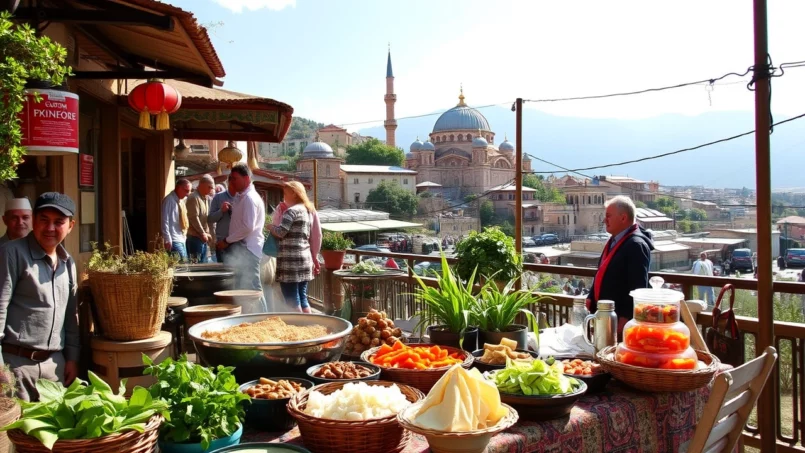
The markets are at once giant grocery stores, social hubs, and showcases of seasonal abundance. Among the pyramids of melons, mountains of rice, sacks of spices, and meat stalls, one immediately understands that the Turkmen table has been shaped by pastoral life, the desert, and caravan trade.
The Russian Bazaar (Gulistan): The All-Purpose Hall
In central Ashgabat, the Russian Bazaar – also called the Gulistan Shopping Center – is one of the city’s institutions. Located at 72 Azadi Street, it’s one of the largest and oldest covered markets in the country, built during the Soviet era and remodeled in the early 2000s, now clad in white marble.
There is a large main hall with several levels: on the ground floor, food; upstairs, clothing, shoes, and souvenirs. Turkmen describe it as a clean, organized, well-maintained place. At its center stands a large abstract sculpture by Klych Yarmamedov, nicknamed the “bowl of gazelles,” which adds an unexpected artistic touch to this cathedral of daily life.
For an expatriate, the local market is a near-obligatory stop where one can buy everything: fresh produce like pomegranates, tomatoes, cucumbers, and apples; herbs, spices, dried fruits, nuts, and honey; local cheeses and dairy products; fish, Caspian Sea caviar (Russian Sea), and meat; as well as breads, pastries, candies, vodkas, wines, and even playful fake caviar sold as souvenirs.
Several stalls sell hot specialties. North of the hall, down a few steps, is an area dedicated to small eateries, where one can order local soups and steamed dumplings for less than 10 manats. It’s the ideal place to taste a first bowl of şurpa (meat broth with vegetables) or a few manty (large stuffed dumplings) without breaking the bank.
Hours are generous – generally from 8 a.m. to 10 p.m. – and entry is free. Payment is almost always in cash, in Turkmen manat, and credit cards are practically unheard of. It’s therefore better to arrive with cash. Most vendors speak little or no English, but exchanges are generally warm; a few words of Russian or Turkmen often work wonders.
Altyn Asyr (former Tolkuchka): The Sunday Extravaganza
About five kilometers northwest of central Ashgabat, over an area of more than 1.5 km², stretches the immense Altyn Asyr bazaar, heir to the legendary Tolkuchka. Seen from the sky, its layout reproduces the pattern of a Tekke tribe carpet; at the center, a tower rises like a secular minaret, setting the tone: here, everything is on the scale of the country.
This market is only open on Sundays, from morning until late afternoon. It is organized into numbered sectors (like A1, A2, B1, etc.) where one finds a great variety of products: spice stalls, pyramids of dried fruits, sacks of flour, mountains of melons, dairy stands, still-warm breads, but also electronics, embroidered traditional clothing, silver jewelry, and a significant selection of carpets.
Part of the bazaar is dedicated to livestock: sheep, cows, horses, dromedaries, chickens. Even if one isn’t coming to buy a herd, walking through this section helps understand the importance of meat and dairy products in the Turkmen diet.
To ensure the freshness and quality of dishes like plov, somsas, or shashliks at the market, it is advised to observe and choose stalls where Turkmen are queuing, which indicates a good turnover of dishes.
Other Shopping Places: Halk Market, Shopping Malls, and Small Bazaars
For daily needs, many expatriates adopt a mixed rhythm: modern hypermarkets for some products, markets for the rest.
In the Kopetdag district, Halk Market is a large, busy supermarket where one finds both local products and more “international” items. Open every day from 8:30 a.m. to 8:30 p.m., it offers fruits, vegetables, groceries, but also handicrafts that can serve as gifts.
New centers like Arkach Shopping and Entertainment Center, on Magtymguly Avenue, combine shops, restaurants, cafes, a cinema, a gym, and a playground. They are useful when looking for a meal, a bit of entertainment, and an air-conditioned place to escape the heat.
Finally, other more modest markets – like Teke Bazaar or Mir Bazaar – offer a rawer and often less touristy version of local commercial life. One readily eats on the go there: shashlik, samsa, chebureki, gutap, or simply a large glass of çaý (tea) accompanied by bread and dried fruits.
Markets and Food: Some Practical Benchmarks for Expatriates
Frequenting bazaars requires knowing a few simple codes, useful for avoiding misunderstandings.
| Subject | What to Know in Turkmenistan |
|---|---|
| Payment | Prefer manat in cash; cards are rarely accepted at markets. |
| Haggling | Common for souvenirs, clothing, carpets; food prices often fixed. |
| Photos | Always ask for permission before photographing vendors or stalls. |
| Language | Russian and Turkmen dominate; English is rare. A few local words are very useful. |
| Ideal Time | In the morning for fresh products and to avoid crowds and heat. |
| Attire & Comfort | Comfortable shoes, hat, water bottle; heat and crowds can be intense. |
Understanding the DNA of Turkmen Cuisine
To appreciate local gastronomy, one must integrate a few structuring elements. Turkmenistan is a land of herders, marked by the desert, sheep and camel herding, water scarcity, and, on the Caspian coast, fishing. This is reflected on the plate.
A Herders’ Cuisine, Nourished by Desert and Steppe
For centuries, Turkmen lived largely from livestock, especially sheep. Their cuisine still bears the traces. Dishes are rich in meat – particularly sheep and lamb – and animal fats. Beef is more recent in the culinary landscape and remains less central. Chicken, game, non-working camels, and fish in regions near the Caspian and Amu Darya are also consumed. Horse, unlike other Central Asian countries, is not eaten.
Spices are used sparingly: many recipes play on the “straightforward” taste of ingredients, enhanced mainly by salt and black pepper. Cottonseed oil is a common cooking fat, a legacy both agricultural and Soviet.
The Turkmen table is also marked by geography: in oases, market gardening allows for a beautiful diversity of fruits and vegetables in summer and autumn; in more arid zones, meat and dairy products largely dominate.
The Central Role of Meat
For a carnivorous expatriate, the country is a sort of robust paradise; for a strict vegetarian, a terrain of permanent compromise. Practically all staple dishes contain meat, sometimes simply in the form of small pieces or fat added to a soup or stew.
A few major classics structure the meals:
| Iconic Meat Dish | Culinary Description |
|---|---|
| Plov / Palaw | Rice pilaf cooked in sheep fat with meat, carrots, onions, garlic, sometimes raisins or other fruits. |
| Shashlik (çişlik) | Skewers of meat (sheep, lamb, chicken, sometimes beef or fish), charcoal-grilled, served with raw onion. |
| Manty | Large steamed dumplings stuffed with minced meat (often lamb) and onions, sometimes pumpkin. |
| Dograma | Soup or stew rich in offal, bread cut into small pieces, onions, tomato. |
| Yarma | Cracked wheat cooked in sheep fat with small meat cubes. |
| Gowurma | Pieces of meat fried for a long time in a lot of fat, served alone or in soup. |
One also willingly eats a celebratory dish based on meat and wide noodles: gaýun, the Turkmen cousin of Central Asia’s beshbarmak, served on major occasions.
Bread and the Tamdyr: The Hearth at the Center of Everything
Impossible to understand local gastronomy without mentioning bread. In Turkmen culture, çörek is not a simple side: it’s a symbol of life, honor, brotherhood, and prosperity. It is intimately linked to the clay oven, the tamdyr, considered a true spiritual hearth of the home.
Traditional bread comes in the form of large, thick, round flatbreads, baked stuck to the burning wall of the tamdyr. There are several variations:
| Type of Bread | Particularity |
|---|---|
| Çörek (chorek) | Thick round flatbread, base of almost all meals. |
| Ýagly çörek | Buttered, layered, flaky bread, richer and softer. |
| Etli çörek / Ichlekli | Bread stuffed with meat inside, a complete meal. |
| Gatlama / gatlakly | Fried flatbreads, sometimes sweet, crispy. |
| Pişme | Small fried doughnuts or dough bites, often offered to guests. |
Respect for bread translates into daily gestures. It is frowned upon to place it upside down, to throw it away, or to step on it. If a piece falls, some pick it up, kiss it, and briefly place it on their forehead before putting it back on the table.
Fruits, Vegetables, and Treasures of the Oases
In the markets, fruit and vegetable stalls show the other face of Turkmen cuisine: that of the oases. The country is famous for its melons (gawun), to the point of instituting a “Melon Day.” Local sources mention several hundred varieties, including the very renowned Turkmenbashi melon. Pomegranates, grapes, apricots, watermelons, raisins, carrots, and cucumbers complete this colorful picture.
Two emblematic vegetables, the tomato and pumpkin, are used in multiple culinary preparations.
The downside of this agricultural picture: droughts and water scarcity make market gardening more difficult, especially in winter and early spring, when the supply of fresh produce dwindles. Greenhouses and fruit imports (oranges, tangerines, bananas) partially compensate for this lean season.
Dairy Products and Fermented Drinks
Pastoral culture is also found in the glasses. Turkmenistan is a land of milk and fermented products.
The most surprising for an expatriate is probably çal: fermented camel’s milk, white, fizzy, with a sour and fresh taste, considered the national drink. It’s sometimes compared to neighboring drinks like Kyrgyz shoro. It’s very perishable, thus difficult to export; it’s an experience to have on site.
Around this pivotal product gravitate other specialties:
| Dairy Product | Description |
|---|---|
| Gatyk | Thick drink similar to kefir or drinking yogurt, often served for breakfast or as an accompaniment. |
| Süzme / suzmeh | Strained fermented milk resembling Greek yogurt, used plain or in sauce. |
| Agaran | Butter collected from the surface of çal, very fatty and aromatic. |
| Ayran | Drink made from diluted, salted yogurt, refreshing. |
| Kumis | Fermented mare’s or camel’s milk, slightly alcoholic, consumed in some rural areas. |
These sour drinks have a dual function: they refresh during scorching summers and help digest meals often very rich in fats.
Hot Drinks, Alcohol, and Food Safety
In daily life, the real star is green tea (çaý). Served at all hours, it’s more than a drink: the word can mean a meal (especially breakfast) or a friendly visit. In some regions like Dashoguz, it’s drunk “Kazakh-style,” with milk.
Discover the traditions and accompaniments associated with black tea consumption during the cold seasons, particularly in the west of the country.
Black tea is particularly popular and appreciated during the autumn and winter months.
Its consumption is more pronounced in the western part of the country.
It is traditionally accompanied by sugar to sweeten its taste.
It is willingly served with dried fruits, pichme (local pastry), halva, or small cakes.
Regarding alcohol, the contrast is interesting for a predominantly Muslim country. Vodka – a Russian legacy – remains the most common alcohol, due to its low cost. Beer (some locally produced since the 19th century), wine, brandy, and sparkling wine are also consumed. Turkmen and tourists mention very sweet local wines and production of over 200 references of wines and spirits based on about a hundred grape varieties. Local rules, however, prohibit drinking in certain public places (parks, beaches, train stations), and alcohol sales are restricted to certain times and types of establishments.
Expatriates must, moreover, remain vigilant with tap water, generally considered non-potable. This implies avoiding ice cubes of unknown origin, poorly washed salads, or unpeeled fruits in dubious places. At markets, it is advisable to favor stalls where hygiene seems monitored and customer flow is high.
Essential Dishes to Discover
Once these cultural benchmarks are acquired, it’s time to move on to what interests food lovers the most: the dishes. Some are pillars of the Turkmen meal; others are regional specialties or legacies of neighboring cuisines.
Plov: The “King” of the Turkmen Table
Plov (or palaw) is everywhere. It’s the dish for major occasions, but also the daily lunch in many families. It’s found in canteens, restaurants, and bazaars.
It consists of rice pilaf cooked in a lot of fat (often sheep fat) with pieces of meat, carrots cut into sticks, onions, garlic, and sometimes raisins, other fruits, or fish. Small pieces of minced meat can replace large pieces depending on the variant.
Traditionally, plov is eaten with the right hand, all around a large communal platter. For an expatriate, this direct contact can be surprising, but in more formal contexts, utensils will generally be offered. The important thing is to show appreciation, without necessarily finishing one’s plate: leaving a little food is customary and is not seen as disrespectful.
Manty, Somsa, Gutap: The Kingdom of Stuffed Pastries
Turkmen cuisine excels in the art of stuffed dough. In markets or small restaurants, these bites allow for snacking without sitting down for a long meal.
The local cuisine offers several variants of stuffed pastries: Manty, large steamed dumplings filled with meat and onions, served with sour cream; Somsa, oven-baked pastries stuffed with meat or vegetables, to be eaten on the go; and Gutap, flat fried pastries, sometimes vegetarian, but it’s prudent to check for the absence of animal fat in the filling.
Fitchi, börek, and other fritters belong to the same universe of crispy dough and generous fillings.
Soups and Stews
Contrary to preconceived notions about desert countries, Turkmenistan is a land of soups. They often play the role of starter, sometimes a complete meal.
A few benchmarks:
| Soup / Stew | Typical Composition |
|---|---|
| Şurpa / shorpa | Meat broth with vegetables (carrots, potatoes, onions). |
| Unash | Noodle soup with milk or beans, depending on the version. |
| Dograma | Mixture of crumbled bread, offal, onion, tomato, served in broth. |
| Şurpa maş | Mung bean soup. |
| Etli börek şurpasy | Soup garnished with dumplings stuffed with meat. |
| Şüle | Watery rice porridge with meat, sometimes grated carrots. |
| Etli köje (sorgho) | Sorghum porridge with meat, traditional for Nowruz. |
Alongside this galaxy of soups, the country has adopted lagman, a noodle dish of Uyghur origin, served as soup or a semi-sauced dish with meat, vegetables, and spices.
Caspian Fish and Regional Specialties
Regions near the Caspian Sea or the Amu Darya have developed a culinary culture around fish, less visible in the desert interior. They prepare grilled or fried fish, often accompanied by rice, sesame, dried apricots, grapes, and pomegranate juice. Fish pastries cooked in dough – like балык börek – are cited as specialties of the Balkan region.
Desserts, Sweets, and Fruits
Desserts in the Western sense (cakes systematically served at the end of a meal) are not always the norm. On the other hand, tea is willingly accompanied by sweets.
One finds notably: articles, reports, case studies, tutorials, and various analyses. These elements serve to illustrate or deepen the subjects covered in the main content.
– Halva: confectionery made from seeds and sugar, very widespread in the Muslim world.
– Baklava: flaky pastry with nuts and honey, inherited from Ottoman tradition.
– Nabat: crystallized sugar in large crystals, to which medicinal virtues are sometimes attributed.
– Bekmes: “fruit honey,” concentrated syrup obtained by reducing fruit juice.
– Small fried cakes like pişme, “oreshki”-type cakes filled with condensed milk, marbled cakes like “Zebra cake,” etc.
But the real conclusion of summer meals often remains… the melon or the watermelon, cut into large slices shared among guests.
Where to Eat: Restaurants, Cafes, and Street Food
Even if Turkmen cuisine is often experienced at home, Ashgabat and large cities offer a range of places to discover specialties, from smoky skewer stands to fine dining restaurants.
Eating on the Go: Shashlik, Samsa, and Company
In and around markets, on main roads, at the exit of some tourist sites, shashlik stands are omnipresent. Skewers of marinated meat (sheep, lamb, chicken, sometimes beef or fish) grill over charcoal. They are served with raw onion, sometimes a little bread and a vinegar-based sauce.
Samsa and chebureki (stuffed fritters) are picked up at small stalls; they offer a very economical lunch. Gutap is harder to find outside markets, but some stalls specialize in these dough pastries stuffed with vegetables.
For an expatriate, street food is an excellent way to discover local popular cuisine. To enjoy it while limiting risks, it is advised to choose stalls with good traffic, avoid dishes exposed to the sun for a long time, and, for more sensitive stomachs, favor preparations cooked right before your eyes.
Restaurants in Ashgabat: From Traditional to Fusion
The capital concentrates the majority of the offering for expatriates: purely Turkmen restaurants, multi-cuisine places, cafes with a European style, modern steakhouses, Turkish, Chinese, or Lebanese tables.
For example, one finds establishments very focused on local cuisine – serving plov, manty, shashlik, dograma, ichlekli, gutap – as well as restaurants that reinterpret Turkmen classics in a more “gastronomic” or fusion spirit, integrating international touches. Other places, popular with expatriates, focus on a more European menu (pizzas, burgers, pasta) but keep a few local dishes.
Modern shopping malls like Berkarar or Arkach offer a practical solution for group meals, with a variety of restaurants and food courts offering Russian, Turkish, Central Asian cuisines and sometimes Western fast food.
In the Provinces: Local Tables and Hotels
Outside Ashgabat, the offering is more limited, but one finds the major staples: plov, shashlik, manty, soups, stuffed breads. In some cities like Mary, Turkmenabat, or Türkmenbashy, restaurants renowned for their tamdyr breads, their manty, their fish, or their skewers are mentioned by travelers.
In many small towns or near tourist sites (Konye-Urgench, Darvaza, etc.), one will often depend on one or two restaurants or cafes collaborating with local agencies. The plate is generally simple and hearty, without great sophistication, but it’s an opportunity to discover the “standard” Turkmen cuisine, far from any tourist staging.
Eating at a Local’s Home: Hospitality as the Keystone
For an expatriate, receiving an invitation to eat at a Turkmen home is a privilege. The tradition of hospitality is deep, inherited from the necessities of survival in the desert: a guest is considered sent by God. A person’s character is readily judged by how they treat their guests.
Entering a Turkmen Home
A few unspoken rules structure this moment. One systematically removes their shoes before entering. It’s good manners to bring a small gift: cakes, candies, flowers, or even a bottle of alcoholic drink if one knows the family consumes it. You will generally be offered indoor slippers (terlik); if they are too small, it’s better to come with your own slippers.
In this context, meals are taken sitting on cushions around a low table. It is essential never to point one’s feet towards the food and, above all, never to step on the tablecloth, as it is considered an almost sacred object.
At the Table: Bread, Blessing, and Moderation
Before starting, a short praise to God is frequent. One waits for the host to begin the meal before helping themselves. Bread often occupies the center of the table, with saucers of dairy products, salads, dried fruits, sometimes a few candies, then the hot dishes arrive.
Refusing bread is very frowned upon; one must at least take a piece. Finishing one’s plate is not obligatory, but it is inappropriate to speak with your mouth full, to lean over the dishes, or to burp loudly.
The meal often concludes with tea. Placing the teaspoon across the glass means you don’t want any more. Expressing gratitude, even with a few rudimentary words in Turkmen or Russian, is greatly appreciated.
Dress Code and Modesty
Society is generally conservative. One avoids too short or too tight clothing, even more so in the countryside. Men refrain from wearing shorts; women cover their shoulders and knees at a minimum. In a family context, public displays of affection (kisses, hugs) are to be avoided.
Muslim Tourists, Halal, and Religious Practices
Turkmenistan, a predominantly Muslim country, is however not structured as a halal tourism destination in the strict sense. For a practicing Muslim expatriate or visitor, this requires some adjustments and a good dose of resourcefulness.
Understanding the Context
There are over a thousand mosques in the country, with a strong presence of places of worship in major cities like Ashgabat. Many families respect Islamic dietary prohibitions (no pork, ritual slaughter), but not everything sold on the street or in restaurants is systematically certified halal according to international standards. Alcohol, for example, is widely available and consumed by part of the population.
Strategies for Eating Halal On Site
Several approaches can help a Muslim expatriate navigate this context:
To respect specific dietary prescriptions (like halal) in Turkmenistan, it is recommended to: favor naturally compatible dishes like vegetarian dishes, fish, eggs, vegetables, breads, and dairy products; ask restaurateurs directly, in Russian or Turkmen, about the origin of meat and the presence of pork or alcohol in preparations; use, when internet connection allows, applications like HalalTrip, HalalGuide, Zabihah, or Muslim Pro to locate the few listed establishments; cook for oneself using raw products bought at markets (vegetables, rice, legumes, fish, bread) if one has a kitchen; and finally, avoid so-called ‘international’ sauces and dishes when their composition is unclear, like industrial mayonnaise, desserts with gelatin, or sauces with wine.
For long bus or train journeys, or excursions far from urban centers, bringing dry snacks (dried fruits, nuts, biscuits, cereal bars) is a good safety measure.
Daily Life and Religious Practice
Respecting local religious customs also means adapting certain behaviors: during Ramadan, it’s preferable to avoid eating ostentatiously in public during the day in more traditional neighborhoods, especially near mosques. In places of worship, attire must be very modest, shoes removed at the entrance, and photography is generally prohibited inside.
Practical Advice for Expatriates: Eating Well Without Mistakes
Living in Turkmenistan isn’t just about discovering a cuisine, it’s also about learning to integrate it into daily life, with its constraints and its joys.
Managing Expectations: A Solid Cuisine More Than a Spectacular One
Feedback from travelers and expatriates is quite consistent: Turkmen cuisine is “good”, “nourishing”, “honest”, but rarely explosive in flavors. One eats plov, skewers, soups, stuffed breads, fritters, fruits; all this is filling but can become repetitive if one stays within a limited circle of addresses.
Variety increases as soon as one combines markets, street stalls, small family restaurants, international cafes, and a few more creative tables in Ashgabat. Russian, Turkish, Persian, Chinese, and European influences enrich the mix: pelmeni, Russian salads, Turkish kebabs, noodles, pizzas, burgers, etc.
Surviving (and Living Well) as a Vegetarian
Turkmenistan wasn’t designed for vegetarians, and many vegetable dishes still contain a bit of meat or animal fat to “give flavor.” But it’s possible to manage, especially in the city, by combining:
Traditional Azerbaijani cuisine offers several vegetarian options, including breads like çörek, yagly çörek, and pişme, as well as gutap (pastries) stuffed with spinach or pumpkin (check for absence of meat). One also finds salads of cucumbers, tomatoes, and onions, grilled or stewed vegetables, and vegetable or bean soups like şurpa maş or certain versions of unash. Rice or wheat side dishes (without meat sauce) and international vegetarian dishes in Westernized cafes and restaurants complete these choices.
Clearly explaining one’s diet – ideally in Russian or Turkmen – is essential. Many consider meat broth, or even tiny pieces of meat, as compatible with a “meatless” meal; specifying explicitly can avoid misunderstandings.
Managing Hygiene, Heat, and Water
Summer heat and the variable quality of water are the main enemies of sensitive stomachs. A few reflexes reduce risks:
To avoid digestive issues, it is recommended to drink only bottled or purified water, avoid ice cubes of unknown origin, favor fruits you can peel yourself, choose well-cooked dishes served very hot, and check the general hygiene of points of sale.
Eating early in the morning at the market – when products have just arrived and the temperature is milder – significantly improves the experience.
Respecting Implicit Rules
Beyond the table, certain attitudes are considered rude: losing your temper in public, speaking loudly, displaying affectionate gestures in the street, or being overly critical of local customs. At the table, one avoids pointing fingers, blowing your nose loudly, or stubbornly refusing dishes insistently offered. It is perfectly acceptable to taste symbolically, then decline more firmly if you are full.
Learning a few polite words in Turkmen (“Khosh geldiniz!” – welcome, “Sag boluň” – thank you) instantly creates a more relaxed atmosphere, whether in a home, at the market, or in a restaurant.
A Culinary Heritage Linked to Carpets, History, and the Desert
Turkmen gastronomy can only be fully understood by placing it in a broader cultural ensemble, ranging from carpets to Ashgabat’s monuments and major archaeological sites.
The same patience that shaped carpets of such finesse that they seduced Marco Polo and Russian aristocrats is observed in the slow preparation of a plov or a yarma. The carpets, inscribed on UNESCO’s intangible heritage list, are produced from local wools and natural dyes (madder for red, indigo for blue, pomegranate peels for yellow). They once covered tents, doors, bags, and animal harnesses. Even today, they are found in homes, under tables, on the walls of living rooms where tea and plov are served to guests.
Uzbek Craft Heritage
The ruins of Jeitun and Namazga‑Tepe bear witness to the region’s first agriculture; the oases at the foot of the Kopet‑Dag tell of the ancient viticulture from which the current production of wines and spirits stems; the Caspian Sea explains the presence of fish and caviar recipes in markets in the heart of the desert.
For an expatriate, immersing oneself in this cuisine means accepting an implicit contract: making room for sheep fat, for green tea from morning to evening, for overly sweet melons, for large shared platters, and for invitations that stretch on around a samovar. In return, the Turkmen table offers a privileged entry to what really matters: honor, family, hospitality, and an ability to celebrate abundance in the midst of a harsh environment.
An Expatriate in Turkmenistan
By learning to frequent the bazaars, to recognize a good plov, to appreciate the sharp taste of a glass of çal, or simply to break a piece of çörek in good company, an expatriate doesn’t just “eat local”: they anchor themselves in a country where a man is judged as much by what he serves his guests as by what he says.
Disclaimer: The information provided on this website is for informational purposes only and does not constitute financial, legal, or professional advice. We encourage you to consult qualified experts before making any investment, real estate, or expatriation decisions. Although we strive to maintain up-to-date and accurate information, we do not guarantee the completeness, accuracy, or timeliness of the proposed content. As investment and expatriation involve risks, we disclaim any liability for potential losses or damages arising from the use of this site. Your use of this site confirms your acceptance of these terms and your understanding of the associated risks.

Cyril Jarnias is an independent expert in international wealth management with over 20 years of experience. As an expatriate himself, he is dedicated to helping individuals and business leaders build, protect, and pass on their wealth with complete peace of mind.
On his website, cyriljarnias.com, he shares his expertise on international real estate, offshore company formation, and expatriation.
Thanks to his expertise, he offers sound advice to optimize his clients' wealth management. Cyril Jarnias is also recognized for his appearances in many prestigious media outlets such as BFM Business, les Français de l’étranger, Le Figaro, Les Echos, and Mieux vivre votre argent, where he shares his knowledge and know-how in wealth management.





