
 Published on and written by Cyril Jarnias
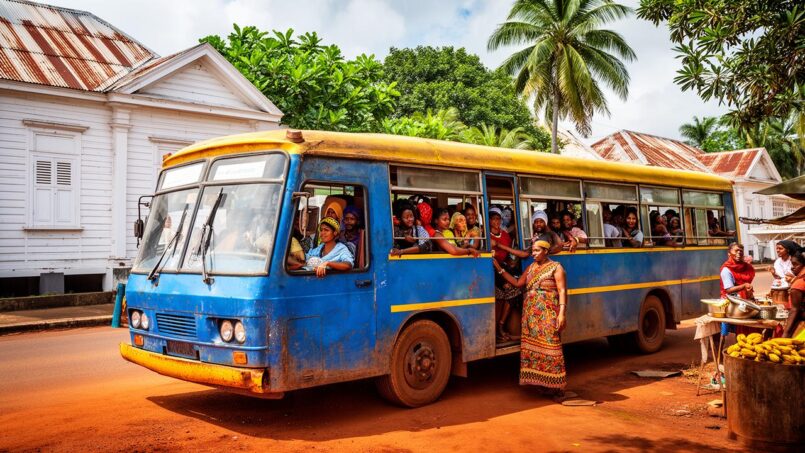
Exploring Suriname Without Renting a Car is not only possible, but often the best way to connect with local life. Between colorful buses, packed minibuses, official or improvised taxis, and dugout canoes speeding along the river, the country offers a patchwork of transportation options that is as bewildering as it is fascinating. This practical guide gathers, in one place, everything you need to know about getting around on public transport in Suriname, with a special focus on Paramaribo, intercity connections, and crossings to Guyana and French Guiana.
Understanding Suriname’s Transport Landscape
Getting a handle on Suriname’s transport system starts with a simple observation: here, there is no subway, no tram, no passenger trains. The network rests on three main pillars – buses, minibuses, and taxis – along with boats and dugout canoes, which become essential as soon as you leave the coast.
The bus is the most widely used form of public transport, valued for its low cost and broad coverage of urban areas and major routes. Minibuses, which are faster, and taxis, which offer more comfort and flexibility, round out the options. For travel into the interior, boats (ferries and dugout canoes) are essential along major rivers like the Suriname, Marowijne, and Corantijn.
The downside of this diversity is the lack of an integrated system that’s easy for a visitor to understand. Few official maps, sometimes erratic schedules, and a strong informal component: getting around on public transport in Suriname requires a bit of planning, plenty of flexibility… and a fair amount of patience.
Getting Around Paramaribo: Buses, Minibuses, and Walking
In Paramaribo, the capital, you get around without a subway or tram. The backbone of the network is buses and minibuses, supplemented by taxis and, to a lesser extent, boats on the river.
Most routes start around the lively city center, especially near the Central Market, Domineestraat, and the Heiligenweg area. That’s where departures to outlying neighborhoods and towns like Lelydorp, Albina, or Nieuw Nickerie are concentrated.
Despite this abundance, official route maps that are clear and designed for visitors are rare. Buses and minibuses usually display their destination or a route number on the front, but the information remains fragmented. Locals and drivers become your best sources: asking your accommodation staff or a shopkeeper is often the most effective way to find the right vehicle.
Paramaribo’s historic center is very easy to navigate on foot, as many iconic sites (colonial wooden houses, churches, mosques, Hindu temples) are clustered within a small area. For an efficient and budget-friendly visit, it’s best to combine walking for short trips with the bus or taxi for longer distances.
The P.L.O. Network: The Backbone of Urban Buses
The main organized structure for urban transport in Paramaribo is the bus network operated by P.L.O. This company runs about twenty routes serving approximately 727 stops, covering most neighborhoods and connecting many “Bushalte” (bus stops).
A particular feature of this network is the lack of strict schedules. Buses run on fixed routes but often depart when they are full enough rather than on a posted timetable. The result: variable wait times, especially outside peak hours or in outlying neighborhoods. In Paramaribo itself, frequency is fairly decent, but it drops as you move toward rural areas.
To get a clearer picture, the Moovit app is invaluable. It displays route maps, stops, and even real-time information on schedules, delays, or service detours. For a traveler, it’s the closest thing to a modern transit map.
The longest bus line on the P.L.O. network, named PNA, covers more than 62 km.
The table below summarizes some key features of the P.L.O. network in Paramaribo.
| Element | Detail |
|---|---|
| Number of routes | 20 |
| Approximate number of stops | 727 |
| Type of services | Urban and suburban buses |
| Longest route | PNA (≈ 62 km, 92 stops) |
| Shortest route | L2 (≈ 4 km, 10 stops) |
| Main departure areas | Central Market, Domineestraat, Heiligenweg |
| Reference app | Moovit (maps, schedules, alerts) |
For detailed fares and possible online ticket purchases, P.L.O. refers to its official website. The Moovit app allows you to check approximate prices per route.
How to Use Buses and Minibuses in Practice
In Paramaribo and throughout the country, using buses and minibuses follows a few simple but essential rules. Vehicles, often medium-sized (some are called “jumbos”), display either a number or their destination on the windshield. You flag them down from the roadside by waving your hand; there’s no need to wait at a designated stop, except in the most central areas.
Bus payments are made in cash (USD or SRD) directly to the driver or conductor. It is strongly recommended to have exact change, as change is often limited. Fares are modest: $0.40 to $1.10 USD for a city trip, and remain competitive for intercity journeys.
The fare structure, in broad terms, can be summarized as follows.
| Type of trip | Indicative fare |
|---|---|
| Short urban trip in Paramaribo | ≈ 8–15 SRD (≈ 1–2 USD) |
| Single bus ticket (general range) | ≈ 0.40–1.10 USD |
| Monthly urban bus pass | ≈ 681 SRD (≈ 90 USD), unlimited rides |
| Long distance (Paramaribo–Albina, etc.) | Higher fare, check locally |
In addition to official buses, minibuses – sometimes called “taxi bus,” “busholtes,” “busholtjes,” or “piko-piko” – ply the city on fixed routes. They are recognizable by their often flashy decorations and the omnipresent music on board. Faster and slightly more expensive than state-run buses, they offer an appreciated alternative for those who value time savings. However, their operation remains very similar: departures on demand, approximate schedules, cash payment, and boarding at the roadside.
For a visitor, the most comfortable strategy is to combine observation and questions: spot vehicles indicating your destination neighborhood, and confirm with the driver or a passenger that the bus is right for you. Surinamese people are generally very helpful when it comes to guiding a foreigner.
Intercity: Reaching Other Towns by Bus or Minibus
Outside Paramaribo, the bus and minibus remain the most common means of transport for connecting major towns and villages. The most frequent routes go to destinations like Albina (toward the border with French Guiana), Nieuw Nickerie (toward the Guyana border), Paranam, or Lelydorp.
Intercity buses, often run by private or semi-public operators, are valued for their very affordable prices. The trade-off is a certain unpredictability: departures don’t always follow rigid schedules, with vehicles leaving the terminal only once the number of passengers is deemed sufficient.
To illustrate the variability of transport services, consider buses to Albina that depart only twice a day (late morning and early afternoon) from the Heiligenweg bus station. Tickets, cheap at around 30 SRD, often need to be purchased early in the morning on the same day. Conversely, for trips like Paramaribo–Nieuw Nickerie, frequency is higher, usually allowing travelers to find a seat during the day, especially if they arrive early at the terminal.
For greater comfort and predictability, many visitors opt for private shuttles or shared taxis pre-booked through platforms like AndesTransit or local companies. These services guarantee a seat – not always a given on a bus that only leaves when full – and allow for better control over travel times.
The Central Role of Taxis: Flexibility and Comfort
While the bus is unbeatable in terms of cost, the taxi stands out as the most flexible and comfortable option, especially for those traveling in groups, carrying heavy luggage, or wanting to avoid vehicle changes.
The taxi landscape in Suriname is varied. On one hand, there are official taxis recognizable by their yellow plates and, sometimes, a meter device. On the other, a multitude of private operators, often called “green taxis” when not clearly identified, operate on per-ride fares negotiated directly with the customer.
Most taxis, even in the city, do not have a meter. It is therefore essential to always agree on the price with the driver before getting in. This precaution avoids unpleasant surprises and excessive fares, especially if the driver senses you don’t know local prices.
During the day, a typical fare within Paramaribo runs around a few dozen SRD. For longer trips, such as a ride to Lelydorp or to the international airport, amounts climb quickly, especially for a private vehicle.
The table below gives some price ranges (amounts are indicative and subject to change with inflation and fuel costs).
| Route | Mode / Service | Indicative Fare |
|---|---|---|
| Standard urban ride in Paramaribo | City taxi | ≈ 35 SRD (≈ 1.70 USD) |
| Paramaribo – Lelydorp | Private taxi | ≈ 46 USD |
| Paramaribo – Intl. Airport (PBM) | Private taxi | ≈ 115 USD |
| Airport – Paramaribo (shared shuttle) | Shuttle / shared taxi | From about 10–15 EUR / pers |
| Airport – Paramaribo (private taxi) | Organized service | From about 40–55 EUR |
In Paramaribo, several structured companies, like Tourtonne’s Taxi or operators specializing in airport transfers, offer 24/7 service, mobile app booking, and large fleets. These providers generally offer fixed prices for popular routes (city center – airport, transfers to certain hotels, etc.), reassuring travelers who are less inclined to haggle on the spot at the terminal.
Modern ride-hailing services like Ride, which connect passengers and drivers via smartphone for trips within the Paramaribo urban area.
Modeled after Uber, these apps offer upfront fares and an average pickup time of a few minutes within greater Paramaribo.
To use them, you need a working internet connection and be comfortable using mobile apps.
In any case, the basic rule is to favor taxis recommended by your accommodation or recognized services, especially at night, on Sundays, and on public holidays when vehicles are scarcer.
On the River: Ferries, Dugout Canoes, and Water Taxis
In Suriname, geography imposes its own rules of mobility. Beyond the outskirts of Paramaribo, paved roads thin out, dirt tracks multiply, and soon rivers become the true arteries of the country. The Suriname, Marowijne, and Corantijn – these major waterways are plied by motorized dugout canoes, tourist boats, and ferries connecting the banks or neighboring countries.
Water taxis connect Paramaribo to villages on the opposite bank, like in the Commewijne district. These crossings on the Suriname River are fast, picturesque, and offer a unique perspective for discovering the city and its surroundings.
Further upstream, dugout canoes – often called “pirogues” or “korjaals” – are indispensable for reaching indigenous or Maroon communities, rainforest lodges, and natural attractions. In these areas, the boat is not a tourist gimmick but the only real means of transport. Organized tours from Paramaribo usually include the nautical logistics in their packages, as it’s difficult, if not impossible, to arrange these connections on your own when you’re unfamiliar with the terrain and its operators.
For major international crossings, official ferries are essential. Between Nieuw Nickerie and the Corriverton area, a regular service crosses the Corantijn River. To the east, from Albina, another boat crosses the Marowijne to Saint-Laurent-du-Maroni in French Guiana. These crossings have fixed schedules and fares. It’s advisable to check the latest information before departure, especially departure times and passport, visa, or vaccination certificate requirements.
Traveling on a Budget: Costs and Tips
One of the major advantages of Suriname’s transport system, especially for independent travelers, is its cost. Buses and minibuses are extremely affordable, even though prices vary depending on distance and the nature of the service (subsidized public or private).
The typical cost of an urban trip in Paramaribo, in US dollars, rarely exceeds this amount.
Taxis are more expensive but remain reasonable by international standards, especially when shared among several people. Airport transfers represent the largest expense, due to the considerable distance between Johan Adolf Pengel Airport, located in Zanderij, and the capital.
To keep your transport budget in check, adopt simple habits. Favor public buses for short trips over taxis to reduce your daily cost. For downtown travel, walking or renting a bike are economical alternatives that let you immerse yourself directly in local life.
For river excursions and interior visits, the group tour option is often more economical than chartering a boat or vehicle, as costs are split among participants.
Finally, it’s best to travel with small bills in local currency (SRD), as transport services almost never accept bank cards. Payments in US dollars or euros may sometimes be accepted by certain taxis or tour operators, but rarely at a favorable rate for the customer.
Accessibility, Safety, and On-the-Ground Realities
The picturesque image of colorful minibuses and dugout canoes on the river should not obscure certain realities. Suriname’s transport system is, for the most part, not adapted for people with reduced mobility. Most buses have no ramp or lift, and boats often require disembarking onto uneven banks, makeshift docks, or directly onto sand. Officially, the law prohibits discrimination against people with disabilities, but enforcement remains limited. For an affected traveler, the best option is to go through specialized agencies that can anticipate specific needs and negotiate accommodations with transporters.
Public transport is generally usable by following basic principles. Pickpocketing and theft are common on crowded buses, at bus stations, and in busy markets. It’s advisable to keep your belongings close, avoid displaying valuables, and stay vigilant with your bag.
Authorities recommend limiting public transport travel at night, especially on long road trips. Poor lighting, sometimes mediocre road conditions (potholes, subsidence, lack of markings), and the presence of animals or slow vehicles make night driving riskier. Similarly, very cheap minibuses may suffer from minimal maintenance and sometimes aggressive driving. Many travelers therefore choose to favor taxis or private vehicles for late trips.
Protests and gatherings, frequent especially in Paramaribo, often occur on weekends. They can severely disrupt traffic or even block certain roads. It’s advisable to stay informed via local media or your accommodation, and to avoid protest areas, even when they seem peaceful.
Digital Tools and Practical Information
In a system where schedules aren’t always reliable and maps are rare, digital tools offer a real advantage. The Moovit app, widely used worldwide, covers Paramaribo and lets you view P.L.O. bus routes and ferry services, check estimated schedules, and receive alerts about detours or disruptions.
Services like AndesTransit or Busbud allow you to plan your itinerary by comparing options, estimating travel times, and booking certain segments. They don’t cover all companies or all routes, but they are a good starting point.
On the taxi side, local apps like Ride attempt to structure the market, with upfront fares and vehicle geolocation. They don’t completely replace the traditional practice of calling a taxi dispatch or relying on a hotel recommendation, but they add a layer of welcome transparency.
For more specialized transport, such as transfers between Suriname and French Guiana, agencies like Orange Travel offer organized shuttles including bus, boat, and border assistance. These “turnkey” packages appeal to those who prefer to delegate logistics to an experienced intermediary.
Etiquette, Languages, and Social Codes on Transport
Using public transport in Suriname is also about direct contact with a multicultural society where Creole, Indian, Javanese, Maroon, and Indigenous influences coexist. A few behavioral pointers facilitate this encounter.
Boarding a bus or minibus is often accompanied by a brief greeting to the driver or passengers. On a seat, giving up your spot to an elderly person, a pregnant woman, or someone carrying heavy loads is appreciated. Conversations are generally calm; talking loudly, imposing your music, or being intrusive in an already cramped space can be frowned upon.
To facilitate daily exchanges in Suriname, it’s useful to know a few basic expressions in Sranan Tongo, the local creole. For instance, saying “fa waka?” to ask “how are you?” or “tanki” for “thank you” often helps break the ice and make interactions warmer. Although English is understood in the tourism sector, Dutch (the official language) and this creole are the most useful day-to-day.
On crowded buses, the notion of personal space is less pronounced than in some European countries. People often touch, share handrails, and shift to let another passenger board. Patience and goodwill are your best allies in these moments.
Combining Modes for a Smooth Journey
The key to enjoying public transport in Suriname lies in the art of compromise. In the city, combining walking + bus/minibus allows you to get around at very low cost, saving the taxi for when you’re loaded down, in a hurry, or tired. For intercity connections, the bus remains the foundation, but it can be smartly complemented by a shuttle or shared taxi when schedules don’t fit or you want to arrive at a specific time.
In the interior, the road network is limited. To get around, you often need to combine different modes of transport: road, river, and sometimes a small plane to reach isolated forest lodges. For this reason, organized tours, which plan and coordinate all transport segments, are generally the most practical and safest solution.
When preparing your trip, it’s useful to identify in advance the moments where you’re comfortable with some improvisation – for example, an urban bus ride – and those where you’d prefer to secure a seat and schedule – like an airport transfer or a leg to a border.
In a country where over half of residents travel by private car, choosing public transport is also opting for a deeper immersion. You share the daily lives of Surinamese people, hear local languages, and observe the rhythms of the city and villages. As long as you equip yourself with flexibility and a bit of curiosity, the buses, taxis, and boats become less of a logistical headache and more of a guiding thread for the travel experience.
Disclaimer: The information provided on this website is for informational purposes only and does not constitute financial, legal, or professional advice. We encourage you to consult qualified experts before making any investment, real estate, or expatriation decisions. Although we strive to maintain up-to-date and accurate information, we do not guarantee the completeness, accuracy, or timeliness of the proposed content. As investment and expatriation involve risks, we disclaim any liability for potential losses or damages arising from the use of this site. Your use of this site confirms your acceptance of these terms and your understanding of the associated risks.

Cyril Jarnias is an independent expert in international wealth management with over 20 years of experience. As an expatriate himself, he is dedicated to helping individuals and business leaders build, protect, and pass on their wealth with complete peace of mind.
On his website, cyriljarnias.com, he shares his expertise on international real estate, offshore company formation, and expatriation.
Thanks to his expertise, he offers sound advice to optimize his clients' wealth management. Cyril Jarnias is also recognized for his appearances in many prestigious media outlets such as BFM Business, les Français de l’étranger, Le Figaro, Les Echos, and Mieux vivre votre argent, where he shares his knowledge and know-how in wealth management.





