
 Published on and written by Cyril Jarnias
Settling in Suriname means immersing yourself in a rare concentration of cultural diversity, lush nature, and the sweet life. But even in the midst of this warm atmosphere, homesickness can hit hard. Studies confirm it: the vast majority of people who move abroad eventually go through a bout of nostalgia, sometimes intense enough to disrupt sleep, mood, or even work.
To regain control over your expatriation, it is essential to understand the stakes and ground yourself in the specific reality of Suriname. The goal is not to erase the longing for your home country, but to tame it so it can coexist with your new life on the banks of the Suriname River and on the streets of Paramaribo.
Homesickness: a normal phenomenon, not a weakness
International research converges: up to 70% of people who have experienced a major move admit to having suffered from homesickness at least once. Among expatriates, the range varies between 20% and 90% during the first year abroad. In other words, if you feel nostalgic for “home” while watching the boats on the Suriname River or returning to your apartment in Paramaribo, you are perfectly normal.
Changing countries is ranked as the third most stressful life event, after bereavement or divorce.
In Suriname, this transition is sometimes all the more brutal because the gap with your home country can be wide: a new climate, Dutch as the official language, the omnipresence of Sranan Tongo, sometimes precarious infrastructure outside Paramaribo, slow and unpredictable bureaucracy, not to mention a fragile economy that can generate additional stress.
Yet many expatriates end up developing a deep attachment to this country described as “authentic,” both Caribbean and South American, where a mosque and a synagogue stand side by side in the capital’s center, and where more than a dozen languages resonate daily. Between these two states—nostalgia and attachment—your adaptation plays out.
Recognizing the signs: how homesickness manifests in Suriname
Homesickness is not just about “being a little sad.” Research distinguishes three dimensions: behavioral, cognitive (thoughts), and physical. In the Surinamese context, these symptoms can be heightened by the heat, administrative sluggishness, isolation in certain neighborhoods, or the difficulty of projecting yourself into a very different environment.
Among the frequent manifestations, we find:
Settling in Paramaribo can be accompanied by several signs of homesickness: persistent sadness and a feeling of emptiness (especially in the evenings and on weekends), a sense of loneliness sometimes heightened by the lack of a local network, anxiety, irritability, loss of motivation to explore the country, difficulty concentrating at work (especially during demanding assignments or with jet lag), as well as physical symptoms like digestive issues, headaches, fatigue, and insomnia—nearly two-thirds of those affected report sleep problems.
Researchers have observed that, for many expatriates, the peak of homesickness occurs around the third month, when the initial excitement fades and frustrations multiply: endless forms at the foreigners’ police, banking delays, stock shortages in stores, sluggish internet when you need to work, torrential rain flooding the streets during the wet season.
In Suriname, especially in Paramaribo, various factors can influence daily life and disorient visitors. It is helpful to know that perceptions of urban insecurity (petty theft, burglaries), occasionally poor road conditions, traffic jams, and the occasional difficulty finding certain everyday consumer goods are part of reality. The country, though formerly known as “Dutch Guiana,” is a developing nation whose living environment differs significantly from a tropical extension of Europe. Anticipating these elements allows for better adaptation.
Culture shock and the rhythm of nostalgia: learning to read the waves
Adaptation often follows several phases, without being perfectly linear.
At first, it is the honeymoon phase. Everything fascinates you: the central market, the pagaras of Owru Yari crackling on New Year’s, the colorful Hindu temples, kayaks on the river, the pristine jungle of Brownsberg or Raleighvallen. Then comes the negotiation phase: the slowness of services, the notion of “Suriname Time,” the nitpicking administration, supply shortages, or a meeting canceled without notice can trigger frustration, anger, and a feeling of incompetence.
Adaptation to a new cultural environment happens in stages. After an observation period, an adjustment phase allows you to learn the codes, the local language, and anticipate procedures. Over time, a form of mastery sets in, where the culture becomes a normal part of daily life, integrating its positive and negative aspects without a permanent feeling of being out of step.
Identifying which phase you are in helps put homesickness into perspective. Feeling a peak of nostalgia after a few weeks of euphoria does not mean you have “failed” your expatriation: it is often a necessary passage, documented by numerous studies on culture shock.
When Suriname’s diversity becomes an ally against homesickness
One of Suriname’s major assets for taming nostalgia is its extraordinary cultural mosaic. In a country where Hindustanis, Creoles, Javanese, Maroons, Chinese, Boeroes, indigenous peoples, and expatriates coexist, nearly everyone carries a story of migration, uprooting, or identity recomposition.
The Javanese communities who arrived in Guiana from 1890 as contract laborers rebuilt their cultural landmarks using local resources. They crafted gamelan instruments from oil drums and train rails, recreated traditional performances such as wayang kulit (shadow puppetry) and jaran kepang (horse dance), and adapted their language, cuisine, and religious practices to this new context.
This collective memory of exile can become a welcome mirror: you are not the first person who must transform nostalgia into creativity and grounding. In daily life, the peaceful coexistence of mosques, churches, Hindu temples, synagogues, and the practice of an impressive number of festivals (Holi, Eid, Divali, Keti Koti, Owru Yari, etc.) offers many opportunities to integrate and turn your feeling of being a foreigner into active curiosity.
Exposing yourself to this does not erase the longing for your home country, but it changes the inner narrative: you are not just living “far from home,” you are inhabiting a space where plurality is the norm.
Building a Surinamese routine: the foundation for stabilizing emotions
Research on cultural adaptation shows that a structured routine can reduce stress by about 40%. In Suriname, where the pace is notoriously slower than in Europe or North America, the challenge is to find a balance between this local tempo and your personal need for bearings.
The local day starts early, includes a hot meal at noon, a possible siesta in the afternoon, and extended social evenings. Imposing an overly strict Western schedule can lead to fatigue and frustration, while a total lack of structure can revive nostalgia for your old habits. A balance is therefore necessary.
The ideal is to anchor a few non-negotiable rituals that become your fixed points amidst this new rhythm. For example, you could choose a specific time for your morning coffee, a regular walk along the river, a workout session at one of Paramaribo’s gyms, or a weekly market trip to the same spot.
A table helps visualize how a typical day can be adjusted to support your emotional balance.
| Time of day | Possible local specifics | Useful anchors against homesickness |
|---|---|---|
| Morning | Heat already present, life starts early | Structured breakfast, short walk, a few minutes of journaling or meditation |
| Noon | Hot meal, heavy heat, slowed activity | Fixed lunch break, occasional call to a loved one once or twice a week, inspiring reading or podcast |
| Afternoon | Possible siesta, errands or work, seasonal rains | Focused work hours, administrative slot, learning Dutch or Sranan Tongo |
| Evening | Social life, outings, convivial meals | Weekly social activity, quiet screen-free time before bed, gratitude ritual |
Integrating beloved hobbies from “back home” (reading, music, cooking, sports) into this local framework helps recreate a sense of continuity. The more your daily Surinamese life feels coherent and predictable, the less homesickness occupies all the mental space.
Opening up to others: the best protection against isolation
Studies on expatriates are clear: those who get involved in clubs, associations, or local groups integrate about 50% faster. In Suriname, the temptation can be strong to stay in a bubble—air-conditioned apartment, tight expat circle, car trips, daily calls with family back home. This bubble provides short-term relief, but it often fuels nostalgia.
In Paramaribo and the surrounding areas, several types of networks can help weave this indispensable social safety net:
Discover different ways to meet people and integrate through organized communities and support services.
Join structured networks like InterNations to participate in monthly events, outings, and themed groups.
Benefit from comprehensive support with services like Expat/ish: social activities, off-road trips, practical advice, and 24/7 assistance.
Participate in various activities: Hash House Harriers (walking/running), gyms, hiking or kayaking groups.
The goal is not to have dozens of superficial acquaintances, but to build a few solid bonds. Research suggests that two or three trusting relationships in the host country often weigh as much as an entire network of scattered contacts.
Surinamese society, on the whole, facilitates this effort: locals are described as warm, helpful, fairly informal in social life, with a strong taste for shared meals and long evenings. On the other hand, certain cultural specifics require attention: the importance of respecting elders, sometimes indirect communication to preserve harmony, a smaller physical distance than in some European countries, and local humor (the “kisi,” between teasing and trickery) that you need to learn to decode.
Finding your place among other expatriates and Surinamese
Many newcomers, especially in Paramaribo, first turn to other foreigners: Americans, Dutch, Brazilians, Cubans, sometimes a few digital nomads. These bonds are valuable, as they allow you to share common ground and verbalize emotions without having to explain everything.
Research identifies four trajectories when settling abroad: assimilation (adopting the local culture while abandoning your own), separation (staying within your original community), marginalization (feeling excluded from both cultures), and integration (adopting elements of the host country while retaining your own culture). Integration is the most beneficial strategy for psychological well-being.
In Suriname, this translates, for example, into:
– continuing to celebrate your country’s holidays, but also participating in major local dates like Keti Koti or Holi ;
– keeping your language at home while learning Dutch or a few basics of Sranan Tongo to converse at the market or with neighbors ;
– frequenting both expat-favored spots (certain bars, cafés, hotels) and markets, street food stalls, or events more often attended by Surinamese.
This dual belonging loosens the grip of homesickness: you are not living “alongside” Suriname, but moving through it with your own references, without denying them.
The importance of language: reducing the feeling of being “out of the loop”
Language barriers are a major factor in loneliness for foreigners. Not understanding what is being said around you, or being unable to precisely express a health problem or an administrative procedure, easily fuels nostalgia for an environment where communication was fluid.
In Suriname, the situation has a peculiarity: Dutch is the official language, but Sranan Tongo serves as the everyday lingua franca, while English and Portuguese are quite present in Paramaribo. This multiplicity can be disorienting, but it also opens doors.
Dedicating some time to learning the basics of Dutch and Sranan Tongo has several beneficial effects.
– you gain autonomy in administrative tasks, which strengthens your sense of mastery over your environment (studies show that these “small victories,” like grocery shopping or managing a bill, reduce adaptation stress) ;
– you send a signal of respect to locals, which facilitates relationships ;
– you feel less like a spectator and more like an actor, which reduces nostalgic ruminations.
Numerous resources exist: local language classes, informal language exchanges, mobile apps. The key is not perfection, but repetition and concrete use in the street, at the market, or on public transport.
Creating a “home” in Paramaribo or elsewhere
The brutal break with your material and sensory landmarks (smells, objects, food, light) intensifies the sense of loss. Research shows that personalizing your environment reduces adjustment stress by about a third.
In a country where many expat accommodations are furnished and standardized, it can be tempting to leave everything “as is.” But a few simple gestures can transform an anonymous apartment in Blauwgrond or Leidingen into a true cocoon.
For example, you can:
To feel at home in your new country, bring and display personal items filled with memories. Hang photos, children’s drawings, or textiles typical of your home country. Have an international mover ship a few cherished items like a lamp, a rug, books, or a musical instrument. Finally, recreate a sensory bridge by finding familiar scents, such as soaps, coffee, or spices from your country.
The idea is not to replicate your old apartment exactly, but to weave continuities. The more you feel that your home “reflects you,” the more it becomes a soothing refuge when nostalgia resurfaces.
Staying connected to your home country… without shutting yourself in
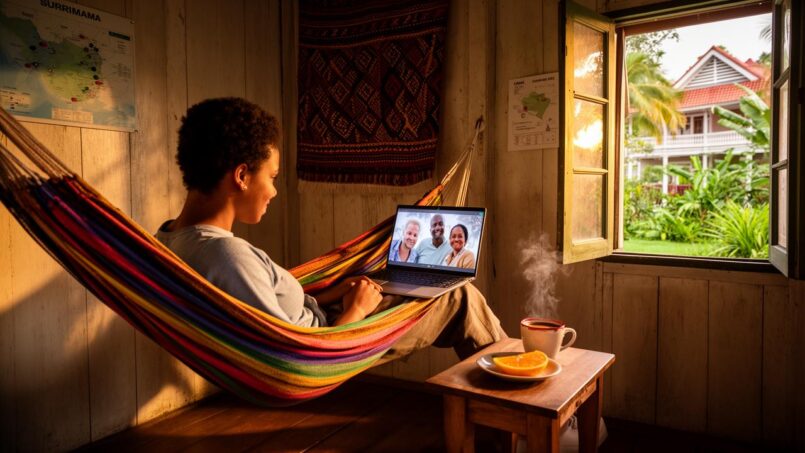
Digital tools today allow you to exchange voice, images, and messages nearly in real time with family and friends. This connection is precious, but it can also, if it becomes constant, keep you symbolically “stuck” in your former life. One study mentions that daily intensive contact with the entourage back home can slow adaptation by about 25%.
Finding a balance is therefore crucial. Rather than scattering exchanges all over the place at all hours, it may be healthier to:
To maintain a strong connection with your loved ones during your stay in Suriname, it is advisable to set regular communication windows, such as two or three video calls per week, taking into account the time difference and your respective schedules. Complement these appointments with the occasional sending of voice messages or photos, which allows you to give news without taking up the whole day. Finally, talk honestly about your homesickness, but don’t forget to also share your discoveries, progress, and moments of joy experienced on site.
During holidays, which often exacerbate nostalgia, organizing hybrid rituals also helps: cooking a traditional dish with a loved one on video call, before going out to see a fireworks display or a local celebration; sharing a special meal with other expatriates from the same culture, then joining an inclusive Surinamese party.
Taking care of your body to soothe your mind
The body is often the first to absorb the shock of a distant move: tropical heat, humidity, disrupted rhythm, different diet. Yet research shows that the quality of sleep, physical activity, and diet plays a major role in resilience to difficult emotions.
In Suriname, several parameters call for special vigilance:
Heat and humidity can disrupt sleep without proper ventilation or adequate air conditioning. Furthermore, excessive consumption of rich local specialties (fried foods, sauces, alcohol) can increase fatigue and mood swings. Finally, access to certain fresh imported products may be limited due to stock shortages or high prices.
Building a lifestyle adapted to the Surinamese context can involve:
– a relatively regular bedtime and wake-up time, even if social evenings can be long ;
– a realistic physical activity: walking, swimming, cycling, gym, dancing, joining club outings like the Hash House Harriers ;
– a diet that combines local products (tropical fruits, vegetables, fish) with familiar spices or condiments from your home country, to maintain gustatory continuity.
This solid physical foundation makes you more resilient to waves of nostalgia. Conversely, accumulating fatigue, dietary imbalances, and sedentary habits creates a breeding ground for anxiety and depression.
Using Suriname’s cultural richness to feel less like a stranger
One of the most effective tips for combating homesickness is to actively engage with local culture, rather than observing it from a distance. This is especially true in Suriname, where almost every aspect of daily life can become a gateway: mixed gastronomy (roti, pom, saoto, moksi alesi, bakabana…), music, dance, religious and secular festivals, visits to Maroon or indigenous villages, museums, and historical sites like the UNESCO-listed center of Paramaribo.
Participating in these activities does not mean giving up your identity, but expanding your references. For example, you can:
To illustrate Suriname’s cultural richness and tolerance, several immersive experiences can be cited: following guided tours with local guides in the interior forest, for instance at Pikin Slee or Anaula, to understand the deep connection of Maroon communities to their environment; attending a traditional music or theater performance with Javanese influences, which shows how the diaspora transformed its nostalgia into vibrant artistic creation; and discovering symbolic sites of religious coexistence, such as the mosque and synagogue side by side in downtown Paramaribo, offering a tangible experience of Surinamese tolerance.
The more you accumulate these kinds of experiences, the more your brain registers Suriname not as a “disorienting elsewhere”, but as a rich environment in which it is possible to experience pleasure, curiosity, and even pride in living there.
Facing concrete difficulties without dramatizing them
It would be misleading to present Suriname as a postcard setting without constraints. The country is a developing nation, with a fragile economy, sometimes high inflation, limited infrastructure outside Paramaribo, imperfect public services, slow internet, regular product shortages, and often cumbersome and opaque bureaucracy.
Daily difficulties abroad can accumulate and fuel strong homesickness. It is advisable to anticipate them and place them in a realistic framework rather than ignore them.
A table summarizes some concrete challenges and possible responses to limit their emotional impact.
| Frequent challenge in Suriname | Impact on homesickness | Mitigation strategies |
|---|---|---|
| Administrative slowness, lengthy residence procedures | Feeling of powerlessness, nostalgia for a more “efficient” system | Delegate to an employer or intermediary when possible, research in advance, accept longer delays, celebrate each completed step |
| Slow internet, outages | Frustration, isolation, difficulty maintaining contact with home country | Plan backup solutions (mobile data, coworking spaces), adjust remote work hours, prioritize asynchronous exchanges (emails, voice messages) |
| High cost or unavailability of certain products | Nostalgia for consumption habits, feeling of loss of comfort | Identify local alternatives, anticipate what is worth bringing, reassess what is truly essential |
| Perception of urban insecurity | Social withdrawal, fear of going out, increased isolation | Research neighborhoods, adopt cautionary rules, frequent groups, do not generalize a few incidents to the whole country |
| Unequal quality of health services | Anxiety, especially in case of chronic issues | Inform yourself about private facilities, take out good insurance, plan check-ups in home country if necessary |
Each time you turn a vague problem into a precise, manageable challenge, you regain power. This feeling of control, even partial, is a massive antidote to homesickness.
Daring to ask for help: mental health matters in Suriname too
Studies on expatriates show a clear link between intense homesickness, isolation, and more serious psychological disorders, such as depression or anxiety. In Suriname, national data already indicate a high prevalence of depressive symptoms in the general population, while the mental health care system remains very centralized and understaffed with specialists.
Less than a quarter of people suffering from mental disorders in Suriname receive formal treatment.
For an expatriate in distress, several options nonetheless coexist:
Resources and services available for mental and emotional support, adapted to residents and expatriates.
123 (Stichting 113 Suicide Prevention Suriname), free and available 24/7. The Mental Health Bureau (BGGZ) reachable during the day. Listening services dedicated to young people.
Platforms specialized for expatriates, offering consultations in your language and time zone.
Consultations offered by institutions in the Netherlands or other countries, sometimes familiar with the Surinamese context.
It is essential not to wait until nostalgia turns into severe depression to seek help. Signals such as a generalized loss of pleasure, overwhelming fatigue, dark thoughts, persistent sleep disturbances, or marked social withdrawal warrant contacting a professional.
If needed, national emergency numbers (such as 115 for police, fire, and rescue) also remain entry points in case of acute crisis.
Drawing inspiration from Surinamese: community as a bulwark
If homesickness can make you want to withdraw, observing local dynamics in Suriname instead invites you to strengthen bonds. Maroon, Hindustani, Javanese, Creole, and Chinese communities often operate with strong internal solidarity, through associations, religious groups, sports clubs, or informal networks.
In the absence of effective public services, especially in mental health, communities, such as certain indigenous villages, organize themselves. Social support and suicide prevention are then ensured by local actors such as traditional leaders, churches, women’s groups, or sports clubs.
As an expatriate, you can draw inspiration from this logic by building a “village” around yourself: neighbors, colleagues, other foreigners, Surinamese met through an association, expat companions via support groups, local online networks. This mesh, even if it consists of people from very different backgrounds, becomes a fabric that cushions the hard blows.
Allowing yourself time and nuance
The temptation is great, in times of doubt, to judge your experience in Suriname by the yardstick of very fluctuating emotions: one catastrophic day of errands can make you fantasize about an immediate return home; a magnificent weekend in the forest or a warm dinner can make you forget any desire to leave.
Adaptation to a new culture is a long process, measured in months, even years. Many expatriates feel a peak of homesickness around the first year, when the novelty effect wears off and local ties are not yet deep.
Allowing yourself the right not to like everything, to doubt, to go through episodes of nostalgia without making them proof of “failure” is an essential form of self-compassion. It is entirely possible that after several years, you might choose to leave for your home country or another destination: that does not disqualify the path traveled, nor the bonds forged.
Conversely, many people who initially felt lost in Suriname end up considering this country a foundational place in their story, even a second home.
In summary: transforming longing into anchoring
Experiencing homesickness in Suriname means simultaneously experiencing two powerful forces: attachment to an elsewhere that shaped your identity, and discovering a country where diversity, slowness, creativity, and resilience are omnipresent.
Research shows you can act on many levers:
For a successful expatriation in Suriname, it is advisable to structure your days to reduce stress, build a local social network mixing expatriates and Surinamese, and personalize your housing to make it a sanctuary. It is also important to balance contact with your home country so it supports you without trapping you, take care of your body to lighten emotional loads, and immerse yourself in Surinamese cultures to replace nostalgia with curiosity. Finally, don’t hesitate to seek professional help if distress becomes too great.
By combining these dimensions, homesickness may not disappear entirely, but it ceases to be the center of gravity of your life. It becomes one component among others in your personal story—a story that, from now on, is also being written in Suriname.
Disclaimer: The information provided on this website is for informational purposes only and does not constitute financial, legal, or professional advice. We encourage you to consult qualified experts before making any investment, real estate, or expatriation decisions. Although we strive to maintain up-to-date and accurate information, we do not guarantee the completeness, accuracy, or timeliness of the proposed content. As investment and expatriation involve risks, we disclaim any liability for potential losses or damages arising from the use of this site. Your use of this site confirms your acceptance of these terms and your understanding of the associated risks.

Cyril Jarnias is an independent expert in international wealth management with over 20 years of experience. As an expatriate himself, he is dedicated to helping individuals and business leaders build, protect, and pass on their wealth with complete peace of mind.
On his website, cyriljarnias.com, he shares his expertise on international real estate, offshore company formation, and expatriation.
Thanks to his expertise, he offers sound advice to optimize his clients' wealth management. Cyril Jarnias is also recognized for his appearances in many prestigious media outlets such as BFM Business, les Français de l’étranger, Le Figaro, Les Echos, and Mieux vivre votre argent, where he shares his knowledge and know-how in wealth management.





