
 Published on and written by Cyril Jarnias
Settling in Suriname means diving into one of the most diverse human landscapes on the American continent. More than twenty languages circulate in the streets, within families, and at markets. Officially, everything revolves around Dutch. But in everyday life, the key that opens the doors to neighborhoods, warungs, and spontaneous conversations is Sranan Tongo.
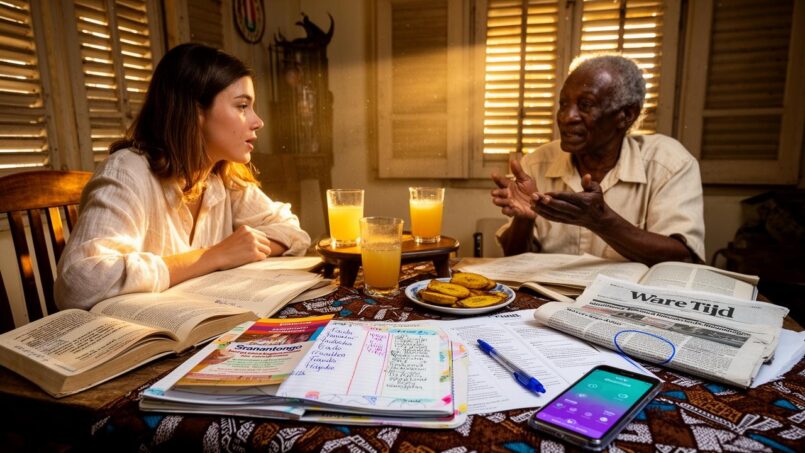
For an expatriate, learning the local language is essential for integration. This guide offers a concrete method for learning both Sranan Tongo (the lingua franca) and Dutch (the administrative and educational language) simultaneously, using resources available locally and online.
Understanding Suriname’s Linguistic Landscape
On paper, Suriname is a Dutch-speaking country. In reality, it is a true archipelago of languages. The official status of Dutch coexists with a mosaic of Creoles, Indian languages, Javanese, and Indigenous languages.
Dutch and Sranan Tongo: The Essential Duo
Dutch is the language of the state, media, schools, and contracts. A direct legacy of colonization, it remains the language of prestige, standardized by the Dutch Language Union, which includes the Netherlands, Belgium, and Suriname. It is estimated that between 60 and 80% of the population speak it as a mother tongue, and 20 to 30% as a second language. In Paramaribo, it is the household language in about two-thirds of homes.
Sranan Tongo is an English-based Creole, also called Surinaams or “Taki-Taki.” It is the language of the heart and the street, omnipresent in daily exchanges at markets, on buses, or on sports fields. It serves as an essential bridge between the country’s different ethnic groups (Hindustani, Javanese, Maroons, Creoles, Indigenous peoples) in a national linguistic context where more than 20 languages are commonly used.
A simple way to visualize the complementarity of the two languages in an expatriate’s life is to compare them by domain of use.
| Area of Daily Life | Dominant Language | Priority for an Expatriate? |
|---|---|---|
| Administration, contracts, children’s schooling | Dutch | High |
| Professional meetings, large companies | Dutch + English | High |
| Neighborhood life, markets, taxis, small shops | Sranan Tongo | Very high |
| Local friendships, humor, subtle cultural nuances | Sranan Tongo | Essential |
| National media (TV, press) | Mostly Dutch | Moderate |
| Interior of the country, Maroon or Indigenous villages | Sranan Tongo + local languages | Very high |
In practice, most Surinamese effortlessly switch between Dutch and Sranan Tongo within a single conversation. For a newcomer, ignoring either of these two languages means accepting a distance from part of the country.
A Multilingual Environment… and a Very Tolerant One
Suriname’s linguistic density is remarkable: Sarnámi Hindustáni, Surinamese Javanese, Chinese (Mandarin, Cantonese), several Indigenous languages and Maroon languages, not to mention English, which is gaining importance in tourism, commerce, and the mining sector.
Linguistic diversity is integrated into the country’s functioning, with a majority of inhabitants being bilingual or trilingual. Educational authorities are considering introducing more local languages in schools, particularly in the interior of the country where Dutch poses an obstacle to learning for many children.
For an expatriate, this context has two positive consequences:
– The population is used to speaking with people who are not 100% fluent in the language;
– Making the effort to speak Sranan Tongo is immediately perceived as a sign of respect and openness.
Sranan Tongo: A Language of the Street… But Not Only
Learning Sranan Tongo allows one to enter the most living dimension of Surinamese culture. It is also, very concretely, the tool that facilitates daily tasks as soon as you step out of air-conditioned offices.
Where Does Sranan Tongo Come From?
Sranan Tongo is an English-based Creole. It developed in the context of the slave plantation system, through contact with English, Dutch, and various African languages. Suriname’s relative isolation from the English-speaking world has made it one of the most conservative English-based Creoles.
Its grammar follows a Subject–Verb–Object order close to English, which makes it less disorienting for an English speaker than, for example, a Verb–Subject–Object language. The lexicon draws from English, Dutch, and other languages present in Suriname. The main challenge for a learner comes from the shifts in sounds and meanings compared to the original English.
We can summarize a few structuring features of the language in an overview table.
| Aspect | Characteristic of Sranan Tongo |
|---|---|
| Language type | English-based Creole |
| Social role | Lingua franca, language of the street and daily life |
| Word order | Subject – Verb – Object (SVO), close to English |
| Spelling | Mainly phonetic |
| Pronunciation of final “n” | Pronounced like “ng” |
| End of words | Generally a vowel or “n” (“m” tends to become “n”) |
| Common phonetic feature | Combined consonants simplified compared to English |
| Difficulty for English speakers | Vocabulary fairly accessible once sound rules are internalized |
For an English speaker, this is often described as a “moderate” difficulty: the vocabulary is relatively easy to remember, but you have to accept that seemingly familiar words are pronounced, and even constructed, differently.
Why Is Sranan Tongo So Valuable for an Expatriate?
Speaking a little Sranan Tongo instantly changes the type of relationship you have with those around you. You go from being a “passing foreigner” to a neighbor who makes the effort to integrate. This is felt everywhere: in how shopkeepers serve you, in the patience of taxi drivers explaining a route, or in the welcome you receive in interior communities.
In some rural areas, especially in more isolated districts, Dutch and English recede in favor of local languages and Sranan Tongo. A basic vocabulary then allows you to handle essential situations: asking a price, checking a schedule, reporting a food allergy.
The creole also carries unique ways of describing the world. Saying “Sribi e kiri mi” for “I’m sleepy” – literally “sleep is killing me” – or “Angri e kiri mi” for “I’m hungry” gives a glimpse of the language’s expressive power. It is this type of phrasing that roots an expatriate in the local experience, beyond mere transactions.
Example of a Creole expression
The First Phrases to Know
Even though the goal of this article is not to provide a complete mini-course, it is useful to identify a few phrases found in Sranan Tongo training resources. They appear everywhere: in Peace Corps courses, in online phrasebooks, and in dialogues used for teaching.
| Situation | Sranan Tongo | Meaning in English |
|---|---|---|
| Greeting | Morgu | Good morning |
| Asking how someone is | Fa y’ tan? / Fa waka? | How are you? / How’s it going? |
| Replying | Mi de | I’m fine / I’m okay |
| Introducing yourself | Mi a laren / Mi e leri Sranan Tongo | I am learning (Sranan Tongo) |
| Asking to speak more slowly | Yu kan taki moro safri? | Can you speak more slowly? |
| Thanking | Grantangi | Thank you |
| Saying goodbye | Waka bun | Have a good trip / go well |
| Saying you don’t speak Dutch | Mi no e taki Nederlands | I don’t speak Dutch |
This type of phrase, learned very early on, serves as a crutch in all interactions. They also show something important: Surinamese people know that foreigners do not necessarily speak Dutch. Making it clear that you are learning – “Mi a laren” – very often invites a slower pace, additional explanations, or even impromptu mini-lessons.
The Best Resources for Learning Sranan Tongo
Unlike widely taught languages like Spanish or German, Sranan Tongo has little formal material. However, some well-designed resources allow for effective progress, especially when combined with plenty of real-world practice.
The Peace Corps Course: A Structured, Free Foundation
The most comprehensive and accessible foundation remains the Peace Corps training program. Designed by volunteers and local trainers, it was created for absolute beginners, often sent to interior villages where Sranan Tongo is essential.
The course consists of two main elements:
– approximately 116 audio files in mp3 format;
– a booklet of around twenty pages (about 23 pages) that serves as a manual.
The entire set is freely accessible via the Live Lingua website, in a section dedicated to Peace Corps language courses. The format is designed for daily work: about thirty minutes a day, on a regular basis, to gradually build vocabulary, listening skills, and automaticity.
The content follows a highly practical progression:
| Peace Corps Course Unit | Main Content | Direct Usefulness for Expatriate |
|---|---|---|
| Lessons 1–3 | Songs, greetings, farewells | Breaking the ice, joining social life, saying hello and goodbye |
| Lesson 4 | Talking about yourself, your family, your role | Introducing yourself, explaining why you are in Suriname |
| Lesson 5 | Numbers and possession | Shopping, indicating quantities, giving your phone number |
| Lessons 6–7 | Days, months, time, birthday song | Setting appointments, understanding a schedule, joining celebrations |
| Lesson 8 | Food, dishes, ordering at table, allergies | Ordering at a warung, discussing allergies (“Mi trefu na pinda” = allergic to peanuts) |
| Lessons 9–10 | Question words, directions | Asking for directions, finding your way, giving instructions to a taxi |
| Lesson 11 | National anthem, cultural dimensions | Understanding a powerful symbol of Surinamese identity |
The realistic dialogues, traditional songs like “Lolo Mi Boto,” and the integration of everyday scenes make it a valuable tool. Its cultural focus is a real plus: learning a popular song helps you grasp the musicality and spirit of the language, not just its grammar.
Peace Corps trainers recommend using this language course both before and after your arrival in Suriname. For optimal support, user feedback is encouraged. A designated language coordinator (with a contact email address) is available to help you with any difficulties, even though this service is primarily intended for official volunteers.
Stories, Interactive Dictionaries, and Videos
Beyond the Peace Corps course, a few scattered resources complement the setup, especially for written and listening comprehension.
Some websites dedicated to stories in Sranan Tongo sometimes offer an interactive glossary: clicking on a word brings up its definition. For a learner, reading a tale or short story with this tool at hand helps develop vocabulary and contextual intuition without drowning in a dictionary.
Books devoted to other local Creoles, such as Saramaccan, sometimes include sections translating into Sranan Tongo, Dutch, English, and French. They can serve as a bridge between different linguistic systems and help identify convergences and differences among Suriname’s Creoles.
On the audio-visual side, several educational videos exist:
Discover a selection of varied, authentic materials to introduce you to Suriname’s Creole language.
Practice reading and listening comprehension through workshops based on folktales and texts in Sranan Tongo.
Follow structured lessons inspired by the Peace Corps educational program to learn the basics of the language.
Listen to native speakers in natural settings, such as on the Wikitongues channel, for an authentic immersion experience.
Watching this type of video, pausing them, repeating sentences out loud, and trying to transcribe snippets constitutes a form of “shadowing” that is particularly useful for a language rarely found in mainstream apps.
General Platforms Useful for Sranan Tongo
Mainstream apps (Duolingo, Babbel, etc.) do not currently offer Sranan Tongo. However, some platforms or language documentation projects serve as entry points:
– Organizations such as the Suriname Bible Society, Wycliffe Bible Translators, or websites like Bible.com offer texts in Sranan Tongo (especially Bible translations). For an intermediate learner, these texts provide a substantial volume of standardized language;
– Projects like the Endangered Languages Project, Omniglot, or I Love Languages offer linguistic descriptions, alphabets, and basic word lists;
– University archives or labs (phonetics, oral literature) store recordings and documentation, useful for getting your ear accustomed to accents and intonations.
To work on vocabulary, apps not specific to Sranan Tongo but focused on word acquisition can be repurposed: you enter your own lists to benefit from spaced repetition tools, flashcards, or games.
Learning Dutch: Essential for Putting Down Roots in Suriname
If Sranan Tongo is the key to daily life, Dutch remains the indispensable tool for everything related to administration, children’s education, or a long‑term career in Suriname. It is also the majority language in Paramaribo homes.
How Long Does It Take to Become Operational?
For an English speaker, typical estimates place the effort between 600 and 750 hours of intensive study to reach a functional level (around B1/B2 on the Common European Framework). In practice, this corresponds to about two years of regular study at 5.5 hours per week.
The CEFR levels provide benchmarks:
| CEFR Level | Typical Study Hours | Target Skills |
|---|---|---|
| A1 (Beginner) | 80–100 hours | Simple sentences, introductions, concrete needs |
| A2 | ≈ 200 hours | Common interactions, short descriptions |
| B1 (Intermediate) | 350–400 hours | Simple but independent conversation, overall comprehension |
| B2 | ≈ 600+ hours | Working in the language, understanding mainstream media |
In the Surinamese context, aiming for a solid A2 quickly is already useful for following a conversation at work, handling basic administrative tasks, or supporting your children in the school system. A B1 opens the door to comfortable independence.
Surinamese Dutch: Same Language, Different Flavor
The Dutch spoken in Suriname – often called Surinaams-Nederlands – is entirely intelligible with the standard Dutch of the Netherlands or Flanders, but it has three important particularities:
Dutch spoken in Suriname has a distinct accent, influenced by local languages such as Sranan Tongo. It is characterized by specific pronunciations, for example, the consonants /v/, /z/, and /ɣ/ tend to become closer to /f/, /s/, and /x/. Its lexicon is enriched with common borrowings, especially in cuisine and culture, such as ‘baka’ (back), ‘bara’ (fritter), and ‘sambel’ (spicy condiment).
For an expatriate, this means that learning based on standard Dutch (often via resources designed in the Netherlands) is a good strategy, to be complemented later by regular exposure to Surinamese variants.
Concrete Methods and Resources for Dutch
The range of resources for learning Dutch is abundant. Several approaches can be effectively combined.
Language schools – physical or virtual – structure learning into A1, A2, B1 modules, etc., using textbooks such as “Nederlands in gang,” “De opmaat,” or “Contact!”. An expatriate in Suriname can take online courses offered from the Netherlands or Belgium and then adjust pronunciation to the local accent through daily contact.
Online platforms complete this setup:
– Massive open online courses (MOOCs) from Dutch universities, offering free introductions for beginners;
– Audio and video platforms structured by level, allowing you to work on comprehension at your own pace;
– Learning apps like Duolingo, Memrise, Babbel, Pimsleur, or Rosetta Stone, useful for starting vocabulary and basic phrases, but insufficient for reaching autonomy if used alone.
Several pedagogical principles recur in these resources:
– The need to move quickly from “passive” learning (listening, reading) to active use (speaking, writing);
– The importance of consistency: fifteen minutes a day is better than two hours once a week;
– The need for frequent feedback from speakers or teachers to adjust grammar and pronunciation.
In Suriname, mastering “standard” Dutch will allow you to be understood; then your ear will gradually become accustomed to Surinamese prosody and vocabulary – just as a French speaker gets used to differences between French from France, Quebec, or Switzerland.
Integrating Through Practice: Immersion and Exchange
No resource, no matter how complete, can replace immersion. In Suriname, the language playground is everywhere: on the bus, at the market, along the riverbanks, or at cultural events. The challenge is to turn these opportunities into systematic learning.
Putting Language at the Heart of Daily Life
Immersion is not just about living in a country; it means voluntarily exposing yourself to the language, even when the easy way out would be to stick to English or French.
Concretely, for an expatriate in Suriname, this can involve several habits:
– Shop at local markets, listen, note down words, and reuse them the following week;
– Frequent warungs and chat with the staff: ask for dish names in Sranan Tongo, inquire about recipe ingredients;
– Attend non‑tourist events: local sports matches, religious ceremonies, neighborhood parties, where Sranan Tongo dominates;
– Observe gestures and intonations: in this highly plural society, non‑verbal communication plays a strong role; copying it is also part of integrating.
It is recommended to keep a notebook to jot down new words, surprising expressions, and misunderstandings you encounter. By revisiting them calmly, this practice turns every daily experience into a true continuous training session.
Relying on Expatriate Communities… and Stepping Out of Them
Paramaribo hosts several expatriate networks, including a large community organized via international platforms. These groups offer:
– Regular meetings;
– Online discussion forums;
– Leisure activities.
They play a useful role in getting practical advice (housing, schooling, administrative procedures). Some local providers even offer personalized support for newcomers, including social support, activities, and help finding language courses.
But staying confined to these circles maintains the temptation to communicate only in English or French. An effective strategy is to use these networks as a base, while setting the goal of gradually spending more time in predominantly Surinamese environments. The ideal is to alternate:
To accelerate learning Dutch and Sranan Tongo, it is recommended to attend expatriate events to share experiences and practical tips, and to deliberately place yourself in social situations where you are the only non-native speaker, forcing your brain to adapt and actively use these languages.
Language Exchange Platforms: Finding Partners in Suriname
To work on conversation, language exchange apps are particularly useful. Some already list profiles based in Paramaribo, featuring Surinamese people looking to practice Spanish, Russian, English, or French.
The features of these platforms are often the same:
– Connecting speakers who want to learn each other’s language;
– Communication via video conferencing, messaging, or audio;
– Profiles detailing native language, languages being learned, and interests.
User descriptions show what is sought: kind, talkative, motivated partners open to new horizons. For an expatriate in Suriname, offering an exchange of “French/English for Sranan Tongo/Dutch” can work very well: many young Surinamese want to improve their English for studies or career prospects.
This type of exchange can take place:
– Online, even before departure, to get familiar with the musicality of Sranan Tongo;
– On the ground, in a Paramaribo café or by the river, to alternate between Dutch, Sranan Tongo, and the expatriate’s language.
Building a One‑Year Learning Strategy
Learning both Sranan Tongo and Dutch while adapting to a new country may seem ambitious. A structured approach makes this challenge manageable.
Before Departure: Preparing the Ground
A few weeks or months before arriving in Suriname, it is realistic to:
– Take an online Dutch module to learn greetings, introductions, numbers, and a few sentence structures;
– Download the Peace Corps audio resources for Sranan Tongo and listen to the first lessons, especially greetings, numbers, and polite phrases;
– Start building a personal mini‑phrasebook of useful sentences (“Ik leer Nederlands en ik moet oefenen,” “Mi e leri Sranan Tongo,” etc.).
The main goal is not to master the language, but to avoid approaching it without any familiarity. Listening to its sounds in advance helps reduce the linguistic shock of immersion.
The First Three Months on Site: Guided Immersion
Once in Suriname, the idea is to turn every day into a learning opportunity without exhausting yourself:
– Set a fixed daily 30‑minute slot to work on Sranan Tongo with the manual and audio;
– Spend at least as much time on Dutch using a structured online course or textbook, focusing on speaking;
– Decide on “100% local” zones: for example, at markets, systematically try to speak Sranan Tongo for simple interactions (greeting, asking a price, thanking);
– Each day, note 5 to 10 new useful words encountered in the field, then integrate them into your flashcard system (app or paper notebook).
The goal of this quarter is to be able: to meet the set objectives and progress in our learning.
– To greet and thank in Sranan Tongo without hesitation;
– To understand the gist of a basic exchange in Dutch (time, price, simple instructions).
Months 4 to 12: Consolidate and Expand
Over the months, the challenge shifts from linguistic survival to genuine participation in local life:
To progress effectively, it is advisable to take a Dutch course until reaching a solid A2 level, aiming for B1 if possible. At the same time, for Sranan Tongo, prioritize practical interaction: find an exchange partner, watch storytelling videos, and sing local songs. To consolidate these skills, set concrete weekly challenges, such as holding a 10‑minute conversation in Sranan Tongo with a neighbor, making a phone call in Dutch to an administrative office, or explaining your work to a colleague without using English.
The key here is not to banish mistakes – inevitable – but to see them as indicators of what is still missing from your linguistic system, then fill those gaps gradually.
Managing Difficulties and Staying Motivated
Even in an environment as rich as Suriname’s, learning a local language includes phases of stagnation, frustration, and even the temptation to give up.
Pronunciation and Interference
Sranan Tongo does not use all the sounds of Dutch, and vice versa. It is easy to mix them up, especially when learning both simultaneously. What matters is not to over‑invest in phonetic perfection at the start. Being understood remains the primary goal.
Dutch presents two main phonetic challenges: guttural sounds and diphthongs.
Psychological Barrier and Impostor Syndrome
In a multilingual society, native speakers juggle codes. An expatriate can quickly feel clumsy. Here again, language acquisition research reminds us of the importance of stepping out of your comfort zone: fear of ridicule is a greater obstacle than grammar mistakes themselves.
A good gauge is to observe how Surinamese people react: in most cases, the effort is appreciated, corrections come kindly, and jokes about mistakes tend to include rather than exclude.
Sustaining Long‑Term Motivation
Cultural immersion, when approached as a personal project, is fueled by concrete goals: attending an event and understanding most of what is said, being able to read a local news article, following a Dutch‑language TV series without subtitles.
An effective trick for language progress is to link your learning to another personal interest, such as cinema, music, cooking, or a hobby. This makes practice more motivating and natural, integrating the language into activities you already enjoy.
– If you love cooking, learn the vocabulary for ingredients and recipes, ask local cooks for variations;
– If you are passionate about music, dive into the lyrics of Surinamese songs, whether in Sranan Tongo or local Dutch;
– If you appreciate history, read about the country’s past, its Maroon communities, and its Indigenous peoples in the country’s languages.
The general idea is to stop seeing language as a mere utilitarian tool and instead regard it as privileged access to social and symbolic worlds that would otherwise remain closed.
In Conclusion: Making Language a Choice for Integration
In Suriname, an expatriate can get by with mainly English, especially in certain professional circles. But they then condemn themselves to staying on the doorstep, never entering the living room.
Learning Dutch is essential for interacting with institutions, schools, and a large part of the working world. Learning Sranan Tongo gives you access to conviviality, jokes, and everyday conversations. Mastering both languages offers privileged access to one of the most diverse societies on the continent.
The specific resources – the Peace Corps course, online stories, videos, and archives – combined with the more general arsenal for Dutch and language exchanges, are more than enough to get started. Added to a well‑thought‑out immersion, they allow you not only to make yourself understood, but also to understand – which, in the end, is the true goal of any linguistic adventure in Suriname.
Disclaimer: The information provided on this website is for informational purposes only and does not constitute financial, legal, or professional advice. We encourage you to consult qualified experts before making any investment, real estate, or expatriation decisions. Although we strive to maintain up-to-date and accurate information, we do not guarantee the completeness, accuracy, or timeliness of the proposed content. As investment and expatriation involve risks, we disclaim any liability for potential losses or damages arising from the use of this site. Your use of this site confirms your acceptance of these terms and your understanding of the associated risks.

Cyril Jarnias is an independent expert in international wealth management with over 20 years of experience. As an expatriate himself, he is dedicated to helping individuals and business leaders build, protect, and pass on their wealth with complete peace of mind.
On his website, cyriljarnias.com, he shares his expertise on international real estate, offshore company formation, and expatriation.
Thanks to his expertise, he offers sound advice to optimize his clients' wealth management. Cyril Jarnias is also recognized for his appearances in many prestigious media outlets such as BFM Business, les Français de l’étranger, Le Figaro, Les Echos, and Mieux vivre votre argent, where he shares his knowledge and know-how in wealth management.





