
 Published on and written by Cyril Jarnias
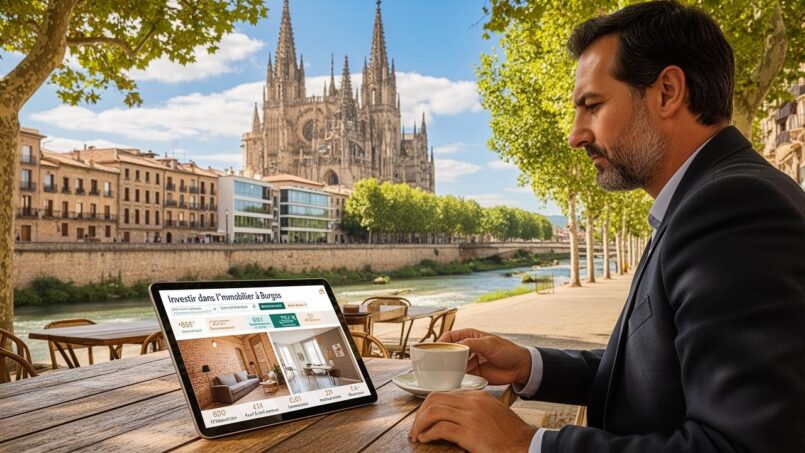
Burgos is neither Madrid nor Barcelona, and that is precisely what makes it one of the most interesting markets in Spain for an investor today. The city combines World Heritage status, a solid industrial base, massive infrastructure projects, and prices that are still reasonable relative to the national dynamic. Result: decent rental yields, a very real potential for capital appreciation, and a clear regulatory environment, even for foreigners.
Burgos has 176,418 inhabitants, offering a stable market with steady growth for investors.
1. A real estate market in acceleration
The Spanish real estate market is in the midst of a bull cycle, driven by above-average economic growth in the eurozone, interest rates stabilized around 2%, and sustained residential demand. Burgos directly benefits from this context, with a dynamic of prices and rents now clearly visible in the figures.
A marked rise in prices and rents
In the municipality of Burgos, the average asking price for sale reached €2,017/m² in August 2025, an increase of more than 13% in one year. On the rental side, the average listed rent reached €10.54/m² per month, up 14.44% over the same period. In other words, we are no longer on a “sleepy” market: the revaluation is already underway.
These values also represent a peak over the last two years, both for sales and rentals, confirming the upward trend.
Yields and key ratios
On average, the gross rental yield in Burgos city is around 4.95%, with an average acquisition price of around €210,000 and an average monthly rent close to €800. The gross payback period is 21.9 years, which remains consistent for a mid-sized Spanish city with a high quality of life.
National statistics on purchase and financing costs make it possible to estimate several important indicators.
| Overall indicator (city) | Approximate value |
|---|---|
| Average price per m² (sale) | €2,190 |
| Average monthly rent | €800 |
| Average rental yield | 4.95% |
| Payback period (price/rent) | 21.9 years |
| Price-to-income ratio | 5.11 |
| Gross rent in city center | ~ 6.29% yield |
| Gross rent outside center | ~ 5.75% |
| Fixed mortgage rate 20 years (Spain) | ~ 3.50% |
This level of yield may seem moderate compared to some very peripheral markets, but it must be read in light of two factors: the stability of the local market and the growth prospects for value, still largely undervalued relative to more exposed metropolitan areas.
Burgos city vs. province: a yield/security trade-off
The province of Burgos, for its part, shows a much higher average yield, around 8.07%, for an average selling price of €125,000 and an average rent of €780. The gross payback period drops to 13.4 years. The gap is easy to understand: as you move away from the provincial capital, prices fall faster than rents, which mechanically boosts yields.
A few provincial benchmarks:
| Data (province of Burgos) | Average value |
|---|---|
| Average sale price | €125,000 |
| Average monthly rent | €780 |
| Average price per m² | €1,390 |
| Average rental yield | 8.07% |
| Payback period | 13.4 years |
The province is even considered one of the most attractive markets in Spain in terms of yield, with areas where average purchase prices remain very low (€35,000 in Sierra de la Demanda, €43,000 in Ribera del Duero). In return, liquidity and rental dynamism are naturally lower than in the provincial capital.
For an investor, the trade-off is therefore clear:
– Burgos city: more moderate yield, but liquidity, sustained demand, strong potential for capital gains, and a diversified rental market (students, families, tourism, professionals).
– Small towns and rural areas of the province: significantly higher yield on paper, but higher vacancy risk, narrower resale market, and greater dependence on sometimes fragile local dynamics.
2. Understanding the market geography in Burgos
Burgos is not a monolithic market. The differences in price per square meter and rents from one neighborhood to another are significant, and some areas offer yields well above average.
The most expensive and most sought-after areas
Data from August 2025 shows a clear hierarchy of prices according to neighborhoods.
| Burgos area | Sale price (€/m²) | Rent (€/m²/month) |
|---|---|---|
| Universidad – Las Huelgas | 2,522 | 10.15 |
| Casco Histórico | 2,334 | 12.62 |
| Centro | 2,227 | 11.04 |
| G3 – S3 – S4 – Villímar | 2,205 | 9.83 |
| Plaza Vega – San Pedro de Cardeña | 2,092 | 10.78 |
| Río Vena – G2 – Plantío | 2,034 | 9.47 |
Universidad–Las Huelgas stands out for the highest price per square meter, driven by proximity to the university and a popular residential environment. Casco Histórico unsurprisingly concentrates the highest rents in the market, making it a choice micro-market for high-end rentals and tourist stays.
The historic center (including Centro, Plaza España, and Plaza Mayor) is the commercial and service heart of the city. It is particularly sought after by professionals and households who want to live as close as possible to the urban buzz.
More affordable neighborhoods, an investor’s hunting ground
At the other end of the spectrum, some areas remain significantly more affordable, while still offering decent rents:
| Burgos area | Sale price (€/m²) | Rent (€/m²/month) |
|---|---|---|
| El Crucero – Cortes | 1,528 | 9.94 |
| Villatoro – Villafría – Castañares – La Ventilla | 1,573 | 7.04 |
| Fuentecillas – Yagüe – Villalonquéjar | 1,637 | 8.81 |
| Gamonal – Capiscol | 1,853 | 9.75 |
| Yllera – Pozanos | 1,843 | 10.75 |
| San Pedro y San Felices – San Agustín – P. Europa | 1,965 | 9.85 |
It is precisely in these areas, particularly Villafría – La Ventilla – Castañares or Gamonal – Capiscol, that the highest gross yields are observed.
The best districts for profitability
The yield analyses by district are enlightening for an investor seeking cash flow:
| District / Area | Gross rental yield |
|---|---|
| Villafría – La Ventilla – Castañares | 15.70% |
| San Pedro de la Fuente | 8.36% |
| Zona Sur – Barrio Cortes | 6.82% |
| Capiscol – Gamonal | 6.57% |
| Illera | 5.46% |
| Plantío – Alcampo | 5.36% |
Villafría – La Ventilla – Castañares, although the area displays among the lowest rents per m² in the city, offers exceptional theoretical profitability, linked to very competitive acquisition prices and a strategic positioning, particularly with regard to industrial areas and infrastructure projects (connection to logistics zones, proximity to the future high-speed rail link, etc.).
San Pedro de la Fuente neighborhood, located on the edge of the historic center, combines old-world charm, strong rental demand, and quick access to the city center. This combination results in an excellent ratio between property purchase price and the rents that can be charged.
Zona Sur – Cortes and Capiscol – Gamonal are, for their part, areas that are both residential and very lively commercially, marked by a strong local community and a network of neighborhood shops, favorable for long-term family rentals.
3. What type of property for what yield?
Statistics by apartment type in Burgos allow for more precise targeting of the type of product to prioritize according to your strategy.
Yield by property size
| Property type | Average price (sale) | Average rent / month | Average annual income | Gross yield |
|---|---|---|---|---|
| Studio | €189,000 | €800 | €9,600 | 5.08% |
| 1 bedroom | €155,000 | €650 | €7,800 | 5.03% |
| 2 bedrooms | €180,000 | €780 | €9,360 | 5.20% |
| 3 bedrooms | €219,000 | €850 | €10,200 | 4.66% |
| 4+ bedrooms | €300,000 | €1,200 | €14,400 | 4.80% |
Two-bedroom apartments (2 bedrooms in the Spanish sense, i.e., T3 for a French person) appear to be the best compromise between purchase price and rents obtained, with a yield slightly above average. This is also the most sought-after typology among tenants (28% of supply, compared to 44% for 3-bedroom apartments), which limits vacancy.
Studios, less numerous (1% of listings), maintain interesting profitability, particularly for targeting students or young professionals, but the entry ticket is not necessarily lower than that of a small two-bedroom.
Rental demand: who rents in Burgos?
Long-term rental demand is fueled by three main profiles:
Rental demand in Burgos is structured around three main profiles. Professionals are attracted to industrial and logistics areas, generating stable demand for managers and employees. Students, numerous thanks to the university and higher education institutions, mainly occupy small and medium-sized homes near the Universidad – Las Huelgas, San Pedro y San Felices neighborhoods, and in the north. Finally, families prefer quiet residential sectors such as Fuentecillas, Huelgas, or parts of Villimar and Gamonal, seeking proximity to green spaces, schools, and good transport links.
Added to this is a growing tourist demand, mainly oriented towards short-term rentals.
Short term: the potential of tourist rentals
Tourism, without reaching the levels of large coastal cities, plays a significant role. Burgos Cathedral, a listed Gothic jewel, festivals, and proximity to natural sites attract a steady flow of visitors each year.
Data on short-term rentals indicate:
| Airbnb indicator (Burgos) | Value (approx.) |
|---|---|
| Active listings | 389 |
| Average annual revenue | €23,000 |
| Average monthly revenue | €1,943 |
| Average occupancy rate | 60% |
| Average daily rate (ADR) | €106 |
| Booked nights / year | ~219 |
| Annual revenue growth | +20.95% |
These figures, significantly higher than long-term rents for well-located properties, illustrate the financial appeal of the tourist segment. But they must be weighed against two factors:
– A regulatory framework described as strict for tourist rentals.
– A strong seasonality, with a peak in August.
For an investor, the most prudent strategy often consists of favoring a long-term model, possibly mixed (standard rental with short-term openings during specific periods if local regulations allow), rather than building a business plan exclusively based on Airbnb.
4. Urban projects and infrastructure: a major lever for value appreciation
One of Burgos’s major assets is the scale of public and private investments in transport infrastructure, industrial zones, and urban renewal. These projects have a direct impact on residential attractiveness, land prices, and rental demand.
The future Burgos – Vitoria high-speed line
The flagship project is the high-speed connection between Burgos and Vitoria, an extension of the Madrid – Valladolid – Burgos line and a key link in the European Atlantic corridor.
Key parameters:
– Length of the new line: more than 100 km.
– Total estimated cost: approximately €1.5 billion.
– Financing: massive support from the European Investment Bank (€1.7 billion approved, including an initial tranche of €325 million).
– Multiple sections under construction or out to tender (Burgos – Valle de las Navas, Piérnigas – Pancorbo, etc.).
– Planned integration with the “Y vasca” linking the Basque capitals and, beyond, the French border.
In addition to macroeconomic effects (better connection to economic hubs, reduced travel times, and increased flows), this infrastructure particularly benefits areas located to the north and east of the city, near rail corridors and logistics platforms.
Industrialization, logistics, and business parks
Burgos already has eight industrial parks, three business parks, and a business center. The main reservoir of quality industrial land is in the Villalonquéjar IV complex, which offers more than 1.2 million m² immediately available, with very good road access.
The municipality’s commitment to invest heavily in industrial zones (more than €7 million planned, including recent works of €3 million in the Este zone) reinforces the attractiveness of these parks. Streets have been reorganized, sidewalks redone, green spaces created, continuous 2.5-meter-wide bike lanes integrated, and parking reconfigured.
For a residential investor, these efforts mean:
– A solid employment base, therefore sustainable rental demand near industrial zones (Gamonal, Villafría, Villalonquéjar, Villimar).
– Increased interest in products such as shared housing for workers, small apartments close to employment areas, and even, for some, housing for middle managers.
Urban renewal and quality of life
The municipality is not limited to transport and industry. An ambitious urban redevelopment project, called Xpande, plans to invest €60 million to transform the city center:
This is the additional surface area in square meters that will now be dedicated to pedestrians as part of this development project.
Added to this are projects around the El Plantío municipal stadium, with a renovation estimated at €50 million (19,000 seats, boxes, restaurants, offices, underground parking). Other sports facilities (Coliseum Burgos, swimming pools, tennis courts, hockey pitches) are to receive an additional €20 million.
All of this reinforces the residential attractiveness of the affected neighborhoods (Río Vena – Plantío, areas near the center, banks of the Arlanzón) and fuels a gradual rise in property values.
Public housing for young people: a signal of residential pressure
The city has also launched an initial municipal housing operation for young people, with the renovation of a building in San Cristóbal into 20 flexible apartments. Budget: €2.8 million. The goal is to respond to the difficulty young households face in accessing the private market and, by implication, illustrates the growing tension in the rental market.
For the investor, this means that demand for affordable, well-located housing should remain very strong in the coming years.
5. Taxation and legal framework for foreign investors
One of Spain’s strengths, and therefore Burgos’s, is a stable and relatively open legal framework for foreign investors. But property taxation, multiple and segmented, requires good preparation for your operation.
Property rights and access for foreigners
– Non-residents, whether individuals or companies, can freely acquire and hold real estate in Spain.
– The Spanish Constitution and the Civil Code guarantee foreigners the same property rights as Spanish citizens, subject to a few sensitive situations (military zones, very specific coastal areas, not relevant for Burgos).
– There is no general restriction on purchase by foreigners, but obtaining an NIE (Número de Identificación de Extranjero) is mandatory for any transaction.
Acquisition taxes
Taxation depends on the nature of the property:
– Second-hand property (resale): subject to Transfer Tax (ITP), with a regional rate typically between 6% and 10% of the sale price.
– New property: subject to VAT (10% for residential) + Stamp Duty (AJD), generally around 1–1.5% of the price depending on the autonomous community.
In addition:
Details of additional costs to budget for when acquiring a property, beyond the purchase price.
In practice, between €2,000 and €4,000.
Often between 1% and 2% of the total transaction amount.
Up to 2% of the loan amount, if financing is used.
Approximate cost of €250 to €600.
In total, you should budget 10 to 15% in costs on top of the net seller price, which is essential for calibrating your down payment and financing.
Recurring taxes for non-residents
Once owner in Burgos, several taxes apply:
In Spain, the wealth tax applies to net assets exceeding €700,000, with progressive rates.
Finally, in case of resale:
– Capital gains tax: non-residents are subject to 19% on the net gain (sale price – purchase price adjusted for certain costs). The buyer withholds 3% of the price and remits it to the tax authorities as a deposit.
– Municipal capital gains tax (Plusvalía municipal): local tax on the increase in land value, calculated on the cadastral value of the land and the holding period, with a maximum rate of 30%. It is not due if there is no actual gain on the land value.
Potential developments to watch
A draft law mentions the creation of a “supplementary state tax” on acquisitions by non-residents from third countries (non-EU), which could theoretically reach up to 100% of the property value if no effective residence in Spain is demonstrated. It also provides for an increase in VAT to 21% on short-term tourist rentals.
At the time of the data, this is only a project, but it highlights an underlying trend: stricter regulation of certain forms of foreign real estate investment, particularly in the tourist segment. Burgos, far from being a saturated zone like Barcelona or Madrid, nevertheless remains exposed to these national developments.
6. Financing a purchase in Burgos: conditions and levers
The Spanish mortgage market is particularly developed and accessible to foreigners, provided you present a solid application.
Credit conditions for non-residents
– Loan generally limited to 60–70% of the lower of the purchase price and the appraisal value.
– Personal contribution of 30–40% required, or even 50% for certain profiles or purely investment properties.
– Loan term often 20 to 30 years, with a requirement to repay before age 70–75.
– Overall debt-to-income ratio (all debts, including the Spanish loan) limited to 30–40% of income.
Average rates in 2025 are around 3.17%, with fixed-rate offers from 2% for the best applications, which remains attractive compared to many countries.
Types of loans available
– Fixed rate: suitable for cautious investors who want to secure their net cash flow over time.
– Variable rate indexed to Euribor: potentially lower in the short term but more volatile.
– Mixed rate: initial fixed-rate period (3–10 years), then switch to variable, very common.
– Green loans: improved terms for highly energy-efficient homes, which may interest those targeting new developments in Burgos, often rated A.
Major Spanish banks (Santander, BBVA, CaixaBank, Bankinter, Sabadell) offer specific products for non-residents. Using a local broker, expert in these institutions, can save time and secure a more advantageous interest rate, sometimes by a few tenths of a point.
7. Where and what to buy in Burgos, concretely?
Based on the available data, several typical investment strategies can be identified.
Strategy 1: city center and Casco Histórico – a bet on value and high-end
– Target: 1 to 3-bedroom apartments, renovated or in quality buildings, around the cathedral, Plaza Mayor, Paseo del Espolón, or in the Casco Histórico.
– Price: between €2,000 and €2,300/m² on average, more for exceptional properties.
– Tenants: executives, couples, expatriates, high-value tourist stays.
– Gross yield: around 4.5–5.5% for long-term, more for short-term, subject to regulations.
– Rationale: secure a “prime” asset in a market where supply is rigid (few new buildings possible in the historic core) and position yourself for the inevitable long-term price rise.
Strategy 2: growing residential neighborhoods – yield + potential
– Key areas: Gamonal – Capiscol, San Pedro de la Fuente, Zona Sur – Cortes, Fuentecillas, Illera.
– Strengths:
– Lower price per m² (€1,600–€1,900/m² for many areas).
– Yields between 5.3% and over 8% depending on the neighborhood.
– Strong demand from families and middle classes, proximity to schools, parks, shops.
– Typologies: 2–3 bedrooms, 70–110 m², often in buildings from the 1980s–2000s, or even newer residences with elevator, parking, communal areas.
This is often the ideal playground for a first rental investment, with a good balance between security, yield, and budget.
Strategy 3: peripheral areas with very high yield – “cash-flow” profile
– Iconic example: Villafría – La Ventilla – Castañares.
– Figures: theoretical yield around 15.70%, modest rents but even lower purchase prices.
– Rental profile: workers from industrial zones, low-income households, temporary contracts.
This option is for experienced investors capable of managing increased rental risk (turnover, potential defaults). It primarily aims to generate significant cash flow with a reduced entry ticket.
Strategy 4: new development – securing a “turnkey” product
The new construction market in Burgos is far from insignificant. Several major developments stand out:
| Development | Area | Typologies | Surface area (m²) | Starting price |
|---|---|---|---|---|
| Torres Dúo Bulevar | South Zone – Cortes | 3–4 bedrooms | 105–159 | €290–380k+ |
| La Quinta Estación | Villimar (S4) | 1–4 bedrooms | 56–134 | €165–325k |
| Galatea Garden | Villimar (V1–V2–S3–S4) | 3–4 bedrooms | 111–142 | €282.5–357k |
| Terrazas de Parque Europa | South Zone – P. Europa | 1–4 bedrooms | 73–173 | €162–306.5k |
| Edificio Verso | El Molino sector | 1–3 bedrooms | 48–96 | €103–170k |
These developments generally offer: the best conditions for processing and managing resources.
– High energy performance (A ratings, aerothermal heating, underfloor heating).
– Amenities appreciated by modern tenants: parking, gardens, pools, gyms, community rooms, pre-equipment for electric vehicles.
– Particular appeal for upper-middle-class families or executives.
Gross yield is often slightly lower than for well-located existing properties, but risks of work, unforeseen charges, and vacancy are reduced. In the long term, the resale value of these well-designed products in expanding neighborhoods like Villimar or the Bulevar ferroviario should benefit from population growth and the city’s upscaling.
8. Tourism, tourist apartments, and hotel pressure
On the tourist front, the dynamic is clear:
– The number of tourist apartments in the province has doubled in a few years, from 109 in 2019 to more than 200 in 2023, with 825 beds available.
– Overnight stays in tourist apartments have more than doubled between 2019 and 2023 (from 31,071 to more than 71,000), with an average length of stay of around two nights.
– The proportion of foreign travelers in these accommodations has increased sharply, with their overnight stays more than doubling between 2019 and 2023.
Professional associations denounce competition deemed “exorbitant” from tourist apartments, while traditional hotel activity is declining slightly in the city.
Professional hotel associations in Burgos
For the investor, this means: the need to carefully analyze the opportunities and risks associated with each investment.
– A real opportunity in the tourist segment, particularly for well-located apartments (Casco Histórico, Centro, Huelgas, areas near the Camino de Santiago) and properly managed.
– But also a risk of regulatory tightening, as already observed in other Spanish cities (capping or freezing of licenses, strict registration obligations, enhanced controls).
In Burgos itself, regulations are already described as strict for short-term rentals. Any strategy based on Airbnb therefore requires legal monitoring and the support of a local lawyer.
9. Acquisition process: key steps for a foreign investor
Buying in Burgos as a foreigner follows the same pattern as in the rest of Spain, with a few essential imperatives:
For a successful property purchase in Spain, follow these essential steps: start by obtaining an NIE (foreigner identification number), essential for signing the deed, opening a bank account, and paying taxes. Then open a Spanish bank account, necessary to pay the seller and fees. Hire an independent local lawyer to check title deeds, absence of debts, planning compliance, and handle contracts. If needed, negotiate financing with a Spanish bank. Sign a deposit contract (approximately 10% of the price) after due diligence, then go before a notary to sign the final deed and pay the balance. Register the deed at the land registry and pay acquisition taxes. Finally, handle post-purchase aspects: transfer utility contracts to your name, take out insurance, register for IBI, and, if you are a non-resident, organize tax monitoring.
The overall timeline, including the NIE, generally spans between 2 and 4 months for a well-prepared purchase.
10. Conclusion: Burgos, a market to seize before it becomes “too expensive”
Everything indicates that Burgos is at a pivotal moment:
The Spanish macroeconomy is robust, supporting a national real estate market that is catching up without a speculative bubble. In Burgos, prices and rents are rising rapidly, reinforced by developing infrastructure (high-speed rail, industrial zones, urban projects) and expanding international tourism, despite increased regulation of tourist apartments.
For an investor, Burgos today offers a rare combination:
– Entry prices still affordable compared to other Spanish cities, even in central or university-adjacent neighborhoods.
– Rental yields that range from decent to very high depending on the area, with spectacular peaks in certain peripheral districts.
– A diversity of possible strategies (long-term, family, student, tourist, new development, old property to renovate).
– A clear legal framework for foreigners, with accessible financing tools and known tax rules.
Provided you are well supported (lawyer, broker, property manager) and carefully choose your neighborhood and property type, investing in real estate in Burgos appears to be a solid option for those seeking to combine yield, capital appreciation, and relative long-term serenity.
Disclaimer: The information provided on this website is for informational purposes only and does not constitute financial, legal, or professional advice. We encourage you to consult qualified experts before making any investment, real estate, or expatriation decisions. Although we strive to maintain up-to-date and accurate information, we do not guarantee the completeness, accuracy, or timeliness of the proposed content. As investment and expatriation involve risks, we disclaim any liability for potential losses or damages arising from the use of this site. Your use of this site confirms your acceptance of these terms and your understanding of the associated risks.

Cyril Jarnias is an independent expert in international wealth management with over 20 years of experience. As an expatriate himself, he is dedicated to helping individuals and business leaders build, protect, and pass on their wealth with complete peace of mind.
On his website, cyriljarnias.com, he shares his expertise on international real estate, offshore company formation, and expatriation.
Thanks to his expertise, he offers sound advice to optimize his clients' wealth management. Cyril Jarnias is also recognized for his appearances in many prestigious media outlets such as BFM Business, les Français de l’étranger, Le Figaro, Les Echos, and Mieux vivre votre argent, where he shares his knowledge and know-how in wealth management.





