
 Published on and written by Cyril Jarnias
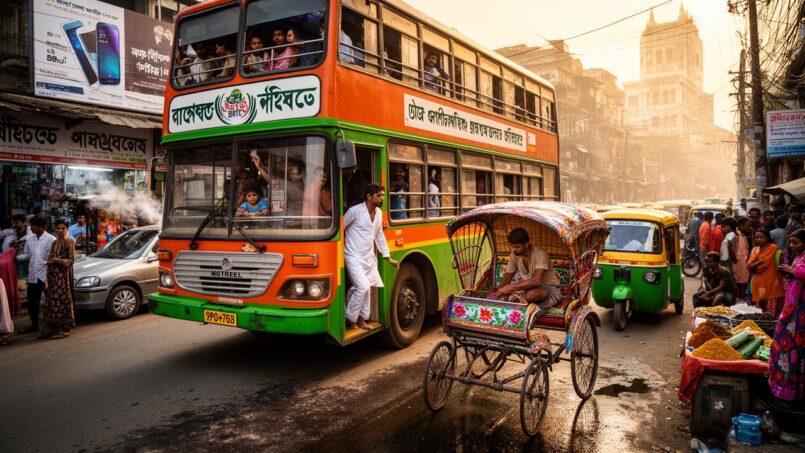
Taking public transportation in Bangladesh means diving into the heart of the country: crowded streets, packed buses, rickety but efficient trains, ubiquitous rickshaws, ferries on massive rivers, and now an ultra-modern elevated metro in Dhaka. The system is dense, often chaotic, sometimes confusing, but it allows you to get almost anywhere at a very low cost.
Good to know:
This practical guide is based on academic studies, official data, and field feedback. It offers a clear overview for foreign travelers, expats, and Bangladeshis looking to optimize their travel, taking into account issues of safety, accessibility, and social inequality.
Understanding Bangladesh’s transport landscape
Bangladesh relies almost entirely on roads to move people and goods. Urban and intercity buses, as well as millions of rickshaws, CNGs (gas-powered auto-rickshaws), motorcycles, and informal vehicles create extremely dense traffic. Three main axes structure the system: road, rail, and waterways, supplemented by a few domestic airlines and a nascent metro in Dhaka.
Attention:
Nationally, road transport is the dominant mode for passengers and freight, far ahead of rail and boats. This imbalance, combined with an explosion in the number of vehicles (especially motorcycles and informal electric rickshaws), worsens congestion, air pollution, and road safety.
The capital, Dhaka, concentrates these tensions. People get around by bus, rickshaw, CNG, taxi, private car, motorcycle, and now also by elevated metro (MRT Line 6). The average vehicle speed there barely exceeds a brisk walk, around 4.8 km/h, making it one of the most congested cities in the world. In this context, knowing your transport options and their limits is essential.
Urban buses: the backbone, but chaotic
Buses remain the pillar of urban public transport, especially in Dhaka. Studies estimate that about 47% of daily trips in the metropolis are made by bus, compared to 14% by car. The numbers illustrate the scale: over 10 million people use local buses in the metropolitan area each day, on more than 300 often overlapping routes.
How do buses work in Dhaka?
The network is dominated by private operators, very numerous, with fleets of uneven quality. The public company BRTC (Bangladesh Road Transport Corporation) accounts for only a minority of buses in operation, even though it manages over a thousand vehicles nationwide.
Private companies operate routes with various names – Achim Paribahan, Bihanga, Balaka, Green Dhaka, Dhakar Chaka, etc. – connecting major hubs: Motijheel, Gulistan, Farmgate, Mohakhali, Mirpur, Uttara, Jatrabari, Gazipur, and many outlying neighborhoods. There is no simple, official map covering the entire network, but platforms like KoyJabo or some local apps allow you to find routes and connections.
15-80
The price range in taka for an intra-city bus ride in Dhaka, varying by distance and vehicle type.
A quick overview of price ranges in the city helps you get your bearings:
| Type of service | Typical fare range in city (Dhaka) |
|---|---|
| Non-AC urban bus | 15–40 BDT |
| “Semi-sitting” urban bus | 20–60 BDT |
| Air-conditioned urban bus (AC) | 30–80 BDT |
In practice, you pay in cash to the conductor or driver, when boarding or during the trip. Queue culture is quite weak: boarding often requires squeezing through the crowd, especially during peak hours.
Quality of service and safety
Urban buses are described by many studies as disorganized, poorly maintained, often overcrowded, and unsafe. There aren’t enough vehicles to absorb demand, leading to vehicles that are packed to the point of becoming dangerous.
Regularly reported problems include:
Attention:
Vehicles often operate without up-to-date technical inspections. Driving is aggressive, with competition between rival buses to pick up passengers, leading to sudden stops and starts, sometimes while passengers are boarding or alighting. There is an almost total lack of facilities for people with reduced mobility. Finally, sexual harassment, especially against women in crowded buses, is a recurring problem.
Authorities have tried several times to reform this sector, for example by introducing a minimum wage for drivers or electronic ticketing, but these efforts have so far changed little in daily reality.
Who are urban buses suitable for?
They are best for:
– people on a very tight budget;
– regulars who know the routes, stops, and unwritten rules;
– those who aren’t afraid to travel standing in a crowd.
They are less suitable for:
– elderly people, people with disabilities, or people with young children;
– those seeking a high level of safety and comfort;
– unaccompanied foreign travelers who don’t speak Bengali, especially at night.
For a foreign visitor, it is often more reasonable to use urban buses in a limited way, on simple stretches, possibly accompanied by a local, and to prefer the metro, rickshaw, CNG, or taxis for more complex journeys.
Intercity buses: dense network and very cheap
To travel from one city to another, intercity buses (intercity or inter-district) are ubiquitous and very frequent. Most routes converge on Dhaka, a true national hub. To connect two provincial cities, you often have to go through the capital or find the rare direct lines.
Bus types and comfort
There are three main categories:
– non-air-conditioned buses, the most basic, but also the cheapest;
– air-conditioned (AC) buses, coach type, more comfortable, often with reclining seats;
– “luxury” or “executive” services, with more space, sometimes snacks and screens.
Major private companies, like Hanif Enterprise, Green Line, Shyamoli, Sakura, or some BRTC lines, cover most major destinations. Prices remain very affordable:
| Route (from Dhaka) | Non-AC fare (approx.) | AC fare (approx.) |
|---|---|---|
| Dhaka – Chittagong | 550–1150 BDT | 900–2200 BDT |
| Dhaka – Cox’s Bazar | 900–1100 BDT | 1200–2400 BDT |
| Dhaka – Sylhet | 550–590 BDT | 1200–1400 BDT |
| Dhaka – Rajshahi | 650–750 BDT | 900–1200 BDT |
| Dhaka – Khulna | 550–700 BDT | 800–1400 BDT |
| Dhaka – Barishal | ~600 BDT | 800–1200 BDT |
Travel time is extremely variable due to traffic, road conditions, and frequent stops. For any intercity trip, it’s wise to allow the whole day, even if the distance on the map seems modest.
Where to buy tickets and how to book
“Bus stations” are often large intersections or market areas, rather than traditional closed terminals. In Dhaka, the three main hubs are generally Gabtoli, Mohakhali, and Saidabad, along with areas like Sayedabad, Kalyanpur, or stations near the Padma Bridge for connections to the southwest.
You can:
– buy directly on site, sometimes on the same day;
– go to company offices the day before, to secure a seat;
– use online booking platforms like Shohoz, bdtickets.com, or busbd.com.bd, which allow you to compare schedules, fares, bus types, and choose your seat.
Depending on the platform, payments are made by bank card (Visa, Mastercard, local cards), mobile money services (bKash, Nagad, Rocket, Upay, etc.), or even cash on delivery of the ticket.
Tip:
After transaction validation, you will generally receive an SMS and/or email with your e-ticket. In most cases, just show this SMS at the company counter on departure day to get your paper ticket or board directly.
Regulated fares on certain routes
On some routes, especially those crossing the Padma Bridge, the Road Transport Authority (BRTA) has set official fares after reviewing tolls. Some of these fares give an idea of the order of magnitude:
| Route (from Dhaka) | Fare set by BRTA (per passenger) |
|---|---|
| Dhaka – Bhanga – Madaripur – Barisal | ~412 BDT |
| Dhaka – Gopalganj – Khulna | ~649 BDT |
| Dhaka – Barisal – Patuakhali | ~502 BDT |
| Dhaka – Madaripur – Barisal – Patuakhali – Kuakata | ~698 BDT |
| Dhaka – Bhanga – Faridpur | ~288 BDT |
These “official” fares are a useful reference for spotting possible price gouging.
Practical tips for intercity buses
To minimize risks and improve comfort:
– choose air-conditioned buses from well-established operators, especially for long trips;
– avoid night travel as much as possible, more risky in terms of accidents and personal safety;
– book a few days in advance during religious holidays (Eid, Puja), when demand skyrockets;
– ask for a seat in the middle of the bus rather than at the back, which is bumpier when braking or hitting potholes.
Rail: an old but essential network
Trains offer an often safer and more comfortable alternative to buses for long distances, even though the infrastructure suffers from chronic underinvestment. The network, largely inherited from the colonial era, stretches over 3,000 km and serves about 43 of the country’s 64 districts, via some 500 stations.
Bangladesh Railway in practice
Bangladesh Railway, the national operator, manages both passenger and freight trains. Its services include:
– intercity trains connecting Dhaka to Chittagong, Sylhet, Rajshahi, Khulna, Rangpur, etc.;
– suburban trains between Dhaka and Narayanganj, Gazipur, Tangail, Bhanga;
– a few international links with India (Maitree Express, Mitali Express, Bandhan Express).
Kamalapur, in Dhaka, is the main central station, from which most long-distance trains depart. Services are generally cheap and, despite frequent delays, appreciated by travelers for the scenic and relatively restful experience compared to the road.
Travel classes
An overview of the typical travel classes offered by airlines and railways, to help you choose the one that best suits your comfort and budget.
Economy
The standard class, offering basic comfort for a low fare. Ideal for short trips or budget-conscious travelers.
Premium Economy
A compromise between comfort and price, with more legroom, improved services, and often included checked baggage.
Business
Designed for professional travelers, offering wider seats, lounge access, fine dining, and priority boarding.
First
The ultimate travel experience, with private suites, premium service, gourmet cuisine, and exceptional comfort.
| Class | Description | Price range (examples) |
|---|---|---|
| Shovon | Economy class, simple benches | from ~40 BDT for short trips |
| Shovon Chair | Individual seat, non-AC | cheaper than AC classes |
| Snigdha | AC car, reclining seats | ~600 BDT depending on route |
| AC Chair | AC seat, superior comfort | ~700 BDT and up |
| AC Berth | AC sleeper for overnight trips | ~1,100 BDT and up |
Ticketing: digital and counters
For booking, several options coexist:
– go directly to the station ticket counter (especially Kamalapur) to buy a paper ticket, with or without seat reservation;
– use the official Bangladesh Railway online ticketing (eticket.railway.gov.bd) after registering;
– use the official Rail Sheba app, available on Android and iOS.
Online registration requires a Bangladeshi phone number and an ID (national ID card number, passport, or birth certificate). After selecting departure and arrival stations, date, and class, the user pays via bank card or mobile payment services. The e-ticket is sent by SMS and/or email and can be shown on a smartphone, along with an ID.
Good to know:
Tickets can generally be booked up to about ten days in advance, which is strongly recommended before busy periods. Discounts exist for students, seniors (60 and over), and groups, but some must be requested directly at counters.
Advantages and limitations of trains
Strengths:
– very competitive fares, sometimes lower than buses for long distances;
– generally lower accident risk than on the road;
– possibility of traveling overnight by sleeper (AC Berth) to optimize time;
– opportunity to enjoy the scenery, especially toward Sylhet or the coast.
Limitations:
– frequent delays, sometimes significant;
– incomplete network (several districts not served, sometimes indirect routes);
– comfort varies greatly depending on the train and class;
– poor accessibility for people with reduced mobility, despite some occasional improvements.
For a cautious traveler, the train is often preferable for long distances over night buses, provided you plan ahead for tickets and schedules.
Dhaka Metro: the new face of mass transit
The Dhaka Metro Rail represents the major innovation in Bangladeshi transport. It marks the first true modern mass transit infrastructure in the country. For now, only one line is operational, MRT Line 6, but several others are under construction.
MRT Line 6: what you need to know
Line 6 is an entirely elevated line that crosses Dhaka from north to south for just over 20 km. It connects the Uttara area in the north to Motijheel in the heart of the business district, passing through major hubs like Agargaon, Farmgate, Shahbag, or Secretariat.
Key practical features:
16
The Dhaka metro will have about 16 stations, all elevated, to serve the city.
Stations are modern, with turnstiles, platform screen doors, cameras, baggage scanners, and especially more advanced accessibility features than the rest of the transport system: elevators, ramps, tactile guidance, braille buttons, accessible restrooms.
A car at the front of the train is reserved for women and children, a significant improvement in a country where harassment in transport is widely documented. Dedicated metro police patrol on board and in stations.
In practice, the metro is considered: a fast and efficient means of transportation in major cities.
– fast;
– reliable;
– relatively cheap;
– safe and comfortable, especially compared to urban buses.
Example:
The Dhaka metro currently has limited coverage, with only one line in service. This line serves only part of the city and does not offer direct connections to the airport or all major bus terminals. However, it is within walking distance of some important hubs, such as Gulistan/Arambagh and Dhaka railway station.
Payment cards: MRT Pass and Rapid Pass
The ticketing system relies on two types of smart cards:
– the MRT Pass, dedicated to the metro;
– the Rapid Pass, designed as an integrated system for multiple transport types (BRTC buses, some river routes, railways, BRT, etc.).
The Rapid Pass is a rechargeable NFC card, sold for about 400 BDT, with 200 BDT preloaded. It can be purchased and topped up at partner bank branches, several sales points in Dhaka (Gulshan-2, Banani, Shahbag, Motijheel, Rampura, etc.), and metro ticket machines.
Authorities have announced plans to gradually mandate the Rapid Pass for all transport modes in the capital, but implementation is still partial, and the card remains underused relative to its potential. For a frequent metro and BRTC bus user, however, it is very convenient: fewer queues, 10% discount on some trips, simplified transport expense tracking.
Rickshaws, CNGs, taxis, and ride-hailing: navigating micro-mobility
Complementing buses and trains, a galaxy of small transport modes fills the network’s gaps: pedal rickshaws, CNGs (gas auto-rickshaws), classic taxis, and app-based services (Uber, Pathao, etc.). In Dhaka, you see them on every street corner.
Rickshaws: Dhaka’s icon
Dhaka is often described as “the world capital of rickshaws”. These decorated pedal tricycles, ubiquitous, handle the majority of short trips in dense neighborhoods. According to some studies from the early 2010s, they account for more than half of all motorized or non-motorized trips in the city.
Their advantages:
– very low price for short distances;
– good ability to navigate narrow and congested alleys;
– a typical mode of transport, deeply rooted in local culture.
Their limitations:
– total lack of protection in case of accident;
– sometimes long travel time when traffic is very dense;
– systematic price negotiation, no meter.
For people in wheelchairs, rickshaws are almost never adapted. Some rickshaw pullers even refuse wheelchair users, or ask for a surcharge to load/unload the chair, aggravating exclusion.
CNG (auto-rickshaws): speed/price compromise
CNGs are motorized three-wheelers powered by compressed natural gas, very common in big cities. They allow longer or faster trips than rickshaws at a still reasonable fare.
Good to know:
It’s important to keep in mind the key points mentioned in the content. Make sure you understand and integrate these points for a complete understanding of the topic.
– vehicles are officially equipped with meters, but many drivers refuse to use them and prefer to negotiate a flat fare;
– typical fares in Dhaka remain modest for an urban trip, often in the 50–200 BDT range;
– safety and comfort are average: open vehicle, no seatbelts.
To avoid scams, it’s advisable to state your destination, propose a fare based on a realistic estimate (or on the Uber/Pathao fare for a similar trip), and refuse if the demand is clearly excessive.
Taxis and cars with drivers
“Classic” taxis exist, especially in Dhaka and Chittagong, as black or yellow vehicles. Yellow ones are newer, often air-conditioned, and more expensive. In theory, they have meters, but negotiating the price before getting in is still common practice.
Tip:
For foreigners or business stays, renting a car with a driver through local agencies or international chains (like Europcar or Hertz) is often recommended by hotels and companies. Although more expensive, this option offers a significantly higher level of safety, flexibility, and comfort, especially suitable for frequent trips or urban outskirts.
Ride-hailing: Uber, Pathao, and others
Ride-hailing and motorcycle taxi services have quickly established themselves in major cities. Uber is present in many cities, including Dhaka, Chittagong, Cox’s Bazar, Sylhet, and offers multiple services (UberX, Uber Moto, Uber CNG, etc.). Pathao, a local player, also offers motorcycle and car rides, as well as delivery services.
Advantages:
– geolocation, fare estimate in advance, ability to track the trip;
– less direct negotiation with the driver;
– generally more transparency and safety than informal taxis or CNGs.
Drawbacks:
– almost exclusively cash payment in local practice, despite digital options in the apps;
– market saturation, especially for motorcycles, with fierce competition and sometimes unstable incomes for drivers;
– surge pricing sometimes seen as abusive, which has led authorities to regulate prices.
For a visitor, Uber or Pathao are nevertheless excellent options for getting around the city: the interface is familiar, trip tracking is reassuring, and fares remain very competitive compared to Western standards.
Water transport: ferries, launches, and “Rocket Steamer”
A land of rivers, Bangladesh historically developed around its waterways. Although the share of passengers carried by boats has declined (from 16% in 1975 to about 8% in the mid-2000s), ferries remain essential, especially for the south and southwest.
Ferries and “launches”
Large passenger boats, locally called “launches”, connect Dhaka to cities like Barisal, Bhola, Patuakhali, or Khulna. For a long time, they were the main access route to these regions, before road improvements and the opening of the Padma Bridge, which significantly reduced travel time by road.
Good to know:
Today, launches have lost much of their practical appeal compared to buses, which are often faster and cheaper. However, ferries remain essential for crossing certain large rivers, especially thanks to their roll-on/roll-off services on key routes.
The “Rocket Steamer” experience
Among the iconic experiences, the “Rocket Steamer” – a historic paddle steamer – connects Dhaka to Khulna via Barisal in about 26 to 30 hours. It’s less a fast way to travel than a cultural and tourist voyage, much appreciated by those who enjoy slow travel and river landscapes.
Air travel: useful but not structural for domestic travel
The country has three international airports and several domestic airports. Hazrat Shahjalal International Airport in Dhaka handles nearly all air traffic, with all domestic routes connecting Dhaka to other major cities (Chittagong, Sylhet, Cox’s Bazar, etc.). There are no direct flights between two provincial cities.
50
The average price in dollars for a one-way domestic flight in Bangladesh, such as on the Dhaka – Cox’s Bazar or Dhaka – Sylhet routes.
For a traveler in a hurry needing to cover long distances in a short time, air travel is useful, but the mobility of the population relies mainly on land and water transport.
Safety, harassment, and vulnerabilities: what studies say
A central aspect, often downplayed in purely practical guides, concerns safety and unequal access, particularly for women, the elderly, and people with disabilities.
Harassment and violence in transport
Studies conducted by NGOs and official bodies reveal a worrying reality: more than eight out of ten women report having experienced sexual harassment on public transport. Assaults range from comments and unwanted touching to more serious violence, sometimes committed by transport staff.
Crowded buses are particularly implicated, as well as some trains. An official report notes that a significant share of gender-based violence in public spaces occurs on transport or near stations and stops.
Field recommendations for women include:
Tip:
To travel safely, it is recommended to avoid traveling alone at night. Favor women-only compartments or cars when available, such as dedicated metro cars. Sit near other women or families when possible. Keep emergency numbers (like 999) handy and consider using local safety apps. If an incident occurs, report it immediately to the driver, other passengers, or, if possible, to authorities.
Elderly and disabled people: silent exclusion
Research conducted in Dhaka, particularly in neighborhoods like Lalbagh and Rayer Bazar, highlights the extent of exclusion of the elderly from public transport. The main problems identified are:
Attention:
Elderly people face serious difficulties in public transport, including boarding overcrowded buses that don’t stop completely, some drivers refusing to stop at requested stops, lack of adapted infrastructure such as ramps or walkable sidewalks near stations, and vehicles (buses, rickshaws, CNGs) not equipped to accommodate a wheelchair.
For people in wheelchairs or with severely reduced mobility, the situation is even more critical. Despite the existence of laws mandating reserved seats (5% for disabled people, 30% for women, children, and disabled people combined) and ministerial circulars on accessibility of ports or buildings, actual facilities remain rare.
The Dhaka Metro Rail is an exception, equipped with elevators and more comprehensive accessibility features, making it, for now, the only truly usable public transport for many people with reduced mobility – at the cost of its limited geographical coverage.
Laws, policies, and initiatives: toward a more inclusive system?
Bangladesh has ratified the United Nations Convention on the Rights of Persons with Disabilities and adopted specific laws governing their rights and protection. These texts notably provide for quotas of reserved seats in transport and accessibility features in public buildings.
Example:
In Bangladesh’s transport sector, several stakeholders collaborate to improve accessibility. Ministries, BRTA, port authorities, municipal corporations, and NGOs such as BRAC or B-SCAN are involved. Projects supported by the World Bank have led to concrete achievements: renovation of sidewalks and intersections, development of strategic visions for better accessibility, and reflections on deploying adapted buses equipped with ramps and dedicated wheelchair spaces.
Progress, however, remains fragmented. Studies highlight a gap between policy and implementation: poorly designed or absent ramps, sidewalks cluttered with waste and street vendors, lack of training for drivers and conductors in handling vulnerable passengers, persistent discriminatory behavior.
For now, it is mainly a few targeted initiatives (accessible metro, pilot inclusive bus projects, integration of the Rapid Pass across multiple modes) that outline the contours of a more inclusive future. The majority of the system remains difficult to use for the elderly, women alone at night, and a large part of people with disabilities.
Culture, practices, and social codes in transport
Beyond the technical aspects, understanding transport in Bangladesh also means integrating local social codes. Society is hierarchical, conservative, and very attentive to respect for elders and status.
In transport, this translates to: collective transport, adapted infrastructure, and reduction of carbon emissions.
Good to know:
In transport and queues, jostling is generally accepted, though priority to the elderly is valued. There is some gender separation in certain spaces (like reserved lines) and limited greetings between men and women. On the other hand, close physical proximity, without romantic connotation, is common between people of the same sex.
Foreigners, often highly visible, may be the object of persistent stares without it being necessarily hostile. Nevertheless, it is advisable:
– to stay calm, not to raise your voice even in tense situations;
– to avoid gestures perceived as rude (showing the soles of your feet, pointing, giving a thumbs up, etc.);
– to dress modestly, especially for women (shoulders and legs covered);
– to be polite when boarding a bus or train (greet, thank).
What future for Bangladeshi public transport?
Bangladesh is at a turning point. On one hand, a heavily road-based, saturated system with a strong informal component (rickshaws, CNGs, motorcycles, disorganized private buses); on the other, the emergence of modern mass infrastructure (metro, future BRT), integrated payment systems (Rapid Pass), and powerful digital tools (booking apps, information platforms like KoyJabo).
Good to know:
Plans for Dhaka include a dense network of five metro lines and several BRT (Bus Rapid Transit) lines. These heavy transport modes, each capable of carrying tens of thousands of passengers per hour per direction, will form the backbone of the system. Regular buses and informal transport modes will be reorganized to feed into these main axes.
The success of this transition will depend not only on building rails or viaducts, but also on:
Attention:
To be effective, transport modernization must integrate informal modes into a network logic, improve the safety and quality of existing services, design accessible infrastructure meeting the needs of women, the elderly, and disabled people, and generalize the use of reliable digital tools like the Rapid Pass.
For today’s user, the key is to know your options, their strengths and risks, and navigate this mosaic of modes. By combining metro for main routes, trains for long distances, buses for intermediate trips, rickshaws/CNGs for the last mile, and possibly ride-hailing for more comfort and predictability, it is possible to get around efficiently in a country where mobility is both a daily challenge and a key component of social life.

Cyril Jarnias is an independent expert in international wealth management with over 20 years of experience. As an expatriate himself, he is dedicated to helping individuals and business leaders build, protect, and pass on their wealth with complete peace of mind.
On his website, cyriljarnias.com, he shares his expertise on international real estate, offshore company formation, and expatriation.
Thanks to his expertise, he offers sound advice to optimize his clients' wealth management. Cyril Jarnias is also recognized for his appearances in many prestigious media outlets such as BFM Business, les Français de l’étranger, Le Figaro, Les Echos, and Mieux vivre votre argent, where he shares his knowledge and know-how in wealth management.





