
 Published on and written by Cyril Jarnias
At first glance, St. Kitts and Nevis conjures images of white-sand beaches, turquoise waters, and Caribbean cruises. But behind the postcard scenery, the small federation has built a dense and structured education system, with a literacy rate over 90% and free, compulsory schooling from ages 5 to 16. For expatriate families and local parents seeking a more international education, the offering is increasingly structured around a few key institutions, some of which compete with the big names in private education abroad.
Three institutions stand out: the St. Kitts International Academy on the island of St. Kitts, and the Montessori Academy Nevis as well as the Nevis International Secondary School on the island of Nevis. The educational offering is complemented by a network of private and public schools and universities, particularly medical ones, forming a continuum from early childhood to higher education.
This report provides an in-depth overview of these international schools, their programs, their fees, and their respective strengths, placed within the very particular context of the St. Kitts and Nevis education system.
An Already Very Solid Local Educational Framework
To understand the special place of international schools, one must first keep in mind the robustness of the local public system. Education is free and compulsory for twelve years, from age 5 to 16. Children start primary school at age 5, for seven years of instruction, then enter secondary school for five years starting at age 12. The country was, in fact, the first in the Commonwealth Caribbean to introduce free secondary education.
The state not only funds tuition but also provides transportation, textbooks, and daily lunch in primary schools. Schools are generally equipped with libraries, computer rooms, and reading support programs. The end of secondary school is validated by the Caribbean Examinations Council (CXC) exams, which form the basis for certifications across the entire Caribbean region.
In this context, private and international schools do not fill a void but offer an alternative to families seeking:
Discover the main strengths of higher education institutions in Morocco for international and local students.
Curricula aligned with North American or British systems, facilitating mobility and academic understanding.
Degrees more easily recognized in Canada, the United States, or Europe, enhancing your international profile.
Smaller classes and more individualized teaching for tailored support for each student.
A strongly international environment, fostering cultural exchange and a global professional network.
The authorities strictly regulate the entire sector, public and private alike. The Education Act defines several categories of schools (public, private, grant-aided private institutions, faith-based schools) and imposes identical standards regarding hygiene, teacher training, and teaching quality. Private institutions must obtain a permit, undergo inspections, and can lose their authorization for non-compliance with rules. In other words, even the most “international” schools remain subject to a strong local regulatory net.
St. Kitts International Academy: The International Benchmark on St. Kitts
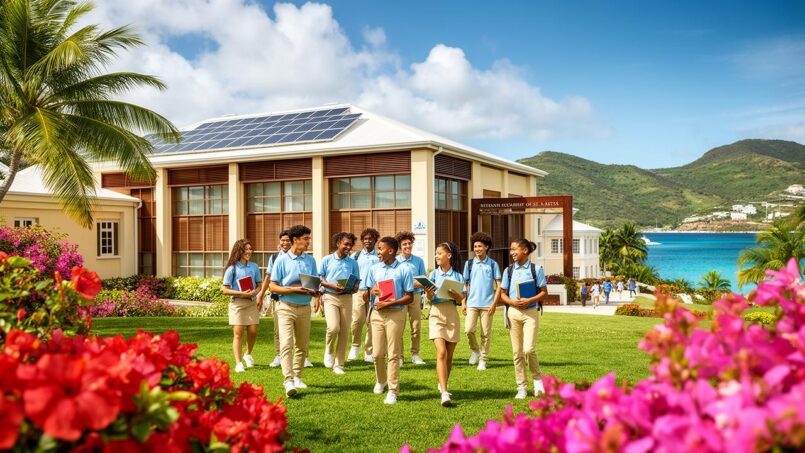
If only one institution had to be named to illustrate the best international schools in St. Kitts and Nevis, the St. Kitts International Academy (often abbreviated as SKI Academy) would top the list. Founded in 2000 and located in Morgan Heights, in the Canada Estates area on St. Kitts, the school has become in a few years the flagship of international education in the federation.
A Comprehensive Campus from Preschool to High School
St. Kitts International Academy covers the entire school cycle, from preschool (Pre-Kindergarten) to 12th grade. It welcomes children from around age four and accompanies them to the gates of university, in an environment designed to foster both academic learning and personal development.
The campus spans approximately four acres and has facilities rarely seen on an island of this size: an in-ground swimming pool, a multi-purpose basketball court, a tennis court, and a large sports field. Classes are intentionally small, allowing for individualized follow-up and strengthening the relationship between students and teachers. The school day continues, for those who wish, with an after-school activities program from 3:45 PM to 4:45 PM.
For families considering a visit or preliminary contact, the school can be reached by phone at +869 466 1026 and by email at [email protected].
An International Pedagogy Anchored in Caribbean Reality
What distinguishes St. Kitts International Academy is not only its campus but first and foremost its educational project. The school promotes an “international liberal arts curriculum,” adapted to a very diverse student body and explicitly oriented towards global openness. In practice, the elementary and middle school programs are built upon international standards inspired by the best global educational practices.
Learning frameworks are designed to be comparable to those in the United States and Canada, ensuring continuity for students transferring to a North American institution. At the same time, programs incorporate a local dimension, including Caribbean history, regional culture, and the study of the island environment.
In high school, SKI Academy makes a strong strategic choice: instead of limiting itself to the classic Caribbean curriculum (CXC), the institution offers a program leading to an Ontario Secondary Schools Diploma, an official diploma from Ontario, Canada. Some pathways also grant access to a US Diploma. In practice, a student can thus graduate from SKI Academy with a certification directly recognized by Canadian and North American universities, without lengthy equivalence procedures.
This international orientation is paired with a very dynamic student life. Starting in Grade 4, students can participate in the Student Council, a real laboratory for citizenship where they learn about student representation and collective decision-making. The school has even created its own news show, “Eye on SKI,” a television news program produced by the students themselves, developing media skills, critical thinking, and teamwork abilities.
Services Designed for Family Daily Life
Beyond classes, SKI Academy plays the “all-in-one” card to simplify parents’ daily lives. School supplies – textbooks, notebooks, basic materials – are included in tuition fees, avoiding multiple back-to-school purchases. The school also offers a hot meal service, charged at 15 EC$ per day, coordinated by a dedicated manager (registration by email at [email protected]). The uniform is standardized, with shirts to be purchased from the supplier Sun Island Clothes.
An after-school activities program is organized Monday through Thursday. It costs 250 EC$ per semester per chosen day of participation. It offers sports, arts, academic support, or thematic clubs to round out the day. These activities are part of an international logic where extracurriculars are increasingly important in university admission portfolios.
Administratively, the school relies on modern procedures: no cash payments, but settlement by check, billing to a student account, or deposit into the school’s bank account (at the National Bank). This rigor extends to collection: in case of unpaid fees exceeding three months, the student may be suspended, report cards withheld, and the file referred to a legal service.
Tuition Fees: A Targeted Investment
As everywhere in the world, quality international schools represent a significant financial investment, especially relative to the local standard of living. SKI Academy is no exception but offers a transparent fee structure differentiated between local and expatriate families.
Available data shows several fee schedules, depending on the year and updates. However, some clear trends can be identified.
Example of Annual Fee Range (2021/22 school year)
| School Level | Annual Fees (EC$) | Approximate Equivalent (US$) |
|---|---|---|
| Lower Level (e.g., elementary) | 17,145 | ~ 6,350 |
| Upper Level (e.g., high school) | 20,690 | ~ 7,650 |
Differentiated Fees for Local and Expatriate Families
The school applies distinct rates depending on whether the student and at least one parent hold a St. Kitts and Nevis passport. Holders of passports from other CARICOM countries are not considered “local” under this policy.
A recent schedule indicates the following amounts for a school year:
| Family Category | Level | Annual Fees (EC$) – scenario 1 | Annual Fees (EC$) – scenario 2 |
|---|---|---|---|
| Local | PreK – Grade 4 | 12,285 to 14,130 | 14,130 |
| Local | Grades 5–8 | 13,500 to 15,525 | 15,525 |
| Local | Grades 9–10 | 15,570 to 18,000 | 18,000 |
| Local | Grades 11–12 | 16,310 to 19,000 | 19,000 |
| Expatriate | PreK/Kind. – Gr. 4 | 15,120 to 17,400 | 17,400 |
| Expatriate | Grades 5–8 | 17,145 to 19,750 | 19,750 |
| Expatriate | Grades 9–10 | 19,750 to 23,000 | 23,000 |
| Expatriate | Grades 11–12 | 20,690 to 24,000 | 24,000 |
In addition to these amounts:
– A non-refundable application fee of 200 EC$ for the file,
– An annual re-registration fee of 200 EC$ to secure a place for the following year,
– Late payment penalties of 100 EC$ per month for missed deadlines.
The school offers a 10% discount on the fees of the youngest child for siblings, but this commercial gesture does not apply to students in the high school program leading to the Ontarian diploma.
Tuition fees for expatriate families are often lower than those at equivalent schools in metropolises like London, New York, or Singapore.
A Structured Yet Accessible Admission Process
On paper, admission to St. Kitts International Academy aims to be “simple and transparent,” which, in the sometimes opaque world of international schools, is no small detail. Families can submit an application online at any time of the year; admissions are rolling, subject to available spaces. However, it is highly recommended to aim for an entry at the start of a semester, usually in September or February.
For PreK and Kindergarten levels, where demand is particularly high, the school recommends submitting applications as early as possible. The further away from the start of the school year, the lower the chances of obtaining the desired class. Furthermore, access to high school is notoriously more difficult for students who have not followed the in-house middle school track.
The required documents reflect academic rigor and the concern for understanding the student’s profile:
| Required Document |
|---|
| Copy of birth certificate |
| Previous school records / report cards |
| Letter of recommendation from a teacher or school administrator |
| Completed medical form |
| Vaccination record and details of treatments (inhalers, EpiPen, etc.) |
| Any official reports (dyslexia, ADHD, autism, special needs) |
| Other documents as requested by the admissions office |
| Payment of the application fee (200 EC$) |
Depending on the level and profile of the student, an interview or entrance test may be scheduled. Once a decision is made, families finalize enrollment by paying the fees and signing the commitment documents.
For expatriate parents, an additional element to anticipate is obtaining a student visa for the children, when necessary. The Ministry of National Security manages these requests, based on the letter of acceptance provided by the school. Obtaining a student visa involves preparing a relatively heavy file (proof of resources, medical certificate, clean criminal record, etc.), but local institutions are accustomed to assisting families with these procedures.
Montessori Academy Nevis: The Montessori Alternative on the Sister Island
Facing St. Kitts, the island of Nevis cultivates a more discreet, almost village-like atmosphere. Yet, it too hosts institutions oriented towards the international community, one of the most notable being Montessori Academy Nevis, located on Pump Road in Charlestown.
A Clear Pedagogical Choice: The Montessori Method
As its name suggests, Montessori Academy Nevis is distinguished less by an “international” label in the administrative sense than by a very specific pedagogical philosophy. The school applies the Montessori method for the elementary level, placing the child at the center of the approach.
The method is based on respect for each student’s individual pace, learning through the concrete manipulation of objects, and the development of autonomy. It aims to reveal the child’s talents, gifts, and personality in a stimulating environment that encourages exploration and progressive responsibility.
This approach contrasts with the more classic structure of public schools or even some local private schools. For parents familiar with the Montessori model or seeking a more individualized pedagogy, Montessori Academy Nevis represents a particularly attractive option, all the rarer as the Montessori offering remains limited on small islands.
A Marked Linguistic and Cultural Openness
Beyond academic fundamentals, Montessori Academy Nevis emphasizes a strong linguistic and cultural dimension. Children take courses in French and Spanish, two languages very present in the Caribbean region and useful for international pathways. Music also holds an important place, contributing to the students’ overall development.
The school also offers games and team sports, which helps balance the great freedom granted in the classroom with structured activities focused on cooperation and community living.
More Contained Tuition Fees
In terms of budget, Montessori Academy Nevis is at a significantly lower level than SKI Academy, while remaining a fee-paying private institution. For the 2021/22 school year, tuition fees were around 10,050 EC$, or approximately 3,710 US$ per school year. The value for money is particularly interesting for local or expatriate families seeking Montessori pedagogy without reaching the higher amounts of major international schools.
The institution’s contact details are as follows:
| School | Location | Telephone | Annual Fees (approx.) | |
|---|---|---|---|---|
| Montessori Academy Nevis | Pump Road, Charlestown, Nevis | +1 869 469 1074 | [email protected] | 10,050 EC$ |
Again, this is a private school under national law, subject to health standards, teacher qualifications, and inspection like other non-public institutions.
Nevis International Secondary School: The Only Private High School on Nevis
Still on the island of Nevis, Nevis International Secondary School (NISS) holds a unique place. Housed in the former St John’s building in Brown Pasture (St. John’s Parish), the institution is described as the only private high school on the island. It welcomes teenagers from 11 to 17 years old and positions itself as a bridge between the national curriculum and students’ international ambitions.
A Balance Between National Program and Caribbean Requirements
The pedagogical structure of NISS is clearly divided between “junior” and “senior” classes:
– In junior classes (equivalent to the first years of secondary school), students follow the official program of the federal government of St. Kitts and Nevis. This guarantees perfect compatibility with the national system, whether for a potential return to the public sector or for access to regional exams.
For Forms 3, 4, and 5, the school uses an enriched curriculum based on the Caribbean Examination Council (CXC) frameworks, thus preparing students for the end-of-secondary exams recognized throughout the Caribbean. Furthermore, in Forms 4 and 5, specific arrangements are made for SAT preparation, the standardized tests required for admission to many American universities.
This dual orientation – national anchoring and openness to Caribbean and North American standards – makes Nevis International Secondary School an attractive compromise for families considering both a regional university future and further studies abroad.
An International School on a Human Scale
With a student population limited to the 11-17 year old range, NISS remains a human-scale institution where each student can be closely followed. The repeated mention of the “quality” of teaching underscores the desire to stand out through academic seriousness more than through oversized infrastructure.
Available contact details make it an accessible institution, ready to engage with local families as well as expatriates:
| School | Full Address | Telephones | Student Body | |
|---|---|---|---|---|
| Nevis International Secondary School (NISS) | Old St John’s Building, Brown Pasture, St. John’s Parish, Nevis | +1 869 469 7006 / +1 869 766 5070 | [email protected] | 11 – 17 years (secondary) |
Moderate Tuition Fees for a Private Secondary School
In terms of cost, NISS is at a significantly more affordable level than major international high schools in global capitals, reflecting both the island’s size and local purchasing power. For the 2021/22 school year, fees were approximately 3,000 EC$ per term, or about 1,110 US$ per term. For a full year, the total cost depends on the number of billed terms but generally remains well below the amounts charged on St. Kitts for programs leading to North American diplomas.
How Do These Schools Fit into the Federation’s Educational Ecosystem?
The three previous institutions constitute only the tip of the iceberg of a vast education system. St. Kitts and Nevis indeed has dozens of public primary and secondary schools, private schools with a more local focus, as well as a network of nurseries and daycares.
At the primary level, the islands are home to public schools like Christ Church Nichola Town, Beach Allen Primary School, Cayon Primary School, or Charlestown Primary School on Nevis. Several private schools, often faith-based or managed by religious organizations, complete the picture: George Moody Stuart School, Immaculate Conception Catholic School, St. Kitts Seventh‑Day Adventist Primary School, St. Christopher’s Preparatory School, Ross Preparatory School, Maude Crosse Preparatory School, Nevis Academy, etc.
Estimated number of private high schools in the federation of St. Kitts and Nevis.
The state closely oversees these institutions via the Ministry of Education and a Chief Education Officer. For higher education, the 2017 Accreditation Act created a specific body: the St. Kitts and Nevis Accreditation Board (SKNAB). Semi-autonomous, this body registers, accredits, and monitors the quality of post-secondary institutions, whether the Clarence Fitzroy Bryant College (the nerve center of local higher education) or the many offshore medical and veterinary universities that attract students from around the world.
International Schools in a Country Very Open to the World
While the country is small, its educational ecosystem is surprisingly internationalized. Several specialized foreign universities – Windsor University School of Medicine, University of Medicine and Health Sciences, Ross University School of Veterinary Medicine, Medical University of the Americas, Universal Caribbean University School of Medicine, and the International University of the Health Sciences – have chosen to establish themselves in St. Kitts and Nevis. They host cohorts of North American students who live on-site for several years, creating demand for schools suited to the children of their professors and expatriate staff.
In this context, schools like St. Kitts International Academy or Nevis International Secondary School meet a dual need.
St. Kitts and Nevis Schools
– Offer local families the possibility of enrolling their children in curricula that open directly to Canada, the United States, or Europe.
– Provide expatriates with educational continuity compatible with the standards of their home countries.
Tuition fees reduced to less than 4,200 US$ per semester for citizens or residents thanks to an agreement with Southern University in Louisiana.
For students who have attended the country’s best international schools, this articulation between secondary and higher education creates a smooth corridor to regional and North American universities.
The Cost of an International Education: How Much to Budget?
The international schools of St. Kitts and Nevis are, unsurprisingly, in a high price range for local standards but remain generally more affordable than in major global metropolises. In parallel, higher education – particularly at local medical universities – displays costs competitive with the United States, the United Kingdom, or Australia.
Main expense items to plan for a foreign family planning a stay in the federation
Includes enrollment fees, course fees, textbooks, and necessary educational materials.
Cost of rent or hotel, recurring utilities (electricity, water, internet), and possible security deposit.
Mandatory medical coverage, civil liability insurance, and possible travel insurance.
Food budget, public transportation passes, travel expenses, and extracurricular activities.
Fees related to visas, residence permits, certified document translations, and diploma equivalences.
Pocket money, cultural outings, discovery trips, and funds for unplanned expenses.
1. Tuition Fees at International Schools
Based on available figures:
| Institution | Level Covered | Indicative Annual Fees (EC$) | Approximate Equivalent (US$) |
|---|---|---|---|
| St. Kitts International Academy (local/expats, by level) | PreK–Grade 12 | ~ 12,285 to 24,000 | ~ 4,500 to 8,900 |
| Montessori Academy Nevis | Elementary (Montessori method) | ~ 10,050 | ~ 3,710 |
| Nevis International Secondary School | Secondary (11–17 years) | ~ 3,000 per term | ~ 1,110 per term |
To these amounts may be added administrative fees (application, re-enrollment, entrance tests), meals, uniforms, transportation, and extracurricular activities.
2. Cost of Living and Higher Education
For international students in higher education, the estimates are as follows:
| Expense Item | Indicative Range (US$ / year) |
|---|---|
| Tuition Fees (all disciplines, average) | 15,000 to 30,000 |
| Cost of Living (housing, food, transportation) | 18,000 to 24,000 (1,500–2,000 / month) |
| Health Insurance | 500 to 1,000 |
| Student Visa | 100 (administrative fees) |
These figures vary according to the program, lifestyle, and type of accommodation. But they confirm the country’s reputation as a relatively affordable destination for higher education, particularly in medicine, compared to other hotspots of student mobility.
Admissions, Visas, and Administrative Constraints: What You Need to Know
For non-citizen families wishing to settle in St. Kitts and Nevis with school-age children, it is not enough to secure admission to an international school. They must also comply with local immigration rules.
Anyone staying more than 30 days in the federation must have an appropriate visa. For studies, this is a student visa, generally valid for one year (August to July) and renewable. The application is processed by the Secretariat of National Security in Basseterre, based notably on the letter of acceptance provided by the host institution.
The visa application requires numerous administrative, medical, and financial documents. All documents not in English must be accompanied by a sworn translation.
The cost of a student visa is around 150 US$ (or 400 EC$) for an initial application or renewal. Some categories are exempt – holders of an indefinite OECS stamp, spouses of citizens, holders of a CARICOM Skills Certificate, etc. – but most expatriate families must go through this procedure.
Family members (spouse and dependent children) must also obtain a visa to reside on-site. For school-aged children from 5 to 16 at the Clarence Fitzroy Bryant College, specific rates may apply (example: 75 US$ per year). Children under 5 receive a simple visitor stamp on their document.
In practice, the best international schools in St. Kitts and Nevis are accustomed to these procedures and can provide practical advice and sample letters to facilitate applications.
Why These Schools Rank Among the “Best” in the Federation
When making a choice, many criteria come into play for parents: academic quality, environment, diploma recognition, international openness, cost, support, etc. On these various axes, St. Kitts International Academy, Montessori Academy Nevis, and Nevis International Secondary School would, for many observers, check a large number of boxes.
SKI Academy offers a program leading to the Ontario secondary school diploma, rare in the region. NISS combines a national curriculum, preparation for CXC exams, and SAT support for triple compatibility. Montessori Academy Nevis offers an original alternative pedagogical approach appreciated by families.
In terms of infrastructure and school life, SKI Academy stands out as the flagship with its sports facilities (pool, courts, sports field), its clubs, its student council, and its television news. On Nevis, Montessori Academy and NISS focus more on the human scale, proximity, and quality of relationships between teachers, students, and parents.
Diplomas and preparation facilitate access to universities in the Caribbean, North America, and Europe, depending on students’ results and choices. The credibility of these pathways is reinforced by a national accreditation framework (SKNAB, National Qualifications Framework).
Finally, cost-wise, while these schools remain expensive for most local families, they offer expatriates a better value for money than in major urban centers, without sacrificing academic quality or the richness of extracurricular life.
Beyond Schools: A Country Betting on Knowledge
The best international schools in St. Kitts and Nevis are not isolated islands. They are part of a broader educational policy that aims to make the country a training hub, particularly in medicine, in the Caribbean. The government displays the ambition of seeing at least 20% of the population reach the tertiary level, multiplies scholarships (over 30 per year), and strengthens partnerships with foreign universities.
The plan emphasizes classroom renovation, the deployment of Wi-Fi connectivity, and the construction of climate-resilient schools. These investments will ultimately benefit all students, whether enrolled in public or private schools.
In this context, choosing an international school in St. Kitts and Nevis is not only about securing education aligned with global standards. It is also about enrolling one’s children in a country that, despite its modest size, has clearly set its course on education, openness, and quality, from the preschool benches to university lecture halls.
For families, local and expatriate alike, considering a life or study project in this small Caribbean federation, these institutions – and primarily St. Kitts International Academy, Montessori Academy Nevis, and Nevis International Secondary School – constitute solid, structured, and surprisingly well-connected options to the rest of the world.
Disclaimer: The information provided on this website is for informational purposes only and does not constitute financial, legal, or professional advice. We encourage you to consult qualified experts before making any investment, real estate, or expatriation decisions. Although we strive to maintain up-to-date and accurate information, we do not guarantee the completeness, accuracy, or timeliness of the proposed content. As investment and expatriation involve risks, we disclaim any liability for potential losses or damages arising from the use of this site. Your use of this site confirms your acceptance of these terms and your understanding of the associated risks.

Cyril Jarnias is an independent expert in international wealth management with over 20 years of experience. As an expatriate himself, he is dedicated to helping individuals and business leaders build, protect, and pass on their wealth with complete peace of mind.
On his website, cyriljarnias.com, he shares his expertise on international real estate, offshore company formation, and expatriation.
Thanks to his expertise, he offers sound advice to optimize his clients' wealth management. Cyril Jarnias is also recognized for his appearances in many prestigious media outlets such as BFM Business, les Français de l’étranger, Le Figaro, Les Echos, and Mieux vivre votre argent, where he shares his knowledge and know-how in wealth management.





