
 Published on and written by Cyril Jarnias
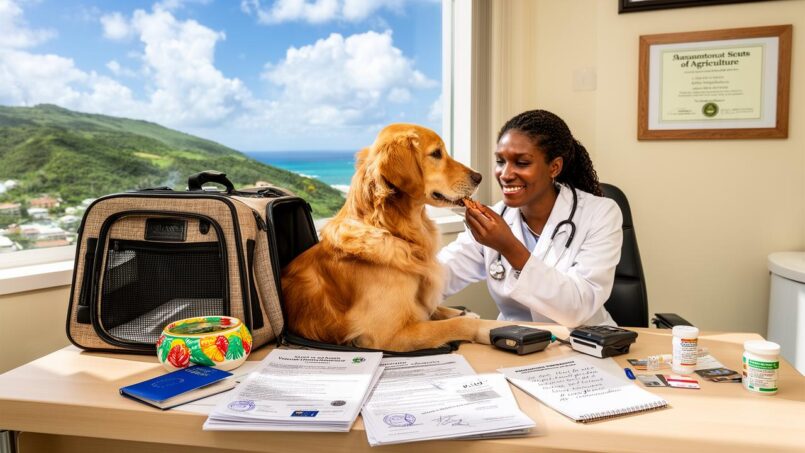
Moving to St. Kitts and Nevis with your dog or cat is not something to be taken lightly. The Federation is officially rabies-free and, as a result, enforces an extremely strict regulation for all animal imports. Between veterinary requirements, administrative permits, travel constraints, and home quarantine, the process can quickly become complex if not planned several months in advance.
This article summarizes in French the official requirements and practical feedback for successfully relocating your pet to St. Kitts and Nevis.
Understanding the context: a rabies-free, highly protective country
St. Kitts and Nevis is classified as a “rabies-free” country. This privileged health status explains the level of precaution required for every dog and cat entering the territory. The slightest flaw in the application can result in entry refusal, immediate return to the country of origin… or even euthanasia in extreme cases as outlined in the regulations.
The local veterinary authorities, led by Dr. Tracey Challenger (CVO), review each animal import application on a case-by-case basis. No procedure is automatic, and a complete application remains subject to explicit validation. All steps must be absolutely finalized in the country of origin before departure, in collaboration with an authorized veterinarian (USDA-accredited for the United States, official veterinarian for other countries).
The importation of very young puppies and kittens is suspended or subject to such strict conditions that, in practice, animals under six months old are very difficult to get accepted. For any animal too young to meet the conditions, it is imperative to contact the St. Kitts and Nevis authorities directly to obtain a written response.
Overview of general rules for dogs and cats
The official rules apply to domestic dogs and cats, including assistance or service animals. Hybrids close to a wild state, such as wolf-dogs, Savannahs, or Bengals, are only potentially admissible from at least five generations of separation from the wild ancestor, and must be discussed case-by-case with the CVO.
Certain dog breeds are banned from entering Australia. For all others, importation requires a strict process: microchip implantation, vaccinations (including rabies), serological tests, parasite treatments, veterinary health certificates, and obtaining an import permit before departure. Upon arrival, all animals undergo an official inspection and home quarantine under close supervision.
Step 1: Microchip identification, the foundation of the entire file
In St. Kitts and Nevis, no procedure can begin before the microchip is implanted. It is what allows the animal to be unambiguously linked to all documents.
The microchip must comply with ISO 11784/11785 standards and have a 15-digit number. Brands like AVID, HomeAgain, or ResQ are accepted. The implantation is performed by a veterinarian, a veterinary hospital, or a trained veterinary nurse, usually subcutaneously at the neck level.
For all procedures (vaccinations, rabies titer, certificates, permit application), it is crucial to use exactly the same microchip number. If an existing chip is not ISO-compliant, it is possible, but more complicated, to provide a compatible reader.
The authorities also require that documentation related to the microchip (manufacturer, registration instructions) be kept and that the number appears perfectly legibly on all official documents. On site, dogs living in St. Kitts and Nevis must even wear this number on a tag attached to their collar, and it is illegal to remove or replace a chip implanted by an official veterinarian without the express authorization of the CVO.
Step 2: Rabies vaccination and “core” vaccines
The rabies vaccination is central to the process. Only inactivated monovalent rabies vaccines (killed) are accepted. Combined or live virus vaccines do not meet the criteria. The authorities consider both annual and three-year vaccines valid, but discourage multi-year injections for an animal’s initial vaccination.
The rabies vaccination must be administered after the microchip is implanted and at least 30 days before entry into the country, while still being valid upon arrival. A vaccine administered to an animal under three months old is not recognized. For animals under one year, a complete schedule requires two injections spaced at least six months apart, the second (most recent) of which must be administered between 30 days and 12 months before arrival.
For adult animals already properly vaccinated, the most recent booster dose must, again, be dated at least 30 days and at most 12 months at the time of entry. In all cases, the following data for the last two rabies vaccinations must appear on the health certificate: commercial name of the vaccine, batch or serial number, expiration date, and route of administration.
In addition to rabies, authorities strongly recommend that dogs and cats be up to date on their “core” vaccines (e.g., DHLPP/DAPP for dogs, FVRCP for cats). A certificate summarizing all injections, signed and stamped by the veterinarian, must be provided.
Step 3: Mandatory rabies serological test (FAVN/RFFIT)
Because the country is rabies-free, a simple vaccination record is not enough. For each dog and cat, a rabies antibody neutralization serological test is required. These are tests such as FAVN or RFFIT, performed by laboratories accredited by the WOAH (World Organisation for Animal Health).
Minimum required rabies antibody titer, expressed in IU/ml, to validate immunity.
The reference laboratories cited for North America notably include the Auburn University College of Veterinary Medicine Diagnostic Laboratory and the Kansas State University Rabies Laboratory. For other countries, any WOAH-certified laboratory is acceptable. The cost of a FAVN at Auburn, for example, is approximately $90, with a reported result time of three to four weeks.
Test results must not be submitted by the owner. They must be sent directly by the laboratory to the office of the Chief Veterinary Officer in St. Kitts and Nevis, by email ([email protected] for St. Kitts, [email protected] for Nevis) or by fax. The report must obligatorily include the antibody titer, the animal’s microchip number, and a complete description (age, sex, breed, color).
The serological test result must also be mentioned on the international health certificate that will be endorsed by the veterinary authorities of the country of departure.
Step 4: Other required veterinary exams and treatments
Beyond rabies, St. Kitts and Nevis regulates several other health risks.
For cats, a combined FeLV/FIV test (feline leukemia and FIV) is requested within the 30 days preceding travel. Only animals testing negative are admitted. Dogs must be certified free of heartworm disease before departure.
All animals must absolutely receive a complete treatment against internal parasites (broad-spectrum dewormer including Echinococcus multilocularis) and external parasites (anti-flea/anti-tick) shortly before transport. Required timeframes vary by source (between 5 days and 48 hours before departure). For a safe application, it is recommended to perform these treatments between 72 hours and 5 days before travel. The name of the product used must be mentioned on the veterinary certificate or on an accompanying document.
Step 5: Health certificates and the role of the official veterinarian
The health-related administrative aspect relies on two main types of documents: an international health certificate issued by the official veterinary authority of the country of origin, and a certificate of good health issued by an accredited practicing veterinarian.
The international certificate (or Certificate of Veterinary Inspection) must be issued within 30 days before arrival in St. Kitts and Nevis. It must be issued and endorsed by the official veterinary authority of the exporting country: USDA APHIS for the United States, with endorsement by a government veterinarian; a specific form with an official stamp for Canada; or the State Veterinary Service for other countries.
This certificate must include: the necessary and mandatory information according to current regulations.
– the animal’s complete description and its microchip number
– the detailed history of the last two rabies vaccinations
– proof of the serological test with a titer ≥ 0.5 IU/ml
– mention of the FeLV/FIV results for cats, and heartworm status for dogs
– dates and products of the parasite treatments
– an attestation that the animal is clinically healthy, fit to travel, and does not come from a rabies quarantine zone.
In parallel, a more recent health certificate, often dated less than 72 hours before travel, is required. Issued by an accredited practicing veterinarian, it confirms that the animal was examined just before departure, shows no signs of disease transmissible to humans or any condition incompatible with air transport.
The top sheet of this certificate should in principle be faxed to the Chief Veterinary Officer’s office at +1 869 465 2928 so the administration can attach it to the permit file.
Step 6: Requesting the import permit from the Chief Veterinary Officer
Without an import permit, a dog or cat legally cannot set foot in St. Kitts and Nevis. The permit is issued by the Chief Veterinary Officer after receipt and verification of all veterinary elements.
The owner must print and complete the official application form, indicating in particular their current address, contact details, the animal’s description, and especially the arrival flight information for St. Kitts. These details are essential to organize the presence of a government veterinarian at the airport upon landing.
The file to be sent to the Ministry of Agriculture (Veterinary Services, Department of Agriculture, P.O. Box 39, Basseterre) includes: the documents required for processing the application.
– the completed application form
– the result(s) of the rabies serological test(s)
– the FeLV/FIV results for cats
– a copy of the endorsed international health certificate
– proof of payment of the application processing fees.
The processing fee is approximately $20 USD or 55 XCD per animal. Payment is ideally made by International Money Order payable to the “Accountant General.” If not possible, payment in exact USD cash can be given to the veterinarian during the airport inspection. Local residents can also pay by local check or cash in Eastern Caribbean dollars (XCD).
Once the complete file is received, the Chief Veterinary Officer generally takes up to ten days to issue the permit. It is then scanned and emailed to the owner, who must absolutely print a copy to present to the airline and authorities upon arrival. Traveling without a permit is considered smuggling of a dog or cat; the regulations then provide for the immediate return of the animal at the owner’s expense or its “disposal,” a term which can include euthanasia.
Summary example of the administrative sequence
| Step | Main Actor | Typical Timeline | Key Document Produced |
|---|---|---|---|
| Microchip implantation | Private Veterinarian | From the beginning | Microchip certificate |
| Rabies + core vaccines | Private Veterinarian | ≥ 30 days before departure | Vaccination certificate |
| 1st serological test | WOAH Lab + Vet | 3–4 weeks after sampling | FAVN/RFFIT result |
| 2nd serological test (if required) | WOAH Lab + Vet | ≥ 4 weeks after the 1st | 2nd FAVN/RFFIT result |
| FeLV/FIV / heartworm tests | Private Veterinarian | ≤ 30 days before departure | Laboratory results |
| International health certificate | Official Veterinarian | ≤ 30 days before arrival | Endorsed certificate |
| Final health certificate | Accredited Veterinarian | ≤ 72 hours before departure | Certificate of good health |
| Permit application | Owner + CVO | Processed within 10 days | Import Permit |
Choosing your airline and organizing the trip
All animals must enter through the Robert L. Bradshaw International Airport in Basseterre. This airport accommodates commercial flights, private jets, and cargo freight. Many airlines operate there, including American Airlines, British Airways, Air Canada, Delta (seasonal), United Airlines, JetBlue, Caribbean Airlines, Liat, WinAir, InterCaribbean Airways, Trans Anguilla Airways, depending on seasons and routes.
Each airline sets its own rules for transporting animals: in the cabin, in the hold as accompanied baggage, or as cargo only. Some, for example, allow two cats under 9 kg together in the same carrier, while others require one carrier per animal. Emotional support animals are generally counted as regular pets, not as carry-on baggage.
Several carriers prohibit travel in case of extreme temperatures (for example above 84°F (29.4°C) or below 45°F (7.2°C)) at any point on the journey. In regions like the Caribbean, heat can reduce available time slots. It is therefore advised to book early, avoid multiple layovers, and favor a direct flight if possible. Furthermore, if a layover is planned in a European Union country, a transit health certificate compliant with European regulations is required.
When confirming the reservation for the animal, the airline generally issues a specific file number for the pet transport. This should be kept carefully, especially if a specialized freight forwarder or relocation service is involved.
Home quarantine: a mandatory step not to be underestimated
Even with a flawless application, a dog or cat will not be free to roam upon arrival. St. Kitts and Nevis imposes a so-called “home” quarantine, the duration of which is mentioned as 14 days in some texts and 30 days in others. Many intake programs, particularly university ones, clearly speak of a 30-day period, sometimes linked to human quarantine (e.g., 14 days for the human, then continuation of animal quarantine in private housing).
From the moment of exiting the airport, the animal must absolutely remain in its carrier until reaching the declared confinement location. Dogs must then be kept indoors or in a fully fenced and secure yard. Cats must remain indoors, with openings equipped with screens and closed to prevent any escape.
Contact with other animals is prohibited during quarantine, including with friends’ or neighbors’ pets. Outdoor outings are only authorized if they have been expressly approved by the veterinary authorities, for example for a medical emergency. During this period, control visits are conducted: some documents mention three visits, others four. These “home checks” incur additional fees, around $40 US for one animal, plus a supplement per additional animal.
Basic rules of home quarantine
| Subject | Main Requirement |
|---|---|
| Location | Private home or approved hotel (e.g., Royal St. Kitts) |
| Movement | Prohibited except with authorization (veterinary emergency) |
| Contacts | No contact with other animals |
| Dogs | House or fully enclosed and secure yard |
| Cats | Strictly indoors, doors/windows screened |
| Monitoring | Visits from veterinary services during the period |
| End of quarantine | Issuance of a certificate of release from confinement |
Any breach of these rules can lead to the animal’s deportation. In cases where the animal bites someone during a rabies monitoring period, the regulations even provide for immediate euthanasia.
During the COVID-19 pandemic, additional measures were applied, including mandatory testing of animals belonging to positive owners. In some cases, a threat of prolonged euthanasia was mentioned if the animal remained positive after five months. These provisions, although linked to a specific health situation, illustrate the authorities’ rigor regarding biosecurity.
Banned dog breeds and specific restrictions
St. Kitts and Nevis legislation strictly regulates so-called “dangerous” dogs. Certain breeds simply cannot be imported, even if the animal is perfectly trained and fully vaccinated. The list of banned breeds notably includes:
– Pit Bull Terrier
– Staffordshire Terrier
– Dogo Argentino
– Fila Brasileiro
– Japanese Tosa
– American Bulldog
– Perro de Presa Canario / Presa Canario
Mixed breeds of prohibited dogs are generally banned if the type is identifiable. Crossbred dogs without typical morphology may escape this, subject to assessment. The American Staffordshire Terrier is sometimes explicitly excluded from lists, but it is crucial to verify the current interpretation with the CVO before any air travel.
The concept of a “dangerous dog” does not stop at breed: any dog that bites or maims a person without being in defense of its owner can be classified as dangerous, with obligations for a muzzle and leash in public and very severe penalties in case of recurrence.
Where to stay with an animal upon arrival: hotels, rentals, quarantine
On a small island territory, the choice of accommodations accepting pets remains limited, especially when adding the constraint of quarantine. High-end chain hotels like the Park Hyatt St. Kitts, the St. Kitts Marriott Resort, the Koi Resort-Hilton, or some resorts in Nevis do not accept pets. In contrast, the Royal St. Kitts Hotel, in Frigate Bay, is recognized as a government-approved establishment for housing a pet in quarantine, at the rate of one pet per room and subject to specific fees.
Platforms like Airbnb or Vrbo offer pet-friendly accommodations, sometimes equipped. It is crucial to coordinate with the owner to obtain their agreement for home quarantine, which involves visits from authorities and the temporary prohibition of other animals.
Comparative overview of some pet-friendly accommodation options
| Type of Accommodation | Example | Pet Policy (excerpts) | Strengths for Quarantine |
|---|---|---|---|
| Approved Hotel | Royal St. Kitts Hotel | 1 pet per room, non-refundable fees (~$200 USD), pet in crate during cleaning | Supervised setting, green space for leashed walks, well-established procedures |
| Large Resort | Park Hyatt St. Kitts, St. Kitts Marriott | Pets generally not allowed | To be ruled out for a stay with a pet |
| Vacation Rental | Villas / houses in Frigate Bay, Calypso Bay, Nevis | Policy varies by owner, some with fenced gardens | Privacy, space, possibility to set up a comfortable confinement area |
| Guesthouses | Small guesthouses on St. Kitts or Nevis | Acceptance case-by-case | Good compromise for longer stays, to be combined with a good agreement on rules |
For a long stay or actual expatriation, many newcomers choose a long-term rental in neighborhoods like Frigate Bay, Bird Rock, Calypso Bay or some areas of Nevis, ensuring that the accommodation allows for compliance with quarantine conditions (full fencing, screens, absence of other animals in a shared yard…).
Veterinarians and pet stores on site
Despite the country’s small size, veterinary services and pet services are relatively structured, although options are significantly fewer than in a large country.
On the island of St. Kitts, the St. Kitts Veterinary Clinic offers a full range of care: surgery (including laparoscopy and endoscopy), sterilizations, dentistry, modern radiology, vaccinations against major diseases (including rabies, leptospirosis, parvovirus, etc.), parasite prevention programs for puppies/kittens, adults, and senior animals. The practice has an online pharmacy allowing ordering of therapeutic food and medications delivered to the home.
The Ross University School of Veterinary Medicine has a year-round clinic on St. Kitts. Care is provided by supervised students overseen by experienced veterinarians. Services offered include surgery, acupuncture, 24/7 emergency care, a specialized pharmacy, and a store offering Hill’s Prescription Diet foods, available only by veterinary prescription.
On Nevis, public veterinary offerings revolve around a government practice located at Prospect Estate, run by Dr. Ambrose James and Dr. Pat Bartlette, open on weekdays with, notably, sterilization sessions on Tuesday mornings. In addition, there is the non-profit organization Nevis Animal Speak, which runs the Paws for a Cause Small Animal Clinic, the Federation’s first private small animal clinic in history. This facility offers consultations, vaccines, low-cost sterilizations, wound care, an internal pharmacy, as well as a small charity shop whose proceeds help fund care, including for stray animals.
The Federation’s main specialized store for pet food and accessories, located on the Kim Collins Highway.
Wide selection of kibble and treats for your pets.
Toys, litter, and bedding for your pets’ comfort and well-being.
Supplies for other animals like fish, horses, and bees.
Showcasing local artisans, like a maker of driftwood cat trees.
Mainstream supermarkets on the island also sell popular industrial brands (Pedigree, Beneful, Alpo) and some toys or treats. For specific veterinary diets, expatriates often have to turn to the university clinic or order through specialized channels.
Tropical climate, hurricanes, and animal health
The climate of St. Kitts and Nevis is tropical, with average temperatures around 77°F (25°C) and highs often near 86°F (30°C), especially from May to October. Humidity ranges between 72 and 76%, and the sea, at about 79–84°F (26–29°C), is swimmable year-round. The coolest and driest season runs from January to mid-April, while the warm, humid, and rainy period extends from mid-June to mid-November, coinciding with the Atlantic hurricane season.
For a pet arriving from a temperate climate, adaptation can be delicate: risk of heatstroke, dehydration, increase in parasites. Owners are therefore advised to:
To ensure your pet’s well-being in a tropical climate, plan for well-ventilated housing, ideally air-conditioned or equipped with effective fans. Avoid walks during the hottest hours of the day and provide fresh water at all times. It is also crucial to inform yourself about local vector-borne diseases, such as those transmitted by mosquitoes or ticks. Finally, assemble an emergency kit in anticipation of a cyclone, including water, food for several days, the animal’s medications, and a sturdy travel crate.
Climate projections indicate an increased risk of heatwaves, intense cyclones, and, in the longer term, droughts. It is therefore better to integrate the question of resilience from the start: housing equipped with hurricane shutters, reserve of water and non-perishable food, backup generator when possible, and an evacuation plan for the animal in case of an alert.
Living with a pet in St. Kitts and Nevis: local laws and best practices
Once quarantine is over and the animal is properly settled, the expatriate discovers another set of rules: those that govern the ownership of dogs and cats on a daily basis.
Every dog over four months old must be licensed with a competent officer. Obtaining this license may require presenting the animal to an official veterinarian, notably to verify the microchip. Holders of five or more dogs, or those managing a kennel, must obtain a specific kennel license. Inspections may be conducted by authorized officers to check for undeclared dogs or illegal kennels.
Dogs are generally prohibited in restaurants, food preparation areas, and on most public beaches, especially tourist ones. It is mandatory to pick up their waste in public places under penalty of a fine.
In case of abandonment, mistreatment (lack of food, water, exercise), or participation in dog fights, criminal penalties can include heavy fines and prison sentences. Similarly, it is illegal to import a dog or cat without a permit; animals suspected of having been introduced clandestinely may be seized, and the owner must be able to produce a valid permit (within 24 hours).
Finally, owning a dog that seriously attacks a person can lead to severe criminal convictions and the destruction of the animal.
Should you use a professional pet relocation service?
Given the complexity of the process – microchip, double rabies vaccination, one or two titers, multiple tests, coordination with laboratories, official certificates, import permit, airline constraints – many expatriates choose to entrust the file to a company specialized in international pet transport.
Companies like Air Animal Pet Movers, Happy Tails Travel, Animal Land Pet Moving Services, or Caribbean freight forwarders specialized in inter-island travel offer “turnkey” services. They can, depending on the package, include:
Our comprehensive service handles all administrative and logistical steps for transporting your pet to St. Kitts and Nevis.
Provision of a compliant microchip and preparation of all required health certificates for origin and destination.
Management of veterinary appointments and application for the import permit with the Chief Veterinary Officer (CVO).
Booking of suitable air freight, including for large animals or brachycephalic breeds.
Organization of complex itineraries with layovers or sea connections, and real-time tracking.
Complete transport of your animal including comfort stops and assistance with customs formalities.
These services represent a significant cost, with indicated ranges, for a US → Caribbean departure, from approximately $1,495 to over $6,000 depending on the service level (simple formalities management vs. complete door-to-door handling). But they greatly reduce the risk of procedural error, which, in a country as strict as St. Kitts and Nevis, can have dramatic consequences for the animal.
Preparing for the future: anticipating future travel and returns
Finally, expatriating with a pet to St. Kitts and Nevis also requires thinking about the future. A later return to the country of origin or a move to another destination will involve complying with other rules, sometimes just as demanding (United Kingdom, European Union, Australia, New Zealand, etc.).
Before a departure, it is advisable to have a complete blood workup (CBC, biochemistry) done by your veterinarian and send the results to the destination veterinarian. Also keep all proof of vaccination and titers, as they facilitate procedures for a future expatriation. For frequent travelers, a single annual titer may suffice after the initial double test, provided vaccination is kept up to date without letting its validity expire.
Owners must also keep in mind that entry conditions for St. Kitts and Nevis can change without notice, as demonstrated by the implementation of new rules or requirements linked to health crises. Systematic verification with the Chief Veterinary Officer or through official channels (for example, the “Pet Travel” sheets from the veterinary authorities of the country of origin) is therefore essential for each travel project.
In summary: rigor, anticipation, and ongoing information
Expatriating your dog or cat to St. Kitts and Nevis is perfectly possible, but only by accepting a long timeline and absolute rigor in executing the steps. Compliant microchip, double rabies vaccination for young animals, one or two serological tests validated by certified labs, additional screenings, parasite treatments at the correct date, certificates endorsed by authorities, import permit issued in due form, organizing travel with an airline that accepts pets, home quarantine followed to the letter: these are all boxes to check before fully enjoying the tropical setting with your four-legged companion.
In return for the import procedures, the expatriate benefits from an overall safe environment regarding rabies, a local community familiar with pets, and a network of veterinarians and associations of good standard, although limited in number, on both islands. With methodical preparation and patience, life on site can become an adventure safely shared with your animal.
Disclaimer: The information provided on this website is for informational purposes only and does not constitute financial, legal, or professional advice. We encourage you to consult qualified experts before making any investment, real estate, or expatriation decisions. Although we strive to maintain up-to-date and accurate information, we do not guarantee the completeness, accuracy, or timeliness of the proposed content. As investment and expatriation involve risks, we disclaim any liability for potential losses or damages arising from the use of this site. Your use of this site confirms your acceptance of these terms and your understanding of the associated risks.

Cyril Jarnias is an independent expert in international wealth management with over 20 years of experience. As an expatriate himself, he is dedicated to helping individuals and business leaders build, protect, and pass on their wealth with complete peace of mind.
On his website, cyriljarnias.com, he shares his expertise on international real estate, offshore company formation, and expatriation.
Thanks to his expertise, he offers sound advice to optimize his clients' wealth management. Cyril Jarnias is also recognized for his appearances in many prestigious media outlets such as BFM Business, les Français de l’étranger, Le Figaro, Les Echos, and Mieux vivre votre argent, where he shares his knowledge and know-how in wealth management.





