
 Published on and written by Cyril Jarnias
In the Caribbean, many travelers are familiar with big names like Guadeloupe or Barbados. But the Federation of Saint Kitts and Nevis remains a well-kept secret. This tiny country of about 50,000 inhabitants brings together on two volcanic islands a rare density of spectacular landscapes, varied beaches, major historical sites, and small laid-back spots. Far from the crowds, you’ll find sweeping panoramas, UNESCO-listed fortresses, rainforest hikes, dive sites, and beach bars where you can sip rum punch while watching the sunset.
To explore the archipelago in a coherent way, this article organizes the must-see sites around seven main themes: beaches, historical heritage, towns, nature, diving, culture, and gastronomy, rather than just a list of addresses.
The Iconic Beaches of Saint Kitts and Nevis
On both Saint Kitts and Nevis, the coastline changes character depending on whether you look toward the Atlantic or the Caribbean Sea. You’ll move from long stretches of golden sand to coves with volcanic black sand, with some areas very lively and others completely wild, sometimes accessible only by dirt tracks.
On the island of Saint Kitts, the northern beaches stand out for their dark sand, a result of volcanic activity. At Dieppe Bay, for example, the sand is completely black. There, in a rare occurrence, the Atlantic Ocean meets the Caribbean Sea, creating a striking landscape. The water is generally calm thanks to a protective reef, and the spot is popular with snorkelers.
Heading down the east coast, you’ll find beaches more exposed to the winds and waves of the Atlantic. Cayon Beach or North Friars Bay are often rough, with strong currents, to the point that these areas are not recommended for swimming. Cayon Beach also suffers from difficult road access. However, these areas remain spectacular for observing the power of the ocean.
The Southeast Peninsula of Saint Kitts illustrates the diversity of the island’s landscapes. On the Caribbean side, Frigate Bay South, near Basseterre, is lively with “the strip,” a series of bars, wooden shacks, and restaurants offering live music and nightlife. On the opposite side, on the Atlantic Ocean, Frigate Bay North offers a protected swimming area and houses a large hotel complex, the Marriott, in a more beachfront atmosphere with warm water and golden sand.
Further along the peninsula, South Friars Bay is a typical postcard scene: golden sand beach, calm sea, and two iconic establishments, Shipwreck Beach Bar and Carambola Beach Club, which frame the cove. The loungers, local cuisine, cocktails, and the opportunity to snorkel make it an almost mandatory stop for a “laze + snorkeling” day.
Located at the southern tip of the peninsula, Cockleshell Bay is a major beach on Saint Kitts. It stretches for two kilometers of ultra-fine white sand, offers a direct view of Nevis, and has clear, shallow water. The beach is lively with a concentration of bars, restaurants, and water sports centers. Notable spots include Reggae Beach Bar for grilled lobster and lively evenings, the more upscale restaurant The Spice Mill, and St. Kitts Watersports, which offers activities like jet skiing, paddleboarding, and kayaking. It is also a departure point for boat excursions to Nevis or day trips at sea.
More secluded beaches are not lacking. Banana Bay, at the very end of the Southeast Peninsula, is home to the luxurious Park Hyatt Saint Kitts, but retains a surprisingly peaceful atmosphere, with beautiful clear water ideal for snorkeling. Majors Bay and Whitehouse Bay, a bit more raw, are often reached via dirt tracks and attract mainly those seeking tranquility. Majors Bay is also the departure point for the Sea Bridge car ferry to Nevis.
On the Atlantic side of the peninsula, Sandy Bank Bay blends silky white sand with a wilder environment. Although exposed to the Atlantic, the cove is relatively sheltered, allowing swimming when the sea is not too rough. It is part of the Christophe Harbour area, a vast project including private villas, a marina, a beach club, and a golf course. Further south, Turtle Beach combines a beach bar, a protective reef, opportunities to watch pelicans hunting, and occasional sea turtles coming to nest.
The main beach, Pinney’s Beach, is the longest, widest, and most frequented on the island, offering golden sand, numerous bars like the famous Sunshine’s, and a view of Saint Kitts, without feeling overcrowded. Further north, Oualie Beach offers a quieter alternative, with shallow waters and departures for water activities.
Fans of more isolated beaches should head to Lover’s Beach, on the north coast of Nevis, accessible via a bumpy track or a short trail, and with no facilities. The spot is ideal for those who want to feel alone in the world, provided you bring water, snacks, and sunscreen. Herbert’s Beach, Chrishi Beach, or Paradise Beach round out this panorama, each with its own style, ranging from a chic beach club to a small friendly hut to an area exclusively reserved for a resort.
The tables below allow you to quickly compare some key beaches according to their main features.
| Beach | Island | Sand Type | Sea / Exposure | Main Vibe |
|---|---|---|---|---|
| Dieppe Bay Beach | Saint Kitts | Volcanic black sand | Atlantic/Caribbean meeting | Village, calm, snorkeling |
| Frigate Bay South | Saint Kitts | Golden sand | Caribbean | Bars, restaurants, nightlife |
| South Friars Bay | Saint Kitts | Golden sand | Caribbean | Beach clubs, snorkeling |
| Cockleshell Bay | Saint Kitts | Fine white sand | Caribbean, view of Nevis | Lively bars, water sports |
| Banana Bay | Saint Kitts | Light sand | Caribbean | Upscale resort, snorkeling |
| Sandy Bank Bay | Saint Kitts | Silky white sand | Sheltered Atlantic | Relatively wild beach |
| Turtle Beach | Saint Kitts | Light sand | Reef side | Beach bar, turtle watching |
| Pinney’s Beach | Nevis | Golden sand | Caribbean | Numerous bars, most popular |
| Oualie Beach | Nevis | Light sand | Shallow bay | Family-friendly, water sports |
| Lover’s Beach | Nevis | Light sand | North, more exposed | Very isolated, no facilities |
One important safety point: there are no lifeguards on the beaches of either island. The sea is generally calm and warm, but you should remain cautious, especially on the Atlantic coasts subject to waves and currents.
Basseterre, Charlestown, and the Historic Towns
Saint Kitts and Nevis is not just a beach destination. Its colonial history, its squares, and its buildings add particular depth to a stay. The two capitals, Basseterre and Charlestown, concentrate a good part of this heritage.
Basseterre, the capital of Saint Kitts, is one of the oldest cities in the Eastern Caribbean. Nestled in a sheltered bay, it was long a major center of British administration. Its historic heart is easily explored on foot. At Port Zante, the cruise terminal, passengers disembark amid an array of shops, bars, and restaurants, just steps from the older streets.
The Circus, Basseterre’s central roundabout, was designed after Piccadilly Circus in London. At its center stands the Berkeley Memorial, a four-faced clock and fountain built in 1883 in homage to a former president of the Legislative Council. The ornate green architecture of this monument makes it one of the city’s symbols.
Laid out at the end of the 18th century under the name Pall Mall Square, this square served as the seat of the Colonial Council and as a site for slave sales. Renamed in 1983 upon independence, it is now a public park with a 19th-century fountain, historic buildings, and the Co-Cathedral of the Immaculate Conception.
The old Treasury building, or Old Treasury Building, now houses the National Museum. This institution presents collections ranging from the pre-Columbian period to modern times, including European colonization and the plantation economy. You’ll find artifacts related to the Amerindian populations, slavery, and the sugar industry that dominated Saint Kitts until 2005. Admission is free according to available information.
The Anglican St. George’s Church, the largest on the island, in its own way tells the story of the fragility of colonial buildings subject to hurricanes and fires. First built in the early 18th century, rebuilt and restored several times, it now stands out for its neo-Gothic style, colorful stained glass windows, and its role as a landmark in the urban landscape. Another notable church, the Immaculate Conception, reflects French architectural influence.
The atmosphere of Basseterre is also felt along Bay Road, a seaside artery where you’ll find markets, a fishing dock, and renowned eateries. The fresh produce and craft markets offer a lively glimpse into daily life, among sellers of fruit, spices, and souvenirs.
On Nevis, Charlestown plays a similar role, but in a quieter register. This small capital, on the west coast, retains many buildings from the 18th and 19th centuries with stone facades in Georgian or Victorian style, often topped with painted wooden structures. The center is compact, peaceful, far from large tourist developments. The lanes lead to old churches, small shops, and cafes.
One house particularly draws attention: the birthplace of Alexander Hamilton, a major figure in American history who became one of the founding fathers of the United States. The building, reconstructed in its original style, houses both the Alexander Hamilton Museum and the Museum of Nevis History. The exhibitions trace not only Hamilton’s life but also the history of Nevis through the colonial period. Admission is paid but modest.
A few minutes’ walk from the center, the Nevis hot springs remind us that the island sits on an active volcanic base. These baths, prized since colonial times for their supposed virtues, reach water temperatures of about 42 °C. The old Bath Hotel, considered the first hotel in the Caribbean when built in 1778, is nearby, as is Bath Stream and Spring House. Access to the outdoor pools is free, making it a very accessible experience, shared by locals and a few visitors.
The following table summarizes some major sites in both capitals.
| City | Site / Monument | Main Features |
|---|---|---|
| Basseterre | The Circus & Berkeley Memorial | Iconic roundabout, 1883 clock-fountain |
| Basseterre | Independence Square | Former slave market, now a commemorative park |
| Basseterre | National Museum (Old Treasury Building) | Island history from pre-Columbian era to present |
| Basseterre | St. George’s Anglican Church | Neo-Gothic church, largest on the island |
| Basseterre | Co-Cathedral of the Immaculate Conception | Prominent Catholic church on the square |
| Charlestown | Alexander Hamilton Museum / Museum of Nevis History | Biographical and historical museum |
| Charlestown | Nevis Hot Springs | Free-access thermal springs, former spa complex |
| Charlestown | Georgian and Victorian buildings | Preserved colonial architecture |
Brimstone Hill, Plantations, and the Memory of Sugar Cane
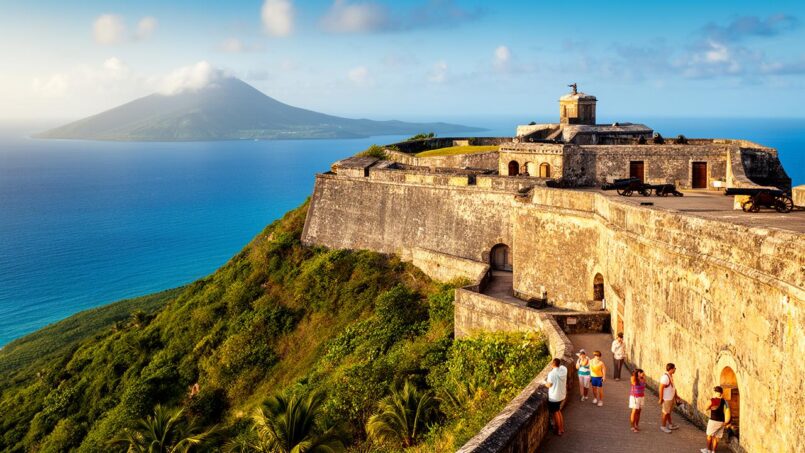
Beyond the towns, the most emblematic site of Saint Kitts and Nevis is undoubtedly Brimstone Hill Fortress National Park. This fortress, a UNESCO World Heritage Site, stands on a double volcanic summit at about 230 meters (750 feet) above sea level. Nicknamed “the Gibraltar of the West Indies” or “of the Caribbean,” it overlooks the west coast of Saint Kitts, near the historic town of Sandy Point.
Begun in 1690, when the British installed a cannon there to drive out French forces, construction spanned nearly a century. The plans were drawn by British military engineers, but the work itself was built and maintained by African slaves. The result, formed of cut basalt blocks and internal rubble masonry, is an imposing set of defensive works: Citadel Fort George, bastions, officers’ quarters, stores, and orillons.
Fort George, at the heart of the site, is the oldest preserved example of a polygonal fortification. It houses the main museum on the construction, military life, slavery, and the island’s history. Other public areas include the West and East Parade Grounds, the Magazine Bastion, ruins of military and civilian quarters, and the Prince of Wales Bastion, used as a conference and banquet center.
From the ramparts, the view is spectacular. You can see the entire coast, Mount Liamuiga, the old port town of Sandy Point, and also several neighboring islands like Sint Eustatius, Saba, and on clear days, Saint Martin, Saint Barthélemy, or even Montserrat. Access is via a winding road that climbs through tropical forest vegetation, where you often encounter vervet monkeys.
Administered by an independent non-profit organization, the Brimstone Hill Fortress National Park Society, the fortress has been undergoing stabilization and restoration work since the early 20th century. A major restoration program was launched in 1965, with symbolic steps such as the reopening of the Prince of Wales Bastion in the 1970s and the official transformation of the site into a national park in 1987, before its UNESCO inscription in 1999.
Access to the park is paid. For foreign visitors, the adult rate is in US dollars, with a reduced rate for children up to 12 years old. Local citizens benefit from a rate in Eastern Caribbean dollars. Payment is cash only. Additionally, during periods of heavy rain, the park may close temporarily for safety reasons (risk of rockfalls or landslides).
Brimstone Hill is not the only place that bears witness to the archipelago’s sugar past. Romney Manor, on the slopes of Mount Liamuiga, is a former 17th-century plantation. The estate belonged to ancestors of Thomas Jefferson, President of the United States, and is said to have been one of the first plantations on the island to free its slaves. Today, the great manor house is surrounded by particularly well-tended tropical gardens, with a botanical highlight: a gigantic saman (rain tree) about 350 years old, sometimes presented as the oldest living organism on the island.
Romney Manor also houses Caribelle Batik, a workshop where you can watch artisans apply batik techniques by hand, a fabric dyeing process. Visitors wander through the gardens, the shop, and a small bar overlooking the forest, for a modest entrance fee. The combination of heritage, nature, and craftsmanship makes this site an essential stop when exploring the interior of Saint Kitts.
A few hundred meters away, Wingfield Estate is one of the oldest plantations on the island. It successively cultivated tobacco, sugar cane, and produced rum. You can see the remains of a sugar mill, aqueducts, and the ruins of what is considered the oldest intact rum distillery in the region. Amerindian petroglyphs carved into the rock attest to occupation of the site long before the arrival of Europeans.
Wingfield also marks the entrance to the Central Forest Reserve National Park, a vast protected area covering the main rainforest of Saint Kitts. Designated a national park in 2007, this wooded massif plays a key role in the island’s water supply, the conservation of nearly a thousand plant species, and the development of measured ecotourism.
Finally, places like Old Road Town, Bloody Point, or the ruins of other estates (Estridge Estate, Fairview Great House) complete this historical tapestry. Old Road Town is known for being the first permanent English settlement in the Lesser Antilles, founded by Sir Thomas Warner in the early 17th century, and capital until 1727. Bloody Point, not far away, recalls a tragic episode in 1626, when French and British colonists massacred several thousand Caribs.
Volcanic Peaks, Forests, and Panoramas
The terrain of Saint Kitts and Nevis is shaped by volcanism. Each island has its iconic peak: Mount Liamuiga for Saint Kitts and Nevis Peak for Nevis. These two dormant giants offer hiking opportunities for experienced walkers, but also panoramas accessible by vehicle or train.
Mount Liamuiga, the highest point in the federation and the British Leeward Islands, reaches about 1,156 meters (3,792 feet). The ascent to the rim of its caldera is considered challenging. The trail, often muddy and steep, passes through several vegetation levels, from secondary forest to cloud forest. Allow more than four hours round trip, with an experienced guide recommended by environmental authorities. At the summit, when weather permits, the view unfolds over the island’s interior, the volcanic crater, and a wide ocean horizon.
Nevis Peak rises to over 3,200 feet, offering a challenging hike through dense, preserved rainforest.
Between these summits, several more accessible viewpoints allow you to enjoy the relief and the contrast between the Atlantic and the Caribbean Sea. The best known is Timothy Hill Overlook, on the Southeast Peninsula of Saint Kitts. From this roadside viewpoint, you can clearly see, on one side, the generally calm turquoise waters of the Caribbean Sea, and on the other, the deeper, often rougher blue of the Atlantic. The bays of Frigate and Friars, the silhouette of Nevis, and the road snaking along the peninsula make for a much-photographed scene.
The Central Forest Reserve National Park offers hiking trails of varying difficulty. For example, the Wingfield-Phillips Rain Forest Nature Trail, accessible from the Wingfield estate, offers a gradual immersion into the forest, with the possibility of seeing seasonal waterfalls. Guides explain traditional medicinal uses of plants. Wildlife observed includes vervet monkeys, introduced during the colonial era and now ubiquitous, as well as free-roaming domestic animals like goats and sheep.
A more unusual experience, the St. Kitts Scenic Railway, offers a different perspective on the terrain. Built between 1912 and 1926 to transport sugar cane to the factory, this roughly 30-mile line is now converted into a tourist attraction. The trains, double-decker—with an open upper deck and an air-conditioned lower level—run along the east coast, passing near villages, plantations, and offering views of Brimstone Hill, Mount Liamuiga, and solidified lava cliffs. Commentary, drinks, and sometimes live Caribbean music complete the experience.
Diving, Snorkeling, and the Underwater World
Saint Kitts and Nevis does not have gigantic coral barriers like some other Caribbean archipelagos, but the marine environment is nonetheless interesting. Most snorkeling sites combine rocks, small boat wrecks, and modest coral areas, while scuba diving gives access to deeper reefs, drop-offs, underwater hot springs, and several wrecks.
Around Saint Kitts, beaches like South Friars Bay, Cockleshell Bay, Banana Bay, Whitehouse Bay, or Dieppe Bay have small spots accessible from the shore. At South Friars, for example, a breakwater of rocky blocks behind Carambola Beach Club, sometimes called Carambola Breaker, shelters tropical fish and some coral. Further north, Frigate Bay South allows you to follow rocky areas with a bit of scattered coral, especially near the jetty of the Timothy Beach hotel.
Whitehouse Bay is ideal for beginners thanks to a shallow-water wreck. Dieppe Bay offers clear, calm conditions with a black sand bottom, protected by a reef. Shitten Bay, on the Southeast Peninsula, is considered one of the best sites; accessible by boat or a trail, it features a beached wreck and underwater rock formations.
Between Saint Kitts and Nevis, Monkey Shoals, sometimes described as a two-mile-wide atoll, attracts divers. The depths vary from 12 to over 30 meters, with vast gardens of hard and soft corals. A nearby site, Coral Gardens, has a nice cover of sponges and anemones on a gentle slope. More unusual, The Thermal Vents, off the coast of Saint Kitts, reveals underwater vents from which water can reach 38 °C, in an area where depth goes from 10 to nearly 30 meters.
Discover the remarkable reefs off the island’s west coast, known for their health and varied underwater landscapes.
Considered one of the healthiest reefs in the area, with drop-offs from 15 to 40 meters punctuated by passages and overhangs.
Located not far from the fortress, this site combines a reef plateau and a drop-off that plunges beyond 40 meters.
Characterized by its wall descending from 12 to over 30 meters, offering an immersive dive.
The dive club catalog also includes Green Point Reef, Ballast Bay, and Turtle Bar Reef.
Several wrecks add variety to the dives. The River Taw, a 44-meter cargo ship sunk in the 1980s, lies in two parts at about 12 meters depth, serving as a refuge for a host of fish. The Talata, another broken cargo ship resting around 17 meters near Basseterre harbor, completes the list, along with smaller wrecks like the Brassball Wreck or an old tugboat (The Tug) sitting between 9 and 20 meters.
In front of the Four Seasons Resort, four breakwaters create an easy, fish-filled, shallow snorkeling spot, considered the best accessible from the shore. Oualie Beach, further north, offers a gentle slope and a sandy-grassy bottom ideal for beginners. For more advanced experiences with caves and corals, favor offshore sites like Booby Island, Herbert’s, Nisbet Reef, or Devil’s Caverns.
The marine life observed is classic Caribbean, with green and hawksbill turtles, southern or spotted eagle rays, moray eels, barracudas, groupers, snappers, parrotfish, angelfish, sergeant majors, trumpetfish, triggerfish, boxfish, lobsters, octopuses, and schools of creole wrasse, wrasses, and other small reef fish. Corals take forms of brain, pillar, black coral, accompanied by sea fans and tube sponges.
The water is generally between 25 and 28 °C depending on the season, with visibility often exceeding 30 meters. The best time for diving, according to local operators, is from November to April, with drier weather and often calmer seas, although activity is possible year-round.
Nevis, Plantation Hotels, and the Art of Living
If Saint Kitts concentrates most of the tourist infrastructure, Nevis offers another side of the destination: more intimate, more rural, more focused on the heritage of plantations and boutique tourism. Once nicknamed “Queen of the Caribbees,” the island has transformed several sugar estates into character hotels where old stone meets tropical gardens, period furniture, and high-level service.
Montpelier Plantation & Beach perfectly illustrates this conversion. This 17th-century estate, nestled on the slopes of Nevis Peak, was the scene of Admiral Horatio Nelson’s marriage to Frances Nisbet in 1787. Today, the former plantation buildings house guest rooms and suites, a gourmet restaurant partly installed in a 300-year-old sugar mill, and landscaped gardens. Guests also have access to a private beach further south.
The Nisbet Plantation Beach Club, located on a former sugar estate, offers cottages in a seaside garden with a beach open to the Atlantic. Although the history of slavery and sugar cane remains palpable there, the establishment emphasizes warm hospitality and relaxation to soften this past.
Golden Rock Inn, another converted plantation, has specialized in a more artistic and botanical approach. Located on the slopes of Nevis Peak, this small establishment blends into a jungle of flowers, tropical trees, and pools, with distant views of the ocean. The restaurant, often cited for its romantic setting, adds a culinary dimension to the experience.
Hermitage Nevis, finally, plays the card of rustic authenticity, with pastel-colored wooden houses, a large porch, and a bar serving rum punch or local juices. Many Nevis island tours include a stop at Hermitage with a complimentary drink.
Nevis has several historical sites open to the public. St. Thomas’ Anglican Church, built in 1643 in the parish of Lowland, is the oldest Anglican church in the Caribbean. Cottle Church, built in 1824, is an important symbol as it allowed slaves and free people to pray together. It now stands as a ruin in the middle of vegetation.
Nevisian Heritage Village recreates a traditional village, with stone and wooden houses, period objects, and cultivated gardens, offering a glimpse of rural life in the past. Add the Nevis Artisan Village, in Charlestown, where you can buy local artworks and watch some artisans at work.
The art of living on Nevis is also seen in its beaches and bars. Pinney’s Beach concentrates several iconic spots, starting with Sunshine’s Beach Bar & Grill and its famous “Killerbee” cocktail, served in a very relaxed atmosphere. A few hundred meters away, other beach bars like Weekendz or Turtle Time offer large plates, often seafood-based, at affordable prices.
Festivals, Culture, and Events
Despite its small size, the Federation of Saint Kitts and Nevis boasts a surprisingly rich festival calendar, reflecting a mix of African, European, and Caribbean traditions. These events also provide an excellent gateway to local culture for visitors.
On Saint Kitts, the big year-end event is the national carnival, nicknamed Sugar Mas. This celebration runs from December to early January and combines soca and calypso competitions, costume parades, children’s parades, and concerts. The highlight is the Grand Parade on January 1st, where troupes parade in flamboyant costumes, followed on January 2nd by a final big “Las’ Lap”. A particularly intense moment is J’Ouvert, on December 26th at dawn, when the crowd takes over the streets, often covered in paint or mud, to the sound of street bands.
Nevis has its own major celebration, Culturama, organized around Emancipation Day weekend, early August. Launched in 1974 to celebrate African and Caribbean heritage, this event lasts about twelve days. It includes calypso (kaiso) competitions, Miss Culture and Mr. Kool elections, parades, folklore shows, poetry readings, and a large fair of crafts, gastronomy, and local products. The “Long Jam“, a festive parade stretching several kilometers from dawn on Emancipation Day, remains one of the highlights of Culturama.
Between these two big festivals, other events mark the year. The St. Kitts Music Festival, in late June, gathers international artists and local talents at Warner Park in all genres, from soca to reggae, afropop to R&B, jazz to dancehall. Around the main concerts, pre-festival parties take place on beaches, in bars, and on the streets, and a closing all-white party, White Sands, is held at South Friars Bay.
Every summer, the Saint Kitts and Nevis Restaurant Week offers special menus, chef demonstrations, culinary competitions, and events like a “Grill Fest” at restaurants on both islands. The focus is on local products and supporting the archipelago’s farmers.
Nevis, for its part, highlights its abundance of mangoes with the Nevis Mango Festival, celebrating the 44 varieties of mangoes grown on the island. The program includes tastings, cooking and mixology workshops, mango-eating contests, a children’s treasure hunt, and masterclasses led by international chefs.
Sports are not left out. The Nevis to Saint Kitts Cross-Channel Swim, a roughly 4-kilometer race between the two islands, attracts local and international swimmers each year. A triathlon, the Nevis Triathlon, is also organized, with formats including a 100-meter introductory race. Warner Park in Basseterre also hosts Caribbean Premier League cricket matches, offering immersion in this iconic regional sport.
In addition to these major dates, there are more targeted events: local festivals like Black San’ Bang-A-Lang in Sandy Point in April or Green Valley Festival in Cayon in May, Latin festivals highlighting ties with Latin America, or historical reenactments of the 1782 battle at Brimstone Hill.
Tasting Saint Kitts and Nevis: Cuisine and Beach Bars
Discovering the tourist sites of Saint Kitts and Nevis also goes through the plate. Local cuisine reflects a mix of African, British, and Caribbean influences, with generous use of fish, seafood, root vegetables, tropical fruits, and spices.
The national dish, Salt Fish and Dumplings, combines salted cod simmered with vegetables, spices, and coconut milk, seasoned plantains, coconut flour dumplings, and seasoned breadfruit. Served as one or several dishes, it condenses in a way the island’s history, between European heritage (salted cod) and Caribbean adaptations (breadfruit, coconut).
You’ll come across classics everywhere like conch fritters, roti – a stuffed flatbread with chicken, shrimp, or vegetables in a curry sauce –, goat water, a spicy goat stew with breadfruit and green papaya, jerk chicken or pork, johnny cakes, blood sausage, not to mention sugar-based desserts like sugar cakes or guava paste.
In Basseterre, on the island of Saint Kitts, several addresses illustrate the vitality of Creole cuisine and street food. Along Bay Road, the family-run restaurant El Fredo’s offers dishes like garlic conch, whole snapper, pigtail soup, or spicy pork. Nearby, the very popular little shop Mrs Moore’s Eat To Live Snackette is renowned for its conch curry, saucy turkey wings, fried fish, and johnny cakes.
More upscale, Ballahoo, with its terrace overlooking the city center, offers West Indian curries, wraps, sushi, and a signature cocktail with mango and passion fruit. Palm Court Gardens & Brasserie, perched in a garden with a pool and view of Basseterre bay, serves shrimp tacos, chicken curry, and smoothies.
On the coast, Sprat Net, with its long tables, TV broadcasting matches, and its casual atmosphere, is an institution for pizzas, grilled shrimp, ribs, and lobster dishes. Arthur’s, at Dieppe Bay, goes for the “sea to fork” approach: locally caught fish (mahi-mahi, grouper, snapper), ceviche, conch, lobster, accompanied by pumpkin fritters. At the other end of the scale, The Kitchen, within Belle Mont Farm, works farm and sea products in a refined farm-to-table approach, with dishes like poached lemongrass lobster or braised cinnamon goat loin.
The beaches of the Southeast Peninsula are also culinary landmarks. Spice Mill, on Cockleshell Beach, combines a beachfront setting with gourmet Caribbean cuisine, with wahoo on the menu and passion fruit cocktails. Reggae Beach Bar & Grill, a few steps away, is famous for its fresh lobster, conch fritters, grilled shrimp, burgers, and rum punch. South Friars Bay hosts Carambola Beach Club, which even offers sushi, and Shipwreck Beach Bar, more rustic, where you enjoy barbecue chicken, fish tacos, and cold beer at sunset.
The following table gives a simplified overview of some places where you can enjoy both the setting and the cuisine.
| Place / Restaurant | Island | Main Location | Specialties / Vibe |
|---|---|---|---|
| Reggae Beach Bar & Grill | Saint Kitts | Cockleshell Beach | Lobster, conch, BBQ, punch, parties |
| Spice Mill | Saint Kitts | Cockleshell Beach | Refined Caribbean cuisine, wahoo |
| Shipwreck Beach Bar | Saint Kitts | South Friars Bay | Local cuisine, fish, sunset vibe |
| Carambola Beach Club | Saint Kitts | South Friars Bay | Chic club, sushi, loungers |
| Arthur’s | Saint Kitts | Dieppe Bay | Local fish, seafood |
| El Fredo’s | Saint Kitts | Basseterre (Bay Road) | Conch, snapper, Creole lunch |
| Mrs Moore’s Eat To Live Snackette | Saint Kitts | Basseterre (near Bay Road) | Creole street food, johnny cakes |
| Sunshine’s Beach Bar & Grill | Nevis | Pinney’s Beach | “Killerbee” cocktail, ribs, seafood |
| Yachtsman Grill | Nevis | Between Pinney’s and Oualie | Local and international cuisine, pizzas |
| Golden Rock Inn (restaurant) | Nevis | Slopes of Nevis Peak | Refined dining in a lush garden |
Alongside these addresses, the large resorts like the St. Kitts Marriott Resort, Park Hyatt Saint Kitts, or the Four Seasons Resort Nevis offer gourmet restaurants, tasting experiences (omakase menus, Caribbean cooking classes, etc.), and sophisticated cocktail bars.
Practical Tips for Exploring the Must-See Sites
In such a compact country, the temptation to multiply visits is great. However, it’s better to keep a few practical pointers in mind to fully enjoy the essential places.
Transport-wise, the two islands are connected by a frequent ferry service between Basseterre and Charlestown (about 50 minutes) and by a Sea Bridge car ferry between Majors Bay, at the end of the Southeast Peninsula of Saint Kitts, and Cades Bay, on Nevis (about 20 minutes). Private water taxis also connect Reggae Beach to Oualie Beach in just a few minutes. On land, taxis, tourist vans, and rental 4x4s or buggies allow you to get around, but some isolated beaches (Majors Bay, Turtle Beach, Sandy Bank Bay, Lover’s Beach, Paradise Beach) are only reachable via dirt tracks, sometimes bumpy.
In Saint Kitts and Nevis, the Eastern Caribbean dollar (XCD) and the US dollar (USD) are both accepted. It is recommended to have small bills, especially for taxis, excursions, and purchases at small shops. Remember to specify the currency used before paying. Many visits, including at some official sites like Brimstone Hill Fortress, still prefer cash payment.
For hikes in the forest or towards the volcanoes, closed-toe shoes, water, mosquito repellent, and a light rain jacket are advised. The terrain can be muddy, slippery, with steep slopes. Local authorities recommend not going alone on mountain trails, but being accompanied by a registered guide.
On the beaches, the absence of lifeguards requires a minimum of vigilance, especially on Atlantic coasts or in areas known for their currents like North Friars Bay. In coves without facilities, it is essential to bring water, food, and sunscreen.
To fully enjoy the major events (music festivals, carnivals, Culturama, Restaurant Week, Mango Festival, sports competitions), it is advisable to book your accommodation and main activities well in advance. Indeed, some concerts or popular experiences may sell out several months before the event starts.
—
Whether you come for the golden sand beaches, to walk the ramparts of a fortress nicknamed “Gibraltar of the West Indies”, to dive on a reef, to sip a Killerbee on Pinney’s Beach, or to immerse yourself in the archipelago’s eventful history, the must-see sites of Saint Kitts and Nevis create a journey that is both dense and soothing. In this small country where sugar cane has given way to tourism, but where plantations, churches, and alleyways still bear traces of the past, each bay, each hill, and each village tells a facet of a story far vaster than the size of the islands suggests.
Disclaimer: The information provided on this website is for informational purposes only and does not constitute financial, legal, or professional advice. We encourage you to consult qualified experts before making any investment, real estate, or expatriation decisions. Although we strive to maintain up-to-date and accurate information, we do not guarantee the completeness, accuracy, or timeliness of the proposed content. As investment and expatriation involve risks, we disclaim any liability for potential losses or damages arising from the use of this site. Your use of this site confirms your acceptance of these terms and your understanding of the associated risks.

Cyril Jarnias is an independent expert in international wealth management with over 20 years of experience. As an expatriate himself, he is dedicated to helping individuals and business leaders build, protect, and pass on their wealth with complete peace of mind.
On his website, cyriljarnias.com, he shares his expertise on international real estate, offshore company formation, and expatriation.
Thanks to his expertise, he offers sound advice to optimize his clients' wealth management. Cyril Jarnias is also recognized for his appearances in many prestigious media outlets such as BFM Business, les Français de l’étranger, Le Figaro, Les Echos, and Mieux vivre votre argent, where he shares his knowledge and know-how in wealth management.





