
 Published on and written by Cyril Jarnias
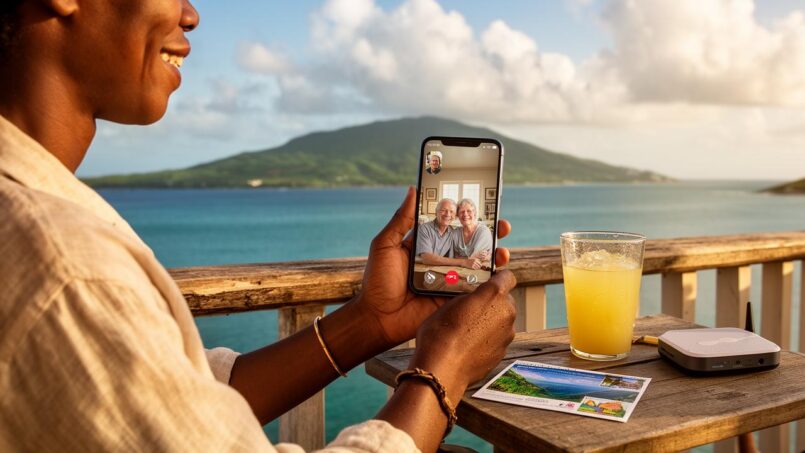
Staying close to family and friends while living or traveling in Saint Kitts and Nevis has never been easier… nor more complex. Easier, because the country now has good internet and mobile coverage, and digital tools are plentiful. More complex, because costs, offers, technologies, and time zones require at least some strategy to avoid blowing your budget or missing important moments.
Good to know:
To stay connected from Saint Kitts and Nevis, several practical solutions exist: internet connection, SIM cards and eSIMs, communication apps, international calls, and postal mail. It’s also important to plan video calls carefully, taking into account time zones and cultural aspects of maintaining family bonds at a distance.
Getting online: the foundation for staying in touch
Without a reliable connection, you can’t make WhatsApp calls, exchange videos with family, or keep up with loved ones on social media. In Saint Kitts and Nevis, network accessibility is improving, but with a few quirks to know.
About 76.4% of the population was connected as of early 2025, or roughly 35,800 internet users. The country also has a mobile connection rate exceeding 115% of the population, meaning many people have multiple lines or devices.
A developing telecom landscape, but still pricey
The market is regulated by ECTEL (Eastern Caribbean Telecommunications Authority). Two major operators dominate: Flow (Cable & Wireless) and Digicel. On the fixed broadband side, Flow leads, along with The Cable (St. Kitts-Nevis Cable Communications Ltd.) and smaller players like City Wi-Fi Inc.
Attention:
The country has invested heavily in fiber optics, with Flow offering a 100% fiber network and The Cable migrating to GPON technology, delivering respectable performance globally. However, subscription prices remain high compared to the international average, and the infrastructure is vulnerable to hurricanes.
An overview of average speeds from recent tests gives you an idea:
| Provider / Type | Average Download Speed (Mb/s) | Average Upload Speed (Mb/s) | Average Latency (ms) |
|---|---|---|---|
| Flow (fiber) | ≈ 146 | ≈ 106 | ≈ 70 (fixed) |
| The Cable (hybrid network) | ≈ 95 | n.d. | ≈ 70 (fixed) |
| Flow Caribbean (recent tests) | 106.86 | n.d. | n.d. |
| The Cable of St. Kitts | 82.56 | n.d. | n.d. |
| City Wi-Fi Inc | 0.66 | n.d. | n.d. |
| Global average (all networks) | 72.43 | 20.11 | ≈ 70 (fixed) |
| 4G LTE mobile networks | 22–23 | n.d. | ≈ 87 (mobile) |
Mobile speeds generally run around 22 to 23 Mb/s for downloads, which is more than enough for video calls or instant messaging, as long as 4G coverage is good.
Fiber, 4G, but not yet 5G
The technologies available fall mainly into:
Good to know:
Several internet connection technologies are available or being developed on the island. Fiber optic (Flow, The Cable undergoing upgrades) is the primary wired solution, while older cable/DSL networks are being phased out. For less covered areas, 4G LTE offers broad coverage in populated zones, and traditional satellite (VSAT) serves as a backup. Finally, Starlink satellite service is announced for late 2025.
Starlink is expected to offer speeds around 150–200 Mb/s with latency of 20 to 40 ms. An interesting option for remote rural areas, though the cost remains high.
The main drawbacks: no 5G and limited competition among operators, keeping prices relatively high.
Average internet access costs
Plans vary widely, but a few benchmarks help you get your bearings:
| Type of Plan | Example Monthly Price (EC$) | Approx. in USD |
|---|---|---|
| Average broadband plan | ≈ 86 | ≈ 32 |
| Flow fiber (symmetrical plan) | ≈ 135 | ≈ 50 |
| Flow fiber 500 Mb/s | ≈ 185 | ≈ 68 |
| The Cable 15 Mb/s | 97 (+ 17% VAT) | ≈ 36 |
| The Cable 320 Mb/s | 500 (+ VAT) | ≈ 185 |
| Digicel+ 100 Mb/s (Nevis) | 156.50 | ≈ 58 |
| Digicel+ 300 Mb/s (Nevis) | 291.50 | ≈ 108 |
| Starlink (planned) | ≈ 270 | ≈ 99 |
To maintain a stable connection with people abroad via video, messaging, and social media, a basic fiber plan or a good 4G plan is plenty. In rural areas, Flow is often seen as more reliable, especially in remote tourist spots, while Digicel stands out with often more aggressive data offers in urban areas.
SIM cards, eSIMs, roaming: choosing the right strategy
To talk with loved ones, the first question is often: how do I get data on my phone upon arrival, and at what price?
Local SIM cards: best value for long stays
For a long stay or settling in, nothing beats a local SIM card. The two major operators, Flow and Digicel, offer prepaid SIMs with calls, SMS, and data.
In practice, a SIM card typically costs around 10 to 15 USD, plus a data plan. Reasonable prepaid plans often range from 15 to 30 USD, covering essential needs: WhatsApp, video calls, social media, email, etc.
A few examples of tourist and prepaid offers:
| Operator / Offer | Data Included | Validity | Price (USD) | Notes |
|---|---|---|---|---|
| Flow – Tourist Prepaid SIM | 10 GB | 30 days | 15 | Local calls & SMS included |
| Digicel – Tourist Prepaid SIM | 15 GB | 30 days | 20 | Bonus data, access to some apps |
| Average local prepaid data plan | varies | 7–30 days | 15–30 | Depends on data volume |
The local SIM card does have some constraints: you must present a passport for registration, go to an official store (in Basseterre, Charlestown, or sometimes at the airport when shops are open), and wait from a few minutes to a few hours for activation.
For a stay of a month or more, it’s the most economical option to stay reachable and use a lot of data.
International eSIMs: the super convenient solution
For those who want to be connected right after landing without queuing at a telecom counter, eSIMs are a very practical alternative. Providers like Airalo or Holafly offer eSIMs specific to Saint Kitts and Nevis or regional ones covering several Caribbean islands.
Tip:
Travel eSIMs stand out for several key features: they allow instant remote activation, eliminating the need for a physical SIM card. They offer great flexibility by letting you store multiple operator profiles on one device and switch between them easily. Designed specifically for travelers, they offer data plans tailored to many destinations, often at competitive rates compared to traditional roaming. Their use also reduces electronic waste from disposable SIM cards.
– online purchase before departure,
– receive a QR code to scan on your phone,
– instant activation upon arrival,
– typically “data only” offers (no local number, no regular calls, but calls and messages via WhatsApp, Signal, FaceTime, etc.),
– higher prices over time compared to a local SIM, but unbeatable in terms of simplicity.
Some ballpark figures:
| eSIM Provider | Volume / Typical Duration | Indicative Price (USD) | Notes |
|---|---|---|---|
| Airalo – local/regional pack | 3 GB / 7 days | ≈ 10 | Ideal for short stay |
| Airalo – Caribbean plans | 1 to several GB / 7–30 days | 15–25+ | Multi-island coverage |
| Holafly – unlimited data | unlimited / 5 days | from 27 | Longer plans also available |
eSIMs are especially suitable for:
– business travelers who need immediate connectivity,
– short stays,
– those comfortable with digital tools and plan to do everything over the internet (VoIP calls, messaging, social media).
For an expat or a long family stay, an eSIM can serve as a stepping stone for the first few days before switching to a local SIM.
Roaming: the option to avoid, except in special cases
Using your home operator’s plan while roaming is almost always the most expensive option. Daily roaming plans easily exceed 10 USD per day, sometimes much more. The result: a few videos sent to the family chat and your bill skyrockets.
Good to know:
Roaming is useful as a backup when arriving at night or for a short business trip. However, for medium-term use, a local SIM card or eSIM is clearly a better deal.
Free Wi-Fi: handy but rarely sufficient
Free Wi-Fi is available at most hotels, some restaurants, cafés, and tourist spots like Port Zante in Basseterre, or at places like The Pavilion or Spice Mill. The government has also equipped all 16 community centers in the country with free Wi-Fi.
However, these networks are often congested, slow, or unstable. They work for sending a few messages or making a quick call, but not if you need to:
– telework,
– hold regular video conferences with family,
– share large videos,
– or follow major family events live.
For a truly reliable connection with loved ones, consider public Wi-Fi as a supplement, not the backbone of your communication.
Apps and digital tools for staying close
Once you have a connection, you need to choose the right tools. In the Caribbean, usage patterns are very distinctive: mobile dominates overwhelmingly, and certain apps have become the center of social life.
A mobile-first environment
About 72% of regional internet traffic goes through smartphones, versus 58% worldwide. More than 70% of Caribbean internet users mainly access platforms on mobile. Unsurprisingly, messaging apps and social networks have become the primary vehicle for family bonds, both within the country and across the diaspora.
WhatsApp: the backbone of family ties
In most English-speaking Caribbean countries, WhatsApp penetration rates range between 84% and 92%. The app isn’t just for chatting: it structures social and family life.
It enables:
Example:
Family groups on messaging apps are used to share daily news and photos, broadcast important announcements, and make free audio or video calls over the internet. They also help coordinate organizing support, managing money transfers, or setting up meetings, and maintain a constant link with family members living abroad, such as in the United States, Canada, or the United Kingdom.
To stay in touch from Saint Kitts and Nevis, WhatsApp is simply essential. In practice, a large part of your exchanges with people abroad (parents, siblings, cousins, friends) will go through WhatsApp calls and messages, as long as you have data or Wi-Fi.
Facebook, Instagram, TikTok: sharing daily life and culture
Social networks play a dual role: maintaining contact and fostering a sense of belonging. Facebook remains widely used across all age groups, especially for following local news, community announcements, and photos of celebrations or ceremonies. Among younger people, Instagram and especially TikTok are gaining ground, with a preference for short video.
The regional dynamic is very pronounced:
3
Three major trends in online Caribbean culture: the explosion of short videos, massive sharing of cultural content on social media, and the strengthening of a transatlantic cultural pride.
For a family split between Saint Kitts and Nevis, New York, London, or Toronto, a simple Instagram or TikTok feed becomes a daily window into each other’s lives: images of Carnival, meals, landscapes, and everyday moments. This constant flow creates what researchers call a “virtual transnational bridge,” reducing emotional distance despite geographical separation.
Other useful apps
Beyond the trio of WhatsApp–Facebook–Instagram, a few apps make exchanges smoother:
– video call apps: Zoom, Google Meet, Skype, FaceTime,
– secure messaging: Signal, Telegram,
– translation apps: Google Translate, handy for multilingual families,
– operator apps (Flow, Digicel) to check usage and top up your plan.
For audio/video communications, many families combine WhatsApp (for daily use) with a more stable platform like Zoom or Meet for large virtual gatherings (birthdays, parties, extended family reunions).
International calls: managing costs without giving up voice
Even though internet calls have revolutionized communication, there are still situations where you need to make “real” calls abroad, or vice versa. Here again, choosing the right service makes a big difference on your bill.
Rates from major traditional operators
Calling Saint Kitts and Nevis from a traditional North American operator can be prohibitively expensive:
| Operator (from abroad) | Rate to Saint Kitts and Nevis (USD/min) |
|---|---|
| AT&T | 2.86 |
| Verizon | 2.68 |
| T-Mobile | 2.15 |
| Generic calling cards | 1.07 (approx.) |
At these price levels, a simple birthday call can quickly cost more than a month of local data. Hence the emergence of alternative services.
Specialized VoIP services and virtual cards
Several platforms offer international calls at greatly reduced rates, often with no commitment and great transparency (no hidden fees, no connection fees, no contract).
Among the frequently mentioned names:
– Yolla
– BOSS Revolution / BOSS Wireless
– Voipfibre
– Pingo (Premium, Platinum)
– DialAnyone
– Clear Choice, Simple Calls, Top Value
80
Maximum possible savings percentage on calls to landlines in Saint Kitts and Nevis compared to major traditional operator rates.
For mobile numbers, rates are still a bit higher, but well below AT&T or Verizon, with examples around 0.21 to 0.28 USD per minute.
A rough idea of observed ranges:
| Destination Type | Example Rates (USD/min) |
|---|---|
| Landlines in Saint Kitts and Nevis | 0.16 – 0.30 (several tiers around 0.19–0.27) |
| Mobiles in Saint Kitts and Nevis | 0.21 – 0.29 (several tiers around 0.23–0.28) |
| Traditional operators (comparison) | 2.15 – 2.86 (AT&T, Verizon, T-Mobile) |
Some services offer:
– per-minute plans (prepaid credit),
– monthly plans (e.g., “World Unlimited” offers for around ten dollars for specific countries),
– or combinations with a few free minutes to Saint Kitts and Nevis then charged at a reduced rate.
BOSS Revolution, for example, highlights plans with no additional fees or credit checks, with unlimited calls to many countries in certain packages.
Voipfibre: cheap calls without data
An interesting case is Voipfibre, which routes through local landlines to optimize costs: international calls are made via a local access number, so you don’t need data or Wi-Fi. For an older person less comfortable with apps, it may be simpler to dial a local number then the international number, while still getting great rates.
When to use traditional voice?
Even though WhatsApp and the like dominate, traditional voice is still relevant in several cases:
Good to know:
It’s recommended to use a traditional phone number (landline or mobile) instead of a messaging or internet calling app in several situations: when your contacts don’t have a smartphone or internet connection, in rural areas with poor mobile data coverage, for official calls (banks, government agencies) that often require a standard number, and in emergencies, especially when internet infrastructure is disrupted or unavailable.
In practice, many families combine:
– VoIP/messaging calls for most exchanges,
– credit on a service like BOSS Revolution or Yolla for the few indispensable “classic” calls.
Planning video calls across time zones
Staying in touch isn’t just about having a signal: it’s about finding compatible times with loved ones scattered across several continents. For Saint Kitts and Nevis, the good news is that the country uses a stable time zone with no seasonal changes: Atlantic Standard Time (UTC-4), with no daylight saving time.
Understanding Saint Kitts and Nevis’s time zone
The country is entirely on UTC-4 year-round. It hasn’t observed daylight saving time since 1945. This simplifies life locally, but complicates coordination with countries that change their clocks twice a year.
Typical time differences:
| Region / Example City | Difference from Saint Kitts and Nevis (UTC-4) |
|---|---|
| US East Coast (NY, Montreal)* | 0 h (when on daylight time), +1 h otherwise |
| US West Coast (Los Angeles) | +4 h |
| United Kingdom, Ireland | +4 h |
| Western/Central Europe (Paris, Berlin) | +5 h |
| Eastern Europe, South Africa, Israel | +6 h |
| Turkey, Kenya, Tanzania | +7 h |
| United Arab Emirates (Dubai) | +8 h |
| India, Sri Lanka | +9 h 30 |
| China, Hong Kong, Singapore, Malaysia | +12 h |
| Japan, South Korea | +13 h |
| Eastern Australia (Sydney, Melbourne) | +14 h |
| New Zealand, Fiji | +16 h |
*When New York is on daylight time (EDT), it is the same time as Saint Kitts and Nevis. During standard time (EST), Saint Kitts and Nevis is one hour ahead.
Finding the “golden hours” for calls
To avoid calling someone at 5 AM or midnight, it’s best to identify acceptable overlapping windows for everyone. Tools like WorldTimeServer, timeanddate.com, or World Time Buddy help visualize these time slots.
Tip:
To maintain regular contact despite the time difference, establish a fixed routine. For example, schedule a video call every Sunday at 5 PM (Basseterre time in Saint Kitts and Nevis), which corresponds to 9 PM in London and 10 PM in Paris during European winter. The reverse also works: morning conversations from Saint Kitts and Nevis with loved ones in Europe or Africa.
Adjusting call length for children
Child development specialists emphasize that video calls can strengthen attachment, especially if an adult is with the child during the call. The American Academy of Pediatrics considers live, supervised video chat suitable even for toddlers, as long as it’s part of a thoughtful “family media plan.”
Recommended durations vary by age:
| Child’s Age | Recommended Video Call Duration |
|---|---|
| Baby | 5–10 minutes |
| 1–3 years (toddler) | 10–20 minutes |
| 3–5 years (preschool) | 15–30 minutes |
| 6–12 years | 20–45 minutes |
| 13 years and up | 30–90 minutes or more |
For very young children, short but frequent calls are better than long, exhausting sessions.
Practical tips for smooth video calls
Good preparation often makes the difference between an enjoyable call and a frustrating session punctuated by “Can you hear me?”
Tip:
It’s important to develop a few useful daily habits. These positive routines help you gain efficiency, reduce stress, and improve the quality of your actions. Take the time to identify and implement those that best suit your needs.
– test the connection before the call (Speedtest, for example),
– sit near the router or in an area with good 4G coverage,
– reduce video resolution if bandwidth is limited,
– have a backup audio plan if video drops (e.g., a simple WhatsApp audio call),
– ensure good lighting (light in front) and a stable phone or computer,
– have a “script” for calls with children (say hello, show a drawing, sing a song, tell a story, say goodbye clearly).
With these precautions, calls become anticipated events rather than stressful moments.
Mail and packages: keeping a tangible connection too
Even in the age of HD video, receiving a letter or printed photos through the mail has a special emotional value. Postal and courier services remain an important part of maintaining bonds, whether sending a gift package or receiving paper photos from family.
Sending mail to Saint Kitts and Nevis from the United States
USPS offers several services for Saint Kitts and Nevis, classified into specific rate groups (e.g., “Group 9” for First-Class Mail International, “Price Group 10” for Priority Mail International and Priority Mail Express International).
For simple letters or cards:
– a Global Forever stamp ($1.65) covers a letter up to 1 ounce,
– beyond that, add extra stamps according to the weight chart,
– postcards also require a Global Forever at $1.65.
Good to know:
Delivery times for a letter are generally estimated at 7 to 21 days. These times can vary depending on the time of year and type of correspondence.
For larger shipments (documents, small packages), weight limits vary by service (4 lbs for First-Class Package International, 44 lbs for Priority Mail International, 66 lbs for Priority Mail Express International or Airmail M-bags).
Options like international registered mail, certificates of mailing, or return receipts exist, but with relatively low coverage limits (e.g., $40.20 for registered mail).
Private couriers and packages
Carriers like DHL, FedEx, Aramex, or specialized companies like Meest-America also connect the United States and other countries to Saint Kitts and Nevis. Delivery times can be 3–5 days for express shipments, with much higher costs but detailed tracking.
For shipments from India, platforms like Global India Express or Courier Dunia display rates calculated per kilo, depending on desired speed (economy or express) and the final destination in Saint Kitts and Nevis. You’ll find the usual:
– volumetric weight considered,
– ID required for the sender,
– possible customs duties based on declared value and nature of the item,
– potential exemptions for low-value gifts.
Sending from Saint Kitts and Nevis
Letters sent from Saint Kitts and Nevis to the United States generally take 7 to 10 days, and 5 to 7 days to Western Europe by airmail, according to available data. Services like DHL or FedEx can speed things up for packages, at a premium.
To stay in touch, some families combine: using technology to exchange news, regular visits to strengthen bonds, and organizing shared activities to create lasting memories.
– daily digital exchanges,
– occasional package shipments (local specialties, gifts, souvenirs),
– sending photo prints via services that turn images received by SMS or internet into paper photos sent by mail.
This “tangible” dimension of connection—receiving a handwritten letter or a package—remains, for many, irreplaceable.
Family ties, diaspora, and culture: beyond the technical
In the Caribbean, migration is deeply embedded in family trajectories. Saint Kitts and Nevis is no exception: a significant portion of its nationals live in the United Kingdom, the United States, Canada, or elsewhere. These “transnational” families are built on exchanges that go far beyond just economics.
A culture of long-distance connection
Research on the Caribbean diaspora shows that:
– extended families (grandparents, aunts, uncles, cousins) play a central role,
– relationships extend beyond national borders,
– there is a strong “kinship morality”: feeling responsible for each other, even at a distance,
– obligations of support (financial, moral, emotional) are at the heart of these networks.
Good to know:
Digital tools enable very frequent contact (messages, photos, video calls), but can also create the illusion of sufficient presence, potentially delaying essential physical visits.
A virtual bridge, but charged with emotions
Tools like Facebook and WhatsApp are not just gadgets: they support what researchers call “transnational chains of care.” In practice, this translates into:
– checking on an elderly parent’s health from abroad,
– helping with children’s education in the family through advice, homework assistance via video, money transfers,
– navigating painful moments (grief, illness) with heavy emotional weight.
Good to know:
For residents of Saint Kitts and Nevis, these digital tools allow them to maintain an active link with their country, even after emigrating. They can follow local news, participate in community projects, and make investments from afar.
During events like economic summits, the country’s leaders regularly emphasize the importance of this diaspora not only as a source of investment but also as a cultural and political bridge internationally.
Multiple identities
The Caribbean experience often combines: cultural richness, linguistic diversity, musical traditions, and culinary influences that make this region a unique and vibrant place.
– a local identity (Kittitian, Nevisian),
– a regional belonging (Caribbean),
– and integration into host societies (British, North American, etc.).
Social networks help navigate between these different layers: you find the music, dialects, and codes of the Caribbean, but also the political debates of the countries where you live. The bonds maintained with Saint Kitts and Nevis through the internet help preserve a memory, practices, a symbolic “home,” even for those who left long ago.
Digital inclusion: leaving no one behind
Staying in touch requires knowing how to use the tools. Yet, worldwide, a digital divide persists, especially among older people. If we want grandparents in Saint Kitts and Nevis to watch their grandchildren grow up via video, digital skills are central.
The challenge for seniors
Without support, many older people struggle with:
– using a smartphone or tablet,
– connecting to a Wi-Fi network,
– using apps like WhatsApp, Zoom, or Facebook,
– protecting themselves from online scams.
Training programs abroad (United States, Singapore, Trinidad and Tobago, Saint Vincent and the Grenadines…) show that these gaps can be bridged by offering:
– in-person workshops,
– loaned or subsidized equipment,
– patient, repeated guidance.
Saint Kitts and Nevis has already taken an important step by offering free Wi-Fi in its community centers. This is a good foundation for eventually organizing basic training sessions: how to make a video call, send a photo, recognize a fraudulent message.
Digital as a tool for dignity
When an older person learns to make a video call on their own to their grandchild in Canada or England, it’s not just a technical achievement: it’s a gain in autonomy, dignity, and sense of belonging.
Tip:
For families, investing a little time to guide parents and grandparents in using digital tools can transform the quality of the bond. From a distance, this can take shape with a few practical ideas like regular video calls, sharing photos, or using simple apps suited to their needs.
– schedule very simple introductory sessions, focusing on one function at a time (answering a call, opening WhatsApp, sending a photo),
– record short explanatory videos that the elder can rewatch at their own pace,
– take advantage of visits to the country to set up devices (clear icons, shortcuts, basic security),
– use traditional international call services that are simpler to dial when technology fails.
In practice: building a “contact ecosystem” from Saint Kitts and Nevis
From all these elements, everyone can put together their own combination of solutions. For a resident or regular visitor to Saint Kitts and Nevis, a typical “kit” might look like this:
Connection and Distance Communication
The essential elements for maintaining a strong bond with loved ones while living abroad or abroad.
Main Internet Connection
A reliable connection, like fiber at home or a generous 4G plan, is the foundation for all communications.
Local SIM Card
Essential for daily communications and mobile data usage on the ground.
Active WhatsApp
The central account for calls, messages, and family groups, using the internet connection.
International Call Services
One or two cheap services for the rare needs of traditional voice calls.
Social Networks
Accounts on Facebook, Instagram, or TikTok to share daily life and follow loved ones.
Video Call Routine
A clear schedule adapted to time zones for calling different family members.
Mail and Packages
Occasional use for symbolic moments: sending gifts, letters, or photo albums.
By combining these building blocks, you can maintain intense, diverse, and lasting relationships, despite the distance. The important thing, ultimately, is not the technology itself, but how it fits into a culture of care, support, and sharing that characterizes Caribbean families.
Thanks to ever-improving connectivity, a very dynamic mobile environment, and a range of digital and postal services, Saint Kitts and Nevis today offers fertile ground for these bonds to continue to be woven, day after day, from island to island and from continent to continent.

Cyril Jarnias is an independent expert in international wealth management with over 20 years of experience. As an expatriate himself, he is dedicated to helping individuals and business leaders build, protect, and pass on their wealth with complete peace of mind.
On his website, cyriljarnias.com, he shares his expertise on international real estate, offshore company formation, and expatriation.
Thanks to his expertise, he offers sound advice to optimize his clients' wealth management. Cyril Jarnias is also recognized for his appearances in many prestigious media outlets such as BFM Business, les Français de l’étranger, Le Figaro, Les Echos, and Mieux vivre votre argent, where he shares his knowledge and know-how in wealth management.





