
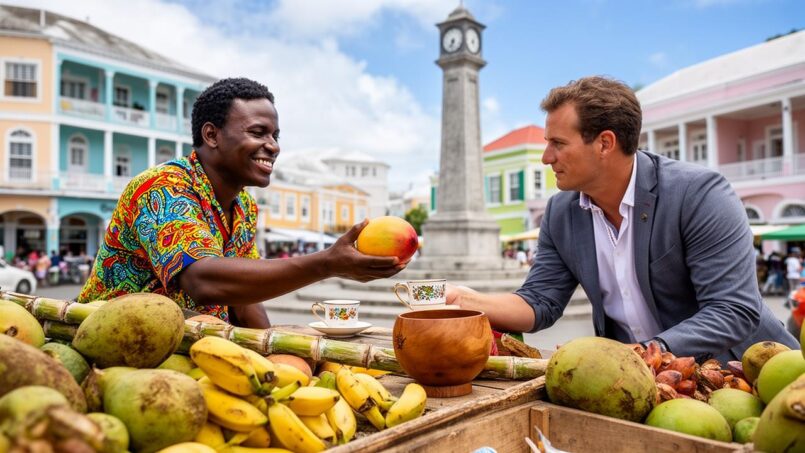
 Published on and written by Cyril Jarnias
Moving to Saint Kitts and Nevis is a dream: sun, beaches, a laid-back vibe, and favorable taxes. But behind the postcard, daily life is built on a very specific set of social codes. Ignoring them can make integration harder, both in private life and at work.
This nation, the smallest in the Americas, has a unique culture resulting from a blend of African, British, French, Caribbean, and Christian heritages. Understanding and respecting these cultural codes is essential to avoid misunderstandings and build trust with the local population.
One country, two islands, two vibes
Saint Kitts and Nevis is a federal state made up of two islands with complementary personalities. Future expats often underestimate how much these nuances affect the choice of where to live and how to be accepted locally.
Saint Kitts, the larger one, is more lively, with more services, shops, schools (including medical and veterinary schools), and a nightlife scene centered around places like “The Strip” in Frigate Bay. On cruise ship days, Basseterre takes on a cosmopolitan small-town feel, which can appeal to entrepreneurs, remote workers, and international profiles looking for a network.
Nevis, smaller and quieter than its neighbor, cultivates an authentic “small island” atmosphere. You’ll find little to no fast food, limited mass tourism, and a very relaxed pace of life. The island exudes a discreet elegance and “old school” Caribbean charm, mainly attracting retirees and those seeking serenity, silence, and nature.
Still, this is a close-knit society. Around 50 to 55,000 inhabitants total, a very extended family structure, communities where everyone knows everyone else (or almost): this “small island, big family” context profoundly changes how social life, reputation, conflicts… and gossip are experienced.
To visualize these differences, a simple comparison table helps.
| Aspect | Saint Kitts | Nevis |
|---|---|---|
| General vibe | Lively, more urban, more services | Quiet, “small island,” serene atmosphere |
| Dominant tourism | Cruises, large resorts | High-end hotels, discreet tourism |
| Nightlife | Beach bars, “The Strip,” concerts | More limited, intimate gatherings |
| Expat population | Entrepreneurs, nomads, students | Retirees, families seeking tranquility |
| Local perception of tourism | Faster development, debates on impacts | Tourism seen more positively, better accepted |
Choosing one island or the other isn’t just about choosing a landscape; it’s also about choosing a social environment, a degree of anonymity, and a lifestyle.
Society, family, and pace of life: the real meaning of “island time”
The people of Saint Kitts and Nevis are described as warm, relaxed, resilient, and deeply community-oriented. Family is at the heart of everything: multi-generational homes are common, grandparents play a big role in raising children, and people readily help each other build a house, harvest, or cook for an event.
The sense of solidarity, inherited from the history of sugar plantations where enslaved people and workers depended on close cooperation, still places community above individualism today. For an expat from a society that values individual performance, this requires a real adjustment.
The concept of “island time” illustrates this mindset. It’s not a caricatured “laziness,” but a more flexible relationship with time. Being on time for an appointment, especially a professional one, is still a sign of respect. However, meetings starting 10 to 15 minutes late, administrative procedures taking longer than expected, or services not always sticking to posted hours are part of daily life.
In this context, showing impatience, complaining loudly, or demanding that “everything go faster” is very poorly received. The priority given to social harmony and personal relationships means that diplomacy, compromise, and patience are the way to go.
Language and Creole: speaking English isn’t enough
English is the official language and the language of administration, business, and education. However, daily life really comes alive in the local Creole, sometimes called Kittitian Creole or Nevis Creole, two very similar variants, enriched by English, French, and West African languages.
For a French-speaking or English-speaking expat, English is sufficient for work, administrative tasks, and daily communication. However, not understanding Creole limits access to informal conversations, jokes, songs, and cultural nuances, which can restrict social integration.
Showing interest in a few Creole expressions or phrases is very well received. It shows both respect for the local culture and a genuine desire to integrate. Without necessarily reaching fluency, the effort is usually appreciated and helps build trust.
First impressions matter enormously in this small country where reputations travel fast. Basic politeness is the foundation: you greet people, take time to exchange a few words, and avoid jumping straight to the point without a preamble.
Standard greetings are “Good morning,” “Good afternoon,” or “Good evening,” with a smile and direct but not aggressive eye contact. The first contact is usually a firm handshake, sometimes accompanied by a slight hand-to-heart gesture in some local variations. Over time, among friends and close acquaintances, it easily moves to a hug or a kiss on the cheek.
Using titles is essential: address an older person or a professional as “Mr.,” “Mrs.,” or “Dr.” followed by the last name, until they invite you to use their first name. Not respecting this can seem overly familiar or even disrespectful, especially with elders.
When invited to someone’s home, removing your shoes at the entrance is the norm, and you will almost always be offered a drink – tea, juice, lemonade, or a cold beverage. Refusing systematically can be seen as distant or cold; accepting at least one drink helps create a climate of trust.
Locals value discretion on certain topics. It’s risky to directly bring up local politics, religion in a controversial way, or personal income with acquaintances or in a professional context; these topics are generally reserved for close circles. To easily strike up a conversation, favor subjects like family, sports (especially cricket), festivals, the weather, or the island’s history.
In a society where privacy is respected, always asking for permission before photographing people, especially in rural areas or during religious events, is essential. It’s a mark of consideration that will be noticed.
Religion and conservatism: a structuring anchor
Religion, mainly Christian (Anglican, Methodist, Pentecostal, Catholic, and other Protestant churches), strongly structures social life. Churches are not just places of worship; they also serve as community centers, organizing events, social support, and youth activities.
Sunday is almost sacred: many businesses close or reduce hours, public transportation is less frequent, and many families attend service. For an expat, ignoring this dimension can lead to misunderstandings, for example, scheduling meetings or professional events at times considered inappropriate.
Although homosexuality is decriminalized and attitudes are evolving among young people and in international circles, society remains generally traditional. Public displays of affection are moderate for all couples, and the visibility of the LGBTQ+ community is limited. Discretion is therefore advised, especially outside expat circles.
Dress code also reflects this relative conservatism: people dress modestly for church, offices, or any official context. Showing up in very short shorts, tank tops, or overly tight clothing in these situations will shock more here than in some Western societies.
Dress and appearance: what you absolutely shouldn’t do
For many newcomers, the most visible cultural differences concern how to dress in public spaces. In a beachside country, you might think wearing swim trunks or a bikini everywhere is fine. It’s the opposite.
Swimsuits and very revealing clothing are strictly reserved for beaches and pool areas. To walk through villages, in town, or to enter a store, more covering attire is required: shorts or lightweight pants with a top covering the shoulders and chest. Walking through a village in a bikini, going to town shirtless, or wearing a sheer sarong outside beach areas is very poorly perceived.
In restaurants, even casual ones, a “resort chic” style is preferred: shorts or cotton pants, a shirt or polo for men; a light dress, skirt, or flowy pants for women. Beach flip-flops are often discouraged in the evening; some establishments require closed-toe shoes for men and ban “flip-flops.”
Wearing clothing or accessories with camouflage patterns is strictly prohibited by law for everyone, including children, to avoid any confusion with the armed or police forces. Such items are confiscated and can lead to penalties. It is therefore advised that expats not have any in their wardrobe.
For religious ceremonies, offices, business meetings, or official events, the norm is a professional style adapted to the tropical climate: lightweight fabrics (linen, cotton, breathable materials), pants or skirts at knee length or longer, and modest shirts or blouses. A tie is not always required but remains appropriate in the most formal settings.
A quick overview of expectations by context can help avoid missteps.
| Context | Dominant dress expectation | Absolutely avoid |
|---|---|---|
| Street / city center | Modest clothing, covered shoulders, decent-length shorts or skirt | Swimsuit, shirtless, sheer fabrics |
| Church / religious ceremony | Conservative attire, covered shoulders and knees | Low-cut tops, thin straps, mini-skirts |
| Office / business meeting | Tropical business casual, light fabrics | Flip-flops, tank tops, overly bright colors |
| Upscale restaurant | Dressed up (pants, dress, shirt), proper shoes | Beach shorts, flip-flops, wrinkled t-shirt |
| Everywhere | No camouflage clothing, even for children | Any military or camouflage pattern |
Eating, sharing, thanking: table etiquette
Local cuisine, enriched by African, European, and Caribbean influences, occupies a central place in social life. Cooking and eating together strengthen family and friendship bonds, whether during big holidays or simple weekend evenings.
In Nevis especially, Friday or Saturday night gatherings around barbecues, traditional dishes, and domino games are common. For an expat, being invited is a sign of real integration. But you need to know a few unwritten rules.
It is polite to wait for the host to start eating. Expressing gratitude, complimenting the meal, and showing interest in local specialties helps create a positive atmosphere. If a prayer is said before the meal, it is appropriate to observe it silently out of respect, regardless of your own beliefs.
A local peculiarity is to leave a small amount of food on your plate at the end of the meal to show you are full and satisfied. Cleaning your plate down to the last crumb can sometimes be interpreted as a sign that you didn’t get enough to eat – a subtle but real nuance.
In restaurants, tipping is customary: around 10 to 15% of the bill, unless a “service charge” is already included. The gesture is also appreciated by taxi drivers and tour guides.
You can’t understand the local culture without grasping the meaning of the word “liming.” It refers to the art of hanging out together, with no set agenda, having a drink, chatting, eating something, watching a cricket match, or simply enjoying the moment with family and friends.
Building social capital can happen in very varied and informal contexts, such as on a beach, at a bar on ‘The Strip’, at a private gathering, under a neighborhood tree, in a churchyard after service, or in a lively alley during a festival. It is precisely these relaxed moments that foster the exchange of recommendations, the sharing of stories, the discovery of professional opportunities, and the formation of community alliances.
For an expat used to very structured networks, scheduled “networking” events, or the idea of “productivity” tied to every meeting, “liming” may seem unproductive. In reality, it’s often where everything happens: showing up regularly, engaging in conversation, listening to stories, honoring invitations, staying until the end of a neighborhood party are all “signals” of a desire to belong.
Festivals, carnivals, and living heritage: how to participate without standing out
The cultural calendar of Saint Kitts and Nevis is very rich: Carnival (often called “Sugar Mas”) in Saint Kitts, Culturama in Nevis, music festivals, community events like the Green Valley Festival, food events such as Restaurant Week or the Mango and Food Festival… These gatherings blend music (calypso, soca, steelpan, reggae, jazz, salsa), costumed parades, competitions, shows, and street parties.
For a newcomer, participating in local events is a great initiative, but it’s crucial to take the right approach. Don’t behave like a mere tourist ‘consuming’ the party; instead, see it as a strong identity moment for the locals.
Carnival, with its parades, its “mas” (masquerades blending African and European traditions), its Moko-Jumbies on stilts, its costumed troupes, is a concentrated piece of history and memory. Similarly, Culturama in Nevis was created specifically to preserve local arts and customs, linked to the abolition of slavery.
To show your respect during festivals or traditional ceremonies, wear festive attire that doesn’t mock local costumes, always ask permission before photographing participants up close, moderate your alcohol consumption to avoid inappropriate behavior, and learn about the meaning of the dances and characters. These gestures show you take the celebration seriously.
In practice, many expats end up getting more deeply involved, whether by joining a dance group, helping run a food stand at a festival, or supporting a local team for a calypso competition. This type of engagement greatly boosts their acceptance by the community.
Business culture: hierarchy, “island time,” and work relationships
The professional environment in Saint Kitts and Nevis is marked by a blend of British and Caribbean influences. Companies, administrations, and organizations often operate with a clear hierarchy, inherited from plantation structures and colonial administrative models: respect for authority and seniority is deeply ingrained.
The professional tone is generally polite and formal in appearance, but warm at heart. Collaboration, loyalty, and team spirit are valued, rather than aggressive self-promotion. It is very poorly viewed to publicly challenge a superior, be confrontational in a meeting, or directly criticize a decision. When it is necessary to express disagreement, do so in private and with tact.
Decisions often come from the top, but it’s not uncommon for several levels to be consulted, which lengthens timelines. Here again, trying to “force” speed can turn people off. Patience, consistency, and reliability (keeping commitments, delivering promised files, meeting deadlines) are more valued than loud demonstrations of efficiency.
For important decisions, prioritize face-to-face meetings or phone calls, as email is considered less personal. It is crucial to start meetings with an informal “small talk” phase (weather, cricket, local events, family) before addressing the main topic. Skipping this step is seen as impersonal and disrespectful of human relationships.
Business cards are commonly exchanged, professional titles are used, and “tropical business casual” attire is expected, even if a tie isn’t always required due to the heat. A small symbolic gift from your home country can also be appreciated during a first meeting, as long as it remains modest and not flashy.
Public behavior, laws, and taboos to know
Beyond customs, certain rules are written into law and can surprise an expat.
Using profanity or offensive language in public can lead to fines or even arrest. This isn’t just a theoretical threat: international artists have been penalized for swearing on stage. Similarly, acts of indecency in public spaces are subject to penalties.
Drug offenses are taken very seriously: even simple possession can result in heavy fines and prison sentences. Some allowances exist for specific religious use of marijuana among Rastafari, but this remains very tightly regulated.
Littering (discarding trash in nature, on the beach, or in the street) is socially condemned and often regulated. In a country dependent on tourism and attached to its landscapes, a newcomer’s failure to respect these rules leaves a very bad impression.
Other gestures are considered rude: pointing at someone with a finger (use an open hand instead), crossing your arms in an obvious way (seen as defensive or closed-off), or making many abrupt or aggressive gestures. Personal space is a bit smaller than in some North American cultures: standing relatively close during a conversation is not threatening here, as long as the tone remains cordial.
Safety, daily life, and “small realities” of expatriation
The federation has a reputation as a relatively safe country compared to other regional destinations. Serious violent crimes remain rare and are often confined to certain specific neighborhoods in Basseterre. However, petty theft, “snatch-and-grab” (purse snatching), home or car burglaries, and pickpocketing in tourist areas do occur.
For an expat, basic precautionary measures are recommended: avoid leaving valuables visible in a vehicle, lock doors and windows at home, stay vigilant at night in isolated areas or on certain beaches, use officially licensed taxis, and don’t overtly display jewelry or large amounts of cash. These are common sense measures and contribute to daily safety.
On a daily basis, you also have to deal with sometimes irregular infrastructure: occasional power outages, narrow or deteriorated roads in remote areas, public services that don’t always keep to posted hours, slow administrative procedures. Island life also means heavy dependence on imports, which drives up the cost of some everyday items and sometimes reduces store selection.
Adopting local habits – buying fruits and vegetables at markets, consuming more fresh local produce, lowering expectations for international brands – helps you better adapt to these constraints, while also lowering your expenses.
Integrating well: concrete strategies for expats
Most expats who successfully settle in Saint Kitts and Nevis share one thing: they accept playing the game of cultural integration, rather than trying to recreate a “little piece of home” on the island.
Several approaches prove particularly effective:
Getting involved in local life, for example, by joining clubs (sports, cultural), participating in volunteer activities, or lending a hand at neighborhood festivals or school events. This shows that you see yourself not just as a consumer of services, but as a responsible member of the community.
To better understand conversations and local sensitivities, it’s useful to learn a few Creole expressions and historical references. This includes the importance of the sugar era, the significance of Emancipation Day, the role of the Moko-Jumbies, and the popularity of cricket.
Respecting local rhythms by avoiding repeated negative comparisons to your home country (“back home it’s better organized”, “back home things go faster”). These remarks, even made jokingly, create distance. Conversely, showing curiosity, asking questions, and acknowledging the qualities of the local system – solidarity, relative safety, closeness to nature – is much better received.
In a small island context where everyone knows each other, behaviors have immediate visibility and consequences. Disrespectful attitudes, public conflicts, or misconduct quickly damage your reputation. Conversely, showing reliability, humility, and discretion are qualities that eventually get recognized and valued by the community.
Finally, keep in mind that a certain “island fever” can set in after a few months: a feeling of isolation, a sense of going in circles, or boredom with the lack of variety in cultural activities or shopping. Many expats manage this by taking regular trips off the archipelago, which allows them to return with more patience and gratitude for the local advantages.
In conclusion: a more human than logistical adaptation
Expatriating to Saint Kitts and Nevis isn’t just about considering the tropical climate, lack of income tax, or relative ease of obtaining residency or a passport through investment. The real challenge lies at the human level: knowing how to navigate a society that is both warm, very community-oriented, relatively conservative, and shaped by a painful but acknowledged history.
Social and professional life is governed by specific codes: greetings, dress, and respect for hierarchy are important. Family and religion occupy a central place. The pace of life, known as ‘island time’, is more relaxed, valuing ‘liming’ (shared leisure moments) and major festivals like Carnival. It is advisable to avoid profanity, discussions about drugs, wearing camouflage clothing, and public nudity.
For an expat, the goal is not to deny your own references, but to find a respectful compromise: keep your identity while aligning enough with local norms to be seen as someone who “plays the game.” Those who succeed then discover the other side of the coin: an island – or rather two – where solidarity isn’t an empty word, where you quickly feel known and recognized, and where the mild climate comes with a deeply human sweetness of life, provided you accept its unwritten rules.
Disclaimer: The information provided on this website is for informational purposes only and does not constitute financial, legal, or professional advice. We encourage you to consult qualified experts before making any investment, real estate, or expatriation decisions. Although we strive to maintain up-to-date and accurate information, we do not guarantee the completeness, accuracy, or timeliness of the proposed content. As investment and expatriation involve risks, we disclaim any liability for potential losses or damages arising from the use of this site. Your use of this site confirms your acceptance of these terms and your understanding of the associated risks.

Cyril Jarnias is an independent expert in international wealth management with over 20 years of experience. As an expatriate himself, he is dedicated to helping individuals and business leaders build, protect, and pass on their wealth with complete peace of mind.
On his website, cyriljarnias.com, he shares his expertise on international real estate, offshore company formation, and expatriation.
Thanks to his expertise, he offers sound advice to optimize his clients' wealth management. Cyril Jarnias is also recognized for his appearances in many prestigious media outlets such as BFM Business, les Français de l’étranger, Le Figaro, Les Echos, and Mieux vivre votre argent, where he shares his knowledge and know-how in wealth management.





