
 Published on and written by Cyril Jarnias
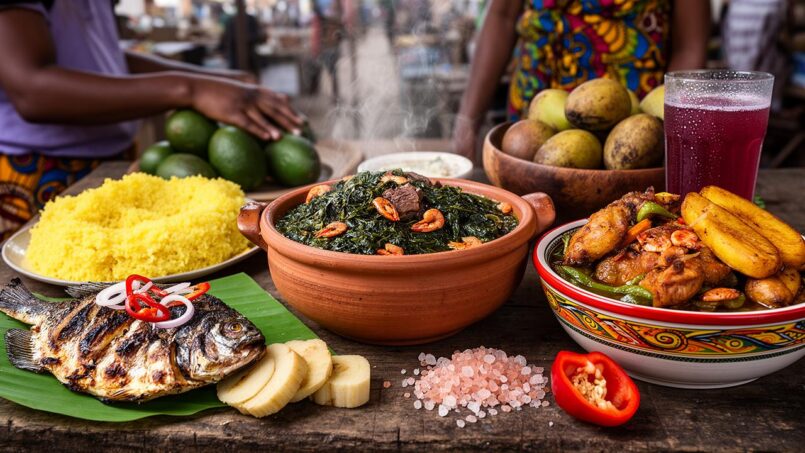
Discovering a country through its plate is arguably one of the quickest ways to understand its culture. In Cameroon, often described as “Africa in miniature,” the gastronomy is a concentrated reflection of this diversity: over 250 ethnic groups, landscapes ranging from equatorial forest to the Sahel, and influences from the coast, savanna, and plateau. For an expatriate, navigating this richness can seem intimidating. But once you grasp the basics — ingredients, iconic dishes, table manners, markets, hygiene — the country becomes a fascinating culinary playground.
Understanding the Landscape: One Country, Multiple Cuisines
Cameroon does not have “one” cuisine, but several, shaped by climate and history. The soil is remarkably fertile across much of the territory, allowing for the cultivation of a wide variety of tubers, cereals, fruits, and vegetables. Influences overlap: Bantu traditions, forest peoples’ practices, colonial-era heritage (corn and tomatoes brought by the Portuguese, bread and omelets popularized by the French), and Sahelian contributions in the North.
The culinary landscape can be roughly divided into major regional zones. As an expatriate, you will likely discover very different specialties and eating habits depending on the region you are in.
| Zone / Region | Main Culinary Characteristics | Examples of Signature Dishes |
|---|---|---|
| Coastal (Sawa, Littoral, Coastal Southwest) | Abundance of fish and seafood, heavy use of palm oil, briny and spicy flavors | Ndolé, grilled fish, mbongo tchobi, miondo |
| Forest (Center, South, East – Fang-Beti) | Cassava, cassava leaves, peanut and palm nut sauces, papillote cooking (ndomba) | Kwem, nfiang owondo, sangah, ndomba |
| Highlands / Grassfields (West, Northwest) | Tubers (taro, cocoyam), yellow sauces with burnt limestone, highly structured ceremonial dishes | Achu and yellow soup, taro with yellow sauce, nkui |
| Sudano-Sahelian (North, Adamawa, Far North) | Millet, sorghum, grilled meats, cereal balls, strong Hausa and Muslim influence | Millet ball with sauce, brochettes/soya, kilichi |
| Cosmopolitan cities (Douala, Yaoundé) | Mix of all traditions, ubiquitous street food, international restaurants | Beignets with beans, chicken DG, jollof rice, shawarma |
This mosaic is found in the markets of Douala or Yaoundé where, within a few meters, you move from piles of taro to the fishmonger, then to mountains of plantains, crates of oranges, and local spices like pèbè or njanssa seeds.
The Basics to Know: Ingredients and Flavors
Before memorizing dish names, it’s helpful to identify the main “families” of ingredients that structure almost every meal.
A traditional West African meal is structured around a central starch (like rice, yam, cassava, or millet), which can be prepared in various ways: boiled, mashed, fermented, steamed, or turned into a ball (fufu) or couscous. This starch is systematically accompanied by a sauce, often very aromatic and spicy, and a source of protein such as meat, fish, or legumes.
| Category | Common Ingredients in Cameroon | Typical Use |
|---|---|---|
| Tubers | Cassava, macabo/cocoyam (taro), yam, sweet potato, taro, plantain (green or ripe) | Fufu, miondo/bobolo, kwacoco, kondré |
| Cereals | Corn, rice, millet, sorghum | Millet balls, jollof rice, cornchaff |
| Legumes | Peanuts, niébé (black-eyed peas), beans, peas | Koki, cornchaff, peanut sauce |
| Leaves | Ndolé leaves (bitterleaf), eru (Gnetum africanum), waterleaf, black nightshade, njama-njama, spinach | Ndolé, eru, sangah, kwem, okok |
| Herbs | Onion, garlic, ginger, leek, celery, local basil (cutmanjo), parsley, lemongrass | Sauce bases and marinades |
| Spices | Peppers (including white Penja pepper), chili, alligator pepper, njanssa grains, pèbè (false nutmeg), burnt “mbongo,” bouillon cubes | Seasoning for stews and grills |
| Fats | Red palm oil, peanut or soybean oil | Cooking, coloring sauces |
| Proteins | Beef, chicken, goat, pork, lamb, fresh fish, smoked fish, dried crayfish, beef skin (kanda), tripe | Accompaniment to sauces |
Two elements often surprise newcomers. First, the massive use of peanuts, not just as a snack, but as a paste that serves as a base for hearty soups. Second, the systematic use of smoked and fermented ingredients: small dried fish, ground crayfish, fermented néré beans, fermented cassava for miondo. They give that depth of flavor — umami — that makes Cameroonian sauces so addictive.
Must-Try Dishes at Least Once
Certain preparations appear everywhere, at parties, corporate buffets, family ceremonies. They form the bedrock of the local taste memory. Here are a few, seen through an expatriate’s eyes: what they contain, where they come from, and how to approach them for the first time.
Ndolé: The National Symbol
Ndolé is regularly presented as the country’s emblematic dish. Originally from the Douala people of the coastal Littoral region, it has conquered the entire territory. It is a creamy stew where young bitter leaves (called ndolé) are thoroughly washed and then simmered with a peanut paste, garlic, ginger, onions, and broth. Depending on the family, beef, shrimp, fish, sometimes pieces of pork rind, and a good dose of ground crayfish are added.
What strikes you is the balance between the controlled bitterness of the leaves, the sweetness of the peanuts, and the richness of the palm oil. The dish often comes with miondo (fermented cassava sticks wrapped in leaves), boiled or fried plantains, or rice.
For a first-time experience, choosing a recommended restaurant rather than an anonymous stall allows you to appreciate a well-mastered ndolé, where the bitterness is softened just right.
Eru: The Green Soup from the English-Speaking Regions
Eru — sometimes called okok or nfoh depending on the ethnic group — comes from the Manyu and more broadly from the Southwest and Northwest. It combines two types of leaves: eru itself (Gnetum africanum, a forest vine, sometimes replaced by okazi leaves) and more watery leaves (waterleaf or spinach) that add softness. The leaves are finely chopped, simmered with plenty of palm oil, crayfish, smoked fish, beef skin, and sometimes beef.
The texture of this dish is dense, almost stringy, with an earthy and smoky flavor, extremely aromatic. It is traditionally eaten with water fufu (fermented cassava paste) or reconstituted garri. Although its smell might surprise unaccustomed palates, it is a very nourishing dish, rich in fiber and minerals.
Achu and Yellow Soup: “The Food of Kings”
In the highlands of the West and Northwest, among the Tikar and Ngemba, achu holds a place of honor in ceremonies. It consists of an elastic dough obtained by pounding taro (cocoyam) and sometimes unripe plantain in a mortar. This pale gray ball is served on large plates hollowed out in the center.
Into this central well is poured the famous yellow soup, whose color comes from a mixture of palm oil and “niki” or “kanwa,” a form of potash or edible limestone. It is seasoned with a complex blend of spices, meat broth, kanda, and tripe, until a silky, slightly spicy sauce is obtained.
Tradition dictates eating with the tip of one finger (referred to as “one finger round the world”), which requires a bit of skill. Achu is highly codified: often served at weddings, funerals, and chieftaincy celebrations. As an expatriate, tasting it during a celebration is a true cultural immersion.
Mbongo Tchobi: The Black Stew of the Bassa
In the Littoral region, among the Bassa, mbongo tchobi is another pillar of local cuisine. This sauce is black, almost anthracite, which intrigues many newcomers. The color comes from controlled burning of a blend of spices, notably a stem called “mbongo” (related to alligator pepper), which is burned and then ground into powder with other seeds (njanssa, pepper, pèbè, etc.). This yields a highly aromatic mixture, both smoky and slightly bitter.
This dish is prepared with a tomato-onion base, palm oil, and fish (often tilapia), forming a thick stew. It is served with plantain, macabo, or rice, offering a complex and addictive flavor, distinct from European tastes.
Poulet DG: The Meeting of French Stew and Plantains
“DG” stands for “Directeur Général” (CEO). Popular lore says this dish was created to impress executives and high-ranking officials before becoming democratized and turning into a classic on restaurant menus across the country.
In principle, it is a kind of chicken fricassee with vegetables, but with a very Cameroonian twist: golden chicken pieces are mixed with fried ripe plantain rounds, carrots, green beans, bell peppers, and onions, all simmered in a tomato sauce seasoned with ginger, garlic, white pepper, and bouillon cubes. It is the quintessential “celebration” dish, often served to guests.
For an expatriate, this is often one of the most accessible preparations, as it combines familiar elements (stewed chicken, vegetables) with a local twist (well-caramelized plantain and spices).
Kwacoco and Mbanga Soup: The Taste of the Southwest Coast
Among the Bakweri in the Southwest, kwacoco is central to the diet. It consists of grated taro, sometimes simply salted, more often enriched with palm oil, smoked fish, crayfish, and green leaves, then wrapped in banana leaves and steamed. The richer version is sometimes called “Kwacoco Bible,” considered a complete bread that “nourishes like the Gospel.”
It is served with a banga soup, a sauce extracted from pounded and boiled palm nuts, flavored with garlic, ginger, smoked fish, or meat. The kwacoco–mbanga duo is very filling and illustrates well how leaves serve as both container and seasoning.
Kondré: The Plantain Stew from the Grassfields
In the West, among the Bamiléké, kondré — or kondres — is another dish often called national. Imagine a pot where large chunks of green plantain, meat (often pork, sometimes goat or beef), tomatoes, onions, garlic, ginger, local spices (pèbè, njanssa, white pepper, rings) cook together, all bound with a little palm oil.
Ndolé is a thick, orange stew where the plantain absorbs the flavors of the meat and spices. A central dish of Cameroonian gastronomy, it is traditionally served at major events such as weddings, funerals, and baptisms.
Soya, Brochettes, and Other Street Grills
Everywhere in the country, and particularly in the popular neighborhoods of Yaoundé and Douala, nightfall brings smells of charcoal and spices. Stalls selling soya — skewers — line up.
| Snack / Street Food | Culinary Description | Typical Price Range* |
|---|---|---|
| Soya / brochettes | Thin pieces of beef, goat, or chicken marinated in peanut-chili spices | From 50 FCFA per skewer in Yaoundé |
| Grilled fish (poisson braisé) | Whole grilled tilapia or mackerel, marinated in spices and served with chili | About 1,000–2,500 FCFA per fish |
| Kilichi | Dried, spiced meat, very concentrated in flavor | From 500 FCFA per portion |
Amounts vary by city, neighborhood, and type of fish or meat.
Soya has Hausa roots, imported from the North. It often features a mixture of peanut powder, chili, onion, and salt. It’s the perfect snack with a local beer or ginger juice.
Grilled fish, popular in Douala, is enjoyed with fried plantain rounds, cassava stick (bobolo), and a very spicy chili sauce. For an expatriate, it’s almost a mandatory moment: sitting on a plastic stool, grabbing the fish with your fingers, tearing the flesh and dipping it into the chili sauce.
Morning Street Food: Beignets, Beans, Porridge
The most typical street breakfast is probably the trio of beignets–beans–porridge (often abbreviated as BHB).
Beignets (puff-puff) are small, sweet dough balls, yeast-risen and sometimes flavored with nutmeg, fried until golden and slightly crispy. The beans are cooked in a tomato sauce with onions, chili, and sometimes a little palm oil. The porridge is a fermented corn and lemongrass-based porridge, slightly tangy.
This combination often costs just a few hundred CFA francs and feeds two people. It is simple, filling, and also one of the places where you can start chatting with the female vendors, who often run this informal sector tirelessly.
Eating in Cameroon: Table Manners and Social Life
Beyond what’s on the plate, the way of eating tells a lot. Cameroonian society remains very community-oriented and hierarchical. Food is a mirror of that.
The evening meal is the main gathering time for the extended family. It is common to share large communal dishes, especially in village or conservative settings. Before eating, the lady of the house brings a basin for guests to wash their hands, sometimes with soap. You eat exclusively with the right hand, pinching a bit of the accompaniment (like fufu or plantain) to soak up the sauce.
Some useful guidelines for an expatriate invited to a Cameroonian home:
During a shared meal, it is polite to wait for the oldest or most respected person to start eating. Each person should only serve from the part of the communal dish directly in front of them. It is advisable to leave a small amount of food on your plate to indicate you are full, without wasting. Although many dishes are traditionally eaten with the fingers, utensils are often offered out of courtesy to foreign guests.
If there is a delicacy you do not wish to eat (for example, a gizzard offered as a sign of honor to the guest), it is politer to explain that you have already eaten a lot and to suggest that this “choice piece” be given to the eldest.
Learning to observe and imitate others’ gestures at the table is the safest way to respect the codes, especially at first.
Markets, Haggling, and Sourcing Supplies
To truly understand local gastronomy, you need to leave air-conditioned supermarkets and frequent open-air markets. In Douala, the Central Market and Sandaga overflow with fish from the Wouri River and giant yams. In Yaoundé, Mokolo, Mfoundi, or Mvog-Mbi are labyrinths where meat, vegetables, clothing, and utensils mingle.
Haggling is the rule. Displaying the actual starting price is not in the culture: the first quote is often intentionally inflated, especially if you look foreign. Bargaining is part of the game but remains a social exchange, not a trench war.
When a vendor quotes a kilo of mangoes at 1,000 FCFA, a common negotiation strategy is to greet, then offer about half the initial price, around 500–600 FCFA. The discussion then gradually moves toward a compromise acceptable to both parties, for example, a final agreement at 700 FCFA.
Knowing a few phrases in French or Pidgin helps enormously. Lines like “Mama, that’s too expensive!” or “Can you give me a little gift?” (the famous “dash,” an extra thrown in for free) often bring smiles.
Carrying small bills of 500 or 1,000 FCFA is essential: vendors cannot always make change for large notes. By returning regularly to the same stalls — a seller of eru leaves, a butcher, a fishmonger — you build a relationship that translates into better prices, products set aside for you, and sometimes valuable cooking tips.
Health, Hygiene, and Food Safety: Enjoy Without Getting Sick
The temptation to try everything is strong, but Cameroon is also a country where certain foodborne and waterborne diseases remain common: diarrhea, typhoid, cholera in some contexts, and parasitic infections. For an expatriate, a few precautions turn culinary curiosity into a serene experience rather than a hospital-toilet loop.
A simple principle sums up most recommendations: “Boil it, cook it, peel it, or leave it.” In other words, prioritize foods:
– served very hot and well-cooked (simmered stews, grilled items cooked through),
– from fruits you can peel yourself (banana, orange, mango, pineapple),
– or vegetables well-washed and then cooked.
Tap water is not always potable. Prefer industrially bottled water (checking the seal) or hot drinks (tea, coffee). In bars, soft drinks and national beers (Castel, 33 Export, Beaufort) are generally safe, but be wary of ice cubes, whose water source is rarely guaranteed.
Markets and street food raise another issue: handling and storage. A study carried out in Yaoundé on street foods highlighted significant levels of microbial contamination, particularly in some artisanal fermented milks. Without becoming paranoid, a few reflexes greatly reduce the risks:
To avoid food poisoning when buying street food, prioritize busy vendors where product turnover is high, ensuring freshness. Strictly avoid foods made from raw or unpasteurized milk sold under questionable hygiene conditions. Opt for fried items and grilled foods prepared and served in front of you. Finally, wash your hands regularly with soap and water, or use hand sanitizer before eating.
In parallel, most health organizations recommend that people settling in Cameroon update their vaccinations (yellow fever mandatory for entry, typhoid, hepatitis, etc.) and take malaria prevention measures if traveling to risk zones. This does not directly concern food but conditions your ability to continue exploring restaurants and “maquis” without prolonged interruptions.
From One Corner of the Country to Another: Reading a Menu by Knowing the Geography
For an expatriate traveling, understanding the links between regions and specialties helps you navigate a buffet or restaurant menu.
– On the coast (Douala, Kribi, Limbé), it would be a shame not to focus on grilled fish, stews like mbongo tchobi, and shellfish preparations. Pounded cassava leaf sauces (mboam kpem, kwem) are also common.
– In the forest regions of the Center and South, peanut sauces, cassava leaves with palm nut cream, and papillotes (ndomba of fish, chicken, or pork) dominate. This is where you often encounter Beti dishes like nfiang owondo (meat stew with peanuts).
On the plateaus of the West and Northwest, cuisine is dominated by dishes based on taro, corn, and beans. Specialties include achu, taro with yellow sauce, nkui (a viscous bark-based sauce served with corn couscous), mashed potatoes with beans, and cornchaff (a mix of corn and beans).
– In the North and Far North, the Sahelian proximity translates into the importance of millet and sorghum, cereal balls topped with sauce, Hausa-style skewers, dried meats like kilichi, and a more discreet use of palm oil.
This diversity also explains the variety of dishes on an urban restaurant menu: even without leaving Douala or Yaoundé, you can in one week go from Bassa flavors to those of the Bayangi, then to a Beti dish, before rising to Bamiléké aromas.
Adapting Your Habits: Eating Local Without Abandoning Your Bearings
Arriving in Cameroon sometimes requires dietary adjustment. Dishes are often richer in complex carbohydrates, spicier, and palm oil — very present — surprises at first. A few strategies allow you to enjoy this cuisine without discomfort.
Starting with “bridge” dishes can help. Chicken DG, jollof rice (tomato rice with vegetables and meat), chicken in tomato sauce, plain beignets, are less disorienting entry points. Gradually, you can explore more distinctive preparations: okra sauce and its “slimy” texture, intensely smoky eru, achu with potash, etc.
Many traditional recipes include leafy greens (ndolé, eru, waterleaf, black nightshade) while being very calorie-dense due to peanuts, palm oil, and starches. If you have health or weight concerns, you can adapt these recipes by reducing the amounts of high-calorie ingredients or seeking lighter alternatives.
– ask for smaller portions of starches (less fufu, more sauce and vegetables),
– balance with seasonal fruits, which are abundant: mangoes early in the year, citrus in the dry season, papayas, pineapples, guavas,
– take advantage of grilled fish, often a lighter option than some heavily sauced dishes.
Markets are also full of more “familiar” vegetables — cabbage, carrot, eggplant, green beans — very affordable, allowing you, at home, to alternate between local cuisine and recipes from your home country.
Street Food, Restaurants, and World Cuisines: Where to Eat as an Expatriate
In Yaoundé and Douala, the range goes from the neighborhood hole-in-the-wall to the gourmet restaurant, including Lebanese, Indian, Chinese, and French establishments. Street food remains the most economical and exotic option, but it requires some adjustment time.
In the morning, you can find beignets, beans, akara, corn or millet porridge, and bread with omelet sometimes garnished. During the day, markets offer koki (black-eyed pea cake), kwacoco packets, boiled peanuts, and roasted plantains served with peanuts.
In the evening, grilled items take over: meat skewers, grilled fish, soya, grilled pork. In some neighborhoods like Briqueterie in Yaoundé — nicknamed “the ministry of soya” — or Deïdo in Douala, the offering is vast.
For an expatriate, the ideal is to alternate between these experiences and more structured restaurants, especially during the first few months, while getting used to the flavors and identifying establishments serious about hygiene.
Respecting Social Codes Around Food
In Cameroon, inviting someone to eat is a gesture of great hospitality. When a colleague invites you for lunch, it is normally expected that he or she will pick up the tab, especially if a man is inviting. You can, however, clarify in advance that each will pay their share, especially if you feel it would embarrass them.
It is appreciated to bring a bottle of wine, whiskey, or a fruit basket when invited, unless the family is Muslim (avoid alcohol). However, bringing a cooked dish can be seen as criticism of the host.
Gifts, like food, are generally given with the right hand (or both hands), never just the left. And do not be surprised if the gift is not opened immediately: it is not coldness, simply a different way of doing things.
Making Cameroonian Cuisine Your Own at Home
Gradually, many expatriates start cooking local dishes, either out of curiosity or because ingredients to exactly replicate their home country’s recipes are not always easy to find. The advantage of Cameroon is that the basic products of its cuisine — cassava, plantain, peanuts, leafy greens, meats, fish — are available everywhere.
With a large, heavy-bottomed pot, a sturdy frying pan, a mortar, or a good blender, it is possible to prepare many classics at home, like peanut sauce, bean stew, chicken in tomato sauce, Cameroonian-style jollof rice, or oven or pan-fried soya.
Learning from colleagues or neighbors is often the best school. Cameroonians are generally proud of their specialties and happy to show you how to wash ndolé to remove bitterness, how to obtain a smooth cassava fufu, how to burn mbongo spices without charring them.
Once you master a few, these dishes become a shared language. Serving a good ndolé or kondré to colleagues or employees at a small gathering at your home sends a strong message: you take the culinary culture of your host country seriously.
Between Discovery and Caution: Finding Your Own Balance
Exploring gastronomy in Cameroon means accepting to step outside your comfort zone: eating with your fingers, trying unusual textures (slimy okra, very oily sauces, finely chopped and long-cooked leaves), accepting a degree of chili and smokiness, haggling at the market, trusting street vendors.
But this immersion is also a fast track to understanding society. Family hierarchies are read in the order of serving dishes, the pooling of resources is seen in how people share a large plate of fufu, ingenuity appears in the use of every part of the cassava or palm tree.
For an expatriate, the goal is not to like everything, nor to force yourself systematically. Rather, it is about tasting with curiosity, respecting local codes, asking questions — of the cook, the vendor, the colleague explaining the difference between okok beti and okok bassa — and gradually adopting what, in this cuisine, resonates with your own habits.
Advice for an Expatriate
Over time, many find themselves dreaming, back home abroad, of a grilled fish with chili, a plate of achu shared with fingers, or a simple beignet-haricot wolfed down on a street corner in Yaoundé. That is perhaps the sign that they have truly settled in… Cameroon.
Disclaimer: The information provided on this website is for informational purposes only and does not constitute financial, legal, or professional advice. We encourage you to consult qualified experts before making any investment, real estate, or expatriation decisions. Although we strive to maintain up-to-date and accurate information, we do not guarantee the completeness, accuracy, or timeliness of the proposed content. As investment and expatriation involve risks, we disclaim any liability for potential losses or damages arising from the use of this site. Your use of this site confirms your acceptance of these terms and your understanding of the associated risks.

Cyril Jarnias is an independent expert in international wealth management with over 20 years of experience. As an expatriate himself, he is dedicated to helping individuals and business leaders build, protect, and pass on their wealth with complete peace of mind.
On his website, cyriljarnias.com, he shares his expertise on international real estate, offshore company formation, and expatriation.
Thanks to his expertise, he offers sound advice to optimize his clients' wealth management. Cyril Jarnias is also recognized for his appearances in many prestigious media outlets such as BFM Business, les Français de l’étranger, Le Figaro, Les Echos, and Mieux vivre votre argent, where he shares his knowledge and know-how in wealth management.





