
 Published on and written by Cyril Jarnias
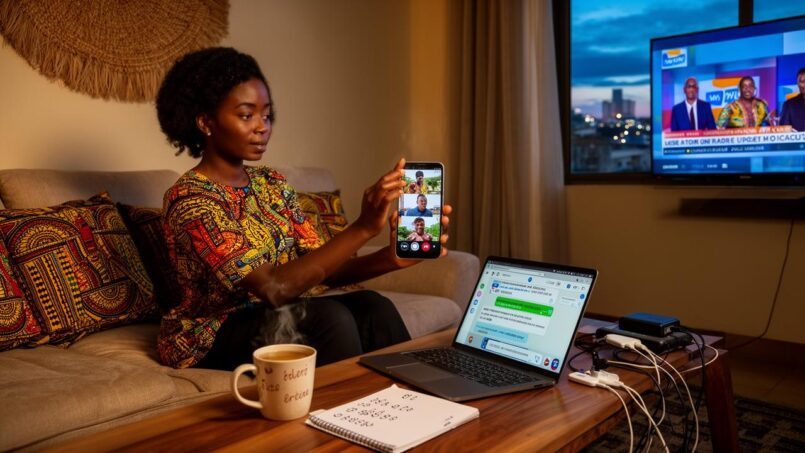
Staying close to your family has never been easier… nor more complex. In Cameroon, between sometimes unreliable connections, the cost of internet, the realities of the diaspora, and very strong cultural habits around family, keeping in touch requires a bit of organization and good choices of tools.
This guide is based on recent data to present in a concrete way all the means of staying in touch from Cameroon. It covers offers from telephone operators, the rise of apps like WhatsApp, money transfer services, as well as traditional means like postal mail.
A hyper-connected country… but not for everyone
Cameroon is far from disconnected. By the end of 2025, there are approximately 29 million active mobile connections, or more than 96% of the population. This does not mean everyone owns a smartphone, but access to a phone has become nearly universal.
At the same time, 12.6 million people use the internet, representing just over 41% of the population. The gap is significant: everyone makes calls, but less than half browse the web, make video calls, or use social media.
By the end of 2025, nearly 5.9 million social media user identities are recorded, representing about 20% of the population.
The local landscape is very clear: Facebook and WhatsApp dominate massively, with Instagram, TikTok, and other platforms far behind. Social media market share statistics illustrate this reality.
| Platform | Estimated market share (Jan. 2026) |
|---|---|
| 87.86% | |
| 9.22% | |
| YouTube | 1.08% |
| TikTok | 0.81% |
| X (Twitter) | 0.61% |
| 0.35% |
Behind these figures lie very real uses: family chats on WhatsApp, video calls with the diaspora, Facebook pages to follow news from the country, support groups, etc. Staying in touch in Cameroon today primarily involves mobile phones and messaging apps.
Choosing your connection wisely: Camtel, MTN Cameroon, Orange Cameroun
Before talking about apps, we need to talk about what makes them work: the internet connection. In Cameroon, three players dominate the market: Camtel, MTN Cameroon, and Orange Cameroun. Each offers mobile packages and sometimes fixed internet solutions for the home.
The most useful mobile and home internet plans for communicating
To stay in touch via messaging, video calls, or social media, you need to find a balance between cost, data volume, and connection stability. A few offers illustrate the possibilities well.
Example of Camtel plans
| Camtel Offer | Price (XAF) | Volume / Details | Validity |
|---|---|---|---|
| BLUE GO S | 2,000 | 9 GB (300 MB/day) | 30 days |
| BLUE GO M | 5,000 | 25.5 GB (850 MB/day) | 30 days |
| BLUE MO XXL | 5,000 | 10 GB (total) | 30 days |
Offers with “daily consumption” like BLUE GO S or M are interesting for those who want a very controlled budget, with a fixed amount of data per day. They suit regular but reasonable usage: WhatsApp, Facebook, a few short video calls.
Example of MTN Cameroon plans
| MTN Cameroon Offer | Price (XAF) | Volume / Details | Validity |
|---|---|---|---|
| Mobile Surf Month 850 | 850 | 250 MB | 30 days |
| Mobile Surf Month 2,000 | 2,000 | 1.2 GB | 30 days |
| Mobile Surf Month 4,000 | 4,000 | Higher volume (details not specified) | 30 days |
The “Mobile Surf Month 850” offer is very affordable, but 250 MB over a month requires being extremely frugal, especially if you plan video calls. It’s enough for messaging (text, audio) and light social media use. Beyond that, you need a larger data plan.
A powerful fixed internet solution for the home, designed for intensive digital use.
Ideal for watching lots of high-definition video without interruption.
Perfect for smooth, frequent video calls or group meetings.
Offers the stability and speed needed to work from home under optimal conditions.
Example of Orange Cameroun plans
Orange Cameroun focuses on bundled offers combining internet and calls, especially suited to families.
| Orange Plan Type | Price (XAF) | Main Content | Validity |
|---|---|---|---|
| 1-day plan | 204–2,000 | 170–300 MB + unlimited calls to Orange | 1 day |
| 3-day plan | 510–2,500 | 7 GB (1 GB/day) + unlimited calls to Orange | 3 days |
| 7-day plan | 7,500–10,000 | 45 GB (1.5 GB/day) + unlimited calls to Orange | 7 days |
| 30-day plan | 11,500 | Unlimited calls to Orange + local minutes | 30 days |
For intensive family use – frequent calls, sending photos/videos in WhatsApp groups, traditional voice calls – these combo plans are especially practical.
Orange also offers “Wanda net”, a range of small data plans for occasional consumption, sometimes very cheap (80 XAF for 70 MB, 150 XAF for 150 MB, etc.), useful for top-ups.
How to choose your plan when the main goal is to stay in touch
To stay connected with loved ones over time, three practical questions to ask yourself:
The main communication tools today include text and audio messaging (like WhatsApp and SMS), voice calls (traditional or via apps), individual or group video calls, and social media platforms such as Facebook, TikTok, and Instagram. These means enable instant and multimedia exchanges, suited to various personal and professional contexts.
2. How often will I communicate?
Just a few messages a day? Weekly video calls? Daily chats with the diaspora?
3. What is my reasonable monthly internet budget?
For usage centered on WhatsApp (texts, audios, some photos), a small monthly plan (around 850 to 2,000 XAF with MTN or 2,000 XAF with Camtel) may be enough.
For regular video calls with family abroad, it’s wise to aim for at least 1 to 2 GB per month, or more if you do group calls.
The “home” offers from MTN and Orange, or BLUE HOME from Camtel, become interesting when several people in the household connect at the same time (parents, children), or when there is a need for a stable connection for work.
Making video calls with limited internet: playing smart
One of the major frustrations in Cameroon (and in many countries): starting a video call, seeing the image freeze, losing sound, or even the call dropping. The good news is that with a few technical adjustments, you can often improve the situation, even with modest bandwidth.
Technical recommendations show that it is theoretically possible to do a video conference with only 0.3 to 0.5 Mbps. For a comfortable standard-definition experience, the ideal is rather between 1 and 2 Mbps. For high definition, you need more, but that’s not essential for talking to family.
Recommended bandwidth for video calls
| Type of communication | Recommended bandwidth |
|---|---|
| Audio only | ~100 Kbps |
| Basic video (minimum SD) | 0.3–0.5 Mbps |
| Decent video (comfortable SD) | 1–2 Mbps |
| HD 720p | 3–5 Mbps |
| Full HD 1080p | 5–10 Mbps |
When the connection is weak, the goal is not perfect image, but that the voice gets through clearly and the conversation remains smooth. Several platforms (Zoom, Google Meet, some solutions like Jitsi or KalamTime) include “low bandwidth” modes or automatically adapt quality.
A few simple settings that make a big difference
In practice, several tips can significantly improve call quality from Cameroon, without changing operators.
To save data and improve stability during video conferences, it is advisable to reduce video resolution. For example, switching from HD to 360p or 480p yields significant savings. On Zoom, you can disable HD video in settings. On Google Meet, you can lower the send and receive resolution.
Next, turn off your camera when you are not speaking. This is a simple habit: start with video to see each other for a few moments, then switch to audio only if the connection becomes unstable. The other person may continue with video if their connection allows, but by stopping your own video stream, you significantly reduce data usage.
Move closer to the router (for those with a home box) or position yourself in an area with better 3G/4G coverage can also transform a choppy call into a smooth conversation. Simply moving to another room or near a window can make a difference.
To ensure call quality, it is essential to close other applications that consume bandwidth (downloads, video streaming, automatic updates). In a household sharing the connection, asking for a temporary pause of services like Netflix or YouTube may be necessary to avoid interruptions.
Adapting the tool to on-the-ground realities
Each video conferencing app has its specific settings. A few examples from the experience of organizations working in low-bandwidth areas show that:
– By setting video quality to 360p, limiting the number of active video streams, and prioritizing wired connections (where possible), NGOs have managed to organize regular meetings with underserved regions with much fewer dropouts.
– Schools have reported fewer student dropouts in online classes when they systematized these low video quality settings and “optimized for low bandwidth” modes.
In the Cameroonian context, where a significant part of the population lives in rural areas with uneven connectivity, these adjustments are valuable for maintaining regular calls with relatives in other cities or abroad.
WhatsApp: the real “digital family living room”
If you had to choose a single tool to stay in touch with loved ones from Cameroon, it would probably be WhatsApp. Studies show it is used by nearly all smartphone owners in the country, with usage rates often exceeding 95% among young adults.
WhatsApp is no longer just a messaging app: it has become a family space, a social space, sometimes a professional one. Family groups, village groups, neighborhood groups, old classmates groups number in the dozens.
Why WhatsApp has become central to family life
Several factors explain this dominant position. The app is simple, lightweight, works relatively well even with an average connection, and allows everything: texts, voice notes, photos, videos, voice calls, video calls, groups, statuses, and now “Communities” for organizing large sets of groups.
Research conducted notably in Africa and elsewhere shows how families use WhatsApp to compensate for distance. Groups are created for the nuclear family (daily organization, logistics), for the extended family spread across several countries, for coordinating financial contributions during family events, or for tracking the progress of a project (building a house, caring for an elderly parent, pregnancy, etc.).
Thanks to group capacity (up to 1,024 members) and video calls (up to 32 participants), a family scattered between Yaoundé, Douala, Bafoussam, Paris, Brussels, and Montreal can organize a virtual reunion to celebrate a birthday, a birth, or support each other during a bereavement.
Typology of family groups observed on WhatsApp
Qualitative studies on family groups offer a very telling picture, which resonates strongly with the experience of many Cameroonian families.
There are groups dedicated to managing daily life: who picks up the kids, what’s for dinner, practical information. Others, much larger, bring together several branches of the family. Exchanges are often multilingual, sometimes very visual (photos, videos, stickers, emojis), so that everyone understands at least the essentials.
Some groups focus on good news: photos of the children, school results, small achievements, vacation memories. Messages perceived as too negative or conflictual are sometimes de facto banned, to preserve the atmosphere.
Other groups are thematic. For example, groups created to support a pregnancy, manage a construction project, care for a sick parent, or keep the memory of a deceased loved one (“memorial groups”). These spaces allow for sharing practical information as well as emotional support.
Within family groups, there are discreet subgroups to discuss sensitive topics (like politics or family tensions) so as not to disturb the main conversation. Other subgroups are reserved exclusively for the women or men of the family, allowing freer exchanges on certain subjects.
What studies say: strengthened bonds but also tensions
A study conducted on a family group of 34 members showed that the majority of exchanges concerned friendship and positive interactions. Over a month, more than 280 conversations were analyzed, with a large number of support messages, congratulations, and positive reactions.
It also appears that generations do not use the tool in the same way. Middle-aged adults (Generation Y in the study) see the group as an essential means of staying close to distant relatives. The younger generation, on the other hand, sometimes sees it more as a social obligation, preferring individual conversations or other platforms (TikTok, Instagram).
Other work highlights challenges: notification overload, public arguments over sensitive topics, spread of rumors or misinformation, difficulties managing privacy when everyone sees everything.
For children and teenagers, exposure to conflicts between adults in online family groups can be unsettling. It is recommended to clarify the group’s purpose, create separate spaces for logistics and informal discussions, establish basic rules like respect and bans on insults or anxiety-inducing chains, and split groups that have become too large.
The usefulness of WhatsApp goes far beyond casual conversation. A study conducted in Yaoundé with pregnant women showed that a WhatsApp group (“Wise Moms”) moderated by health staff, with weekly educational videos, significantly improved attendance at prenatal check-ups.
Participants could ask questions, share concerns, and encourage each other. Exchanges remained supervised by moderators who prevented drift toward informal medical advice. This type of experience illustrates how the tool can simultaneously strengthen the bond between patients and professionals, and between women in similar situations.
More broadly, surveys on young adults in Cameroon show that WhatsApp and Facebook are major sources of information, including health information, although content reliability varies. In this context, family groups often play a filtering role: a diaspora member can correct misinformation about a miracle cure, or share more reliable resources.
International calls: reaching loved ones in Cameroon from abroad at low cost
For diaspora members, staying in touch with family in Cameroon often involves a combination of internet messaging, VoIP calls (WhatsApp, Messenger, etc.), and traditional phone calls for relatives who are not comfortable with smartphones or who live in areas with very poor coverage.
Internet calls are free in appearance but consume data and require a good connection on both ends. Traditional calls, on the other hand, are paid, sometimes expensive, but are often more reliable, especially to local mobile numbers.
“2.0” calling cards for Cameroon
Services like Yolla offer a sort of modernized calling card, fully managed from a mobile app. The goal is to simplify what physical cards used to do: offer advantageous rates for international calls, without needing to scratch codes or use complicated access numbers.
Announced rates for Cameroon give an order of magnitude of cost:
| Type of call or SMS to Cameroon | Indicative rate with Yolla |
|---|---|
| Call to landline | 23.9 cents/minute |
| Call to mobile | 36.9 cents/minute |
| SMS | 17 cents/SMS |
With a credit of $10, you get about 41 minutes of calls to a landline and 27 minutes to a mobile. The sales pitch highlights savings of up to 90% compared to certain standard rates, provided of course you compare with the initial offer.
– This type of service becomes useful in several situations:
– when one of the speakers does not have access to a smartphone or mobile internet,
– when the data connection is too unstable for a WhatsApp call,
– or when you want to be sure the call will go through, even if the recipient has no data left.
Call quality is generally good, as these services leverage recent telecommunications technologies and optimize international routes.
Choosing between internet call and traditional phone call
To stay in touch from or to Cameroon, the choice between VoIP (WhatsApp, Messenger, etc.) and traditional call must be made on a case-by-case basis.
Internet calling is ideal when:
– Both parties have a smartphone and a sufficient data plan.
– The connection is stable (at least 0.3–0.5 Mbps consistently for voice with degraded image, 1–2 Mbps for better quality).
– You want to see the person (video).
A traditional phone call, via an operator or a virtual card like Yolla, remains relevant when:
– The relative has a basic phone (no data or smartphone).
– They are in an area with very poor or no internet, but where the GSM network works.
– You need to reach them urgently without worrying about their data credit.
In practice, many families combine both: WhatsApp and Facebook for daily life, and traditional calls or low-cost services for important events, or when apps don’t work properly.
Sending money: another way to “talk” at a distance
Maintaining the bond is not just about exchanging news; for the Cameroonian diaspora, it also involves money transfers. These fund essential expenses (education, health, food) and are often at the center of family discussions on WhatsApp.
Many specialized services now allow sending money to Cameroon: Remitly, Taptap Send, MoneyGram, Afriex, BOSS Money, WorldRemit, Cash-Me, Accrue, among others.
How does money arrive in Cameroon?
There are three main reception methods:
Discover the different ways your loved ones can receive the money you send them, tailored to their needs and situation.
The amount is credited directly to an account at a local bank (Banque Atlantique, BGFI Bank, CCA Bank, UBA, etc.). Ideal solution for families who already have bank accounts.
The most common method for quick transfers. Money is sent directly to an MTN Mobile Money or Orange Money Cameroon account via services like WorldRemit or Remitly.
The recipient withdraws cash at an authorized partner (Wafacash, Express Exchange, MoneyGram points) by presenting an ID and a transaction code.
Some services, like Cash-Me, also accept sending to several mobile money networks (MTN, Orange, Airtel, Vodafone in other countries). Others, like Afriex, emphasize speed (99% of transfers in under 20 seconds) and very low or zero fees.
Costs, limits, and precautions
Each service has its own fees, exchange rates, and limits. A few key points:
Money transfers to mobile wallets like Orange Money and MTN are subject to limits per transaction and per day, which vary by service and operator. Promotional offers, such as fee-free transfers or favorable rates, are sometimes available for new customers. Generally, the recipient does not pay fees to receive, but fees may apply when withdrawing cash from the mobile operator.
On the sender’s side, the procedure is generally the same: create an account on the app, enter the recipient’s information (exact name, mobile money phone number or bank details), choose the amount, currency, reception method, and payment method (bank card, wire transfer, etc.), then confirm.
This constant financial flow also feeds family conversation: who sends, when, for what need, how to split contributions for a hospitalization, funeral, or school fees. WhatsApp groups are often where these decisions are organized in real time, between those who stayed home and those who live elsewhere.
Letters, postcards, and packages: the tangible bond that still matters
In the age of video calls and instant transfers, one might think the letter is dead. Yet sending a postcard, a letter, or a package to Cameroon remains a powerful way to show special attention. For grandparents uncomfortable with digital technology, for children discovering mail from far away, this gesture has a strong symbolic value.
Sending a letter or postcard from the United States to Cameroon
The basic rules of the U.S. postal system provide a good example of what mail to Cameroon costs.
The price in dollars of a ‘Global Forever Stamp’ for sending a standard letter up to 1 ounce from the United States.
Estimated delivery times generally range from one to three weeks. Envelopes must meet certain dimensions and remain rectangular and flexible to avoid surcharges.
For a postcard, the base rate is also $1.65, with slightly different format constraints (smaller and thinner). Recent rate increases show that the cost of sending is gradually rising, but remains manageable for occasional sending.
Addressing mail correctly to Cameroon
The Cameroonian addressing system relies heavily on post office boxes (“B.P.”). A typical address will include:
To correctly address mail to Cameroon, include: the recipient’s name, possibly their company name, the post office box or physical address, the city (like Yaoundé or Douala), the five-digit postal code (though the city is often preferred), and the country written in capital letters: ‘CAMEROUN’.
Post offices recommend writing in capital letters, without unnecessary punctuation, and mentioning “AIRMAIL / PAR AVION” for airmail.
For packages, you must be prepared to fill out detailed customs forms, describe the contents, estimate their value, and sometimes pay customs duties or VAT upon arrival in Cameroon.
Despite these constraints, the arrival of a package or letter from the diaspora is still an event in many families. It is also a way to maintain an intergenerational bond when some family members are not comfortable with digital technology.
Social networks: an extension of the Cameroonian household
Beyond WhatsApp, other social networks play a key role in maintaining ties with loved ones. Facebook remains by far the most used platform in Cameroon, with nearly 5.9 million users by the end of 2025 and steady growth.
Data shows that Facebook reaches nearly half of the country’s internet users. Men are slightly more numerous than women, but the gap is gradually narrowing.
Although Instagram, TikTok, LinkedIn, and X (formerly Twitter) remain niche markets compared to other platforms, their growth is significant among specific audiences such as urban youth, professionals, and content creators.
Studies on 18–35 year olds show massive use of WhatsApp (nearly 98% in one sample) and very strong use of Facebook, followed by TikTok and Instagram. A significant portion of these young people say they spend more than five hours a day on social networks, especially to scroll the feed, react to posts, and exchange private messages.
In a collectivist cultural context, digital platforms serve as an extension of family and community life. They allow sharing and following major events (weddings, funerals, academic successes, projects), cultural celebrations like Ngoun and Ngondo (UNESCO heritage), as well as the exploits of national athletes and artists abroad.
For dispersed families, following the Facebook profile of a cousin who stayed home or a nephew who went abroad, watching a little sister’s Instagram stories or the TikTok videos of young parents is a way to “see” their daily life, even when you don’t call every day.
Learning to use the tools: the challenge for older adults
While young Cameroonians are massively present online, older adults – parents, grandparents – are not always comfortable with smartphones and apps. Yet several international studies show that good digital skills improve seniors’ quality of life, strengthen ties with their entourage, and can even have a positive effect on cognitive functions (memory, attention).
In Cameroon, initiatives like those of the Community Development Network offer digital training, including in rural areas, with modules on using basic software (Word, Excel, Photoshop) and, more broadly, on using the internet.
In other countries, effective programs rely on small learning groups, an adapted pace, and individual support, using concrete examples like sending a message to grandchildren or making an online medical appointment. Studies show that intergenerational teaching approaches, pairing students and older adults, increase seniors’ confidence and reduce their isolation.
Transposing these good practices to Cameroon, or integrating them into the activities of neighborhood associations, parishes, community centers, would be an effective way to allow older people to stay fully connected to their children and grandchildren, especially when they live abroad.
Staying in touch without losing yourself: finding balance
With so many tools available – traditional calls, instant messaging, video, social networks, money transfers, packages – the temptation is to stay connected permanently. Studies on intensive social media use in Cameroon show ambivalent effects on mental health: on one hand a feeling of support and closeness, on the other possible social pressure or information overload.
To navigate hyper-connected family life well, it is beneficial to set a few flexible rules: plan screen-free moments (like during meals), avoid conflictual topics (like politics) in online family groups, manage notifications sensibly, and alternate between digital exchanges and in-person meetings when possible.
Digital tools do not replace visits, face-to-face conversations, concrete acts of solidarity, but they extend and amplify them. In a country where the diaspora plays a major role – whether through community initiatives, money transfers, or participation in debates about the country’s future – these tools become indispensable for maintaining the warmth of family bonds despite the distance.
Staying in touch with loved ones from Cameroon today means knowing how to intelligently combine these different means:
To keep in touch with family abroad, it is advisable to choose communication plans that fit the budget, use optimized video calls for limited connections, and manage WhatsApp groups tactfully to make them supportive spaces. Money transfer services should match the economic realities of families, and sending letters or packages remains a precious way to show affection.
By mastering these resources, everyone can turn geographical distance into a simple time zone difference – and continue to nurture, every day, that family bond so central to Cameroonian society.
Disclaimer: The information provided on this website is for informational purposes only and does not constitute financial, legal, or professional advice. We encourage you to consult qualified experts before making any investment, real estate, or expatriation decisions. Although we strive to maintain up-to-date and accurate information, we do not guarantee the completeness, accuracy, or timeliness of the proposed content. As investment and expatriation involve risks, we disclaim any liability for potential losses or damages arising from the use of this site. Your use of this site confirms your acceptance of these terms and your understanding of the associated risks.

Cyril Jarnias is an independent expert in international wealth management with over 20 years of experience. As an expatriate himself, he is dedicated to helping individuals and business leaders build, protect, and pass on their wealth with complete peace of mind.
On his website, cyriljarnias.com, he shares his expertise on international real estate, offshore company formation, and expatriation.
Thanks to his expertise, he offers sound advice to optimize his clients' wealth management. Cyril Jarnias is also recognized for his appearances in many prestigious media outlets such as BFM Business, les Français de l’étranger, Le Figaro, Les Echos, and Mieux vivre votre argent, where he shares his knowledge and know-how in wealth management.





