
 Published on and written by Cyril Jarnias
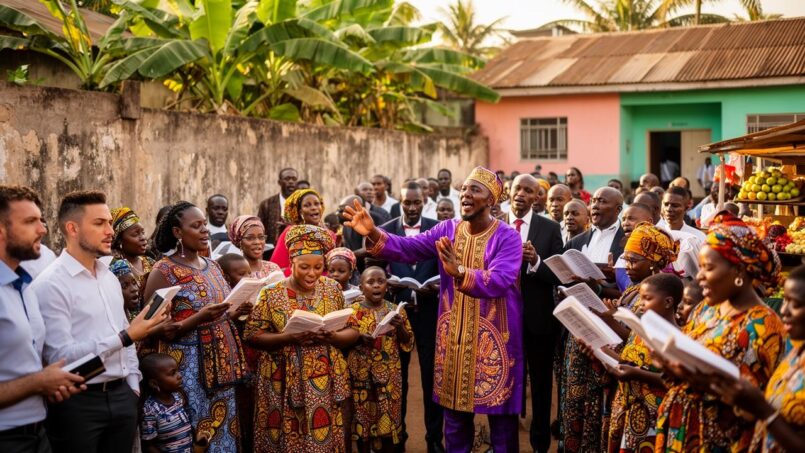
Settling in Cameroon means entering a country where religion permeates daily life, festivals, calendar rhythms, and even the most ordinary conversations. For an expatriate, faith is not just “one topic among others”: it is a social reference point, a cultural code, and often a bridge—or a wall—depending on how one approaches it.
This guide aims to ease your integration by presenting Cameroonian religious practices. It enables you to participate in services, festivals, and ceremonies while respecting often very strong cultural sensitivities, in order to avoid any missteps.
A Uniquely Diverse Religious Landscape
Cameroon is a secular state whose constitution guarantees freedom of religion and conscience. In practice, faith occupies a central place in the lives of the majority of the population, to the point that nearly 95.5% of residents say religion is important to them.
Who Believes in What?
Figures vary depending on the source, but all converge on one point: the country is predominantly Christian, with a very significant Muslim minority and a more discreet but real presence of traditional African religions.
Here is an overview of several estimates from different surveys and organizations:
| Source / Year | Christian (%) | Muslim (%) | Traditional Beliefs / Animism (%) | No Religion / Other (%) |
|---|---|---|---|---|
| 2005 Census | 69.2 | 20.9 | 5.6 | 4.3 |
| Pew-Templeton 2010 | 70.3 | 18.3 | 3.3 | 8.2 |
| General Estimate (one source) | 66.3 | 30.6 | ≈ 3.3 | 5.5 |
| Another Common Estimate | 70 | 18 | 3.3 | 5.5 |
The variations stem from counting methods, whether certain groups are included or not (e.g., rural communities without official paperwork in the north), and the overlap between major religions and traditional beliefs.
If we zoom in on Christians, several major groupings emerge.
| Christian Denomination | Estimated Share of Total Population |
|---|---|
| Roman Catholics | 26.5 to 39.2% |
| Protestants (historical) | 20 to 28.1% |
| Other Christians (evangelicals, Jehovah’s Witnesses, etc.) | 2.2 to 6.9% |
| Orthodox | ≈ 0.5 to 0.75% (about 200,000 faithful) |
On the Muslim side, the vast majority of Muslims are Sunnis belonging to the Maliki school of jurisprudence, with small Shia minorities (about 3%) and Ahmadiyya (2 to 12% depending on the source). Sufi brotherhoods, such as the Qadiriyya, also play a role in the religious life of the north.
Percentage of the population practicing traditional African religions, a figure that masks a broader religious syncretism.
A Geography of Faith
The religious map of Cameroon partly follows linguistic and ethnic lines.
Cameroon presents a religious diversity marked by geographic distributions. The South, Center, East, Littoral, and West regions are predominantly Christian (Catholic and Evangelical), while the English-speaking Northwest and Southwest regions are more Protestant. In the North, Far North, and Adamawa, Islam is in the majority, particularly among the Fulani and Bamoun, although groups like the Tupuri are primarily Christian there. At the same time, traditional practices remain predominant in many rural communities in the West, South, and East, though less often claimed in urban areas.
In cities like Yaoundé or Douala, mosques and churches often coexist just a few streets apart, and it is common to hear the muezzin’s call to prayer mingling with the bells of a cathedral. This proximity does not preclude tensions, but the country remains generally marked by a high degree of religious tolerance and active interfaith dialogue initiatives (e.g., through the Cameroonian Association for Interfaith Dialogue (ACADIR)).
Traditional Religions: An Often Invisible Foundation
For an expatriate, the pitfall would be to reduce the religious landscape to a face-off between Christianity and Islam. Deep down, traditional belief systems continue to structure the worldview of many Cameroonians, including those who call themselves “good Catholics” or “practicing Muslims.”
The “Foundation Stones” of Traditional Religion
Researchers and African theologians—and local figures like Father Humphrey Tatah Mbuy—describe a set of constants in the traditional religions of sub-Saharan Africa:
These religions are based on faith in a single creator God, but also incorporate intermediary deities associated with nature. Ancestor worship, with ancestors regarded as active protectors, is central. The worldview is communitarian, where the individual is part of the group, and morality aims to strengthen social cohesion. Finally, they postulate a constant link between the visible and invisible worlds, interpreting events as signs of spiritual balance or imbalance.
Within this framework, “fetish priests” or traditional healers are not merely “sorcerers” but authority figures who are therapists, family counselors, guardians of rites, and mediators with ancestors.
For an expatriate, it is common to meet colleagues who go to mass on Sunday but also consult a traditional healer in the event of an unexplained illness, family conflict, or work difficulty. Openly criticizing these practices is very poorly perceived; it is better to approach them with cautious curiosity and respect.
Taboos, Prohibitions, and Sacred Food
Traditional religions also translate into a network of very concrete taboos, especially regarding food. These prohibitions vary greatly by ethnicity, age, gender, and life situation.
For example:
Many Cameroonian communities observe dietary restrictions linked to traditional beliefs. Among the Banso, pregnant women avoid certain preparations made from pumpkin seeds (egusi), believed to cause complications. In Nyen-Mbo, a young woman who eats the liver of certain poultry risks infertility, while a newly married man must avoid eggplant, thought to harm his fertility. Among the Mankon, a woman cannot drink directly from the chief’s wine calabash under penalty of gynecological problems. Regarding children, some communities forbid them from eating the chicken’s head, while others, like the Kom, encourage it to promote intelligence. Finally, among the Fani of the north, beef is often taboo because it symbolizes wealth and bride price; consuming it would be equivalent to ‘burning one’s capital.’
The essential thing for an expatriate is not to memorize these details, but to understand that they exist and carry weight. If a female colleague refuses a certain dish during pregnancy or if in-laws advise against certain foods for your children, this is not “folklore” superstition to be brushed aside, but deeply rooted norms that structure relationships with the body, health, and community.
Christian Practices: From Catholic Mass to Revival Churches
With about two-thirds of the population, Christianity is omnipresent, but pluralistic.
Catholicism, the Backbone of the South
The Catholic Church is the largest Christian denomination in the country, structured into around twenty dioceses. In major cities like Yaoundé or Douala, the Catholic mass combines a classic Roman liturgical framework with a strong local flavor: hymns in national languages, percussion, rhythmic processions.
For an expatriate wishing to attend a Catholic mass in Yaoundé or Douala, certain rules of conduct help avoid awkwardness.
Regarding attire, the faithful are expected to be dressed modestly and neatly, especially on Sunday:
– Clean, non-tight clothing, with no deep necklines or see-through fabrics.
– For men, a collared shirt (with or without a tie), long pants; a suit is welcome but not required.
– For women, skirts or dresses covering the knees, shoulders covered, modest necklines; local wrappers (pagnes) are very appreciated.
– Short shorts, tank tops, athletic wear, miniskirts, and torn t-shirts are considered inappropriate.
– Hats must be removed upon entering, as should sunglasses.
Mass is a sacred act in its entirety. It is recommended to arrive 10 to 15 minutes early to pray and find a seat. Arriving late or leaving before the final blessing is considered disrespectful, except in case of a clear emergency.
At the entrance, it is customary to cross oneself with holy water and genuflect toward the tabernacle. Once seated, each person is expected to:
– Remain silent or whisper very discreetly before mass.
– Keep their phone completely silent and put away; texting during the service is frowned upon.
– Participate actively: respond to prayers, sing hymns, stand, sit, and kneel with the congregation.
Communion is governed by strict rules: in principle, only Catholics who have made their First Communion, are in a state of grace, and have observed a fast of about one hour may receive the host. Others may come forward to receive a blessing by crossing their arms over their chest. Local priests are used to this; a non-Catholic expatriate who remains in the pew will not shock anyone.
Preparation and meaning of the collection moment for a respectful and peaceful participation.
Consider preparing some money before mass begins to avoid fumbling noisily in your wallet at the last moment.
The offering (or collection) is a significant liturgical act, an expression of gratitude and participation in the life of the community.
Protestantism and Evangelical Churches
Historically, Protestant missions (Baptist, Presbyterian, Lutheran…) were the first to establish themselves in Cameroon. Today, large historical churches like the Presbyterian Church in Cameroon (PCC), the Evangelical Church of Cameroon (EEC), and the Cameroon Baptist Convention coexist with a multitude of Evangelical and “revival” churches.
Their common ground: services that are often longer, very song-filled, with a strong emphasis on the sermon, personal testimony, and deliverance prayer. Attire remains generally modest, although some evangelical assemblies are more lenient about casual style than the Catholic Church.
In these circles, it is not uncommon for pastors and faithful to vigorously denounce “sorcery” or certain traditional rites. Yet many believers combine, sometimes in secret, fervent prayer with occasional recourse to a traditional healer. As an expatriate, if you are invited to a service, you can participate simply: follow the congregation’s actions, stand during communal prayers, join in the songs. You will not necessarily be asked to take communion or give a testimony.
Islam in Cameroon: Mosques, Dress Codes, and Etiquette
Islam is particularly present in the North, Far North, and Adamawa regions, but also in the major cities of the south. The majority is Sunni Maliki, with well-established Sufi brotherhoods and a local Islam marked by centuries of trans-Saharan contacts.
Visiting a Mosque: How to Dress and Behave
Even if you are not Muslim, it is possible to visit some mosques, especially those that welcome tourists, like the Hassan Roman 2 mosque in the north, known for relatively flexible dress expectations. But the basic rule remains modesty.
For men:
– Clothing covering from shoulders to knees: shirt or t-shirt with sleeves, long pants.
– Shorts above the knee and tank tops are prohibited.
– Clothing should not be tight or see-through.
For women:
– Arms, legs, and torso covered: dresses, skirts, or long pants, long-sleeved tops.
– Loose-fitting clothing, no tight or low-cut outfits.
– A scarf to cover the hair is highly recommended, even if some places, especially in touristy northern areas, are more flexible.
In all cases, choose sober colors and avoid inscriptions or images that could be considered offensive.
Before entering the prayer hall, you must remove your shoes. Plan for shoes that are easy to take off and, if you prefer, clean socks. Inside, it is forbidden to smoke, drink, eat, or use your phone. Also, remain discreet during prayers: do not walk directly in front of someone praying, do not make noise, and do not take photos without explicit permission.
For a non-Muslim, the simplest rule is first to ask: the imam, the guardian, or a worshiper if you can enter, if areas are reserved, and if photography is allowed. A respectful tone, a few simple words in French, and a humble attitude usually work wonders.
Muslim Festivals: Ramadan, Eid al-Fitr, Eid al-Adha
Several Muslim festivals are national public holidays and punctuate collective life:
Ramadan influences business hours, especially in the north. Its end is marked by Eid al-Fitr (Korité), a celebration of prayers, lavish meals, and visits, where an invitation to share a meal is an honor. Eid al-Adha (Tabaski) commemorates Ibrahim’s sacrifice with a ritual slaughter, meat sharing, and family gatherings.
As an expatriate, you are obviously not required to fast. However, in heavily Muslim areas, eating and drinking conspicuously during the day, especially in front of fasting colleagues, may be seen as tactless. Discretion is key.
Mosques, Churches, and Sacred Places: Dress Codes and Attitudes
Beyond the specifics of each religion, a few general principles apply whenever you enter a sacred space in Cameroon.
Regarding attire, three ideas guide conduct:
– Cover shoulders and knees at minimum, more for some mosques and conservative communities.
– Avoid very tight, see-through, or overly short clothing.
– Avoid provocative motifs, political slogans, or offensive images.
In large cities like Yaoundé or Douala, everyday attire is casual, but modest dress is expected for places of worship. In rural or conservative areas, expectations are stricter: sleeves covering the shoulders, long pants for men, and skirts or dresses below the knee for women.
Inside, whether in a church or a mosque, using your phone, chatting, and taking intrusive photos are frowned upon. It’s always better to ask, even in a small neighborhood church, if you can photograph the interior or the faithful.
A Calendar Shaped by Faith
The official Cameroonian calendar reflects its religious pluralism: Christian and Muslim holidays and civic days coexist and often receive days off.
Christian Holidays and Public Holidays
Among the major Christian holidays are: Christmas, Easter, Pentecost, Assumption, and All Saints’ Day.
– Christmas (December 25), widely celebrated beyond just Christians.
– Easter, preceded by Good Friday and followed by Easter Monday.
– Ascension, forty days after Easter.
– Assumption (primarily celebrated by Catholics).
– All Saints’ Day, a day of commemoration of saints and the departed.
During holidays, cities partially empty out, transportation is very busy, and many services slow down due to masses, family meals, and travel to home villages.
Major Muslim Festivals and Date Variations
Muslim festivals, based on the lunar calendar, vary from year to year:
– The start of Ramadan, determined by moon sighting.
– Eid al-Fitr (end of Ramadan).
– Eid al-Adha (Feast of Sacrifice).
– The birth of the Prophet, often called Mawlid or Milad un Nabi.
– Other important nights like Lailat al-Miraj (Ascension) or the Islamic New Year (Hijra) may also be commemorated in specific ways.
The dates of religious festivals, such as Ramadan or Eid, may change based on official announcements tied to moon sighting. For an expatriate, it is therefore useful to regularly consult an updated local calendar or ask colleagues or local contacts to plan activities accordingly.
Civic Days with a Strong Religious Tone
Some civic days also take on a religious tone:
– Youth Day, Labor Day, National Day (Unity Day) feature parades but also ecumenical services.
– Independence Day or various local commemorations are sometimes accompanied by public prayers, broadcast on state radio or television, which regularly airs Christian and Muslim services during major ceremonies.
For an expatriate, these holidays are prime moments to observe how religious affiliations combine with national sentiment and collective memory.
Religion, Customs, and Daily Life: Sensitive Areas
In Cameroon, religion and custom intertwine to the point that it is sometimes difficult to distinguish what pertains to social norms from what is strictly spiritual.
Sensitive Conversations and Topics to Handle with Care
Religion is one of the topics classified as “sensitive,” along with politics, sexuality, and identity issues. This doesn’t mean religion is never discussed—on the contrary, it often comes up in conversations—but certain red lines must not be crossed.
Some unwritten rules:
When asked about your own faith, answer honestly without going into excessive detail or trying to convince. It is essential to absolutely avoid disparaging your interlocutor’s religion, local churches, or Islam. Refrain from mocking rites or beliefs, especially those related to ancestors, healers, or dietary taboos. Keep definitive judgments like “superstition,” “backwardness,” or “fanaticism” to yourself, as these terms can be deeply hurtful.
Similarly, militant atheism or open agnosticism may surprise in a context where the idea that “an African without God” doesn’t really exist is fairly widespread. You can say you don’t practice, or that you are searching, but claiming a total rejection of any form of spirituality risks causing misunderstanding.
Role of Elders, Chiefs, and “Men of God”
Cameroonian society grants a privileged status to elders, traditional chiefs, and religious leaders. Greeting them first, listening without interrupting, and avoiding abrupt gestures or overly familiar tones are part of etiquette.
In a religious context, authority figures (pastors, priests, imams, elders) command great respect. Even in cases of scandals or internal conflicts, such as rivalries that may lead to the temporary suspension of services, it is delicate for a foreigner to criticize them publicly.
Caution is especially warranted in regions experiencing security crises, where rivalries between groups (sometimes correlated with religious lines) have intensified. Clashes have occurred, for example, between Christian and Muslim communities in some northern localities, and both mosques and churches have been burned. In these contexts, an expatriate is better off remaining neutral, not giving an opinion on “who is right,” and avoiding any form of visible alignment with a religious or political camp.
Between Cohabitation and Tensions: Understanding Without Dramatizing
Cohabitation between religions in Cameroon is generally peaceful, with very concrete forms of solidarity: shared meals between Christian and Muslim neighbors during major holidays, mixed marriages, and collaborations between religious leaders for humanitarian actions or peace mediations.
Structures like ACADIR bring together Catholics, Protestants, Orthodox, and Muslims to promote dialogue and counter hate speech. In the Far North, imams and priests have worked together to welcome populations displaced by Boko Haram violence, preaching neighborly welcome even across different faiths.
However, ignoring the existence of tensions would be naive. Several factors combine:
– Land conflicts and rivalries between herders, often Muslim Mbororo-Fulani, and mostly Christian farmers.
– Jihadist radicalization in some border areas, with attacks by Boko Haram or Islamic State-affiliated groups targeting both churches and predominantly Christian villages.
– Political instrumentalization of religious identities within the Anglophone crisis in the Northwest and Southwest, where armed groups have targeted churches or pastors, while security forces have been accused of violating places of worship.
For an expatriate, this implies two types of reflexes:
– Stay informed about safety instructions issued by your employer, embassy, or local authorities, especially for travel in the North, Far North, Northwest, and Southwest.
– Remain discreet about your political and religious opinions, do not participate in demonstrations, nor photograph places or scenes of tension (protests, checkpoints, security units in front of a mosque or church).
Caution should not turn into paranoia: ordinary religious life—masses, Friday prayers, festivals—takes place peacefully in most of the country. But a keen sensitivity to the local context is essential.
Practical Tips for Expatriates: Living Daily with the Religious Dimension
Beyond the big principles, a few concrete reflexes make life easier in an environment where faith structures relationships.
Dressing and Behaving in Public Spaces
Modest dress applies everywhere, but even more so:
– During religious services (mass, Friday prayer, prayer vigil).
– During traditional ceremonies (funerals, customary weddings).
– In rural areas or very conservative neighborhoods.
Even if some Cameroonians adopt very Westernized clothing, the expatriate benefits from “overplaying” modesty a bit, especially at first:
– For women: avoid tight or low-cut tops, very short skirts, see-through clothing; prefer dresses or wraps covering at least the knees.
– For men: t-shirts without provocative messages, long pants in town, no bare torsos outside of beaches or home.
Gestures matter as much as clothing: avoid prolonged public kissing, do not sit with your feet pointed toward an elder or religious officiant, do not ostentatiously cross your legs in front of a traditional chief or a priest.
Accepting Invitations: Meals, Festivals, Funerals
Religion shapes the cycle of life: baptisms, weddings, funerals, death anniversaries, village feasts… Systematically refusing this type of invitation will isolate you.
Some points to watch:
– When you are offered food or drink in a religious or customary context, refusing without a valid reason may be perceived as rejection. If you have constraints (allergy, religious conviction, diet), explain calmly; most hosts will understand.
– In some regions, alcohol consumption is very liberal; in others, especially more Islamic ones, it is frowned upon in public. Observing what locals do is often the best guide.
– Funerals are crucial moments in community life, often marked by both religious and traditional dimensions (prayers, libations, dances, meals). Your discreet presence, even brief, will often be interpreted as a gesture of integration and respect.
Handling Discussions about Faith
It is common for an interlocutor to ask you fairly early on: “What religion are you?” “Where do you pray?”. This is not necessarily intrusive, but a way to place you in a universe where spiritual affiliation is a social marker.
You can:
– Answer simply (“I’m Catholic,” “I’m Muslim,” “I’m Protestant,” “I’m not very practicing but I believe in God”…), without giving a theology lecture.
– Show interest in your interlocutor’s practice (“Which church do you pray at?” “How does your family celebrate Tabaski?”).
– Avoid engaging in debates about the “true” religion, sorcery, or interfaith conflicts within the country.
Photographing Rites and Places of Worship
The urge to take photos of processions, colorful mosques, or traditional dances is understandable. But two simple rules apply:
– Always ask permission before photographing people in prayer, children, or the interior of a sanctuary.
– Refrain from photographing if told no, even if “it would be so beautiful.”
In certain tense contexts, photographing the vicinity of a highly guarded mosque or church could be seen as suspicious. Again, common sense prevails.
Interfaith Dialogues and Peace Initiatives: A Possible Engagement Opportunity
Cameroon is also a testing ground for interfaith initiatives. Organizations like ACADIR, Catholic dioceses through their Justice and Peace commissions, Protestant churches, or Muslim associations participate in:
– Raising awareness against hate speech.
– Welcoming people displaced by internal conflicts or regional crises (notably at the border with the Central African Republic).
– Mediating community tensions with a religious dimension.
Priests, imams, and pastors collaborated to foster the integration of displaced Muslim Fulani families into predominantly Christian villages. Their joint actions included sermons on love of neighbor, cross-visits between communities, schooling for children, and shared work at the market or on community construction sites.
For an expatriate involved in the humanitarian, educational, or social sector, these interfaith networks are natural partners. They often offer a dual legitimacy, religious and community-based, essential for carrying out sensitive projects.
In Conclusion: Religion as a Key to Understanding Cameroon
Understanding local religious practices in Cameroon is not about memorizing a list of “do’s” and “don’ts”. It is above all accepting the idea that, in this country, faith—Christian, Muslim, or ancestral—is a basic language for talking about life, death, health, politics, justice, and the future.
For the expatriate, three attitudes make the difference:
To approach local religious practices with respect, adopt a posture of humble observation by noting behaviors in context (such as in church or mosque), family rituals, or sacred periods. Practice active respect by adapting your attire in sacred places, avoiding judgments, participating discreetly, and politely declining what deeply conflicts with your convictions. Finally, cultivate cautious curiosity by reading up, asking questions, or visiting places of worship with a guide, without ever reducing others’ beliefs to an exotic spectacle.
In a country that is officially secular, where nearly seven out of ten residents are Christian, where about one in four to three is Muslim, and where ancestors continue to watch over the living, understanding the religious dimension is perhaps one of the best cultural passports an expatriate can acquire. Not to “convert” at all costs, but to inhabit the country with tact, intelligence, and, perhaps, a new depth of perspective on what believing means.
Disclaimer: The information provided on this website is for informational purposes only and does not constitute financial, legal, or professional advice. We encourage you to consult qualified experts before making any investment, real estate, or expatriation decisions. Although we strive to maintain up-to-date and accurate information, we do not guarantee the completeness, accuracy, or timeliness of the proposed content. As investment and expatriation involve risks, we disclaim any liability for potential losses or damages arising from the use of this site. Your use of this site confirms your acceptance of these terms and your understanding of the associated risks.

Cyril Jarnias is an independent expert in international wealth management with over 20 years of experience. As an expatriate himself, he is dedicated to helping individuals and business leaders build, protect, and pass on their wealth with complete peace of mind.
On his website, cyriljarnias.com, he shares his expertise on international real estate, offshore company formation, and expatriation.
Thanks to his expertise, he offers sound advice to optimize his clients' wealth management. Cyril Jarnias is also recognized for his appearances in many prestigious media outlets such as BFM Business, les Français de l’étranger, Le Figaro, Les Echos, and Mieux vivre votre argent, where he shares his knowledge and know-how in wealth management.





