
 Published on and written by Cyril Jarnias
Feeling homesick while living… in Cameroon may seem paradoxical. Yet many people experience it daily: students freshly arrived from a village to a big city, internally displaced persons fleeing crises, young people returning from a stay abroad, professionals coming back “home” after years of expatriation, or simply city dwellers nostalgic for their childhood in the village. Added to this are Cameroonians in the diaspora trying to maintain a living connection with Cameroon… and for whom every return home awakens as much joy as nostalgia.
Homesickness is a complex feeling that goes beyond simply regretting being elsewhere. It mixes nostalgia, loss of bearings, loneliness, and can be accompanied by anxiety or sadness. Psychologists describe it as a “bittersweet” feeling: while memories can be a comfort, they can also prevent you from fully enjoying the present.
In Cameroon, this experience blends with a very specific context: political crises (notably the Anglophone crisis since 2016), internal displacement, the weight of traditions, the importance of the extended family, the rise of social media, but also cultural effervescence, the power of cuisine, the vitality of diasporas, and the multiplication of support associations. All of this can either fuel or ease homesickness.
This article offers concrete ways to better manage this unease when living in Cameroon, whether you were born there, returned after an expatriation, or are just passing through for a while. The goal is not to “eliminate” nostalgia, but to turn it into a lever: fuel for rebuilding connections, taking care of your mental health, and feeling at home, here and now.
Understanding homesickness: a nostalgia that can heal… or trap
Research shows that about 70% of adults regularly experience nostalgia. It is often linked to childhood memories, departed loved ones, or periods of life perceived as simpler. Specialists describe it as a universal, “two-faced” emotion: both a source of comfort and suffering.
Remembering a happy moment in Bafoussam, Douala, or Garoua, a Ngondo experienced on the banks of the Wouri, a village festival in Baham or Bafut, can soothe a difficult daily life. Mentally reliving a morning of beignets-haricots-bouillie (BHB) shared with family, a soya eaten on the go at the briqueterie, or a plate of ndolé enjoyed on a holiday, reconnects you to positive emotions and strengthens your sense of belonging.
Nostalgia as emotional oxygen
But this same nostalgia can also turn against you. When it leads to rumination, idealizing the past while rejecting the present, it creates a permanent feeling of displacement: you no longer really feel “here,” and you have no grip on “now.” This is the strong sense of homesickness: the impression of no longer having a “home,” whether in your village of origin, your current big city, or even the country as a whole.
Accepting that this nostalgia is part of the human experience, and that it is exacerbated by crises (political, economic, health-related like the 2019 coronavirus pandemic) is a first step. The second is to work on it so that it supports rather than overwhelms.
When Cameroon itself becomes “another country”: internal culture shock and difficult returns
We often talk about culture shock for people who go abroad. But this shock also exists within the same country, especially in a country as diverse as Cameroon, with over 240 ethnic groups and more than 200 dialects.
Arriving from the village to Yaoundé or Douala, moving from the North to settle in the Littoral or West regions, fleeing a conflict zone for a peripheral neighborhood of a big city: every radical move can create a feeling of uprooting. Sociologists describe several typical phases of adaptation: honeymoon (enthusiastic discovery), frustration, gradual adjustment, then a feeling of bicultural ease. People often move back and forth between phases several times.
Cameroonians who return to the country after several years abroad (for example in France, Canada, or Belgium) may experience “reverse culture shock.” This phenomenon is characterized by a feeling of strangeness in their own country, a disconnect with family and friends who stayed behind, and sometimes a sense of misunderstanding. As former expats report, this experience creates the sensation of being “between two worlds,” fully belonging neither to Cameroon nor to the country they left.
Recognizing that this discomfort is normal, and that it is not a personal failure, helps to defuse the situation. The challenge then is to give yourself concrete tools to get through these phases, instead of remaining stuck in nostalgia.
Relying on the strength of connections: family at a distance, local community
Cameroon is a country where the extended family and community ties play a central role in psychological balance. International research furthermore reminds us that strong social ties reduce the risk of chronic diseases and increase life expectancy. For children, having a strong relationship with grandparents or aunts/uncles improves their sense of identity and resilience. For elders, these ties fight isolation.
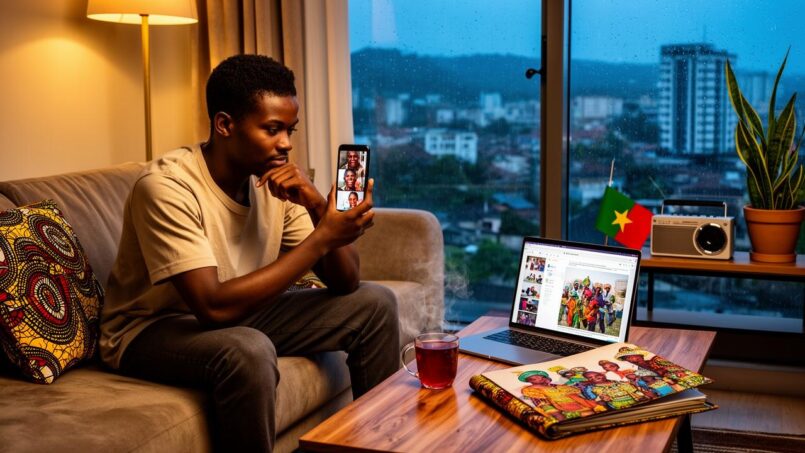
When distance is present (part of the family in the village, another part in the city, and others still in the diaspora), it is possible to use digital tools as emotional “bridges”.
Regularly using communication apps like WhatsApp, Messenger, Skype, Zoom, Telegram, or Signal helps create rituals that maintain family bonds. For example, a weekly video call with a distant relative or a family group dedicated to sharing photos, children’s drawings, and short everyday videos helps nurture a sense of continuity and presence.
Hybrid solutions even exist for families less comfortable with technology: services like Familéo or Neveo (paper gazettes created from photos sent via an app) show that technology can be adapted for every generation. The essential thing is not the tool, but regularity: a short call every week is better than a very long, rare conversation.
In Cameroon, these remote connections can also be strengthened by real physical get-togethers: an annual visit to the village, a family gathering around a holiday (National Day, Youth Day, Tabaski, Christmas, etc.), a joint project (renovating a family home, launching a small farming project, funding a nephew’s studies). Having “something to do together” gives meaning to the relationship and eases the feeling of separation.
Remote rituals: a few concrete examples
Rather than lists, let’s imagine ordinary scenes that, repeated, create a sense of “home” despite the distance:
How Cameroonian families use technology to maintain and celebrate their bonds, despite the distance.
A grandmother in Bafoussam reads a story every Sunday via video call to her grandchildren in Douala, using a simple smartphone.
An expat father in France sends voice messages to wish his children goodnight in Yaoundé, messages listened to before bed.
An aunt in Garoua shares a family recipe book via WhatsApp, allowing her niece abroad to cook kondrè or sweet okok “like at the village.”
Cousins between Maroua, Yaoundé, and Brussels get together monthly on Zoom for a quiz on family history, riddles in the native language, and sharing memories.
This type of ritual, far from being trivial, strengthens common roots. Homesickness decreases when you feel that, even far away, you are still part of a living family story.
The power of associations and the diaspora: not staying alone with your nostalgia
For many Cameroonians, at home and abroad, the feeling of isolation fuels homesickness. Finding yourself surrounded by people who do not share the same references, who do not understand jokes in Pidgin or Medumba, who know neither the Ngondo nor the Nyang Nyang festival, can increase the sensation of “not belonging.”
This is where associations play a key role, both in Cameroon and in the diaspora.
Internationally, there is a galaxy of organizations: the Association of Cameroonians in France (ACF), the Union of Cameroonians Abroad (UCE), structures like ARCC in Canada, Yogam Canada, the Bansoa Association of Canada, or Nkul Beti Production, the Ethnocultural Association of Cameroonians of Greater Sudbury, etc. These organizations offer integration support, legal assistance, psychological counseling, material aid, and above all, cultural activities: national holidays, cooking workshops, dance nights, student meetups, sports days.
Even if you live in Cameroon, knowing that this diaspora exists and organizes itself can be comforting: you no longer feel isolated in your attachment to the country. For those returning after years abroad, connecting with these return networks (e.g., UCE’s “back-to-roots” programs) can ease readjustment.
In Cameroon, structures like Douala Accueil help newly arrived Francophones, including Cameroonians returning from expatriation, find practical and social bearings. At the same time, cultural associations, federations of young Afro-descendants, and groups like LE VECAD multiply opportunities for meeting.
Some community support actors
Here, in table form, is a summary of some useful organizations for breaking isolation and turning nostalgia into collective engagement:
| Organization / Location | Country / Main city | Core mission | Types of activities or services |
|---|---|---|---|
| Association of Cameroonians in France (ACF) | France | Integration, solidarity, connection to Cameroon | Workshops, language courses, cultural events, mutual aid |
| Union of Cameroonians Abroad (UCE) | Europe (federative platform) | Defending diaspora interests, solidarity, contributing to the country | Health support, civic aid, return support, solidarity fund |
| ARCC | Canada (Montreal) | Bringing Cameroonians together, comprehensive support | Housing assistance, career orientation, legal aid, mentoring |
| Nkul Beti Production | Canada | Promoting Cameroonian culture | Events, workshops, community network |
| Ethnocultural Association of Cameroonians of Greater Sudbury (AECGS) | Canada (Sudbury) | Cultural transmission, inclusion, solidarity | Festivals, classes, community activities |
| Yogam Canada / Bansoa Association of Canada | Canada | Preserving cultures of origin, mutual aid | Friendly gatherings, cultural events |
| Douala Accueil | Cameroon (Douala) | Welcoming Francophones, adapting to the city | Meetings, practical info, outings |
| FDM-ADFE Cameroon | Cameroon (Douala, Yaoundé) | Liaison with France for French expatriates | Administrative help, activities, contact with elected officials |
Getting involved in this type of network, whether you are in Cameroon or abroad, helps to “normalize” your experience: you meet other people going through the same phases of longing, adaptation, and identity questioning.
When culture heals: festivals, traditions, and pride of belonging
Managing homesickness in Cameroon also means reactivating cultural pride where weariness, violence, or daily difficulties have sometimes stifled it.
The country is crisscrossed by traditional festivals that, beyond their folkloric dimension, have a strong identity significance: the Ngondo of the Sawa people in Douala, the Nguon in Foumban, the Lela in Bali, the Lemou in Bafou, the Achum in Bafut, the Medumba in Bangangté, the Mpo’o cultural festival in Edéa, the Nyang Nyang in Bafoussam, etc. These celebrations blend ancestral rites, music, dance, competitions, gastronomy, and interethnic exchanges.
The Ngondo is a major cultural festival of the Sawa peoples of Cameroon. It takes place throughout the month of November and culminates on the first Sunday of December on the banks of the Wouri River. The program includes visits to cantons, a trade fair, a traditional wrestling competition, canoe races, a queen pageant, an ecumenical service, the Douala carnival with musical stages, street painting, and a half-marathon. The event concludes with the “water mass,” a powerful ritual moment where a sacred vase is immersed in the river.
These events are not just tourist attractions: they are opportunities to reweave a living connection with your history, your village, your cultural region, even if you no longer live there. For a young person in Yaoundé originally from the Grassfields who feels like a stranger both in the city and the village, regularly participating in the Nékou of Bamendjinda or the Msem Todjom of Bandjoun can give flesh to belongings that seemed abstract.
Diversity of festivals: a therapeutic potential
The variety of traditional festivals in Cameroon allows almost everyone to reconnect to an origin:
| Festival / Ceremony | Main location / Region | Approximate frequency | Cultural or symbolic specificity |
|---|---|---|---|
| Ngondo | Douala (Littoral) | Annual (Nov.-Dec.) | Sawa gathering, “water mass” |
| Nguon | Foumban (West) | Every 2 years | Great Bamoun festival, people–chiefdom dialogue |
| Lela | Bali (Northwest) | Annual | Traditional festival of the Bali chiefdom |
| Achum | Bafut (Northwest) | Annual (December) | Sacred mask ceremony |
| Gah’chou (FECUGA) | Batchingou (West) | Annual (Nov.-Dec.) | Gah’chou cultural festival |
| Kaing / Lie La’a Ttomdjap | Baham (West) | Every 2 years (varies) | Local traditional ceremonies and festivals |
| Nyang Nyang | Bafoussam (West) | Every 2 years | Major city cultural festival |
| Mpo’o Cultural Festival | Edéa (Littoral) | Annual (December) | Celebration of the Mpo’o peoples |
| Mayi | Kribi (South) | Annual (May 9) | Coastal traditional festival |
Allowing yourself to experience these moments, to document them (photos, recordings, stories to share with family or the diaspora) moves nostalgia from a state of silent pain to that of active memory: you become an actor of your cultural transmission, instead of remaining a sad spectator of what is being lost.
Cameroonian cuisine: taste therapy and remedy for longing
Among the most powerful resources against homesickness, cuisine ranks very high. Sensory memories are often the most persistent: the smell of koki cooking in banana leaves, the smoke of soya in the Yaoundé night, the scent of mbongo tchobi, the crispiness of street beignets…
Five traditional dishes or food rituals are mentioned as structuring childhood or youth moments.
Here are some iconic dishes often associated with these memories, which can become real “self-therapy sessions” when you cook or share them.
| Dish / Preparation | Brief description | Associated regions / peoples | Typical “anti-homesickness” effect |
|---|---|---|---|
| Ndolé | Vernonia leaves, peanut paste, meat/fish, spices | Littoral, Sawa peoples | Reminds of holidays and big family meals |
| Koki | Savory cake of cowpea and red oil, cooked in a leaf | West, Littoral, Southwest | Taste of Sunday church and neighborhood sales |
| Eru (or Afang) | Okok leaves and waterleaf, smoked meat, dried fish, pepper | Southwest, Bayangui people | Memory of student meals or regional festivals |
| Soya | Marinated meat skewers, grilled over wood fire | Everywhere in cities | Taste of evenings with friends, street atmosphere |
| Mbongo tchobi | Spicy black sauce with “mbongo,” often with smoked or fresh fish | Bassa, Bakoko | Evokes coastal roots and Sunday meals |
| Achu | Taro puree + yellow sauce made with kanwa, red oil, spices | Grassfields (Northwest) | Symbol of returning to the village and big ceremonies |
| Kondrè | Green plantain steamed with meat and spices | Bamiléké | Celebration, solidarity, festivities |
| Beignets–Haricots–Bouillie | Breakfast trio: beignets, bean sauce, corn/millet porridge | All over Cameroon | Weekend mornings, neighborhood conviviality |
| Grilled fish | Marinated fish grilled, served with plantain or cassava | Littoral / big cities | Night outings, casual conversations |
Even for those who have never left Cameroon, cooking these dishes can compensate for the longing for a region of origin when living far from it. For expats, recreating a ndolé “like from the neighborhood” or a soya “almost like back there” allows you to turn a wave of nostalgia into a warm moment, to share with local friends and build cultural bridges.
YouTube cooking channels, such as “Mimi International Kitchen” or “La cuisine de Mamie Jacka,” make it easier to pass on culinary knowledge. They provide detailed recipes, recall the origins of dishes, and even offer spice blends adapted to life abroad.
In Cameroon, the growth of furnished apartments with kitchens (for example via dedicated rental sites) also allows internal travelers or members of the diaspora visiting to cook for themselves, rather than relying solely on restaurants: a way to feel “at home in the country,” even in a city you don’t know well.
Social media: between comforting connection and trap that worsens the longing
Social media play an ambivalent role in the experience of homesickness in Cameroon.
On one hand, they allow you to stay connected: a student from Yaoundé in France continues to follow national debates on Twitter, comments on Indomitable Lions matches live, watches videos of a festival in Kribi or the Ngondo on Facebook. A Cameroonian who stayed in the country follows a cousin’s journey in Canada, discovers the activities of ARCC or Yogam Canada on Instagram, checks out diaspora association lives. This digital “window” reduces symbolic distance.
In Cameroon, nearly 5 million Facebook users are daily exposed to a stream of information mixing violence, political crises, fake news, and cyberbullying.
Studies indicate that nearly 40% of young Cameroonians have experienced forms of online harassment. Add to that the pressure of aesthetic and social norms conveyed by Instagram or TikTok: many young people, especially those under 25, report feeling dissatisfied with their body or life after spending time on these platforms.
For someone already weakened by homesickness, constant comparison with friends who seem to be succeeding abroad can be harmful. It can lead to a feeling of being “behind,” loneliness in not “enjoying life,” and thus double the nostalgia with a sense of failure.
Managing homesickness today therefore involves negotiating with these tools. A few simple principles can help:
– Limit screen time, especially in the evening.
– Curate the accounts you follow: prioritize those that inspire, inform reliably or create community bonds, rather than those that fuel frustration and anger.
– Use social media for real exchange (family groups, associations, mutual aid) rather than passive comparison.
– In case of cyberbullying, allow yourself to block, report, leave a toxic group, and talk about it to loved ones or a professional.
Citizen campaigns (#JeBlogueDoncJeSuis, #StopTribalisme, #AuNomDeNosEnfants…) show that social media can also become tools for education toward more responsible use.
Taking care of your mental health in Cameroon: breaking the silence
Homesickness, especially when it persists and worsens, is not just a matter of nostalgia. It can be accompanied by anxiety, sleep disturbances, loss of appetite, difficulty concentrating, or dark thoughts. The line with depression or generalized anxiety disorder can become blurred.
The World Health Organization reminds us that mental health is one of the most neglected public health areas globally, and Cameroon is no exception: stigma remains strong, which prevents many people from seeking help.
The country has a network of professionals and specialized facilities to manage mental health.
Medical doctors specializing in diagnosing and treating mental disorders.
Professionals providing psychological support and therapy.
Healthcare staff specialized in psychiatric nursing.
Facilities specialized in patient reception and treatment.
Programs and support offered by non-governmental organizations.
Some reference points among available resources
| Type of structure / actor | Examples of places or people in Cameroon | Role in care |
|---|---|---|
| General hospitals / specialized departments | Laquintinie Hospital (Douala), Jamot Hospital (Yaoundé), Douala General Hospital, Benoît Meni Catholic Hospital, Bafoussam Regional Hospital, Garoua General Hospital… | Psychiatric consultation, hospitalization if needed |
| Mental health centers | BIMEHC Center (Babungo), Saint Luke Mental Health Center (Bafoussam), CEEPSYPEC (Douala, Logbaba)… | Psychological follow-up, long-term support |
| Private psychology / psychotherapy practices | C.P.D in Douala (directed by Dr. Silvia Piavento), NEIF-NEIF Education in Yaoundé (Thierry Dong), La Maison du Psy, Les Ateliers Psy… | Individual therapy, family therapy, psychological coaching |
| Identified professionals | Dr. Erero F. Njiengwe (Douala), Dr. Toguem (Douala), Marie Abanda (Douala), Christine Pola (Douala), Dr. Ovambe (Yaoundé), Memong Ndengue Fabien (Yaoundé)… | Assessment, diagnosis, psychotherapy, medication management |
| NGOs and foundations | Bluemind Foundation, H.E.L.P., Action Against Hunger, CARE, ICRC/Cameroonian Red Cross… | Psychosocial support programs, support groups, interventions in crisis zones |
| Online services | PsychoApp (remote consultations), blog “Noire et Psy” (Yann V. Tsobgni)… | Easy access to psychologists, awareness, self-help |
Programs implemented by NGOs show that distress related to displacement, conflict, or economic crises can be alleviated by approaches combining material aid and psychological support. For example, Action Against Hunger has supported hundreds of people in the Southwest through mobile clinics, psychoeducation sessions, and discussion groups for adults and children.
Allowing yourself to consult a professional does not mean being “crazy”; it means recognizing that the weight of what you carry (exile, losses, ruptures, uncertainties) needs a space to be deposited, understood, and worked through.
Turning homesickness into a life project
Ultimately, managing homesickness in Cameroon means accepting that you will not become the person you were “before”: before exile, before expatriation, before the crisis, before the move from village to city. Going back is impossible. But it is possible to do something with this displacement.
Several paths emerge:
– Prepare and inform yourself: whether leaving your village for Yaoundé or returning to the country after ten years abroad, taking time to learn about the new context (local culture, social codes, security risks, healthcare system, etc.) reduces the shock. Experts recommend dedicating at least a few hours of targeted research.
Set up a structured day with fixed times for waking up, work or studies, as well as dedicated slots for sports, cooking, prayer or meditation, and loved ones. This structure provides a reassuring framework. While it won’t make nostalgia disappear, it prevents it from invading all mental space.
– Open up to the surrounding culture: attending a local festival, joining a neighborhood association, participating in a clean-up campaign or an urban marathon, taking a dance or language class, supporting a cultural project (like those of “La Route des Chefferies” which promotes heritage in the ten regions), are all ways to re-anchor yourself here and now.
To maintain the link with your country of origin without dissolving into it, it is advisable to use cultural bridges like video calls, traditional cuisine, music, stories, and symbolic objects (pagne fabric, photos, masks, CDs of makossa or bikutsi). The goal is not to break this bond, but to integrate it harmoniously into the richness of the present life.
– Allow yourself to ask for help: loved ones, associations, online groups, mental health professionals… Homesickness becomes dangerous when it is lived in solitude and shame. Talking about it is already starting to transform it.
In a country marked by crises, but also rich in extraordinary cultural creativity and an active diaspora, homesickness can paradoxically become a strength: one that pushes you to reweave connections, defend the dignity of your people, value what deserves to be valued, and build, step by step, an inner “home” that resists displacement and storms.
Nostalgia will not disappear. But it can become a companion rather than a burden, provided it is listened to, shared… and nourished with tasty dishes, village dances, true words, and common projects.
Disclaimer: The information provided on this website is for informational purposes only and does not constitute financial, legal, or professional advice. We encourage you to consult qualified experts before making any investment, real estate, or expatriation decisions. Although we strive to maintain up-to-date and accurate information, we do not guarantee the completeness, accuracy, or timeliness of the proposed content. As investment and expatriation involve risks, we disclaim any liability for potential losses or damages arising from the use of this site. Your use of this site confirms your acceptance of these terms and your understanding of the associated risks.

Cyril Jarnias is an independent expert in international wealth management with over 20 years of experience. As an expatriate himself, he is dedicated to helping individuals and business leaders build, protect, and pass on their wealth with complete peace of mind.
On his website, cyriljarnias.com, he shares his expertise on international real estate, offshore company formation, and expatriation.
Thanks to his expertise, he offers sound advice to optimize his clients' wealth management. Cyril Jarnias is also recognized for his appearances in many prestigious media outlets such as BFM Business, les Français de l’étranger, Le Figaro, Les Echos, and Mieux vivre votre argent, where he shares his knowledge and know-how in wealth management.





