
 Published on and written by Cyril Jarnias
Moving to Niue means choosing an island life that’s the polar opposite of major cities: a population of roughly 1,600 people, one small town (Alofi), a 64 km (40 mi) ring road around the island, and, above all, a heavy reliance on imports. For an expat, this translates to an atypical cost of living: generally high for a small Pacific nation, sometimes comparable to or higher than major cities, but with pockets of relative affordability, particularly for housing and local transportation.
This article analyzes in detail and with figures the budget needed to live in Niue as an expat or digital nomad. It explains why some expenses are high, how others remain affordable, and what compromises allow for a comfortable life without blowing your budget.
Understanding the Cost Structure in Niue
Niue uses the New Zealand Dollar (NZD) as its official currency. The island is extremely dependent on imports: the value of its imported goods is about four times that of its exports. In 2023, goods imports exceeded $30.4 million, compared to just over $2 million in exports.
This dependence directly impacts daily prices. Most consumer goods, from processed foods to electronics, must be shipped or flown in from New Zealand, Australia, or other partners like Fiji or Japan. Transport costs, the small market size, and the lack of significant competition inflate shelf prices.
International comparisons are telling. In Alofi, the cost of living is estimated to be:
– 19% higher than in Tokyo
– 26% higher than in Manila
– 22% higher than in Santiago, Chile
– 10% higher than in Baltimore, USA
In contrast, the picture is more nuanced compared to New Zealand. The cost of living in Niue, including housing, would be about 4% lower than in New Zealand. But if you remove rent from the equation, consumer prices are nearly 18.4% higher than in New Zealand, with a dramatic surge for food and daily groceries: +54.8%.
In other words: living in Niue costs about as much as living in New Zealand overall, but for different reasons. Housing is cheaper, almost everything else is more expensive, sometimes significantly so.
Sample Budgets for Expats: From Minimal to Comfortable
The available cost of living data for Niue allows for a fairly accurate picture of monthly budgets based on household size and desired comfort level.
Monthly Spending Profiles
The following estimates include the main expense categories (housing, food, services, local transportation, common leisure) and are expressed in dollars (USD or converted NZD, sources don’t always distinguish). The important thing is the order of magnitude and relative differences.
Average Monthly Cost by Household Type
| Profile | Without Rent (USD) | With Rent (USD) |
|---|---|---|
| Single (national average) | 1,576 | 2,526 |
| Couple | 2,715 | 3,665 |
| Family of 4 | 3,975.5 | 5,210.5 |
| Solo Nomad (“light” estimate) | 434 | 506 |
| Family of 3 (“light” profile) | 1,101 | 1,293 |
It’s immediately clear that there are two realities:
Minimum monthly cost to live solo by adopting a frugal, local lifestyle.
To better grasp the gap between a “budget” and a “comfortable” lifestyle, aggregated data distinguishes three levels.
Range of Monthly Budgets by Lifestyle
| Lifestyle Level | Profile | Without Rent (USD) | With Rent (USD) |
|---|---|---|---|
| Tight Budget | Single | 777 | 1,377 |
| Couple | 1,355.4 | 1,955.4 | |
| Family of 4 | 2,005.9 | 2,785.9 | |
| Comfort / “Local Luxury” | Single | 3,548 | 5,048 |
| Couple | 5,941.5 | 7,441.5 | |
| Family of 4 | 8,540.5 | 10,490.5 |
An expat who is content with a simple local lifestyle, cooks at home, uses little heating, limits paid leisure activities and consumption of imported goods can therefore get by reasonably well. Conversely, a very “Westernized” lifestyle with frequent restaurant meals, imported alcohol, heavy use of air conditioning, electronic gadgets, and multiple trips can push the budget into the $5,000 to over $7,000 per month range, even for a childless couple.
Average Salary and Local Purchasing Power
The average monthly net salary in Niue is around $1,700, with a rough range from about $730 to $3,000. In theory, this income level is sufficient to cover the average cost of living for a single person (about $2,526 with rent) if that person is in the higher end of the salary range or benefits from housing allowances (which is common for some public or NGO positions).
For a salaried expat, the package often includes housing or an allowance, which significantly changes the budget. For a digital nomad with income in a strong currency, Niue is more expensive than most Asian destinations but remains less costly than major Western cities for a frugal lifestyle.
Housing: A Key but Manageable Expense
Housing is one of the few areas where Niue is clearly more affordable than New Zealand. Average rents are nearly 27% lower than its neighbor.
Rent Levels and Options
The available figures give a clear idea of the order of magnitude.
| Type of Housing | Location | Approx. Monthly Rent |
|---|---|---|
| 3-room apartment | Alofi Center | 450 NZD |
| 3-room apartment | Outside Center | 400 NZD |
| General range (primary residence) | Anywhere | 600 to 1,500 USD |
| 3-bed rental (overall low range) | Outside center (aggregated data) | 246 to 413 NZD |
| Modest house (purchase, Avatele) | Avatele | ~200,000 NZD |
| Seaside property (purchase) | Avatele | ~500,000 NZD |
For an expat, two realities coexist:
– The tourist market (villas, resorts, guesthouses) charged per night, with prices from $100 to $500 per night depending on the standard. At this level, extending your stay without negotiating a monthly rate quickly becomes prohibitive.
– The “local” residential market, much more affordable, but less visible online and often accessible through networks, word of mouth, or via local sites like niuerentals.nu.
The average monthly rent for a primary residence, lower than the New Zealand average of $1,300.
Utilities and Associated Services
Basic utilities (electricity, water, waste) for a dwelling of about 85 m² (915 sq ft) run around 100 NZD per month according to some sources, or $60 to a little over $100 in other more detailed estimates. This variability is explained by usage: air conditioning and certain energy-intensive appliances can quickly drive up bills.
On the island of Niue, electricity production is structurally expensive (about $0.50 per kWh). While water is currently free for households, a government project plans to install individual meters and introduce volume-based tariffs (between $0.25 and $1.70 per m³) to cover pumping costs (over $80,000 per year). Long-term, anticipate a combined increase in water and energy bills.
In addition, a typical budget for a household includes, for services:
| Item | Monthly Range (USD) |
|---|---|
| Electricity | 48 to 180 |
| Water | 15 to 40 |
| Gas / Heating | 15 to 45 |
| Internet (unlimited, high-speed) | 75 to 150 |
| Mobile plan (voice + data) | 55 to 130 |
Internet access is both more expensive and slower than in major cities, even though advertised speeds around 50 to 60 Mbps exist. An unlimited fixed-line connection often costs around 100 NZD per month, sometimes plus a mobile plan.
Food: A Significantly Inflated Expense
For an expat, this is probably the main shock in Niue: food prices. Due to the island’s isolation and heavy reliance on imports, goods, especially processed ones, are significantly more expensive than in New Zealand, and well above levels seen in Asia or the US.
Daily Groceries: The Sting is in the Details
A few typical prices give an idea. They vary by source but remain in the same order of magnitude.
| Product | Approx. Price (NZD) |
|---|---|
| Inexpensive restaurant meal | 18 to 30 |
| 3-course meal for 2 (mid-range restaurant) | 37 to 62 |
| Fast-food combo meal | 11 to 25 |
| Cappuccino | 4.8 to 5 |
| White bread (500 g – 1 lb) | 2.4 to 4 |
| Dozen eggs (standard) | ~5 |
| Dozen “large” eggs in some surveys | up to 20 |
| Tomatoes (1 kg) | ~10 |
| Boneless chicken (500 g) | 12 |
| Whole milk (1 L) | 4 |
| Mid-range bottle of wine | 15 to 25 |
| Local draft beer (1 pint) | 8 |
| Imported beer (small bottle) | 3.6 to 6 |
| Pack of Marlboro cigarettes (20) | 18 to 30 |
There is a wide dispersion between surveys – some prices seem abnormally low (e.g., 2.5L of Coca-Cola listed at less than $1) and others extremely high (bread at nearly $9.50 in a detailed shopping list). This variability reflects what residents experience: prices fluctuate, some shipments arrive more expensive depending on the cargo, and stock shortages sometimes cause temporary spikes.
Groceries and food items cost about 55% more than in New Zealand.
Where to Shop and How to Limit the Bill
Niue has several well-stocked supermarkets and grocery stores, concentrated around Alofi and the airport.
The main points of sale are:
– Swanson Supermarket, the largest, near the airport, with a wide range of New Zealand, Australian, and local products, including an in-house bakery (Rolling Pin) open on certain days.
– Double M, at the Alofi shopping center, with meats, fruits, vegetables, and local specialties like Niue honey and noni juice.
– Moko’s Central Mart (MCM), in the same area, offering general groceries, baby products, fruits/vegetables, fresh bread on weekdays.
– Central Services, a service station and convenience store south of Alofi, with hot food, drinks, and some fresh produce.
– Other small village shops and a bakery-grocery (Ilena’s Bakery & Store) complete the landscape.
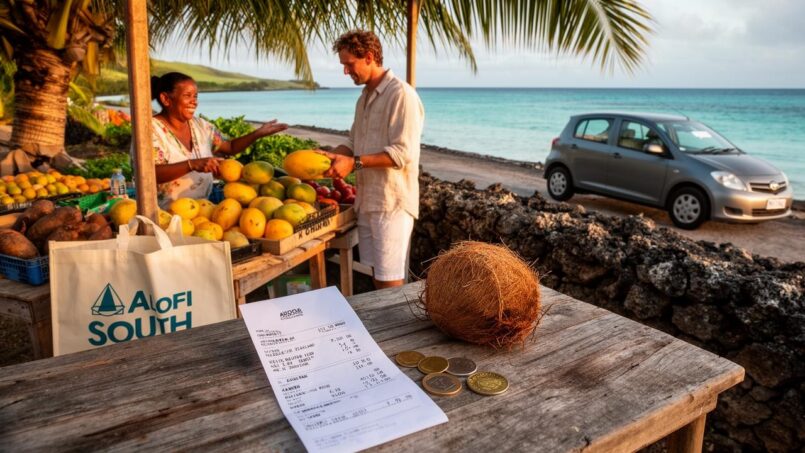
The Alofi Market, also called “Niue Market” or “Makete,” is held several times a week. You can find vegetables, local fruits, *uga* (coconut crab), fresh fish, *umu* (earth oven) cooked food, and handicrafts. Specific markets, like the monthly organic market and the Friday night market, offer additional opportunities to source local products.
The key for a budget-conscious expat is twofold:
– Prioritize local when possible: taro, kumara (sweet potato), cassava, papaya, bananas, seafood. These products are generally more affordable than imported fruits and vegetables, even though seasonality is strong and the peak tourist season is paradoxically the period when fruit supply is most limited.
– Cook at home. Most accommodations (outside large resorts) are equipped for self-catering. Eating regularly at restaurants or bars, especially consuming imported alcohol and typical Western dishes, quickly blows up expenses.
Overall estimates put the food and grocery budget between $380 and $1,100 per month depending on the comfort level. For a family, $650 per month on groceries is presented as an average, well above a New Zealand average of around $420.
Transportation & Mobility: Few Public Transport Options, But Short Distances
Niue has no buses, no trains, no operational daily taxis, and no ferry network. The island has a single 64 km (40 mi) sealed ring road, supplemented by secondary roads to villages and unsealed tracks to the coast and plantations.
Getting Around Daily
The most realistic option for an expat is renting a motor vehicle (car, scooter, sometimes motorbike) or, for the more active, bicycles or e-bikes for short trips around Alofi.
Car rental rates generally fall within the following ranges:
| Vehicle Type | Daily Rate (NZD) |
|---|---|
| Small city car / budget | 50 to 60 |
| Sedan / small SUV | 60 to 100 |
| Recent SUV / 4×4 | 65 to 125 |
| Van / people-mover (6–7 seats) | 85 to 200 |
Most contracts include unlimited mileage, and some agencies offer a free day for a weekly rental. However, rental cars are not always insured in the conventional way; a refundable deposit ($300 to $500 NZD) is often required and, in some cases, additional insurance ($0 to $25 NZD per day) must be purchased.
A full loop of the island’s ring road covers a distance of 64 kilometers (40 miles).
Synthetic data suggests monthly transportation budgets ranging from $20 to $280 per month depending on usage. A sedentary expat who mostly walks or cycles will spend very little, while a family renting a vehicle almost continuously, especially during the peak tourist season, will quickly reach the high end of the range.
Overall Transport Costs, Comparison with New Zealand
Paradoxically, considering gasoline prices, the “transportation” category appears as 75% cheaper than in New Zealand in average comparisons. The explanation is simple: little to no paid public transport, very short distances, and intensive use of soft modes (walking, cycling) by local residents. However, for an expat reliant on a rental car, the feeling can be quite different, especially in peak season when rates are at their highest.
Healthcare: Free for Niueans, Significant Cost for Expats
Niue has one hospital, Niue Foou Hospital, based in Alofi. The facility concentrates all public health services: general medicine, maternity, minor surgery, emergency care, basic radiology, laboratory, pharmacy, physiotherapy, basic dental, maternal and child health.
Legislation (Niue Act 1966) stipulates that medical care is provided free of charge to Niueans. For foreigners and non-residents, however, “reasonable” charges are payable, and payment may be required before or immediately after the service.
The hospital’s technical capabilities are limited, so patients with serious conditions (cancers, major trauma, major surgeries, premature babies requiring intensive care) must be evacuated to New Zealand, an extremely expensive solution.
For an expat, it is therefore highly recommended to take out an international health insurance or a solid travel insurance plan. The monthly cost ranges noted for an expat are significant:
| Healthcare Item for Expat | Monthly Range (USD) |
|---|---|
| International / expat health insurance | 60 to 400 |
| Medication & pharmacy | 15 to 225 |
| Medical / dental consultations | 10 to 500 |
These amounts mainly reflect the risk of needing services not covered locally or payable in New Zealand, more than the cost of simple consultations in Niue itself.
For any stay longer than 60 days in Niue, a comprehensive medical certificate is required. It must include a clinical examination, blood tests (full blood count, kidney function, HIV, VDRL, hepatitis B serology), and a chest X-ray (except for children under 12 and pregnant women). This file must be validated by Niue’s health services before arrival. This measure aims to protect a fragile healthcare system and a population heavily affected by non-communicable diseases like obesity, diabetes, hypertension, and cancers.
For an expat, healthcare is therefore less a daily expense item than a major financial risk to manage with good insurance.
Services, Telecoms & Leisure: Comfort Comes at a Price
Basic services — telecoms, various subscriptions, leisure — often follow the same logic as physical goods: a small island market, high fixed costs, and prices higher than those in a large country.
A typical profile of monthly expenses can include:
| Item | Monthly Range (USD) |
|---|---|
| Unlimited fixed-line internet | 75 to 150 |
| Mobile plan (voice + data) | 55 to 130 |
| Gym membership | 25 to 65 |
| Leisure (movies, cafes, outings) | 24 to 288 |
| Cleaning / laundry services | 55 to 230 |
A gym membership costs on average between 18 and 30 NZD per month according to some surveys, but other sources mention subscriptions up to over $100, suggesting great variability depending on the service (simple local gym vs. better-equipped club, classes, etc.).
The average cost of a mobile plan in Niue, compared to $50 in New Zealand.
For leisure, the offering is naturally limited: very few bars and restaurants, hardly any performance venues or cinemas, few specialized shops. Most entertainment is based on nature: diving, swimming, hiking, whale watching, village life. A few figures (cinema, excursions, paid activities sometimes quoted at $100 or more) highlight that the few “organized” activities are not cheap but remain a minority in daily life.
Detailed Comparison with New Zealand
Aggregated data allows for a comparative table item by item between Niue and New Zealand, very useful for an expat coming directly from there.
| Expense Item | Niue (Avg. USD) | New Zealand (Avg. USD) | Difference (%) |
|---|---|---|---|
| Average Rent | 950 | 1,300 | –26.9% |
| Electricity | 90 | 73 | +23.3% |
| Water | 25 | 35 | –28.6% |
| High-speed Internet | 110 | 98 | +12.2% |
| Gas / Heating | 30 | 55 | –45.5% |
| Mobile Plan | 85 | 50 | +70% |
| Food & Groceries | 650 | 420 | +54.8% |
| Household Supplies | 65 | 55 | +18.2% |
| Monthly Transport | 45 | 180 | –75% |
| Leisure (outings, cafes…) | 96 | 145 | –33.8% |
| Clothing & Shoes | 65 | 70 | –7.1% |
| Health Insurance | 180 | 55 | +227.3% |
| Medication & Pharmacy | 75 | 30 | +150% |
| Doctor / Dentist | 60 | 65 | –7.7% |
| Gym Membership | 40 | 45 | –11.1% |
| Cleaning / Laundry | 140 | 100 | +40% |
| Food & Basic Care per Pet | 100 | 115 | –13.0% |
| Total Monthly Cost (selection) | 2,526 | 2,631 | –4.0% |
| Avg. Monthly Net Salary | 1,700 | 4,350 | –60.9% |
This table clearly shows a paradox: the total cost is barely lower than in New Zealand, but local incomes are much lower, which makes the cost of living objectively high for a Niuean. For an expat paid in foreign currency at a level close to Western salaries, Niue may simply seem “expensive but manageable.” For a resident paid the local salary, the equation is much tighter.
Visas, Formalities & Their Indirect Impact on Budget
Visa conditions also have an indirect impact on the cost of living. Many travelers, especially from Western countries, can enter Niue without a visa for tourism, business, or transit purposes, and receive a 30-day permit on arrival. Extensions are possible via the immigration office in Alofi, for a fee.
For a stay longer than 60 days (work, study, residence), a specific visa is required. It requires proof of good health (with a full medical certificate), good character, and sufficient financial resources. These procedures involve administrative costs (exams, X-rays, tests) to be planned into the budget.
Entry conditions also include the requirement to have an accommodation booking and proof of sufficient funds, which implicitly encourages new arrivals to budget several months’ rent and expenses in advance.
Strategies to Manage the Cost of Living in Niue
For an expat, living in Niue without breaking the bank means adapting your lifestyle to the local reality rather than trying to exactly replicate your big-city daily life.
Several levers are particularly effective:
To reduce expenses during a long stay on Niue, adopt the following strategies: For housing, target the local residential market (simple house or apartment) rather than tourist accommodation and negotiate monthly rents. For food, cook for yourself, shop at the market prioritizing local produce (root vegetables, seasonal tropical fruits, fish and seafood), and limit imported and processed goods, which are very costly. For getting around, avoid continuous vehicle rental if possible, prioritize walking, cycling, or an e-bike, and reserve a car for days requiring heavy shopping or distant excursions. For healthcare, take out good international insurance including medical evacuation to avoid exorbitant costs. Finally, for telecoms, compare plans, avoid multiple subscriptions, and use home Wi-Fi rather than mobile data.
An expat who adopts this type of behavior approaches a budget like the “tight budget” presented earlier, between $1,300 and $2,000 depending on household size, instead of ending up in the “comfortable/luxury” life ranges which can triple or quadruple expenses.
What the Money Doesn’t Say: Intangible Value and Compromises
Beyond the figures, the cost of living in Niue must also be judged against what the island offers: a very safe environment, a tight-knit small community, a slow pace of life, direct access to spectacular nature, and a form of forced disconnection from the excesses of consumption.
In Niue, the cost of living reflects the island lifestyle. Imported and modern products are expensive, while traditional activities linked to the sea, village, and outdoor life remain more affordable. The island favors a simple, nature-based quality of life over shopping or urban entertainment.
For expats willing to embrace this simplicity, the cost of living, while not negligible, becomes overall sustainable. For those who want everything, all the time, as in a Western metropolis, the bill will be hefty.
In summary, Niue is a country where the stated cost – in dollars – is not low, but where the perceived value – in quality of life – can largely offset the bill, provided you accept moving away from an intensive consumption model and making simplicity an integral part of the expatriation project.
Disclaimer: The information provided on this website is for informational purposes only and does not constitute financial, legal, or professional advice. We encourage you to consult qualified experts before making any investment, real estate, or expatriation decisions. Although we strive to maintain up-to-date and accurate information, we do not guarantee the completeness, accuracy, or timeliness of the proposed content. As investment and expatriation involve risks, we disclaim any liability for potential losses or damages arising from the use of this site. Your use of this site confirms your acceptance of these terms and your understanding of the associated risks.

Cyril Jarnias is an independent expert in international wealth management with over 20 years of experience. As an expatriate himself, he is dedicated to helping individuals and business leaders build, protect, and pass on their wealth with complete peace of mind.
On his website, cyriljarnias.com, he shares his expertise on international real estate, offshore company formation, and expatriation.
Thanks to his expertise, he offers sound advice to optimize his clients' wealth management. Cyril Jarnias is also recognized for his appearances in many prestigious media outlets such as BFM Business, les Français de l’étranger, Le Figaro, Les Echos, and Mieux vivre votre argent, where he shares his knowledge and know-how in wealth management.





