
 Published on and written by Cyril Jarnias
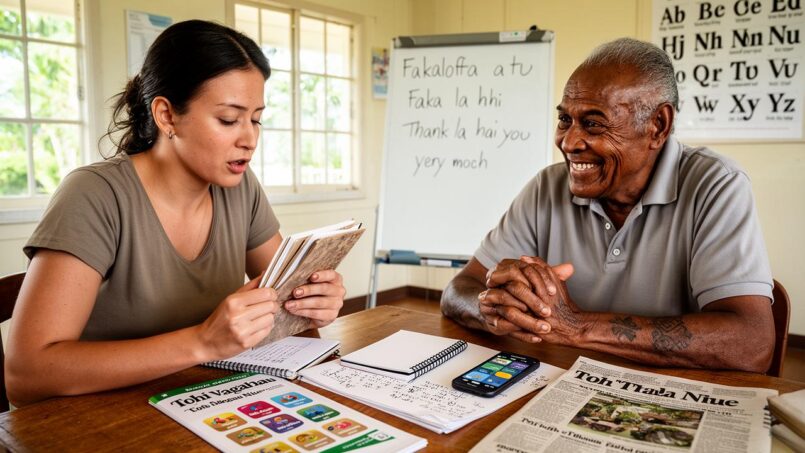
Relocating to Niue, this “Rock of Polynesia” lost in the Pacific, is not just about changing scenery. It’s about entering a small island society – fewer than 2,000 inhabitants, a very tight-knit community fabric, a sacred Sunday – where the local language, vagahau Niue, carries a large part of the collective identity. For an expatriate, learning a few words is not a simple polite gesture: it’s participating, on their own scale, in the survival of a language classified as endangered by UNESCO.
In Niue, learning the language (vagahau Niue) goes beyond mere practical utility. It is an approach that should be done in a respectful, effective, and beneficial manner for the community, incorporating both emotional and political dimensions.
Understanding the Stakes: A Threatened Language, an Identity at Play
Vagahau Niue is a Polynesian language belonging to the Austronesian family, close to Tongan and related to Samoan, Māori, and Hawaiian. It is one of the island’s two official languages, on equal footing with English according to the Niue Constitution. In practice, most inhabitants are bilingual, and English dominates in administration and many services.
This is the estimated number of vagahau Niue speakers worldwide, a language that remains threatened despite a large diaspora.
This situation explains why UNESCO classifies vagahau Niue as “definitely endangered,” even critically so compared to other Pacific languages. Among them, it is one of those facing the strongest threat of extinction.
For an expatriate arriving in Niue, this changes the perspective on language learning. Saying “Fakaalofa atu” (hello) or “Fakaaue lahi” (thank you very much) is not simply conforming to local codes: it is also a sign of support for a fight that has been waged for decades by teachers, families, and institutions like Tāoga Niue or the Vagahau Niue Trust.
Getting into the Music of the Language: Sounds, Alphabet, and Pronunciation
Even before memorizing phrases, it is useful to understand the music of vagahau Niue. It is a language with relatively regular pronunciation, phonetic spelling, and a simple syllable structure (consonant + vowel). Words almost always end in a vowel, giving them a melodic sound.
The vowel system is based on five vowels, with an important distinction between short and long vowels:
| Vowel | Approximate Pronunciation in French | English Equivalent Example |
|---|---|---|
| a | “a” as in far / car | father |
| e | “è” as in belle | egg |
| i | “i” as in ici | machine (the ee sound) |
| o | “o” as in sort | sore |
| u | “ou” as in fou | rule, cool |
The consonants, largely familiar, nevertheless have a few particularities that will surprise French speakers.
| Letter | Key Particularity | Example |
|---|---|---|
| g | Pronounced like ng in singing | uga (coconut crab) → “oo-ng-a” |
| t | Often becomes a sound close to “s” before e or i | Avatele → “Ava-seleh” |
| r | Rolled consonant, mainly in loanwords | Variable |
| s | Used mostly in loanwords; no purely Niuean word begins with r |
This phonetic logic is integrated into modern educational resources, like the Fakaako e Vagahau Niue app, which offers audio recordings of letters, words, and phrases, useful for practicing how to distinguish the sounds well.
A Simple Yet Demanding Alphabet
Vagahau Niue uses a reduced set of letters compared to the full Latin alphabet. Grammarians and lexicographers do not all list the letters the same way, but teaching resources generally describe:
| Letter Type | Main Inventory | Notes |
|---|---|---|
| Vowels | a, e, i, o, u (and their long versions ā, ē, ī, ō, ū) | Distinctive vowel length, often marked by a macron |
| Consonants | f, g, h, k, l, m, n, p, s, t, v | r and s mainly in loanwords; no native word begins with r |
Words almost always follow a (C)V(V) pattern. This structure facilitates reading but requires paying attention to vowel length and double vowels, which can change the meaning. In common practice, many speakers do not systematically mark long vowels in writing, but modern guides recommend using them to avoid ambiguity.
For an expatriate, the goal is not to become a linguist, but to integrate a few basic rules to correctly pronounce names, village names, or common greetings. Making a mistake once is not serious; however, making the effort to adjust and correct one’s pronunciation is highly appreciated and facilitates integration.
Living in Niue: How the Language Structures Daily Life
In Niue, widespread bilingualism (vagahau Niue / English) could give the illusion that learning the local language is optional. In reality, social, family, and religious life continues to largely revolve around vagahau Niue, especially among older people, in religious services, ceremonies, and village events.
In daily life, a few words are already enough to send a signal of respect. When entering a store, meeting a neighbor, or participating in a community meal, simple expressions like:
To illustrate a few common polite expressions in Niuean, one can cite: **Fakaalofa atu** or **Fakaalofa lahi atu** to say hello or offer warm greetings; **Fakamolemole** for please; **Fakaaue lahi** to express a big thank you; and **Tulou** to ask for pardon or apologize, especially when passing in front of someone.
immediately show that one recognizes the place of the language in Niuean culture.
Vagahau Niue is not just a functional tool: it carries key values, such as respect, humility, care for family (magafaoa) and community, reciprocity in exchanges, and the relationship to land and sea. A simple “Nakai Fakaaue” (no, thank you) is perceived as the polite way to refuse, much more socially accepted than a brief, isolated “Nakai” (no).
Methods for Expatriates: Combining Immersion, Digital Tools, and Community
For an expatriate, the good news is that vagahau Niue now has a particularly rich ecosystem of tools for such a small language. The key is to combine several approaches rather than relying on a single resource.
Leveraging Apps and Online Resources
Several projects supported by New Zealand ministries and the Niuean community have given rise to a quality digital offering, accessible even from Niue where the connection can sometimes remain fragile.
Among the flagship resources are:
| Digital Resource | Type | Main Content | Particularities for the Expat Learner |
|---|---|---|---|
| Fakaako e Vagahau Niue | Mobile/web app | Alphabet, common vocabulary, daily conversations, numbers, proverbs, songs, visuals | Integrated audio, learning by thematic units, app supported by the New Zealand Ministry of Education (Pacific Innovation Fund), official blessing from the Niue government |
| Asalei – Learn Niuean Online | App / interactive platform | Fun and gamified lessons, challenges, progress tracking (streaks, XP, milestones) | Usable offline, accessible on web and mobile, oriented toward real-life situations (home, church, community events) |
| learnniue.com | Website | Complete course in graded units, online audio | Project of the New Zealand Ministry for Pacific Peoples, aggregates many links to other resources |
| Niue Language Ebnemar Collection | Digital collection | Immersive material, thematic resources | Intercultural focus, interesting for going beyond the beginner level |
For an expatriate in Niue, these tools can easily integrate into daily life: 10 to 15 minutes of review in the morning or evening, a conversation unit before going to church, a vocabulary game before a village event. Learning in small doses, but regularly, is particularly suited to this type of language where opportunities to practice “for real” are plentiful as soon as one dares to take the step.
Enrolling in Structured Courses (Even Remotely)
Most structured vagahau Niue programs are now found… in New Zealand. This is the paradox of a language whose survival relies mostly on its diaspora. For an expatriate settled on the island, these offerings remain useful, especially as a complement to local immersion.
The Centre for Pacific Languages, registered with NZQA in New Zealand, offers free vagahau Niue courses funded by the government. Although eligibility is primarily intended for New Zealand citizens or residents, this program provides an interesting model of language progression.
| Course Level | Typical Duration & Format | Content Goals | Targeted Skills |
|---|---|---|---|
| Introductory / Beginner | 10 weeks, 2 hours of online class + ≥ 1 hour of review per week (≈ 30 hours total) | Introducing oneself, talking about family, home, village, greeting formulas, language for life events (birthdays, weddings, funerals) | Understanding and producing simple sentences, basic pronunciation, appropriate cultural behaviors |
| Intermediate | Same format | Family roles, honorific terms, directions, seasons, opinions on cultural practices, at least 200 vocabulary words | Simple conversations with friends, colleagues, relatives; active listening; improved accuracy |
| Advanced (often NZQF level 2 or 3) | Same format, language prerequisites | Family/community relationships, taboos, social norms, gifts, leadership in Niue, at least 300 words | Communication in more formal contexts (work, ceremonies), short speeches, understanding historical and cultural references |
Even if these courses were not all open at the time the information was gathered, their existence provides concrete benchmarks: an expatriate can draw inspiration from them to set realistic goals. For example, aiming for 200 active vocabulary words and the ability to introduce oneself and talk about one’s family and work after a few months is an achievable milestone.
Several institutions offer educational programs to learn and preserve vagahau Niue, the language of Niue Island.
Offers a Level 3 qualification in vagahau Niue.
The University of the South Pacific delivers courses coded “NU” (e.g., NU111, NU211) taught in the Niuean language.
Betting on Cultural Immersion: Church, Village, Family
In Niue, culture and language meet in community life. For an expatriate, the best “evening classes” are often:
– Religious services, which are well-attended, where hymns (lologo), prayers, and readings – especially from the Bible in Niuean, Ko e Tohi Tapu – offer dense exposure to vagahau Niue.
– Village events: hair-cutting ceremonies, ear-piercings, preparation of umu (traditional oven), family celebrations, sports competitions, weaving workshops.
– Thematic days or weeks, notably the Faahi Tapu he Vagahau Niue (Niuean Language Week), which offers workshops, poetry recitals, speech contests, singing, dancing, sports, cooking, children’s activities.
Participating does not mean immediately putting oneself at the center of the stage, but first being present, observing, listening, learning the codes. Sitting at the back of a church and following the greetings, meals, and exchanges before and after the service can be a lesson in open-air sociolinguistics.
Advice for participant observation
Relying on the Community’s Goodwill
All official resources emphasize one point: Niueans, on the island and in the diaspora, are generally very eager to help those making the effort to learn their language. Initiatives like the learnniue.com site were launched by individuals precisely to respond to growing requests from people wanting to connect with the language.
For an expatriate, this translates concretely into: challenges of social and professional integration, adapting to a new lifestyle, managing administrative aspects, and maintaining ties with the home country.
– not hesitating to ask: “How do you say…?” in vagahau Niue;
– accepting corrections on pronunciation or word choice with good humor;
– showing that you practice what you’ve learned, even clumsily.
Several accounts mention the loss of confidence among some young Niueans, who no longer dare to speak for fear of making mistakes. For a foreigner, displaying an attitude of an “unapologetic beginner” can, paradoxically, also free the speech of these hesitant young speakers.
Building Your Personal Learning Plan in Niue
Learning vagahau Niue as an expatriate means balancing work, administrative procedures, family life, and language courses, often without a formal program on site. This is where a simple but structured plan makes the difference.
1. A Survival Foundation: Greetings, Politeness, and a Few Verbs
From the first weeks, the goal is not to write essays but to function: greet, thank, apologize, express a simple need.
A basic mini-repertoire could include: contact, address, phone, email, website.
– Fakaalofa atu / Fakaalofa lahi atu – hello / warm greetings
– Fakamolemole – please
– Fakaaue / Fakaaue lahi – thank you / thank you very much
– E – yes
– Nakai – no
– Tulou – excuse me/pardon (especially when passing in front of someone)
– Kai – to eat / food
– Mitaki – good, well
– Kelea – bad
– Nofo – to sit, to stay
– Fano – to leave, to go
Combining a few verbs like laka (to walk), inu (to drink), mohe (to sleep), gahua (to work) with everyday nouns (fale – house, kato – bag, vakalele – airplane) already allows one to start describing simple situations.
2. Setting “Mini-Goals” Inspired by Official Programs
NZQA and university curricula offer clear stages: 200 words for a basic level, 300 for a more advanced level, then a progressive increase in competency. An expatriate can adapt these benchmarks to their own pace.
| Timeframe | Realistic Goal Inspired by Curricula | Concrete Means in Niue |
|---|---|---|
| 1 month | 50–80 words used actively, being able to introduce oneself and greet correctly | Daily app (Fakaako, Asalei), repeating formulas during basic interactions (store, neighbors) |
| 3 to 6 months | 150–200 words, describe one’s family, work, village, follow simple exchanges | Online courses if possible, regular participation in services, listening to songs, YouTube videos in vagahau Niue |
| 1 year | 300+ words, hold a simple conversation about daily life, understand the gist of a sermon or simple speech | Continuous engagement in community life, a modest role in ceremonies (reading, greetings), regular exchanges with one or two informal local “tutors” |
3. Creating a Daily Practice Environment
Even without formal courses on the island, Niue’s natural environment offers many opportunities to practice, provided one organizes them oneself:
To integrate the Niuean language into daily life, several methods are effective. Place bilingual labels on household objects, like *fale* (house), *falevao* (toilet), *mohega* (bed), and *kato* (bag). Establish a daily language ritual, for example a morning greeting (*Monuina e pogipogi*) or a phrase at mealtimes (*Magaaho kai* – it’s time to eat). Reinforce your vocabulary by following and repeating aloud educational videos, such as those from the Ebnemar collection or the New Zealand ministry for Faahi Tapu he Vagahau Niue. Finally, set yourself the goal of saying at least one phrase in vagahau Niue in every interaction with a Niuean neighbor or colleague.
It is these repeated micro-habits that gradually transform the language into a living tool rather than just a subject of study.
Building on Major Revitalization Initiatives
Individual learning does not happen in a vacuum. For decades, institutional and community actors have worked on the revitalization of vagahau Niue. Understanding this context allows one to know where to look for resources and how to fit into a broader dynamic.
Tāoga Niue, Vagahau Niue Trust and the “Cultural Bridge”
The term Tāoga Niue refers to Niuean cultural heritage. It is also the name of an entity tasked with “securing” the future of culture and language. Facing a declining resident population and an exodus to New Zealand, Niuean authorities have proposed building a “cultural bridge” between the island and the diaspora: confirming the desire of Niueans living abroad to maintain their identity, organizing their contribution to Tāoga Niue, and strengthening linguistic and cultural ties.
In this landscape, the Vagahau Niue Trust plays a central role, particularly in New Zealand. Mandated by the Niue government, the Trust:
– produces written, audio, and video resources in vagahau Niue for schools and the general public;
– runs local groups (Auckland, Waikato, Wellington, Christchurch) and helps structure communities in Australia and Hawaii;
– includes youth representatives and contributed to the creation of the Niue Youth Network;
– is heavily involved in Niue Language Week (Faahi Tapu he Vagahau Niue).
For an expatriate, contacting these actors – even just following their online content – provides a source of vocabulary, songs, stories, often more authentic and emotional than simple word lists.
Niue Language Week: A Privileged Time to Progress
Every year, Faahi Tapu he Vagahau Niue is celebrated in October, often parallel to Niue’s Independence Day. In New Zealand, it is one of the seven Pacific language weeks, with a different theme each year, such as:
“Fakatūleva e Vagahau Niue mo e Tau Aga Fakamotu ma e Tau Atuhau” – preserving the Niuean language and culture for future generations.
“Fakafiafiaaga ma e Vagahau Niue” – the celebration of the Niuean language
The organized activities – flag raisings, religious blessings, weaving workshops, dancing, singing, sports, storytelling, oratory contests – serve as excellent teaching supports. The video content produced for these weeks (for example by Poporazzi Productions or the Ministry for Pacific Peoples) often offers series of “phrases of the day,” perfect for building a stock of useful expressions.
Even if residing on the island, following this content allows one to connect the local reality to the broader dynamic of the diaspora. It is also a time when more educational content is shared for free.
Using Digital Tools Without Forgetting Human Connection
As with many minority languages, digital tools play a leveraging role. Gamified apps like Asalei or Fakaako e Vagahau Niue, educational YouTube videos (nursery rhymes, body vocabulary, animals, household objects), online dictionaries (the digitized Tohi Vagahau Niue, Tohi Vagahau Niue | Niue language dictionary from Auckland University of Technology) offer a rich environment.
Research in language learning emphasizes that speaking with real people is irreplaceable. Neither a tutor nor a conversational AI can alone recreate the social context, nuances, gestures, and rituals specific to the language, like that spoken in Niue.
Ideally, for an expatriate, this means: adapting quickly to their new environment while maintaining a balance between personal and professional life.
– using digital tools to prepare and review (memorize vocabulary, practice pronunciation, revisit a grammatical point);
– investing in daily interactions to test what has been learned, accepting corrections;
– if possible, establishing an ongoing relationship with one or two native speakers – a colleague, neighbor, church member – who agree to play, informally, the role of a “language buddy.”
Experiences with other languages show that a regular relationship, even just 30 minutes per week, with the same interlocutor can lead to more progress than a multitude of sporadic contacts.
Children, School, and the Place of Expatriates
For expatriates settling in Niue with family, school obviously plays a key role. The Niuean education system, financially supported by New Zealand, is largely modeled on the New Zealand system while remaining bilingual: both English and vagahau Niue are taught, with a particular emphasis on the latter in the early years.
Historically, Niue invested early in education: as early as the 1990s, primary school enrollment rates reached 100%. Students there often become bi- or trilingual, with the English curriculum being fully introduced only from a certain level (around Year 4 according to some accounts).
For an expatriate child, several scenarios emerge:
To maintain the Niuean language (vagahau Niue) in New Zealand, children can: attend the local school where exposure happens through the playground, songs, ceremonies, and language classes; follow complementary distance programs, like those from the Centre for Pacific Languages or use bilingual resources designed for New Zealand classrooms; and benefit at home from a multilingual environment where Niuean expressions, such as “Kua hoko e magaaho ke fano ke mohe” to announce bedtime, structure meals, play, and daily life.
New Zealand authorities have even developed dual resources (PDFs, MP3s) to support Pacific children in English-speaking classrooms. Even though these tools primarily target schools in Aotearoa, they can be repurposed by expatriate parents in Niue wishing to offer their children a gentle introduction to vagahau Niue.
Learning While Respecting History: From Repression to Rediscovered Pride
An element that expatriates rarely grasp immediately, but that colors Niueans’ relationship to their language, is the history of its repression. In the 1960s, speaking vagahau Niue at school was forbidden, punished, in favor of English and an ideal of Western “modernity.” Many adults today were raised with the idea that their language was worth less than English.
This history explains: the importance of the choices we make in our lives and how they can influence our destiny.
Language transmission is hindered by parental ambivalence (fear of disadvantaging children), internal devaluation (belief in a necessary prior academic legitimization), and heavily depends on institutional recognition, such as its integration into the NCEA system in New Zealand.
For an expatriate, being aware of this past helps understand why linguistic pride is a sensitive subject. When you announce that you are learning vagahau Niue, you are not just pleasing your interlocutors: you are sending them the message that their language is worth learning, even by someone who could get by with English alone.
Going Further: Dictionaries, Literature, and Research
Beyond daily phrases, Niue and its diaspora have produced an impressive corpus of linguistic work for such a small community.
Among the major references:
| Work / Resource | Author / Publisher | Content and Interest for the Motivated Learner |
|---|---|---|
| Tohi Vagahau Niue: Niue Language Dictionary (1997) | Wolfgang B. Sperlich | Bilingual dictionary of ~10,000 entries, with examples, etymological information; available in digital version (dictionaryniue.com) |
| Niuean Language Guidelines – Tau Hatakiaga ma e Vagahau Niue | New Zealand Ministry of Education | Framework for teaching vagahau Niue in the NZ curriculum, useful for understanding levels and pedagogical objectives |
| Haia! An Introduction to Vagahau Niue | Official educational resource | Structured introduction to the language, used in a school context |
| Linguistic works (Massam, Seiter, Starks, etc.) | Various linguists | Grammatical, phonological, historical analyses – for those who want to understand the language in depth |
For a passionate expatriate, consulting these resources allows for more coherence in their learning: one better understands why a word is constructed a certain way, how prefixes like faka- change meaning (ako – to learn, fakaako – to teach), or how reduplication (gagau from gau) expresses repetition or intensity.
Integrating Through Language: What the Expatriate Gains
One might object that in Niue, almost everyone speaks English, and it is possible to live there for years without going beyond a few perfunctory “Fakaalofa atu“. That’s true. But one then misses several layers of local reality.
Learning vagahau Niue, even modestly, allows for: enriching your understanding of Niuean culture, establishing deeper connections with the Niuean community, and contributing to the preservation of this unique language.
Learning vagahau Niue allows you to understand the jokes, nuances, and proverbs in conversations, especially among elders. It also offers privileged access to historical and family narratives, carrying untranslatable subtleties. The language enables authentic participation in community rituals, where a simple thank-you speech, even imperfect, strengthens bonds. Finally, this linguistic effort builds trust and respect with Niueans, by acknowledging their sovereignty and the value of their heritage.
For an expatriate, this linguistic integration also has an intimate benefit: it changes the relationship one has with the island. Niue ceases to be an “exotic backdrop” and becomes an inhabited world, with its voices, references, debates, in which one can begin to take part.
In Practice: A Few Principles for Sustainable Learning
Faced with an abundance of resources, the temptation is strong to try everything without continuity. To avoid scattering oneself, several simple principles can guide the expatriate in Niue:
For effective Rapa Nui learning, it is recommended to practice daily, even briefly (10-15 minutes). Anchor each lesson in concrete situations, like learning phrases before a social event. Accept that making mistakes is part of the process, the effort being valued by the community. Structure your progression using existing resources (NZQA courses, apps). Finally, systematically associate language learning with cultural discovery, including its history, traditions, and cuisine.
Learning vagahau Niue in Niue is therefore not just about “making an effort” to integrate. It is about entering an ongoing history, where each new speaker – even an imperfect one – contributes to pushing back a little the specter of extinction. For an expatriate, it is a concrete way of saying: “I am not just passing through; I take seriously the language of this country that is hosting me.”
And often, a single well-placed “Fakaalofa lahi atu” is enough to open the doors to conversations, friendships, and discoveries that English alone would never have allowed.
Disclaimer: The information provided on this website is for informational purposes only and does not constitute financial, legal, or professional advice. We encourage you to consult qualified experts before making any investment, real estate, or expatriation decisions. Although we strive to maintain up-to-date and accurate information, we do not guarantee the completeness, accuracy, or timeliness of the proposed content. As investment and expatriation involve risks, we disclaim any liability for potential losses or damages arising from the use of this site. Your use of this site confirms your acceptance of these terms and your understanding of the associated risks.

Cyril Jarnias is an independent expert in international wealth management with over 20 years of experience. As an expatriate himself, he is dedicated to helping individuals and business leaders build, protect, and pass on their wealth with complete peace of mind.
On his website, cyriljarnias.com, he shares his expertise on international real estate, offshore company formation, and expatriation.
Thanks to his expertise, he offers sound advice to optimize his clients' wealth management. Cyril Jarnias is also recognized for his appearances in many prestigious media outlets such as BFM Business, les Français de l’étranger, Le Figaro, Les Echos, and Mieux vivre votre argent, where he shares his knowledge and know-how in wealth management.





