
 Published on and written by Cyril Jarnias
Moving abroad with your dog or cat is already a challenge in any country. When the destination is a small, isolated Pacific island like Niue, the project becomes a full-scale strategic operation, at the intersection of law, air logistics, and… common sense. Between veterinary requirements, quarantine constraints, scarce cargo flights, and the absence of an established veterinarian on the island, nothing should be left to chance.
This article details the administrative steps to anticipate, the expected costs, and daily life with a pet in Niue. It is based on regulatory and practical information to help you manage your relocation project safely for your companion.
Understanding the General Framework: Why Niue is a “High-Logistical-Risk” Destination
Before diving into forms, vaccines, and transport crates, it’s useful to understand the context for relocating pets to Niue. The island combines three key specificities: extreme biosecurity sensitivity, strong geographical isolation, and an almost non-existent veterinary service.
Niue, an island nation in free association with New Zealand, applies a strict border control system to prevent the introduction of animal diseases. Protecting its wildlife, agriculture, and population, it has a comprehensive legal arsenal on quarantine and animal importation, with enhanced surveillance for domestic animals like dogs and cats.
Add to this a central point for any prospective expatriate: Niue has no permanently residing qualified veterinarian. To address this structural weakness, the island has implemented a “paravet” training program—assistants capable of providing basic care and animal health advice. Twice a year, veterinary teams from New Zealand organize free clinics for domestic pets. Between missions, the paravets and the Livestock Division within the Department of Agriculture, Forestry & Fisheries (DAFF) take over.
For an expatriate with a dog or cat, it is essential to ensure the animal is in excellent health and has an impeccable veterinary history before departure. One must also anticipate that on-site emergency veterinary solutions may be limited in case of a serious problem.
The Legal Foundation: What Niue’s Laws Provide for Animals
Niue doesn’t just have “recommendations” regarding animals; the country has actual animal legislation. Several texts structure this framework: the Animals Act on the treatment and welfare of domestic and farm animals, the Wildlife Act of 1972 for the protection of wild fauna, and, above all, a whole series of quarantine and biosecurity regulations.
Maximum fine amount in dollars for acts of cruelty towards animals, including abandonment, according to the Animals Act.
Animal quarantine texts, particularly the “Agricultural Quarantine (Prevention of Animal Disease) Regulations” and the “Animal Quarantine (Disease Control) Regulations” of 1991, govern the importation of animals, animal products, feed, and also objects that have been in contact with animals (crates, harnesses, bedding, etc.). They give authorities a range of powers from isolation to the destruction of animals deemed dangerous to public health or the environment.
The logic is clear: biosecurity comes first. The competent Director can refuse any import permit for an animal considered venomous, harmful to the environment, or likely to cause a nuisance. If a disease is suspected, the animal can be placed in quarantine, kept on declared “infected” premises, or, as a last resort, destroyed.
Importing a Dog or Cat to Niue: The Regulatory Process
For dogs and cats, importation to Niue is formally possible but governed by a set of very strict procedures. Some of these rules are detailed in a market access document (OMAR) developed by New Zealand for the export of dogs and cats to Niue.
The Import Permit: The Key Document Without Which Nothing Is Possible
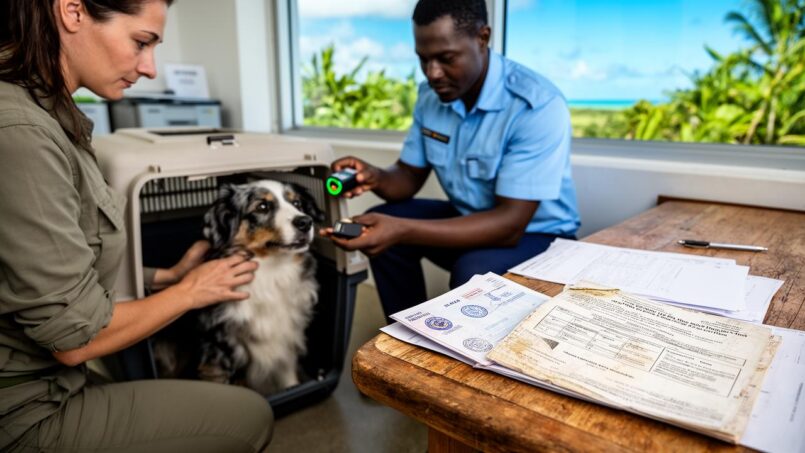
The first, essential step is obtaining an import permit issued by Niue’s Department of Agriculture, Forestry & Fisheries. Without this permit, any entry of an animal, semen, or ova is illegal. The application must be made in writing and must specify the species, origin, travel conditions, and health guarantees.
The Director has broad discretionary power to accept or refuse. A dog of a breed considered dangerous, for example, may be denied entry. Some texts targeting exports from New Zealand to Niue explicitly cite prohibited dog breeds (American Pit Bull Terrier, Dogo Argentino, Japanese Tosa, Fila Brasileiro, and crosses of these breeds). It is reasonable to consider that these restrictions reflect the expectations of Niuean authorities regarding public safety.
The import permit can impose strict conditions (duration and location of quarantine, examinations, vaccination, treatments). It is crucial to scrupulously respect each clause, as any breach can lead to extended quarantine, return, or destruction of the animal.
The Zoosanitary Certificate: Your Companion’s “Health ID Card”
The entry of dogs and cats into Niue requires the presentation of an official zoosanitary certificate completed and signed by an official veterinarian from the country of departure. In the case of an export from New Zealand, this certificate is issued by the Ministry for Primary Industries (MPI), under the reference PETANI.NI.
This document, which is only certified if all requirements are met, attests notably that:
– the animal has been clinically examined and shows no sign of contagious disease;
– it has resided for at least six months in the country of departure (or since birth if younger);
– it has met vaccination requirements (distemper, hepatitis, parvovirus for dogs, etc.) and, where applicable, required laboratory tests;
– it is properly identified and traveling in a crate conforming to international standards.
In addition to the veterinary certificate, a declaration from the exporter or owner is required. It must certify that the animal has shown no sign of disease and has not been in contact with sick animals during the 30 days prior to export.
Minimum Age, Identification, and Transport Conditions
Animals must be of a minimum age to be imported. For shipments from New Zealand to Niue, the animal must be at least four months old at the date of export. This ensures it has had time to receive its basic vaccinations, and possibly boosters.
Identification by microchip has become a standard in international exchanges. Many systems, notably those related to New Zealand or the United States, require a 15-digit ISO chip readable by a universal scanner. The chip number must appear on all documents (health certificates, vaccination records, test results). Even if Niue’s specific texts don’t detail all these points, it is very prudent to align with these standards, especially since many animals transit through New Zealand to reach Niue.
For air transport, notably from New Zealand to Niue, the crate must meet IATA standards. It must be spacious enough for the animal to stand up, turn around, and lie down, while being sturdy and well-ventilated. Furthermore, an official numbered or marked seal is affixed to the crate, guaranteeing its integrity and enhanced control throughout the journey.
The Question of Quarantine: A Possible Requirement Upon Arrival
The texts mention the possibility of mandatory quarantine for animals imported to Niue. The import permit can specify the location (official station, private site under surveillance) and the duration. At this stage, there is no single, publicly applicable duration for all cases; it all depends on the animal’s profile, country of origin, health history, and risk assessments by biosecurity services.
It is useful to keep in mind the example of New Zealand, which imposes a minimum of ten days of quarantine for dogs and cats from most countries (excluding Australia), with the possibility of extension in case of documentary or health issues. Niue, which strongly follows this approach, can demonstrate the same rigor, even if the precise modalities remain to be clarified at the time of the permit application.
Air Connections: A Puzzle Involving Cargo, Stopovers, and Breed Restrictions
Reaching Niue with an animal does not involve a direct flight from Europe or North America. International airlines only land in major hubs like Auckland or Christchurch in New Zealand, from where rotations to Niue depart. For animals, the general rule is that they travel as freight (cargo), rarely in the cabin, especially on international segments.
Several major airlines, including American Airlines, Air France, British Airways, Emirates, Etihad, Lufthansa, Qantas, Singapore Airlines, and United Airlines, are authorized for this transport. For flights to Pacific Islands, Air New Zealand Cargo is often essential, but it prohibits brachycephalic dogs (bulldogs, pugs…) on flights longer than five hours due to respiratory risks.
Many airlines refuse brachycephalic breeds or accept them under reinforced conditions, sometimes requiring the owner to go through a specialist pet travel agency. Air New Zealand, for example, does not accept direct bookings from the public for animals on international flights: one must go through an accredited carrier.
Another constraint: the hold capacity for animals is limited, depending on the aircraft size, season, number of passengers, and weather conditions. It is therefore imperative to book well in advance, sometimes several months before the desired date.
Fees and Rules from Airlines
Animal transport fees are generally non-refundable and charged per crate and per journey. For transport via American Airlines Cargo service, the price varies depending on distance, combined weight of animal + crate, and stopovers. If a journey includes a voluntary stop or a connection of more than four hours, additional fees are applied for each segment.
Airlines also impose limits on the number of animals per passenger, particularly for checked pets. In some cases, only military or diplomatic personnel on official assignment can travel with animals in the hold as checked baggage. Others must use cargo freight.
These elements show that it is often simpler to delegate the logistical part to a specialist pet transporter, especially for complex segments to the Pacific.
Cost of Relocating with a Pet to Niue: Order of Magnitude and Financial Pitfalls
Transporting an animal to Niue is expensive, sometimes very expensive. While precise figures for Niue are not always published, ranges for other Oceania destinations (Australia, New Zealand) give a good idea of the scale of expenses.
For a departure from the United States to Oceania, the overall budget for one animal (dog or cat) can range from $5,095 to $13,395 US dollars, or more for large dogs, complicated itineraries, or cases of extended quarantine. This amount generally includes microchipping, health certificates, air transport, terminal services, and possibly some quarantine fees.
The most common expense items break down as follows:
| Expense Item | Indicative Range (USD) |
|---|---|
| Veterinary Consultations & Certificates | 100 – 300 |
| Vaccines & Microchip | 50 – 200 |
| Special Tests (e.g., RNATT, Babesia, etc.) | 100 – 600 per test depending on country |
| IATA-Compliant Transport Crate | 70 – 500 (standard) to 800 – 1,800 (custom) |
| Airline Fees (Cargo) | 200 – 1,200 (some routes) to 900 – 3,000+ (international) |
| Professional Relocation Services | 1,000 – 4,000 (up to 6,000+) |
| Quarantine (if applicable) | 500 – 1,500, sometimes more |
| Import Permit & Customs Formalities | 50 – 300 |
| Ground Transport (Departure & Arrival) | 200 – 600 per segment |
For comparable routes to Australia or New Zealand, figures rise quickly: $6,000 to $10,000 for a medium-sized dog, $4,000 to $8,000 for a small dog or a cat. Some concrete case examples mention up to $11,100 for a dog + cat duo to New Zealand, or over $7,700 for a medium dog to Australia. It is therefore reasonable to anticipate a total cost in that ballpark for Niue, or even more if the itinerary involves multiple stopovers.
The additional cost linked to administrative errors in animal transport, which can reach $2,500.
Comparing “Do-It-Yourself” and Professional Services
Some owners choose to manage everything themselves to save several thousand dollars in agency fees. This is possible, but it requires comfort with complex regulations, official veterinary forms, dealings with multiple ministries (animal health, agriculture, customs), and juggling the specifics of each airline.
Specialized services typically charge between $1,500 and $5,000 for a complete international relocation. They handle all essential administrative and logistical steps: obtaining permits, veterinary appointments, cargo transport booking, transit organization, and coordination with authorities. Their expertise is particularly valuable for specific destinations like Niue, as it reduces risks and ensures a safe journey for the animal.
Health Preparation: Impeccable Animals Before Boarding
In a country with no resident veterinarian and non-existent emergency services, it is crucial to arrive with an animal in full health, up-to-date on all vaccines and treatments. Preparation often begins several months before departure, especially if the animal must transit through countries with strict regulations like New Zealand.
The recommended core vaccination schedules to protect the health of dogs and cats against the most common and serious diseases.
Complete protocol including canine distemper, infectious canine hepatitis, and parvovirus, often combined with other antigens like parainfluenza.
The core FVRCP trio protects against viral rhinotracheitis, calicivirus, and panleukopenia. Vaccination against feline leukemia is sometimes recommended.
In certain frameworks, notably for countries with high rabies vigilance, a rabies vaccine and an antibody titer test (RNATT) are required, with waiting periods that can reach three months between blood draw and the ability to travel. Even if Niue does not publish a detailed schedule comparable to New Zealand’s, aiming for that level of security is a prudent choice, especially in case of transit.
The example of the export protocol for dogs from New Zealand to the island of Niue illustrates the level of health rigor expected. It requires complete vaccination against distemper, hepatitis, and parvovirus. Strict internal parasite treatments are mandatory, including treatment with praziquantel within 21 days before shipping, followed by a pyrantel or fenbendazole-based dewormer within the last four days. For diseases like leptospirosis, specific antibiotic treatment (doxycycline for 14 days within 30 days prior to departure) is also required. These measures aim to protect an island territory with limited control means against the introduction of parasites and pathogens.
Before departure, it is wise to ask your veterinarian to perform a complete blood panel (CBC, biochemistry) and to bring the results to Niue. This will give the paravets or visiting veterinarians a valuable baseline in case of a future problem.
Living with an Animal in Niue: Limited Services, Local Initiatives, and Daily Constraints
Arriving in Niue with a healthy animal and papers in order is only the first step. Daily life on the island presents specificities that are better anticipated, both on a practical and legal and social level.
The Absence of Veterinarians and the Role of Paravets
One of the most striking facts for an expatriate is the absence of a permanent, fully qualified veterinarian in Niue. To address this gap, a paraveterinary training program has been implemented: six trainees have already passed their final assessment and are progressing towards certification. Their mission is to provide basic animal healthcare, advice to breeders, monitor sick animals, and act as liaisons with reference veterinarians, often based in New Zealand.
The training of veterinary paraprofessionals improves the local management of animal health and protects livestock. For pet owners, this allows for obtaining local advice and basic care, but complex or surgical interventions remain difficult to perform immediately on-site.
Twice a year, free clinics for domestic pets are organized, in partnership with a veterinary team from New Zealand, the Rock Vets. These missions allow for spaying/neutering campaigns, vaccinations, and general consultations. Animals presented there leave in better health, according to reports from the organization. Between campaigns, the team provides remote veterinary advice as much as possible, relying on the paravet network.
Dog and Cat Overpopulation: Why Spaying/Neutering is Strongly Recommended
Niue faces a problem of overbreeding of dogs and cats, resulting in a significant number of stray or semi-stray animals. This situation poses animal welfare, public health, and wild fauna protection challenges, especially in sensitive areas like the Huvalu Conservation Area.
Local authorities and NGOs recommend spaying/neutering as the primary method to control animal populations. For an expatriate, the most responsible and useful action is to arrive in the country with an already sterilized animal, except within the framework of a strictly regulated breeding project (a complex process). Anticipating this step before departure is crucial, especially since on-site spaying/neutering campaigns are not permanent.
Dog Registration and Management: A System Overseen by the Police
The official management of dogs on the island is handled by the Police. In 2022, 146 dogs were registered, but authorities acknowledge the existence of a large number of undeclared dogs. Fees related to registration include an initial registration fee of approximately $60, an annual renewal fee of $22.50, and $15 for the official collar.
Registering your dog is not a mere formality. It allows the animal to be recorded, contributes to better management of the canine population, and ensures compliance with the law. Any expatriate arriving with their dog must quickly contact the Police and DAFF to learn and follow local registration procedures.
Fragile Biodiversity and Invasive Species Control: The Stakes for Cats and Dogs
The island has developed a “National Invasive Species Strategy and Action Plan” (NISSAP) covering the period 2013‑2020, still structuring current action. The goal is to protect Niue’s natural heritage and livelihoods against invasive species, which threaten biodiversity, agriculture, and human well-being.
Rodents (rats, mice) and feral cats are among the priority species to control. Feral pigs also pose a problem, to the point that a control program has been implemented with specially trained dogs equipped with GPS collars, in connection with training for local hunters.
In this context, owning a dog or cat implies increased responsibility: preventing the animal from hunting native wildlife, monitoring its outings, keeping it identified and, ideally, sterilized. Cats in particular can have a very strong impact on birds and other small vertebrates; limiting their access to sensitive natural areas is a gesture of good neighborliness towards the local biodiversity.
Housing and Daily Life: Pet-Friendly Accommodations, Neighborhood, and Island Constraints
In terms of accommodation, Niue offers several hotels, guesthouses, and lodges, some accepting pets. Online booking platforms allow filtering results by the “pet-friendly” tag and identifying establishments ready to welcome dogs and cats, even other animals like birds or fish.
Accommodation facilities offer varying services for travelers with pets. Some offer specific amenities like grooming, dog walking, or are located near suitable spaces. Others simply accept the animal under strict conditions: restricted access to certain areas, prohibition on beds, and mandatory cleaning at the owner’s expense.
Before booking, it is essential to read the accommodation’s “pet policy” in detail: some apply additional fees per night or per stay, others cap the weight or number of animals, or even prohibit certain breeds. In an island context where options are more limited than in a large city, it’s better to check in writing, even confirming by email with the host.
Daily life in Niue includes the frequent presence of free-roaming animals (dogs, cats, roosters), often noisy, especially at dawn. For a foreign dog, encounters with poorly socialized peers can be stressful. It is advisable to do socialization work before the trip, maintain good leash control on-site, and remain vigilant. For visitors, earplugs can be useful to mitigate noise nuisance.
The island’s isolation also translates into limited access to certain products: specific kibble, dietary supplements, animal medications, advanced grooming equipment. It is recommended to bring a supply of suitable food, especially if the animal is on a special diet, as well as a basic medical kit (parasite preventatives, antiseptic, bandages, etc.) for the first few months.
The Special Case of Animals on Board Boats: Strict Rules for Yachters
Niue regularly hosts yachts and pleasure boats on stopover. For animals traveling on board, the regulations are particularly strict. Dogs and cats must remain confined on board for the entire duration of the stay, under penalty of heavy sanctions.
For keeping animals on board, a bond deposit of $100 NZD is required. Any animal found ashore without authorization will be euthanized according to biosecurity law. If an animal dies in Niuean waters, its remains must be handed over to an agent for controlled disposal.
Any new companion acquired in Niue during the stopover must be added to the vessel’s bond (the guarantee). This severity may be surprising, but it reflects the island’s obsession with preventing any uncontrolled intrusion of pathogens or species likely to destabilize its ecosystem.
Recommended Steps: Plan Early, Centralize Information, and Anticipate the Unexpected
A relocation project with an animal to Niue cannot be improvised. The deadlines related to vaccinations, possible tests, obtaining the import permit, booking quarantine (if imposed), and organizing cargo transport require planning over several months.
The number of months of procedures to plan in advance for an itinerary involving New Zealand, especially in case of complex health procedures.
From a practical point of view, it is advisable to create a single file containing:
Ensure you gather all the official documents and necessary contact information before your animal’s journey.
The animal’s passport or vaccination record, along with all laboratory test results with the microchip number clearly legible.
The successive certificates of good health and the final fitness-to-travel examination issued by an accredited veterinarian.
Copies of the Niue import permit, the zoosanitary certificate, and any transit documents (e.g., for New Zealand).
Contact details for veterinarians, paravets, and reference structures in Niue (like Rock Vets and the DAFF).
Logistically, familiarizing the animal with its transport crate several weeks before departure significantly reduces stress: leaving the crate open at home, placing treats, toys, or a blanket with the scent of home inside facilitates acceptance of confinement on the big day.
Finally, setting aside a financial buffer dedicated to unforeseen events (flight delay, quarantine extension, additional veterinary consultations in transit) is a prudent reflex. Administrative or operational surprises are frequent in this type of long-haul travel, and their cost can be significant.
In Summary: A Demanding, But Not Impossible, Project
Taking your pet to Niue means accepting a set of constraints: a strict regulatory framework, complex import procedures, transport exclusively as cargo, no permanent veterinarian, local animal overpopulation, extreme vigilance regarding biosecurity. It is also an opportunity to join a community very attached to protecting its environment and the well-being of its animals, structured around the DAFF, the paravets, and partners like the Rock Vets.
For the relocation to go well, a few principles clearly emerge:
For a successful move to an island, anticipate the steps very early, integrating the animal into the preparation. Aim for a health standard well above the minimum, drawing inspiration from strict protocols (e.g., New Zealand, Hawaii). Seriously consider an accredited pet transporter to secure flights and paperwork. Arrive with an animal already sterilized, socialized, and stable, ready to adapt to the island context. Quickly register with the local network (paravets, DAFF, Police, Rock Vets clinics) to ensure follow-up on-site.
With rigor, time, and an appropriate budget, relocating with a pet to Niue remains a feasible project. The main challenge is never to lose sight of the fact that, on such an isolated island, every precaution taken before departure is a safety net gained for your companion—and for the fragile ecosystem that will welcome them.
Disclaimer: The information provided on this website is for informational purposes only and does not constitute financial, legal, or professional advice. We encourage you to consult qualified experts before making any investment, real estate, or expatriation decisions. Although we strive to maintain up-to-date and accurate information, we do not guarantee the completeness, accuracy, or timeliness of the proposed content. As investment and expatriation involve risks, we disclaim any liability for potential losses or damages arising from the use of this site. Your use of this site confirms your acceptance of these terms and your understanding of the associated risks.

Cyril Jarnias is an independent expert in international wealth management with over 20 years of experience. As an expatriate himself, he is dedicated to helping individuals and business leaders build, protect, and pass on their wealth with complete peace of mind.
On his website, cyriljarnias.com, he shares his expertise on international real estate, offshore company formation, and expatriation.
Thanks to his expertise, he offers sound advice to optimize his clients' wealth management. Cyril Jarnias is also recognized for his appearances in many prestigious media outlets such as BFM Business, les Français de l’étranger, Le Figaro, Les Echos, and Mieux vivre votre argent, where he shares his knowledge and know-how in wealth management.





