
 Published on and written by Cyril Jarnias
Moving to Iceland isn’t just about changing countries—it’s about stepping into a different relationship with time, light, wind, rain… and heating. The climate dictates everything, from clothing to energy budget, including your mood in the middle of January. For an expat, understanding and taming this environment is almost as important as getting a kennitala.
This article offers practical tips for living with the local climate, covering weather, appropriate clothing, housing, transportation, diet, mental health, and Icelandic habits to get through winter smoothly.
Understanding the Icelandic Climate Without Panicking
Before pulling out the heavy-duty parka, let’s bust a myth: Iceland isn’t the ice block you might imagine. The country sits just south of the Arctic Circle, but the North Atlantic Current significantly moderates the temperatures.
Year-round, the average hovers around 6 °C (43 °F). On the coast, especially in Reykjavík, winters are relatively mild for the latitude: often between 0 and 3 °C (32–37 °F), though occasional dips to -10 or -15 °C (14–5 °F) are possible during cold snaps. In summer, most days range from 10 to 15 °C (50–59 °F), with peaks of 20–25 °C (68–77 °F) during brief warm spells.
The average wind speed in Iceland, in meters per second, which makes the wind chill factor feel much colder.
A local saying sums it up well: “If you don’t like the weather in Iceland, wait five minutes.” You can indeed experience sun, snow flurries, driving rain, and clear blue skies all in the same morning, summer or winter.
Bright Summer, Dark Winter: Two Dominant Seasons
Icelanders often talk about a long, bright summer and a long, dark winter, with the transitional seasons being more blurred. What changes most isn’t the temperature, but the light.
In summer, Iceland lives by the rhythm of the midnight sun. Between late May and early August, true darkness is nearly absent. In Reykjavík, the sun sets just after midnight and rises around 3 a.m. around the summer solstice. In northern parts of the country, the sun even stays above the horizon 24 hours a day during this period.
In winter, the situation reverses dramatically. From late November to mid-January, the capital gets only 4 to 5 hours of daylight. Dawn arrives around 11 a.m., and night falls around 3:00–3:30 p.m. In some deep fjords in the north or west, the sun can remain hidden behind mountains for weeks.
This light/dark cycle has a significant impact on daily life, concentration, sleep, and mood. Preparing for it is an integral part of adapting to the climate.
Dressing Like an Icelander: The Golden Rule of Layers
Faced with such unstable weather, the key isn’t owning “the” perfect coat, but systematically adopting layering. This approach is often summed up by the three-layer rule: base, insulation, protection.
The Base Layer: Stay Dry on Your Skin
The role of the first layer is to keep your skin dry by wicking away sweat. This is crucial in a windy, humid climate: if your inner clothes stay wet, you’ll be cold even under the best parka.
Recommended materials are merino wool or technical synthetic fibers. They dry quickly, breathe well, retain insulating power even when damp, and don’t get too smelly after a long day outdoors. Conversely, cotton should be avoided for outdoor activities: it absorbs moisture, takes a long time to dry, and leaves you chilled as soon as the wind picks up.
The essentials are a long-sleeved top and thermal leggings in winter, then a lighter version in milder weather. Many Icelanders use technical underwear year-round, simply adjusting thickness by season.
The Mid Layer: Trapping Heat
The second layer serves as insulation. It traps warm air around your body. The most effective options are <fleeces, wool sweaters, light synthetic or down vests/jackets.
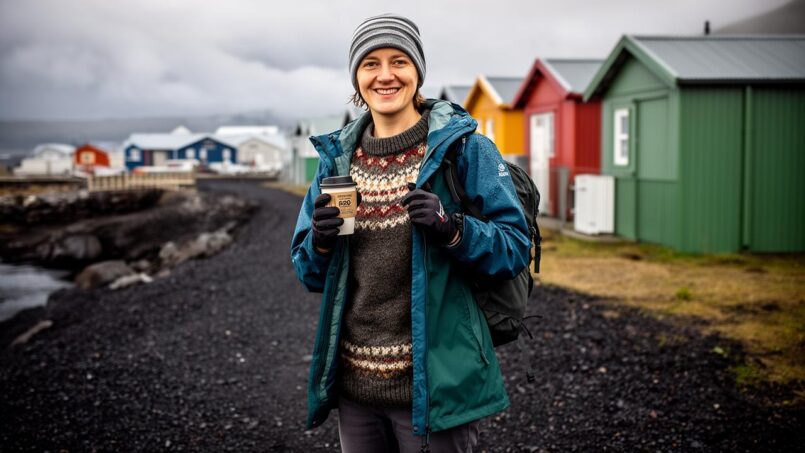
Fleece has the advantage of being lightweight, breathable, and performs well even when damp. The traditional Icelandic wool sweater (lopapeysa) plays a similar role, with the added benefits of being slightly water-repellent and having cultural significance. Many expats end up buying one, both to blend in and for thermal comfort.
The idea isn’t to pile on endlessly, but to have one or two adjustable layers that you can add or remove throughout the day. In winter, a combo of merino + fleece + lopapeysa + parka provides decent protection for most urban situations.
The Outer Shell: Blocking Wind, Rain, and Snow
The third layer is what directly faces the elements. It absolutely must be windproof, waterproof, and breathable. A good rain jacket or mountain shell with sealed seams, adjustable hood, and ventilation zips is often the most worthwhile investment year-round.
Even if a thick coat is common, a waterproof shell is still essential for facing frequent windy and rainy days, even above freezing.
For your legs, water-resistant rain pants or softshells are nearly indispensable if you walk a lot, whether in the city or on trails. In winter, you simply wear thermal leggings underneath. For more demanding activities (glacier hiking, waterfall exploring, boat trips), fully waterproof pants become a real comfort—even a necessity.
How to Adapt This Strategy by Season
For an expat, it’s helpful to translate this theory into practical needs by season.
| Season | Typical Temperatures (South Coast) | Clothing Priority |
|---|---|---|
| Winter | ~ -3 to +3 °C (26–37 °F) | Thermal base + good insulation + waterproof parka, warm accessories |
| Spring | ~ 0 to 10 °C (32–50 °F) | Light but complete layers, shell essential |
| Summer | ~ 10 to 15 °C (50–59 °F), up to 20–25 °C (68–77 °F) in peaks) | Thinner layers, shell always in the bag, light beanie |
| Autumn | ~ 5 to 10 °C (41–50 °F), very rainy | Maximum rain/wind protection, warm base at hand |
In practice, many newcomers underestimate spring and autumn and overestimate winter. Yet these are the wettest and windiest seasons, where quality waterproof gear makes all the difference.
Choosing the Right Footwear and Accessories
Adjusting to Iceland’s climate also comes down to your feet, hands, and head. A perfect outfit ruined by canvas sneakers always ends the same way: soaking wet feet, cold creeping up, day ruined.
Footwear: All-Terrain Waterproof Boots
High-cut hiking boots, rugged and truly waterproof, are practically essential for anyone wanting to explore beyond Reykjavík’s sidewalks. They should offer:
– A waterproof/breathable membrane,
– Good ankle support,
– An aggressive tread for traction on compacted snow, mud, gravel, and wet volcanic rock,
– Ideally light insulation for winter.
Key criteria for choosing boots suited to city life in cold weather
They must provide thermal protection against cold and be sealed against moisture and snow.
A sole with good grip is essential for safety on slippery surfaces.
Enough volume to fit thick socks without compression, ensuring comfort and warmth.
In winter, adding mini-crampons (microspikes, ice cleats) for icy sidewalks and around waterfalls is an excellent idea. They are readily available locally.
Year-Round Essential Accessories
The trio of beanie – gloves – neck gaiter isn’t just for excursions. Wind and humidity wick away a huge amount of heat from your head, neck, and extremities.
In winter, plan for: warm clothes, extra blankets, salt pellets for ice, winter tires for your vehicle, and non-perishable food in case of a storm.
– A warm beanie covering the ears,
– A pair of insulated, waterproof gloves or mittens,
– A buff or balaclava to protect the lower face in strong winds,
– Thick wool or synthetic socks.
In summer, a lighter version of this kit remains useful. Even under the midnight sun, a boat trip, a walk on a black sand beach, or a long stop at a waterfall can quickly get chilly.
What’s Best Left in the Closet
Some clothing habits don’t work well in Iceland:
– Jeans for extended time outdoors — they hold water and cold,
– 100% cotton clothing for any outdoor activity,
– Heavy urban coats that aren’t waterproof,
– Umbrellas — routinely battered and broken by the wind.
It’s better to invest in a few well-chosen technical pieces than to accumulate unsuitable clothing.
Living with Light (and Darkness): Daily Strategies
For expats, the biggest surprise is sometimes not the weather but the light. Going from 4 hours of daylight in December to over 20 hours in late June profoundly changes your relationship with time, sleep, and energy.
Managing the Near-Perpetual Night of Winter
In the heart of winter, it’s common to wake up in the dark, go to work in the dark, and come home… in the dark. In the south, the day then lasts barely four or five hours. This cycle can lead to fatigue, low mood, and for some, Seasonal Affective Disorder (SAD).
Interestingly, studies show that strictly defined SAD is less common in Iceland than in some countries farther south, supporting the hypothesis of some genetic adaptation. But many people—both expats and locals—still feel a dip in energy and motivation in winter.
Several concrete strategies help buffer this shock:
To better cope with very short days and lack of natural light, it’s recommended to get exposure to daylight whenever possible, for example by going for a walk during your lunch break. Using a light therapy lamp in the morning can be beneficial, after medical advice. At home, opt for warm lighting with fairy lights, lamps, or candles, the Icelandic way. Monitor your vitamin D levels through diet (fatty fish, cod liver oil) or supplements, after consulting a doctor. Finally, maintain a regular sleep routine despite the surrounding darkness.
Icelandic schools, universities, and businesses sometimes incorporate this reality. You’ll find experiments with daylight-mimicking lighting in some facilities and schedule adjustments to make better use of the few hours of daylight.
Taming the Midnight Sun
Summer brings the opposite extreme: the sky never gets truly dark for several weeks. In Reykjavík around the solstice, the sun sets just after midnight and reappears around 3 a.m.; farther north, it barely dips below the horizon. If you’re not careful, you can easily lose track of time and unconsciously lengthen your days.
Most homes have blackout curtains, but it’s wise to bring or buy a sleep mask for total darkness. To help fall asleep despite the lingering summer brightness, create a bedtime ritual. This could include dim lighting, reading, or a non-caffeinated warm drink. This ritual helps give your body a clear signal that the day is over, even if the sky outside is still bright.
This constant light also has its advantages: it offers immense opportunities for leisure, photography, and late-night trips on empty roads. Many Icelanders make the most of these weeks by spending more time outdoors, gardening, working late in the fields, or simply socializing on terraces until late.
Heating Without Breaking the Bank: Understanding Energy in Iceland
One of the most pleasant surprises for a newcomer: despite the very high cost of living, heating is relatively cheap in Iceland. Why? Because about 90% of homes are connected to geothermal heating, and 100% of electricity comes from renewable sources (hydro and geothermal).
Geothermal: A Daily Ally
Iceland’s underground, made of still-hot lava, magma, and porous rock, is a giant natural boiler. Rainwater and glacial melt take about two centuries to seep down to areas near the magma, where they turn into superheated water and steam. Networks of wells, power plants, and insulated pipes then bring this heat to towns.
In the Reykjavík area, electricity and hot water are distributed from large geothermal plants like Hellisheiði via pipes running dozens of kilometers. The natural water, stored in colorful tanks, arrives at homes at 80–90 °C (176–194 °F). It is used for heating, domestic hot water, and melting snow from sidewalks and parking lots via built-in piping under the surfaces.
Result: surprisingly low energy bills compared to other Nordic countries. Studies show that a 100 m² (1,076 sq ft) apartment in Reykjavík can be heated for the equivalent of a few hundred euros per year, significantly less than in Helsinki, Oslo, or Copenhagen. For a family home of about 130 m² (1,400 sq ft), some reports mention monthly heating bills around $60–70.
What This Means for an Expat
For someone arriving from a country where energy is expensive, this abundance of heat can be surprising. Icelanders lived in damp, poorly insulated houses before geothermal became widespread, and you sometimes see a culture of “heat high and air often.” It’s not uncommon to see windows open in midwinter to refresh the air.
It’s worth paying attention to a home’s energy performance, especially in older neighborhoods or in regions without geothermal access, such as some rural or eastern areas.
– Ask the landlord or agency for the consumption history before signing a lease, especially in older buildings;
– Check the condition of windows and doors, common sources of drafts;
– Pay attention to roof and wall insulation in peripheral houses.
Simple improvements (weatherstripping windows, insulating heating pipes in unheated basements, installing a programmable thermostat) can reduce consumption by 5 to 25%. Simply lowering the thermostat by one degree (about 1.8°F) in living spaces can save up to 5%.
Comparing Costs with Other Expenses
To get a sense of scale, compare heating with other common expenses.
| Monthly Expense Category (Approximate) | Typical Amount (Indicative) |
|---|---|
| Heating an average apartment in Reykjavík | ~ 50–70 € |
| Electricity (excluding heating) | ~ 30–70 € |
| Groceries for one person | Very high, often well above heating |
| Rent for a 2- to 3-room apartment in the capital | By far the largest expense |
For an expat, this means there’s no need to skimp excessively on heating. It’s better to maintain reasonable thermal comfort (around 20–22 °C (68–72 °F) in the living room, 18 °C (64 °F) in the bedroom) and focus savings on other areas, like food choices or transport.
Driving and Getting Around in a Fickle Climate
In theory, the best way to explore the country is by car, especially via Ring Road No. 1 that circles the island. In practice, weather conditions can turn the simplest trip into a small expedition, especially in winter.
What the Climate Means for Driving
From about November to April, snow, ice, rain, sleet, and gusts can all occur within a few hours. Main roads are plowed regularly, but snow can quickly accumulate again. You’ll frequently encounter:
– Compacted snow or slush,
– Visible ice… or not (the infamous “black ice“),
– Crosswinds that really shake the vehicle,
– Areas of near-zero visibility during snowstorms.
The strongest winds occur on bridges, plateaus, coastal areas, and flat, open spaces. The northern and eastern regions, as well as the Westfjords, are more prone to heavy snowfall and prolonged road closures. Mountain roads and Highland tracks (marked “F”) are completely closed all winter.
Even in summer, when conditions are generally milder, it’s crucial to factor in sudden weather changes, heavy autumn rains, and strong winds into your plans.
Adapting: Equipment and Reflexes
For an expat considering buying or renting a car, a few rules apply:
– Preferably choose a 4×4 or all-wheel-drive vehicle if you plan to leave the Reykjavík area, especially in winter or for trips to the south coast, east, or north;
– Make sure the car is equipped with appropriate winter tires; in the cold season, rental cars usually have studded tires, mandatory during the regulated period;
– Keep your headlights on at all times, day and night, to be clearly seen in fog, rain, or snow;
– Absolutely adjust your speed to conditions, even if the road looks clear;
– Increase following distance (5 to 6 seconds) to allow time to react on slippery surfaces;
– Avoid using cruise control whenever there’s a risk of ice;
– Never open a door without holding it firmly: the wind can literally rip it off.
Before any trip in Iceland, it’s imperative to check vedur.is for weather, road.is for road conditions, and safetravel.is for safety advice. These sites, updated frequently with color-coded alerts, are essential. Ignoring a road closure can result in a fine and endanger vehicle occupants and rescue teams.
Additionally, having a basic kit in the vehicle is highly recommended: extra warm clothes, a blanket, water, some snacks, phone charger, ice scraper. In case of a prolonged breakdown or unexpected road closure, these precautions make a real difference.
When to Opt for Public Transit or Tours
Public transportation outside the capital area remains limited, especially outside summer. Buses between regions are more frequent from June to August, rarer the rest of the year, and schedules are highly weather-dependent.
For expats less comfortable with winter driving, organized tours are a good entry point: they let you explore the south coast, the Golden Circle, or even glaciers without having to handle the road yourself. Within Reykjavík, the city bus network serves the main neighborhoods decently, but you have to accept that during a storm, the whole city slows down.
Eating and Shopping According to the Climate
Iceland’s climate doesn’t just shape what you wear—it also structures the food supply and shopping habits. As an expat, understanding this interaction helps you manage your budget, health, and integration.
Agriculture Under Glass and Over Lava
The cold and short growing season outdoors have pushed the country to maximize the use of geothermal energy for agriculture. Many heated greenhouses produce tomatoes, cucumbers, and other vegetables year-round, using hot water and electricity from geothermal or hydro sources. Irrigation uses water of drinking quality, naturally filtered by volcanic rock.
This helps limit imports and provides, even in winter, local, pesticide-free vegetables, sometimes grown hydroponically. There’s also significant production of potatoes, carrots, turnips, and various root vegetables adapted to the climate.
Proteins mainly come from extensive livestock farming (sheep, cattle, horses) and fishing. Seafood from cold, rich waters is a significant source of vitamin D and omega-3s, beneficial for winter mood.
Shopping in an Expensive Country
The downside of this island model, heavily reliant on imports for many goods and consumer items, is a high cost of living, especially in food. Several major chains shape the supermarket landscape:
– Discount stores like Bonus or Kronan, handy for stocking up before a road trip;
– More general stores like Netto, combining groceries and household goods, some open 24/7;
– Small neighborhood convenience stores and gas stations, often pricier, but invaluable in bad weather or rural areas.
Plastic bags are generally not provided or are very limited on-site. To anticipate this common practice, linked to environmental and recycling concerns, it’s advised to bring your own reusable bags.
A good strategy for an expat is to take advantage of local, seasonal products, often more affordable and sustainable: skyr, fresh fish, lamb, rye bread, root vegetables, berries, as well as locally grown greenhouse vegetables. Farmers’ markets and farm shops, which are multiplying, sometimes offer good prices and allow you to support producers directly.
Adapting Your Diet to Winter
Winter naturally pushes towards richer, heartier comfort foods, which align well with energy needs and cultural habits: lamb soups, fish stews, dense breads, desserts made with skyr, berries, rhubarb. For an expat, adopting these recipes lets you combine climate adaptation (eating warm and nourishing), cultural integration, and budget efficiency (local products are often cheaper than exotic imports).
Protecting Your Mental Health in This Climate
Adapting to the climate also means psychological self-care. The sequence of autumn storms, winter darkness, and very short days tests everyone’s resilience. Icelanders, even if they seem to cope well, aren’t immune: depression statistics remain high by European standards, even if the strict seasonal form is less common than elsewhere.
Drawing on Local Strategies
A few pillars structure how the population manages these constraints:
Icelanders adopt several approaches to handle long, dark winters. They value outdoor activities like geothermal baths, walking, or skiing, properly equipped. Social life revolves around pools, cafes, and sports clubs, offering informal support. Many use the season for personal projects (reading, creating, DIY), giving meaning to long evenings. Finally, they combat darkness with light decorations (fairy lights, candles) that often extend the Christmas atmosphere.
For an expat, joining this rhythm by signing up for a club, class, association, choir, or hiking group can make a major difference. Expat groups on social media are also a valuable resource for sharing tips and coping with low moments.
Taking Care of Your Rhythm and Body
On an individual level, several habits help cushion the climate’s impact:
To mitigate the effects of winter light deprivation, several actions are recommended: engage in regular physical activity, even moderate like yoga, stationary biking, or daily walking; monitor sleep quality by reducing screens in the evening and setting up the bedroom (sleep mask in summer, dim light in winter); consult a healthcare professional without delay for persistent symptoms (extreme fatigue, ongoing sadness); and, if possible, schedule a short escape to a sunny destination in the heart of winter to “recharge” your light batteries.
Adjusting Your Home to the Climate
Even though energy is cheap, the climate demands attention to your home’s thermal quality, both for comfort and health (humidity, mold).
Choosing and Improving Your Home
In Reykjavík and geothermal towns, nearly all homes have district heating, via radiators fed by natural hot water. Nevertheless, not all buildings are equal. Constructions from before the 1980s often have weaker insulation and pronounced thermal bridges.
For an expat looking for housing, a few useful habits:
Before signing a lease, ask for specific heating bills from previous winters to get an idea of monthly costs. Also inspect window condition (single, double, or triple glazing) and check for signs of moisture. It’s also possible to negotiate with the landlord for small insulation improvements, like replacing window seals or installing draft excluders under doors.
Once settled, simple actions help optimize comfort:
– Maintain different temperatures per room (cooler in bedrooms, warmer in living areas);
– Avoid turning off heating completely in some rooms to prevent thermal shock and mold;
– Ventilate regularly, even in winter, but for short periods—open windows wide and then close them, rather than leaving them ajar for hours.
Making the Most of Pools and Hot Tubs
One of the great advantages of Iceland’s energy system for daily life is the density of heated municipal pools. Almost every town, and many villages, have outdoor hot pots, hot tubs, and baths at various temperatures. They are fed by geothermal water, keeping access affordable.
For expats, adopting the routine of a hot bath—sometimes daily—helps adapt to the climate by enjoying the cold air/hot water contrast and socializing outdoors. This practice also promotes muscle relaxation, improves sleep quality, and has a positive impact on mood.
Building a Pleasant Life in an Extreme Climate
Adapting to Iceland’s climate isn’t about ticking a few boxes on a clothing list. It’s about gradually integrating a set of reflexes and mindsets:
To live harmoniously under Nordic latitudes, it’s crucial to accept that weather sometimes dictates your schedule and to keep some flexibility in your plans. Check the forecast and road conditions each morning before a long trip. Always have a Plan B for outdoor outings. Adopt a positive attitude toward gear: layers of clothing are a tool for freedom, not a constraint. See the long winter nights as an opportunity to slow down, read, create, and gather. In summer, use the endless light to explore, hike, camp, or photograph, while being mindful to protect your sleep.
Iceland is a country where children play outside in town, where people walk in the rain, where sidewalks steam with geothermal heat while snow is still falling. For an expat, letting yourself be immersed in this uninhibited relationship with the climate is probably the best way, in the end, to feel at home.
With good clothing, a reasonably optimized home, a few habits inspired by Icelanders, and a dose of curiosity, the climate ceases to be an obstacle and becomes the backdrop—often harsh, frequently spectacular—of a new life.
Disclaimer: The information provided on this website is for informational purposes only and does not constitute financial, legal, or professional advice. We encourage you to consult qualified experts before making any investment, real estate, or expatriation decisions. Although we strive to maintain up-to-date and accurate information, we do not guarantee the completeness, accuracy, or timeliness of the proposed content. As investment and expatriation involve risks, we disclaim any liability for potential losses or damages arising from the use of this site. Your use of this site confirms your acceptance of these terms and your understanding of the associated risks.

Cyril Jarnias is an independent expert in international wealth management with over 20 years of experience. As an expatriate himself, he is dedicated to helping individuals and business leaders build, protect, and pass on their wealth with complete peace of mind.
On his website, cyriljarnias.com, he shares his expertise on international real estate, offshore company formation, and expatriation.
Thanks to his expertise, he offers sound advice to optimize his clients' wealth management. Cyril Jarnias is also recognized for his appearances in many prestigious media outlets such as BFM Business, les Français de l’étranger, Le Figaro, Les Echos, and Mieux vivre votre argent, where he shares his knowledge and know-how in wealth management.





