
 Published on and written by Cyril Jarnias
Moving to the “land of fire and ice”, with its volcanoes, glaciers, and northern lights, is a dream for many. Yet behind the postcard landscapes, many newcomers discover a different reality: homesickness. Whether you come for studies, a permanent job, a work season, a love story, or a life project, the longing for “home” almost always strikes eventually.
Most expats go through a phase of homesickness, which is a human reaction to change, not a failure. In Iceland, this feeling can be amplified by the isolation of a small society, the language barrier, the harsh climate, and family distance.
The goal of this article is twofold: first, to normalize what you’re feeling; second, to offer concrete strategies tailored to the Icelandic context to tame homesickness, day by day, without ignoring the very real challenges of life in the North Atlantic.
Understanding Homesickness in the Icelandic Context
Homesickness, in the strict sense, is the emotional shock of losing your familiar environment: places, people, habits, language, food, even everyday sounds and smells. Research shows that 50 to 75% of people have experienced this type of nostalgia at least once. Among first-year students, nearly 70% show symptoms during the first semester. In other words: in Iceland, you’re surrounded by others struggling with very similar feelings, even if it doesn’t show.
In Iceland, several factors amplify this feeling. The country is tiny in population, with tight-knit communities, subtle social codes, and a language that few people master before arriving. Add a harsh climate, extreme seasonal light variations, and a high cost of living that makes trips back home difficult. This combination slows down adaptation, especially if it’s your first time living far from home.
Culture Shock, Then Adaptation
Most expats go through several stages that aren’t linear. It’s common to start with a “honeymoon phase”: everything is new and exciting—waterfalls, auroras, hot pots, Reykjavík cafés… Then comes a tougher phase: cultural misunderstandings, fatigue from speaking another language, feeling like “the foreigner” all the time, and irritation at small daily differences. This is often when homesickness sets in.
This phase, though normal, can generate anxiety, sadness, irritability, sleep problems, concentration difficulties, and appetite changes. Without strategies to manage it, it may evolve into lasting anxiety or depression. However, with the right approaches, it can become a springboard for personal growth and resilience.
When Iceland Amplifies Nostalgia
The local context plays a role. In Iceland, several realities come up in newcomer testimonials.
Distance from loved ones—often several hours away by plane with a significant time difference—and the high cost of plane tickets limit the frequency of visits, which can increase feelings of isolation compared to other European destinations.
Next, the social structure. Many Icelanders have friend circles formed in school or high school, very tight-knit, and hard to break into at first. Relationships are direct, not big on small talk. People use first names and informal address, even at work, but that doesn’t mean emotional closeness comes quickly.
Finally, light and weather. Limited daylight hours in winter, strong winds, frequent rain, and the cold feeling intensified by gusts along the coast near Keflavík or Reykjavík weigh on mood and energy. Icelandic researchers have shown that Nordic nature has profoundly restorative effects… but only if you go out to meet it, which takes effort when you’re feeling down.
Decoding Icelandic Social Codes to Feel Less Like an Outsider
A big part of expatriation discomfort comes from feeling like you never “do things right”. In Iceland, certain codes are unwritten but very present. Understanding them already eases a lot of the tension.
Direct Communication, Little Frills
Icelandic communication is straight to the point. People value clarity and honesty over polite formulas. The language doesn’t even have a direct equivalent for “please.” This can make people seem abrupt or cold, when really it’s often just straightforwardness without aggression.
People rarely interrupt, appreciate when you get to the point, and don’t sugarcoat things to spare someone’s ego. Taking this as sincerity rather than rejection really changes how you experience certain conversations at work or with the administration.
Advice for professional and administrative interactions
Distance, Modesty, and Respect for Privacy
Icelanders are known to be warm once the ice is broken, but reserved at first. They value authenticity and dislike boasting. Talking at length about your success or bank account will lose you more points than gain them.
Respect for personal space is important. You don’t hug someone on the first meeting; a firm handshake with eye contact is enough. Showing up unannounced at someone’s home is frowned upon. When invited, it’s good form to bring a small gift: flowers, chocolates, pastries, or a bottle of wine.
Everyday Habits That Surprise
Cultural differences are in the details. In Iceland, you take off your shoes when entering homes, but also in many medical clinics, offices, and especially swimming pools. In geothermal pool locker rooms, a full shower without a swimsuit is mandatory before entering the pools, for hygiene. Showers are often communal, separated by gender, which can be awkward at first, but everyone gets used to it.
Punctuality is highly appreciated for medical or professional appointments. For parties, however, arriving late is almost expected. Also, tipping at restaurants isn’t required, as service is usually included in the bill.
The better you know these codes, the less you interpret them as signs of rejection, and the more legitimate you feel in your new everyday life.
Learning to Balance Ties with Your Home Country
Studies on homesickness are unanimous: cutting all ties with family and friends is just as harmful as being glued to your phone. The challenge is finding a balance.
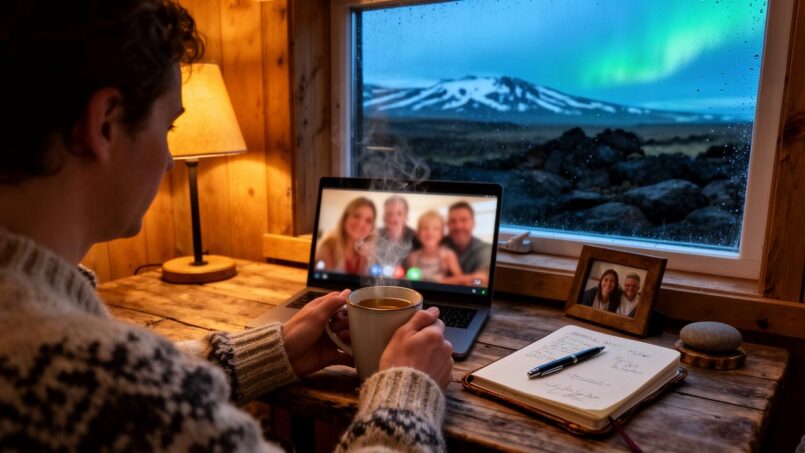
It’s helpful to set regular check-ins rather than communicating in a scattered, compulsive way. For example, one video call per week, voice messages on WhatsApp, a few photos of your discoveries: this nourishes connections without taking up all your mental space.
Having a planned upcoming call or visit reduces anxiety and feelings of abandonment, according to research.
Excessive social media use, on the other hand, strongly fuels comparison and the dreaded FOMO (fear of missing out) on what’s happening “back home.” Studies on cultural adjustment indicate that this constant comparison slows adaptation by about 30%. Limiting scrolling, temporarily uninstalling certain apps, or setting short connection times can make a real difference.
Examples of Possible Contact Rhythms
| Type of contact | Realistic frequency in Iceland | Effect on homesickness |
|---|---|---|
| Long video call (family) | Once a week | Strengthens bond, useful if not too emotional |
| Voice messages / photos | 2–3 times a week | Sharing daily life without invading the present |
| Scrolling “home” social media | 10–15 min/day max | Watch out: high risk of FOMO |
| Visits back home (budget allowing) | 1–2 times a year | Big mood boost, plan early |
The idea isn’t to follow a table strictly, but to realize that balance matters as much as the nature of the exchanges.
Building an Icelandic Routine: Your New Anchor
Researchers studying adaptation to a new country emphasize the importance of routines. One study cited in work on cultural transitions shows that structured habits can reduce stress by up to 40%. In Iceland, where time and light play with your nerves, establishing daily anchors is even more crucial.
Morning and Evening Rituals
Starting the day with a repetitive, pleasant gesture helps your brain feel “at home.” It could be coffee in the same mug, a few minutes of meditation, a short journal noting three positive things, or a quick walk—even in the rain. The Icelandic saying about weather is clear: there’s no bad weather, only bad clothes. Adopting this philosophy is part of integration.
Simple evening habits to promote falling asleep and improve sleep quality, regardless of the season.
Use soft lighting in the evening to signal to your body that sleep is approaching and to mitigate the impact of constant summer daylight.
Reading a few pages of a book helps shift your mind away from worries and prepare for rest, counteracting restlessness linked to light changes.
A warm shower or bath in the evening helps relax muscles and then lowers body temperature, which promotes falling asleep.
Listening to calm music or soothing sounds can create a bubble of serenity, helpful for falling asleep despite the prolonged darkness of winter.
Making Your Space Your Own
Whether it’s a shared room in Reykjavík, a small studio in Akureyri, or company housing in a rural village, personalizing your space is a powerful tool against nostalgia. Psychologists working with expats recommend bringing a few meaningful objects: photos, a favorite blanket, a cherished mug, a small flag, books.
Investing a little to buy a plant, a candle, some string lights, a cozy rug, or a duvet cover you like isn’t a decorative whim: it’s a tangible way to tell your brain “this place is a home, not just a camp.”
Example of a Mini Weekly Routine in Iceland
| Day | “Home” anchor | “Iceland” anchor |
|---|---|---|
| Monday | Quick call to a loved one | Geothermal pool soak after work |
| Wednesday | Comfort TV show or movie night | Coffee break at the same neighborhood café |
| Friday | Weekly gratitude journal | Nature outing (short walk, even in the city) |
| Sunday | Cook a dish from home | Walk to a local viewpoint |
It’s not so much the exact content that matters, but the regularity and the combination of old and new roots.
Leveraging Icelandic Nature to Recharge
One of Iceland’s major strengths against homesickness is its nature. Beyond the cliché of spectacular landscapes, research conducted in the northwest of the country shows that Icelandic natural environments have a measurable effect on mental state.
Over a year, participants visited nature sites near Ísafjörður weekly—forests, shorelines, a park—taking time to engage all their senses. Their psychological state was assessed before and after. Result: after two hours on site, they felt calmer, clearer-headed, happier, and more alert. Feelings of inner peace increased, while irritation did not increase despite wind, rain, or cold.
Natural environments, especially shorelines, are perceived as very beneficial for mental well-being. The sound of waves can interrupt negative thoughts, the open horizon gives a sense of space, and the presence of animals or signs of wildlife enriches the experience. In forests, plant diversity and the shelter of trees contribute to a strong sense of refuge.
How to Use This Resource Daily
You don’t need to travel to the Westfjords to benefit from these effects. Around Reykjavík, short walks along the coast, on trails at Seltjarnarnes, in the hills above Hafnarfjörður, or around urban lakes and parks can produce similar feelings if you adopt the same attitude of mindfulness: walk slowly, listen to the wind, watch the water, touch the lava rocks, smell the air.
Theorists of “attention restoration” explain that this type of nature requires little conscious mental effort: your mind can drift, rest, and regenerate. In contrast, a noisy, stimulating urban environment demands constant vigilance. When homesickness manifests as rumination and anxiety, regularly giving yourself breaks in Icelandic nature almost becomes a therapeutic appointment.
Hot Baths and Hot Pots: The Spa as Psychological Support
Geothermal pools and hot pots are not just a tourist pastime but a true pillar of daily life. From the Blue Lagoon to small neighborhood pools, these places combine three elements that research links to better well-being: hot water, sensory immersion, and light socializing.
Entry is affordable. They offer various facilities: lap lanes, pools at different temperatures, steam rooms, saunas, and sometimes cold baths. Strict hygiene (showering before entering the pool) is mandatory. These pools are important social spaces where Icelanders relax and chat, often after work.
For a newcomer, turning the neighborhood hot pot into a weekly ritual helps you physically relax, connect to a central part of local culture, and pick up fragments of Icelandic conversation. In the long run, these regular soaks help reduce accumulated tension, and therefore vulnerability to homesickness.
Building a Social Network in Iceland Without Losing Yourself
Studies on migration in Iceland are clear: the smaller your local support network, the longer homesickness persists. But making friends in a small, tight-knit society isn’t always intuitive.
Start with Other Foreigners… But Don’t Get Stuck There
Many testimonials note that initially, it’s easier to connect with other expats than with Icelanders. In Reykjavík, Facebook groups like “Expats in Iceland” or “Reykjavik Newcomers” help you find roommates, outings, and practical tips. Platforms like InterNations organize regular meetups for people from abroad.
Within these circles, you find understanding and concrete tricks for surviving the supermarket, weather, or bureaucracy, and you can talk openly about homesickness without fear of making others uncomfortable. This support is invaluable, especially during the first months.
A study of African students in the United States showed that those who spent more time with American students adjusted more easily to their new environment. This principle applies in Iceland, too: staying exclusively among foreigners can prolong the feeling of being a transient and slow integration.
Breaking Into “Icelandic Circles”
It’s notoriously hard to break into friendship circles formed in childhood. But several entry points exist.
The first is activities. Iceland is a country of clubs and groups: choirs (there are dozens, including queer ensembles in Reykjavík), amateur soccer or handball teams, running groups associated with pools, cultural associations, book clubs, professional networks like the Icelandic Women’s Network or the Chamber of Commerce. You meet people week after week, gradually turning acquaintances into deeper connections.
Finding a job can be a challenge for a foreigner, but once employed, the workplace becomes a key social space. Icelandic work culture is characterized by informality, flat hierarchies, first-name usage, and respect for work hours. Company parties, though sometimes seen as obligatory or tiring, are also an important place for socializing.
The third is public events: film festivals, Pride, National Day, concerts, markets, marathons or trail runs, events organized by universities. Participating, even just as a spectator, helps you feel part of something bigger than your own apartment.
Sense of Time and Perseverance
Research on integration in Iceland highlights an important point: gaining the friendship of Icelanders often takes time. You need to prove you’re reliable, not going to leave overnight, and that you share certain codes (respect for nature, discretion, sometimes dark humor). This is where the Icelandic motto “þetta reddast” – “it will all work out” – can serve as a mantra: accepting that things take time, that bonds are woven slowly but surely.
The Icelandic Language: Obstacle, Bridge, and Antidote to Homesickness
On paper, Icelandic is intimidating: an ancient North Germanic language, complex grammar, four cases, three genders, an alphabet with special letters like þ and ð. Experts estimate it takes about 1,100 hours of study to achieve good proficiency, making it a difficult language for English speakers.
Yet both research and expat testimonials agree on one point: tackling the language, even modestly, changes everything about the expatriation experience.
Why Icelandic Really Helps
From a practical standpoint, a minimum of Icelandic opens doors: understanding a poster, making a joke about a word, saying a few simple phrases earns you smiles you wouldn’t get by sticking to English alone. In some professional fields, especially outside Reykjavík, it determines access to more interesting positions.
Learning Icelandic provides a sense of progress and control in an often unpredictable environment. This cognitive challenge strengthens memory, pattern recognition, and self-confidence. Each new word mastered becomes a small victory that eases homesickness.
But there’s also the cultural dimension. Understanding a bit of the language gives you access to a millennium of sagas, myths, contemporary literature, local jokes, and proverbial nuances. The famous “language of silence” celebrated in the sagas—the idea that you’re never completely foolish if you know when to be quiet—takes on a deeper meaning when read in the original text.
Where and How to Learn
Iceland has a fairly dense network of learning opportunities, designed precisely for newcomers. In Reykjavík, the University of Iceland’s Language Centre offers modular courses. Adult education centers like Mímir-Símenntun or specialized schools like Múltí Kúltí or The Tin Can Factory offer practical courses, in-person and online. On the South Coast, organizations like Fræðslunetið offer courses at multiple levels. The Ministry of Education sometimes subsidizes these programs for foreigners.
To learn Icelandic, various digital resources are available: international platforms, conversation-focused apps, government websites, and language exchange networks. You can also contribute to language preservation through open-source projects, like those collecting voices to improve Icelandic speech recognition, while practicing the language.
Learning a language takes time and energy, and can be tiring at first. But research on immersion shows that the more you’re exposed to the language in daily life, the faster progress accelerates. Accepting being “bad” for a while, stumbling, and making mistakes are all part of the process—and Icelanders generally appreciate the effort, even if imperfect.
Food, Traditions, and Little Pieces of “Home”
Food plays a major role in the experience of homesickness. It crystallizes memories, seasons, family gatherings. In Iceland, where prices are high and store shelves can be puzzling, meals can either strengthen the feeling of displacement or become a tool for anchoring.
Historically, local gastronomy is based on surviving a harsh environment: dried fish, smoked meats, fermented products, root vegetables, skyr. Today, Reykjavík has an inventive food scene influenced by New Nordic, and supermarkets offer a decent selection of international foods.
To avoid a food shock in Iceland—where some familiar ingredients may be missing, prices are high, and very traditional dishes like hákarl (fermented shark) or sheep’s head can be off-putting—it helps to combine discovery with familiar staples.
Cooking dishes at home that remind you of home, using ingredients found locally or brought in your luggage, allows you to periodically recreate the atmosphere of a family Sunday. At the same time, getting acquainted with more accessible Icelandic classics—lamb soup (kjötsúpa), skyr, baked fish, dense rye bread—helps you root yourself in your new country.
The Power of Food Rituals
Expatriation psychologists recommend preserving certain rituals: a specific cake for a birthday, a holiday dish at Christmas, a brunch that reminds you of home. Community events in Iceland, like festivals serving meat soup in Reykjavík or fish festivals in the north, can also become new traditions without erasing old ones.
The key is not to default to international fast foods as a “refuge,” as that can reinforce feelings of being unmoored. Instead, use cravings for familiar flavors as an excuse to learn to cook, explore local markets, or host shared meals at home, creating moments of connection and integration.
Taking Care of Your Mental Health in Iceland
Homesickness is not, in itself, a pathology. But when sadness, anxiety, fatigue, or sleep problems last for several weeks and prevent you from working, studying, or building relationships, it’s important to seek help.
Iceland has a network of psychological support structures, both public and non-profit, that are not reserved for Icelandic citizens.
Useful Resources and Numbers
Several organizations play a key role. The Icelandic Mental Health Alliance (Geðhjálp) is an association offering listening, information, support groups, and lectures. Its counseling services are free, with contact possible by phone, email, or in person in Reykjavík.
Calls handled annually by the Icelandic Red Cross’s 24/7 anonymous helpline, available in Icelandic and English.
Regional health services—for example in West or East Iceland—employ psychologists who offer targeted consultations, often based on cognitive-behavioral therapies. For mild to moderate disorders (anxiety, early depression, post-traumatic stress), a few sessions may be enough to restore some balance. Fees are regulated, and union funds sometimes subsidize these treatments.
In case of acute crisis, 112 is the emergency number. Dedicated helplines also exist for specific groups, including LGBTQIA+ individuals or those facing addiction.
When to Seek Help
Studies conducted in Europe and Asia on expatriate adaptation identify several warning signs: persistent sleep problems, significant weight loss or gain, difficulty leaving the house, loss of interest in all activities, recurring dark thoughts, a constant feeling of danger in an otherwise safe country. When these symptoms last beyond two to four weeks, it’s reasonable to consult.
One common trap of expatriation is thinking “it’s just homesickness, it’ll pass”. Yes, many uncomfortable feelings are normal. But no, you don’t have to endure them alone. Studies show that people who accept psychological support early recover faster, with less risk of later complications.
Giving Yourself Time, Accepting the Ups and Downs
Research on long-term expats reveals a surprising phenomenon: even after several years, some experience waves of homesickness, sometimes stronger than at the beginning, especially among 30–39 year-olds after 6 to 8 years abroad. Over time, places become familiar, but the feeling of never being completely “from here” can resurface.
In Iceland, mood often fluctuates with the seasons: relative euphoria in summer, when the sun barely sets, followed by a dip in autumn with the abrupt shortening of days. Understanding and anticipating this cycle allows you to live through it with less worry.
Recognizing Your Own Resources
Living in Iceland means facing unpredictability daily: weather that changes hour by hour, closed roads, canceled ferries, volcanoes waking up. This reality builds a certain flexibility in Icelanders and, over time, in newcomers. Many expat testimonials describe how this country taught them independence, patience, and the ability to live in the present moment.
Homesickness isn’t a fixed state, but a wave that comes and goes. Each cycle lets you see how far you’ve come. Tools like routines, contact with nature, hot pots, using the local language, a social network, and psychological support serve as anchors to ride these emotional waves.
The idea is not to deny your home country or erase nostalgia. It’s about giving it a reasonable place, alongside new attachments. In Iceland, a country that has made the phrase “þetta reddast” a summary of its philosophy, this means accepting that there will be days of longing, days of pure joy, ordinary days—and that all of them, strung together, will eventually compose something that feels like a life.
Disclaimer: The information provided on this website is for informational purposes only and does not constitute financial, legal, or professional advice. We encourage you to consult qualified experts before making any investment, real estate, or expatriation decisions. Although we strive to maintain up-to-date and accurate information, we do not guarantee the completeness, accuracy, or timeliness of the proposed content. As investment and expatriation involve risks, we disclaim any liability for potential losses or damages arising from the use of this site. Your use of this site confirms your acceptance of these terms and your understanding of the associated risks.

Cyril Jarnias is an independent expert in international wealth management with over 20 years of experience. As an expatriate himself, he is dedicated to helping individuals and business leaders build, protect, and pass on their wealth with complete peace of mind.
On his website, cyriljarnias.com, he shares his expertise on international real estate, offshore company formation, and expatriation.
Thanks to his expertise, he offers sound advice to optimize his clients' wealth management. Cyril Jarnias is also recognized for his appearances in many prestigious media outlets such as BFM Business, les Français de l’étranger, Le Figaro, Les Echos, and Mieux vivre votre argent, where he shares his knowledge and know-how in wealth management.





