
 Published on and written by Cyril Jarnias
Traveling Without Renting a Car in Iceland is not impossible, but it requires a good understanding of how public transportation works, accepting some constraints, and most importantly, planning carefully. The country has no trains, subways, or trams: everything relies on a bus network supplemented by a few ferries and domestic flights. This practical guide explains in detail and concretely how to use this system, with a particular focus on the Reykjavík area and intercity connections.
Understanding the System: A Country Without Trains, but With a Real Bus Network
Iceland has no railway network. The only form of public transport in the strict sense, accessible to all and organized as a regular service, is the bus. Everything else—ferries, domestic flights, private shuttles—is run by separate companies, often private or semi‑public, and does not function as a single integrated network.
The heart of this system is Strætó, the public company that operates:
– urban buses in the capital region (Reykjavík and its suburbs),
– almost all intercity coaches across the country, in cooperation with the Roads and Coastal Administration (Vegagerðin).
Around this core, there are a few local networks (like SVA in Akureyri), ferries to reach certain islands, and airlines for long distances. The consequence for the traveler is clear: in the capital, you can reasonably live without a car; as soon as you leave it, frequencies drop, distances skyrocket, and organization becomes essential.
Strætó: The Backbone of Icelandic Public Transport
Strætó is a public company owned by six municipalities in the capital region (Reykjavík, Kópavogur, Hafnarfjörður, Garðabær, Mosfellsbær, Seltjarnarnes). Its roots go back to 1931, but its current structure results from an intermunicipal merger in the early 2000s. It works with Vegagerðin on rural lines, which are funded and planned at the national level.
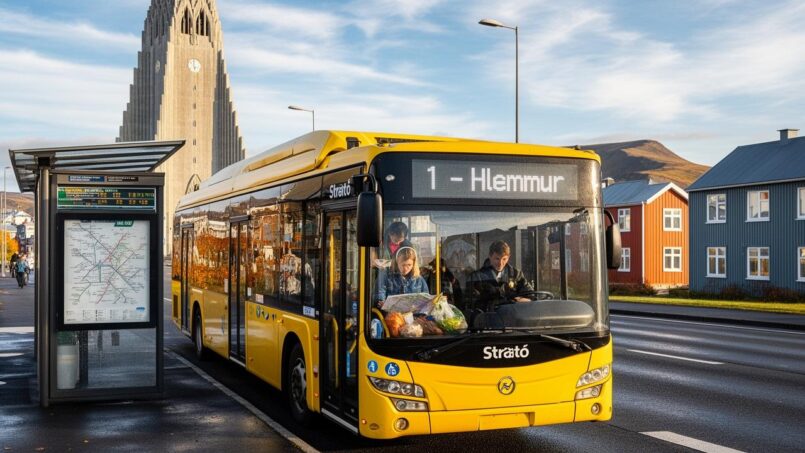
Urban buses are bright yellow, while intercity coaches are often half yellow, half blue. Stops are marked by a red circular logo with a yellow ‘S’, and transfer hubs are clearly identified.
Strætó does not simply “place buses” on existing routes: the network is designed to maximize the number of people served with limited resources, in a country where the majority of residents own a car. This constraint explains strong choices: high frequency in the capital region, but sparser and often seasonal services in the countryside.
Getting Around the Reykjavík Area: A Well-Structured Urban Bus Network
In the capital region, Strætó operates about thirty lines (between 27 and 29 depending on the source, as the network evolves). These lines connect Reykjavík with neighboring towns like Kópavogur, Hafnarfjörður, Garðabær, Mosfellsbær, and Seltjarnarnes, covering most residential neighborhoods, commercial areas, and major points of interest (Perlan, Hallgrímskirkja, Harpa, Laugardalur, etc.).
The urban buses run every day, with relatively extended hours. On weekdays, services generally start around 6:30 AM, a bit later on Saturdays (around 7:30 AM) and even later on Sundays and holidays (around 9:30 AM). Most lines stop between 11:30 PM and 1:00 AM.
To find your way, several major transfer hubs play a key role.
Major Hubs in the Capital Region
Several stops concentrate connections between urban lines, and sometimes between urban buses and intercity coaches:
| Main Hub | Role in the Network | Special Feature |
|---|---|---|
| Mjódd | Major node in southeastern Reykjavík | Main departure point for Strætó intercity lines |
| Lækjartorg | Central stop in the heart of Reykjavík | Hub for many urban lines |
| Hamraborg | Hub in Kópavogur | Multiple connections to the west of the capital |
| Fjörður | Hub in Hafnarfjörður | Connection for the southern part of the metropolitan area |
| Ásgarður | Hub in Garðabær | Access to suburban and connecting lines |
| Ártún | Key stop in eastern Reykjavík | Crossroads for several heavily used lines |
| Spöngin | Hub for the northeastern region | Connections with several neighborhood lines |
| Háholt | Hub in Mosfellsbær | Connection between the city and the northern suburbs |
Historically, Hlemmur was the city’s central terminal. Due to a large urban redevelopment project and the future Borgarlína bus rapid transit line, this role has been partially transferred, with a reorganization toward Skúlagata and other points.
Mjódd deserves special attention: it is the main crossroads where urban and intercity buses meet. For any trip leaving the capital region, it is very common to have to go through this station.
Frequencies and Schedules: What to Expect in Practice
The urban network in the capital region is designed as a real daily transport system. This translates into high frequencies on main lines, especially during peak hours.
The five most used lines (1, 3, 5, 6, 12) run:
– approximately every 10 minutes during weekday peak hours,
– approximately every 15 minutes between peaks,
– approximately every 30 minutes in the evening and on weekends.
Most other lines run about every 15 minutes at peak times and 30 minutes off-peak. On weekends, frequency drops to 30 minutes across most of the network. Some small or neighborhood lines may be less frequent, or even run only on weekdays. A few very rural routes within the extended perimeter even require calling ahead to have a bus come.
Estimated number of daily bus trips in Iceland’s capital region in March 2023.
Urban Lines: Concrete Route Examples
Even if you won’t memorize all the lines, knowing the role of a few can help you get around. Among the typical routes:
| Line | Main Route (Simplified) | Usefulness for Travelers |
|---|---|---|
| 1 | Skúlagata – Hafnarfjörður (Skarðshlíð) | North‑south backbone between the center and Hafnarfjörður |
| 2 | Háskóli Íslands – Mjódd | University – major intercity hub connection |
| 3 | Grandi – Mjódd | Crosses Reykjavík from west to southeast |
| 5 | Gamla Hringbraut – Norðlingaholt | Connects the expanded center to the eastern residential area |
| 6 | Háskóli Íslands – Egilshöll | Connects the university to northern neighborhoods |
| 11 | Mjódd – Seltjarnarnes | Allows access to the Seltjarnarnes peninsula |
| 12 | Skerjafjörður – Ártún | Very busy line linking southwest and east |
| 15 | Mosfellsbær – Vesturbær | Major north‑west cross-city route |
In practice, most occasional travelers use a few major axes to get to downtown, main tourist sites, or large shopping centers like Kringlan and Smáralind, all well served.
Night Buses in Reykjavík: Getting Home Late Without a Taxi
On Friday and Saturday nights, a limited night service allows you to return from downtown nightlife to the suburbs. These are lines numbered 101, 103, 104, 105, and 106.
What you need to know:
– these buses run only in one direction, from the center to residential neighborhoods;
– each line offers three departures, roughly between 1:20 AM and 3:45 AM;
– the frequency is about one bus per hour;
– the fare is announced as the same as a regular adult trip.
The routes of the night buses can be found in the Klappið app, which also allows you to track vehicle positions in real time. The service was tested from 2018, interrupted during the Covid‑19 pandemic, and relaunched in 2022 with some adjustments. During major events (like Culture Night), additional night services may be added.
Paying and Validating Your Trip: Klappið, Bank Cards, and Tickets
Since June 2025, urban buses in the capital region no longer accept cash. Payment is therefore entirely cashless or via prepaid physical media. Four main options coexist.
Payment Methods in the Capital Region
| Payment Method | How It Works | Key Advantages |
|---|---|---|
| Klappið App | Buy tickets and passes on your smartphone, scan QR code onboard | Flexible, English interface, advance purchase |
| Klapp Card (plastic) | Rechargeable card, validated on a reader at the entrance | Convenient for daily use, no phone needed |
| Klapp Paper Tickets | Disposable multi‑use cards or single tickets | Useful for short stays without the app |
| Contactless Payment | Visa/Mastercard bank card, Apple Pay, Google Pay | Ideal for passing travelers |
The Klappið app (iOS and Android) is the nerve center of the system. It is available in Icelandic and English, requires an internet connection to buy or activate tickets, and stores your tickets in a “My Tickets” section. When boarding, you scan the QR code on a validator near the front door; a green screen confirms everything is fine.
Physical Klapp cards can be topped up via the app or at sales points (bus terminals, shopping centers, etc.). They are useful for residents and those who don’t want to rely on their phone. The initial purchase cost of the card is about 1,000 ISK.
Contactless payment allows you to pay directly with a bank card or compatible smartphone, without needing a dedicated physical medium. This option is especially suitable for travelers making only a few trips. It is linked to the Kapp fare capping system, which guarantees you never pay more than the price of the most advantageous ticket for the trips you take in a day.
Kapp: Fare Capping for Contactless Payments
The Kapp system is a form of “daily/weekly cap” integrated into the ticketing system. For adults paying contactlessly, it guarantees that:
– the daily cumulative amount never exceeds the price of three trips,
– the weekly cumulative amount never exceeds the price of nine trips.
In other words, after your third trip in a day, subsequent ones are effectively free. The same applies beyond the ninth trip in a week. This logic brings the system closer to that of a subscription while allowing pay‑as‑you‑go. Important condition: you must use the same bank card or the same device (smartphone, watch) for all trips concerned, otherwise the cap calculation won’t work.
Fares, Ticket Validity, and Passes
The exact amounts for single tickets have varied over time, and some figures differ depending on the source. The most recent data indicates that in fall 2024, a single adult ticket cost 650 ISK in the capital region, with another source mentioning 670 ISK.
Beyond nuances of style or subject, the general structure of an article remains clear and identifiable. For example, an article typically follows an introduction, a development in several parts, and a conclusion. This organization helps guide the reader and present information in a logical and coherent manner, regardless of the complexity of the content covered.
– a single adult ticket in the capital region entitles you to 75 minutes of travel with unlimited transfers;
– reduced fares exist for youth and seniors (about –50%);
– people with disabilities receive a more significant discount of about –70% through the Klapp system;
– children under a certain age (often 11 according to sources) travel free;
– blind people do not pay on buses in the Reykjavík area.
Discover the different subscription options for transport, offering excellent value for stays of several weeks.
About 11,600 ISK. One of the cheapest monthly tickets among Nordic countries.
Available for youth, students, seniors, and people with disabilities.
Longer plans are also available: three months and one year.
Additionally, a pack of 20 tickets can be purchased for about 9,500 ISK, reducing the unit cost per trip.
Reykjavík City Card: Unlimited Bus Rides and Museums Included
For visitors focused on the capital, the Reykjavík City Card is sometimes more interesting than a simple bus pass. This tourist product gives you, for 24, 48, or 72 hours:
– unlimited trips on Strætó urban buses in the capital region (excluding line 55 to the airport),
– free admission to many museums and galleries,
– entry to all municipal geothermal swimming pools in Reykjavík,
– a ferry ride to Viðey Island,
– discounts on certain guided tours and in some shops.
The card works as a time‑based pass: the duration starts from the first use or upon collection if you request it that way. It remains a good deal if you are combining cultural visits, pools, and bus trips over one or two days.
Traveling Outside the Capital: Strætó Intercity Lines
As soon as you leave Reykjavík and its suburbs, you enter another world. Distances are long, frequencies are low, and weather constraints are much stronger. Nevertheless, Strætó operates a network of about thirty intercity lines covering almost the entire country, at least along the main axes.
The major reform of January 2026 profoundly overhauled this network. The objectives were clear: separate commuter trips (home‑work, home‑school) from long distances, improve punctuality, strengthen links between regions, and align everything with the transition to zero‑emission buses.
Zone Logic and Characteristics of Intercity Lines
Outside the capital region, fares are based on a zone system. The country is divided into fare segments, and the ticket price depends on the number of zones crossed. For example, one source explains that a trip between Keflavík Airport and Reykjavík passes through four zones, each charged about 490 ISK, for a total close to 1,960 ISK.
Other characteristics of intercity lines:
– tickets are generally paid on board, directly to the driver, in cash or by bank card (charged according to distance);
– there is no advance seat reservation on most lines; you board the bus as long as there is space;
– if you need to change buses along the way, the driver can give you a “transfer ticket” valid for 90 minutes to continue your journey on another line;
– some sections, especially in very rural areas, run only a few days a week, or only in summer, or only by phone request;
– in case of interruption due to weather, Strætó is required to refund you or get you on the next available bus, and provide accommodation if you are stranded overnight.
Major Intercity Lines After the 2026 Reform
To orient yourself, it is useful to know the major lines, numbered from 50:
| Line Number | Main Route (Simplified) | Special Features |
|---|---|---|
| 50 | Reykjavík – Akranes – Borgarnes | Result of the split of the former line 57 |
| 51 | Reykjavík – Selfoss | Increased frequency on weekdays, no longer follows the entire south coast |
| 52 | Reykjavík – Höfn via Vík, Skaftafell, Jökulsárlón | Covers the entire south coast, 4 days a week (Tue., Thu., Fri., Sun.) |
| 53 | Selfoss – Landeyjahöfn – Hvolsvöllur | Provides connection with the Herjólfur ferry to the Vestmann Islands |
| 55 | Capital region – Keflavík International Airport | Daily service, schedules coordinated with flights |
| 56 | Akureyri – Egilsstaðir | East‑west link in the north of the country |
| 57 | Reykjavík – Akureyri | 1 departure per day, duration 8 to 10 hours, no longer goes via Akranes |
| 58 | Stykkishólmur – Borgarnes | Connection to the Snæfellsnes peninsula |
| 71 | Þorlákshöfn – Hveragerði | Frequency increased to 5 trips per day on weekdays |
| 72 / 73 | Flúðir, Laugarvatn and the Golden Circle area | Partial access to some interior tourist sites |
| 78 / 79 | Siglufjörður, Húsavík from Akureyri | Services to the north coast and northeast |
| 81 | Borgarnes – Reykholt | Runs a few days a week |
| 82 | Hellissandur – Stykkishólmur | Connects the western tip of Snæfellsnes |
| 87 | Vogar – Reykjanesbær Miðstöð | Regional link in the southwest |
The busiest services are concentrated in the southwest of the country, around Reykjavík and along major economic corridors. More remote regions, like parts of the northeast or the Westfjords, still have services, but with very low frequencies.
Examples of Typical Intercity Trips
To give a concrete idea, here are some connections and fares cited in recent sources:
| Route | Main Line | Approximate Duration | Indicative One‑Way Fare |
|---|---|---|---|
| Reykjavík – Keflavík (Airport) | 55 | About 45 min | 2,400 ISK |
| Reykjavík – Vík (South Coast) | 52 (former 51) | About 3 hours | 8,400 ISK |
| Reykjavík – Höfn | 52 | Full day | 17,400 ISK |
| Reykjavík – Landeyjahöfn | 53 (former 52) | Variable depending on connections | 6,000 ISK |
| Reykjavík – Akureyri | 57 | 8 to 10 hours | 13,200 ISK |
| Akureyri – Egilsstaðir | 56 | About 4 to 5 hours | 10,800 ISK |
| Akureyri – Siglufjörður | 78 | About 2 hours | 3,600 ISK |
You immediately see two things: travel times are much longer than by car, and fares skyrocket as you accumulate kilometers. For a solo traveler, this is often still cheaper than renting a car for several days. For a family or group, the trade‑off quickly favors the car, especially if you add the need for local tours to reach undserved sites.
Accessibility Limitations and On‑Demand Buses
Urban buses in the capital region are equipped with ramps for wheelchairs (one space per bus) and drivers help deploy the ramp. However, the passenger must be able to secure their wheelchair with the belt. Bikes give priority to wheelchairs in the designated space.
On rural lines, coaches generally do not offer wheelchair access, which is a crucial point for travelers with reduced mobility. Specific solutions exist in the capital (specialized shuttles under municipal authorization), but they are not deployed nationwide.
Some intercity services operate partly “on call”: if no passenger has booked or signaled their presence, the bus may skip a given locality. It is therefore recommended to check carefully on the Strætó website or with customer service when a route mentions this feature.
Other Urban Networks: Akureyri and Secondary Towns
Outside the Reykjavík area, a few towns have their own urban bus systems.
Akureyri: Free Buses for Everyone
Akureyri, the second largest urban area in the country with about 20,000 inhabitants, has a network operated under the SVA brand. It consists of three main lines (often called R1, R3, R4, or A1 for some routes). Their most notable feature is that buses are completely free for all passengers.
The operation is simple:
All bus lines serve Miðbær, the central point near the main square, running loops. A full loop takes between 30 and 50 minutes. On weekdays, buses run from about 6:30 AM to 11:00 PM. On weekends and holidays, hours are reduced, with service generally from noon to 7:00 PM.
Schedules are available on the Akureyri municipal website and in the Strætó app, which also aggregates this data. From 2026, some rural lines are to connect to Akureyri Airport with schedules coordinated with Icelandair flights, further strengthening local intermodality.
Reykjanesbær and Other Towns
Reykjanesbær, a municipality near Keflavík International Airport, also has a small local bus network. This network is independent of Strætó but integrates into the overall transport ecosystem. Urban networks also exist in Akranes and Egilsstaðir, with more modest operations.
Local buses serve as extensions of Strætó coaches in regional towns. It is crucial to check schedules and transfers to ensure continuity of your journey.
Ferries, Domestic Flights, and Other Supplements to the Bus
Since the bus network cannot cover everything, Iceland relies on ferries and domestic flights to connect its islands and most remote regions. These modes are not public transport in the strict sense (they are not always funded as such), but they play a similar role for the traveler.
Ferries: Vestmannaeyjar, Flatey, Viðey, and Other Islands
Several companies operate regular maritime services:
Main maritime connections for reaching islands and crossing fjords, with fares and durations.
Connects Landeyjahöfn (or Þorlákshöfn) to the Vestmannaeyjar. Crossing: ~35 min. Adult one‑way fare: ~2,500 ISK.
Stykkishólmur – Brjánslækur via Flatey. 2 rotations/day in summer. Journey: ~2h30. Adult fare: ~7,400 ISK (Brjánslækur) or ~5,000 ISK (Flatey).
Departure from Reykjavík (Skarfabakki). Up to 8 departures/day in summer, reduced service in winter. Adult fare: 2,400 ISK.
You can reach Skarfabakki by Strætó bus line 5 from Reykjavík center, illustrating how buses and ferries combine to expand the area accessible without a car.
Maritime connections exist to islands like Hrísey or Grímsey. They operate seasonally, and it is imperative to check schedules in advance, as weather can quickly disrupt traffic.
Domestic Flights: The Fast Alternative to a Long Bus Ride
For distances like Reykjavík – Akureyri or Reykjavík – Egilsstaðir, flying is the only real alternative to the car and the long coach. Companies like Icelandair (via its domestic branch), Eagle Air, or Norlandair operate flights from Reykjavík Domestic Airport (RKV), located about 1.5 km from downtown.
Some examples of travel times:
| Flight Route | Approximate Flight Time |
|---|---|
| Reykjavík – Akureyri | 45 to 60 min |
| Reykjavík – Ísafjörður | 40 to 50 min |
| Reykjavík – Egilsstaðir | About 60 min |
Fares vary greatly by season and demand, but you can sometimes find one‑way trips around $80 to $150 USD. Compared to 8 to 10 hours by bus to reach Akureyri, these flights can be reasonable, especially in winter when roads are uncertain. They also allow you to organize itineraries combining flying and local bus to explore an area without taking on a whole road trip.
Planning Tools: Websites, Apps, and Real‑Time Data
With a network split between urban buses, intercity buses, ferries, and planes, the key to a successful trip using public transport in Iceland is planning.
Strætó provides:
– a bilingual website (https://straeto.is/en) with schedules, maps, a trip planner, and fare information,
– the Klappið app, which combines ticketing, trip planning, schedules, and real‑time bus tracking.
Since 2018, bus schedules and stops have been available as open data (GTFS), integrable into apps like Google Maps. Since 2024, this data also includes real‑time arrival times. You can therefore check the theoretical schedule on the Strætó website and the actual delay via the Klappið app or a third‑party app.
For service alerts, major delays, or route changes, Strætó also communicates via X (@straeto), while the Moovit app aggregates some disruption information.
Additionally, sites like publictransport.is offer synthetic “metro map” style charts bringing together services from over thirty operators (public buses, private buses, ferries, regular tours). It is a good starting point to visualize what is feasible without a car.
What Public Transport Allows… and What It Doesn’t
Once this overview is done, you need to be clear‑eyed about what using public transport in Iceland really allows.
On a capital‑region scale, they are perfectly usable daily. You can live, work, and enjoy leisure activities in Reykjavík without ever owning a car, provided you accept adjusting to bus schedules, especially in the evening and on weekends. Electric scooter networks, taxis, and walking complement the system well.
As soon as you leave this area, every travel plan must be reasonably justified, planned, and checked in advance. A Strætó coach will get you to a major regional town or a village on Route 1, or even a port connected to a ferry.
Strætó
– many iconic sites (isolated waterfalls, canyons, remote hot springs) are several kilometers from the main road, with no bus service,
– the highlands (F‑roads) are completely outside the scope of conventional public transport, except for a few specialized summer tourist buses,
– the wildest fjords (like some parts of the Westfjords) are poorly served, or not at all.
Concretely, public transport is well suited for:
Tourist bus travel in Iceland is especially suitable for short stays centered on Reykjavík, solo travelers on a tight budget, those who refuse to drive in winter or on snow, and very structured itineraries from point A to point B without too many detours.
For those who want to explore the Ring Road, stop at every waterfall, visit the most remote beaches, or improvise based on the evening light, renting a car remains almost essential. The costs of multiplying bus fares by two, three, or four people, added to the cost of local tours for inaccessible sites, often end up meeting or even exceeding the budget of a shared rental vehicle.
Looking Ahead: Electric Buses and the Borgarlína Project
Despite its limitations, the Icelandic system is rapidly evolving toward greater integration and sustainability. Strætó has already introduced electric buses into the urban fleet (about 28 vehicles out of 74), as well as some natural gas buses. In the south of the country, almost all provincial coaches are now electric, except for the Höfn – Vík – Höfn connection, more difficult to electrify for the moment.
The stated goal is to achieve a 100% zero‑emission fleet by 2030. The 2026 overhaul of the rural network was also based on installing charging stations across the country, showing how much the energy transition is integrated into the transport strategy.
Length in kilometers of the first line of the Borgarlína bus rapid transit project, connecting Hamraborg to downtown Reykjavík.
The estimated cost is around 70 billion ISK, and the opening of the first section has already been delayed: some documents mention a launch around 2026‑2027, others a more distant horizon around 2031. In any case, if completed, this infrastructure will bring the capital region closer to a “surface metro” system, with a level of service difficult to achieve with buses running in mixed traffic.
Practical Tips for a Successful Trip to Iceland Using Public Transport
Throughout this guide, one idea comes up: planning is key. A few principles can maximize your chances of success.
It is essential to always check the schedules before you leave, especially in winter. Intercity services can be canceled or modified due to wind, snow, or road closures. The Klappið app, the Strætó website, and, for road conditions, the Vegagerðin and road safety websites are reflexes to adopt.
It is crucial to allow safety margins for connections, such as between an intercity bus and a ferry, or a coach and a domestic flight. A delay of a few dozen minutes can cause you to miss a one‑time connection that may not come again until the next day.
In rural areas, bus stops do not always offer shelter. It is wise to bring warm, windproof, and waterproof clothing, even in summer. In winter, it can be dark for most of the day; locating stops in advance using online maps avoids searching for them in the dark.
Finally, don’t hesitate to combine several modes: urban bus + intercity bus + ferry; or bus + domestic flight; or bus + local guided tour for a day in a valley otherwise inaccessible. Iceland is rarely explored with a single mode of transport when you give up the car.
—
Public transport in Iceland, though different from dense European networks, forms a reliable system. It allows you to live without a car in the Reykjavík area and serves most major towns across the country, often in combination with ferries and domestic flights. To use it effectively, you need to accept certain schedule constraints, plan your route in advance, and forgo last‑minute detours. This approach offers a more relaxed, sober, and eco‑friendly way to discover Iceland.
Disclaimer: The information provided on this website is for informational purposes only and does not constitute financial, legal, or professional advice. We encourage you to consult qualified experts before making any investment, real estate, or expatriation decisions. Although we strive to maintain up-to-date and accurate information, we do not guarantee the completeness, accuracy, or timeliness of the proposed content. As investment and expatriation involve risks, we disclaim any liability for potential losses or damages arising from the use of this site. Your use of this site confirms your acceptance of these terms and your understanding of the associated risks.

Cyril Jarnias is an independent expert in international wealth management with over 20 years of experience. As an expatriate himself, he is dedicated to helping individuals and business leaders build, protect, and pass on their wealth with complete peace of mind.
On his website, cyriljarnias.com, he shares his expertise on international real estate, offshore company formation, and expatriation.
Thanks to his expertise, he offers sound advice to optimize his clients' wealth management. Cyril Jarnias is also recognized for his appearances in many prestigious media outlets such as BFM Business, les Français de l’étranger, Le Figaro, Les Echos, and Mieux vivre votre argent, where he shares his knowledge and know-how in wealth management.





