
 Published on and written by Cyril Jarnias
Settling in Iceland starts with falling in love with the volcanoes, glaciers, and fjords. But the real immersion often begins at the table. Between Viking traditions, ultra-modern Nordic cuisine, seafood of exceptional freshness, and a booming veggie scene, the local gastronomy can fascinate… as much as it can baffle a newcomer.
This guide helps expats navigate Icelandic cuisine: understand its codes, identify traditional dishes, choose between fine dining and casual eateries, find local spots (with or without meat), and manage daily life between supermarkets, farms, food markets, and culinary events.
Understanding the DNA of Icelandic Cuisine
Icelandic cuisine was born from a harsh land: little wood, long winters, few arable acres (barely 1% of the territory), and the need to preserve everything to survive. From this come three pillars that still shape the country’s diet: lamb, fish, and dairy products, especially skyr.
The first Nordic settlers lived in longhouses heated by a central fire, cooking their food in pits dug in the ground or using hot stones thrown into wooden vessels. From the 14th century onward, the appearance of turf houses introduced a separate kitchen equipped with a stone hearth. Despite these architectural changes, the basic diet—mainly mutton, fish, and milk—remained unchanged.
To preserve these resources through an entire year, Icelanders perfected techniques of fermenting, drying, smoking, and salting. This explains today’s famously… challenging specialties: fermented shark (hákarl), boiled sheep’s head (svið), harðfiskur (dried fish), blood and offal sausages (slátur), and pickled ram’s testicles (hrútspungar).
Iceland’s economy historically developed through fishing (cod, haddock, herring, etc.), vitalizing ports like Siglufjörður. Agriculture later diversified the food supply with the introduction of hardy vegetables in the 19th–20th centuries and the development of geothermal greenhouses.
Today, modern Icelandic cuisine is a unique blend:
– Peasant and maritime foundations,
– A very strong Danish heritage in bakeries and pastries,
– Revisited Nordic techniques,
– An open embrace of international influences,
– And a “farm-to-table” movement driven by chefs who now freely work with wild herbs, seaweed, berries, or greenhouse vegetables.
Everyday Eating in Iceland: A Guide for Expats
Settling in Iceland also means discovering a meal rhythm and table manners fairly similar to the rest of Northern Europe, but with a few nuances.
Breakfast is often hearty and plays a key role: breads, cheeses, cold cuts, skyr, hard-boiled eggs. At farm-hotels or guesthouses, it sometimes makes up for lunches eaten on the go. Lunch is still frequently a simple meal (sandwiches, soup, daily special), while dinner can become a real social moment, often at home, sometimes at a restaurant.
In Iceland, table service is warm but low-key: the staff leaves you alone without forgetting you. Communication is direct, with implicit use of first names and informal address dominating, even with staff. This approach reflects the importance placed on ingredient quality, seasonality, and local sourcing.
As for the bill, there’s neither added tax nor mandatory tipping: listed prices include service. Since wages are relatively high, “tipping” is never required, though a small gesture for exceptional service is appreciated. Tap water is free, remarkably pure, and served automatically in nearly all restaurants.
Finally, a reassuring note for newcomers: the lack of an exact word for “please” in Icelandic does not mean a lack of politeness. The use of “takk” (thank you) remains central, especially for thanking the host or the cook.
Iconic Dishes You Should Know
To avoid getting lost on menus—and to avoid saying yes to a dish without really knowing what it is—a few reference points are in order.
Lamb, the Backbone of the Cuisine
Icelandic lamb is everywhere. Sheep graze freely on meadows of wild herbs, berries, angelica, or even seaweed, yielding meat that is surprisingly tender and mild.
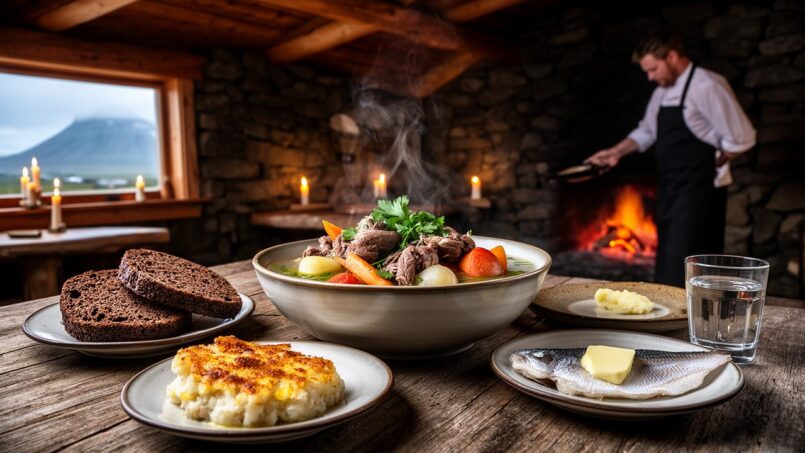
In homes, the classic Sunday roast remains leg of lamb (lambalæri), served with potatoes, canned peas, pickled red cabbage, and brown gravy. In the depths of winter, smoked lamb (hangikjöt), literally “hanging meat,” takes center stage at Christmas tables, served hot with béchamel, potatoes, and laufabrauð (thin fried flatbread), or cold on flatkaka (flatbread).
Kjötsúpa is an iconic Icelandic mutton soup, prepared with chunks of lamb (often fatty and rustic), carrots, rutabaga, potatoes, and sometimes barley or herbs, all slow-simmered. You can enjoy it at country or city restaurants, as well as spots like Café Loki in Reykjavík or Vogafjós near Lake Mývatn.
Fish, Langoustine, and Harðfiskur
With a dominant fishing industry, it’s almost harder to avoid eating fish in Iceland. Cod and haddock are everywhere, but you’ll also find Arctic char (bleikja), monkfish, salmon, and skate.
Plokkfiskur is a must to understand local comfort food: mashed potatoes, flaked fish (often cod or haddock), onions, and white sauce, sometimes spiced up with chives, curry, or cheese, served with rye bread (rúgbrauð) and butter. Spots like Messinn in Reykjavík have made it a family specialty, served in a skillet.
Another classic: harðfiskur, fish dried in wind and cold since Viking times, now eaten in strips with butter. You’ll find it in every supermarket, but also at the Kolaportið flea market.
Iceland’s south coast, particularly Höfn, is famous for langoustine (humar). Iconic restaurants like Fjöruborðið in Stokkseyri, Pakkhús, and Humarhöfnin in Höfn serve specialties such as langoustine soup and garlic-butter sautéed tails.
Skyr, Dark Rye Breads, and Pastries
Skyr, technically a fresh cheese but eaten like a high-protein yogurt, accompanies breakfasts, desserts, and snacks. It serves as a base for modern panna cottas, like those made during Salt Eldhús cooking classes, or simply served with fresh berries and a drizzle of honey in summer.
Rye bread (rúgbrauð), meanwhile, is dense, very dark, slightly sweet, similar to pumpernickel. Traditionally, it was buried in the ground near a hot spring to bake with geothermal heat—a practice still carried on by places like Vogafjós at Mývatn. This bread is eaten with butter, smoked salmon, pickled herring, or hangikjöt.
Danish-style pastries and baked goods include specialties like vínarbrauð (cream-filled puff pastry), kleinur (twisted donuts), snúður (cinnamon roll topped with icing), and celebration cakes such as vínarterta (layered cake with prune jam) and randalín.
Street Food and “Bravery Specialties”
It’s impossible to talk about Icelandic gastronomy without mentioning the hot dog, an institution. The pylsa or pylsur, a mix of pork, beef, and lamb, is ordered “ein með öllu” (one with everything): raw onions, fried onions, slightly sweet ketchup, mild mustard, and remoulade. The stand Bæjarins Beztu Pylsur in Reykjavík claims the title of the city’s best sausage.
On a more extreme note, the famous hákarl, shark fermented for six months to remove natural toxins, sits atop Þorrablót buffets, the midwinter festival. It’s eaten in tiny cubes, often with a shot of Brennivín, the local caraway-flavored aquavit nicknamed “Black Death.” Other seasonal specialties—sour ram’s testicles, sheep’s head, slátur—are more easily appreciated as occasional cultural experiences than daily habits.
The New Nordic Revolution: Iceland Goes Green Gastronomy
Over the past fifteen years, Reykjavík has earned a spot on the creative Nordic cuisine map. For an expat, these tables are ideal laboratories to discover local products in a contemporary light, often more accessible to modern palates.
Dill, the Starry Pioneer
Dill, in Reykjavík, is the symbol of this revolution. The first Icelandic restaurant to earn a Michelin star, it also boasts a green star for its environmental commitment. Chef Gunnar Karl Gíslason offers five- or seven-course tasting menus entirely focused on Icelandic ingredients: fish, free-range lamb, wild herbs, geothermal greenhouse vegetables, dairy like skyr or Icelandic brunost (whey cheese).
The approach isn’t to revisit peasant dishes literally, but to compose a cuisine that “tells the story of Iceland”: minimalist in plating, highly technical in cooking and fermenting, deeply rooted in the landscape. For an expat, a meal at Dill is almost like an accelerated course in the country’s culinary geography.
Fine Dining Reimagined: From Moss to ÓX
The upscale rise doesn’t stop there. Moss, the gourmet restaurant at the Blue Lagoon, offers a seasonal menu and an impressive wine cellar, with a chef’s table at the heart of the kitchen for an immersive experience. In Reykjavík, ÓX pushes intimacy to the extreme: 17 seats hidden behind a cocktail bar, 20 dishes served by three chefs, all centered on Icelandic products. The idea: a dinner show entirely dedicated to the terroir.
The restaurant Brút, housed in one of the capital’s most beautiful buildings, focuses on fish and seafood. Its cuisine remains anchored in the day’s catch, with a superb wine list.
Ragnar Eiríksson, former Dill chef and first Icelander with a Michelin star
New Nordic in a Glass Greenhouse
Geothermal greenhouses don’t just produce tomatoes or cucumbers. In Hafnarfjörður, Sól Restaurant occupies a glass greenhouse overlooking the sea. The table offers locavore New Nordic cuisine: Icelandic lamb, Arctic char, inventive vegetarian plates, creative cocktails. The setting—plants, ocean view, natural light—alone tells the intimate story of greenhouse agriculture, renewable energy, and gastronomy.
Located near Iceland’s Golden Circle, Friðheimar is a family farm that grows tomatoes year-round in geothermally heated greenhouses. Visitors can dine among the plants, with a menu entirely dedicated to tomatoes (all-you-can-eat soup, pasta, cocktails, jams), while discovering the production facilities.
When Haute Cuisine Also Speaks to Vegetarians
Over the years, the Icelandic fine dining scene has embraced the needs of vegetarians and vegans. Dill offers adapted menus, as do spots like Kol (near Hallgrímskirkja), which bills itself as modern Icelandic fusion: lamb fillet, but also vegetarian and vegan options, all paired with creative cocktails and a bottomless weekend brunch.
Sól, Grillmarket, Fish Market, and Rub23 in Akureyri (marrying Icelandic seafood with Asian techniques) are also accustomed to featuring local vegetables and plants as main courses, not just sides.
Exploring Icelandic Cuisine from North to South
One of the major perks of living in Iceland is the chance to explore tables deeply rooted in their landscapes, from the West Fjords to the East Coast, via the North and the Snæfellsnes Peninsula. For an expat, these culinary getaways are opportunities to understand the regions… and the people.
Reykjavik: From the Most Traditional to the Most Cutting-Edge
In the capital, the offering is incredibly diverse for a city of this size. You can, in the same day, lunch on plokkfiskur at Café Loki (right next to Hallgrímskirkja), snack on herring and fish stew at the Settlement Center Restaurant during a trip to Borgarnes, then finish with a tasting menu at Dill or Fish Market.
The overview of a few iconic addresses shows this diversity well, between pure Icelandic cuisine, fusion, street food, and veg* options:
| Type of Experience | Address | Specialty Highlighted |
|---|---|---|
| Pure Tradition | 3 Frakkar | Whale, puffin, shark, “hard” Icelandic dishes |
| Modern Bistro | Old Iceland Restaurant | Lamb, cod, char, vegan options, rhubarb & kleinur desserts |
| Icelandic Street Food | Bæjarins Beztu Pylsur | Pylsa með öllu (hot dog with everything) |
| High-End Seafood | Fish Market | Icelandic seafood with Japanese twists |
| Creative New Nordic | Skál! | Small local plates, Bib Gourmand Michelin |
| Traditional Café | Café Loki | Plokkfiskur, lamb soup, rye bread ice cream, fermented shark |
| Gourmet Fast Food | Le KocK | Burgers and wings with local ingredients, excellent vegan burger |
| Identity Bar-Restaurant | Islenski Barinn | Lamb soup, plokkfiskur, whale, reindeer, shark |
| Middle Eastern Fusion | Sümac | Icelandic ingredients + Middle Eastern and North African spices |
| Original Hot Dogs | Víkinga Pylsur | Pulled lamb hot dog, béarnaise sauce, crispy onions |
The whole is rounded out by concepts like Indian (Austur-Indiafjelagid), Mexican (La Poblana, Tres Locos), Icelandic tapas (Tapas Barinn), contemporary brasseries (Apotek Kitchen + Bar, Solon Islandus), soup bars (Svarta Kaffið), or casual eateries like Reykjavik Kitchen or Hresso, where you can order fish soup just as easily as try sheep’s head or fermented shark.
Salt Eldhús school offers “Cook & Dine” workshops in English to learn Icelandic cooking. The course includes preparing a three-course menu (e.g., Arctic char, roast leg of lamb, skyr panna cotta) and tasting local products like homemade rye bread, dried fish, smoked lamb, and craft beers. It’s a hands-on experience to discover Iceland’s ingredients and culinary techniques.
South Coast and Golden Circle: Farms, Bistros, and Langoustines
Leaving the capital, the South Coast and the Golden Circle offer a concentration of landscapes… and great addresses.
In Hveragerði, The Greenhouse and Mathöll Suðurlands offer food halls where pizza, modern local cuisine, vegetarian options, and ice cream coexist. Further on, near Skógafoss, Hótel Skógafoss Bistro Bar serves a creamy leek-and-potato soup described as “comfort perfection”: an illustration of the role of veg-friendly soups for those avoiding meat.
On the road to Vík, stops like Eldsto Art Café (gallery-café-bistro-guesthouse) or restaurants Sudur Vik and Halldorskaffi offer pizza, pasta, and European dishes amidst black sand landscapes.
Further east, in Höfn, langoustine becomes a way of life, from Pakkhús housed in an old warehouse to the festivities of Humarhátíð, the annual lobster festival at the end of June. Restaurants there serve soups, grilled tails, and fish dishes based on the daily catch.
West Fjords and Snæfellsnes: Kingdom of Fish
In the northwest, the West Fjords harbor gems often considered the best fish restaurants in the country. In Ísafjörður, Tjöruhúsið, in a historic house, operates without a menu: in the evening, a buffet of large sizzling pans offers only what the sea provided that day. Reservations are essential, with two services per evening.
Discover establishments showcasing local products in exceptional settings.
Highlights local fishing, while also offering burgers and steaks.
Serves seafood soups, lamb, and vegetarian dishes with panoramic ocean views, at the foot of Snæfellsjökull.
Stykkishólmur, a small town on Breiðafjörður bay, concentrates two iconic addresses: Narfeyrarstofa, in one of the oldest wooden houses, and Sjávarpakkhúsið, a former seafood warehouse turned creative restaurant. The latter focuses on white wine mussels, scallops, robust fish soups, and small sharing plates, all with craft beer and a harbor view.
Further west, Bjargarsteinn Mathús in Grundarfjörður, in a century-old house, marries local lamb and fish with international influences, facing the iconic Kirkjufell mountain.
North and Northeast: Fjords, Icelandic Sushi, and Farm-Café
In the north, Akureyri acts as a regional culinary capital. Strikið, on a rooftop, offers fjord views, hearty lamb and fish dishes, and creative vegetarian options at prices considered reasonable for Iceland. Rub23, meanwhile, has built a reputation by combining Icelandic fish with Asian techniques, notably a wide selection of sushi and spiced dishes.
Further on, Siglufjörður upholds the herring legacy, celebrated each year by the Síldarævintýri festival. The restaurant Siglunes, in the hotel of the same name, surprises with a Moroccan twist: lamb, fish, and vegetable tagines, all in an intimate, highly rated setting.
Around Lake Mývatn, Vogafjós Farm Resort is often cited as one of the best “farm-to-table” experiences in Iceland. Guests dine in a former glass-walled cowshed with direct views of the cows. A typical menu includes lamb soup, smoked trout, local cheeses, and rye bread baked underground in volcanic rocks, offering total immersion in local production.
Further northeast, Húsavík, besides its whale-watching tours, hosts Gamli Baukar on the harbor, a fish and seasonal dish restaurant with a good beer and wine list.
East Fjords: Seaside Houses and Contemporary Art
The East Coast, wilder and less frequented, holds several addresses intimately tied to maritime and mining history. Eskifjörður houses Randulff’s Sea House, an 1890 fishing house turned restaurant-museum. They serve hearty Icelandic cuisine, fresh fish, reindeer, fermented shark, dried fish, pickled herring, all surrounded by maritime artifacts and with a fjord view.
In Seyðisfjörður, the Aldan Hotel & Restaurant on the main street perfectly illustrates the New Nordic trend applied to the East: local ingredients, freshly caught fish, careful presentation, warm decor, and impeccably made oat-milk lattes. Just steps away, Skaftfell Bistro, in a 1907 wooden building that also houses an art center, goes for a bistro vibe: hearty Icelandic and international dishes, small plates, pizzas, and desserts, in a relaxed and creative atmosphere.
Not far away, Egilsstaðir offers two flagship spots: Nielsen Restaurant, in the town’s oldest house, serving lamb, fish, and garden vegetables in a cozy setting, and Salt Café & Bistro, a simple, family-friendly address with a long menu (pizzas, burgers, salads, steamed dumplings) ideal for lunch.
Continuing southeast, Berunes Restaurant, attached to a HI hostel near Djúpivogur, runs seasonal dinner service: fresh trout, lamb, homemade breads, always with a fjord view.
Living and Cooking Icelandic Every Day
Beyond restaurants, the most sustainable—financially and ecologically—way to sink into local gastronomy is through supermarkets, farmers’ markets, and home cooking.
Supermarkets: Where to Shop and What to Find
The country has a dense network of chains with very distinct profiles. For an expat, identifying them helps optimize budget and quality.
| Chain | Positioning | Strengths for Expats |
|---|---|---|
| Bónus | National discount | Low prices, staple items, fruits and vegetables, health options (whole grains, lactose-free) |
| Krónan | Good value for money | Wide selection, focus on organic, preservative-free, vegan; supports small local producers |
| Netto | Mixed supermarket | Present in several regions including the East; sometimes open 24/7, online sales |
| Hagkaup | High-end hypermarket | Huge choice (food, clothing, cosmetics), good local and organic options, extended hours |
| Krambúðin | Convenience | Found in small towns, handy in rural areas (higher prices) |
| 10/11 | 24/7 convenience | Snacks, drinks, ready-to-eat meals, pricier but useful late hours |
| Melabúðin | Independent grocery | Very good butcher/fishmonger, specialty Icelandic products (svið, specialties) |
In Reykjavik, there are also specialty shops: Vegan búðin (100% vegan), Asian and Mediterranean markets, and fine food stores like Taste of Iceland (breads, smoked fish, spices, specialties).
On the product side, despite the climate, over half of the vegetables consumed in Iceland are grown locally, often in geothermally heated greenhouses, pesticide-free, sometimes using insects for biological control or aquaponics. The average shopper can find:
Discover the diversity of products available in Iceland, blending modernity, tradition, and climate adaptation.
Varied dairy including Skyr, plus plant-based alternatives like vegan milks, cheeses, and yogurts.
Local meats (lamb, horse, pork, poultry) and a wide variety of fresh fish.
Greenhouse vegetables (tomatoes, cucumbers, bell peppers, herbs) and root vegetables (potatoes, carrots, rutabagas).
Iconic packaged items like harðfiskur, hangikjöt, slátur, hákarl, and rye bread.
Prices remain high compared to many European countries, but plant-based products (oat milk, vegan cheeses, meat substitutes) are not systematically much more expensive than their animal counterparts, depending on brands.
Markets, Farms, and Short Supply Chains
To better understand Icelandic raw ingredients, a few places deserve attention:
– Ljómalind Farmer’s Market, in the west, sells ceramics, wool, jams, teas, and meats from local farms.
– Urta Islandica, in Keflavík and Hafnarfjörður, transforms Icelandic herbs and fruits into teas, syrups, flavored salts, and jams.
– Vallanes Farm (Móðir Jörð), near Egilsstaðir, organically grows over 100 varieties of grains, vegetables, and plants, turned into oils, breads, cereals, and pickled vegetables.
– Sólheimar, an eco-village, combines an organic canteen (Græna Kannan), Vala market, and craft workshops.
In Iceland, the Slow Food movement is active with communities in Reykjavík and Höfn. It promotes local and traditional products such as geothermal salt from the West Fjords, seaweed from Breiðafjörður (söl/dulse), cheeses, seafood, and forgotten vegetables like fjörukál (coastal cabbage).
Managing Your Food Budget Well
Food in Iceland is expensive, especially if you eat out often. For an expat, a few simple strategies make a big difference:
– Prioritize Bónus and Krónan for big grocery runs,
– Cook most meals at home, saving restaurants for a few targeted occasions (lunch menus, street food, “must” addresses),
– Buy alcohol at the airport duty-free or at state-run Vínbúðin stores (not at restaurants),
– Always keep snacks in the car or bag (dried fruit, bars, bread, skyr) for long stretches where gas stations and restaurants are scarce,
– Use city supermarkets to pack picnics for road trips.
Vegetarians, Vegans, and Flexitarians: Eating Local Without Meat
Contrary to stereotypes, it has become significantly easier in recent years to live vegan or vegetarian in Iceland, especially in Reykjavik. The vegan community has launched a website, a dedicated app, and the capital even has a 100% plant-based supermarket. The practice of “Veganuary” has found its audience, and many restaurants offer at least one vegetarian, often vegan, option.
Vegan soups (tomato, vegetable, lentil) are common on menus. Cafés almost universally offer oat milk. Many traditional dishes can be adapted: rye bread, laufabrauð, beet salads, braised red cabbage, rhubarb desserts, and rutabaga stews.
For those who still want to “taste Iceland” without consuming flesh, many New Nordic restaurants or inventive bistros—from Grillmarket to Eyri Restaurant in the north (which serves both classic Icelandic cuisine and vegan versions with local ingredients)—know how to create ambitious plant-based plates: caramelized cabbages, whey-based sauces (or alternatives), autumn mushrooms, sea herbs, Vallanes grains, etc.
Festivals, Seasons, and the Gourmet Calendar
Living in Iceland also means pacing your year with culinary festivals and seasons.
Icelandic gastronomy follows a marked seasonal rhythm. Winter is dominated by Jól (Christmas) and Þorrablót celebrations, with dishes like hangikjöt (smoked lamb), laufabrauð (leaf bread), jólagrautur (rice pudding), lobster soup, and skata (skate) for Þorláksmessa. In February–March, Bolludagur, Sprengidagur, and Öskudagur bring pastries and hearty stews. Spring sees trout fishing and the arrival of greenhouse vegetables. Summer, under the midnight sun, is the season for lamb BBQs, grilled langoustines, wild berries, and food festivals. Autumn, marked by réttir (sheep gathering), brings back lamb soups, game, mushrooms, and preserves.
This calendar, combined with production heavily dependent on seasons (vegetables, berries, mushrooms, migratory fish), gives each time of year a different gastronomic color. For an expat, adapting to and enjoying this is an integral part of integration.
As a Culinary Compass
Settling in Iceland isn’t just about learning to pronounce “rúgbrauð” or “kjötsúpa”. It’s about becoming familiar with a history of survival and inventiveness, understanding that fermentation and smoking aren’t folkloric oddities but solutions to an extreme climate, and accepting that local cuisine can be both very rustic and ultra-sophisticated.
It’s also realizing that modern Iceland is far more than a land of meat and fish: geothermal greenhouses, a growing veggie scene, Slow Food initiatives, cooking schools open to foreigners, restaurants that treat mushrooms, rhubarb, or seaweed with as much respect as lamb.
For an expat, the best strategy is probably to proceed in concentric circles: start with soups, skyr, grilled fish, and rye bread; then explore traditional bistros and New Nordic addresses; finally immerse yourself in Þorramatur buffets or extreme gastronomic experiences like ÓX or Moss. All the while, keep a curious eye on the stalls of farms, markets, and supermarkets, because that’s where, day in and day out, true Icelandic gastronomy is best read.
Disclaimer: The information provided on this website is for informational purposes only and does not constitute financial, legal, or professional advice. We encourage you to consult qualified experts before making any investment, real estate, or expatriation decisions. Although we strive to maintain up-to-date and accurate information, we do not guarantee the completeness, accuracy, or timeliness of the proposed content. As investment and expatriation involve risks, we disclaim any liability for potential losses or damages arising from the use of this site. Your use of this site confirms your acceptance of these terms and your understanding of the associated risks.

Cyril Jarnias is an independent expert in international wealth management with over 20 years of experience. As an expatriate himself, he is dedicated to helping individuals and business leaders build, protect, and pass on their wealth with complete peace of mind.
On his website, cyriljarnias.com, he shares his expertise on international real estate, offshore company formation, and expatriation.
Thanks to his expertise, he offers sound advice to optimize his clients' wealth management. Cyril Jarnias is also recognized for his appearances in many prestigious media outlets such as BFM Business, les Français de l’étranger, Le Figaro, Les Echos, and Mieux vivre votre argent, where he shares his knowledge and know-how in wealth management.





