
 Published on and written by Cyril Jarnias
Moving to Iceland is a dream for many expats: exceptional safety, almost surreal landscapes, a very high standard of living, widespread English proficiency… but also skyrocketing rents, limited housing supply, and a highly competitive market. In this context, choosing the right neighborhood becomes essential, especially in the Reykjavik area, where the majority of job opportunities and services are concentrated.
This article details the most sought-after neighborhoods and towns, particularly in the capital region, based on profiles (young professionals, families, digital nomads, investors). It provides practical information on prices, atmosphere, available services, and real estate market specifics.
Understanding the Icelandic real estate context
Before diving into each neighborhood, it’s important to grasp the general framework. Iceland faces a housing shortage, especially in the capital region. About 80% of Icelanders are homeowners, leaving a relatively small, expensive, and highly competitive rental market. Growth in tourism, the rise of short-term rentals like Airbnb, and a steady influx of foreign workers have intensified the pressure.
This is the average purchase price in millions of ISK for a home in the Icelandic capital region, well above the provincial average.
The table below provides some monthly price ranges for one-bedroom and three-bedroom apartments, based on recent available data:
| Location | Property type | Average rent (ISK/month) | Average rent (USD/month, approx.) |
|---|---|---|---|
| Reykjavik – expensive area | 1 bedroom | 275,476 | ≈ 2,176 |
| Reykjavik – expensive area | 3 bedrooms | 395,541 | ≈ 3,125 |
| Reykjavik – “normal” area | 1 bedroom | 252,500 | ≈ 1,994 |
| Reykjavik – “normal” area | 3 bedrooms | 341,272 | ≈ 2,696 |
| Akureyri | 1 bedroom | 220,000 | ≈ 1,738 |
| Akureyri | 3 bedrooms | 263,000 | ≈ 2,078 |
| Southwest region (Reykjanes peninsula) | 1 bedroom | 150,000–180,000 | ≈ 1,200–1,500 |
| South region | 1 bedroom | 120,000–160,000 | ≈ 1,000–1,300 |
In the capital, a small apartment is hard to find for under 175,000 ISK per month, and a two-bedroom in a neighborhood popular with expats often ranges between 1,800 and 2,200 dollars monthly. On top of that, a deposit equivalent to two or three months’ rent is frequently required, payable upon signing the lease.
In the current tight housing market where properties sell very quickly, it is advisable for expats to contact agencies or landlords as soon as possible after a listing that interests them is published, so as not to miss the opportunity.
– act very quickly when a property meets their criteria,
– prepare a strong application (employment contract, local references, previous landlord),
– avoid signing a lease without viewing the property,
– rely on specialized resources for tenants (Leigjendur website, Leigjendaaðstoð service, Tenants’ Association).
With this backdrop in mind, let’s take a closer look at the neighborhoods and towns that most attract newcomers.
The beating heart: central Reykjavik neighborhoods
Reykjavik is home to over 60% of the country’s population and the vast majority of skilled jobs, especially in tech, renewable energy, culture, and tourism. It’s also where the largest expat community is structured, with dedicated clubs, associations, and social networks.
Miðborg / 101: the ultra-lively city center
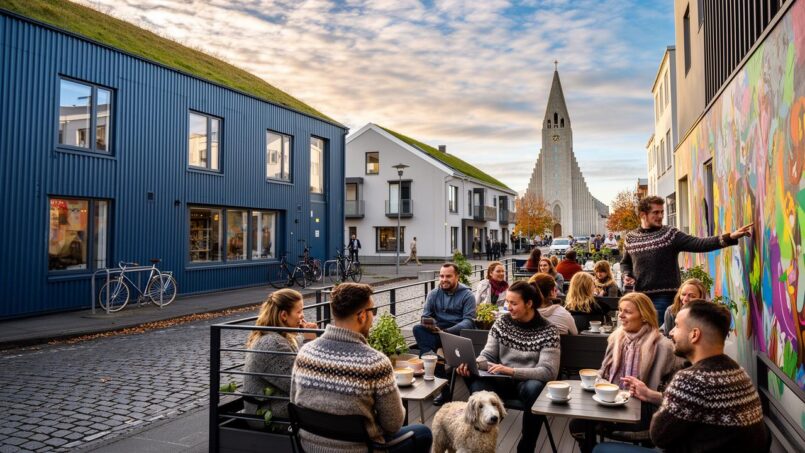
The postal code 101 refers to the historic center, sometimes called Miðborg. It’s “the” iconic neighborhood for a first stay: colorful shopping streets, street art, bars, cafes, Hallgrímskirkja, Harpa, Parliament, the walk to the old harbor… everything is within walking distance.
For expats, 101 represents:
– the best access to cultural life (museums, concerts, festivals);
– maximum density of cafes and spaces suitable for remote work;
– proximity to many employers, especially in tourism, hospitality, and creative services;
– intense nightlife, where nights out start late and easily extend into the early morning.
Downtown Reykjavik is the most expensive and touristy area. Rents are at their peak, long-term rental apartments are scarce, with a large portion of the housing stock dedicated to seasonal rentals. For a well-located one-bedroom, an expat should budget 250,000 to 350,000 ISK per month, or even more for a renovated or furnished unit.
For a young professional or digital nomad willing to allocate a significant portion of their budget to housing, Miðborg remains the most practical choice for immersing yourself in local life, building a network quickly, and minimizing reliance on a car.
Hlíðar / 105: the more affordable “almost center”
The Hlíðar neighborhood, postal code 105, starts a few minutes’ walk east of the center. Many guides consider it an extension of the city center, as it’s easy to walk back to 101.
The urban landscape here is more residential, with tree-lined streets, apartment buildings, and a mix of Icelandic families, students, and young professionals. You’ll find:
– the highest concentration of small hostels and budget hotels in the city;
– several museums (including the highly unusual Icelandic Phallological Museum);
– appreciated green spaces, like Klambratún Park or the proximity to Perlan.
For expats in Reykjavik, the Hlíðar neighborhood offers an interesting compromise. It allows you to enjoy the city center atmosphere without the very high rents of the Miðborg (101) area. Although prices remain high, you can save several tens of thousands of Icelandic kronur per month on a similar property, while still being able to walk or bike to work.
Vesturbær / 107: the chic and family-friendly “West Town”
Just west of the center, Vesturbær (postal code 107) is one of the most sought-after – and most expensive – neighborhoods in Reykjavik. Historically a fishing district, it has transformed into an affluent residential area, very popular with families, academics, and many expats.
Its advantages are numerous:
– proximity to the center on foot or by bike;
– presence of the University of Iceland and the National Museum, attracting international students and researchers;
– direct access to the seaside with beautiful cycling and jogging paths;
– neighborhood pool (Vesturbæjarlaug), a true community hub where all generations gather;
– a well-regarded selection of daycare centers and schools, often ranked among the best in the city.
A neighborhood popular with high-income expat families, offering a pleasant living environment but with a very tight housing market.
Neighborhood vibe with colorful single-family homes, local cafes and restaurants.
Environment very popular with high-income expat families.
Prices among the highest in Paris, both for buying and renting.
Finding a three-bedroom apartment for long-term rent can be a real ordeal.
Budgets for housing must be substantial.
Grandi: the old industrial port turned creative hub
Extending the old harbor promenade westward, you reach Grandi, an area long industrial, now converted into a cultural and creative zone. Here you’ll find:
– the Maritime Museum,
– immersive experiences (FlyOver Iceland, Lava Show, northern lights exhibitions),
– contemporary art galleries,
– food courts like Grandi Mathöll,
– the “Iceland Ocean Cluster”, bringing together innovative ocean-related companies.
For creative expats, entrepreneurs, or digital nomads, Grandi represents a stimulating microcosm, although the pure residential offering remains limited and often expensive. Many choose to live in Vesturbær or the 101 area, while frequenting this sector daily to work in coworking spaces, cafes, or studios.
Living a bit greener: Reykjavik’s residential neighborhoods
Moving away from the center, you’ll find neighborhoods that particularly appeal to families and expats seeking peace, green spaces, and slightly more manageable rents.
Laugardalur / 104: the great valley of recreation
Laugardalur, east of the center (about 3 km), is often seen as Reykjavik’s big playground. Its name means “valley of hot springs” and it houses:
– the city’s largest geothermal pool (Laugardalslaug),
– the zoo and children’s amusement park,
– the botanical garden,
– the national football stadium and an ice rink,
– numerous walking and jogging paths.
It’s a very green, family-oriented, mostly residential area. Buses connect easily to the center, but you’re clearly farther from the nightlife of 101. For expats with children, Laugardalur offers an excellent compromise between quality of life, space, accessible schools, and rents, generally lower than in the historic heart.
Árbær: history, family homes, and a river
Located about ten kilometers southeast of the center, Árbær stands out for its small-town-within-the-city atmosphere. The neighborhood is known for:
– its open-air museum (Árbæjarsafn), recreating a village of old with traditional houses,
– the nearby Elliðaárdalur valley, with a river, waterfalls, walking and mountain biking trails,
– its neighborhood geothermal pool (Árbæjarlaug),
– a dense network of family housing.
Expats who settle in Árbær are often families or individuals who prioritize peace, nature, and cost per square meter. Rents for a two- or three-bedroom are on average 15% to 20% lower than in central neighborhoods, while maintaining good bus connections. It’s also an area often mentioned as interesting for finding a house or large space to rent.
Breiðholt: diversity, gentler rents, and community spirit
East of Reykjavik, Breiðholt is one of the city’s largest residential neighborhoods. It long suffered from a less prestigious image, but today it is described as:
– affordable (by Icelandic standards),
– very multicultural,
– with many schools, local shops, and community centers,
– popular with Icelandic families and expats on a tighter budget.
Indicative monthly rent range for a two-bedroom in Breiðholt, in dollars, compared to 1800-2200 in central neighborhoods.
Grafarvogur and Mosfellsbær: families and nature within bus reach
Grafarvogur, northeast of the city, and the neighboring municipality of Mosfellsbær are regularly recommended to expats looking for a house or large apartment at a price lower than the center. They offer:
– a very family-friendly atmosphere,
– recent housing developments, with townhouses, semi-detached homes, or small condos,
– well-established schools and daycare centers,
– relatively decent access to the center by bus or car, although morning traffic can lengthen commutes.
Rents here can be 15% to 20% lower than within Reykjavik proper. For an investor or expat looking to buy, these are also areas where prices remain slightly more accessible than in the most upscale neighborhoods, while benefiting from the dynamics of the capital’s market.
The table below summarizes, as an indication, some rent ranges for a two-bedroom apartment in areas popular with expat families:
| Zone / Neighborhood | Typical expat profiles | Estimated 2-bedroom rent (USD/month) |
|---|---|---|
| Greater center (101–107) | Young professionals, couples, nomads | 1,800–2,500 |
| Breiðholt | Families on a medium budget | 1,500–2,100 |
| Árbær | Nature-loving families | 1,600–2,200 |
| Mosfellsbær | Families, remote workers | 1,600–2,300 |
Municipalities in the capital region: highly sought-after alternatives
Around Reykjavik, several municipalities are connected to the city by roads and bus lines. Many Icelanders live there while working in the capital. For expats, these towns often represent a winning combination: more living space, a quieter environment, nature close by, (slightly) lower rents, while remaining within Reykjavik’s economic orbit.
Kópavogur: large, modern, and dynamic suburb
Kópavogur is the second-largest municipality in the country by population, less than 15 minutes south of the center by car. It’s a rapidly developing suburb, with:
– modern housing developments, often very colorful,
– large commercial infrastructure (Smáralind shopping center),
– museums (Gerðarsafn, Natural History Museum),
– pools (Kópavogslaug, Salalaug),
– a botanical garden,
– many well-rated schools.
Kópavogur is about 17% cheaper than Reykjavik in terms of cost of living, especially for restaurants, transport, and entertainment.
Kópavogur thus attracts many foreign families who want to stay close to the capital without paying top dollar. It also houses the British International School in Iceland (BISI), adding a strong argument for English-speaking parents.
Garðabær: greenery, prestige, and international schools
Located south of Kópavogur, Garðabær is known for its high living comfort, upscale homes, green spaces, and very family-friendly environment. It’s a municipality where some of the country’s wealthiest people reside, and you’ll find:
– parks, walking trails, and nearby beaches,
– the historic site of the Hofstaðir Viking Settlement,
– quality sports facilities,
– the Álftanes pool, home to the country’s only wave pool.
Leading international school located in Garðabær, offering an IB curriculum (Primary Years Programme and Middle Years Programme) and a bilingual Icelandic/English track. Many expat families permanently settled in Iceland choose this area to benefit from both a very safe environment and an international education for their children.
International School of Iceland (ISI)
Rents here remain high – sometimes comparable to those in Reykjavik’s best neighborhoods – but the available space and quality of environment appeal to an audience ready to invest in a high-end lifestyle.
Hafnarfjörður: Viking folklore, harbor atmosphere, and community life
South of Reykjavik, Hafnarfjörður is the country’s third-largest city and part of the greater capital region. Built on lava fields, it has forged a unique reputation:
– strong Viking tradition and folklore about “elves”;
– lively town center with cafes, restaurants, seasonal markets, and festivals (Viking Festival, Bright Days, etc.);
– active port and significant maritime heritage;
– gardens, small ponds, seaside promenade.
This city offers a more peaceful and slightly more affordable alternative to Reykjavik, while being only 15 minutes away by car. Its family-friendly atmosphere, dynamic community life, and artistic scene particularly attract families and remote workers looking for a human-scale town.
Seltjarnarnes: quiet peninsula with sea views
At the western tip of the metropolitan area, Seltjarnarnes is a small municipality on a peninsula. Very residential, it is appreciated for:
– its coastal walks,
– the Grótta lighthouse, a popular spot for watching sunsets and sometimes northern lights,
– its 9-hole golf course,
– its geothermal pool.
Expats who choose Seltjarnarnes accept being a bit farther from the center’s activity in exchange for an extremely peaceful setting, good local schools, and a rare landscape quality. Housing options are limited, and rents are not particularly low, but the “small seaside resort” atmosphere appeals to families seeking serenity.
The following table summarizes the main characteristics of these municipalities for expats:
| Municipality | Time to Reykjavik center (approx.) | Dominant profile | Housing vs. center |
|---|---|---|---|
| Kópavogur | ~15 minutes by car/bus | Families, upper-middle class | Slightly cheaper |
| Garðabær | ~15–20 minutes | Affluent families, long-term expats | Similar or more expensive, but more spacious |
| Hafnarfjörður | ~15 minutes | Families, remote workers | Slightly cheaper |
| Seltjarnarnes | ~10 minutes | Families seeking peace | High level, limited supply |
| Mosfellsbær | ~20–30 minutes | Families, remote workers | 15–20% cheaper |
Beyond the capital: other attractive cities for expats
Even though the Reykjavik area concentrates most jobs, other Icelandic towns attract a growing number of expats, especially those who prioritize nature and peace over intense urban life.
Akureyri: the “Capital of the North”
The country’s second-largest urban area with about 18,000–20,000 inhabitants, Akureyri lies at the end of a majestic fjord in northern Iceland. It is often described as the “Capital of the North”:
– dynamic small-town atmosphere, with cafes, restaurants, bars, and shops;
– local university, hospital, and good public services;
– excellent air quality, low crime, solid healthcare infrastructure;
– outdoor activities within everyone’s reach: skiing, hiking, snowshoeing, whale watching, etc.
For expats, Akureyri represents an interesting alternative to Reykjavik:
The average monthly rent for a studio in Iceland outside the capital is about 220,000 ISK.
The city is also developing a small coworking ecosystem and attracts digital nomads seeking nature and tranquility. However, the distance from the international airport remains a constraint: about 4 hours’ drive to Reykjavik, and domestic flights sometimes disrupted in winter.
Keflavik and the Reykjanes Peninsula
The Reykjanes Peninsula houses the Keflavik International Airport and several coastal towns. For expats, it can represent a compromise between proximity to Reykjavik and more reasonable rents:
Key information on the rental market and the environment of the Reykjanes region, ideal for mobile professionals.
A one-bedroom apartment typically rents for between 150,000 and 180,000 ISK per month.
The area offers quick access to the airport, a major asset for aviation workers, tourism, or highly mobile professions.
The environment is marked by the sea, lava fields, and renowned natural sites like the Blue Lagoon.
Keflavik and its surroundings also attract an expat community linked to airport services and tourism companies.
Hafnarfjörður, Selfoss, Húsavík, Seyðisfjörður, etc.
Other towns and villages appear on the “mental map” of expats:
– Selfoss, south of the capital, with low property prices and a growing small-town atmosphere;
– Húsavík, a top spot for whale watching, attracting seasonal workers and tourism employees;
– Seyðisfjörður, in the east, famous for its art scene, colorful houses, and fjord landscapes;
– Siglufjörður, once the herring fishing capital, now known for skiing and maritime heritage.
These places mainly appeal to expats seeking deep immersion in nature and local culture, willing to accept a more limited job market and a certain isolation, especially in winter.
Expat families: neighborhoods, schools, and local support
For families settling in Iceland long-term, the choice of neighborhood often goes hand in hand with the choice of school. Iceland has a free public education system up to university, focused on equality, creativity, and critical thinking. Reykjavik also has several international and bilingual schools that shape the residential preferences of many expat families.
Main international school hubs around Reykjavik
Here is a summary of some significant international or bilingual schools and their locations:
| School / Program | Location | Features for expats |
|---|---|---|
| International School of Iceland (ISI) | Garðabær | IB PYP & MYP, English and bilingual track, K–10 |
| Landakotsskóli – The English School | Reykjavik (center) | Bilingual Catholic school, Cambridge program |
| Reykjavik International School (RIS) | Reykjavik (112) | Cambridge program, English instruction, Y1–11 |
| Lycée Français en Islande | Reykjavik | French program, AEFE network |
| British International School in Iceland | Kópavogur | British curriculum, Early Years & Primary |
| Nordic International School | Reykjavik | Combination of Nordic and international pedagogies |
| ABC International School | Reykjavik (104) | English instruction, program close to the Icelandic system |
| Menntaskólinn við Hamrahlíð (IB) | Reykjavik | IB program for secondary (ages 16–19) |
The presence of these schools largely explains the popularity of neighborhoods like Garðabær, Kópavogur, certain areas of Reykjavik (Vesturbær, Hlíðar, Laugardalur), as well as municipalities like Mosfellsbær that remain within reasonable driving distance.
For expats considering a long stay in Iceland, enrolling children in the public system is a realistic option. Public schools are numerous, free, and generally well-regarded. It is important to note that instruction is primarily in Icelandic, which requires intensive language learning for children.
Municipal services and family support
Municipalities in the capital region offer several measures that directly interest expat families:
– recreation subsidies (Frístundastyrkur) for extracurricular activities for ages 5/6–18 (music, sports, dance, etc.);
– subsidized daycare and kindergartens from age 1;
– after-school care programs at low cost.
Reykjavik, Kópavogur, Hafnarfjörður, Mosfellsbær, Garðabær, and other municipalities like Akureyri or Selfoss have set up online platforms to manage registrations, subsidies, and activity choices. These services reinforce the attractiveness of family-friendly neighborhoods in these municipalities.
Digital nomads and remote workers: where to set up your laptop?
Iceland is among the rising destinations for remote workers, helped by:
– excellent internet infrastructure, even in low-density areas;
– very high English proficiency in the population;
– a specific remote work visa for certain non-EEA nationals (up to 180 days, subject to high income requirements).
For digital nomads, the most sought-after neighborhoods reflect a mix of connectivity, cafes, coworking spaces, and access to nature.
Reykjavik: 101, Vesturbær, Hlíðar, Laugardalur
In the capital, nomads are mostly spread among:
Discover the main neighborhoods of Reykjavik and their advantages to choose the one that best suits your lifestyle.
In the heart of the action, with maximum cafes, bars, cultural venues, and coworking spaces.
A residential setting near the center, with a pool and seaside promenade.
Enjoy the benefits of the center with sometimes more affordable rents and easy access to green spaces.
Prioritize sports facilities, the large pool, parks, and a quieter environment.
Several coworking spaces, incubators, and clusters (Innovation House in Seltjarnarnes, Regus at Höfðatorg or the harbor, creative spaces in Grandi, etc.) further enhance the appeal of these neighborhoods for freelancers.
Akureyri, Westfjords, small towns: working in slow mode
In the north, Akureyri offers a tempting alternative: a compact small town with free city buses, cafes with Wi-Fi, occasional coworking spaces, and immediate access to many natural sites. Nomads who stay there for a while particularly appreciate:
The city offers the advantage of being able to do everything on foot. Its cultural life is decent for its size, with festivals and exhibitions. The expat community, though smaller, is often very tight-knit.
Further west, in the Westfjords, villages like Þingeyri (with the Blábankinn space) explicitly position themselves as havens for remote workers, combining shared housing, coworking, and incubation programs. Other small localities like Stykkishólmur, Ísafjörður, or Flatey also play this card, with reliable internet infrastructure and daily life on a very small scale.
These destinations appeal to a specific profile: workers who can isolate themselves for several weeks or months, and for whom the priority is nature, peace, and inspiration, rather than nightlife or large professional networks.
Tight market, smart strategies: specific advice for expats
In a context where price per square meter is skyrocketing and long-term rentals are becoming scarce, expats would do well to adapt their strategy to the realities on the ground.
On the rental side: vigilance and networking
A few reflexes are particularly useful:
To succeed in your housing search in Iceland, start your research several months in advance on specialized sites (mbl.is, Visir, etc.) and Facebook groups. Mobilize your network through word of mouth (colleagues, associations). Set aside a significant financial reserve for the deposit and first month’s rent (often 3-4 months’ rent in total). Before signing, check the lease’s compliance and have it officially registered. Finally, always visit the property to check its condition (moisture, heating, etc.) and avoid unpleasant surprises.
There are also tenant support services, managed by the Icelandic Consumer Association, which offer information and assistance in case of disputes.
On the purchasing side: rules for foreigners and target neighborhoods
European Economic Area (EEA) nationals can buy property in Iceland under the same conditions as locals. Non-EEA nationals must obtain authorization from the Ministry of Justice, which is generally easier to get if they have a strong connection to the country (residence, marriage, professional use of the property, etc.).
In the Reykjavik area, the neighborhoods most popular with expats or investors remain:
– the center and harbor area (Miðborg, Grandi) for properties with strong rental potential, but also very expensive;
– family neighborhoods (Vesturbær, Laugardalur, Hlíðar) for those aiming for a family setup;
– bordering municipalities (Kópavogur, Garðabær, Hafnarfjörður, Mosfellsbær, Grafarvogur, Árbær) to combine slightly gentler price per square meter and strong rental demand.
Gross rental yields at the national level hover around 5%, a bit less in Reykjavik, with sustained rental demand especially among foreigners who cannot buy immediately. However, the complexity of procedures and the high price level generally imply a medium to long-term investment horizon.
How to choose your neighborhood when moving to Iceland?
Ultimately, the “best” neighborhoods for expats in Iceland depend mainly on the profile and priorities of each person:
Tips for choosing your place to live in Iceland based on your personal and professional situation.
Little dependent on a car and wanting to enjoy urban activity. Favor the center (101), Hlíðar (105), or Vesturbær (107) if budget allows.
Looking for schools, green spaces, and spacious housing. Target Laugardalur, Árbær, Breiðholt, Grafarvogur, Mosfellsbær, Kópavogur, or Hafnarfjörður.
Very committed to international schooling. Look toward Garðabær (ISI), Kópavogur (BISI), or Reykjavik areas near international schools.
For whom image and network matter as much as square meters. Consider 101, Vesturbær, Grandi, Hlíðar, or occasional stays in Akureyri or the Westfjords.
Seeking peace, with remote work or a seasonal project. Explore Akureyri, Hafnarfjörður, Keflavik, and small coastal towns like Húsavík or Selfoss.
In any case, Iceland combines rare assets: very high safety, solid healthcare and education systems, spectacular natural environment, and a generally welcoming society, though sometimes reserved. But these qualities come at a cost: daily life – housing, food, transport – is among the most expensive in the world, and the housing market, especially in the capital region, can be bewildering for a newcomer.
For a sustainable move, it is essential to thoroughly research neighborhoods, use expat networks and official resources, and consider compromises like a smaller space, distance from the center, or sharing accommodation.
Disclaimer: The information provided on this website is for informational purposes only and does not constitute financial, legal, or professional advice. We encourage you to consult qualified experts before making any investment, real estate, or expatriation decisions. Although we strive to maintain up-to-date and accurate information, we do not guarantee the completeness, accuracy, or timeliness of the proposed content. As investment and expatriation involve risks, we disclaim any liability for potential losses or damages arising from the use of this site. Your use of this site confirms your acceptance of these terms and your understanding of the associated risks.

Cyril Jarnias is an independent expert in international wealth management with over 20 years of experience. As an expatriate himself, he is dedicated to helping individuals and business leaders build, protect, and pass on their wealth with complete peace of mind.
On his website, cyriljarnias.com, he shares his expertise on international real estate, offshore company formation, and expatriation.
Thanks to his expertise, he offers sound advice to optimize his clients' wealth management. Cyril Jarnias is also recognized for his appearances in many prestigious media outlets such as BFM Business, les Français de l’étranger, Le Figaro, Les Echos, and Mieux vivre votre argent, where he shares his knowledge and know-how in wealth management.





