
 Published on and written by Cyril Jarnias
Setting foot in Iceland feels like entering another world. Between glaciers, volcanoes, black sand beaches, iceberg lagoons, hot springs, and the northern lights, the country is packed with spectacular landscapes. Many are free to access, but often far from towns, at the end of winding roads between mountains and lava fields. To plan a trip without missing anything, it’s best to know the major routes, key regions, and truly unmissable experiences.
Understanding the Major Routes: Golden Circle, South Coast, and Ring Road
Before listing the must-see places, it helps to understand how the country is structured, as most iconic sites are organized along a few main road arteries.
The capital, Reykjavík, is the natural starting point for most trips. Once you leave the city, traffic almost disappears. The main road, Route 1, better known as the Ring Road, circles the entire island for about 1,300 km. Nearly 98% of this ribbon is paved and can be driven with a regular two-wheel-drive rental car, as long as you stay on this main route.
Driving the Ring Road straight through without stopping would take between 10 and 17 hours of driving. In reality, if you want to enjoy detours to glaciers, fjords, beaches, and canyons, you need about thirty hours of pure driving, spread over several days. Experts recommend one to two weeks for a truly comfortable trip, more if you include more isolated regions like the Westfjords.
The Ring Road (Route 1) is structured around two must-do routes: the Golden Circle, an iconic tourist loop near Reykjavík, and the South Coast, which features some of the country’s most spectacular landscapes.
The Golden Circle: A Concentrated Iceland Within a Day’s Reach
Less than an hour from Reykjavík, a circuit of about 230 km lets you check off three Icelandic icons in a single day: Þingvellir (Thingvellir) National Park, the Geysir geothermal area, and Gullfoss waterfall. The roads are well-maintained, accessible year-round, and Reykjavík agencies run daily excursions, summer and winter.
This circuit isn’t just a tourist cliché: it concentrates much of what defines the country’s essence, from visible tectonic plates and erupting geysers to a massive glacial waterfall and the birthplace of Icelandic democracy. Around it, other stops perfectly complement the route, such as the Kerið volcanic crater, the small Faxafoss waterfall, the Secret Lagoon, and the Laugarvatn Fontana geothermal baths.
The South Coast: A Postcard Paradise
Heading the other way, Route 1 hugs the South Coast, a succession of cliffs, black sand beaches, glaciers nearly reaching the sea, green canyons, and monumental waterfalls. From Reykjavík to the village of Vík takes about two hours by car, not counting stops. Continuing to the glacial lagoons of Jökulsárlón and Fjallsárlón turns this drive into a true cinematic road trip.
Southern Iceland concentrates a series of spectacular natural sites: the waterfalls Seljalandsfoss and Skógafoss, the black sand beach Reynisfjara with its basalt columns, the Dyrhólaey cliff with its puffin colonies, the accessible Sólheimajökull glacier, and finally the vast Vatnajökull glacier, the largest in Europe, which towers over iceberg-dotted lagoons.
The Ring Road: Backbone to All Major Sights
Beyond the Golden Circle and the South Coast, the Ring Road connects nearly all of the country’s great landscapes. It runs along the East Fjords, circles the volcanic areas of Lake Mývatn in the north, passes through the surroundings of Akureyri, the “Capital of the North,” before heading back west to spectacular peninsulas like Snæfellsnes.
Depending on trip length, some travelers settle for a segment (e.g., Reykjavík–Vík–Jökulsárlón round trip), others do the full loop in 7 or 8 days (very tight), and the more foresighted spread the journey over 10 to 14 days to stop at truly unmissable places.
The table below summarizes key distances on the Ring Road for orientation:
| Approximate Segment | Driving Time (non-stop) |
|---|---|
| Reykjavík → Vík | ~ 2 h 30 |
| Vík → Höfn | ~ 3 h 30 |
| Höfn → Egilsstaðir | ~ 2 h 45 |
| Egilsstaðir → Mývatn region | ~ 2 h |
| Mývatn → Akureyri | ~ 1 h 20 |
| Akureyri → Reykjavík | ~ 4 h 30 |
The Golden Circle: Tectonic Plates, Geysers, and a Monumental Waterfall
It’s impossible to discuss Iceland’s must-see tourist sites without starting with the Golden Circle, as this loop has become a must-do for the first days of any trip.
Þingvellir: Where History Meets Geology
First usual stop: Þingvellir National Park, a UNESCO World Heritage Site. At first glance, you see a vast plain crossed by cliffs and fissures, with a peaceful lake in the background. But the scene is far more fascinating than it appears.
Here, the Eurasian and North American tectonic plates are slowly pulling apart, creating a visible rift for several kilometers. You can walk through the Almannagjá gorge, see the dark lava walls, and physically feel the invisible boundary between continents. Some crevices are filled with crystal-clear water, like the Silfra fissure, where snorkeling and diving let you literally float between two plates.
As early as 930 AD, the Alþingi, one of the world’s oldest parliaments, met here every summer. On the Lögberg rock, the “Law Rock,” decisions were proclaimed and conflicts arbitrated. The site combines geological value and political memory, set in a landscape of birch forests and dark lava fields, dotted with spots like the small Öxarárfoss waterfall.
Þingvellir, Iceland’s political birthplace
Geysir and Strokkur: Theater of Boiling Water
The second pillar of the Golden Circle lies in the Haukadalur valley: the Geysir geothermal area. The “Great Geysir” itself is mostly dormant today, but its neighbor Strokkur puts on the show. Every few minutes, it shoots a column of boiling water up to about 20 meters, sometimes 30 meters, to the astonishment of onlookers.
The ground is dotted with steam vents, mud pots, and hot pools where water temperatures can reach 90°C (194°F). It is essential to stay on the paths to avoid any risk of serious burns.
Gullfoss: The Waterfall That Plunges into the Canyon
The last great classic of the loop: Gullfoss, a spectacular waterfall on the glacial river Hvitá. The water cascades down two successive steps into a narrow gorge, the Hvitárgljúfur, with a combined drop of just over 30 meters. In summer, the average flow exceeds 130 cubic meters per second, giving a sense of the power at work.
Developed trails offer different viewpoints of this mass of water: from above, you get a panoramic view of the river breaking into two steps and then suddenly disappearing into the rift. Closer to the edge, the spray sometimes freezes in winter, forming icicles on the cliffs, though the waterfall never completely freezes. On sunny days, rainbows frequently appear in the mist.
Around the Golden Circle: Craters, Hot Springs, and Greenhouses
Alongside this star trio, several secondary stops are well worth the detour.
The Kerið crater is a natural amphitheater with dark red walls and a small circular lake at its center. You can walk around its rim or descend to the shore to observe the color contrasts.
Further on, the village of Flúðir is home to the Secret Lagoon, Iceland’s oldest swimming pool, filled with water at around 38–40°C (100–104°F) year-round. Far from the luxury of large complexes, it’s a simple basin surrounded by grass, with a small geyser that erupts every five minutes. The experience emphasizes authenticity over Instagram-worthy decor.
At Laugarvatn, another town on the circuit, the Fontana geothermal baths combine hot pools of varying temperatures, steam rooms built right over bubbling hot springs, and the option to swim in the adjacent lake for a cold plunge. You can also discover a local tradition: baking rye bread directly in the geothermally heated ground.
The following table provides a comparative overview of several iconic geothermal baths, often included in travelers’ itineraries:
| Bathing Site | Region / Route | Type of Experience | Basic Entry Fee (approximate) | Notable Features |
|---|---|---|---|---|
| Blue Lagoon | Reykjanes Peninsula | Iconic geothermal spa | ~ €90 | Milky blue water, hotel complex, luxury |
| Sky Lagoon | Reykjavík metropolitan area | Design spa with infinity pool | ~ 7,900 ISK | Ocean view, 7-step ritual |
| Mývatn Nature Baths | North, Mývatn region | More intimate “lagoon”-style pools | ~ 6,490 ISK | Less touristy, volcanic atmosphere |
| Secret Lagoon | Golden Circle (Flúðir) | Simple, historic pool | ~ 3,300 ISK | Old pool, on-site small geyser |
| Laugarvatn Fontana | Golden Circle (Laugarvatn) | Baths + steam rooms + lake | ~ 4,990 ISK | Rye bread baked in hot ground |
| GeoSea | North (Húsavík) | Geothermal seawater baths | Moderate | View of Skjálfandi Bay, whales |
| Vök Baths | East (Lake Urriðavatn) | Floating pools on a lake | ~ 6,490 ISK | Platforms on the water, half the price of Blue Lagoon |
Iconic Waterfalls: From Gullfoss to Skógafoss and Seljalandsfoss
Iceland is estimated to have nearly 10,000 waterfalls. Some, hidden in remote valleys, see almost no one. Others have become true icons, embodying the power of Icelandic elements all by themselves.
Seljalandsfoss: The Experience of Walking Behind the Curtain
Located directly along Route 1 on the South Coast, Seljalandsfoss is instantly recognizable for its stream of water falling nearly 60 meters from a steep cliff. Its uniqueness lies in the trail that lets you walk behind the water curtain, into a natural hollow carved into the cliff, and observe the landscape through this moving screen.
In summer, this circular path is accessible, provided you accept being thoroughly sprayed despite a raincoat. In winter, however, ice makes the passage too dangerous: the area behind the falls is often closed. The river feeding the cascade, Seljalandsá, originates from the Eyjafjallajökull glacier, whose name remains linked to the 2010 eruption.
Height in meters of the Gljúfrabúi waterfall, hidden at the back of a narrow gorge in Iceland.
Skógafoss: The Great Wall of Water
A bit further along the South Coast, still on Route 1, Skógafoss impresses with its nearly perfect shape: a rectangular curtain 60 meters high and 25 meters wide, pouring with full force into an easily accessible pool.
Visitors can get very close to its base, at the cost of being quickly soaked by spray. On sunny days, rainbows frequently form at the foot of the falls. For a different perspective, a staircase of about 417 steps leads to a platform above, offering views of the Skógá river as it flows inland.
Skógafoss is also tied to a popular legend: a Viking chief supposedly hid a chest of gold behind the waterfall. According to the tale, locals once managed to grab the chest’s ring, but it broke, leaving the treasure out of reach. That ring is said to be preserved today at the Skógar Folk Museum, just steps from the waterfall.
Other Major Falls: Godafoss, Dettifoss, Dynjandi, Svartifoss
While Gullfoss, Seljalandsfoss, and Skógafoss appear on every list, other waterfalls are well worth the detour.
Godafoss waterfall in Iceland is 12 meters high and 30 meters wide, forming a broad horseshoe shape. It’s called the “waterfall of the gods,” referring to an event in the year 1000: according to tradition, an Icelandic chieftain threw statues of pagan deities into its waters to symbolize the country’s conversion to Christianity.
Further east, within Vatnajökull National Park, Dettifoss is a behemoth. About 44 meters high and 100 meters wide, this falls is often considered the most powerful in Europe, with an average flow around 193 cubic meters per second. The roar is constant, and the mist cloud is visible from afar.
In the Westfjords, the Dynjandi waterfall tumbles down a cliff in a series of successive tiers, resembling a large unfolded cape. The approach hike lets you pass several smaller falls before reaching the main curtain.
At Skaftafell, in the southern part of Vatnajökull National Park, Svartifoss stands out for the black basalt columns framing its slender stream. These volcanic organ pipes directly inspired the architect of Hallgrímskirkja, Reykjavík’s great church, whose facade echoes the same verticality.
Black Sand Beaches, Cliffs, and Iceberg Lagoons: The South Coast in All Its Glory
The South Coast is arguably the most photogenic part of the country, combining volcanic beaches, sea arches, seabird promontories, glaciers, and lagoons filled with icebergs.
Reynisfjara: The Black Beach Under Watch
A few kilometers from the village of Vík, Reynisfjara is a black sand beach lined with impressive basalt columns and a cave, Hálsanefshellir, carved into the cliff. Facing the sea stand the rocky pinnacles of Reynisdrangar, said in folklore to be trolls petrified by daylight while trying to drag a ship to shore.
Ranked among the world’s most beautiful beaches and famous as a filming location for productions like Game of Thrones, this beach hides a danger. Powerful “sneaker waves” can suddenly surge far up the sand and sweep the unwary out to sea. Swimming is strictly discouraged. Authorities recommend constantly watching the ocean and always keeping a safe distance from the water.
Erosion is a growing concern here: part of the beach was no longer accessible by mid-2026, proof that Iceland’s coastline remains a living environment, reshaped year after year.
Dyrhólaey: Balcony Over the Atlantic and Puffin Haven
Not far from Reynisfjara, the Dyrhólaey promontory offers a panoramic view over the South Coast. From this cape, you can see the black sand beaches stretching endlessly, the cliffs, and on clear days, some inland glaciers. A massive sea arch, about 120 meters wide, cuts through the tip above the surf.
The cliffs of Dyrhólaey are also a favored nesting site for puffins in summer. These small, colorful-beaked birds come to dig their burrows and can be observed from marked trails, provided you stay away from the crumbling edges.
Glacial Lagoons: Jökulsárlón, Diamond Beach, and Fjallsárlón
Continuing east, the massive silhouette of Vatnajökull draws closer to the road. Several glacial tongues descend to the plain, and some end in lagoons filled with icebergs.
Jökulsárlón is Iceland’s most famous glacial lagoon. It formed at the foot of the Breiðamerkurjökull glacier, from which chunks of ice break off and drift across this body of water, now the country’s deepest lake. The icebergs, with their blue hues or streaks of volcanic ash, create an otherworldly atmosphere. They are slowly carried to the sea through a narrow channel, and seals are often spotted here.
Just steps away, on a black sand beach called Diamond Beach (or Fellsfjara), these pieces of ice wash ashore, sculpted by waves into crystalline shapes. The contrast between the dark sand, white foam, and translucent ice gives this shore its name.
A bit further west, Fjallsárlón offers a more intimate version of this landscape. Less crowded than its big sister, this small lagoon at the foot of a glacial tongue often provides a quieter atmosphere.
Boat tours, especially in Zodiacs, depart from the shores of these lagoons to get as close as possible to the ice blocks while maintaining a safe margin.
Glaciers and Ice Caves: The Realm of Vatnajökull and Sólheimajökull
Glaciers are omnipresent in the Icelandic landscape. Vatnajökull, the largest in Europe, alone covers about 8% of the country’s area and is surrounded by a national park that spans nearly 15% of the territory. Other ice caps like Langjökull or Mýrdalsjökull complete this ice network that feeds major rivers and waterfalls.
Glacier Hiking: Walking on a Sea of Ice
Several glaciers are accessible for guided hikes suitable for beginners in good physical shape. Sólheimajökull, a glacial tongue descending from Mýrdalsjökull on the South Coast, is particularly popular as it’s a reasonable distance from Reykjavík. A 15-minute walk from the parking lot gets you onto the ice.
The landscapes are marked by streaks of ash from past eruptions mixed with white snow, creating a black-and-white patchwork. Guided by certified instructors, hikers equip themselves with crampons, helmets, and ice axes to navigate terrain shaped by crevasses, blue moulins, hummocks, and undulations.
Discover tours designed for exploring glacial tongues like Falljökull in Vatnajökull National Park.
Tours designed for an accessible introduction to glaciers, perfect for a first experience.
More challenging tours for deeper immersion into the glacial landscape of Falljökull.
On Langjökull, the second largest ice cap in the country, excursions often combine hiking or snowmobiling with visits to man-made ice tunnels carved inside the glacier. The “ice tunnel” infrastructure allows year-round access to galleries with ice walls, offering a more educational than purely adventurous experience.
Spontaneous, unguided access to a glacier is strongly discouraged. Snow and ice conditions are changeable, crevasses can be invisible, and weather can turn quickly. Routes are therefore done with a guide, provided gear, and often in small groups.
Ice Caves: Blue Cathedrals Beneath the Surface
Another iconic experience: visiting natural ice caves. These only form under certain conditions, when meltwater temporarily carves tunnels through the glaciers. They are therefore highly seasonal and constantly changing: one winter might produce a spectacular cavity where the year before there was nothing.
Several so-called “crystal” caves are accessible in winter, starting from Jökulsárlón or Skaftafell. Access involves a super-jeep ride followed by a walk on the ice. Inside, filtered light gives the walls spectacular blue hues, sometimes streaked with volcanic ash. Guides typically allow time for photos while monitoring the cave’s stability.
On Mýrdalsjökull, near Vík, the famous “Katla Ice Cave” can be visited almost year-round. Its unique feature: combining blue ice with black ash deposits from the Katla volcano, creating graphic patterns in the ice.
On Langjökull, beyond the artificial tunnels already mentioned, some natural caves, like Neptune Ice Cave, round out the offerings for travelers seeking novelty.
Tours to these caves are well-regulated. They generally include crampons, helmets, headlamps, and sometimes harnesses. Most last between two and four hours on site, plus transport from the departure town. They are suitable for people willing to walk on sometimes uneven terrain in damp cold.
Geothermal Baths and Lagoons: A Ubiquitous Bathing Culture
In Iceland, bathing in naturally heated water isn’t an occasional spa activity; it’s almost a way of life. The country has dozens of geothermal municipal pools, developed lagoons across the island, and wild hot rivers.
Taking a geothermal bath is often seen as an essential part of any trip to the country. Beyond the pleasure of floating in water at 37–40°C (98–104°F) surrounded by lava or snow, many attribute skin-soothing properties to these mineral-rich waters. Most complexes regularly test water quality, and some lagoons completely refresh in less than two days.
Before entering the pools, it is customary to shower completely naked in the changing rooms. Not doing so is considered a major social faux pas. As the waters can tarnish silver jewelry and leave a slight film on swimsuits, it’s best to remove rings and necklaces and avoid wearing your best bikini.
Blue Lagoon: Iceland’s Global Showpiece
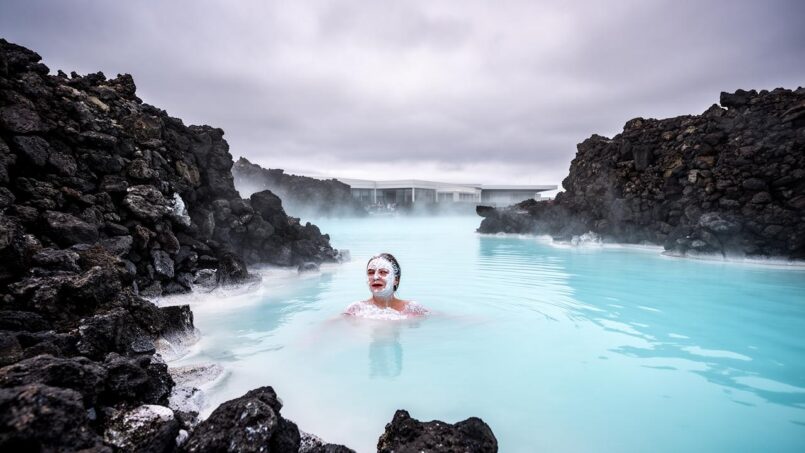
Set in the middle of an 800-year-old lava field on the Reykjanes Peninsula, the Blue Lagoon has become the icon of Icelandic lagoons. Its milky blue water, due to a high concentration of silica that reflects light, stretches across a landscape of black volcanic rocks partly covered in green moss. The site even appears on a list of the 25 wonders of the world compiled by National Geographic.
The lagoon, however, was originally an industrial accident: it formed in 1976 from the hot water runoff of a nearby geothermal power plant. Today, the greatly expanded facility includes a main spa, an upscale area called Retreat Lagoon reserved for Retreat Hotel guests, and a more intimate lagoon linked to the Silica Hotel.
Visitors to the main lagoon enjoy water at 37–39°C (99–102°F), a silica mud mask included in the basic ticket, saunas, steam rooms, and small massaging waterfalls. Restaurants, cosmetics shops, and designer hotels complete the complex. On the downside, it’s expensive and very crowded: entry runs around 90 euros for the simplest package, time slots must be booked in advance, and check-in can sometimes take about thirty minutes on busy days.
Its proximity to Keflavík International Airport makes it a logical stop upon arrival or departure from Iceland, despite a heavily “marketing machine” feel that attracts criticism, even from Icelandic politicians.
Sky Lagoon: A Design Alternative with Atlantic Views
On the outskirts of Reykjavík, in Kópavogur, Sky Lagoon offers a more intimate version of the geothermal lagoon. Carved into a cliff overlooking the ocean, the main pool ends with a 70-meter-long infinity edge that seems to merge with the sea. The design focuses on clean lines, natural materials, and walls of turf and lava covered in moss, inspired by traditional Icelandic architecture.
The water is maintained between 38 and 40°C (100–104°F). A unique feature is a seven-step ritual alternating hot and cold: immersion in the lagoon, a cold plunge, a panoramic sauna, a cold mist, a body scrub, a steam room, and a drink made from crowberries before returning to the warm water. This circuit, presented as beneficial for circulation and relaxation, is not included in the basic entry ticket and requires an additional fee.
Access, however, is easier than for the Blue Lagoon: the site is connected to central Reykjavík by city bus. The atmosphere, described as calmer and more wellness-oriented than mass consumption, attracts those seeking a slightly less touristy experience.
Other Lagoons Across the Country: Local Vibe and Authenticity
Moving away from Reykjavík, the options diversify. In the north, the Mývatn Nature Baths take the idea of a large milky blue pool surrounded by volcanoes, but in a more modest and less expensive version. The sulfur is more present, both in smell and in its effect on jewelry, but the overall atmosphere is calmer than the large southern complexes.
In northern Iceland, GeoSea in Húsavík uses seawater heated by geothermal energy and offers a view of Skjálfandi Bay, where whales can sometimes be spotted. Near Akureyri, Forest Lagoon features pools integrated into a rare wooded area with views of the fjord.
In the east, Vök Baths has installed floating pools on Lake Urriðavatn: from these warm-water platforms, you gaze out over the lake surface and surrounding hills, before moving to the sauna or steam room on dry land.
Finally, Iceland is full of small municipal pools at negligible prices, especially in Reykjavík, where Laugardalslaug, Sundhöllin, or Vesturbæjarlaug let you immerse yourself in local life for just a few euros. On a travel budget scale, choosing these pools over a highly touristy lagoon can make a huge difference.
Reykjavík and Its Surroundings: Between Modernity, History, and Accessible Nature
Even though Iceland is best known for its landscapes, its capital deserves more than a simple transit. Reykjavík concentrates museums, contemporary architecture inspired by geology, a lively cultural scene, and quick access to nature.
Hallgrímskirkja, Harpa, and Sun Voyager: City Symbols
Upon arriving in the city center, the silhouette of Hallgrímskirkja dominates. This Lutheran church, at 74.5 meters tall, is one of the tallest buildings in the country. Its architect, Guðjón Samúelsson, drew inspiration from the basalt columns found at Svartifoss and Reynisfjara to design a stepped facade that is both massive and vertical. Some also see a nod to Thor’s hammer. An elevator leads to a viewing platform offering a 360° view of the city, the bay, and Mount Esja.
On the waterfront, Harpa, a concert hall and conference center, continues this dialogue with geology. Its glass facade, cut into modules reminiscent of lava structures, reflects the changing light of sky and sea. The building houses the Iceland Symphony Orchestra, the Opera, cafés, and shops, and has established itself as both a cultural and social meeting point.
On Reykjavík’s coastal walkway, the Sun Voyager (Sólfar) sculpture represents a stylized steel Viking longship. Designed as an ode to the sun rather than a historical replica, it has become a favorite spot for photos, especially at sunset.
Museums, History, and Living Heritage
Reykjavík has over sixty museums, galleries, and exhibition spaces. Among them, several sites help visitors understand the country’s history without turning into a lecture.
The National Museum traces the evolution of Icelandic society, from the first Viking settlers to modern times, through thousands of artifacts: weapons, tools, jewelry, religious objects like the carved door from Valthjófsstaður, and more contemporary works.
The Settlement Exhibition, built around the remains of a Viking longhouse discovered in the city center, uses projections and interactive displays to reconstruct life in these early dwellings, with accessible explanations for non-specialists.
The Saga Museum takes a completely different approach, using wax figures to reenact key scenes and figures from the Icelandic sagas in a very visual way. The Reykjavík Maritime Museum, housed in a former fish warehouse, tells the central role of fishing in the local economy and culture, with the option to visit a coast guard vessel.
The Phallological Museum stands out for its unique and unabashed theme. Also, the Reykjavík Art Museum is not in a single location but spreads its collections of modern and contemporary art across three separate sites.
Nature and Culture Minutes from the Center
One of the capital’s assets is the immediate proximity to nature. In a few minutes’ walk, you leave the city bustle to walk around Lake Tjörnin, surrounded by parks, and then reach residential neighborhoods with colorful wooden houses.
On Öskjuhlíð hill, around the circular building of Perlan – a former water reservoir turned into an exhibition center on Icelandic nature – wooded trails let you stroll among old military structures and reach the geothermal beach Nauthólsvík, where a hot pool adjoins the ocean.
A short bus ride takes you to larger green spaces like Elliðaárdalur, a green valley crossed by rivers and small rapids, or Laugardalur, where botanical gardens and pools coexist.
Finally, by boat, you can reach Viðey, a small uninhabited island with walking paths, historic buildings, and artworks, including the Imagine Peace Tower light beam, a work by Yoko Ono in honor of John Lennon.
North, East, West: Other Regions Not to Miss
While many visitors focus their trip on Reykjavík, the Golden Circle, and the South Coast, the island’s other regions hold equally remarkable sites, often in a more tranquil setting.
North Iceland: Mývatn, Goðafoss, Húsavík, and Akureyri
Around Lake Mývatn, volcanic landscapes follow one after another: the bizarre lava formations of Dimmuborgir, the pseudo-craters of Skútustaðir, the black Hverfjall crater, the Hverir geothermal area where mud boils and steam escapes from the ground. The lake itself, born from an eruption over 2,300 years ago, is now a haven for numerous bird species.
Nearby, the Mývatn Nature Baths offer a warm outdoor soak amidst this lunar landscape, with views over the scenery. Further west, Goðafoss, already mentioned, marks the entrance to the Akureyri region.
Akureyri, often called the “Capital of the North,” offers both urban amenities (restaurants, accommodations, a geothermal pool) and quick access to the surrounding nature: Eyjafjörður, a long fjord sheltered from Atlantic waves, trails on the nearby mountains, and agricultural valleys like Eyjafjarðarsveit.
Húsavík, in northern Iceland, is renowned as Europe’s whale watching capital. Boat tours set out to explore Skjálfandi Bay, very rich in plankton and thus food for cetaceans. In season, sighting odds are around 99%, with humpback whales common, sometimes accompanied by blue whales, dolphins, or porpoises. The visit can be completed with the local whale museum.
East and Westfjords: Fjords, Cliffs, and Isolation
The East Fjords, less frequented than the South Coast, fan out along the sea, with small colorful towns like Seyðisfjörður or Djúpivogur, connected by winding roads between mountains and shores. Sites like the Hengifoss waterfall, with its red strata in the cliff, or the legends surrounding Lake Lagarfljót add a touch of mystery to these landscapes.
In contrast, in the Westfjords, the feeling of isolation is even more pronounced. Far from the Ring Road, the road winds between sea inlets and cliffs. Dynjandi, already mentioned, reigns as the region’s great waterfall. At the tip of the Látrabjarg peninsula, sheer cliffs, among the most important in Europe for seabirds, host thousands of puffins, kittiwakes, and guillemots in summer, accessible by walking carefully along the edge.
Rauðasandur, a red-orange sand beach, offers a striking contrast to the black beaches of the south, while Breiðavík, sometimes called “Golden Beach,” unfurls a long crescent of pale sand.
Snæfellsnes Peninsula: Iceland in Miniature
Often nicknamed “Iceland in miniature,” the Snæfellsnes Peninsula packs volcanoes, lava fields, black pebble beaches, cliffs, small fishing villages, and a glacier-capped stratovolcano into a relatively small area.
At its center, Snæfellsjökull, made famous by Jules Verne in Journey to the Center of the Earth, dominates a national park that mixes lava flows, formations like the Lóndrangar cliffs, beaches like Djúpalónssandur, and lava caves like Vatnshellir.
On the north coast, the conical mountain Kirkjufell, at 463 meters, has become one of the most photographed landforms in the country, especially combined with the neighboring Kirkjufellsfoss waterfall. The villages of Grundarfjörður or Stykkishólmur serve as bases for exploring the region.
Snæfellsnes is also an excellent area for whale watching, with departures from Ólafsvík, where orcas, sperm whales, dolphins, and humpback whales can appear, especially in spring and early summer.
Northern Lights, Seasons, and Highlight Experiences
Beyond places, certain natural phenomena are considered must-do experiences in Iceland. This includes northern lights, whales, and, to a lesser extent, long hikes and extended stays in the countryside.
Northern Lights: Chasing the Lights in the Arctic Night
Between late August and early April, when the night is dark enough, the Icelandic sky can light up with green veils, sometimes tinted pink or purple: the aurora borealis. Peak season is generally between October and March, with transition months like September and March often cited as ideal due to slightly milder weather.
To maximize your chances, you need to move away from light pollution (so leave Reykjavík), check the cloud cover and solar activity. Numerous agencies, some with decades of experience, organize nighttime excursions by bus, super-jeep, or boat from Reykjavík or Akureyri. Most offer a free “second chance” if no aurora appears during the outing.
A stay of 4 to 7 nights is often recommended to increase the likelihood of encountering the phenomenon at least once, knowing it remains inherently unpredictable. Some packages combine aurora hunting with daytime visits to major sites (Golden Circle, South Coast, glacial lagoons, geothermal baths), or glacier hikes.
Whales and Puffins: Marine Life as a Backdrop
Whale watching is possible year-round around the island, but the most favorable period is from spring to autumn, especially June to August. In summer, many species of migratory baleen whales move to higher latitudes to feed, greatly increasing the chance of sightings.
Success rate for spotting at least one whale in season in the Húsavík and Akureyri areas.
Puffins, meanwhile, only inhabit the Icelandic coasts from late April to mid-August or so, before heading back out to sea. They nest in colonies on cliffs like Látrabjarg in the Westfjords, on the Dyrhólaey peninsula, around certain islands like the Westman Islands or Grímsey, and on islets off Reykjavík. Many whale-watching tours include a detour past rocks occupied by these birds with their distinctive whirring flight.
Seasons: How Timing Changes the Experience
Iceland’s face changes radically with the season. Summer, from June to August, brings endless days, sometimes nearly 24 hours of light in June, lush vegetation, purple lupines colonizing roadsides, and waterfalls swollen by glacial melt. This is also when all roads are open, including those to the Highlands, campsites operate at full capacity, and activities like long hikes or sea excursions are most numerous. On the flip side, it’s peak tourist season: flight, accommodation, and car rental prices can be up to three times higher than in winter, and the most popular sites see heavy crowds during midday hours.
From November to March, Iceland offers a winter landscape with very short days (4-5 hours of daylight in December). This season is less crowded and travel costs are roughly halved. It allows for specific activities like ice cave exploration, glacier hiking, and super-jeep safaris. This is the prime time for viewing the northern lights. Note: unstable weather can lead to road closures or restricted access to certain waterfalls for safety reasons.
Shoulder seasons, spring (March–May) and autumn (September–November), offer an interesting compromise: fewer crowds than summer, more light than winter, and transitional landscapes – emerging greenery, returning migratory birds, and lambs in the fields in spring, golden foliage colors and early aurora nights in autumn. Accommodation and flight prices are often more moderate, and many travelers consider these “shoulder seasons” the ideal time to visit.
Summary of key characteristics across four historical periods in terms of visitor experience at must-see sites.
Perilous and long journeys, reserved for scholars, merchants, and pilgrims. Experience based on oral accounts and local guides.
Development of pilgrimages. Beginning of written travel accounts. Access limited to a wealthy and curious elite.
Birth of the ‘Grand Tour’ for young aristocrats. Appearance of the first printed travel guides and structuring of itineraries.
Mass democratization through transportation. Mass tourism, digitalization (online reviews, reservations), and search for personalized experiences.
| Season | Light & Weather | Crowds & Prices | Highlights for Tourist Sites |
|---|---|---|---|
| Summer (Jun–Aug) | Very long days, 10–20°C (50–68°F), variable but milder weather | Very high, prices at peak | All roads open, green landscapes, whales & puffins, long hikes |
| Autumn | Decreasing light, 0–10°C (32–50°F) | Moderate, more affordable rates | Autumn colors, start of aurora season, fewer crowds |
| Winter | 4–7 h of daylight, -1 to +5°C (30–41°F), snow, ice | Low, low prices, sites sometimes empty | Northern lights, ice caves, winter atmosphere at waterfalls and lagoons |
| Spring | Increasing light, 0–10°C (32–50°F) | Moderate to low | Large meltwater waterfalls, return of birds, landscapes greening up |
—
Through these itineraries, regions, and experiences, one thing becomes clear: the must-see tourist sites in Iceland are first and foremost places where nature holds the reins. Waterfalls, glaciers, volcanic valleys, black sand beaches, fjords, geysers, and geothermal pools are not static backdrops but environments in motion, subject to volcanic eruptions, glacial melt, and coastal erosion. Traveling in this country means accepting the need to adapt to these forces, to check a weather forecast before hitting the road, to stay on trails to protect fragile vegetation, to step back a few meters from a wave stronger than expected.
This is also what makes each visit unique: no two auroras are alike, an ice cave changes shape from year to year, an iceberg on Diamond Beach is visible for only a few hours before breaking apart. More than checking off boxes, touring Iceland is about multiplying these fleeting encounters with places that will continue to transform long after travelers have left.
Disclaimer: The information provided on this website is for informational purposes only and does not constitute financial, legal, or professional advice. We encourage you to consult qualified experts before making any investment, real estate, or expatriation decisions. Although we strive to maintain up-to-date and accurate information, we do not guarantee the completeness, accuracy, or timeliness of the proposed content. As investment and expatriation involve risks, we disclaim any liability for potential losses or damages arising from the use of this site. Your use of this site confirms your acceptance of these terms and your understanding of the associated risks.

Cyril Jarnias is an independent expert in international wealth management with over 20 years of experience. As an expatriate himself, he is dedicated to helping individuals and business leaders build, protect, and pass on their wealth with complete peace of mind.
On his website, cyriljarnias.com, he shares his expertise on international real estate, offshore company formation, and expatriation.
Thanks to his expertise, he offers sound advice to optimize his clients' wealth management. Cyril Jarnias is also recognized for his appearances in many prestigious media outlets such as BFM Business, les Français de l’étranger, Le Figaro, Les Echos, and Mieux vivre votre argent, where he shares his knowledge and know-how in wealth management.





