
 Published on and written by Cyril Jarnias
Moving to Iceland means entering a country where religion is both highly visible in the public sphere and surprisingly discreet in daily life. Churches dot every hill, major holidays still follow the Christian calendar, but a growing share of the population describes themselves as not very observant, or even without religion, while still keeping religious rites for life’s major milestones. Added to this are a revival of Norse paganism, the presence of Muslim, Buddhist, Jewish, and humanist communities, and many small spiritual associations.
Understanding Iceland’s religious context is essential for expats. It helps decode public holidays, social codes, invitations to ceremonies, and how institutions work. This guide offers an overview of religious practices and framework, detailing the practical implications of living there.
A Lutheran country, but increasingly pluralistic
Iceland remains officially a Lutheran country. The Constitution designates the Evangelical Lutheran Church of Iceland, the Þjóðkirkjan, as the national church, supported and protected by the state. In practice, however, the situation has changed profoundly in a few decades.
In 2025, just over 68% of the Icelandic population declares itself Christian, marking a significant decline compared to 1990.
Here is a simplified overview of the main religious affiliations in 2025:
| Group / affiliation | Estimated share of population |
|---|---|
| Evangelical Lutheran Church of Iceland | 57.23% |
| Other Lutheran churches (so-called “free”) | 5.28% |
| Roman Catholic Church | 3.89% |
| Other Christian denominations | 1.73% |
| Ásatrú / Norse paganism | 1.56% |
| Humanists (Siðmennt, etc.) | 1.57% |
| Buddhists | 0.42% |
| Muslims | 0.34% |
| Zuists (Mesopotamian neopaganism) | 0.10% |
| Other recognized religions | 0.16% |
| No declared religion / unregistered | 19.79% |
| No explicit religious affiliation | 7.75% |
Two movements are particularly telling of this evolution: the rise of people with no declared religion, from 0.6% in 1990 to nearly 20% in 2025, and the growth of humanist and neopagan associations, such as the Ásatrúarfélagið or the humanist association Siðmennt.
For an expat, this means that appearances can be deceiving: most Icelanders are officially registered with a church, but many practice very little, or even identify as agnostic. On the other hand, religious rites continue to structure life’s important milestones.
A highly structured legal framework, but great freedom of conscience
The Icelandic peculiarity lies in a dual movement: on one hand, the Constitution still enshrines a state church, on the other, rights to freedom of conscience and religious association are very strongly protected.
The Constitution guarantees freedom of belief and practice, provided it does not disturb public order or good morals. It allows the creation of religious associations or groups of ‘life stance.’ However, any modification of the constitutional status of the national church is subject to a mandatory national referendum.
One of the key mechanisms of the Icelandic system is the church tax, sóknargjald. Every resident over 16, registered with a state-recognized religious or belief group, pays an annual contribution that the administration redistributes to the corresponding organization. In 2023, this amount was around 13,000 Icelandic kronur per person. Those who do not belong to any recognized group do not pay less: their contribution is simply allocated to the University of Iceland.
A few figures illustrate the weight of this system:
| Financial element (2022) | Approx. amount (ISK) | Detail |
|---|---|---|
| Total state budget for religious affairs | 8.1 billion | Religions + life stances |
| Direct subsidies to the National Church | 3.8 billion | Specific support for Þjóðkirkjan |
| Share of church tax paid to National Church | 3.9 billion | Redistribution of sóknargjald |
| Share shared by other religious/philosophical groups | 579 million | Proportional to number of members |
For an expat, this system has two practical implications. First, when registering in the national register, you will be asked to choose a religious affiliation or leave the field blank. This choice will determine where your share of the contribution goes. Second, if you wish to create a local religious or philosophical community, official recognition allows access to these funds and the ability to perform legally recognized marriages.
Religious or philosophical groups that are not officially registered enjoy extensive freedom of practice. They can legally exist, rent premises for their activities, and open a bank account, provided they comply with current law. However, this status involves two major restrictions: they are not eligible for public subsidies, and their ceremonies (such as marriages) do not receive official recognition from the authorities.
The National Church: a church “of the people” more than of worshippers
The Evangelical Lutheran Church of Iceland still structures a good part of public life. It functions as a large Nordic tradition church, with a bishop based in Reykjavík, two auxiliary bishops in Skálholt and Hólar, and about 260 parishes spread across the country, grouped into nine deaneries.
This is the percentage of funerals held in church, illustrating its central role in rites of passage.
For an expat, this means that the local parish can become an important social landmark, even if you do not consider yourself very religious. Many activities take place there: choirs, youth groups, senior gatherings, lectures, concerts… And Lutheran priests provide pastoral services to all residents, including non-members.
Hallgrímskirkja and Dómkirkjan: two faces of Icelandic Lutheranism
In Reykjavík, two churches play a strong symbolic role:
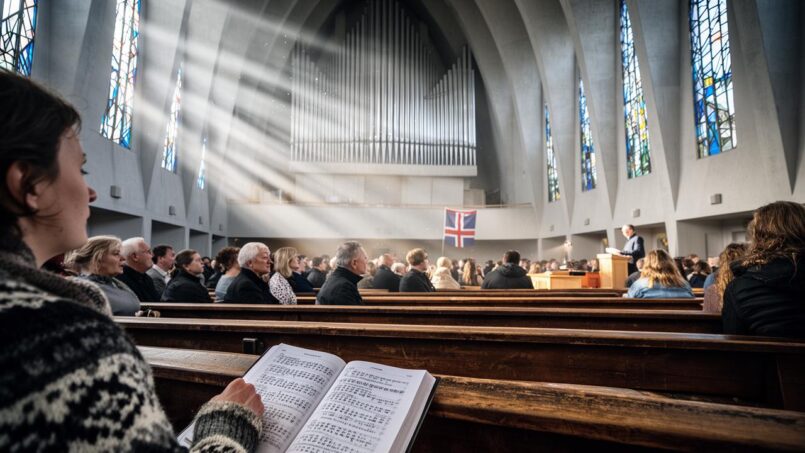
Hallgrímskirkja, a modern church evoking basalt columns, is an active parish and a national monument. It has a large organ and holds regular services, including a monthly English-language mass. Dómkirkjan, the older neoclassical cathedral near Parliament, hosts various celebrations, ‘Pop Masses,’ and also serves for state ceremonies like the opening of Parliament. Both welcome visitors with respect for the space.
As a visitor or foreign resident, attending a service in one of these churches is a good way to feel the cultural role of Lutheranism. Even without fully understanding Icelandic, you can appreciate the liturgy, organ music, and very Nordic sobriety of the setting.
Ásatrú: rebirth of Norse paganism and an embraced religion
Behind the Lutheran steeples, another face of Icelandic religiosity has asserted itself since the 1970s: the avowed return of Norse paganism, or Ásatrú. The Ásatrúarfélagið, literally “Association of Ásatrú,” was founded in 1972 by twelve people, led by poet and farmer Sveinbjörn Beinteinsson. The Icelandic state officially recognized the association as a religious organization in 1973.
This movement does not aim to replicate Viking practices exactly, but is a modern reconstruction, inspired by medieval texts (Eddas, sagas) and Icelandic folklore. Members often define themselves as “heathens,” and many hold a pantheistic view, where nature, the forces of the earth, and the ancient deities – Óðinn, Þór, Freyja, the landvættir (land spirits) – are expressions of a single vital reality.
Number of members of the Ásatrúarfélagið in 2025, up from 1040 in 2007, making it the largest non-Christian religion in Iceland.
How do Ásatrú rituals take place?
The central practice is the blót, a community ritual that ends with a feast. It echoes some descriptions of sacred banquets from the Viking age, but adapted to modernity.
Typically, a goði (priest or priestess) begins by consecrating the space and proclaiming a truce: during the ritual, no quarrels, no conflicts. Stanzas from the Eddas, especially the Hávamál, are recited or sung. A drinking horn then circulates; each person makes a toast – to the gods, ancestors, spirits of the place – and part of the drink is poured out as a libation.
The Ásatrúarfélagið organizes four major rituals (blót) each year, usually followed by a communal meal, sometimes accompanied by music or poetry. These are the Jólablót at the winter solstice (in honor of Freyja), the Sigurblót on the first day of summer (focused on Freyr), the Þingblót at the summer solstice (linked to society and laws), and the Veturnáttablót on the first night of winter (dedicated to Óðinn).
For a curious expat, these celebrations offer a very particular insight into Icelandic culture: they speak Icelandic, quote medieval poems, but the atmosphere is welcoming and non-dogmatic. Many members emphasize the peaceful, tolerant, and anti-racist nature of their religion, with the association having broken ties with foreign far-right groups and firmly denounced identity-based or supremacist uses of Ásatrú.
The Ásatrúarfélagið also officiates life ceremonies: pagan baptisms, confirmations, weddings – including for same-sex couples – and funerals. Since its official recognition, its goðar can perform legally valid marriages, and the association receives a share of the church tax.
Islam, Catholicism, Buddhism, Judaism: a mosaic of active minorities
The increase in the immigrant population – about 18% of residents in 2024 – has brought new religious practices. Several main clusters can be distinguished.
Muslim communities
Muslims are few in number – estimates are around 3,000 people – but relatively well organized. Three structures are particularly visible:
– The Islamic Cultural Center of Iceland (ICCI), in Reykjavík, which serves as a mosque, community center, and school (IQRA school) for children, with classes in Arabic, Icelandic, English, and Quranic studies.
– The Félag múslima á Íslandi (Fellowship of Muslims in Iceland).
– The Stofnun múslima á Íslandi (Organization of Muslims in Iceland).
These centers offer daily prayers, Friday congregational prayer, Eid celebrations, as well as information activities for newcomers – workshops on voting rights, women’s rights, access to healthcare, translation help for asylum seekers, etc.
As a Muslim expat, it is possible to practice your faith in Iceland. The available places of worship are mainly concentrated in Reykjavík and a few other towns. For burials, reserved sections for Muslims exist in cemeteries, notably at Gufunes cemetery in Reykjavík.
Catholicism: a predominantly immigrant church
The Catholic Church, nearly nonexistent in the mid-20th century, has experienced rapid growth with the arrival of Polish, Lithuanian, and Filipino workers. It now represents nearly 4% of the population. Most Catholics live in the capital and a few provincial towns, and nearly 80% of them are of foreign origin.
The diocese of Reykjavík, led by a Capuchin bishop, organizes masses in several languages. The Cathedral of Christ the King, in Reykjavík, holds services in Icelandic, Polish, and English. Another Catholic parish, often called Mariukirkja, holds English masses and family masses. In regions without a Catholic church, Lutheran pastors sometimes lend their church for occasional masses, revealing a rather cooperative climate between denominations.
For a Catholic expat, it is therefore relatively easy to find a Sunday mass, especially in the capital, where schedules often include an English mass.
Buddhists, humanists, and other minorities
Buddhism is present through several associations: the Búddistafélag Íslands (Buddhist Fellowship of Iceland), Zen groups, and a branch of Soka Gakkai. The number of adherents to the main registered Buddhist group is estimated at just over 1,000, while other practitioners may not be officially registered.
The association Siðmennt, founded in 1990 and recognized by the state in 2013, offers secular ceremonies (weddings, funerals, civil confirmations). It advocates for the complete separation of church and state and for non-denominational education. With a membership higher than that of the Ásatrúarfélagið, it is a major player in the non-religious landscape of Iceland.
Judaism is a very small minority – a few hundred people – but the Menningarfélag Gyðinga á Íslandi (Jewish Cultural Community) obtained official recognition in 2021. This allows for easier organization of holidays, services, and relations with authorities. Isolated antisemitic incidents have been reported, but community leaders generally note good relations with the police and public authorities.
Public holidays and religious calendar: what you’ll actually see in daily life
For an expat, the most tangible way to encounter religion is often… the calendar of public holidays. Iceland has 16 public holidays, a large part of which are linked to Christianity, even if personal practice varies.
The Icelandic calendar is marked by religious holidays (Easter, Ascension, Pentecost, Christmas) and specific cultural celebrations like *Sumardagurinn fyrsti* (first day of summer) and *Þrettándinn* (official end of Christmas). It also includes events at the border between culture and religion, such as the *Þorrablót* (winter feast of pagan origin), as well as days from the old Norse calendar like *Bóndadagur* (Men’s Day) and *Konudagur* (Women’s Day).
It is useful to keep in mind that:
– Days like Good Friday and Christmas Day are very strict regarding store closures.
– The days just before, like Maundy Thursday, or more “cultural” holidays like Commerce Day (early August), lead to large internal migrations, festivals, camping, and concerts.
On these days, Lutheran churches hold special services. At Easter, for example, the solemn mass at Hallgrímskirkja attracts both believers and the curious. But for many Icelanders, these days are above all family time, around a long meal, outings in nature, or festival weekends.
Rites of passage: being born, growing up, marrying, and dying in Iceland
Even in an increasingly secularized society, rites of passage remain central, and most are still overseen by religious institutions, particularly the National Church.
Birth, given names, and naming traditions
The Icelandic naming system has an almost “ritual” dimension. Icelanders generally do not have family names in the classic sense. The “last name” is actually a patronymic or matronymic. A boy whose father is named Einar will be called, for example, Einarsson; his sister, Einarsdóttir. Women keep their name after marriage, and a couple does not always share the same patronymic.
Parents have six months to choose the given name and have it registered. The name is often revealed at a church baptism or a secular or pagan naming ceremony, sometimes months after birth. In the meantime, the baby is very frequently given a nickname, which sometimes has no connection to the official given name chosen later.
Another practical peculiarity: since many members of the same family do not have the same “last” name, directories, administrative files, and daily interactions use first names. In social or professional life, even with a doctor, university professor, or company manager, people generally address each other by first name.
For an expat, this means: adapting to a new culture, managing complex administrative procedures, and often learning a new language. These challenges can sometimes be difficult, but they also offer unique opportunities for personal and professional growth.
It is important to use the first name when addressing someone, as using the last name can be perceived as distant. At events like a baptism or presentation, it is appropriate to congratulate the parents and respect the ceremony’s framework, whether Lutheran, pagan, or humanist.
Around age 14, the vast majority of Icelandic teenagers participate in a confirmation ceremony. Historically, this was exclusively a Lutheran Christian confirmation, preceded by catechism classes. Today, some choose a secular alternative, the “civil confirmation” organized by Siðmennt.
In both cases, the event goes far beyond the strictly religious framework: families gather, teenagers receive sometimes substantial gifts, many photos are taken, and lavish meals are organized. For an expat, if your child is in school in Iceland, they will quickly face this tradition and the choices it involves, especially since schools sometimes still plan church visits around major holidays.
Marriage: between tradition, freedom, and the low weight of civil marriage
In Iceland, getting married is neither a social obligation nor a condition for having children. About two-thirds of births occur outside of marriage, without stigma. Cohabitation is common and recognized by law.
In Iceland, a marriage can be performed and have legal validity in various settings, provided the organization is recognized by the state. This includes Lutheran and Catholic churches, but also the Ásatrúarfélagið (pagan association) or humanist organizations. A purely civil ceremony at city hall exists but is less common.
For an expat invited to a wedding, the setting is therefore very varied: whitewashed village church facing the ocean, large modern church in Reykjavík, outdoor ceremony led by a pagan goði, or secular celebration in a community hall. The dress code is generally classic and elegant, but the tone is often relaxed, and couples freely choose their symbols and references.
Funerals: a highly regulated culture, dominated by the National Church
The area where religious institutions retain the strongest control is death. By law, all coffins must be buried in a consecrated cemetery. The National Church manages all cemeteries in the country, although some have sections reserved for other faiths, such as at Gufunes for Muslims or people of other religions.
The general rule is that funerals follow the religious tradition of the deceased. In most cases, this is a Lutheran service, built around the liturgical book of the National Church. The ceremony can be held in a large church, a chapel, a funeral home, or another gathering place.
After a death, a wake is held between two and six days later, including readings, hymns, prayers, and sometimes music. The funeral typically takes place five to ten days after death. The coffin is carried along a codified path, often facing north, then east and south, avoiding direct left turns, followed by the community to the grave. During burial, the pastor pronounces a blessing, then loved ones come to pay their respects, sometimes making the sign of the cross. Wreaths and flowers are placed once the grave is closed.
Cremation exists but is less common than burial. A request for cremation can be made online through Kirkjugardar Reykjavíkur; only those over 18 can sign this wish. Relatives cannot witness the cremation process, which follows international ethical standards, and the urn must be buried within a year.
For an expat, it is important to keep in mind that:
– Even if you are not a member of the National Church, it is very likely that most funerals you are invited to will take place in this setting.
– Respect for gestures, silence, and sober clothing is highly appreciated.
– The Icelandic vocabulary retains traces of old imagery: the word útför for funeral literally means “going out,” and folklore still associates death with a passage where spirits may wander around the body for a time.
Living your faith (or lack thereof) as an expat in Iceland
Beyond the large structures, daily religious life in Iceland is marked by a certain reserve. Icelanders often describe themselves as tolerant, disinclined to conflict, and attached to individual freedom. Public displays of faith are rare, and the topic of religion rarely comes up in ordinary conversation unless you bring it up yourself.
A few cultural traits are useful to know:
The tone of public conversations is generally low, and strong emotions are rare. Direct honesty is appreciated, but overly controversial topics are avoided outside a trustful setting. Society places great importance on gender equality and LGBTQ+ rights, values integrated by many religious groups. Although the Christian heritage marks the culture, religious practice varies considerably from person to person.
If you are religious, you will easily find services in English at several churches in Reykjavík: Catholic masses, Lutheran services, evangelical services like those at Filadelfia Church, which offers an international service every Sunday afternoon. The International Congregation at Breiðholts Church, for example, gathers Protestants of various backgrounds around an English service, with social time after the service.
If you are more non-religious or humanist, networks like Siðmennt or secular philosophical circles organize lectures, civil ceremonies, and debates on ethics, science, and citizenship. You can thus celebrate a wedding, confirmation, or funeral in a fully non-religious setting, while respecting local legal requirements.
School, children, and religion: what you need to know
For expat families, the question of religion also arises at school. In Iceland, compulsory education includes a component called “Christianity, ethics, and theology,” which mainly covers the Christian heritage but also includes elements on other world religions. The law requires that this instruction adopt a multicultural approach and promote equality, tolerance, and respect for human dignity.
In Icelandic schools, the National Church retains visibility during events like Christmas or Easter. To regulate these interactions, municipalities like Reykjavík have established rules: religious representatives may present their traditions, but student participation in rituals is prohibited, as is the distribution of proselytizing materials during school hours.
Parents who wish can request that their child be exempted from religious classes or certain activities by submitting a written request to the school administration. The school is not required to offer alternative instruction during that time.
For an expat, this means it is useful:
– to inquire specifically, school by school, about how these classes are implemented,
– to discuss with the administration if you wish an exemption for your child,
– to keep in mind that, even if the teaching is still tinged by the Christian heritage, educational authorities display a goal of tolerance and pluralism.
Interfaith relations and minorities: a rather cooperative climate
Despite the presence of a state church, Iceland has established bodies for interfaith dialogue. The Icelandic Forum for Interfaith Dialogue was created in 2006, aiming to promote tolerance, respect, and religious freedom. It brings together representatives from many Christian churches, Buddhism, Islam, Ásatrú, the Bahá’í faith, the Jewish community, and other groups.
Iceland’s capital, Reykjavík, has established a consultation forum bringing together representatives of religious and secular communities, such as the Salvation Army, the Islamic Cultural Center of Iceland (ICCI), the National Church, the humanist association Siðmennt, and the Jewish community. This structure allows exchanges on practical issues like access to halls and cemeteries, school calendar organization, or refugee integration, and aims to prevent or alleviate potential conflicts.
For an expat belonging to a religious minority, these spaces can be entry points to make yourself known to the authorities, ask questions, and participate in public life. They are also a sign that, even if the system remains centered on the National Church, public authorities seek to make room for other beliefs.
Folklore, superstition, and diffuse spirituality
Finally, understanding Icelandic religiosity means not limiting oneself to institutional records. Part of the population identifies neither with traditional churches nor with humanist associations, but retains beliefs linked to the landscape, chance, or the supernatural. Many people claim to believe in the possibility of spirits, elves, or “hidden people,” and everyday language retains numerous expressions related to ghosts and revenants.
An Icelander may officially belong to the National Church while adhering to folk beliefs, such as the existence of elves or the fear of disturbing stones inhabited by invisible beings. Conversely, people declaring themselves non-religious may participate in festive pagan rituals (like the Þorrablót) or adopt New Age spiritual practices, illustrating the coexistence and blending of beliefs.
For an expat, this cultural fabric can be encountered in a conversation about the weather (not stepping on a certain black beetle, lest it bring rain), at a popular festival, or during a walk in a landscape that some locals describe as “inhabited.” It reminds us that in Iceland, the boundary between religion, tradition, and imagination often remains fluid.
In summary: a few reference points for your daily life
Living in Iceland with or without religion therefore means navigating a particular landscape:
An overview of the main characteristics of religious practice and framework in contemporary Icelandic society.
An official institution still very present in public life, but with low daily practice among the population.
Active presence of Catholic, Muslim, Buddhist, and Jewish communities, as well as local movements like Ásatrú (neopaganism) and the humanist association Siðmennt.
A legal system that funds recognized religious organizations via a tax, while guaranteeing broad freedom of conscience and worship for all.
Baptisms, confirmations, weddings, and funerals are still often overseen by religious institutions, including for many non-believers.
A generally tolerant environment where religious beliefs are considered personal, provided equality and fundamental rights are respected.
As an expat, you have great freedom to maintain your own practices, join an existing parish or religious community, become part of a humanist group, or explore the local spiritual heritage – whether Christian, pagan, philosophical, or simply rooted in the strong connection Icelanders have with their landscape.
Understanding this context will help you decode the unspoken, avoid faux pas (like addressing people by their last name or taking photos during a service without asking) and make informed choices for your own spiritual journey or that of your children. In a country where religion is both institutional and discreet, traditional and changing, this informed perspective becomes a valuable asset for settling in smoothly.
Disclaimer: The information provided on this website is for informational purposes only and does not constitute financial, legal, or professional advice. We encourage you to consult qualified experts before making any investment, real estate, or expatriation decisions. Although we strive to maintain up-to-date and accurate information, we do not guarantee the completeness, accuracy, or timeliness of the proposed content. As investment and expatriation involve risks, we disclaim any liability for potential losses or damages arising from the use of this site. Your use of this site confirms your acceptance of these terms and your understanding of the associated risks.

Cyril Jarnias is an independent expert in international wealth management with over 20 years of experience. As an expatriate himself, he is dedicated to helping individuals and business leaders build, protect, and pass on their wealth with complete peace of mind.
On his website, cyriljarnias.com, he shares his expertise on international real estate, offshore company formation, and expatriation.
Thanks to his expertise, he offers sound advice to optimize his clients' wealth management. Cyril Jarnias is also recognized for his appearances in many prestigious media outlets such as BFM Business, les Français de l’étranger, Le Figaro, Les Echos, and Mieux vivre votre argent, where he shares his knowledge and know-how in wealth management.





