
 Published on and written by Cyril Jarnias
Moving to Niue has nothing to do with relocating to another city or simply changing countries. You arrive on a vast coral island lost in the middle of the Pacific, with fewer than 2,000 residents, no supermarkets, no fast food, no movie theaters, very few cars, and virtually no crime. In return, you discover a tiny, tight-knit, deeply Christian society structured around fourteen villages, where from day one everyone knows who you are, who you live with, and where you work.
Good to know:
Before leaving, it’s crucial to prepare beyond practical aspects like budget or visa. You need to understand the deep cultural differences of the destination country, including social codes, the role of religion, language, attitudes toward time and work, and the role of family. This foresight helps avoid misunderstandings and facilitates better adaptation.
This article decodes these differences, drawing on available factual data, to help future expats and “remote” workers in the tropics gauge what awaits them in Niue.
A highly cohesive micro-insular society
Living in Niue means entering a village… on a country-wide scale. The island has fewer than 2,000 permanent residents but 14 villages, each with its own identity and community leader, the pule. Everyone knows everyone else, directly or through the extended family (magafaoa). The bonds are so tight that Niueans readily describe their society as one big extended family.
Attention:
In a very small community, anonymity is impossible. Newcomers are quickly identified, and their reputation, based on their behavior, spreads fast. This extremely tight social environment, while surprising for those used to big cities, creates an exceptional level of safety, with thefts extremely rare and a near-total absence of insecurity.
Daily life is shaped by the village, family, and Church, more than by work or consumption. There are no shopping malls, fast-food chains, or nightclubs. Mail arrives once a week by plane. Scarcity reinforces the need to be resourceful, creative, and able to improvise with what’s available.
The country as a whole is understood through the concept of Taoga Niué, living cultural heritage, which authorities actively document and protect. This is not tourist folklore: there is no reconstructed “cultural village”; culture is lived in the villages, daily, through celebrations, funerals, ceremonies, and family gatherings.
Faka Niué: values at the heart of social life
To understand Niuean society, one word keeps recurring: faka Niué. It refers to all the customs, language, and values that define the country’s identity. It encompasses several essential pillars for anyone wanting to integrate.
The first is fakaalofa – a term that combines love, respect, compassion, and giving. Giving a gift, doing a favor, welcoming, feeding: all these are part of fakaalofa. In a context where the collective takes precedence over the individual, showing this generosity is a marker of good upbringing and social cement.
Tip:
Generosity is closely tied to reciprocity. Receiving a *fakaalofa* (gift, help, or hospitality) creates a moral obligation to reciprocate, whether immediately or later, in the form of money, time, services, or food. This balance of giving and receiving is fundamental, even if never expressed directly. An expat who consistently accepts without ever contributing risks being seen as ungrateful or a free rider.
Magafaoa (extended family) comes next. Family is not limited to the nuclear unit: it includes cousins, uncles, aunts, grandparents, often spread across several villages or even within the diaspora, notably in New Zealand. Important decisions are discussed within this extended framework, and the group’s well-being comes before individual aspirations. For a foreigner, this means that relationships (friendships, professional, romantic) always fit, in one way or another, into this family network.
Example:
In this society, elders, especially men and firstborns, hold a higher status. Respect for the elderly, called *fakalilifu*, governs interactions: you must speak and behave deferentially in their presence and consult them for decisions. Acts like not greeting them, interrupting them, directly contradicting them, or ignoring their advice are considered serious insults.
A deeply Christian society and the sacred role of Sunday
Niue is straightforwardly described as a Christian nation. Nearly the entire population attends church, and religion shapes the weekly rhythm, social organization, and even part of political debate. The arrival of Christianity in the 19th century, through the Niuean missionary trained in Samoa, Nukai Peniamina, is commemorated each year on Peniamina Day.
Good to know:
Sunday is a day devoted to worship, rest, and family. Two main services are typically held in the morning (around 9 or 10 a.m.) and in the afternoon (around 3 or 4 p.m.). Throughout this day, certain behaviors are prohibited or considered inappropriate.
– No swimming, diving, fishing, or boat trips near churches or village squares,
– No wearing swimsuits in villages or town,
– Limiting visible leisure activities (noise, music, festive gatherings).
Good to know:
Certain activities like golf, walks, or swimming far from villages are tolerated on Sundays, but discretion is key. Ostensibly ignoring these customs can harm social integration. Conversely, attending a service, even without sharing the faith, is a sign of respect and a way to understand society and meet locals.
Religion also permeates major life events: weddings, funerals, coming-of-age ceremonies (like the boys’ haircutting, tama hui) are inseparable from the spiritual dimension. They include songs (lologo), prayers, speeches by matapule (traditional orators), and often large feasts.
Language and communication: the importance of Vagahau Niué
Officially, Niue is bilingual: English and Vagahau Niué have the same constitutional status. In practice, English dominates in administration, education, and business, while the Niuean language remains very present at home, in church, during ceremonies, community meetings, cultural classes, or in the pages of the Niue Star, the weekly newspaper printed in both Niuean and English.
Good to know:
Vagahau Niué, a Polynesian language close to Tongan and Samoan, has a 16-letter alphabet and a consonant-vowel structure that makes it fairly easy to pronounce. However, it is currently classified as endangered by UNESCO. This decline is mainly due to the exodus of the population to New Zealand, where the majority of Niueans now live, weakening intergenerational transmission. To counter this, authorities now encourage its use at home and its teaching in schools.
For an expat, making the effort to learn basic Vagahau Niué is one of the best ways to integrate. A simple “Fakaalofa lahi atu” (hello), “Fakamolemole” (please), “Fakaaue lahi” (thank you very much), “E” (yes), or “Nakai” (no) is often enough to spark smiles, goodwill, and curiosity. Returning a greeting, repeating the phrase, showing you’re trying: these are strong signs of respect.
The table below provides some key points:
| Aspect | Detail |
|---|---|
| Official status | English and Vagahau Niué |
| Language family | Polynesian, close to Tongan and Samoan |
| Alphabet | 16 letters (5 vowels: a, e, i, o, u; 11 consonants: f, g, h, k, l, m, n, p, s, t, v) |
| Situation | Endangered language; revitalization efforts underway |
| Domains of use | English: government, school, commerce – Niuean: family, church, culture, local media |
Beyond words, the communication style is marked by a pursuit of harmony. Direct confrontations, public criticism, and abrupt judgments are avoided. What is unsaid, silences, topic shifts, and detours through humor or metaphor count as much as explicit statements. Elders, in particular, prefer face-to-face discussions punctuated by proverbs and cultural references.
Settling in Niue thus requires adjusting one’s way of speaking, especially at work: soften statements, prioritize listening, accept that some answers are implicit or come through a third party rather than through direct confrontation.
Politeness, social codes, and dress
Niueans are unanimously described as extremely polite. This translates into everyday courtesies that an expat would do well to adopt quickly. Greet people when entering a shop, take an interest in your interlocutor’s family, thank warmly, say “Tulou” when passing in front of someone or apologizing. While driving, pedestrians, cyclists, and drivers alike wave at each other at every crossing.
Tip:
Home visits follow specific codes. It is appreciated to bring a small gift such as food, fruit, or flowers. At the table, wait for the host or hostess’s invitation before starting to eat. It is important to try every dish offered, as refusing to eat, especially without explanation, can be seen as disrespectful to the household’s generosity.
Dress is another important marker. Niue is not a “beach-lounging island” where you walk around in a swimsuit from morning to night. Outside swimming areas, it is considered inappropriate to walk around shirtless, in a bikini, or in too-short shorts, especially in villages, town, or cafes. For church, cover your knees: collared shirt and pants for men, knee-length skirt or dress for women, hat appreciated, all-white attire to be avoided.
We can summarize some practical rules as follows:
| Situation | Expected behavior |
|---|---|
| In villages / town | Modest clothing, shoulders and stomach covered; no visible swimsuit |
| At church | Formal attire, knees covered, no all-white |
| At the beach | Swimwear allowed, but cover up with a t-shirt or pareu when returning to the village |
| At someone’s home | Small gift welcome; wait for invitation to eat; try everything |
| In shops / on the road | Greet, smile, wave in car or on bike |
Aggressive haggling and systematic tipping are not part of local culture. Bargaining is not customary, and tipping is not expected, though it may be appreciated in some cases.
Attitudes toward time, work, and daily organization
For an expat from a strongly “clock” culture (strict punctuality, tight schedules), one of the main gaps lies in the relationship with time. In Niue, things operate more on “event time” than precise time. Meetings sometimes start late, parties and ceremonies stretch out, promises for appointments are flexible. A wide window of lateness is tolerated without offense.
Good to know:
Perception of time is influenced by the small size of the island, the lack of complex public transport, and the priority given to family or community obligations, which can override strict professional punctuality. For foreigners, it is important to respect your own work hours while avoiding any aggressive or condescending attitude toward others’ lateness.
The world of work is marked by the weight of the public sector – the country’s main employer – and by a form of pragmatism. Since 2014, a four-day workweek policy for civil servants allows them to work Monday through Thursday (32 hours paid as 40), with Friday free for family, village, volunteering, or a side activity. Usual hours are around 7:30 a.m.–3:30 p.m. or 8 a.m.–4 p.m.
Good to know:
Labor law in Niue is governed by the Employment Act 2008. There is no national statutory minimum wage, but wages are generally lower than in New Zealand. The standard workweek is around 40 hours. Working conditions (hours, leave, overtime) are defined by the employment contract and depend largely on the employer’s provisions. It is advisable to have a clear written agreement.
Add to this a crucial reality for expats: the scarcity of skilled positions for Niueans themselves. The active population often has solid practical skills but fewer formal degrees, and the government acknowledges a shortage of skilled labor. Hence a strongly affirmed ethical principle: a foreigner should never take the place of a trained Niuean for a given position. Expats are encouraged to seek roles with no local candidate, or focus on skill transfer missions, or work remotely for foreign employers, without impacting the local job market.
Family, gender, and the place of elders
In the hierarchy of priorities, family – in the broad sense – is paramount. Financial decisions, career choices, travel, studies – everything is potentially discussed at the level of the magafaoa. Children are not only the responsibility of biological parents: cousins, grandparents, older siblings all participate in their upbringing, care, and cultural training.
Intergenerational relationships are rich, often tinged with humor and teasing. Grandparents play an essential role in transmitting traditional knowledge, foundational stories, songs, and dances. But this warm bond doesn’t preclude hierarchical distance: you don’t address an elder like a peer, and direct disagreement is avoided.
Good to know:
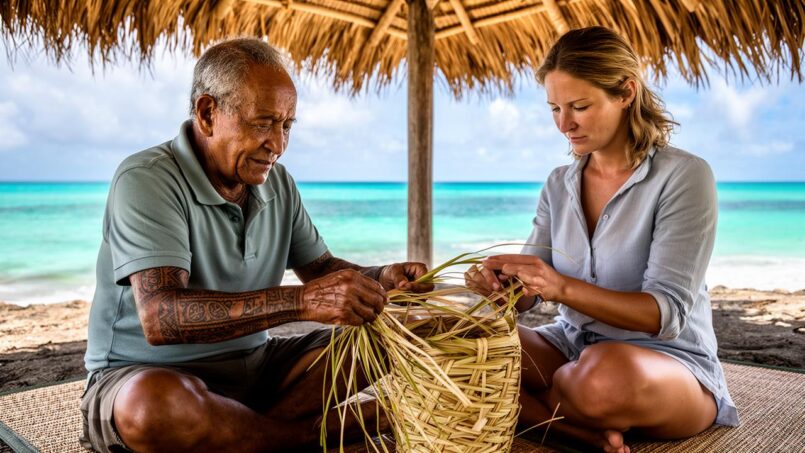
The social system remains patriarchal, giving special recognition to men and firstborns. However, women can attain positions of authority through education and experience, with some even holding leadership roles. Within the family, they take on much of the organization of ceremonies, household management, and craft production, such as weaving.
For expats in mixed couples, these realities have concrete implications. A marriage or union is never just about two individuals: family and village have a say, directly or indirectly. The foreign partner’s ability to respect customs, participate in events, and accept the weight of family obligations will be scrutinized.
Celebrations, food, and alcohol: the art of hosting in Niue
In Niue, no celebration is complete without a spectacular abundance of food and drinks. Whether for a Fiafia Night (festive evening with songs and dances), a Village Show Day, a wedding, birthday, mourning, or a simple gathering, the table is central. It symbolizes generosity, sharing, friendship, and belonging to the group.
Traditional dishes are often prepared in an umu, an earth oven where meats, fish, tubers, and fruits are slow-cooked under layers of leaves. Preparation sometimes involves the whole village, each person contributing. Refusing to eat, making derogatory comments about the food, or not bringing anything when everyone contributes can be very poorly received.
Good to know:
Alcohol is ubiquitous at large celebrations, where hosts are expected to supply it. For some men, consuming all available alcohol is a kind of identity ritual. Abstinence is not systematic, but a non-drinker will need to calmly explain their choice to avoid being perceived as distant.
Again, the key is participation. Being ready to help set up tables, serve, clean up after the party, bring a dish or a drink, sometimes counts more than long speeches about one’s “good integration.”
Religion, Sunday customs, and practical prohibitions
The Sunday rules are not the only protocols to follow. A set of norms, sometimes marked by discreet signs, applies to everyone, including foreigners.
Some sea access points are closed during the season when young kaloama fish gather. Other areas, signaled by tied coconut leaves – a fono – are temporarily off-limits for religious, ecological, or community reasons. Entering them regardless, even without ill intent, is a serious sign of disrespect.
Attention:
Canoes (vaka) left near sea access points are private property, sometimes with symbolic value. It is forbidden to touch them, move them, or sit on them for a photo without the owner’s explicit permission.
These rules extend to the marine world: it is illegal to swim with whales without being accompanied by a licensed operator. Any part of the coast or reef where you wish to fish requires asking permission from local authorities.
Memorial sites – graves, cemeteries, burial grounds – demand absolute respect: no parking, walking without reason, leaving trash, or sitting on them. For an expat used to urban parks with benches and sculptures, you must learn to see these spaces differently, as sacred sites.
Integration: stepping out of the expat bubble
In a country so small and relational, sticking to foreigners is the surest way to remain an outsider. Integrating into Niue requires a deliberate effort to frequent Niuean social spaces:
Tip:
For an authentic immersion in Niue, attend Village Show Days, where each village celebrates its agricultural produce, crafts, cuisine, and games. Go to a *Fiafia Night* to experience traditional dances, songs (*hiva*), and percussion (*pate*, *lali*). Visit the Niue market, a prime meeting place with local producers and artisans. Get involved by joining plantation visits, weaving workshops, or school events (assemblies, performances, cultural days). Finally, accept invitations to religious ceremonies or major family occasions with spontaneity, avoiding a posture of an outside observer trying to analyze everything.
Integration also requires a certain humility. Those who arrive with the idea of “modernizing” the island, making it closer to their urban ideal, or constantly comparing Niue to their home country are quickly identified and rarely appreciated. Official reports recommend “not trying to change the island, but take it as it is.”
A clear sign that you’re beginning to integrate? You navigate between villages without GPS, you know the local jokes, you know what to do (and not do) on Sundays, and you have neighbors you can count on in case of a car breakdown, a storm, or simply a desire to share a meal.
Legal framework, immigration, and the ethics of expatriation
Even though Niue is in free association with New Zealand and all Niueans are New Zealand citizens, the island fully controls its immigration policy. You don’t enter, and especially you don’t settle, without strict conditions.
For a short stay (up to 30 days), a simple visitor permit is issued upon arrival, provided you present a valid passport, return ticket, proof of sufficient funds, and – key point – accommodation reservations covering the entire stay. Camping and couchsurfing are prohibited, and lack of confirmed accommodation can lead to denial of entry.
Attention:
For a stay exceeding 30 days, an extension application must be made locally. For long-term settlement (work, volunteering, expatriation), a complex procedure is required: obtaining a work and residence permit, using a local sponsor, and submitting a specific medical certificate. This certificate, not a mere formality, must be issued in the country of origin and sent to Niue at least two months before arrival. It includes a full physical exam, blood tests, a chest X-ray (with exceptions), and verification of vaccination records for minors.
This system aims to protect a very limited health system – one public hospital in Alofi, restricted technical capabilities, need for evacuation to New Zealand for serious cases – from massive arrivals of patients with heavy pathologies. For an expat, this is a warning: you don’t come to Niue to “seek treatment,” and any serious chronic illness requires robust health insurance covering repatriation.
Good to know:
To qualify for long-term stay or permanent resident status (possible after three continuous years of residence, subject to government approval), you must demonstrate to the authorities your good character, financial self-sufficiency, and sincere commitment to integrate durably into the community.
On an ethical level, the message is clear: expatriation to Niue is not a right, but an agreement between an individual and a micro-society that seeks to protect itself while welcoming useful skills.
Education, children, and cultural transmission
For expat families, another cultural gap concerns education. The Niuean school system is directly inspired by the New Zealand model: six years of primary school (ages 6–12), then six to seven years of secondary (ages 13–19), with end-of-Form 5, 6, and possibly 7 certificates. Instruction is bilingual English-Niuean, with a majority of English.
School is public and free up to age 16, which represents a significant financial advantage. For foreign children, the classroom environment is mostly Anglophone, but Niuean language and culture are present through dedicated classes, artistic activities, cultural days, dance and song performances.
Good to know:
Immersion in a new school setting can be a powerful integration tool for children. It requires parents to accept that their children develop in an environment with distinct values, characterized by strong community expectations, marked respect for elders, significant investment in school events, and close ties among students’ families.
For adults, Niue mainly offers distance learning via the University of the South Pacific (USP) campus and private institutions like St Clements University Higher Education School – Niue, which provides online programs (from certificate to doctorate) in fields such as management or engineering.
Living with little, living together: what Niue asks in return
Material life in Niue is marked by dependence on imports, hence high prices for many products (food, care, communications), while some costs – rent, local transport – remain relatively low. But beyond the budget, what transforms the experience is the acceptance of a frugal and relational lifestyle.
You learn to live with a limited choice of goods, irregular shipments, long delays (cargo takes weeks, mail a week), and the absence of services you’re used to (nightlife, shopping malls, fast food). You develop creativity to repair rather than replace, to cook with available products, to organize your leisure differently.
In return, you benefit from an environment where solidarity – felagomataiaki, mutual aid – is real. Car breakdown? The neighbor comes to help. Need vegetables? You’re offered produce from the family garden. Mourning, wedding, birth? The whole community mobilizes, with time, money, food. This also means playing the game: give when you can, show up when asked – otherwise the cooperative system weakens.
Polynesian community principle
Niue, “The Rock of Polynesia,” is therefore not just an idyllic backdrop for remote workers seeking sunshine. It is a highly structured social world, where custom, family, Church, and language weave a tight net. Moving there means accepting to be caught in it, giving up a measure of individualism and immediately available comfort, to enter an implicit pact: respect faka Niué, bring something concrete to the community, and learn, patiently, the local way of saying “we.”

Cyril Jarnias is an independent expert in international wealth management with over 20 years of experience. As an expatriate himself, he is dedicated to helping individuals and business leaders build, protect, and pass on their wealth with complete peace of mind.
On his website, cyriljarnias.com, he shares his expertise on international real estate, offshore company formation, and expatriation.
Thanks to his expertise, he offers sound advice to optimize his clients' wealth management. Cyril Jarnias is also recognized for his appearances in many prestigious media outlets such as BFM Business, les Français de l’étranger, Le Figaro, Les Echos, and Mieux vivre votre argent, where he shares his knowledge and know-how in wealth management.





