
 Published on and written by Cyril Jarnias
Moving to Niue, a small coral island lost in the Pacific, is a dream for many expatriates seeking peace, nature, and a break from urban stress. With fewer than 2,000 inhabitants, a very low crime rate, and a particularly close-knit community, the island enjoys a reputation as a peaceful destination where you can leave your belongings without fear of theft. But this apparent tranquility does not mean that settling here long-term should be done with your eyes closed.
Safety in Niue depends on several factors: geographical isolation, a limited healthcare system, exposure to cyclones, strict immigration procedures, and a narrow job market. For a smooth expatriation, it is essential to understand this environment well, anticipate potential difficulties, and put concrete safeguards in place before arriving on the island.
This guide provides a comprehensive overview of safety in Niue, with a decidedly practical angle for prospective expatriates.
A tranquil paradise… but tiny and isolated
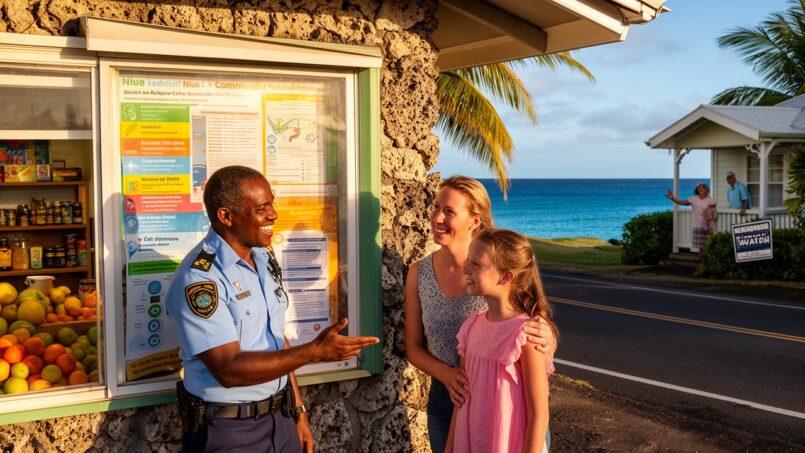
Niue is often described as one of the safest islands in the Pacific. Crime is very low, serious violence is rare, and the example of belongings left unattended without disappearing is often cited. Society is very communal: everyone knows each other, which drastically limits delinquent behavior but also makes any form of anonymity impossible.
In the background, anyone considering living here must understand three structuring realities.
Fewer than 2000 residents live in Niue, spread across 13 or 14 mainly coastal villages.
Then, the isolation: no regular ferry service, two weekly flights via Auckland, a massive dependence on imports for food and consumer goods. Stock shortages, logistical delays, and very limited choices in stores are part of daily life.
The community is described as welcoming, very Christian, and safe, with life paced by religious and village events. However, it is also marked by a strong weight of collective norms and the gaze of others.
For an expatriate, this setting offers remarkable personal safety, provided one accepts that this tranquility comes with real isolation, limited services, and high social visibility.
Entering, staying, working: safety also depends on solid legal status
In Niue, one of the primary forms of security is to be impeccable on the administrative front. Immigration rules are both strict and very specific given the country’s small size.
Short-stay visas and initial steps
Most nationals from Europe, North America, and many other countries can come to Niue without a visa for tourist or business stays of up to 30 days, provided they have a valid passport, a return or onward ticket, and sufficient financial means. This initial status is managed as a visitor’s permit.
This permit can be extended on-site, by appearing in person at the immigration services, which are attached to the police in Alofi. This is already a first difference from more touristy destinations: almost everything is done face-to-face, in a small but accessible administration, without the large online platforms expatriates are used to.
Beyond 60 days: the famous immigration medical certificate
The major administrative turning point occurs as soon as you plan a stay of more than 60 days. For any long-term expatriation, volunteering, work, or extended residence project, one document becomes central: the “Niue Immigration Medical Certificate“. Without this certificate validated by the local health authorities (Niue Health), the chances of obtaining a long-term residence permit are very uncertain.
This certificate, mandatory for expatriation, must be issued by a doctor in your country of residence following a comprehensive examination. The required medical file is very detailed and includes: a medical history, a complete clinical examination, and a series of mandatory tests (complete blood count, kidney function, urinalysis, serology for HIV, syphilis (VDRL) and hepatitis B, and a chest X-ray). Additional tests (parasitology, STI screening, tests for dengue, etc.) may be required if medically suspected.
For children, the vaccination aspect is closely scrutinized: authorities require verification of vaccinations against diphtheria, tetanus, polio, measles, hepatitis B, HPV, and Covid. The objective is clear: to protect a small island population and a fragile healthcare system from the arrival of poorly controlled serious diseases.
Two time constraints are major to avoid jeopardizing your project:
– the medical examination must be less than three months old at the time it is performed;
– the complete medical file must reach Niue Health at least two months before the planned arrival date.
This process requires significant anticipation, especially for medical appointments, tests, and international mailing of documents. Do not underestimate these deadlines.
Work permits, sponsorships, and permanent residence
Working in Niue is not as simple as arriving with your backpack and offering your services on the spot. To hold a salaried job, a specific work permit is required, in practice linked to a local employer or a sponsor.
The sponsor can be a person of Niuean nationality or origin with permanent resident status, a company established on the island, or a local administration. This sponsor must demonstrate the absence of a suitable local candidate for the position and the relevance of the expatriate’s skills. This requirement reflects a clear priority: to protect a very restricted job market and prevent foreigners from taking the few jobs available to Niueans.
The residence application via sponsorship is also dense. You must provide:
– proof of accommodation and financial support by the sponsor;
– a bond covering potential repatriation costs;
– two character reference letters for the applicant;
– a police clearance certificate from the country of origin;
– a health certificate.
Any stay exceeding the duration allowed by the permit can lead to being classified as a ‘prohibited immigrant’, with a real risk of deportation. For an expatriate, not respecting these deadlines jeopardizes their legal security and the stability of their life.
Access to permanent resident status is conditional on at least three years of continuous legal residence in Niue, with the obligation to convince the Cabinet of one’s intention to settle permanently. The island’s small size is evident here: authorities want to ensure that new permanent residents are genuinely committed for the long term and to the collective interest.
Keeping control of your administrative security
A smooth expatriation to Niue therefore requires: conducting thorough research on the culture and local life, organizing moving logistics, familiarizing yourself with regulations and administrative requirements, and developing a network of contacts on the ground.
– systematically and personally verify with the immigration service the updated requirements (deadlines, documents, forms) before departure and upon arrival;
– anticipate the preparation of the medical file and police certificates by several months;
– never delay an application for extension or change of status;
– include in your budget a possible repatriation bond and application fees.
Daily tranquility on the island also depends on the certainty of being in a regular situation and not risking a sudden administrative reversal.
Health and care: building your own safety
On an isolated island, safety is not just about the absence of crime. The ability to be properly cared for in case of a major medical problem becomes a central issue. In Niue, the healthcare system is entirely concentrated around a single hospital, Niue Foou Hospital, located in Alofi.
A single, versatile but limited hospital
Niue Foou Hospital is the hub of all health services in the territory. It provides general medicine, maternity, minor surgical procedures, emergencies, radiology, laboratory analysis, pharmacy, dental care, physiotherapy, and maternal and child health programs.
For a country of fewer than 2,000 inhabitants, this concentration is logical. But for an expatriate, it implies accepting significant limitations:
– limited healthcare staff, with part of the medical corps aging;
– rare or non-existent state-of-the-art equipment, especially for neonatology or serious conditions (cancer, major surgery, complex trauma);
– absence of a hyperbaric chamber on the island for diving accidents, with the nearest chamber located far away and not always operational.
When a serious case arises, the realistic option is medical evacuation to New Zealand. This procedure exists and works, but it is costly, dependent on weather conditions and transport availability, and requires being well insured.
Who pays what: Niueans vs. expatriates
The legal framework clearly distinguishes between Niueans and non-residents regarding healthcare costs. Niueans benefit from free health services. In contrast, visitors and expatriates must pay fees described as “reasonable.” In practice, this means that:
You may be asked to pay before receiving care, including at the emergency room. Furthermore, any medical evacuation to New Zealand generates extremely high costs.
A prudent expatriation to Niue therefore involves considering the worst medical scenario and ensuring you have the financial means (insurance, savings) to handle it.
Health insurance, a pillar of personal safety
Authorities and specialized organizations strongly recommend taking out travel insurance or expatriate health insurance adapted to Niue’s reality. The coverage to prioritize is not just local consultations and hospitalizations, but especially:
– coverage for medical evacuations to New Zealand;
– coverage for repatriation if necessary;
– coverage for medications prescribed on-site.
Available estimates give an idea of the order of magnitude to include in your monthly expatriate budget:
| Health expense item | Estimated monthly range (USD) |
|---|---|
| Health insurance | 60 – 400 |
| Medications | up to 225 |
| Doctor / Dental | up to 500 |
Specialized providers like MSH International, Expatriate Group, or AXA Global Healthcare offer international contracts covering Niue, with options for temporary (3 to 11 months) or renewable annual plans, suitable for individuals, families, NGOs, companies, or students. This type of contract combines emergency care, evacuation, coverage for chronic conditions, and even optional dental or optical care.
For expatriate students, partnerships like those offered via Aon emphasize the need to avoid common “coverage gaps”: evacuation, civil liability, luggage, legal assistance, etc.
Medical preparation before departure: obligation… and common sense
The famous immigration medical certificate is not just a formality: it forces the expatriate to have a real health check-up before leaving. Beyond that, health authorities and international organizations recommend:
Before a stay, it is essential to be up to date on basic vaccines (diphtheria, tetanus, polio, measles) and to plan for those against hepatitis A, hepatitis B, and typhoid, especially for a long stay. Consult a doctor to assess specific risks like dengue (prevention with repellents), rabies (if in contact with animals), or flu. If you have a chronic condition, bring enough personal medication for the entire duration, as some treatments may be difficult to find on-site.
Preparing a personalized medical kit is also highly recommended, including supplies to manage cuts (coral), minor skin infections, digestive issues, pain, allergies, as well as materials to disinfect water if necessary.
Diseases, environment, and daily precautions
Health-wise, Niue has some particularities that an expatriate must keep in mind.
The country is free of malaria and yellow fever, and the risk of rabies is limited to certain animals. However, dengue circulates sporadically, transmitted by daytime-active mosquitoes. Prevention relies on constant application of repellents, wearing loose, light-colored clothing, using mosquito nets, and eliminating stagnant water near dwellings.
The tropical climate also implies a high risk of sunburn, heatstroke, and dehydration. High-SPF sunscreen, regular hydration, and smart management of physical activities during the coolest hours become safety reflexes as important as buckling your seatbelt in a car.
Another often underestimated point: injuries related to coral and the island’s sharp coastal rocks. Walking barefoot can quickly turn into an infectious nightmare. Local authorities consistently recommend closed shoes for walking and reef shoes for water access, immediately and thoroughly cleaning any wound, removing coral fragments, using antiseptic, and applying appropriate protection.
Finally, drinking water: the island has no rivers, relying on a freshwater lens and rooftop rainwater collection systems. Quality is generally monitored but remains under pressure (droughts, risks of agricultural or waste contamination). Several sources indicate that tap water may be drinkable in some areas, but cautionary recommendations remain: prioritize filtered water provided by accommodation, bottled water, or boiling water for about ten minutes before consumption, especially after bad weather or a cyclone.
For an expatriate, knowing these constraints, adapting to them, and integrating them into daily routines is a key factor for health safety.
Cyclones, rough seas, and a vulnerable small island: managing natural risks
Niue, like many Pacific islands, is highly exposed to climatic hazards. Its location in the South Pacific tropical cyclone belt, its limestone cliff terrain, and its lack of a protective lagoon make it particularly vulnerable to strong winds, storm surges, and tsunamis.
Cyclones: a recurring but managed threat
The cyclone and rainy season generally runs from November to April, with a peak risk in December, January, and February. Regional statistics show an average of several cyclones per season in the basin, some reaching high categories. On Niue itself, major events like Cyclones Heta (category 5 in 2004), Waka (2001), or Ofa (1990) have left lasting marks: massive destruction in coastal areas, uprooted trees, downed power lines, water contamination, and, for Heta, the near-destruction of old Alofi by waves.
However, it would be reductive to focus only on these catastrophic images. Since these episodes, Niue has developed a more structured disaster risk management framework:
Niue’s natural disaster preparedness and response system rests on three main pillars: a structured legal and organizational framework, an international meteorological monitoring network, and clear multilingual warning procedures.
Implementation of an updated National Disaster Plan, supported by emergency laws. It relies on a National Disaster Management Council, an emergency operations center (NEOC), and specific plans for cyclones, tsunamis, and pandemics.
Weather communication chain supported by the Niue Meteorological Service, New Zealand’s MetService, the specialized center in Nadi (Fiji), and the World Meteorological Organization for reliable forecasting.
Color-coded warning systems (blue, yellow, red alert) with clear instructions relayed in Niuean and English via radio and other communication channels to reach the entire population.
The island is also covered by a regional parametric insurance (PCRIC) for cyclones, allowing for rapid fund disbursement in case of a major disaster, subject to an indemnity distribution plan.
For an expatriate, this translates into a dual reality: the risk of severe cyclones exists and must be taken seriously, but the island is not without tools to cope.
Living through the cyclone season safely
Moving to Niue implies accepting that, for certain months of the year, you will need to adapt your lifestyle and remain vigilant. A prepared expatriation involves a true culture of “plan B”:
– regularly follow weather bulletins (accommodation, radio, official networks, Tourist Information Centre);
– know how to interpret cyclone alert levels, recognize signs of a strengthening tropical depression;
– know the local evacuation plan, the location of the reinforced shelter or safest building nearby.
Material preparation is not a luxury but a safety condition:
Assemble a personal emergency kit including drinking water for several days, non-perishable food, a battery-powered radio, flashlights, spare batteries, copies of important documents, a first aid kit, and a reserve of essential medications. During a pre-alert period, secure your home by storing outdoor objects that could become projectiles, checking shutters and solar panel fixings, and evacuating stagnant water. Coordinate with your neighbors, especially the most vulnerable, to organize mutual aid in case of road or power cuts.
During a cyclone, the golden rule remains the same as everywhere else: do not go outside, even if the apparent calm of the eye can give the illusion that it’s over, avoid any open flame (risk of gas leak), stay away from windows, and follow instructions on the radio.
Afterwards, caution is still required: possible fallen power lines, weakened structures, water contamination. The reflex should be to boil water, go to the hospital or health center for any significant injury, and continue to follow official information.
Sea, reefs, and marine life: a nature as beautiful as it is dangerous
Niue does not have wide, supervised sandy beaches with lifeguards. Most access to the sea is via “sea tracks” carved into the cliff, leading to natural pools, sea caves, or reef entry points. It’s spectacular but requires great caution.
The swell can be powerful and tidal currents strong. It is advisable to ask locals or tour operators for advice before swimming. Some areas become dangerous during high sea season or during heavy swell warnings, even for experienced swimmers. Swimming with whales without going through a licensed operator is prohibited.
Regarding wildlife, the island is home to an endemic sea snake, the katuali, with very toxic venom but which rarely bites, and whose bite would have difficulty penetrating human skin. Also found, more rarely, are stonefish, lionfish, venomous crown-of-thorns starfish, all species that justify using reef shoes and gloves for snorkeling.
There is also the risk of ciguatera, poisoning linked to consuming certain reef fish that have accumulated algae toxins. Recommendations clearly differentiate reef species, to be avoided, from pelagic fish like tuna, wahoo, or mahimahi, considered safer.
For an expatriate who enjoys water activities, safety comes through humility: do not overestimate your abilities against the ocean, do not explore caves or sheer cliffs alone, comply with temporary bans related to customary fishing seasons, and always inquire about daily conditions.
Getting around Niue: roads, permits, and small daily pitfalls
The almost total absence of crime does not mean everything is risk-free on Niue’s roads. This is even one of the areas where expatriates can put themselves most at risk if they approach the island like a classic beach resort.
A simple but aging road network
Niue has a network of about 120 km of roads, mainly paved. A circular road runs along the coast for about sixty kilometers, very popular for circling the island in an hour and a half or two. Cross-island roads allow reaching eastern villages in about thirty minutes from Alofi.
While the structure is generally good, the road surface suffers from historical lack of maintenance: frequent potholes, aging surfaces, poor night lighting. Western roads are somewhat better maintained than eastern ones, but overall, they are far from the standards of a major city.
During heavy rain, potholes fill with water and are hard to assess, increasing risks. Avoid unpaved tracks after rain. Grassy edges can hide ruts; always check the ground before parking.
Authorities have launched road repair programs, in partnership with donors like China or climate funds, especially to secure access to the hospital, power plant, and evacuation routes. But for now, individual caution remains crucial.
Permits and driving rules: taking the time to do things right
In Niue, all drivers, including visitors, must have a local license. The procedure is quite simple: present yourself at the Alofi police station with your foreign license, pay a moderate fee, and obtain a Niuean license. The minimum driving age is 18. Specific rules apply to commercial licenses and their renewal, especially for older drivers who must provide a medical certificate.
Driving is on the left, and speed limits are generally 40 km/h in villages and 60 km/h on the open road. In practice, the narrow width of lanes, the presence of animals and children often require driving below posted limits.
Helmet use is mandatory for motorcycles and highly recommended for bicycles. Using a phone while driving without a hands-free kit is prohibited. Drunk driving is banned with low legal limits, and police plan to increase random checks. The country has implemented a points system and progressive fines for speeding, driving without a valid license, not wearing a helmet, or vehicle non-compliance.
For an expatriate, respecting these rules is both a matter of personal safety and credibility with a police force that remains close to the population and for whom every infraction stands out clearly in a small vehicle fleet.
Vehicle rental and absence of public transport
There is no structured public transport in Niue. Most travel is by private vehicle, car, or two-wheelers. For a new arrival, most accommodations and agencies offer car rentals, from small two-wheel drive models to 4x4s, minibuses, or scooters. Rental fleets are generally well-maintained and include breakdown assistance.
Before renting a vehicle, it is crucial to check several insurance points: the coverage offered, coverage in case of an accident involving an animal, the policy applied during a cyclone or storm (mandatory return or sheltering of the vehicle), and exclusions, especially for driving on unpaved tracks. In an island context, you must also consider that the supply of spare parts can be slow, which implies driving and using the vehicle with great caution.
Anticipation again plays a key role: organize airport-accommodation transfers before arrival, book a vehicle in advance, and ensure you get your local license in the first few days.
Cost of living, housing, and financial security
Even though the main theme is safety, it is impossible to ignore the budgetary dimension: in Niue, getting into financial difficulty also compromises your safety, in a context where there is neither an extensive social safety net for foreigners nor large aid structures.
High costs, especially for such a small island
Available data shows a high cost of living, largely driven by imports. For a single person, the average monthly cost, including housing, is around 2,500 US dollars, and over 5,000 dollars for a family of four. For a more “budget” life, minimums are around 1,400 dollars for a single person but rise to nearly 2,800 dollars for a family.
We can summarize some average benchmarks in a table to better visualize the scale of amounts:
| Household profile (with rent) | Average monthly expense (USD) |
|---|---|
| Single person | ≈ 2,526 |
| Couple (2 adults) | ≈ 3,665 |
| Family (2 adults + 2 children) | ≈ 5,210.5 |
And for minimum budgets (“economical”):
| Household profile (with rent) | Basic monthly budget (USD, starting from) |
|---|---|
| Single person | ≈ 1,377 |
| Couple | ≈ 1,955.4 |
| Family (2 adults + 2 children) | ≈ 2,785.9 |
Most expense items are impacted by insularity: food, fuel, internet, phone. A few examples in New Zealand dollars illustrate the relative expensiveness: a simple restaurant meal around 30 NZD, a fast-food meal at 11 NZD, 1 L of milk at 4 NZD, a dozen eggs can climb to 20 NZD depending on the source, a liter of gasoline at 3 NZD, internet subscription at 100 NZD per month.
In Alofi, the capital of Niue, the cost of living index exceeds that of major cities like Tokyo, Manila, or Santiago. It is comparable to Auckland’s, a surprising situation for a small Pacific island without a real large urban area.
Housing: market by network, not by platforms
The Niuean rental market reflects the country: microscopic and very relational. Some available accommodations are actually tourist lodgings (guesthouses, villas, motels) rented by the night, with nightly rates that, without negotiation, would quickly exceed the capacity of a long-term expatriate.
The few truly affordable “residential” rentals are mostly accessible via local contacts, discussions with shopkeepers, neighbors, or through the Visitor Information Centre in Alofi. The site niuerentals.nu offers a first glimpse of properties owned by Niueans, with direct contact details useful for negotiating monthly rates.
A secure strategy for an expatriation project involves:
Plan an initial stay of one to two months in tourist accommodation. Use this period to actively search for long-term housing on the ground: meet property owners, visit different types of properties (houses, bungalows, fales, apartments), evaluate the real cost of bills (electricity, water, waste), and identify areas that best suit your lifestyle.
Financially, monthly rents for a main residence roughly range between 600 and 1,500 US dollars depending on size and location, with specific examples around 400–450 NZD per month for a three-room place outside central Alofi. Basic utilities (water, electricity, waste) remain reasonable on paper, around 100 NZD per month for an average home, but increase significantly if air conditioning is overused.
Income, work, and safety nets
The average salary in Niue is around 1,700 US dollars per month, with a range from 730 to 3,000 dollars depending on the sector. This average income slightly exceeds the cost of living for a single person excluding rent but does not leave much margin for an expatriate without local-priced housing or other resources.
The job market is described as narrow, which directly impacts the economic security of expatriates. Available positions are rare and found mainly in administration, international organizations (for temporary projects like UNICEF or the Asian Development Bank), tourism, or a few technical trades.
For an expatriate, it is therefore important to adopt a responsible positioning:
– do not seek to take positions that a trained Niuean could fill;
– aim for roles where expertise is clearly lacking locally, with a component of skills transfer;
– or prioritize remote work for foreign clients, especially in IT development, data analysis, graphic design, etc., relying on internet connectivity that, thanks to the Manatua cable and local fiber, is now of good quality.
This balance is crucial to avoid ending up in financial difficulty on an island where access to credit, informal odd jobs, or social assistance for foreigners is limited, and where an emergency return to your home country is expensive.
Social integration and psychological well-being: an often overlooked safety aspect
Safety in Niue is not measured solely in terms of assaults and injuries or natural risks. Culture shock, potential loneliness, and lack of anonymity can also weaken expatriates, especially those arriving with idealized expectations of a “tropical paradise.”
A warm but tradition-bound society
Niuean culture is based on strong concepts like faka Niue (the set of customs, language, values) and fakalofa (love, respect, mutual aid). Daily life revolves around the extended family, community obligations, the Church, and village events. On Sundays, most motorized leisure activities, fishing, or work are prohibited, and attendance at religious services is the norm.
The hierarchy of age is very marked: respect for elders structures social relations. Visitors and expatriates are well received, often included in meals, ceremonies, village days, provided they show respectful curiosity and do not seek to “change” society.
To succeed in your expatriation and avoid isolation, it is crucial to integrate by respecting local codes. This includes: dressing appropriately for church, avoiding noisy activities on Sunday, greeting people on the road, and respecting customary prohibitions like fono areas marked by coconut leaves. Ignoring these practices risks cutting the expatriate off from an important social network and making their experience more vulnerable.
Language, religion, and links with the diaspora
English is widely spoken, especially in administration, schools, and business. But vagahau Niue remains the language of home and intimate exchanges, and its status as an endangered language encourages the population to value it daily. A monolingual English-speaking expatriate can manage perfectly well administratively but will sometimes encounter moments of “language bubble” during family or religious gatherings, where everything happens in Niuean.
Learning a few words (“Fakaalofa lahi atu” to greet, “e” for yes, “nakai” for no, “tulou” to apologize, “kai” to eat) is not just a polite gesture: it’s a way to reduce the feeling of being perpetually “palagi,” a Polynesian term used for foreigners, without an insulting connotation but constantly reminding one of their outsider position.
The large Niuean diaspora, especially in New Zealand, fosters a continuous exchange of ideas and lifestyles, as well as returns to the homeland. Programs encourage Niueans born abroad to return to the island. In this context, European or North American expatriates constitute a minority, and long-term integration within this close-knit community requires time and patience.
Managing isolation and preserving mental health
Geographical remoteness, infrequent flights, the cost of round trips to the mainland, the size of the community, and the weight of social norms can generate a feeling of confinement for some expatriates. Testimonies mention cases of “reverse culture shock” for returning Niueans, which gives an idea of what a foreigner without strong local ties might feel.
Planning ways to maintain strong ties with friends and family abroad, taking advantage of the very good internet connectivity for regular video calls, organizing periodic trips off the island, and actively integrating into local life (volunteering, clubs, community activities) are integral parts of the psychological safety of an expatriation to Niue.
Conclusion: conditions for a truly serene expatriation in Niue
Niue offers a rare cocktail: very low crime, welcoming population, spectacular environment, stable political system, advanced digital connectivity for such an isolated island, and a slow pace of life, far from the noise of big cities. On paper, the promise of safety is enticing.
But this apparent safety rests on a fragile balance that every expatriation project must respect and anticipate. Legal, health, financial, environmental, and psychological safety are intimately linked. To turn the dream of a life in Niue into a serene reality, a few major themes emerge:
For a successful move to Niue, it is crucial to accept administrative rigor by preparing all documents in advance (medical certificates, sponsorship, permits) and scrupulously respecting deadlines while maintaining constant contact with the Immigration Office. You must also over-insure the health aspect with robust international insurance, precise knowledge of the limits of Niue Foou Hospital, a complete medical kit, and serious monitoring of infectious and climatic risks. Integrating the cyclone season as a structural reality means building an emergency plan for your household and neighborhood upon arrival. Approaching work and housing with humility is essential: prioritize remote work or high-value-added positions over standard local employment, plan a substantial housing budget, and accept a phase of on-site research. Finally, investing in the community while respecting religious and customary codes allows integration into the island’s dense social network, a major asset for receiving support and mutual aid when needed.
Safety in Niue is not just a statistic or a crime index. It is a balance to be built, between preparation and adaptation, autonomy and local integration. For those ready to play by the rules, the island can offer one of the most peaceful expatriations in the Pacific – provided you accept that, in a community of fewer than 2,000 people, every individual choice has an impact, and collective serenity is an integral part of everyone’s safety.
Disclaimer: The information provided on this website is for informational purposes only and does not constitute financial, legal, or professional advice. We encourage you to consult qualified experts before making any investment, real estate, or expatriation decisions. Although we strive to maintain up-to-date and accurate information, we do not guarantee the completeness, accuracy, or timeliness of the proposed content. As investment and expatriation involve risks, we disclaim any liability for potential losses or damages arising from the use of this site. Your use of this site confirms your acceptance of these terms and your understanding of the associated risks.

Cyril Jarnias is an independent expert in international wealth management with over 20 years of experience. As an expatriate himself, he is dedicated to helping individuals and business leaders build, protect, and pass on their wealth with complete peace of mind.
On his website, cyriljarnias.com, he shares his expertise on international real estate, offshore company formation, and expatriation.
Thanks to his expertise, he offers sound advice to optimize his clients' wealth management. Cyril Jarnias is also recognized for his appearances in many prestigious media outlets such as BFM Business, les Français de l’étranger, Le Figaro, Les Echos, and Mieux vivre votre argent, where he shares his knowledge and know-how in wealth management.





