
 Published on and written by Cyril Jarnias
Settling in Niue, this “Rock of the Pacific” set in the middle of the ocean, means accepting life at the pace of a tiny island… but with a surprisingly rich culinary culture. Between ultra-fresh fish, flavorful roots, smoking underground ovens, and trendy cliffside cafes, the table is one of the best ways to understand your new adoptive land.
This practical guide helps expats adapt to Niue’s culinary life. It covers local eating habits, top spots in Alofi, markets, and food events. It also touches on practical aspects like supplies, prices, biosecurity, and special diets.
Understanding Niuean Cuisine: Between Sea, Roots, and Coconut
Niue’s cuisine is first and foremost a cuisine of local resources. Niueans have lived for generations on a limestone plateau, without large rivers or vast plains, but with an incredibly fish-rich sea and fertile soil for tropical tubers.
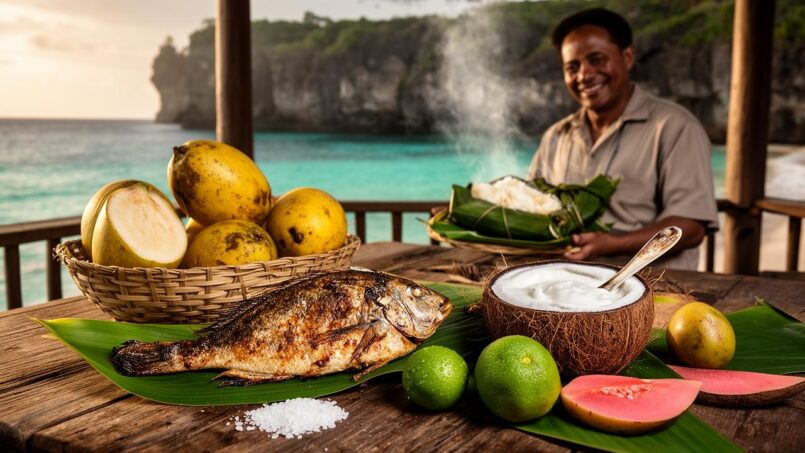
The absolute cornerstone of the diet is fish. Ahi (tuna), mahi mahi, parrotfish, barracuda, as well as shellfish and crustaceans, make up the majority of dishes. Fish is eaten raw in coconut milk and lime, grilled over fire, roasted, in curries, soups, or stews. This is the base to which are added taro (talo), cassava, yam, sweet potato (kumara), breadfruit, banana, papaya, and—ever-present—coconut.
The villages cultivate an impressive variety of exotic produce such as taro, yams, cassava, breadfruit, bananas, papaya (pawpaw), and coconut palms. These foods are then served in various settings: in family homes, at village feasts, in traditional restaurants, and even in modern cafes, illustrating their complete integration into local food culture.
The culinary style blends Polynesian roots with European or Asian influences. Alongside ancestral preparations like the umu (underground oven), today you’ll find wood-fired pizzas, sushi, Indian curries, reinvented burgers with papaya chutney, or trendy poke bowls.
For an expat, the appeal is twofold: you can eat “like home” thanks to supermarkets well-stocked with New Zealand or Australian products, but you can also let yourself be carried away by a unique island gastronomy, where pork is still cooked in the earth, coconut is used in every form, and the famous coconut crab, the uga, is served.
The Beating Heart of the Culinary Scene: Alofi and Its Hotspots
Even though every village has its own small shop(s), all organized gastronomic life on the island converges on Alofi, the capital. This is where you’ll find restaurants, cafes, bars, caterers, the market, and supermarkets.
Eating Out: From Container Cafes to Traditional Buffets
To fully enjoy local cuisine while having some “urban” anchors, a few spots quickly become favorites for expats.
Kaiika, for example, sums up the current culinary DNA of the island. In central Alofi, this restaurant serves New York-style sourdough pizzas baked in a wood-fired oven, Middle Eastern plates, as well as sushi and sashimi prepared by a chef from Tokyo, using fish delivered daily by local fishermen. The menu blends Japanese, American, and Mediterranean influences, with an obsession for ultra-fresh seafood and a “modern” take on very simple ingredients.
Located in a red container on the cliff overlooking Hio Beach, this cafe-bar is an ideal stop after visiting Matapa Chasm, Limu Pools, or Avaiki Cave. They serve wood-fired pizzas, simple dishes, smoothies, coffee, and cocktails, all in a bohemian atmosphere with sea views. Friday happy hours are especially popular, for both the sunset and the plates offered.
In the “trendy village cafe” category, Fana Cafe (Swanson Complex, near the airport) offers contemporary counter cuisine: homemade focaccia, scrambled eggs with spicy papaya chutney, umu-inspired revisited dishes, smoothies with Niue honey, vegan options. The menu changes based on local supply, making it a good barometer of seasonality.
Crazy Uga Cafe & Bar, on the edge of Utuko Bay, combines a beach cafe with a licensed bar. People come here for a proper espresso, a hearty breakfast, a midday salad, or fish & chips, while overlooking the reef. The playful decor references the uga, the coconut crab.
The restaurant Manuiz, in Opaahi, used to host an iconic Wednesday buffet featuring a large umu with Niuean specialties like takihi, huli (baby taro), povi masima, ota ika, a pigeon (lupe) risotto, and crab and seafood salads. Though temporarily unavailable, its reopening would be a key opportunity to discover Niue’s traditional festive cuisine.
Jenna’s Restaurant, on the main road, also offers this mix of simplicity and tradition: a short menu on a blackboard (lasagna, fish steak, fries, salads), a rustic open-air setting, family atmosphere, and buffet evenings with uga and takihi. It’s one of the tables that comes up most often when talking about a “Niuean feast”.
Vanilla Cafe Bar & Restaurant finally illustrates the more cosmopolitan face of Alofi: a largely Indian menu (butter chicken, korma, madras, rotis), fish curries using the best of the local catch, and a bar that highlights Niue vanilla-infused coffee.
Summary table of the main outlets in Alofi and its surroundings to help you get your bearings quickly.
Retail points for your food shopping and basic necessities.
Places to eat, grab a coffee, or a snack.
Local stores and souvenirs to discover the island’s handicrafts.
Banks, post office, pharmacies, and other practical services.
Rentals, cultural centers, and entertainment venues.
Vehicle rental agencies and transport services.
| Establishment | Cuisine Style | Culinary Highlights | Atmosphere / Specialties |
|---|---|---|---|
| Kaiika | Japanese fusion / pizza / Middle Eastern | Sushi & sashimi with local fish, wood-fired pizzas, premium ice cream | Modern restaurant, very popular, reservation recommended |
| Hio Cafe & Bar | Snacks, pizzas, simple cuisine, cocktails | Pizzas, light dishes, smoothies, view of Hio Beach | Red container on cliff, post-snorkeling spot |
| Fana Cafe | Contemporary cafe, market cuisine | Homemade focaccia, umu-inspired dishes, “Fana Mac Friday” | Near airport, great for brunch or lunch |
| Crazy Uga Cafe & Bar | Cafe & bar, simple international cuisine | Breakfasts, fish & chips, paninis, espresso | View of Utuko Reef, decor featuring the coconut crab |
| Manuiz | Traditional Niuean cuisine | Umu buffet evening (takihi, povi masima, ota ika, etc.) | Go-to address for local cuisine (when open) |
| Jenna’s Restaurant | Niuean & simple European | Buffets with uga and takihi, rustic daily specials | BYO alcohol, very warm welcome |
| Vanilla Cafe Bar & Restaurant | Indian & international | Fish curries, butter chicken/pork, vanilla coffee | Lively bar in the evening |
| Vaiolama Cafe | Cafe & grill | Fish & chips, burgers, milkshakes, surf & turf | Set on a cliff, happy hour & mini-golf |
| Crow’s Nest | Fish & chips, sweet snacks | Fried fish, mussels, hot dogs, Keke Time cakes | “Cake night” on Sundays |
| Buk Buk Chicken | Fast food | Fried chicken & chips, gravy combos | Unbeatable for a late-night snack |
Hours often change, sometimes without notice. Upon arrival, stop by the Visitor Information Centre next to the market: they update a weekly chart of openings and special evenings, a valuable habit to avoid finding yourself in front of a closed door on a Saturday night.
Bars and Nightlife: Falala Fa, Clubs, and Taverns
Nightlife is limited by big-city standards, but it exists. Falala Fa Café and Bar is often described as the heart of Alofi’s evenings: cocktails made with local spirits and island fruits, live music, a crowd mixing Niueans, tourists, and expats.
Around it, several bars complete the picture: Avi’s Ark & Inu Hake with its Thursday karaoke-disco nights, Pacific Way Bar, or the clubs associated with the golf course or lawn bowls, which become places for dancing and socializing on weekends. Again, food is never far away: toasts, snacks, even umu dishes or the local porridge nane at taverns like Sevene Tavern.
Alofi Market: The True Face of the Niuean Table
To understand what Niueans really eat, you need to get up early and head to the Alofi makete. Located right next to the Visitor Information Centre, this market is the food hub of the island.
Days and hours vary by source, but can be summarized as follows:
| Market Type | Day / Frequency | Approximate Hours | What You’ll Mainly Find |
|---|---|---|---|
| Main Market (Niue Market / makete) | Tuesday & Friday morning | Generally 6am–8am | Fruits and vegetables, fish, live uga, umu dishes, snacks |
| Lady Farmers Market | Wednesday | About 8am–12pm | Women’s farm produce, homemade preparations |
| Women at Work Market | Saturday | About 6:30am–12pm | Sales to fund meals for the elderly |
| Organic Night Market | 1st Thursday of the month | From 5pm | Organic produce, coconut oil, honey, local snacks |
| Airport Market | Flight days | 10:30am–2pm | Snacks, takeaway meals for travelers |
| Friday Evening Food Market | Every other Friday | Late afternoon / evening | Food stalls, burgers, local dishes |
Arrive ideally between 6:30am and 7am to have the best pick of fish, uga, and roots. You’ll see baskets of taro, cassava, kumara, breadfruit, bananas of all sizes, as well as ready-made preparations:
– Nane or nane pia, a translucent porridge made from arrowroot starch and coconut, very popular for breakfast.
– Pitako fusi, a flourless banana “bread”.
– Cooked taro and cassava, to take away.
– Dishes from the day’s umu: meat, roots, and vegetables steamed in a stone oven.
– Banana, taro, and kumara chips, often sold by craftswomen like at Lupe Niue.
On Friday afternoons, Makfurly Burgers adds a very “street food” touch to the market: beef/chicken/pork burgers served in a homemade bun, topped with papaya chutney, grilled papaya slices, and fresh lettuce. It’s a go-to for a quick end-of-week meal.
The market is also where you’ll see live uga. For an expat, it’s a chance to observe the animal, listen to discussions about its size, capture rules, and prices, and grasp just how central this crab is to environmental/gastronomy debates.
The Umu: The Underground Oven That Structures Big Occasions
It’s impossible to talk about food in Niue without mentioning the umu, the large ground oven that has been used for millennia in the Pacific. The principle is simple: dig a pit, place wood and stones (volcanic or river stones when available) in it, build a big fire, then let the stones absorb the heat. Next, add layers of green vegetation (banana leaves, etc.) for steam, then baskets of food, and cover everything with leaves and earth for several hours.
In Niue, the umu is much more than a cooking technique; it’s a social institution. It is systematically used to cook a whole pig for big feasts, as well as a variety of foods like papayas, taros, cassavas, yams, breadfruits, chickens, and sometimes salted meat (povi masima). Preparation is collective and can span several days for major ceremonies, including harvesting the produce, preparing the leaves, and setting up the oven, sometimes in a large buried metal drum. For some celebrations, the fire is lit late at night, the umu is loaded around 2 or 3 in the morning, and the dishes are taken out at dawn.
The village show days, those annual days when each village opens its stalls, are a prime time to see a giant umu in action. The fourteen villages on the island organize their day, usually a Saturday between April and November. You’ll find food stalls, plenty of umu, cooking demonstrations, dance performances, sports, and crafts. For an expat, attending several show days is probably the best culinary immersion possible: you’ll go from one village to another, from one umu to another, and discover variations in takihi, ota ika, or povi masima from one community to the next.
Some families organize weekly feasts (fiafia) centered around the traditional oven (umu). They serve local dishes like deep-sea fish, vegetable salads, and taro and coconut desserts. These events are sometimes open to visitors through organized tours; to participate, inquire with Niue Tourism or your host village.
The Uga, Coconut Crab: A Delicacy on Borrowed Time
For a newly arrived expat, the word “uga” comes up very quickly. This coconut crab (Birgus latro), the largest terrestrial arthropod in the world, embodies Niue’s gastronomy, culture, economy, and conservation challenges all at once.
How It Is Consumed and Cooked
Traditionally, uga is a choice delicacy, reserved for big occasions, important guests, or elders. It is roasted over coals in the forest, cooked in curry (kakaviri), in salads, in coconut sauce (uga i te kikau), in risotto at some modern buffets, or even in spring rolls and tacos in more contemporary versions.
The most sought-after part is often the tail, very fatty, sometimes compared to foie gras in texture. The meat is described as drier and more pronounced than that of a lobster, a flavor some call “acquired.”
The uga is a central food resource, used in resort buffets, for family consumption, and as a gift for the diaspora.
A Cultural Symbol… in Danger
Scientifically, recent studies paint a worrying</strong picture. The uga population on Niue is around 150,000 individuals, but with very few large specimens. Less than 5% of crabs measured exceed 45 mm in thoracic length, less than 2% exceed 50 mm. The average number of uga caught per unit effort has indeed increased in coastal areas between 1990 and 2014, but the decline in average size and the scarcity of large individuals indicate significant hunting pressure.
Biologically, the uga grows very slowly: a male takes 8 to 9 years to reach the minimum legal catch size (36 mm), a female 13 to 14 years. It lives 40 to 60 years, reproduces from 5–6 years, with a well-marked reproductive season: mating on land, female migration to the coast from October/November, egg release in the sea around January/February. After a planktonic larval phase, juveniles return to land in a very random way depending on currents.
Faced with pressure from exports to New Zealand and non-selective hunting, the government has implemented several measures: a minimum catch size of 36 mm to protect females, a ban on catching egg-bearing females, and an almost total ban on exports without special Cabinet authorization. Seasonal closures and coastal reserves are also recommended.
For you, the expat, the consequence is twofold. On one hand, you will have the opportunity to taste this iconic dish, for example at a buffet or feast, or to observe uga on nocturnal outings with operators like Taue Uga Tours. On the other hand, you will quickly be confronted with the debate over its preservation. Many Niueans do not yet perceive the risk of decline, while biologists point to the near absence of large crabs as a warning signal.
In your consumption, therefore, prioritize supervised collective occasions, respect breeding periods, avoid stimulating additional individual demand, and use your expat voice to support sustainable management approaches when the topic comes up in conversation.
Supplies, Supermarkets, and Daily Life
Living in Niue is not about dining out every night. The bulk of your meals will be at home, in your accommodation, especially since most rentals (except some resorts) offer kitchens or kitchenettes for self-catering. Knowing the landscape of supermarkets and small shops is therefore crucial.
The Major Supermarkets in Alofi
The biggest player is Swanson’s Supermarket, in the Swanson Complex near the airport. It’s your island “hypermarket.” There you’ll find:
– A wide range of imported products from New Zealand: milks, cheeses, cereals, sauces, canned goods, pasta, snacks, drinks.
– Fresh products: fruits, vegetables, meats, frozen items.
– An in-house bakery, Rolling Pin, which opens some days early in the morning to sell bread, hot pies, cream cakes.
– A cosmetic and pharmacy section.
– A “special diets” corner with gluten-free products, plant milks, etc.
Double M supermarket, located in the Alofi commercial center, is a neighborhood grocery store. They sell meat, fruits and vegetables, and dry goods. It stands out for featuring local products, notably Niue honey and noni juice. Promotions are regularly held mid-week.
Moko’s Central Mart (MCM), also at the Commercial Centre, focuses on essentials: basic products, baby items, canned goods, frozen foods, and a regular supply of fresh bread.
Central Services, south of Alofi, serves as both a gas station and a convenience store. They carry ice cream, sodas, hot pies, and sometimes local fruits and vegetables. It has the advantage of also opening late on Sundays.
Finally, Ilena’s Bakery & Store and several small village shops complete the network. Some, like Niue Adventures or Tiki’s Shop in Hakupu, sell a mix of food items, snacks, water bottles, and various goods.
Local Products, Taro, and Prices
Despite the massive importation of New Zealand products, some ingredients remain purely Niuean: taro roots, cassava, kumara, breadfruit, tropical fruits, honey, coconut, vanilla, and hydroponic vegetables from Niue Fresh.
The retail price of Niuean taro can reach USD 5.3 per kilogram at local markets.
Traditional agronomic knowledge surrounding taro is very precise. A “noble” purple variety, for example, should only be planted in February to form a single large tuber; planted at another time, it will produce several smaller tubers, often considered tastier. People also readily remind you never to eat raw taro because of the irritating calcium oxalate crystals. Stored in a cool, dry place, the tuber can keep for a week at room temperature, longer in the refrigerator.
For an expat, expect prices to be higher than in mainland countries or Asia, especially for imported fresh products like cheeses or certain fruits. It’s advisable to structure your basic meals around local roots and fruits, which are more affordable. It’s also crucial to keep in mind that supply depends on a monthly boat: shelves can empty at the end of the month and restock after the cargo arrives.
Biosecurity and Imported Food: What You Can (or Cannot) Bring
Niue fiercely protects its ecosystem. Upon arrival, you fill out a detailed landing card requiring you to declare all food: raw, cooked, dried, canned, frozen. Rules are strict:
– Food must be commercially produced, packaged, and clearly labeled.
– Homemade fruits, vegetables, and herbs are forbidden.
– Honey and all bee products are prohibited.
– Free-range eggs are prohibited.
– Meats and meat products are accepted only if they come from a butcher or supermarket (with receipts or labels).
Declaring does not mean confiscation: you will not be penalized for indicating an allowed food, but lying can lead to seizure, a fine, or even deportation. Conversely, there’s no need to come with suitcases full of food “for fear of missing out”: the island is well supplied, even if prices are high. Stick to very specific products (medical diets, intolerances, favorite cheeses) and a few snacks.
Special Diets: Being Vegetarian or Vegan in Niue
The reality is clear: Niue is not, for now, an easy destination for vegans. Most restaurants offer one or two vegetarian dishes at best, and almost no dishes designed from the start without animal products. Nearly all kitchens handle meat and fish, with no strict separation policy. There is no 100% vegetarian or vegan restaurant.
That doesn’t mean it’s impossible to manage, but it requires strategy and flexibility.
Some establishments like Fana Cafe offer adapted dishes, made with local vegetables, homemade bread, and coconut. At Hio Cafe & Bar, the owner gladly explains vegan options and will modify recipes and toppings on request.
Vanilla Cafe can serve vegetable curries based on coconut milk and rice, naturally free of animal products, if you specify. Gill’s Indian Restaurant, the only Indian place on the island, offers a few vegetarian dishes and can prepare options without animal products on request.
Crazy Uga Café is more limited, though a simple plate of baked beans on toast and a coffee with soy milk can help. Washaway Bar & Cafe, on Avatele Beach, doesn’t spontaneously offer vegetarian options on the menu, but the team can whip up a meat-free focaccia if you ask ahead.
Beyond restaurants, self-catering is a practical solution. Swanson’s Supermarket offers staples like plant milks, canned legumes, pasta, rice, dried fruits, nuts, and occasionally tofu. Markets and local shops provide fresh produce such as taro, cassava, breadfruit, bananas, papayas, leafy greens, herbs, and coconut. Many traditional dishes are naturally gluten-free or dairy-free, often using coconut milk as a substitute for cream.
If you have a strict diet, it’s worth bringing some very handy basics: gluten-free soy sauce, nutritional yeast, protein bars, breads or pizza bases to give to restaurateurs, etc. Always ask questions about cooking methods (shared oil with meat products, deep-frying, meat-based broths). Umu buffets may look spectacular, but they remain very meat/fish-oriented: given the price, vegans will often find a limited cost/variety ratio.
Festivals, Celebrations, and Major Gastronomic Events
Niue also lives to the rhythm of its cultural and agricultural events, where food takes on a symbolic dimension.
KaiNiue is a five-day culinary festival designed to promote Niuean cuisine internationally. It invites renowned chefs from New Zealand (from restaurants or cooking schools) to lead masterclasses with local cooks, create a gala menu, and reinterpret island products like fish, uga (coconut crab), taro, vanilla, and honey. For expats, it’s a unique opportunity to observe the meeting of professional culinary techniques and traditional Niuean methods such as umu (steam cooking), takihi (taro and coconut cake), or ota ika (marinated raw fish).
The village show days, mentioned earlier, also function as a rotating culinary festival: fourteen villages, fourteen dates, umu stalls, competitions, dance, sports, crafts. In years when you stay for several seasons, you can literally follow the “tour” of show days like a tour of French terroirs.
Finally, other celebrations, like the yam blessing or certain culture and arts festivals, always include large community meals with distribution of traditional dishes. Joining in means accepting to eat what is served, participating in the dishes, sharing benches and conversations: the best shortcut to integration.
Practical Tips for Eating Well as an Expat in Niue
Living long-term in Niue is not the same as visiting for two weeks. The food choices you make daily will impact your finances, health, and your relationship with the community.
Here are some concrete guidelines to help.
First, anticipate the budget issue. Prices are generally comparable to those in New Zealand, sometimes higher for imported products. The key is to base your diet on what the island produces: roots, fruits, fish, coconut, honey, hydroponic vegetables, and use imported products as supplements, not staples.
Inquiring about market days in Alofi and your village allows you to eat more economically and sustainably. It’s an opportunity to buy directly from producers, chat about their farming or fishing methods, and stay informed about upcoming events and celebrations.
On the restaurant and cafe front, get into the habit of reserving, even outside peak season, especially for buffets, themed evenings, or flagship establishments (Kaiika, Hio, Matavai Resort, certain umu buffets). Supply is limited and the island is small: a group of colleagues on a night out can be enough to max out a service.
Regarding drinks, note that most restaurants have a licensed bar, but some operate on a BYO basis (bring your own alcohol, e.g., Jenna’s). The NB Liquor store (the “Bond”) in the Swanson Complex offers beers, wines, and spirits, with a duty-free section for new arrivals and departures.
Quarantine inspectors at Hanan Airport rigorously check food items, seeds, plants, and animal products. To export honey or noni juice to New Zealand, a phytosanitary certificate is required.
Finally, on a cultural level, approach food with respect. In Niue, you don’t criticize your host’s cooking, you serve yourself moderately the first time and generally accept second helpings with a smile. Also remember that certain foods like uga or large yams are loaded with symbolism: they are meaningful gifts, not just “exotic dishes.”
By Way of Conclusion: Embracing the Niuean Table Means Embracing the Island
Discovering local gastronomy in Niue, for an expat, is about much more than ticking off trendy Alofi addresses. It’s learning to recognize the different varieties of taro on a stall, to smell an umu ready to be opened, to distinguish a well-made takihi dish, to gauge what a platter of uga placed before you represents.
It’s also about accepting discomfort: the absence of international fast food, the difficulty finding vegan or refined organic products, the empty shelves when the boat is delayed. But behind these constraints lies a freedom: that of living in a short food system, where most of what you consume comes from a few miles around, where you can know by name the fishermen who supply your favorite restaurant.
A resident of a remote island
By taking the time to frequent the Alofi market, to chat with the cooks at Fana or Vanilla Cafe, to join show days, to cautiously but sincerely taste umu and uga dishes, you will eventually understand that the Niuean table is neither a postcard backdrop nor a museum. It is a living language, in which you can read the island’s Polynesian history, colonial influences, ties with the Auckland diaspora, ecological concerns, and economic hopes.
For you, the expat, this language is likely one of the most beautiful paths to making Niue not just a place to live, but a true home.
Disclaimer: The information provided on this website is for informational purposes only and does not constitute financial, legal, or professional advice. We encourage you to consult qualified experts before making any investment, real estate, or expatriation decisions. Although we strive to maintain up-to-date and accurate information, we do not guarantee the completeness, accuracy, or timeliness of the proposed content. As investment and expatriation involve risks, we disclaim any liability for potential losses or damages arising from the use of this site. Your use of this site confirms your acceptance of these terms and your understanding of the associated risks.

Cyril Jarnias is an independent expert in international wealth management with over 20 years of experience. As an expatriate himself, he is dedicated to helping individuals and business leaders build, protect, and pass on their wealth with complete peace of mind.
On his website, cyriljarnias.com, he shares his expertise on international real estate, offshore company formation, and expatriation.
Thanks to his expertise, he offers sound advice to optimize his clients' wealth management. Cyril Jarnias is also recognized for his appearances in many prestigious media outlets such as BFM Business, les Français de l’étranger, Le Figaro, Les Echos, and Mieux vivre votre argent, where he shares his knowledge and know-how in wealth management.





