
 Published on and written by Cyril Jarnias
In Niue, the phrase “public transportation” doesn’t quite mean what one might imagine. No municipal buses, no trains, no taxis waiting in line at the airport exit. On this 101 sq mi (269 km²) rock lost in the middle of the Pacific, getting around is more about personal organization, a plan B… and a certain art of taking one’s time.
In Niue, there is no organized public transportation network. However, with good planning, it is entirely possible to explore the island, access the main attractions, and travel on a reasonable budget.
Understanding the Transportation Reality in Niue
Before planning anything, you must accept a major fact: in Niue, there is no public transportation in the classic sense. The authorities state it in black and white, and the government has even included in its national transportation strategy a plan to study only the “potential necessity” of a limited public service, for example to limit drunk driving.
Length in kilometers of the ring road that circles the island and structures all travel.
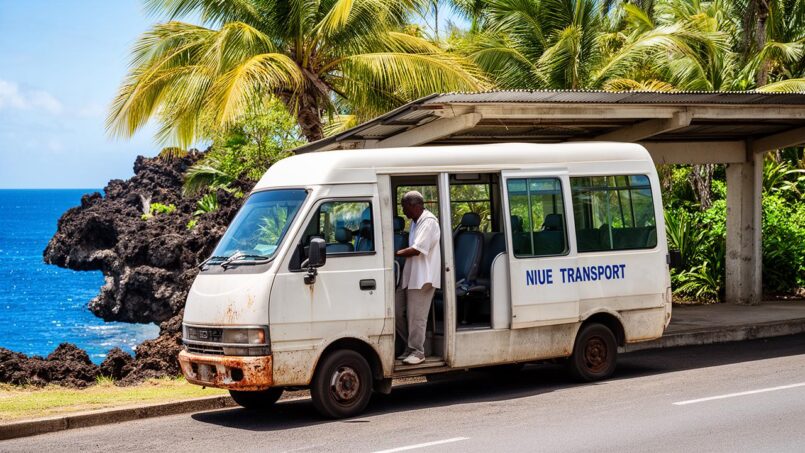
Niue does have the beginnings of “public transport”: a few private minibuses used primarily for school transportation, and, depending on the season, a chauffeur-driven taxi service organized by car rental companies. But this remains marginal, irregular, and certainly not sufficient to base your entire stay on.
For a visitor, the consequence is clear: you must organize your own transportation and, above all, do not arrive at Hanan International Airport expecting to find a bus or a waiting taxi.
From the Airport to Your Accommodation: The Most Critical Step
The first trip to plan carefully is the one between Hanan International Airport (IUE) and your accommodation. The airport is about a five-minute drive south of Alofi and about two miles (three kilometers) from the Scenic Matavai Resort, but this proximity should not be misleading: there is no public transportation at the terminal exit, and traditional taxis are rare or non-existent depending on the season.
The authorities require that accommodation for the entire stay be booked before arrival, as this information is necessary for entry formalities. This is also what allows you to arrange airport transfers in advance.
Transfers Organized by Accommodations
The vast majority of accommodations in Niue offer an airport transfer service, often included in the rate or charged at a low cost. The most common procedure is simple: when booking the room or villa, the traveler provides their flight number and arrival time, and the accommodation manager picks them up at the airport.
Upon arrival, a representative will be waiting for you in the arrivals area with a sign bearing your name. For some complexes like the Scenic Matavai Resort and its villas, a dedicated kiosk is present at the airport to facilitate your welcome. You can organize the return transfer to the airport with your accommodation, usually the day before your departure.
Several well-known establishments offer or arrange these transfers, such as Lau’s Getaway in Avatele, Stone Villas in Alofi, the Scenic Matavai Resort and its apartments, Lolani’s Retreat in Makefu, Aliutu Guesthouse in Alofi South, Aleki Guesthouse near Avatele Beach, Mahofi Cottage in Alofi, or Luta Aliutu near the airport. Even if your chosen accommodation isn’t on these lists, it is still very wise to clearly ask about it when booking.
Using a Rental Car Right After the Plane Lands
The other option is to immediately combine arrival and independence: rent a car that can be picked up at Hanan International Airport. Almost all local rental companies offer a vehicle drop-off and return service on-site, with no extra fees.
In Niue, the car rental procedure is very specific. The administration (contract, license, instructions) often happens at a temporary counter in the arrivals area. The vehicle is parked outside, in the airport parking lot or nearby. Some rental companies even leave the vehicle unlocked, with the keys inside and a booklet detailing the rental conditions in the glove compartment, along with written instructions to identify the vehicle.
For the return, no formalities are usually required: just leave the vehicle in the airport parking lot, with the keys inside. A local tip is worth taking seriously: on some newer vehicles, leaving a window slightly open prevents the car from automatically locking with the keys inside.
Private Transfer Services
Beyond accommodations and rental companies, private transfer platforms also exist, such as TaxiTransfers.Me or B2B providers like FX‑Port which cater more to travel agencies. They operate on the classic model: online booking, vehicles ranging from sedans to minibuses, a driver waiting in the arrivals area, baggage assistance, and possible options (child seat, wheelchair, etc.). In the context of Niue, this type of service remains marginal and primarily aimed at organized groups.
Renting a Vehicle: The True “Backbone” of Transportation
In the absence of public transportation, vehicle rental becomes, in fact, the primary transportation system for visitors. Tourism authorities and specialized guides are unanimous: renting a car is the easiest, fastest, and often ultimately the most economical way to explore the island.
A Well-Established Network of Rental Companies
Despite the island’s small size, the rental offerings are surprisingly diverse. You’ll find names like Alofi Rentals, Niue Rentals, Niue Rock Rentals, Niue 4×4 Rentals, Heahea Rentals, Denzel Car Rentals, Gasma Auto Rentals, Ilenas/Ilena’s Rentals, Lotouli Rentals, or Riderz Rental. Some, like Lotouli Rentals, claim 24/7 online operation and an excellent service reputation.
The types of vehicles offered range from small city cars to 4x4s, including family sedans, people movers, and even minibuses like the Nissan Caravan or Toyota Hiace for groups. In practice, a 4×4 is not essential for most visitors, as most sites are accessible via paved roads. However, it can offer extra comfort on some tracks on the east coast.
A summary of the main types and price ranges gives an idea:
| Vehicle Type | Example Models (indicative) | Daily Price Range (NZ$) |
|---|---|---|
| Small City Car | Mazda Demio, Nissan Note, Toyota Passo, Toyota IST | 50 – 60 |
| Compact / Mid-size Car | Suzuki SX4, Toyota OPA, Toyota Wish, Nissan Wingroad | 60 – 100 |
| SUV / 4×4 | Toyota RAV4, Mitsubishi Pajero, Kia Sportage | 65 – 125 |
| Minibus / People Mover | Mazda MPV, Toyota VOXY, Toyota Estima, Nissan Caravan | 85 – 200 |
| Motorcycle / Scooter (125 cc approx.) | Suzuki GN125 or equivalent | 45 – 55 |
| Regular Bicycle | Mountain bike or hybrid bike | ~20 |
| Electric Bicycle (e-bike) | Various electric-assist models | ~50 |
Weekly rates often include a free day, which reduces the average daily cost for a multi-day stay.
Rental Conditions and Local License
One important particularity sets Niue apart from other destinations: it is legally mandatory to hold a Niuean driver’s license to drive any motorized vehicle (car, scooter, motorcycle). Visitors may briefly drive with their foreign license upon arrival but are required to convert it quickly.
To convert your national driver’s license to a local license in Niue, go to the Alofi Police Station, the only one on the island. The procedure is simple: present your national license, have your photo taken, and pay a fee of about 22.50 NZD (some sources mention 11.30 NZD, but the 22.50 NZD rate is most commonly cited). The local license, valid for one year, makes for a genuine souvenir of your trip.
The minimum age rules for renting are standard: most rental companies require at least 21 years, sometimes more depending on the vehicle category. A Visa or MasterCard credit card is almost always required, with a refundable deposit typically ranging from 300 to 500 NZD. Some apply a card fee of around 3 to 5% of the amount.
In most rentals, insurance is not included in the base rate. The contract includes a significant deductible in case of damage. It is possible to reduce this deductible through daily paid options (e.g., 10, 15, or 25 NZD per day). In an island context with a limited road network and risks like potholes, dogs, or coral stones that can surprise you, it’s essential to take the time to read the insurance conditions carefully.
Fuel, Gas Stations, and Driving Rules
The island has very few gas stations: only one according to some sources, two according to others. In any case, you won’t find a pump in every village, and fuel prices are high: over 3.50 NZD per liter for gasoline, about 3.70 NZD for diesel. Rental contracts require returning the vehicle with a full tank, otherwise an additional charge applies.
On the road, driving is on the left, on a fairly simple network: a large 64 km (40 mi) coastal ring road, cross roads to the eastern villages (Lakepa, Liku, Hakupu), and a myriad of tracks leading to plantations, the forest, or sea access points (sea tracks). Most main roads are paved; tracks to the sea and bush paths are often dirt or raw coral.
The speed limits are modest, which contributes to safety and the “cool” aspect of local driving:
| Area | Official Speed Limit |
|---|---|
| Within 50 m of schools | 12 mph (20 km/h) |
| Congested areas | 12 mph (20 km/h) |
| Villages (“40” signs) | 25 mph (40 km/h) |
| Roads outside villages (main road) | 37 mph (60 km/h) |
Locals emphasize the importance of driving calmly: not only for the safety of children, pedestrians, and cyclists, but also to have time to avoid potholes, chickens, and dogs that cross without warning. A road sign sums up the local atmosphere quite well: “keep calm and be nice.”
Violations, Safety, and Best Practices
The road code in Niue essentially follows New Zealand rules: right-of-way, respecting stop signs, no parking on yellow lines in Alofi, no U-turns in certain places (especially near government buildings), and the obligation to stop at stop signs. Wearing a seat belt is not legally mandatory but strongly recommended, as is wearing a helmet on a bicycle (mandatory on a motorcycle, advised on a bicycle).
In case of an offense, the police generally treat the matter with a ticket rather than as a criminal offense, and the fine amounts indicate the seriousness taken.
| Offense | Indicative Amount (NZ$) |
|---|---|
| Driving without a Niuean driver’s license | 150 |
| Speeding (depending on excess) | 75 – 300 |
| Dangerous driving or riding | 125 |
| No valid Warrant of Fitness | 50 |
| Failure to give way / not yielding | 75 |
The driver has 15 days to pay the fine, request a clemency hearing, or contest it in the Niue court. There are also rules on drunk driving, with a legal limit of 35 micrograms of alcohol per 100 ml of breath or 70 milligrams per 100 ml of blood.
Emergency services can be reached by dialing 999, the police at 4324, and Niue Foou Hospital at 4100. Given the island’s isolation and the presence of only one hospital, authorities strongly recommend travel insurance that includes medical evacuation, especially if you plan to rent a motorcycle or scooter.
Taxis, Pseudo-Taxis, and What Remains of Them
Talking about “taxis” in Niue is misleading. A taxi service in the classic sense – multiple vehicles, wide availability, possibility of hailing a car on the street – does not exist. For a period, a service operated by one person and one vehicle functioned, but it has been stopped.
Chauffeur-driven transport options available on the island, organized by rental companies.
Occasionally offers chauffeur-driven trips by reservation, depending on demand and availability.
Provides a vehicle with a driver, but schedules are variable and unreliable for an entire stay.
Travel guides sometimes mention a local number for a certain Brian, responsible for shuttles between Alofi, a supermarket, the Bond Store, and the Scenic Matavai Resort, but these services are sporadic and should not be considered guaranteed.
For a budget-conscious visitor, it is sometimes suggested to use “public transport rather than taxis” in a typical budget calculation… even though there are no real public transportation services. In practice, this mainly means turning to bicycles, e-bikes, or walking, and possibly sharing a rental car with other travelers.
Bicycles, E-Bikes, and Walking: The Unofficial “Public Transportation”
For lack of buses and trains, bicycles and walking become, in a way, the most accessible transportation system for everyone. The island is well-suited for it: very gentle terrain (highest point 226 ft / 69 m above sea level), almost no traffic, roads that are fairly safe despite potholes, and many marked trails.
Renting a Bicycle or E-Bike
Regular bicycles and mountain bikes are available for rent from several operators, sometimes dive centers or activity providers like Niue Blue, located next to the Scenic Matavai Resort. Rates remain attractive: about 20 NZD per day for a regular bicycle, 50 NZD for an electric bicycle.
E-bikes have found their place in Niue. A specialized rental company offers a dedicated fleet, supplemented by a few models with other operators. For a traveler who wants to avoid a car but is apprehensive about long distances, electric assistance transforms the experience: the 40-mile (64 km) loop becomes doable without being an athlete, and small climbs are tackled without exhausting yourself under the tropical sun.
To give an idea of non-motorized options:
| Mode of Transport | Estimated Daily Cost (NZ$) | Main Advantages |
|---|---|---|
| Regular Bicycle | ~20 | Cheapest, very flexible, no fuel cost |
| Electric Bicycle (e-bike) | ~50 | Less tiring, faster, still no gas |
| Walking | 0 | Free, perfect in Alofi and some villages |
Some travel budget estimates for Niue allocate a local transportation cost of about 15 NZD per day for an “economical” approach, which in practice assumes using bicycles and walking more than renting a car.
A Network of Tracks and Loops Unique in the Pacific
Beyond simple utility for getting from your lodging to the supermarket, cycling opens up a real playground. Over 105 miles (170 km) of cycling loops are identified, combining secondary roads, plantation tracks, and bush paths. Five major loops are notably marked on tourist maps:
| Route (Loop) | Main Area | Estimated Walking Duration (full loop) |
|---|---|---|
| Fuata Road Bike Trail (Trail 1) | Avatele | ~2 h 30 |
| Keleola Bush Road Bike Trail (Trail 2) | Alofi | ~4 h 30 (with shorter variants) |
| Makefu Bush Road Bike Trail (Trail 3) | Makefu | ~1 h 30 |
| Falepipi Bush Road Bike Trail (Trail 4) | Tuapa | ~4 h |
| Vinivini Bush Road Bike Trail (Trail 5) | Huvalu Forest | ~3 h |
These trails are intended for both mountain bikers and hikers. The scenery alternates between taro plantations, tropical forest, clearings, and peaceful villages. Many cross the coastal road, allowing for detours to the famous sea tracks giving access to natural pools, chasms, and caves.
Walking and the “Sea Tracks”: A Form of Transport in Its Own Right
In Niue, you also get around on foot, but not just to run errands. The island is crisscrossed by trails to the sea, identified by blue “Hala Tahi” signs, leading to spectacular sites: Limu Pools, Matapa Chasm, Talava Arches, Avaiki Cave, Avatele Beach, Togo Chasm, Anapala Chasm… These access points are so numerous and well-marked that they become a real transportation network for those staying nearby.
For example, in the Alofi region, several sea tracks (trails leading to the sea) are accessible within a few minutes’ walk from the road: Vaila, Togalupo, Omahi, Houme, Utuko, Togalahi, Kalaone, Opaahi, and Amanau. On the west coast, other iconic trails lead in 30 seconds to 30 minutes of walking to swimming and snorkeling sites. On the east coast, wilder tracks cross the forest before reaching isolated chasms (coastal sinkholes).
In the villages of Alofi, Tamakautoga, and Avatele, where shops, cafes, beaches, and some activities are clustered, walking is a sufficient daily means of transportation, provided you choose a well-located accommodation. It is, in essence, the equivalent of Niue’s “pedestrian public transport.”
Guided Tours, Restaurant Shuttles, and Other Occasional Transport
Even without a bus network, there are some structured services that include transportation. They don’t replace a car on a daily basis but can meet certain needs.
Guided Tours with Transportation Included
A few operators offer group excursions, with pick-up by vehicle from Alofi or the Scenic Matavai Resort. Explore Niue, for example, organizes tours like the “Island Discovery Tour” or “East Coast Tour,” which serve as both a general orientation to the island and a way to visit sites that are difficult to link without a car.
Ebony Rainforest Tours, based in Hakupu, includes transfer from Alofi or your resort. This offer is convenient if you don’t want to drive, but it’s essential to book early as spaces are limited and tours fill up quickly.
Restaurant Shuttles
A more original system exists on certain evenings: shuttles coordinate trips between accommodations and certain restaurants, particularly around the Scenic Matavai Resort. The idea is to allow guests to go out for dinner without getting behind the wheel again, an important point on an island where drunk driving is an official concern.
This service is not a “night bus” in the strict sense, but it functions somewhat like an evening route: schedules decided in advance, rounds of accommodations, serving several restaurants. Again, you need to inquire on-site with the resort or the Alofi tourist information center.
Accessibility, Travel with Disabilities, and Adapted Transport
On the issue of accessibility, Niue faces its limitations: rugged coastal terrain, numerous stairs, sometimes degraded roads, very few specific facilities. There is no adapted public transport, nor a shuttle service equipped for wheelchairs. Authorities and specialized guides emphasize one point: traveling with a trusted person capable of driving and providing assistance is almost essential for a traveler with reduced mobility.
The only accommodation adapted for people with reduced mobility is the Scenic Matavai Resort, with few rooms and some facilities. Public infrastructure is mostly unsuitable: no reserved parking, public restrooms not equipped, and very few access ramps.
In terms of mobility, the most realistic solution therefore remains renting a spacious vehicle (SUV or minivan), driven by an accompanying person with a Niuean license, combined with a choice of carefully selected activities: boat ramps at Namukulu, drive-up whale watching viewpoints, commercial areas in Alofi or the Swanson Complex near the airport, the Fale Tau Taoga National Museum with assistance. But it is clear that Niue does not currently offer an equivalent to the adapted transportation found in more populated countries.
Transportation Budgets and Money-Saving Tips
Even without buses, it is possible to control your expenses. Overall budget estimates indicate that a “comfortable” trip to Niue costs around 255 NZD per day (accommodation, food, activities, transport), while a tighter budget is around 85 NZD per day. A median budget for a one-week stay for two people is estimated at about 1,988 NZD, or 142 NZD per day, including accommodation, meals, leisure, and transport.
For the transportation component alone, several strategies can help limit the cost:
To reduce costs and environmental impact, prioritize bicycles or e-bikes for short trips and reserve a car rental only for a few days dedicated to grand island tours. Also share the rental vehicle among several travelers to significantly divide fuel and rental costs per person. Choose a central accommodation in Alofi or a village well-served by coastal tracks (sea tracks) to be able to access a maximum number of sites on foot. Finally, take advantage of free airport transfers often offered by accommodations to avoid resorting to a private taxi.
The island’s small size works in favor of savings: even by car, distances are so short that it’s hard to consume a huge amount of fuel. It’s rather the daily rental cost that weighs most on the budget.
Maritime Transport and International Access: What You Need to Know
Even though this guide focuses on land transportation, a few elements about access to Niue shed light on the overall picture. The island is only connected to the rest of the world by one airline, Air New Zealand, which operates direct flights of about 3.5 hours from Auckland. The flight schedule is limited to one or two rotations per week depending on the season, with a spectacular effect of the International Date Line: a flight leaving Auckland on a Saturday can land in Niue on a Friday, seemingly “the day before.”
The main port is the Sir Robert Rex Wharf in Alofi, used by the monthly cargo ship Southern Express (to Tonga), fishing boats, and yachts. Due to swell and shallow depth, transfer by barge from offshore anchorages is often necessary. A few cruise ships call, organizing shore excursions on chartered buses for the occasion, with no connection to regular transport.
This information puts the absence of public transportation into context: with two flights per week and a handful of boats, the volume of travelers is nothing like that of major tourist islands in the Pacific.
How to Plan Your Transportation Like a Local
To live well with this reality without public transportation, it is useful to adopt the ways of the Niueans.
The first rule is to plan. Obtaining the local license, booking the vehicle, the airport transfer, days for guided tours: all this must be thought out before or upon arrival. Don’t count on an improvised solution at the last minute.
On the island, conditions can change quickly (tropical showers, slippery tracks, potholes). It is advisable to adjust your program day by day. After heavy rain, a sea access may become impassable by car; it is then safer to park on the road and complete the journey on foot.
The third rule relates to friendliness. The absence of formal public transportation fosters exchanges: sharing a rental car with other travelers, offering a ride to a site you’re going to yourself, talking with locals to learn the condition of a track or market hours. In Niue, where custom dictates waving to every vehicle you pass, the automobile is not just a tool, it’s also a vector of social connection.
For responsible transportation use, it is essential to drive slowly, avoid parking under coconut trees, not take a small city car onto rocky tracks that are not recommended, and always consider the fragility of the environment and coastline when choosing routes.
By Way of Conclusion: A Human-Scale “Public Transportation”
Talking about public transportation in Niue ultimately means talking about an island where the notion of “in common” does not come through buses or trains, but through a circular road maintained by the villages, trails to the sea open to all, cycling loops to be shared between hikers and mountain bikers, and habits of informal ride-sharing.
In Niue, there is no public transport network or ride-hailing services. To get around, it is essential to plan ahead, rent a vehicle, and learn about local customs. This particular organization, although disconcerting for some travelers, is part of the island’s unique experience and rewards those who prepare for it.
By carefully preparing your transfers, organizing a car or bicycle rental, and taking advantage of trails and guided tours, you will have everything you need to explore the island. Not thanks to public transportation, but thanks to a human-scale mobility system, adapted to a coral rock where people still wave when passing a car on the single road that circles the island.
Disclaimer: The information provided on this website is for informational purposes only and does not constitute financial, legal, or professional advice. We encourage you to consult qualified experts before making any investment, real estate, or expatriation decisions. Although we strive to maintain up-to-date and accurate information, we do not guarantee the completeness, accuracy, or timeliness of the proposed content. As investment and expatriation involve risks, we disclaim any liability for potential losses or damages arising from the use of this site. Your use of this site confirms your acceptance of these terms and your understanding of the associated risks.

Cyril Jarnias is an independent expert in international wealth management with over 20 years of experience. As an expatriate himself, he is dedicated to helping individuals and business leaders build, protect, and pass on their wealth with complete peace of mind.
On his website, cyriljarnias.com, he shares his expertise on international real estate, offshore company formation, and expatriation.
Thanks to his expertise, he offers sound advice to optimize his clients' wealth management. Cyril Jarnias is also recognized for his appearances in many prestigious media outlets such as BFM Business, les Français de l’étranger, Le Figaro, Les Echos, and Mieux vivre votre argent, where he shares his knowledge and know-how in wealth management.





