
 Published on and written by Cyril Jarnias
Nicknamed “The Rock of Polynesia,” Niue is a massive coral block set in the middle of the South Pacific. Seen from a plane, the island seems tiny. On the ground, however, it reveals itself as a fantastic playground for sports, nature, and soft adventure enthusiasts. Rugby, netball, cricket, football, combat sports, powerlifting, as well as diving, sport fishing, hiking, cycling, and mountain biking: the range is surprisingly wide for a country of fewer than 2,000 people.
In Niue, sport goes beyond mere competition. It is deeply integrated into the island way of life, rooted in local culture, village festivals, and the marine environment. This approach makes it a representative example of the role of sport in the Pacific: an essential social bond, a heritage to preserve, and a driver for public health.
A Small State, a Great Sports Culture
Niue is one of the largest coral atolls in the world, self-governing in free association with New Zealand. The population, mostly Polynesian, is concentrated around Alofi, the capital. Despite its size, the island fields federations in many disciplines, a national sports association, and a regular presence at the Commonwealth Games and the Pacific Games.
The local sports landscape, like that of other Oceanian countries, is built on a few well-identified pillars. Rugby union often dominates widely and can hold the status of a national sport. Alongside it, one frequently finds rugby league, netball, football, cricket, strength sports (powerlifting and weightlifting), precision sports such as lawn bowls, as well as a constellation of recreational activities: volleyball, tennis, swimming, athletics, combat sports, canoeing, table tennis, or darts.
On a more institutional level, the Niue National Sports Association and the Niue Island Sports and Commonwealth Games Association (NISCGA) oversee the overall growth of sport, while each flagship discipline has its own structure: Niue Rugby Football Union, Niue Football Association, Niue Powerlifting Federation, Lawn Bowls Association, etc. For a visitor, this translates very concretely into an island where you can almost always find a field, a club, or a competition underway.
Rugby Union: The Beating Heart of Sport in Niue
Nothing tells the story of Niue’s sports passion better than rugby union. The Niue Rugby Football Union, founded in 1952, governs the discipline, affiliated with World Rugby since 1999 and a member of Oceania Rugby. The national team, sometimes called To’a Niue XV, is ranked among the “tier-three” nations but is far from being a mere symbolic participant in the region.
Score of the heavy defeat in the selection’s first match in 1983 against Fiji, despite a symbolic try scored.
Over the years, Niue has faced several nations in the area, including the Cook Islands, Tahiti, Vanuatu, and again Fiji. In 2013, the Niue XV was ranked 71st in the world, before peaking at 94th in 2020, then dropping back to around 101st at the start of 2024. The small country has never managed to qualify for the Rugby World Cup, but it has firmly established itself in the Oceanian landscape.
Some of the best Niuean players compete in New Zealand or Australia, illustrating the diaspora profile typical of Pacific archipelagos. For example, former captain Matt Faleuka played for the Northland province in New Zealand before joining the Italian club Overmach Rugby Parma. Additionally, the Niue rugby sevens team has distinguished itself on the international stage by participating in the World Sevens circuit, the Commonwealth Games, and the Pacific Games, winning a bronze medal at the latter in 2011.
On the field, rugby union is played by both men and women. It is a classic sight in Alofi or the villages: matches that attract the entire community, sometimes accompanied by the traditional war dance, the takalo, which today is as much a ceremonial performance as a vestige of the warrior past.
Rugby League: The Ambitious Little Sister
Rugby league also holds an important place in the Niuean sports landscape. The national rugby league team played its first match at the 1986 Pacific Cup against the Cook Islands, losing 22–8. It was not until 1992 that the first official victory came, a 14–0 win over Fiji.
The selection then played its first test match in 2013, narrowly losing 22–20 to Vanuatu. The following year marked a key milestone: Niue recorded its first test victory, 36–22 against the Philippines, followed in 2015 by a comprehensive 48–4 win over South Africa. In total, by the end of 2020, the record stood at 24 matches: 10 wins, 14 losses, 556 points scored, and 604 conceded. It is modest, but significant for a micro-state.
In the official International Rugby League rankings, Niue was placed 57th as of November 2025. The team regularly participates in the Cabramatta International Nines, a widely followed nine-a-side tournament among Pacific communities in Australia.
The momentum of rugby league is driven by a very active network of diaspora clubs, especially in New Zealand, where Auckland Niue Rugby League collaborates with other regional groups (Wellington, Waikato, Northland) under Niue Rugby League New Zealand. Together, they take part in a larger collective, the Pasifika Aotearoa Collective (PAC), which brings together several island nations—Niue, Tonga, Fiji, the Cook Islands, Tokelau, as well as the Māori.
The collective benefits from a partnership with the NRL club One New Zealand Warriors. This partnership includes coaching clinics, financial support, training programs, and career pathways for players of Pasifika origin in New Zealand and Niue. It materialized with the visit of representative Tony Iro to Niue to oversee coach training, a first for an NRL club on the island.
Women’s rugby league is on a similar upward trajectory. The national team made its debut at the 2003 Women’s Rugby League World Cup, then returned to the international stage in 2020 with a friendly match against Tonga at Mt Smart Stadium in New Zealand. Beyond the score, this match was marked by significant cultural work: accompanied by cultural advisor Lynn Pavihi, the players learned elements of the Niuean language and a traditional song, strengthening the link between sport and identity.
Football: A Revival Under the Niue Football Association
Football, or soccer, is one of the popular sports in Niue, although its development has been more chaotic than that of rugby. The former Niue Island Soccer Association, founded in 1960, had obtained associate member status of the Oceania Football Confederation (OFC) before having that affiliation revoked in 2021 due to inactivity.
This rupture served as a catalyst. The same year, a new governing body, the Niue Football Association (NFA), was created. The NFA immediately organized a first seven-a-side championship for men and women. The Vaiea club claimed the first two titles in these categories, a sign of local enthusiasm. In parallel, the federation relaunched communications with a new logo, designed by Niuean graphic designer Tom Jnr Misikea with government funding.
Capacity of the national stadium, Paliati Grounds, where football competitions in Niue take place.
The federation focuses on youth, partly because many parents perceive football as less risky than various rugby codes. The internet also plays a role: children follow major international championships, technical sessions, and match highlights on YouTube, fueling aspirations.
On the international front, the Niuean national team remains very inexperienced in eleven-a-side football. It has only played two official matches, at the 1983 Pacific Games in Apia, resulting in heavy defeats against Tahiti (0–14) and Papua New Guinea (0–19). Not affiliated with FIFA, Niue cannot participate in the World Cup.
The Niue Football Association (NFA) plans to amend its statutes to submit a new application for affiliation with the OFC by 2025. Its goal is to participate in the 2027 Pacific Games. To support this return, a crowdfunding campaign is being considered. This initiative is part of a broader movement to revive athletics on the island.
Football: From Village Fields to Regional Projects
Alongside institutional structuring, grassroots play is booming. Children improvise matches in parks, on rugby fields, or any available space. Futsal tournaments are gaining popularity: in 2023, Vaiea won both the men’s and women’s events, confirming its status as a stronghold of the round ball.
This revival could eventually benefit from the development programs of the OFC, such as the Just Play initiative, which has already involved nearly 500,000 children aged 6 to 18 in the Pacific since 2009. Although Niue is not currently a member, the OFC has clearly indicated that a new structure meeting the criteria could regain its place. That is what the NFA is working towards, betting on youth, but also on ties with Niuean communities in New Zealand and Australia.
Netball: The Women’s Sports Bastion
In Niue, netball holds a central place in women’s sports. The sport is played exclusively by women, particularly girls and young adults, with matches often taking place on Saturdays. The main season runs from June to August, but games can occur year-round, most often on the high school sports fields.
The popularity of netball in Niue is part of a broader trend in Oceania. In many countries in the region, the sport is considered essentially a women’s discipline and has established itself as one of the few activities where women fully occupy the sports space. In Australia and New Zealand, netball is the most practiced sport among women, and this leadership spills over into neighboring islands.
Sports context in Oceania
In this context, Niue indirectly benefits from New Zealand support, notably through training programs for coaches and referees across the Pacific. The country is also integrated into the Oceania Netball Federation. The Niue national team notably won a noteworthy victory at the 2019 Pacific Games, confirming its status as a rising force among small nations.
Beyond the competitive aspect, netball plays a crucial social role for Niuean women. Research on women’s team sports, such as the “Back to Netball” programs in the UK or social leagues in Oceania, indicates that belonging to a group, social relationships, and shared enjoyment are motivators at least as important as performance for sustained participation.
For Niuean players, netball offers this same “social capital”: a sense of belonging, a network of friends, a space for mutual support. It is also a place for cultural transmission, with specific vocabulary in Vagahau Niue. Words like “netepolo,” “pelê netepolo,” or simply “pelê” have been created to describe the game, proof that the sport has found its place in the local language.
Cricket and Kirikiti: Between Modernity and Tradition
Cricket is one of the most widespread sports in Niue, played by both men and women and considered a major pastime. The island does not have a national team affiliated with the International Cricket Council (ICC) and does not participate in major global competitions, but a 2011 article mentions the existence of a Niue Cricket Association and a local league comprising about ten village teams.
In the Niuean language, cricket is called “kilikiki.” The language has a rich vocabulary related to this discipline because a traditional version of the game, known as “ta kilikiki” or kirikiti, is played. It is an island adaptation of cricket, with simplified rules, two teams of four players, and the use of a bat and a ball.
This dual face, modern and traditional, reflects the place of cricket in the region. On an Oceanian scale, some nations have made cricket a national sport, while others almost ignore it. Niue sits somewhere in between, with strong local participation but no fully developed international structure. For a visitor, it is mainly an opportunity to discover friendly matches, often integrated into village festivals or community sports days.
Strength and Precision Sports: Powerlifting, Weightlifting, Golf, Lawn Bowls
Alongside ball sports, Niue stands out with a solid base in strength sports. Weightlifting and powerlifting have brought the island several notable medals at the Pacific Games and Arafura Games, notably thanks to athletes like Sioe Haioti, Narita Viliamu, or Sione Lolohea. The facilities, modest but effective, include several gyms spread across the island, such as Tano’s Gym in Alofi North, open 24/7, and a dedicated powerlifting gym in Amanau.
Amount in New Zealand dollars of the green fee to deposit in the honesty box of the Niue golf course.
These disciplines allow Niue to feature in a wide range of events at the Commonwealth Games: during the 2006 Melbourne edition, the Niuean delegation competed in rugby sevens, lawn bowls, weightlifting, shooting, athletics, and boxing.
Here is a summary of the main structured sports facilities on the island:
| Facility | Location | Main Features |
|---|---|---|
| Niue Golf & Sports Club (9-hole golf course) | Fonuakula, Alofi | Clubhouse, terrace, green fee via honesty box |
| Lawn Bowls Green | Fonuakula, Alofi | Only bowls green, licensed bar, weekend competitions |
| Tano’s Gym | Alofi North | 24/7 access, free entry with donation box |
| Niue Powerlifting Gym | Amanau, Alofi | Managed by the Niue Powerlifting Federation |
| Other village gyms | Mutalau, Hakupu, Avatele | Community training spaces |
| Paliati Grounds (stadium) | Paliati | Main football/rugby field, capacity ~1000 seats |
Combat Sports, Athletics, Swimming, and Other Disciplines
The sports panorama of Niue would be incomplete without the more “individual” disciplines that accompany the country’s presence at regional games. Athletics, swimming, boxing, shooting, canoeing, and table tennis are practiced, sometimes at a respectable competitive level. A sprinter like Billie Wallbridge-Paea, for example, competed in the 100 meters at the Commonwealth Games, while in swimming, athletes like Teremoana Vaiimene or Tereapii Tapoki have carried the island’s colors at the Oceanian level.
These sports benefit from a modest local base—often school facilities or a few supervised natural pools—but they are part of a broader strategy: to offer young Niueans opportunities to practice, to push themselves, and sometimes to look toward the international stage.
National competitions structure this movement. In Alofi, the swimming and athletics championships are held each year, along with national tournaments in rugby sevens, football, and netball. The high school athletics games serve as a major sports festival, with rival houses—like Pua House, crowned champion in one edition—competing in a spirit halfway between sport and rite of passage.
Water Sports: Between Tradition and High Intensity
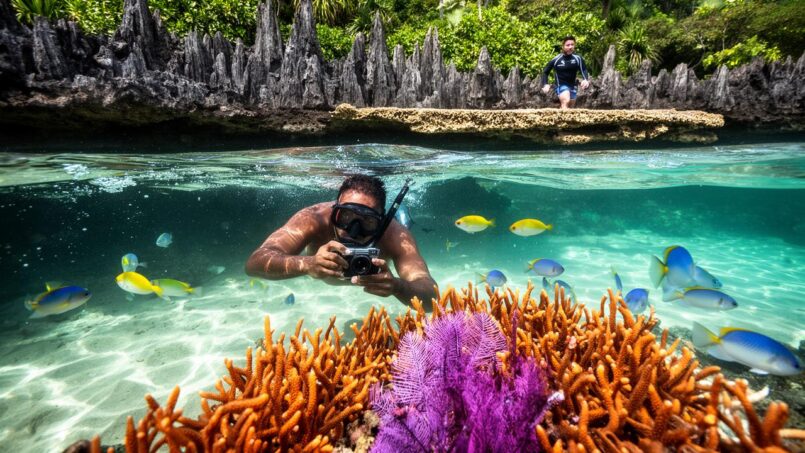
Surrounded by an ocean of crystal-clear waters, Niue could only be a land of water sports. Diving, snorkeling, swimming with whales, kayaking, fishing, and recreational free diving occupy an essential place in daily life as well as in the island’s tourism offerings.
The geographical context is unique: the island is a block of porous limestone with no rivers or lakes, which prevents muddy runoff into the sea. The result is exceptionally clear water around Niue, with visibility often between 40 and 50 meters, sometimes up to 80 or 100 meters in the best conditions. The temperature generally ranges between 25 and 28 °C, with no marked strong currents, making it a particularly welcoming environment for swimming and diving.
Diving and Snorkeling: A Life-Sized Aquarium
The coral reef around Niue, composed mainly of hard corals, drops off quickly into the deep blue. Most dive sites are only a few minutes away by boat, maximizing time underwater. Caverns, chasms, natural arches, and canyons provide a spectacular backdrop inhabited by abundant marine life: colorful reef fish, turtles, sea snakes, reef sharks (white tip, black tip, grey), schools of trevally, and sometimes large pelagics.
These sea snakes, highly venomous but non-aggressive, gather by the hundreds in caves from April to June for reproduction, creating a fascinating and surreal spectacle.
Two dive centers oversee underwater explorations, including Niue Blue (formerly Buccaneer Adventures), which offers a full range of training, from first dives to professional levels. Groups are kept intentionally small to preserve both safety and the quality of the experience.
Discover the island’s best snorkeling spots, accessible via developed coastal trails.
Natural pools and a chasm bathed in light, offering a unique experience. Check tide and safety conditions.
Sea cave and secluded beach, remarkably beautiful sites for exploring marine life.
Reef and spectacular rock formations, regularly cited among the island’s most impressive spots.
Sport Fishing: A World-Class Spot
On the fishing front, Niue enjoys a reputation as a “world-class” destination. The underwater topography means that very deep waters are only a few hundred meters from the coast. At Sir Roberts Wharf in Alofi, boats are lifted into the water by crane due to the rocky coast, and fishing begins almost immediately.
The open sea is rich in sought-after pelagic species: wahoo, yellowfin tuna, mahi-mahi, marlin (black, blue, striped), dogtooth tuna, giant trevally, sailfish, Pacific barracuda, skipjack, rainbow runner, snapper, and jobfish. Several local operators—Fish Niue Charters, Niue Wahoo Fishing Charters, Niue Fishing Charters, Gone Fishing Niue, Sea Turtle Charters, Niue Sport Fishing Charters, Niue Charters/Horizon, Teresa’s Charters, and smaller operators—offer 3- to 5-hour trips, often focused on low-light periods (dawn, dusk).
The gear provided is typically Shimano and rigged to IGFA standards. Trips can combine different techniques: trolling, jigging, casting, or bottom fishing. Regarding catches, the most common policy is that the majority goes to the operator, who redistributes it to local establishments like Vaiolama Café, Fana Café, or Washaway Café. However, anglers are usually offered a piece for their own dinner. For spearfishing enthusiasts, some operators also organize specific trips, with the possibility of bringing your own equipment.
Swimming with Whales and Dolphin Watching
Between mid-year and the austral spring, humpback whales pass through Niue’s waters, often visible from the coast. Supervised whale watching trips, sometimes with regulated in-water encounters, offer a rare experience: being in the water at a controlled distance in the presence of these curious giants.
Spinner dolphins are present year-round around the island and regularly cross paths with dive and fishing boats. Some companies, like Explore Niue, offer trips combining observation, snorkeling, and sometimes interaction with these cetaceans, depending on animal behavior and sea conditions.
Hiking, Cycling, and Mountain Biking: The Island as an Adventure Playground
On land, Niue increasingly attracts travelers seeking “active holidays.” The terrain, mostly flat—the highest point is only 69 meters—lends itself well to exploration on foot or by bike. But make no mistake: the tropical heat, humidity, and nature of the terrain quickly turn a leisurely stroll into real physical exercise.
Coastal Walks and “Sea Tracks”
All around the island, over 30 marked trails lead to caves, chasms, arches, coral pools, or small sheltered coves. These sea tracks are sometimes very short—a 30-second descent like at Hikutavake or Avatele—sometimes longer and more physical, like the access to Togo Chasm from the Huvalu Forest, which requires up to 45 minutes of walking through the forest and then along the cliff.
Hikes last from 1 to 45 minutes. Some starting points, especially on the east coast, require an access walk of about 20 minutes on unpaved track. The terrain can be rocky, uneven, or slippery: plan for good mobility and closed shoes. Many trails are equipped with clean restrooms, fresh water showers, and information boards.
The most striking sites, such as Matapa Chasm (formerly a bathing pool reserved for traditional kings), Avaiki Cave, Talava Arches (former lookout post), Limu Pools, or Anapala Chasm (former main freshwater source for the village of Hakupu), combine natural, historical, and sporting interest. For more experienced hikers, longer routes circle entire biking trails, such as the Falepipi Bike Trail (about 20 km) or the Vinivini Bike Trail (13.5 km).
Cycling and Mountain Biking: “Round the Rock”
For those who like to pedal, Niue is often described as a “cyclist’s paradise” in the Pacific. The main road, a coastal ring of about 64 to 68 km, allows you to ride completely around the island in a good half-day, between 4 and 5 hours depending on fitness and breaks. Traffic is extremely light, and speed limits are low, which enhances the feeling of safety.
The maximum length, in kilometers, of the network of bush roads passable by bike in Niue.
Five official loops, fully signposted, structure cycling:
| Official Bike Track | Approximate Distance | Main Area Covered | Estimated Cycling Time |
|---|---|---|---|
| Bike Track 1 – Fuata Road | 11.5 km | Avatele, Matavai Resort, plantations | ~30–60 min |
| Bike Track 2 – Keleola | 21 km | Alofi, bush road towards Makefu | ~1.5–2 h |
| Bike Track 3 – Makefu | 7.5 km | Village of Makefu and surrounds | ~30–45 min |
| Bike Track 4 – Falepipi | 20 km | Tuapa, northwest coast | ~1.5–2 h |
| Bike Track 5 – Vinivini | 13.3 km | Huvalu Forest, Liku, Hikulagi sculptures | ~1–1.5 h |
All these loops combine quiet coastal roads and 4×4 tracks through plantations, forest, or villages. Some sections are starting to become overgrown with vegetation, so it’s worth asking at the Visitor Information Centre in Alofi, where paper maps and updated advice are available.
One favorite route is connecting Alofi to Avatele and back, a coastal loop of about 26 km, ideal for a few hours’ ride including a swim.
Bike Rentals and Practical Tips
Several operators rent bikes on the island, from standard mountain bikes to electric bikes. The Alofi tourist information center lends or rents mountain bikes, Niue Blue (in Tamakautoga) offers pushbikes, Freedom Bikes delivers e-bikes directly to accommodations, while Niue Rentals adds bikes to its vehicle rental offering. Some accommodations, such as Namukulu Cottages or Kaliki Lodge, provide bikes free of charge, even a tandem.
In a tropical climate, cycling effort is amplified by heat and humidity. Adapt your outings by planning shorter routes than in a temperate climate. Always carry sufficient water reserves, not relying on uncertain supply points. Avoid riding at night due to very limited street lighting. If chased by stray dogs, stop and dismount rather than trying to flee. Although not mandatory, wearing a helmet is highly recommended.
For those bringing their own bike, Air New Zealand—the only airline serving Niue from Auckland—accepts bicycles as checked baggage, provided they are packed in a cardboard box or travel bag. Boxes can be purchased directly at Auckland Airport.
Rally of the Rock: The Year’s Cycling Event
Every year, the long Queen’s Birthday weekend features a major cycling event now known as “Ride the Rock,” after having been called “Round the Rock” or “Rally of the Rock.” The event includes a race of about 60 km around the island, supplemented by speed trials on bush roads. The atmosphere is both competitive and friendly, and the peloton happily mixes locals, Niueans from the diaspora, and visitors who come specifically for the occasion.
Traditional Games: When Sport Becomes Living Heritage
Beyond Olympic or near-Olympic disciplines, Niue cultivates a heritage of traditional games rich in cultural meaning. These practices, long confined to villages, are experiencing a revival, notably through the “Village Games” movement and initiatives by the diaspora in New Zealand.
Toho Toume: Coconut Skiing
Among these games, Toho Toume (also spelled To’o Toume or Toho Tohume) is undoubtedly the most emblematic. It is often described as “Niuean land skiing.” The principle is simple: a “skier” balances on a curved piece of coconut palm called a toume—the rigid sheath that envelops coconut flowers—while two runners pull him at full speed using a long stick. The race takes place on a more or less prepared field, and the goal is to cross the finish line without falling. Both men and women can take part, and the atmosphere evokes competition as much as carnival.
The traditional Niuean game, toume, is used as an educational tool in New Zealand schools to teach the language and culture of Niue. Due to the scarcity of materials needed to make it outside the island, educators have developed versions using recycled materials, allowing its symbolic dissemination.
Sika, Niu Fola, Takalo, and Other Ancestral Games
Other traditional games complete this sports heritage. Sika, for example, resembles a form of javelin throwing: participants throw a stick (the sika) as far as possible, sometimes stuck into a lime to evoke the shape of a spear. The game of Niu Fola (or Ola Fiu Niu) is played with coconuts used as balls. Takalo, originally a war dance performed before combat, is now performed during ceremonies, sports events, or official visits, often with a welcoming version where a green coconut is offered to a guest of honor.
Traditional games and rituals, beyond their cultural aspect, are used as tools for public health and social cohesion. Programs like that of Healthy Families South Auckland, in collaboration with Niuean teachers, employ them to promote physical activity, combat non-communicable diseases, and strengthen cultural ties within Niuean diaspora communities.
A Sports-Focused Island Looking to the Future
On a Pacific scale, Niue rarely makes headlines. Yet its sports density, its inventiveness, and its ability to integrate tradition, performance, and active tourism make it a unique case. In rugby union and league, netball, football, and powerlifting, the island fields teams that are not afraid to face much more populous nations. In the water, it rivals the best diving and sport fishing destinations in the world, with added rare encounters with whales and dolphins.
For sports travelers, Niue offers a varied palette of activities: golf with ocean views, cave diving, rainforest cycling, and rugby or netball spectacles. Immersion continues with participation in traditional games and community meals (umu). The sports spirit is omnipresent, often allowing visitors to join a local team or share a memorable fishing outing, making each experience an authentic human adventure.
Disclaimer: The information provided on this website is for informational purposes only and does not constitute financial, legal, or professional advice. We encourage you to consult qualified experts before making any investment, real estate, or expatriation decisions. Although we strive to maintain up-to-date and accurate information, we do not guarantee the completeness, accuracy, or timeliness of the proposed content. As investment and expatriation involve risks, we disclaim any liability for potential losses or damages arising from the use of this site. Your use of this site confirms your acceptance of these terms and your understanding of the associated risks.

Cyril Jarnias is an independent expert in international wealth management with over 20 years of experience. As an expatriate himself, he is dedicated to helping individuals and business leaders build, protect, and pass on their wealth with complete peace of mind.
On his website, cyriljarnias.com, he shares his expertise on international real estate, offshore company formation, and expatriation.
Thanks to his expertise, he offers sound advice to optimize his clients' wealth management. Cyril Jarnias is also recognized for his appearances in many prestigious media outlets such as BFM Business, les Français de l’étranger, Le Figaro, Les Echos, and Mieux vivre votre argent, where he shares his knowledge and know-how in wealth management.





