
 Published on and written by Cyril Jarnias
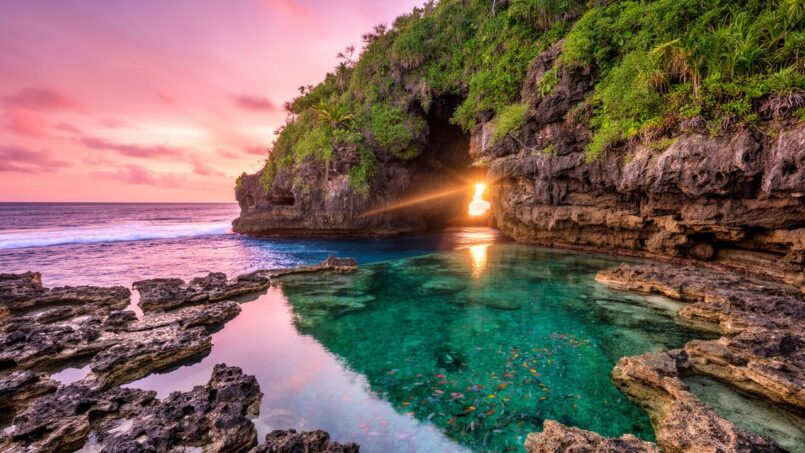
Halfway between the Cook Islands, Tonga, and Samoa, Niue has all the makings of a movie set… without the crowds, the glitzy resorts, or the shopping malls. This small raised coral atoll, nicknamed “The Rock of Polynesia,” packs onto 100 square miles a coastline of jagged limestone cliffs, pristine rainforest, spectacular caves, and a lagoon of almost unreal clarity. You don’t come here to lounge on miles of white sand, but to descend dizzying chasms, squeeze through limestone arches, walk on the reef at low tide, and swim in crystal-clear natural pools where tropical fish seem to float in mid-air.
The island of Niue is primarily explored via a single, roughly 48-mile circular road, at a leisurely pace. It connects the villages and taro fields. To reach the remarkable natural sites (caves, pools, arches, hidden beaches), you must take access trails to the sea called “sea tracks.” These short walks, from 30 seconds to 45 minutes, lead to some of the island’s most beautiful tourist spots.
Understanding Niue Before Setting Out to Explore
Niue’s natural landscape is the result of a unique geological history. The island is a massive block of coral limestone resting on an ancient extinct volcano. Rainwater seeps into the porous rock, disappearing into a vast network of caves; thus, there are no rivers or lakes on the surface. This base, carved by the waves, has given birth to hundreds of caverns, arches, and chasms—those spectacular marine faults where the sea forms deep pools between steep walls.
This is the exceptional visibility in meters offered by the clear waters around certain areas of the island, a paradise for underwater activities.
The population, approximately 1,500 to 1,600 inhabitants, lives scattered across a handful of villages, with Alofi as the main center. Crime is virtually nonexistent, the atmosphere is communal, and the welcome extended to visitors is intimately linked to the concept of “Taoga Niue,” the cultural and natural heritage that the inhabitants are keen to preserve. It is within this framework that the island’s must-see sites are discovered.
The Iconic Chasms: Niue’s Mineral Cathedrals
One of Niue’s most striking features is the succession of chasms – deep rock fissures where, after often steep walks, you access natural pools of fresh or saltwater. Several of them are considered essential stops.
Matapa Chasm, the Royal Pool
In the northwest, near the village of Hikutavake, Matapa Chasm stretches out like a turquoise water corridor framed by dizzying cliffs, about ten meters high. Historically, this pool was reserved for the bathing of Niue’s kings, which speaks to its exceptional character.
Access to this cove is via a shaded trail of about seven minutes through dense vegetation. The seawater, sometimes mixed with freshwater seeping from the walls, is remarkably clear. The site, protected from the swell by its sunken configuration, allows for peaceful swimming. The wildlife, consisting of reef fish, crabs, and sometimes turtles, completes this idyllic picture.
Anapala Chasm, the Stairway to Freshwater
In the east, near the village of Hakupu, Anapala Chasm plunges into the heart of the limestone. Access is via a staircase of approximately 146 to 155 steps, carved into the wall. At the bottom, a large basin of freshwater awaits visitors. This clear pool was once a vital source for the inhabitants, who drew their daily water from it.
Today, it’s possible to swim or gently snorkel in this chasm, surrounded by walls covered in moss and roots. The experience is marked by the striking contrast between the tropical heat on the surface and the cool shade of the depths.
Togo Chasm, the Beach Hidden in the Rock
Also on the east coast, in the Huvalu Forest Conservation Area, Togo Chasm is among Niue’s most spectacular outings. You reach it via a 20 to 45-minute walk through a tropical forest, before emerging onto a landscape of sharp coral pinnacles and cliffs battered by the swell.
At the edge of the reef, a staircase and a tall wooden ladder allow you to descend into a narrow fissure. At the bottom, a surprise: an “inner beach,” with white sand, palm trees, and a pool fed by the sea, sheltered from the waves. This enclave, once associated with the island’s chiefs, feels like it was custom-sculpted for an adventure film.
To best plan the discovery of these chasms, it’s useful to compare some practical data.
| Site | Location | Water Type | Walking Access (approx.) | Special Features |
|---|---|---|---|---|
| Matapa Chasm | Hikutavake (northwest) | Seawater | 7 min | Former royal pool, protected from swell |
| Anapala Chasm | Hakupu (southeast) | Freshwater | 15 min + 146–155 steps | Former village water source |
| Togo Chasm | East coast, Huvalu forest | Seawater | 20–45 min | “Inner beach” at the bottom of a rocky corridor |
Caves, Arches, and Caverns: The Kingdom of Limestone
Niue is often described by European speleologists as one of the most spectacular cave systems in the South Pacific. Here, the coral rock has been dissolved, sculpted, and hollowed out over millennia by rain, waves, and variations in air pressure, giving birth to a multitude of cavities.
Avaiki Cave, Between Legend and Natural Pool
On the west coast, at Makefu, Avaiki Cave concentrates Niue’s history and geology in one place. The name Avaiki refers to Hawaiki, the mythical homeland of the Polynesians. Local tradition holds that the first Polynesian settlers’ canoe landed here. For a long time, this site of strong symbolism was accessible only to high dignitaries.
The sea cave is accessible and safe only at low tide, offering an intimate experience. At high tide, the swell floods the cavity, making the site dangerous.
Talava Arches, Niue’s Mineral Emblem
Also in the northwest, along a sea track starting from the village of Hikutavake, the Talava Arches are among the island’s most photographed landscapes. After a walk of about 30 to 40 minutes over uneven coral terrain and through vegetation, you first enter caves adorned with stalactites, before emerging into a massive rock collapse.
In the center of this natural “well”, two large limestone arches span the turquoise water. One of them measures about thirty meters long, with sheer walls over 15 meters high. At low tide, you can cross the reef to find yourself under these stone bridges and snorkel in a channel filled with corals and fish.
Palaha Cave, a Limestone Setting with Changing Colors
A bit further south, near Tuapa, Palaha Cave offers another facet of Niue’s underground heritage. Access is via a short trail and then sometimes slippery rocks, especially at low tide. Inside, several chambers follow one another, adorned with concretions in green and red hues, fed by minerals filtering through the rock.
At the entrance, there is a small pool where the sea invites itself in. Some Niueans describe Palaha as an illustration of what cave dwellings were like before the introduction of Western-style houses: a dry, ventilated shelter, safe from cyclones.
To navigate this abundance of caverns, a second table highlights some major sites.
| Cave / Arch | Village / Coast | Sea Track Duration (approx.) | Highlights |
|---|---|---|---|
| Avaiki Cave | Makefu, west | 5 min | Sea pool in a historic cave |
| Talava Arches | Hikutavake, N-W | 30–40 min | Large limestone arches, snorkeling at low tide |
| Palaha Cave | South of Tuapa, west | 5–10 min | Colorful concretions, pool at entrance |
Other caves, like Ulupaka Cave or Makatea Cave, often require a guide, especially when venturing into the deep, dark parts. A flashlight and shoes with good grip are essential: the rocks can be very slippery, especially when the surf sends spray into the cavities.
Natural Pools and Reef Pools: A Snorkeling Paradise
Unlike other tropical islands, Niue is not fringed by long sandy beaches and enclosed lagoons. Here, you swim mainly in natural pools, chasms, and protected coves carved into the reef. Several sites have become true classics for snorkeling.
Limu Pools, the Natural Aquarium
On the northwest coast, Limu Pools is a collection of rocky basins connected to the ocean by discreet passages. The sea track leading there, about five minutes long, opens onto a landscape of translucent pools separated by limestone blocks. Sheltered from the swell, these pools are ideal for safe swimming, even for the less experienced.
This basin is home to many tropical fish and colorful corals. A ladder on a rocky outcrop provides access to a second basin equipped with an underwater arch for experienced swimmers. The water may appear milky at certain times due to the mix of seawater and freshwater filtering through the rock.
Hio Beach, the Secret Cove and Its Cave
Further south, towards Tuapa, Hio Beach is a small sandy cove framed by coral formations. A sea track of about five minutes provides access, and a café-bar overlooks the beach, ideal for extending the day.
At low tide, by following the coast northward, you can enter a sea cave where shafts of turquoise light filter through. The surrounding reef, with its hollows and tide pools, is perfect for exploration on foot, wearing reef shoes. This is also where a Peruvian ship, the ‘Irole’, was wrecked in 1877, an episode often recounted in local stories.
Local Coastal Stories
Tamakautoga and Avatele: The Rare Swimming Beaches
In the southwest, Tamakautoga Beach and Avatele Beach are among the few beaches where you find a more classic stretch of sand combined with good swimming conditions. At Avatele, the reef accessible at low tide allows you to discover corals and fish, while a very particular washaway café opens only on Sundays, making the beach a weekly gathering point.
Snorkeling enthusiasts also find excellent conditions at Namukulu, Tautu Reef, or along the north coast near the Hikutavake Pools. In all cases, tide and weather play a crucial role: most sites are ideally visited at low or falling tide, when the waves are less strong and the currents remain manageable.
A third table allows you to visualize some of the main swimming and snorkeling spots.
| Site | Type of Place | Approximate Ideal Tide | Main Asset |
|---|---|---|---|
| Limu Pools | Natural pools | Mid-rising – High tide | Easy snorkeling, protected setting |
| Hio Beach | Small beach + cave | Around low tide | Warm pools, accessible sea cave |
| Avatele Beach | Beach + reef | Low to mid-tide | Reef walk, family-friendly swimming |
| Tamakautoga | Local beach | Low tide | Village atmosphere, tranquil swimming |
| Hikutavake Pools | Reef basins | Around low tide | Two large pools fringed with coral |
Huvalu Forest and Inland Trails: Niue’s Other Face
While the coastline concentrates most of the iconic tourist sites, the island’s interior is well worth exploring. On the east coast, the Huvalu Forest Conservation Area covers nearly one-fifth of the territory, about 13,300 acres of preserved tropical forest.
In this protected area, no animal or plant is venomous or dangerous, a particularity that makes hiking more serene than in many other tropical jungles. You’ll find ancient trees, a rich plant pharmacopoeia used for traditional medicine, and the spectacular Niue flying fox, a large fruit bat that participates in pollinating many species.
Discover the trails and attractions of this forest through marked routes and a unique sculpture park.
A marked trail that runs through the forest, ideal for hiking.
A trail accessible to mountain bikes and hikers, starting from Liku village to join the circular road.
An outdoor sculpture park where artists, like Mark Cross, create monumental works from reclaimed objects.
Here again, distances remain modest but the atmosphere changes radically compared to the coast: you walk under dense vegetation cover, accompanied by the buzz of insects and bird calls, discovering along the way cultural remnants like the Laufoli Umu Pit, a traditional earth oven pit linked to the legend of a warrior who is said to have taken his own life in an umu, an underground oven.
Sea Tracks: Gateways to the Reef
The key to fully enjoying Niue’s natural wonders is the sea tracks. This network of marked trails most often starts from the circular road and descends to the sea, sometimes for a few dozen meters, sometimes for a half-hour walk. They are numbered, mapped, and signposted, allowing for varied explorations without getting lost.
Several coastal trails (sea tracks) are iconic routes: Motu, between Liku and Lakepa, leads to cliffs overlooking a reef accessible by a ladder at low tide. Tautu Reef, near Liku, descends to a large rocky arc opening onto a reef flat ideal for sunrise. Puluhiki, at Lakepa, leads to an open reef platform, perfect for exploring tide pools at low tide. The Uluvehi and Tuhia sites are also mentioned as classics.
On the west coast, Alofi’s sea tracks – Vaila, Omahi, Houme, Utuko Reef, Opaahi, Amanau and others – are strung along the coastline. Some lead to simple viewpoints, others to pools or sea caves. Vaila Sea Track, for example, leads in two minutes to rocky basins that are part of the Alofi North Marine Protected Area, a zone where the reef benefits from enhanced protection measures. Picnic tables there allow you to observe the sea in complete tranquility.
These sea tracks are mostly free and open to all, but it is imperative to respect local guidelines: stay on marked trails, do not collect corals or plants, take your trash with you, and respect signs indicating a sacred site or temporary closure (for example, during fish breeding periods).
History and Culture: When Natural Sites Tell the Past
In Niue, major natural sites are rarely dissociated from history and foundational stories. Every cave, every chasm is laden with legends, warrior or religious episodes.
Tomb Point, Between Panorama and Memory
In Alofi, by the sea facing the shopping center, Tomb Point juts out as a promontory above the bay. You’ll find a picnic area, a 180° viewpoint over the ocean, and, above all, the tombs of two former kings of Niue. A monument also pays homage to Niueans who fell during the First World War.
This very accessible site is also an excellent observation post for humpback whales during the season, which sometimes approach within about fifty meters of the shore.
Opaahi, the “Savage Island” Seen by Cook
Not far away, at Opaahi, a sea track leads to the spot where Captain James Cook attempted to land in 1774. Greeted by Niuean warriors disinclined to see their island invaded, he and his men departed, baptizing the place “Savage Island.” This episode marked minds enough to discourage other explorers from coming for nearly 80 years.
Today, the site is a peaceful place. It is notably used to shelter traditional canoes (vaka) and offers a viewpoint over the coast.
Peniamina, Mutalau and the Taue i Fupiu Fortress
In the 19th century, Nukuai Peniamina, a Niuean converted to Christianity in Samoa, returned to the island to spread the new religion. Initially greeted with suspicion, he was protected in the village of Mutalau, where the inhabitants installed him in a traditional fortification, the Taue i Fupiu Fort, on the island’s northern point.
A commemorative day, Peniamina Gospel Day, is dedicated each year in Niue to recall the importance of the religious turning point initiated by Peniamina.
Avaiki, Palaha and the Cave-Dwellings
As mentioned earlier, Avaiki Cave is charged with dual symbolism: that of the landing site of the first Polynesian navigators, and that of a bathing pool reserved for chiefs. Palaha Cave is sometimes described as a life-size reconstruction of a Niuean house before the arrival of European constructions, showing how much caves structured human habitation until the mid-1800s. Indeed, some caverns, like Anaana Burial Cave or other burial sites, also served as graves, with bones still visible in places.
The Marine Sanctuary: Whales, Dolphins, and Dives into the Blue
The ocean around Niue doesn’t just provide countless swimming and snorkeling sites. The island has self-proclaimed itself a whale sanctuary, and the cetacean migration has become one of the destination’s major attractions.
Each year, between June and October – peaking between July and September – humpback whales leave Antarctica and travel over 5,000 miles to come mate, give birth, and nurse their young in the warm waters of the South Pacific. Niue, lacking a lagoon but surrounded by dizzying drop-offs where depth quickly reaches over 1,000 feet, offers these 40 to 50-foot-long giants direct access to calm waters close to shore.
Duration in minutes of the complex melodies sung by male humpback whales, audible up to 19 miles away.
Niue is one of the few places in the world where swimming with humpback whales is permitted, but within a strict framework. Interactions are only allowed on the surface, snorkeling, without deep free-diving or scuba diving nearby. Two licensed operators – Niue Blue and Explore Niue – oversee these trips, typically 3 to 4 hours, in very small groups (around five to six swimmers per guide), with safety briefing, wetsuit, fins, and mask provided. A minimum distance of about 65 feet must be respected, and time spent with mothers and their calves is limited to reduce stress.
Niue’s waters are home to a varied marine fauna including spinner dolphins visible year-round, reef sharks, turtles, and pelagic fish like tuna or marlin. Scuba diving is practiced on remarkable sites such as Snake Gully, a coral canyon populated by anemones, trevallies, and sea snakes, and The Chimney, a vertical tunnel allowing descent from 16 to nearly 100 feet deep.
Daily Niuean Life, Between Sea, Fields, and Craftsmanship
While Niue’s landscapes first catch the eye, the experience wouldn’t be complete without a detour into local culture. In Alofi, the Fale Tau Tāoga Niue, the national museum, displays artifacts saved from Cyclone Heta in 2004, objects from the First World War, family treasures, hats from a 2005 competition, and traditional weavings. Housed on the former primary school site, it tells both the ancient history of the island – inhabited for over a thousand years by navigators from Samoa, Tonga, and the Cook Islands – and its adaptation to contemporary challenges.
The Taoga Niue represents the entirety of Niue’s cultural heritage, both tangible and intangible. It includes the language, close to Samoan and Tongan, as well as traditional practices like rites of passage (haircuts, ear piercings). It also encompasses Sunday liturgical singing and community events, the village ‘show days,’ which mix dances, feasts, sports competitions, and agricultural exhibitions.
Women play a central role in transmitting artisanal know-how. Weaving is omnipresent: baskets, hats, tablecloths, jewelry, tropical dresses… In Alofi, a group of weavers meets on Wednesday mornings at Makini Hall to pray, weave, sew, and exchange village news. You can buy unique pieces there or visit the Tahiono Art Gallery, a gallery founded in 1995, which highlights Niuean artists or those associated with the island, like painter Mark Cross or hiapo artist John Pule. Hiapo, a decorated tapa with very detailed plant motifs, is experiencing a revival, between tradition and contemporary creations.
The traditional vaka canoe, shaped by master carvers, is experiencing renewed interest despite motorized boats, thanks to its ancient design optimized for local conditions. In Tamakautoga, you can visit a construction workshop, observe schoolchildren carving model boats, or buy carved models.
In terms of flavors, Alofi’s markets – open early in the morning, especially on Tuesdays and Fridays – offer fruits, vegetables, fish, honey, nonu (Noni juice with medicinal virtues), coconut breads, and specialties like takihi (traditional preparation of taro and papaya cooked in coconut milk), povi masima, faikai ika (marinated raw fish), or coconut crab (uga) meat. An organic noni farm, south towards Vaiea, and a significant vanilla orchard near Alofi complete this agricultural landscape.
Exploring Niue by Bike and on Foot: A Human-Scale Island
With its little-traveled, relatively flat, and paved roads, Niue is an ideal playground for cycling. Five major marked loops allow you to combine bush, villages, and coasts. The Alofi Bike Trail loop, for example, starts in the capital, crosses the bush via Keleola Bush Road and Makefu Bush Road, reaches Makefu village, then returns via the coastal road past sites like Peniamina’s tomb, Vaila Cave, or Togalupo Sea Track. Allow three to four hours taking your time.
Discover the island’s main cycling routes, offering varied landscapes between forest, coast, and plantations.
A loop of about 12 miles starting from Tuapa, crossing fields and forests before reaching the coast near Matapa Chasm, Limu Pools, and Hio Beach.
A shaded route of about 8.5 miles from Liku, delving into the Huvalu Forest and passing by plantations.
Traverses the areas around Tamakautoga and Avatele in the south, running past the Scenic Matavai Resort and offering sea views.
Walkers will find more than 30 referenced routes in local guides, from the Cross Island Track, which crosses the island from Alofi to the east coast through dense jungle, to small family walks like Ekalesia Hill – a short climb offering a panoramic view – or strolls along Avatele Beach to explore the reef at low tide.
To fully enjoy the hikes, prioritize the cool season from May to October. Plan for at least 2 liters of water per person, sun protection, sturdy shoes (sandals or hiking shoes) suitable for rocky terrain, and a waterproof bag for your belongings. Check with local tourist offices, like the Visitor Information Centre in Alofi, for up-to-date maps and recommendations on trails and tide times.
An Island Without “Glitz and Glam,” But Rich with 101 Things to Do
Niue proudly claims its difference: no large hotel complexes, very few shops, only one true resort (the Scenic Matavai Resort), but a multitude of small guesthouses, limestone villas, cliffside cottages, and vacation homes nestled in gardens. Most are self-contained, with equipped kitchens, and some even include the use of a car for the duration of the stay.
The price for a double room in a Niue guesthouse can start from 50 New Zealand dollars per night.
The island’s small size, combined with the absence of mass tourism, allows for a very personal experience. You can spend a morning swimming in a deserted royal chasm, the afternoon discussing weaving with the women of Alofi, and the evening watching for whale blows from a funeral promontory. Another day will be dedicated to following sea tracks of just a few minutes each, each opening onto a different pool, a little corner of reef, a hidden cave.
In the end, the must-see tourist sites in Niue aren’t limited to a handful of ‘Instagram spots.’ They form a dense network of natural and cultural places, connected by the same coral rock that earned the island its nickname ‘Rock of the Pacific.’ From Matapa Chasm to Talava Arches, from Limu Pools to Togo Chasm, from Avaiki Cave to Tomb Point, each stop tells in its own way how a tiny raised atoll has managed to transform the absence of fine sand, lagoon, or skyscrapers into a unique travel experience, where the sea, the stone, and traditions take center stage.
Niue, nicknamed ‘Rock of the Pacific’
Disclaimer: The information provided on this website is for informational purposes only and does not constitute financial, legal, or professional advice. We encourage you to consult qualified experts before making any investment, real estate, or expatriation decisions. Although we strive to maintain up-to-date and accurate information, we do not guarantee the completeness, accuracy, or timeliness of the proposed content. As investment and expatriation involve risks, we disclaim any liability for potential losses or damages arising from the use of this site. Your use of this site confirms your acceptance of these terms and your understanding of the associated risks.

Cyril Jarnias is an independent expert in international wealth management with over 20 years of experience. As an expatriate himself, he is dedicated to helping individuals and business leaders build, protect, and pass on their wealth with complete peace of mind.
On his website, cyriljarnias.com, he shares his expertise on international real estate, offshore company formation, and expatriation.
Thanks to his expertise, he offers sound advice to optimize his clients' wealth management. Cyril Jarnias is also recognized for his appearances in many prestigious media outlets such as BFM Business, les Français de l’étranger, Le Figaro, Les Echos, and Mieux vivre votre argent, where he shares his knowledge and know-how in wealth management.





