
 Published on and written by Cyril Jarnias
Living in Niue, a small self-governing state in free association with New Zealand, is more than just buying a plane ticket to the South Pacific and finding a house with a lagoon view. Behind the postcard image, the administrative framework is dense, highly regulated, and designed first and foremost to protect a population of fewer than 2,000 people, customary lands, and a fragile environment.
Before settling in Niue, it is crucial to understand the overall framework, which links several aspects: entry conditions, temporary stay permits, permanent residence, buying or renting a home, starting a business, taxation, opening a bank account, importing personal goods, the cost of living, and the healthcare system. No single step guarantees the right to stay long-term. This article provides a structured and practical overview of the procedures to anticipate.
Entering and Staying in Niue Legally
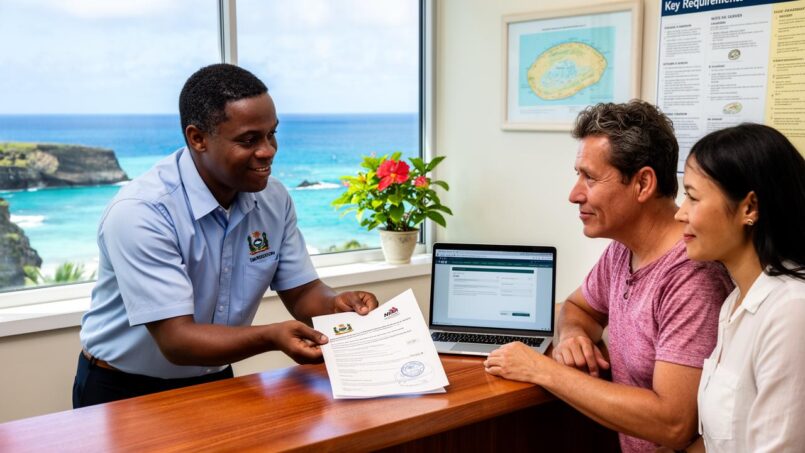
Niue manages its immigration under its own law, the Entry, Residence and Departure Act 1985. Even though all Niueans are New Zealand citizens, the visa and permit system is separate from New Zealand’s. For a foreigner, the first step is always the same: obtaining permission to come and then to stay.
Short-Term Stay: 30 Days Without a Prior Visa
For most travelers, whether coming for tourism or a short business trip, a visa is not required before departure for a stay of 30 days or less. Entry is granted via a Visitor’s Permit issued upon arrival.
In practice, the procedure relies on the passenger arrival card, filled out on the plane, which serves as the application form. However, visa exemption does not mean there are no conditions. Upon arrival, passport control systematically checks several items:
– a passport valid for at least three to six months after the date of arrival, with at least two blank pages;
– a return or onward ticket, without which boarding or entry may be refused;
– confirmed accommodation for the duration of the stay (hotel, guesthouse, rental, with relatives);
– proof of sufficient financial means (bank statements, cards, cash);
– if applicable, documents for the next leg of the journey (visa for the next country, corresponding ticket).
The 30-day visitor permit strictly prohibits work, business, and study. Any attempt to use it as a stepping stone to stay and work illegally exposes you to serious risks: refusal of renewal, classification as a “prohibited immigrant,” and removal from the territory.
Extending Your Stay Beyond 30 Days
As soon as a project exceeds one month — on-site reconnaissance, extended remote work, family stay — a stay extension or another type of visa becomes necessary. Extensions beyond 30 days are obtained from the Niue Immigration Office, based in Alofi. They are considered on a case-by-case basis.
For longer stays, Niue uses a system of temporary permits tailored to the purpose of the visit: long-term visit, employment, studies, sometimes business or specific missions. Some visas can go up to one year, sometimes renewable, but each case is individual. The government does not promise a “general immigration program”: it examines the coherence of the project, compliance with health and character criteria, and above all, the interest for the island.
The processing flow generally follows this logic: determine the type of visa needed, gather documentation (form, financial proofs, accommodation, insurance, invitation letters or employment contract), submit to Niue Immigration (often via New Zealand), then possibly an interview. Authorities recommend applying one to two months before departure, with processing time usually between 20 and 30 working days.
Temporary Permits: Sponsor, Guarantee, and Control
Living in Niue for more than 60 days requires obtaining a temporary permit and often a local sponsor. The system is based on the idea that the island can only absorb a small flow of newcomers, and that these newcomers must be “backed” by already well-established actors.
To be a sponsor in Niue, a person must meet one of the following conditions: reside in Niue, be born there with at least ten years of residence, or hold a permanent residence certificate for ten years. They must also be of sufficient age or deemed capable of fulfilling their obligations. A Niuean company can also act as a sponsor, especially for a foreign employee.
This sponsor undertakes to cover repatriation costs and guarantee payment of any debts incurred by the foreigner. In some cases, they must deposit a bond in New Zealand dollars with the Chief Immigration Officer. For a work permit, the employer must also demonstrate the absence of a suitable local candidate and the appropriateness of the foreign profile.
In parallel, the applicant must provide at least two character references, a criminal record extract, and medical certificates. Anyone wishing to reside for more than 60 days must obtain a “Niue Immigration Medical Certificate.” This certificate, issued by a doctor in the home country and sent to the Niue Health Department at least two months before arrival, must not be older than three months. Without medical clearance, chances of obtaining a long-term permit are low.
The permit may be granted for up to three years, at the minister’s discretion, and remains revocable, especially in case of fraud or non-compliance with conditions.
Obtaining Permanent Residence: A Highly Selective Path
Niue does not offer any residence or citizenship by investment program. Buying real estate or starting a business, even significant ones, does not grant resident status.
The permanent residence certificate, decided at the government level, allows indefinite stay, visa-free travel, and legal work without any other permit. However, access to this status is highly regulated, and there is no automatic right to obtain it.
Two regimes coexist in the texts:
– the Entry, Residence and Departure Act 1985 provides that a candidate must have resided continuously in Niue for at least three years under a temporary permit, prove their intention to live there permanently, present good character references, and an understanding of the rights and duties attached to the status;
– a more recent framework mentions a threshold of ten years of continuous residence under a temporary permit, referring to criteria published from time to time by the Cabinet.
In all cases, the application can only be submitted by a person already present in Niue, in a regular situation, and sometimes with a new sponsor deemed acceptable. The Cabinet is not required to provide reasons for refusals.
Another crucial point: prolonged absence results in loss of status. A permanent resident who remains outside Niue for more than three consecutive years, except for medical, study, or other predefined reasons, is deemed to have abandoned their permanent residence.
Prohibited Persons and the Risk of Irregular Stay
The law creates the concept of a “prohibited person” or “prohibited immigrant”, which covers both individuals representing a security or health risk and those violating immigration rules (serious criminal records, notifiable diseases, lack of a valid permit).
Anyone remaining on the island without a valid permit is considered illegal and is liable for deportation. Staying after a permit expires, or working without authorization, is not just a “simple administrative problem”: on the scale of such a small state, this type of behavior is quickly detected and treated as a violation of basic rules.
Working, Starting a Business, and Investing in Niue
For many expatriation candidates, the heart of the project is economic: opening a guesthouse, setting up a small tourism business, participating in an agricultural project or real estate development. In Niue, this dimension is governed by two main pillars: immigration on the one hand, and the Development Investment Act 1992 on the other, which regulates foreign investment.
Registering a Business and Obtaining Permits
Any commercial activity must be licensed and, for foreigners, registered as a “foreign enterprise” under the Development Investment Act 1992. The stated objective is twofold: to encourage development while protecting the land, the local economic fabric, and the environment.
Registering a foreign enterprise involves providing a detailed description of the structure (shareholders, directors) and a business plan. The administration assesses not only economic viability but also consistency with development priorities, environmental impact, and the expected contribution to the community.
The process is heavier than for a small artisanal activity, with increased documentary requirements, annual monitoring, reporting obligations, and a high level of vigilance by authorities. In return, this framework offers legal security (limited liability with appropriate structuring, better clarity for multiple investors, and potential access to public incentives, particularly in tourism or certain agricultural projects).
But registration does not equal immigration authorization. A foreign entrepreneur must accumulate:
– a registered and licensed structure;
– a work or temporary residence permit allowing them to manage this business;
– and, in the long term, potentially an application for permanent residence, with no guarantee.
Taxation for Individuals and Businesses
Settling in Niue also means anticipating your tax situation. The system, largely inspired by New Zealand’s, is based on several components: income tax, corporate tax, consumption tax, and withholding taxes.
Personal income is taxed in brackets, with progressive rates ranging from about 11% on the first 10,000 NZD to 25% above 50,000 NZD. Companies are subject to a corporate tax rate of about 20% on their Niue-source profits. There is no specific capital gains regime: capital gains are integrated into the taxable base according to income tax rules.
Consumption tax rate (NCT) applied to most goods and services in Niue.
For departures from the island, a departure tax of 150 NZD is due from every passenger aged 12 and over. It is usually included in the plane ticket, but boat travelers must pay it as part of their clearance fees.
Niue has implemented a unique tax identification number (TIN), mandatory for any person or entity with reporting obligations, particularly for opening a bank account. Employees have tax withheld at source by their employer, who remits the amounts to the Treasury. Each year, an individual return (TF1) must be filed before the end of August, and any balance of tax paid by the end of January. Late payments incur penalties and interest.
U.S. tax residents must report their Niue income, claim tax credits, file an FBAR if their foreign accounts exceed $10,000 USD, and, if applicable, a FATCA form (8938). Canadians must include this income in their return, file a T1135 if their foreign property exceeds $100,000 CAD, and declare rental income via a T776. These obligations are in addition to Niue’s local tax rules.
Tax Residence Conditions
The tax criterion does not exactly follow the immigration criterion. One is generally considered a tax resident of Niue if they have a permanent home on the island or if they are present more than 183 days in a twelve-month period. In this case, the rule is taxation on worldwide income.
Non-residents, on the other hand, only pay Niue tax on their local-source income (salaries paid by a Niue employer, rental income from property located in Niue, profits from a local activity, etc.), often subject to withholding taxes.
Housing: Renting, Buying, Understanding the Land System
One of the major specificities of Niue concerns land. The land tenure system is profoundly different from what is known in North America or continental Europe. Most land is customary land collectively owned by extended families, not freehold parcels easily sold to a foreigner.
Renting: Limited Market, Local Network, and Online Platforms
For a newcomer, renting is generally the first realistic option. The permanent market is small, and many long-term rentals are found through word of mouth, via local contacts, local sites like niuerentals.nu, or by negotiating monthly rates with villa or guesthouse owners usually catering to tourists.
Rents remain significantly lower than in New Zealand, although supply is limited. Available data indicates, for example, that a three-bedroom apartment in “downtown” costs around 450 NZD per month, and 400 NZD on the outskirts. Basic utilities (electricity, water, garbage collection) for an apartment of about 85–90 m² are estimated at around 100 NZD per month, higher if air conditioning runs a lot.
A broader set of estimates for a primary residence puts the monthly rent between 600 and 1,500 USD, depending on size and location, which remains lower than the New Zealand market but should be seen in a context where salaries are about 60% lower than in New Zealand.
Buying Property: A Long, Political, and Highly Regulated Process
The dream of buying a house with a sea view in Niue quickly runs into reality: it is possible for a foreigner to own property, but within an extremely regulated and limited framework. The rules have the explicit objective of preserving local land ownership, the community fabric, and the ecological balance of the island.
Several elements structure this framework:
– any acquisition by a foreigner requires government approval, regardless of the size or location of the property;
– this approval notably goes through the Niue Foreign Investment Review Board (FIRB), which evaluates the project even before a formal offer is made;
– in most cases, a non-resident can directly own only a small plot, generally limited to a quarter of an acre;
– the purchase of customary land is, in practice, excluded for non-Niueans; only long-term lease arrangements are feasible, while freehold remains reserved for certain areas and local owners.
Around Alofi, in the few areas of freehold property, there are more properties available for standard purchase. Freehold, inspired by the New Zealand model, confers stronger rights and greater development freedom, but it remains rare and highly regulated.
Freehold, Long-Term Lease, and Niuean Specificities
Most foreign investors turn to long-term leases, sometimes up to 99 years. These leases, often negotiated with customary owners, offer a more flexible solution for setting up a commercial, tourist, or residential project while respecting community logic.
Niue’s land system, shaped by history and custom, may involve multiple rightsholders for the same piece of land, whose agreement is necessary. Although disputes over titles are rare, few precedents exist for conflicts involving foreigners. It is therefore crucial to conduct a thorough check with a lawyer expert in Niue land law and the practices of the Land and Titles Court.
The local legal architecture largely follows New Zealand’s Land Transfer Act 1952: sale agreement, title verification, payment of duties and taxes, registration with the land registry, issuance of a title deed. The Land and Titles Court, or an equivalent office, handles registration and updating of records.
Even for foreigners, freehold ownership is possible, especially on parcels that are already freehold. However, customary land is not transferable to a non-Niuean. One can possibly obtain a lease on it, but not full ownership.
Purchase Process: A Marathon, Not a Sprint
The typical process for a foreign acquisition follows the broad outlines of New Zealand transactions, but with longer timelines and more stakeholders.
In practice, it often starts with an informal expression of interest to the seller or agent. Before even drafting an offer, the buyer must submit a file to the Foreign Investment Review Board. This file includes:
– a valid passport and proof of address in the home country;
– a set of character references (criminal record extracts, references);
– proof of financing: bank statements for six months, attestation of available funds, documentation on the source of funds;
– a description of the intended use: residence, rental, tourism development, etc.
After a preliminary approval in principle, the buyer makes a written offer, which leads to a negotiation phase covering price, deadlines, and conditions precedent (obtaining final FIRB approval, results of legal and technical checks). This phase can be complex, involving well beyond the “official owner”: extended family members, community leaders, government representatives.
Once the Sale and Purchase Agreement is drawn up by a lawyer, a due diligence period longer than in major markets begins. It includes a detailed examination of the title deed, verification of any customary claims, analysis of zoning and permits from the Planning and Development Control office, and identification of easements and environmental constraints. Ecological protection zones or construction restrictions, which are frequent, can severely limit projects.
Final approval of the foreign investment requires a Cabinet decision. At this stage, a negative perception of the project (environmental risk, community imbalance, land speculation) can still block the transaction.
Only once these steps are validated does the buyer proceed to settlement. International transfers must be anticipated, as the island has limited banking infrastructure, mainly centered around Kiwibank and Western Union. After payment, the transaction is registered, the new owner is recorded in the land registry, and receives their title.
Transaction Costs: What to Budget For
The ancillary costs of a purchase are far from negligible. A very concrete example: for a property worth around 250,000 NZD, the following fees should be considered:
| Type of Fee | Indicative Amount (NZD) |
|---|---|
| Foreign investment application fee (FIRB) | 500 to 1,000 (e.g., 750) |
| Legal fees (standard transaction) | 2,000 to 5,000 (e.g., 3,500) |
| Survey costs (if necessary) | 1,500 to 3,000 |
| Land registration fees | 300 to 500 |
Added to this are possible transfer taxes or stamp duties, the rate of which varies with the value of the property. Legal fees are often higher than in New Zealand or Australia, due to the small number of specialists able to handle complex international transactions.
Finally, once an owner, one must comply with the conditions attached to the investment approval: regular reports for commercial projects, an obligation to seek a new agreement for any substantial change in use, and the risk of sanctions (fines, activity restrictions, withdrawal of approval) for non-compliance.
Cost of Living: A Key Parameter for Your Budget
Even if obtaining a permit or land title is possible, the question of the cost of living remains central. Niue is neither a low-cost paradise nor an extreme destination, but a place where some items (housing) are more affordable than New Zealand, while others (food, health) are much more expensive.
Budget Overview by Profile
Global estimates give an idea of monthly budgets, including rent:
| Profile | Average monthly budget with rent (USD) | Without rent (USD) |
|---|---|---|
| Single person | 2,526 | 1,576 |
| Couple | 3,665 | 2,715 |
| Family of four | 5,210.5 | 3,975.5 |
For more frugal lifestyles, there are lower “basic” ranges:
| Profile | Minimum monthly budget (with rent, USD) | Without rent (USD) |
|---|---|---|
| Single person | 1,377 | 777 |
| Couple | 1,955.4 | 1,355.4 |
| Family of four | 2,785.9 | 2,005.9 |
At the other end, a comfortable or luxurious lifestyle can significantly increase the bill:
| Profile | “Comfort” budget with rent (USD) | Without rent (USD) |
|---|---|---|
| Single person | 5,048 | 3,548 |
| Couple | 7,441.5 | 5,941.5 |
| Family of four | 10,490.5 | 8,540.5 |
The gap with local incomes is notable: the average net salary in Niue is estimated at around 1,700 USD per month, with a range from 730 to 3,000 USD. Hence the need for a foreigner to carefully plan their financing (remote income, savings, structured local activity).
Housing, Utilities, and Basket of Goods
To refine this budget, several items deserve detailed breakdown. On the housing front, as seen, rents remain relatively low, but availability is limited. Statistical ranges give the following:
| Item | Monthly range (USD) |
|---|---|
| Primary residence rent | 600 to 1,500 |
| Electricity | 48 to 180 |
| Water | 15 to 40 |
| Gas / heating | 15 to 45 |
| High-speed internet + TV | 75 to 150 |
| Mobile plan | 55 to 130 |
| Groceries | 380 to 1,100 |
| Household and hygiene products | 40 to 100 |
| Transportation | 20 to 280 |
| Entertainment and dining out | 24 to 288 |
| Clothing and footwear | 20 to 110 |
| Health insurance | 60 to 400 |
| Prescription medications | 15 to 225 |
| Medical / dental consultations | 10 to 500 |
| Gym membership | 25 to 65 |
| Laundry / cleaning | 55 to 230 |
| Pets | 50 to 180 |
In terms of retail prices, the differences with New Zealand are striking. Food and basic items are significantly more expensive, as almost everything is imported:
Groceries and food items are on average nearly 55% more expensive than in New Zealand.
Zooming in on Alofi, the capital, the cost of living appears:
– about 4% higher than Wellington;
– comparable to Auckland;
– more expensive than cities like Tokyo (19% more), Manila (26% more), or Santiago (22% more).
Example of Common Prices
Listing a few prices in New Zealand dollars gives a concrete idea:
| Product / Service | Indicative Price (NZD) |
|---|---|
| Simple lunch menu with drink (city center) | 37 |
| “Fast-food” meal | 11 |
| Inexpensive restaurant meal | 30 |
| Three-course meal for two | 62 |
| Dozen eggs (high end) | 20 |
| 1 liter of whole milk | 4 |
| 1 kg of tomatoes | 10 |
| Daily bread for two people | 4 |
| 1 liter of gasoline | 3 |
| Pack of Marlboro cigarettes | 30 |
| Local draft beer (pint) | 8 |
| Imported beer (small bottle) | 6 |
| Cappuccino | 5 |
| Bottle of water or soda (small) | 5 |
| Mobile plan (calls + 10 GB) | 20 per month |
| Unlimited internet ≥ 60 Mbps | 100 per month |
| Gym membership | 30 per month |
| Basic utilities for ~85–90 m² | 100 per month |
| Rent for 3-bedroom apartment (city center) | 450 per month |
The differences between various sources (for example, the price of a dozen eggs ranging from 5 to 20 NZD) reflect the volatility of a small market dependent on shipments and stocks.
Importing Personal Belongings: Customs and Restrictions
Moving to Niue almost always involves shipping personal effects by sea or air freight. Niue customs applies rules largely inspired by New Zealand, with enhanced controls on health and environmental risks (biosecurity).
Basic Customs Procedures
Importing personal belongings requires:
– a passport;
– a detailed content declaration for each package or container (specific form, sometimes bilingual);
– properly filled labels for each package.
International moving companies, like some specialized operators, provide the forms and remind you to check in advance with Niue Customs for duties and restrictions. Documents must be printed, signed, and attached to shipments.
Legally, goods remain under customs control from arrival until they are released for consumption. The term “importer” covers both the original consignee and any person who becomes owner or has an economic interest in the goods.
Entry of goods must be declared at the port of arrival within 21 working days of receipt. Passengers’ personal effects can be released after a declaration to the competent officer. For ships and aircraft, arrival reports (manifest, general declarations, crew lists) are mandatory.
Exempt goods are, in principle, personal effects used for more than six months and in reasonable quantities for private use. It is often necessary to prove that you have lived abroad for at least twelve months before the move (rental contracts, utility bills, tax assessments). New goods or goods of a commercial nature are subject to customs duties and consumption tax.
Allowances, Duties, and Duty-Free Purchases
Travelers benefit from relatively standard duty-free allowances, provided the items are not intended for sale or gifts beyond certain thresholds. For persons aged 18 and over, the indicative limits are:
– tobacco: 50 cigarettes or 50 g of tobacco or 50 cigars, or a mixed total not exceeding 50 g;
– alcohol: 3.5 liters of spirits, liqueurs or wine, or 8 liters of beer in cans.
In addition:
– various goods (excluding alcohol and tobacco) for a combined value up to about 500 NZD (another source mentions 700 NZD);
– gifts worth up to 110 NZD each, clearly identifying recipients if multiple presents.
Inheritances not intended for resale may be admitted duty-free, upon presentation of supporting documents (such as a notary’s letter). Additionally, personal belongings taken on a trip and brought back can be reimported duty-free. If in doubt, an export certificate can be obtained at departure.
If these allowances are exceeded, standard Niue taxes apply to the excess portion. Good news: it is possible to purchase duty-free alcohol and tobacco upon arrival at Hanan Airport, in the local duty-free shop, as well as upon departure.
Prohibited Items and Items Subject to Authorization
Restrictions are numerous and very close to those of New Zealand, with some local specificities. Notable prohibitions include:
– drugs and narcotics, and their paraphernalia (cannabis pipes, bongs, etc.);
– firearms, ammunition, explosives, without authorization (and in some cases, total prohibition);
– a broad list of hazardous items: acids, explosives, compressed gases, fuels, solvents, radioactive powders, banned pesticides, etc.;
– raw asbestos, certain protected fish (such as Antarctic toothfish without catch documents), and products subject to international conventions (CITES);
– live animals: no new pets can be introduced in practice, except for very specific cases of assistance dogs subject to simplified controls.
Glass beer bottles are strictly prohibited for import and will be confiscated. Furthermore, imported motor vehicles must be compliant, with untampered odometers and meeting applicable standards.
A large set of products requires declaration, authorization, or prior permits: hunting weapons (police permit), foodstuffs, seeds and plants, animal products, sensitive chemicals, objects made from protected species, explosives (including fireworks), certain tires, rough diamonds, disruptive radios, etc. Items deemed a health or environmental risk may be destroyed, treated (at the owner’s expense), or re-exported.
Arrival Procedure: Card, Inspection, and Penalties
All passengers fill out a Passenger Arrival Card which, in addition to immigration information, includes a series of questions about goods carried: food, animal or plant products, equipment that has been in contact with soil, ritual objects, commercial goods, cash sums exceeding 10,000 NZD, etc.
It is important to answer honestly. When in doubt, checking “Yes” and explaining to the officer often helps avoid penalties. The card is first checked at passport control, then presented to customs and quarantine for the final inspection. Violations can lead to confiscation, fines, or even criminal prosecution or deportation.
Banking, Currency, and Financial Organization
Niue uses the New Zealand dollar (NZD). It has no central bank of its own but relies on the Reserve Bank of New Zealand for financial regulation. On the ground, banking infrastructure is very limited: services are mainly provided through a branch of Kiwibank, which handles day-to-day operations for residents and visitors, supplemented by Western Union services for international transfers.
Opening a local bank account in Niue is possible but difficult for non-residents without local ties. Procedures typically require a tax identification number (TIN), identity and residence documents, and sometimes a clear professional or entrepreneurial involvement. A practical alternative for many expatriates is to open an account in New Zealand, which is easier to manage, and then transfer funds to Niue as needed.
Foreign investments can benefit from certain advantages (moderate tax regime, no annual property tax), but these tools should be used with caution, respecting international transparency obligations. Niue has signed several tax information exchange agreements and applies the CRS automatic exchange standard, moving away from the model of an opaque tax haven.
Money transfers must be planned: the economy of scale does not exist in Niue, delays can be long, and physical access to a bank counter is not immediate from all areas of the island.
Health and Social Protection: Rights and Limits
Health is another pillar not to be overlooked in a project to settle in Niue. The island has one hospital, Niue Foou Hospital, located in Alofi, which provides most primary care and a good portion of secondary care: general medicine, emergencies, minor surgeries, maternity, radiology, laboratory, pharmacy, physiotherapy, dental and paramedical services.
For Niueans, care is free. For non-Niueans, reasonable fees are charged, and payment is generally expected at the time of service. The health system devotes a significant share of GDP (about 7.5%) to health, but on a very small economic base.
The hospital also handles several essential public health programs. These missions include vaccinations, screenings, and monitoring of non-communicable diseases such as diabetes, hypertension, and cardiovascular diseases. It also provides health education, conducts annual school medical exams, and implements prevention programs.
However, the limitations are clear: few specialists, limited equipment, difficulty recruiting and retaining qualified professionals, dependence on New Zealand for tertiary care. Complex cases (high-risk births, advanced surgery, oncology) are referred to New Zealand, via a medical evacuation system (medevac) that can be costly for a non-resident without insurance.
The obesity rate in the population, illustrating a major health challenge despite successes in other areas.
For a foreigner settling in Niue, solid international health insurance is essential. It must cover on-site care, but above all medical evacuation and hospitalization in New Zealand. Niue does not offer an autonomous social security scheme for new arrivals.
However, the New Zealand rules for retirement (NZ Superannuation) provide that a New Zealand citizen or permanent resident who has contributed sufficiently and lived in the “Realm” (New Zealand, Niue, Tokelau, Cook Islands) can receive their pension while residing in Niue, subject to accumulated years of residence (between 10 and 20 years depending on year of birth).
Assessment: A Demanding Framework for a Highly Committed Life Project
Living in Niue involves dealing with a set of strong constraints: access only via New Zealand, ultra-selective immigration, no fast track through investment, tight control of land ownership, cost of living higher than many major cities on some items, limited banking system, and specialized healthcare outsourced.
Sustainable projects benefit from a strong community, a privileged relationship with New Zealand, legal stability inspired by Wellington, and a lifestyle far from big cities. In return, one must accept protecting a small territory, adapting ambitions to the local scale, and meticulously respecting administrative procedures essential for the island’s fragile balance.
Disclaimer: The information provided on this website is for informational purposes only and does not constitute financial, legal, or professional advice. We encourage you to consult qualified experts before making any investment, real estate, or expatriation decisions. Although we strive to maintain up-to-date and accurate information, we do not guarantee the completeness, accuracy, or timeliness of the proposed content. As investment and expatriation involve risks, we disclaim any liability for potential losses or damages arising from the use of this site. Your use of this site confirms your acceptance of these terms and your understanding of the associated risks.

Cyril Jarnias is an independent expert in international wealth management with over 20 years of experience. As an expatriate himself, he is dedicated to helping individuals and business leaders build, protect, and pass on their wealth with complete peace of mind.
On his website, cyriljarnias.com, he shares his expertise on international real estate, offshore company formation, and expatriation.
Thanks to his expertise, he offers sound advice to optimize his clients' wealth management. Cyril Jarnias is also recognized for his appearances in many prestigious media outlets such as BFM Business, les Français de l’étranger, Le Figaro, Les Echos, and Mieux vivre votre argent, where he shares his knowledge and know-how in wealth management.





