
 Published on and written by Cyril Jarnias
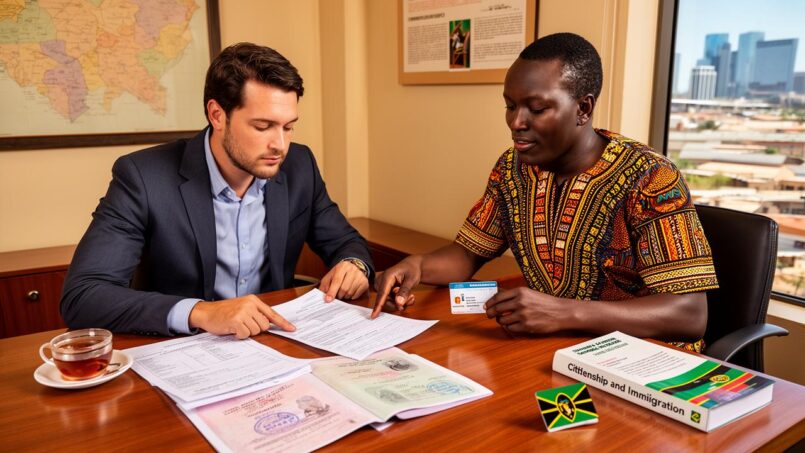
Settling in Botswana is not just about booking a plane ticket and finding accommodation. Between visas, work permits, residence, taxation, healthcare, children’s schooling, opening a bank account, or purchasing property, the country imposes a precise administrative framework with rules that can surprise a newcomer. For any expatriate or investor, the challenge is to turn this administrative maze into a well‑managed process.
Good to know:
This article provides a structured guide for legally settling in Botswana, based on official data and the latest practices, to ease the transition from project to reality while respecting local laws.
Understanding the institutional framework and competent authorities
Before applying for a visa or permit, it is useful to know who does what. The system is relatively clear but involves several ministries and agencies.
The Ministry of Nationality, Immigration and Gender Affairs oversees the Department of Immigration and Citizenship, whose Migration and Visa Division handles visas, work permits, and residence permits. It is this administration that affixes permits in passports and manages most immigration cases once on the ground.
Tip:
For any foreign recruitment in Botswana, it is essential to go through the “labour market test.” This verification, managed by the Department of Labour and Social Security and the Ministry of Employment, Labour Productivity and Skills Development, aims to ensure that no Botswana citizen is available and qualified for the position before authorizing the hiring of a non‑resident worker.
Permit applications are reviewed by the National Immigrants Selection Board and its regional branches. For tax matters, the contact is the Botswana Unified Revenue Service (BURS), while company registration and property rights fall under the Companies and Intellectual Property Authority (CIPA) and the Deeds Registry, in coordination with the Ministry of Lands and Housing for land.
For nationals residing in the United States, the Embassy of Botswana in Washington, D.C. and the Permanent Mission to the UN in New York represent important entry points for consular information, although most residence and work permits must be finalized on Botswana territory.
Entering Botswana: visas, exemptions, and general conditions
Living in Botswana begins with the right to enter. The visa policy distinguishes between nationals of exempted countries and those who must apply for a visa before departure.
100
More than one hundred nationalities can enter Brazil without a visa for tourist stays of up to 90 days.
Other nationalities, particularly from many parts of Asia, Africa, and Latin America, must obtain a visa. Even within the Commonwealth, certain countries such as Ghana, Nigeria, Bangladesh, India, Pakistan, and Sri Lanka are subject to visa requirements. The updated list of visa‑subject countries is available on Botswana’s official e‑Visa portal.
Attention:
Whether exempt from a visa or not, the basic entry conditions are the same for everyone: a passport valid at least six months after arrival with enough blank pages, proof of a return or onward ticket, and sufficient financial means. These documents may be requested upon arrival. A mandatory rule for dual nationals: they must enter and leave the country using the same passport.
A yellow fever vaccination certificate is required only when arriving from a country where the disease is endemic. Other vaccines (tetanus‑diphtheria‑polio, hepatitis A) and malaria prophylaxis are strongly recommended but not mandatory.
COVID‑19 requirements have been lifted: no more tests or vaccination proof at borders, and enhanced health screenings have been discontinued.
Types of visas and permits: from short stay to long‑term settlement
Botswana does not rely on a simple “tourist visa / work permit” pair. The country offers a full range of visas and permits that correspond to very different stay situations.
Short‑stay visas: tourism, business, transit
The tourist visa is used for leisure stays, safaris, or visiting relatives. It allows up to 90 days within 12 months but does not permit work. Fees are around 300 Pula for a single entry (about one month stay) and 500 Pula for a multiple‑entry visa up to three months.
The business visa is for short‑term professional trips: meetings, conferences, market exploration. It does not replace a work permit and does not allow sustained salaried employment. Its usual validity ranges from 30 to 90 days, with fees around 50 USD for a single entry up to three months and 100 USD for a multiple‑entry visa.
Good to know:
For transit travelers, a transit visa limited to seven days is available. Additionally, very short‑stay permits can be issued directly at borders for one‑off excursions, for example from Namibia or Zambia to Chobe National Park.
Work, volunteering, and investment visas
As soon as a foreign national engages in paid or voluntary activity, including internships or volunteering, a work permit or exemption authorization becomes necessary under the Employment of Non‑Citizens Act. A business visa or a simple tourist visa is not sufficient.
Two main categories coexist:
– The Short‑Term Work Authorisation Visa, akin to a visitor visa accompanied by an exemption certificate, allows professional activity for a maximum of three months ;
– The Long‑Term Work Authorisation Visa (often referred to as a work permit or employment permit) covers assignments beyond three months, typically one to two years, renewable up to five years per permit, with a long‑term total duration of up to ten years.
For urgent assignments, emergency work permits exist, valid from seven days to three months depending on the case, with very low or no fees for ultra‑short authorizations and around 1,000 Pula for three months.
Example:
In Botswana, the work permit system is primarily employer‑driven. To recruit a foreigner, the company must first prove that no Botswana citizen is available for the position. This involves posting a job advertisement reserved for nationals for at least fourteen days and providing documented justification that no qualified candidate was found. Additionally, the employer must often present a plan to “localize” the position—i.e., transfer it to a national in the medium term. For certain regulated professions (health, education, civil aviation, sports, etc.), additional approval from the relevant sector authorities is required before any permit application.
Investors have specific permits, sometimes valid for up to five years, which require presenting company registration certificates, business licenses, list of directors, shareholding structure, business plan, and bank statements showing the investment.
Residence permits, family reunification, and permanent residence
Once the stay exceeds the standard visitor period (often one month), a residence permit becomes necessary, regardless of the entry visa. This permit is tied to a specific reason: employment, studies, investment, or family reunification.
The spouses and children of permit holders may apply for a dependent permit, aligned with the duration of the main permit. This permit does not automatically authorize work; a separate application is required. Only heterosexual marriages are recognized, excluding common‑law unions or same‑sex marriages.
Dependent Permit Policy in Botswana
In the long term, established foreigners can aim for a permanent residence permit, granting indefinite residency, provided they generally show five to ten years of continuous legal stay, good moral character, genuine integration, and significant contributions to the economy or society. The country has also implemented a points system that allows certain highly skilled profiles or large investors to access permanent residence more quickly, or even directly without a standard temporary permit.
Finally, acquiring Botswana citizenship by naturalization requires, among other things, ten years of cumulative residence within the twelve years preceding the application, one year of uninterrupted residence just before the application, good proficiency in Setswana or another local language, a clean criminal record, and a willingness to settle permanently. Botswana does not recognize dual nationality: a new citizen must formally renounce their original nationality.
Applying for a visa or permit: procedures and documents
Botswana launched an e‑Visa system in 2021 that allows many applications to be submitted online via the official website. Applications can also be submitted in person at immigration offices, consulates, or embassies, especially for countries without full online access.
For standard visas, the procedure relies on Form 1 (Application for Visa). For residence or work permits, other forms are added: Form 3 for the medical report, Form 4 for the work permit or exemption application, Form 15 or 16 for certain residence cases, Form 21 for permanent residence. Most files must be submitted to the Department of Immigration and Citizenship in Botswana; diplomatic missions abroad are often limited to preliminary collection and basic entry visas.
7 to 14
Typical processing time in business days for a standard visa, with a recommendation to allow up to three weeks.
Typical supporting documents
Most applications include a common set of documents, to which are added specific items depending on the purpose:
Documents required for a visa application
List of essential supporting documents to provide for a complete visa application file.
Form and passport
Duly completed application form along with a valid passport and a certified copy of the biodata page.
Photos and cover letter
Several color passport photos and a letter explaining the purpose of the stay.
Itinerary and accommodation
Travel itinerary or flight booking, as well as proof of accommodation (hotel reservation, lease, host address).
Financial resources
Proof of sufficient financial means to cover the entire planned stay.
Criminal record and health
Police clearance certificates from countries of recent residence, and a medical report certifying the absence of communicable diseases (often via Form 3).
Civil status documents (residents)
For residents: birth and marriage certificates, sometimes previously apostilled in the country of origin.
For long‑term work permits, additional items include employment contract, detailed CV, diplomas and professional certificates translated into English and, if necessary, validated by the Botswana Qualifications Authority, as well as all evidence of unsuccessful local recruitment. Investors must provide all company documents (certificate of incorporation, articles, list of directors and employees, business license, financial statements or bank statements demonstrating the investment level).
Documents in a language other than English must be accompanied by certified translations, usually notarized.
Children, minors, and family reunification
Formalities for children and adolescents are subject to specific rules. To enter the country, minors must present a valid passport, as well as an unabridged birth certificate. When traveling with only one parent or with a relative, authorities often require a certified letter of consent from the non‑accompanying parent(s). An exception exists when the father’s name does not appear on the birth certificate, in which case no paternal authorization is required.
Good to know:
For a residence permit application based on family reunification, you must provide proof of the family relationship (birth and marriage certificates) and a letter of financial support from the main permit holder. Dependent children and grandparents may be included, provided their economic dependency is proven, as well as the sponsor’s ability to support everyone.
An important point: individuals over 18 must, in principle, file their own permit application, even if they are attached to a parent or spouse as a dependent.
Good to know:
Once settled, children can attend public or private schools, including English‑speaking international schools. Enrollment is generally possible with a valid residence permit, without any specific academic certificate requirement. However, high demand leads many expatriate families toward international institutions, where admission is conditional on an application file and often high fees.
Overview of some international schools
To get your bearings, it is useful to look at price ranges and types of curricula offered by a few popular private international schools.
| School | City | Grade levels | Main curriculum | Approximate fees (per year) |
|---|---|---|---|---|
| Westwood International School | Gaborone | Primary to High School | International Baccalaureate (PYP-MYP-DP) | 14,000 – 25,000 USD per year (depending on level) |
| Maru a Pula | Gaborone | Secondary | Cambridge IGCSE & A‑Levels | ~31,750 BWP/year for day students |
| Delta Waters International | Maun | Secondary | Cambridge IGCSE, AS & A‑Levels | Upon request from the school |
| Northside School | Gaborone | Primary | IB‑inspired | Upon request |
| Thornhill Primary School | Gaborone | Reception – Standard 7 | Based on UK National Curriculum | Upon request |
Enrollment procedures vary but almost always require an application form, previous report cards or transcripts, possible entrance tests, a copy of the passport or residence permit, and sometimes medical and vaccination certificates. Since spaces are limited, it is recommended to initiate these steps as soon as the expatriation project takes shape.
Healthcare system and administrative requirements for foreigners
Botswana has developed a largely public healthcare system : about 98% of facilities are state‑run and spread across 27 districts. Almost the entire population lives within eight kilometers of a health center, thanks to a network of large hospitals, clinics, dispensaries, and over 800 mobile units.
For citizens, access to care is heavily subsidized, even free for certain services (maternity, vaccinations, sexual and reproductive health, antiretroviral treatments). Basic consultations cost only a few Pula. In contrast, foreigners do not benefit from this free care : a consultation at a public hospital can cost several dozen dollars, and presenting a passport and residence or work permit is almost always required.
Attention:
The public system in Botswana faces long queues, staff shortages, and medication shortages, especially in rural areas. In major cities like Gaborone and Francistown, expatriates favor modern, well‑equipped private clinics, but these facilities have high costs, sometimes required upfront, and may ask for proof of insurance before admitting a patient.
Local medical aid organizations (Bomaid, Pula Medical Aid Fund, Symphony Medical Aid…) offer coverage for residents, but their caps, co‑payments, and waiting periods for pre‑existing conditions (up to 12 to 24 months) make them less attractive for a new expatriate. Most specialists therefore recommend opting for international health insurance that includes medical evacuation coverage to South Africa, where some advanced treatments are more accessible.
Administratively, accessing healthcare often requires:
– presenting a passport and permit (work or residence) ;
– a personal medical file in the form of a paper “card” kept by the patient in public facilities ;
– in some cases, proof of insurance or a guarantee deposit at the private clinic.
Short‑term visitors can benefit from a temporary health permit of three months for emergencies, but this is more of a financial coverage mechanism than a residence document.
In case of a critical situation, the emergency number is 997, with ground and air ambulance services. Linguistically, English is widely spoken in cities, but learning a few basics of Setswana remains useful, especially in remote areas.
Personal taxation: becoming a tax resident in Botswana
Living in Botswana for several years or working there also means entering the local tax system. The country applies a source‑based taxation, meaning it primarily taxes income derived from Botswana sources. The key question for an expatriate is when they become a tax resident.
An individual is considered a tax resident if their permanent home is in Botswana, or if they stay in the country for at least 183 days during a tax year (which runs from July 1 to June 30). Even temporary absences for holidays or business trips do not affect this status if the total time present exceeds this threshold. “Continuity” rules may also qualify someone as a resident if they are in the country over two consecutive tax years.
156,000
This is the annual income threshold, in Pula, above which the top marginal tax rate of 25% applies for residents in Botswana.
Employment income is subject to the Pay As You Earn (PAYE) system, withheld by the employer. The tax base includes salaries, bonuses, housing allowances, rent payments, company cars, tax reimbursements, etc. However, certain benefits remain exempt when provided for in the contract, such as plane tickets or specific medical expenses for the employee and family. End‑of‑contract gratuities are half taxable and half exempt, with specific limits for non‑citizens depending on the number of successive contracts.
Tip:
Investment income is subject to different tax regimes depending on its nature and the origin of the funds. Dividends paid by resident companies to resident individuals are not included in the tax base. However, certain foreign‑source dividends and interest are taxable. Locally earned bank interest benefits from a tax allowance. For payments to non‑residents, interest and dividends are subject to withholding tax, with rates that may be adjusted by international double taxation treaties.
Beyond income tax, most residents encounter VAT, set at 14%, and various more occasional levies: property transfer duties, capital transfer tax on gifts or inheritances, but no annual property tax or mandatory social security contributions like a national social security system.
Anyone earning over 36,000 Pula in taxable income per year must register with BURS to obtain a Tax Identification Number (TIN). Annual tax returns are required for most residents, unless annual income remains below 48,000 Pula, and any tax due must be paid within 30 days of receiving the assessment notice. Penalties exist for late filing, non‑payment, or incorrect declarations.
U.S. citizens or nationals of other countries practicing worldwide taxation must also meet their home country’s tax obligations, taking advantage of foreign tax credits or income exclusions to avoid double taxation.
Living in Botswana in practice: cost of living, housing, property
Once the visa, health, and tax questions are clarified, settling in also means renting or buying a home, opening a bank account, and organizing your daily budget.
Comparative data shows that the cost of living in Botswana remains generally moderate. Gaborone ranks among the cheapest capitals in the world in some Mercer studies, although certain rankings identify it as one of the most expensive African cities due to the price of imported goods. Overall, compared to North America or Europe, rents and some services remain very attractive, while imported products (food, electronics, international brands) can be significantly more expensive.
To visualize some benchmarks, here is a summary of common prices expressed in Pula:
| Expense item | Average observed price |
|---|---|
| Simple meal at a restaurant | 60 to 120 BWP |
| Full meal for two (restaurant) | 350 to 400 BWP |
| Rent 1‑bedroom apt. Gaborone center | 3,000 to 3,500 BWP / month |
| Rent 3‑bedroom apt. Gaborone center | 6,500 to 7,000 BWP / month |
| Rent 1‑bedroom outside center | 1,800 to 2,500 BWP / month |
| Utilities (elec/water/internet) 85 m² | 1,400 to 1,700 BWP / month approx. |
| Mobile plan + data | 330 to 370 BWP / month |
| Local bus ticket | 7 to 9 BWP |
| Gasoline (1 liter) | 15 to 16 BWP |
Consolidated estimates put a single person’s monthly budget around 15,000 to 17,000 BWP, and that of a family of four around 32,000 to 40,000 BWP, excluding international school fees and travel. Highly skilled expatriates often earn between 20,000 and 40,000 BWP net monthly salary, sometimes more, with housing, health insurance, and schooling partially covered.
Buying real estate: legal and tax framework
Botswana has a unique land system, divided among tribal land, state land, and freehold land. About 70% of the territory is tribal land, managed by Land Boards. For foreigners, direct access to land is regulated.
Good to know:
As a general rule, a non‑citizen cannot directly acquire tribal or state land. They can, however, purchase freehold properties in specific urban areas such as Gaborone, Phakalane, Lobatse, or Francistown. In neighboring villages under tribal land (Tlokweng, Mogoditshane, Molepolole), direct purchase by a foreigner is excluded, except for exceptions related to job creation or through specific investment structures.
Many real rights take the form of long‑term leases (50 to 99 years) on state or tribal land. The safest title remains the title deed registered with the Deeds Registry. Sometimes, acquisition is made through a company registered in Botswana, which holds the property: in this case, the foreigner holds shares in the company rather than the land itself.
30
Transfer duty rate applied to foreigners for real estate acquisition in Botswana, compared to only 5% for citizens.
In addition to these duties, there are legal fees (often between 1.5% and 2% of the property price), notary fees, appraisal fees, technical inspection fees, and registration fees, bringing the total acquisition cost for a foreigner into a range of 33 to 35% above the listed price.
Good to know:
Local bank financing is possible but subject to strict conditions: major banks typically require existing construction on the land, a clear residential purpose, a substantial down payment, and stable local income. Consequently, many investors opt for loans from their home country or legal arrangements through local companies.
To purchase, a foreigner must generally hold a valid work or residence permit. Files usually include a certified copy of the passport, proof of address, income statements, as well as proof of company registration, board resolution, and previous title deeds when a legal entity buys the property.
Local professionals almost always recommend renting before buying, to ensure that the neighborhood, city, and country truly meet long‑term expectations. The legal transfer process, from offer to registration, typically takes two to three months, or even longer for non‑citizens.
Opening a bank account: KYC requirements and specifics for foreigners
Daily life in Botswana involves opening a Pula account, and possibly a foreign currency account. The country has a stable banking sector, well‑regulated, with several international and regional institutions.
Banks enforce rigorous KYC (Know Your Customer) procedures, requiring all clients, especially non‑citizens, to provide a fairly comprehensive set of documents.
For an individual, most banks require:
– a completed application form in block capitals, with all personal information, addresses, contacts, employment, and tax status ;
– two recent passport photos ;
– a proof of residence less than three months old (water or electricity bill, lease agreement, employer’s letter, or official certificate); if unavailable, a letter from a local authority (Kgotla) stating city, neighborhood, and plot number may sometimes suffice ;
– proof of income or source of funds (pay slips, employer’s letter, bank statements, sponsorship letter) ;
– a certified copy of an identity document : Omang for citizens, passport and, for foreigners, a copy of the residence card or work permit.
Some banks add an identity verification via selfie or video, especially for online account openings. International tax compliance questions (FATCA, CRS) also aim to identify U.S. taxpayers or related persons.
Attention:
For companies, the list of documents to provide includes registration certificates (forms 2, 4, 5…), articles of association, minutes appointing signatories, copies of ID for directors and beneficial owners holding more than 10%, recent financial statements, activity details, turnover estimates, and source of funds. Foreign companies must also provide their country and date of incorporation, as well as capital links with their subsidiaries or parent companies.
Accounts can be held in Pula, but also in USD, EUR, GBP, ZAR, or JPY, sometimes with Visa cards, online access, mobile apps, and SMS alert services. Depending on the bank and account type, initial deposits or minimum income levels may be required.
For a newly arrived expatriate, a crucial practical point is the synchronization between opening an account and obtaining a work or residence permit: many banks do not finalize the account opening until the client presents their long‑term visa or permit. Anticipating these delays helps avoid several weeks of paying entirely in cash.
Starting a business and working for yourself
Many newcomers choose Botswana to start a business, attracted by a stable political and legal environment, an attractive corporate tax rate, no exchange controls, and the ability to freely repatriate profits and dividends.
The most common structure is the Private Limited Company (Pty Ltd). It can be set up with a single shareholder of any nationality and no minimum capital. However, the law requires at least one director resident in Botswana and a company secretary who is also a resident, often a lawyer or chartered accountant. Using a “nominee” director is possible through specialized firms but requires significant trust in the intermediary.
The standard process follows several steps:
Example:
Starting a business in Botswana involves a sequence of administrative steps. First, reserve the company name with CIPA for about 20 Pula, valid for 30 days. Then, draft and sign the constitutive documents, including a declaration of compliance before a commissioner of oaths (can be done remotely). Next, register the company to obtain the certificate of incorporation. Depending on the activity, site inspections by health or environmental authorities may be required. A business or industrial license must also be applied for, with publication of notices in the Official Gazette. Opening a professional bank account is necessary, followed by tax registration with BURS for a TIN and, if applicable, VAT registration if turnover exceeds a certain threshold.
Basic administrative fees for a small company remain relatively modest (a few hundred Pula for registration, a few dozen for licenses), but consultant, lawyer, and accountant fees can increase the overall budget.
Good to know:
A self‑employed person can opt for the simple form of a ‘sole proprietorship’, with no minimum capital or mandatory dedicated bank account. However, a foreigner without a solid residence or work permit may face obstacles. Additionally, certain sectors require a local investor, an investor’s permit, or at least a valid work permit.
From a tax perspective, a resident company generally pays 22% corporate income tax, or 15% for manufacturing companies, entities in the International Financial Services Center, or businesses in the Botswana Innovation Hub. Branches (external companies) are taxed at 30%. A sole proprietorship is subject to the progressive income tax scale, with a top rate of 25%.
Employers must also comply with PAYE rules, withholding tax, and may have to pay a specific levy for vocational training.
Conclusion: preparing your life project in Botswana
Living in Botswana requires navigating a set of rules where immigration, healthcare, school, taxation, property, and banking intersect. The country has a clear desire to attract foreign skills and capital through a relatively transparent system, tax incentives, and a stable currency. But this openness comes with safeguards: labor market controls, land restrictions, and stringent documentation and compliance requirements.
Tip:
The key to a successful overseas settlement is anticipation. It is crucial to start visa and work permit procedures several months before departure, checking the updated list of visa‑subject countries. Prepare complete files with the necessary certified translations. Simultaneously, choose solid international health insurance, research transfer duties for any real estate project, compare school options for your children, and take the time to understand local tax rules as well as those of your home country.
In this context, Botswana can offer those who prepare thoroughly a rare combination in Southern Africa: political stability, a competitive business environment, a reasonable cost of living, and improving service levels—provided that all the necessary administrative steps are taken seriously to live there legally and with peace of mind.

Cyril Jarnias is an independent expert in international wealth management with over 20 years of experience. As an expatriate himself, he is dedicated to helping individuals and business leaders build, protect, and pass on their wealth with complete peace of mind.
On his website, cyriljarnias.com, he shares his expertise on international real estate, offshore company formation, and expatriation.
Thanks to his expertise, he offers sound advice to optimize his clients' wealth management. Cyril Jarnias is also recognized for his appearances in many prestigious media outlets such as BFM Business, les Français de l’étranger, Le Figaro, Les Echos, and Mieux vivre votre argent, where he shares his knowledge and know-how in wealth management.





