
 Published on and written by Cyril Jarnias
Setting in Botswana often involves choosing between a highly urban life in the capital, a more provincial atmosphere in Francistown, or a “middle of nowhere” daily existence in Maun, at the gateway to the Okavango Delta. Behind these broad options lie specific neighborhoods that have, over the years, become landmarks for the expatriate community. Security, access to schools, rental prices, proximity to offices, neighborhood vibe: each area ticks different boxes and attracts a particular profile.
The three main cities for expatriates are Gaborone, Francistown, and Maun. The information on rents and cost of living presented is based on official real estate market studies and cost-of-living comparisons available for the country.
Gaborone, the epicenter of expatriate life
Political capital, nerve center of the economy, administrative hub: Gaborone is home to the majority of expatriates living in Botswana. It hosts major institutions, headquarters of mining and financial companies, the main auditing firms, international organizations, as well as the best network of private hospitals and almost all the high-level international schools.
With around 230,000 inhabitants in the city proper (and more than double that in the urban area), Gaborone remains a human-scale capital, without skyscrapers, but with infrastructure that is surprisingly functional for the region: generally reliable running water, a decent road network, efficient banks, modern shopping malls, and internet that is faster than in the rest of the country, although speeds seem modest by Western standards.
For expatriates, the choice of neighborhood mainly comes down to several residential areas: the central extensions close to institutions, the planned “Blocks”, the affluent suburbs like Phakalane, and some semi-urban peripheral villages. The trade-off is between commute time, rental price, proximity to schools, and the perceived “safety bubble.”
Phakalane and Phakalane Golf Estate: the reference suburb
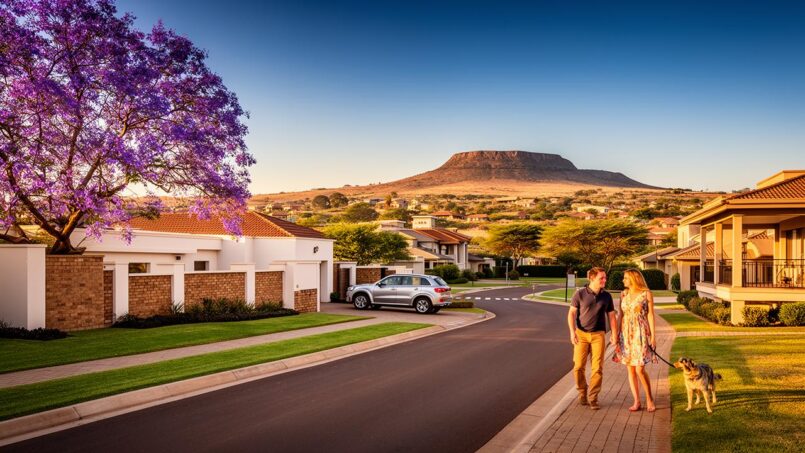
About fifteen kilometers north of Gaborone, the vast development of Phakalane has become the favorite address for a large part of expatriate professionals and families with children. Originally a simple farm, the area gradually transformed into a residential suburb before evolving, in recent years, into a veritable self-contained small town.
Phakalane now hosts two shopping malls – Mowana Shopping Centre and Acacia Mall – with major grocery stores and many international tenants, a wide range of restaurants, a cinema, gas stations, medical offices, dentists, opticians, several pharmacies, beauty salons, a gym, private schools (from daycare to secondary), and even a family leisure center like Honeycomb Hub. On site, families also find academic support structures such as Kumon or Lion Tutoring, as well as a range of established preschools and daycares.
The core of Phakalane’s appeal for expatriates, however, remains the Phakalane Golf Estate, the country’s only residential golf estate. This secure complex, conceived in the 1980s, features spacious villas, contemporary houses sometimes worthy of true “mansions,” and more modest family homes, almost all with gardens, often with pools, and sometimes with tennis courts or private small gyms. Many properties enjoy direct views of the 18-hole course. Security is enhanced by controlled access and permanent surveillance, which explains the high demand, particularly from expatriates working for large private companies, the government, or international organizations.
The Phakalane real estate market offers a wide variety of housing. It includes two-bedroom apartments, townhouses suitable for a “lock-up and go” lifestyle, and individual villas with more than three bedrooms. These villas often feature staff quarters, large kitchens, and security equipment. Many micro-estates are secured by gates and fences, an aspect particularly appreciated by families with young children.
The downside of this appeal is a tight rental market and rental levels among the highest in the country. In high-end areas like Phakalane Golf Estate, rents for villas with pools and premium finishes typically range from 15,000 to 25,000 Pula per month, and up to 30,000 Pula for the most luxurious properties. More modest apartments in well-located complexes remain expensive compared to other neighborhoods but offer a secure setting and shared services (communal pool, covered parking, guards).
The other often-mentioned downside is road congestion during rush hour: with over 15,000 residents and a single main access road that long remained undersized, entering and exiting the neighborhood in the early morning is notorious for sometimes spectacular traffic jams. Road projects are underway, including a new route via Morula Park and a link to Broadhurst/Ledumang, but the feeling among expatriates remains that of a “daily bottleneck” to anticipate.
Finally, there is a real contrast between the ultra-secure image of the Golf Estate and some parts of “Old Phakalane,” where unfinished plots sometimes serve as shelter for informal workers or undocumented migrants. These semi-finished constructions, without water or sanitation, are perceived by some residents as a factor degrading the quality of life (presence of shacks, informal small drink stalls, illegal dumping, nuisances). The original developer, Phakalane Estates, points to mandatory construction clauses and legal proceedings to reclaim dormant lots, but on the ground, this duality between the Golf Estate and Old Phakalane remains a recurring topic of conversation in the expatriate community.
Central Extensions: Extension 9, Extension 10, and the “Village”
For expatriates who want to live closer to offices, ministries, and shopping malls without giving up a certain level of comfort, Gaborone’s central extensions are a prime alternative to Phakalane.
Extension 9 and Extension 10 are often considered the most central addresses among residential areas. These neighborhoods, organized around tree-lined streets, feature modern houses, upscale villas, and some small apartment buildings. Their main advantage lies in their location: close to flagship malls, popular restaurants, administrative offices, and corporate headquarters. To a certain extent, one can lead a more “walkable” life here, with the possibility of walking to some cafes, restaurants, or shops, which is rare elsewhere in the city.
The “Village” – not to be confused with the peripheral villages – is the former administrative center of Gaborone. It still houses embassies, government buildings, as well as historic houses sometimes converted into offices. Rents are high, and the stock of family homes is limited. This area is therefore more sought after by diplomats, single professionals, or couples without children, who prioritize proximity to institutions and restaurants over large gardens.
The monthly rent for a furnished one-bedroom apartment in central areas of Gaborone ranges between 5,000 and 10,000 Pula.
Gaborone West (G-West), Broadhurst, and the residential Blocks
If Phakalane and the central extensions represent the very high-end, other neighborhoods in Gaborone attract a significant segment of the expatriate community for their value for money, proximity to international schools, and a more “everyday” vibe.
Gaborone West, often abbreviated as G-West, is one of these fast-growing sectors. Close to Westwood International School – a renowned institution offering the full range of International Baccalaureate programs – Gaborone West naturally attracts expatriate families with children enrolled in the IB. The area mixes recent developments and older houses, in a fairly relaxed residential atmosphere, halfway between suburb and city.
The large suburb of Broadhurst, northwest of the city, plays a similar role for a broader audience, including expatriates on a tighter budget or those on long-term contracts who want to settle in a less “expat bubble” setting. Broadhurst is characterized by a wide range of housing types, from small townhouses to more spacious individual villas. Access to the A1 highway and the presence of Broadhurst Mall make the neighborhood practical for daily commutes and shopping.
Around these large areas are a series of numbered “Blocks” (3, 5, 6, 7, 8, 9, 10), some of which are frequently mentioned in housing searches by newcomers. Block 8 and Block 10, for example, are highlighted for their stable residential environment, proximity to schools, and functional road links. Block 7 and Block 3 are known for their quiet, family-friendly atmosphere, with low-traffic streets and a predominantly local population, which appeals to expatriates wanting to avoid the strict insularity of large estates.
In these sectors, rents for a three-bedroom house in a so-called “standard” area of Gaborone generally range between 6,000 and 12,000 Pula per month, depending on the condition of the house, the presence of a garden, fencing, an alarm system, and possible outbuildings (maid’s quarters, office, etc.). For apartments in good-quality secure complexes, rents are often around 4,500 to 7,000 Pula for a two-bedroom, with the added bonus of 24/7 security, a communal pool, covered parking, and sometimes a small gym.
Kgale View, Gaborone North, Naledi, and the peripheral villages
Kgale View also features on the map of Gaborone’s upscale neighborhoods. Located near the Kgale hills, this sector offers high-end houses often with beautiful open views, in a less dense environment than the center. For expatriates seeking tranquility, it’s a credible alternative to Phakalane, with properties typically very well secured and equipped. The proximity to natural areas like the Gaborone Dam and the Gaborone Game Reserve adds an advantage for weekend getaways.
Gaborone North is a sought-after area for its rather upscale houses, proximity to shopping malls and schools. In full expansion, it is attracting more and more local middle classes and some expatriates, offering a good compromise between price, space, and access to services.
Naledi, on the other hand, is among the neighborhoods listed as residential areas, although its image is more mixed than that of Gaborone West or the extensions. Some expatriates live there, often in specific secure apartment complexes rather than in the diffuse residential fabric.
On the periphery, several peri-urban villages like Tlokweng, Mogoditshane, Gabane, Oodi, or Mokolodi play an interesting role. Tlokweng, for example, is experiencing strong residential growth thanks to its more affordable rents and easy access to major roads. But it is tribal land, which implies strong restrictions on land purchase by non-citizens. Gabane and Mokolodi appeal more to expatriates seeking a more rural setting, houses inspired by local architecture, and a closer link with nature. In Mokolodi, the immediate proximity of the animal reserve of the same name reinforces this feeling of living “in the countryside” while still being within reach of Gaborone.
Land purchase in these villages is highly regulated for foreigners. On the other hand, renting is free, allowing expatriates to settle without legal constraints, provided they accept a sometimes lower level of services and infrastructure than in the city.
Typical budget in Gaborone: impact of the chosen neighborhood
The differences in rent between neighborhoods have a direct impact on an expatriate’s overall budget. Available estimates indicate that a single person can live comfortably in Gaborone on a monthly budget of around 18,000 Pula, including a one-bedroom apartment in the center (around 5,500 Pula), utilities (about 800 Pula), food, some outings, and miscellaneous expenses. By opting for shared housing or a more outlying location, this budget can drop to around 12,000 to 14,000 Pula per month. At the other extreme, a very comfortable lifestyle in a neighborhood like Phakalane Golf Estate or Kgale View, with regular outings and leisure, can easily exceed 25,000 Pula per month for one person.
For families, a reference budget of around 35,000 Pula per month is often mentioned for a comfortable life in Gaborone, with a three-bedroom house in a decent residential area (about 10,000 Pula) and utilities. International school fees are added to this base and can quickly become heavy, with some private schools charging several tens of thousands of Pula per year per child.
The following table illustrates the order of magnitude of rents in Gaborone by type of housing and neighborhood standing.
| Type of housing | Location / Standing | Indicative monthly rent (BWP) |
|---|---|---|
| 1-bedroom apartment downtown | Central neighborhoods, extensions | 3,000 – 5,500 |
| 2-bedroom apartment in secure complex | Gaborone (standard) | 4,500 – 7,000 |
| 3-bedroom house, average residential neighborhood | Blocks, Broadhurst, G-West, etc. | 6,000 – 12,000 |
| High-end villa with pool | Phakalane, Phakalane Golf Estate | 15,000 – 25,000 (up to 30,000) |
| Room in shared housing | Gaborone, all areas | 2,500 – 4,000 (utilities included) |
These ranges help illustrate the gap between a “reasonable” expatriate lifestyle in intermediate blocks and a more high-end profile in closed estates like Phakalane.
Francistown: a more affordable alternative for expatriates
Botswana’s second city, Francistown has just over 100,000 inhabitants, with about 147,000 people in the agglomeration according to the 2022 census. Located nearly 400 km north-northeast of Gaborone, it plays a key role as a commercial crossroads towards Zambia, Zimbabwe, and further north, the DRC. Historically linked to mining and industrial activity, the city now attracts expatriates working in logistics, transport, industry, as well as some services and hospitals.
Compared to Gaborone, Francistown is less cosmopolitan and has fewer recognized international schools. The flagship institution, Francistown International School, according to feedback, does not reach the level of the capital’s major schools. Many expatriate families based in Francistown therefore choose boarding school solutions in Gaborone or distance learning for their children, which strongly influences the choice of neighborhood: proximity to the airport or major roads, for example, can weigh in the balance.
Francistown is about 9 to 12% cheaper than Gaborone, especially for food, transportation, and personal care.
Popular neighborhoods: Aerodrome and Tati
Francistown does not have as fine a mosaic of neighborhoods as Gaborone, but a few sectors clearly stand out for expatriates. Two of them consistently come up in recommendations: Aerodrome and Tati.
Aerodrome, as the name suggests, is close to the airport area and groups a good part of the quality rental supply. Houses there are generally better built than in poorer peripheral neighborhoods, with standards closer to those of the urban middle classes in the capital. You’ll find individual fenced properties, often equipped with alarm systems, sometimes small pools. This area attracts many expatriate staff from the mining and industrial sectors, as well as healthcare professionals working at Nyangabgwe Referral Hospital or neighboring private clinics.
For expatriates seeking housing of superior quality to local standards, the Aerodrome and Tati neighborhoods are recommended. They concentrate the majority of the supply meeting these criteria, with more well-maintained homes, better finishes, and sometimes larger plots. These sectors are also appreciated for their neighborhood structure and proximity to services.
Rents in Francistown reflect the cost-of-living differential with Gaborone. A family home typically rents for between 3,500 and 7,000 Pula per month, with variations depending on the sector, size, and condition of the property. Apartments in secure complexes, less numerous than in Gaborone, are still present, with the same basic features: security guards, sometimes a communal pool, sheltered parking.
An expatriate in Francistown benefits from advantageous housing costs but faces a limited supply of modern apartments, dining options, international schools, and cultural activities. This situation particularly impacts families, where it is common for one parent to work on-site while the children are schooled in Gaborone or abroad.
Cost of living and lifestyle in the north
Cost-of-living comparisons show significant gaps between Gaborone and Francistown in some categories. In Francistown, food, local transportation, and personal care products cost significantly less than in Gaborone, which is felt in the daily budget. On the other hand, rents are sometimes slightly higher for comparable space, due to a narrower rental market and a rarer supply of quality housing.
In practice, this means the big difference is less about rent and more about incidental expenses: groceries, fuel, outings, various services. A digital nomad, for example, can budget around $2,330 per month in Francistown, which is over 20% less than what they would spend in Gaborone for a similar lifestyle. However, they will have to accept slightly slower internet and a less developed coworking ecosystem.
For expatriates seeking an environment cheaper than Gaborone while still in a major urban center, Francistown – and more specifically Aerodrome and Tati – appear as a pragmatic option, provided the issues of schooling and specialized healthcare are well anticipated, as these are often better assured in the capital.
Maun: the choice for expatriates in tourism and conservation
At the geographical and symbolic opposite of Gaborone, Maun represents another facet of expatriate life in Botswana. Gateway to the Okavango Delta, self-proclaimed safari capital, the town mainly attracts professionals from tourism, conservation, ecotourism, and environmental research. Guides, lodge managers, project coordinators, researchers, photographers, small plane pilots: the foreign community in Maun has a very different profile from that of Gaborone or Francistown.
The urban landscape of Maun has nothing in common with that of a capital city. The town remains largely horizontal, somewhat spread out along the Thamalakane River, with a mix of simple houses, small commercial structures, lodges, and safari camps. Here, there are no large apartment complexes with pools and gyms like in Gaborone: the dominant form of housing is the individual house.
Expatriates living in Maun therefore almost all reside in independent houses, sometimes on large plots, sometimes more modest, but generally without the density of a typical urban neighborhood. Rents for these houses, in the Maun area, average between 4,000 and 8,000 Pula per month. The supply remains limited, however, meaning good opportunities rent quickly, especially during the high tourist season.
In Maun, the supply of international education and specialized healthcare services is very limited. Expatriate families generally resort to distance learning, possibly supplemented by local tutors, in the absence of international schools comparable to those in Gaborone. For healthcare, a public hospital and a private clinic cover routine needs, but complex cases often require medical evacuation to Gaborone or South Africa.
In terms of daily life, Maun offers a slower pace, direct contact with nature, but also connectivity constraints (internet slower than in Gaborone), logistical challenges (some imported products are expensive or arrive irregularly), and different safety concerns, related more to the environment (wildlife, malaria risk in season) than to organized crime.
Gaborone vs Francistown vs Maun: neighborhood profiles and installation choices
For an expatriate hesitating between the three main hubs, the comparison is made both at the city scale and at the neighborhood scale.
In Gaborone, the bulk of the foreign community is spread between secure upscale suburbs (Phakalane, Phakalane Golf Estate, Kgale View, certain Blocks), central neighborhoods close to offices (Extension 9, Extension 10, Village, Block 10), and intermediate residential neighborhoods (Gaborone West, Broadhurst, Block 7, Block 8, Block 3). The main criteria are access to international schools, proximity to private hospitals, security, commute time, and the comfort level of housing.
In Francistown, the Aerodrome and Tati sectors are favored by expatriates, offering housing quality above the local average. Other neighborhoods present a more mixed profile. Family choice is strongly influenced by the absence of a dense network of international schools in the city.
In Maun, the question is less about the “neighborhood” in the urban sense than about the location of the house (proximity to the center, river view, distance from lodges or the office). Expatriate life there is less segmented by residential sectors, more structured by the type of professional activity (safari, research, conservation).
The following table summarizes the major characteristics of these three hubs for an expatriate.
| City / Hub | Neighborhoods / areas favored by expatriates | Family house rent (order of magnitude) | Dominant expatriate profiles |
|---|---|---|---|
| Gaborone | Phakalane & Phakalane Golf Estate, Kgale View, G-West, Broadhurst, Blocks 3/5/6/7/8/9/10, Extension 9/10, Village | 6,000 – 12,000 BWP (standard) / 15,000 – 25,000 BWP (high-end) | Corporate professionals, diplomats, civil servants, consultants, families with children in international schools |
| Francistown | Aerodrome, Tati | 3,500 – 7,000 BWP | Mining/industry engineers, logistics, healthcare, some independents |
| Maun | Independent houses scattered in and around the town | 4,000 – 8,000 BWP | Safari professionals, conservation, ecotourism, researchers |
This comparison clearly shows that the question of “neighborhoods” in Botswana is most crucial in Gaborone, where the supply is varied enough to create true residential micro-markets.
Why do these neighborhoods appeal so much to expatriates?
Beyond prices and maps, the neighborhoods that stand out to foreigners share several common traits: security enhanced by urban planning (cul-de-sacs, clear boundaries, visibility), a minimum of nearby services, an existing community of expatriates or local upper-middle classes, and a certain land tenure stability.
Phakalane Golf Estate illustrates the typical residential package for expatriates: a secure estate with spacious properties in a green environment, close to private schools, major roads to the city, a dynamic commercial and industrial zone, and a conference hotel. Its appeal is reinforced by continuous development projects, including extensions, a future five-star hotel, and a high-end retirement village, making it a sought-after investment destination for affluent professionals and retirees.
Similarly, neighborhoods like Gaborone West or certain Blocks cumulate very concrete practical advantages: being 10-15 minutes by car from the main malls, being close to schools like Westwood International or Broadhurst Primary, having houses already fenced with alarms and sometimes guards, while still being at rental levels significantly more accessible than in Phakalane. For expatriates who are well-compensated but without a very generous housing package, these areas represent an optimal compromise.
The Aerodrome and Tati neighborhoods stand out for a real estate stock of relatively better quality, with houses often up to standard, featuring a garden, perimeter wall, and an alarm. They also offer good access to the city center and industrial areas, all for a reasonable rent, unlike other sectors where infrastructure is sometimes lacking.
Maun, finally, offers an attraction of another kind: the possibility of living literally at the gates of one of Africa’s greatest natural wonders, in a town sufficiently equipped with services not to feel totally isolated, but not large enough to erase the feeling of being “in the middle of the bush.” For many “nature”-oriented expatriates, this compromise is well worth the concessions in terms of schools, shopping malls, or internet speed.
Housing and legal framework: what expatriates need to know
Even though the main focus of this article remains residential geography, a few elements of the legal and economic framework help better understand neighborhood choices.
Foreigners can rent freely in Gaborone, without neighborhood restrictions, subject to the landlord’s agreement. The process often goes through local real estate agencies or dedicated online platforms and Facebook groups. One generally needs to provide an advance equivalent to three months’ rent (security deposit + first month) upon signing. Standard leases are for 12 months, with varying termination conditions.
For purchasing, the situation is much more regulated. Foreigners can acquire finished properties in the city (apartments, houses, plots in complexes like Phakalane Golf Estate or Bodulo Apartments in Peto Estate), but they cannot in principle purchase undeveloped land, except in freehold, and have virtually no access to tribal land, which represents about 70% of the territory. Legislation like the Tribal Land Act of 2018 and the Transfer Duty Act, which imposes a 30% transfer duty for non-citizens versus 5% for citizens, has considerably reduced the appetite of foreign investors for certain market segments.
Real estate investment is concentrated in large private projects and specific urban zones, increasing pressure on rents in sought-after neighborhoods. This tension is exacerbated by expatriate demand that often cannot be shifted to purchasing, due to regulations or restrictive banking conditions for non-residents.
Security, health, schools: factors that guide neighborhood choice
The neighborhoods chosen by expatriates are not just about a simple financial trade-off. Other dimensions weigh heavily in the decision.
Although Botswana is one of the safest countries in Africa, major cities like Gaborone, Francistown, and Maun experience issues with crime (burglaries, opportunistic theft, nighttime assaults, carjacking). To protect themselves, residences in favored neighborhoods are often equipped with perimeter walls, barbed wire or electric fences, alarm systems, and sometimes guards or private patrols. Gated estates (like Phakalane Golf Estate) or certain apartment complexes are particularly recommended for simplified security.
Next, health. The large public facilities – like Princess Marina Hospital in Gaborone, Nyangabgwe Referral Hospital in Francistown, or Letsholathebe II Memorial Hospital in Maun – are complemented by better-equipped private hospitals in the larger cities, especially in Gaborone (Life Gaborone Private Hospital, Lenmed Bokamoso Private Hospital, Sidilega Private Hospital). For an expatriate, living a reasonable distance from these facilities weighs in the choice of neighborhood, especially with a family. From this perspective, Gaborone’s neighborhoods are clearly advantaged compared to Francistown and Maun, which have a finer network than the rest of the country but are still far from South Africa’s level in case of serious illness.
Gaborone concentrates many private and international schools (Westwood International School, Thornhill, etc.), attracting expatriate families to the surrounding neighborhoods. In contrast, schooling options are limited in Francistown and Maun, often leading families to separate their residence to ensure their children’s education.
In conclusion: how to choose your neighborhood as an expatriate in Botswana?
For an expatriate settling in Botswana, the question of the “best neighborhoods” does not have a uniform answer: it depends on the target city, budget, family situation, lifestyle, and level of tolerance for isolation or logistical constraints.
In Gaborone, the choice of residential neighborhood varies according to resources and preferences. Affluent families seek a suburban living environment and concentrate in neighborhoods like Phakalane, Phakalane Golf Estate, and Kgale View, which offer pools, gardens, and reputable schools. In contrast, expatriates on more modest budgets or those who prioritize urban living turn to more central and affordable areas like Gaborone West, Broadhurst, Blocks 7, 8, 10, or Extensions 9 and 10, to stay close to downtown.
In Francistown, the choice focuses on Aerodrome and Tati, areas of better construction quality and services. Those who accept a more modest daily life, or who have fewer requirements regarding schools and leisure, can expand the perimeter, but these two neighborhoods remain the obvious landmarks for a smooth installation.
In Maun, the choice of housing for expatriates is primarily based on the type of house and its practical location relative to lodges, the river, and the town. Installation is generally motivated by professional reasons in the tourism or conservation sectors. It is important to accept that the housing mainly serves as an anchor point in a natural environment, prioritizing proximity to nature over urban amenities.
Beyond local variations, a common thread emerges: the neighborhoods most favored by expatriates in Botswana are those that manage to combine, in varying proportions, security, accessibility to essential services (health, schools, shops), legal stability of land tenure, and a sense of belonging to a community. It is this mix, even more than the simple rental level, that explains why the names of Phakalane, Gaborone West, Broadhurst, Aerodrome, Tati, or the well-located Blocks of Gaborone come up tirelessly in the conversations of those preparing to make Botswana their new home.
Disclaimer: The information provided on this website is for informational purposes only and does not constitute financial, legal, or professional advice. We encourage you to consult qualified experts before making any investment, real estate, or expatriation decisions. Although we strive to maintain up-to-date and accurate information, we do not guarantee the completeness, accuracy, or timeliness of the proposed content. As investment and expatriation involve risks, we disclaim any liability for potential losses or damages arising from the use of this site. Your use of this site confirms your acceptance of these terms and your understanding of the associated risks.

Cyril Jarnias is an independent expert in international wealth management with over 20 years of experience. As an expatriate himself, he is dedicated to helping individuals and business leaders build, protect, and pass on their wealth with complete peace of mind.
On his website, cyriljarnias.com, he shares his expertise on international real estate, offshore company formation, and expatriation.
Thanks to his expertise, he offers sound advice to optimize his clients' wealth management. Cyril Jarnias is also recognized for his appearances in many prestigious media outlets such as BFM Business, les Français de l’étranger, Le Figaro, Les Echos, and Mieux vivre votre argent, where he shares his knowledge and know-how in wealth management.





