
 Published on and written by Cyril Jarnias
Leaving Everything Behind to Start Over in Nauru is a dream for some very specific profiles: tax specialists seeking optimization, humanitarian workers, researchers, development workers, healthcare or education professionals drawn to micro-states. But behind the postcard image of an atoll lost in the middle of the Pacific, daily reality is far more ambivalent.
Nauru is an isolated micro-state of 21 km² and 10,000 inhabitants, marked by phosphate mining. Expatriation here offers a slow and safe pace of life, advantageous taxation, and a close-knit community. However, it comes up against a very limited job market, heavy dependence on imports, water scarcity, a limited healthcare system, and a climate already impacted by climate change.
This report provides a nuanced overview of the advantages and drawbacks of expatriation to Nauru, based on available economic, social, environmental, and legal data.
An Isolated Micro-State, Between Lagoon and Lunar Plateau
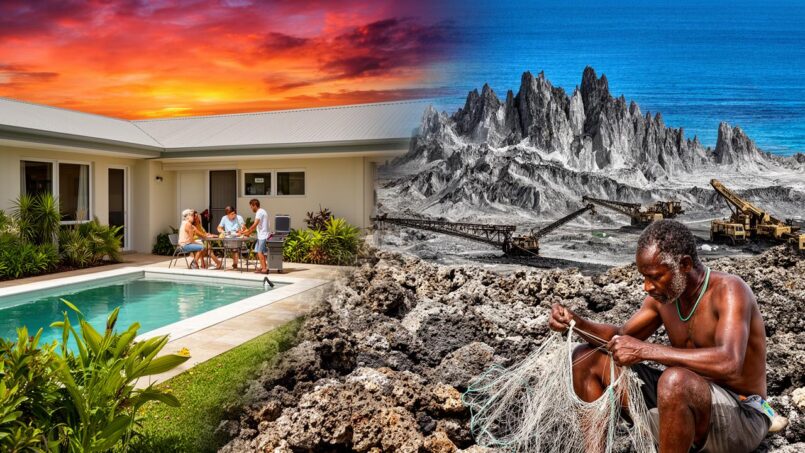
The idyllic image of a tropical island must be tempered by Nauru’s geographical reality. The country is a single raised atoll of 21 km², surrounded by a reef that plunges very quickly to nearly 4,000 m deep. Its highest point is only 61 m. Over 80% of the interior, called “Topside,” has been ravaged by a century of phosphate mining: barren soil, sharp limestone pinnacles up to 15 m high, a quasi-uninhabitable zone.
The population is therefore mainly packed onto a narrow coastal plain, where houses, schools, the hospital, airport, and vital infrastructure are concentrated, often just a few meters above sea level. This concentration makes the country particularly vulnerable to rising sea levels and strong swells.
Average annual rainfall in millimeters at Nauru, mainly concentrated between November and April.
Drought episodes, often linked to La Niña, constitute the main climate risk. Nearly three-quarters of households report having experienced at least one environmental impact over the last decade, with 61% related to drought or irregular rainfall.
Climate and Environment: Sunny Advantage, Heat and Rising Seas Threat
For an expatriate, the warm climate and the constant proximity to the ocean can be a daily pleasure, especially for those coming from temperate and cold regions. You can swim, fish, wear T-shirts year-round, evenings are mild, and sudden rains are impressive but often brief. The near-zero probability of a direct cyclone is also a reassuring argument compared to other Pacific islands.
But climate projections for Nauru are concerning in the medium and long term.
An Island on the Front Line of Climate Change
Climate studies predict an increase in air temperature between 0.9°C and 3°C by the end of the century, depending on emission scenarios. Sea surface temperature is already very high (between 28.9°C and 29.6°C annual average) and episodes of “marine heatwaves” are expected to become more frequent, more intense, and longer. The western Pacific, where Nauru is located, is identified as a global “hotspot” for these phenomena.
Sea level around Nauru is rising faster than the global average. Projections for 2050 predict a rise of 0.19 to 0.33 m under a high-emissions scenario. On this low-lying island, where the population, roads, and vital infrastructure are at sea level, a few dozen centimeters are enough to worsen erosion, cause flooding during high tides, and salinize the few freshwater aquifers.
Short-duration extreme rainfall already seems more intense, and could see its maximum daily intensity increase by 43 to 52% by 2050. In other words, fewer but more violent rain episodes, on already degraded soil, with a limited drainage network: local flooding, runoff, road degradation, soil salinization.
Fragility of Marine and Terrestrial Ecosystems
The marine environment, a key asset for quality of life on an island, is suffering a double shock: ocean warming and acidification. Coral bleaching threatens reef ecosystems, with direct consequences on subsistence fishing, coastal protection, and Nauru’s already modest tourism potential. Overfishing near the coast has already severely reduced coastal fish stocks, in a context of growing population and a lack of effectively enforced regulation.
Over 80% of the land is sterile after phosphate extraction, forming a limestone landscape unsuitable for agriculture. This absence of local production makes the country extremely dependent on imports for its food. Freshwater resources are also very limited: no rivers or lakes, aquifers that are barely usable and polluted by wastewater and salinity.
For an expatriate, this means: few local fresh products, high prices for imported vegetables and fruit, great variability in supply depending on ships, and a relationship with drinking water that can sometimes border on survival, especially during droughts.
Water, a Scarce Resource: Living with Tanks and Desalination
In Nauru, drinking water is a central problem, far more so than in most countries where expatriates traditionally settle. There is practically no surface water resource or aquifer fresh enough for consumption. The island mainly lives on collected rainwater and, as a supplement, on desalination.
A reverse osmosis desalination plant exists locally, but its capacity is insufficient to meet needs during a prolonged drought. During the most severe episodes, the availability of clean water per person falls below the 50 to 100 liters daily recommended by the WHO for a decent life. Furthermore, many rainwater harvesting installations, such as roofs and tanks, are reported to be unsuitable or poorly maintained, worsening the shortage.
Rising sea levels further increase the pressure by raising the salinity of the shallow groundwater. For an expatriate, especially with a family, this imposes constant discipline: limit showers, monitor tanks, accept sometimes poor water quality, plan for filters or bottled water, and anticipate outages.
This context can be livable for a healthy adult, under a comfortable contract, but it is much more delicate for young children, elderly people, or individuals with medical vulnerabilities.
Healthcare: A Single Hospital, Five Doctors, and Frequent Evacuations
Nauru has a quasi-entirely public healthcare system, centered on a single hospital: the Republic of Nauru Hospital, in Yaren. The facility has about 80 beds and an intensive care unit. It combines general medicine, surgery, obstetrics-gynecology, pediatrics, basic radiology, laboratory, pharmacy, basic dental care, and some specialized services (dialysis, mental health, tuberculosis, basic ophthalmology).
The island has only five doctors for the entire population, a mix of local and expatriate practitioners, and relies on occasional missions by foreign specialists. Mental health is particularly underserved: a psychiatrist only visits sporadically.
Major Technical Limitations and Heavy Reliance on Evacuations
The hospital has neither CT scanner nor MRI, nor the technical facilities for complex surgeries or advanced cancer care. Dentistry is largely limited to extractions and simple fillings, without orthodontics or sophisticated prosthetics. Most serious cases require recourse abroad, mainly to Brisbane, Australia, over 4,000 km and about 4.5 hours of flight away.
In Nauru, medical evacuations abroad are common and structural, with the country having one of the highest per capita rates in the world. For local residents and expatriates, a serious health problem almost systematically leads to a transfer abroad, with significant logistical and financial implications.
Medication stocks are limited, regularly out of stock. Some treatments are imported from Australia or the Netherlands, but shortages remain frequent. The concept of a “family general practitioner” doesn’t really exist in the local medical culture: people alternate self-medication, recourse to small Chinese shops selling basic medicines, and visits to the emergency room.
For an Expatriate, International Health Insurance is Not a Luxury but a Prerequisite
For anyone considering settling in Nauru, international health insurance with evacuation coverage is essential. Without it, a serious accident or illness can result in an astronomical bill or an inability to be transferred in time. Many international employers (NGOs, cooperation agencies, partner governments) include this coverage in contracts.
Health authorities and field studies advise against settling in Nauru for people with unstable chronic conditions, for high-risk pregnancies, or for family expatriations without a rapid evacuation solution. In particular, a pregnancy on-site carries a non-negligible risk of requiring a medical transfer mid-term.
Finally, local public health is marked by a very high prevalence of type 2 diabetes, obesity, cardiovascular diseases, early smoking, depression, and anxiety. The system operates almost permanently in “crisis management” mode, with difficult triage choices for caregivers.
A Narrow Economy, Scarce Jobs, Very Mild Taxation
On paper, Nauru shows a GDP per capita around $13,000 to $14,000 USD (purchasing power parity), a relatively high level for the region. But this figure masks an extreme dependence on a few revenue sources: phosphate, international aid, agreements with Australia (notably hosting asylum seeker processing centers), and some services.
Tourism remains practically marginal: few modern facilities, very low visitor numbers, complicated and costly accessibility.
A Tiny and Closed Labor Market
For an expatriate, it is illusory to arrive in Nauru with the intention of “looking for work on the spot.” The job market is ultra-restricted, very compartmentalized, and mainly dominated by:
– public sector positions (administration, education, healthcare, police, etc.)
– activities related to phosphate and land rehabilitation
– international projects (development, climate, infrastructure)
– contracts connected to the former asylum seeker processing center
Opportunities exist for qualified profiles (doctors, nurses, teachers, managers, engineers, environmental/climate experts, development workers, NGO/agency staff). These positions are almost always negotiated from abroad, with contracts including salary, housing, airfare, and health insurance.
Arriving without a contract exposes one to a very high probability of leaving empty-handed, as immigration authorities also condition the granting of work and residence visas on a clearly established need for skills not available locally.
An Attractive Tax System, But to be Handled with Caution
Nauru’s tax system is often presented as a major advantage of expatriation. It is true that it is distinguished by several characteristics:
– no generalized personal income tax by the standards of large economies
– an employment and services tax with a very high non-taxable threshold for residents: approximately AUD 110,800 of annual income exempt, then a rate of 20% above that
– no dedicated wealth tax, no inheritance tax, no specific capital gains tax
– competitive corporate profit tax rates (20 to 25%), with no heavy minimum capital requirement
Basic tax rate on Nauru-sourced income for non-residents.
On the business side, different categories of taxes (Small Business Tax, Business Profits Tax, Non-Resident Tax) apply depending on the company’s status (resident, non-resident, controlled or not by non-residents) and turnover. A threshold of AUD 250,000 in turnover can be exempt for structures entirely owned by Nauruan residents.
Nauru has adopted laws conforming to international standards on transparency and information exchange (Common Reporting Standard, anti-money laundering, etc.). The country no longer functions as an opaque tax haven. For an expatriate, especially if they are a citizen of a country with worldwide taxation (like the United States), expatriation to Nauru does not exempt them from their original tax obligations, nor from the risk of dual residence. The appeal of the Nauruan regime must therefore be evaluated with specialized tax advice.
Citizenship by Investment: A Gateway for a Very Small Number
Nauru offers an official citizenship by investment program, the Economic and Climate Resilience Citizenship Program (ECRCP). Stated goal: to finance climate resilience and economic diversification through a direct contribution to the Treasury.
The non-refundable contribution starts around $90,000 to $105,000 USD. Government fees start at approximately $12,700 USD for a single applicant and $26,700 USD for a family of four. The program offers great flexibility to include family members. Processing, which requires using a licensed agent, thorough checks, an online interview, and biometric data collection, typically takes between 3 and 5 months.
Potential advantages: a passport allowing visa-free access or visa-on-arrival to about 90 countries (including the United Kingdom, United Arab Emirates, Hong Kong, Singapore), the possibility to open a local bank account (in practice reserved for citizens), no taxation on worldwide income, no residence or even visit requirement, and allowance of dual citizenship.
But obtaining this citizenship does not automatically make the holder a tax resident of Nauru, nor does it end their tax ties with their country of origin. It is a powerful tool, but reserved for wealthy individuals with a structured tax and asset strategy.
Cost of Living: Statistically “Moderate,” Perceived as High
International indices place Nauru among countries with a cost of living below the global average: about 1.56 times cheaper than this average, and about 11% cheaper than the United States. The country ranks beyond 130th place out of nearly 200 countries in terms of price level, and around 80th-90th in overall quality of life.
But this statistical snapshot, based on standardized consumption baskets, does not fully reflect the lived experience of expatriates.
The average local salary is about $680 USD per month after taxes and GDP per capita is modest. However, expatriates working for international organizations or partner governments face a high cost of living, particularly for housing, transportation, imported food, and certain services.
The gaps are largely explained by the subsidies many Nauruans benefit from (social housing, support for certain basic goods), and by the fact that expatriates systematically pay “market” prices, in a tiny niche market where supply is ridiculously small relative to potential demand.
Some Numerical Benchmarks
Overall estimates vary greatly depending on sources and comfort levels considered, but we can outline some orders of magnitude for a single person, in US dollars:
| Type of Monthly Budget (1 person) | Approximate Amount (USD) |
|---|---|
| “Tight” Budget (incl. rent) | ~1,300 |
| “Average” Budget (incl. rent) | 1,500 – 2,500 |
| “Comfort”/Luxury Budget | ~4,900 – 5,000 |
For a family of four, still excluding extravagances:
| Type of Monthly Budget (family of 4) | Approximate Amount (USD) |
|---|---|
| “Tight” Budget (incl. rent) | ~2,845 |
| “Average” Budget | 3,500 – 5,600 |
| “Comfort”/Luxury Budget | up to ~10,300 |
Basic expenses are roughly distributed as follows for a single person (in USD, average orders of magnitude):
| Expense Category | Estimated Monthly Amount |
|---|---|
| Rent + Utilities | 330 – 700 |
| Food | 300 – 800 |
| Local Transportation | 15 – 200 |
| Communications (phone/internet) | 30 – 200 |
| Leisure & Outings | 45 – 480 |
| Healthcare (insurance, care) | 85 – 480 |
The unit prices of certain products illustrate the “importing island” effect:
| Product (USD) | Average Price |
|---|---|
| Milk (1 L) | 1.53 |
| Bread (0.5 kg) | 1.42 |
| Rice (1 kg) | 1.34 |
| Dozen Eggs | 2.04 |
| Chicken (1 kg breast) | 5.28 |
| Steak (1 kg) | 10.30 |
| Water Bottle (1 L) | 0.53 |
| Wine Bottle (750 ml, mid-range) | 10.90 |
| Beer (0.5 L, store) | 1.48 |
| Pack of Cigarettes | 3.75 |
| Simple Restaurant Meal | 6.5 – 7 |
| Dinner for Two at Restaurant | ~29.70 |
Ultimately, for an expatriate paid on the local scale without particular benefits, the salary/cost of living ratio is rather tight: an average net salary of around $680 USD barely covers a month of “standard” expenses. Conversely, an international executive earning several thousand dollars per month with housing covered will live in relative comfort, despite supply and infrastructure constraints.
Housing: Chronic Shortage and Often Disproportionate Rents
Housing is one of the most sensitive points for any expatriation project to Nauru. The real estate market is extremely limited, with no real formal market: most Nauruans live in state-subsidized houses, “free” rentals are rare, and high-end offerings are practically non-existent.
For foreigners, property ownership is limited to long-term leasehold arrangements, with full land ownership reserved for citizens. The state also reserves the right to reclaim land for mining or rehabilitation needs.
Very Heterogeneous Price Data… and Often Theoretical
Rent estimates vary enormously depending on sources, reflecting the absence of a structured market. Some databases suggest, in USD:
| Type of Property (month) | Indicative Range (USD) |
|---|---|
| 1-Bed Apartment Center | 320 – 350 |
| 1-Bed Apartment Economical | 230 – 250 |
| 3-Bed Apartment Center | 600 – 670 |
| 3-Bed Apartment Economical | 430 – 480 |
Other sources, expressed in Australian dollars, mention rents for a 1-bedroom in the city center ranging from AUD 2,000 to AUD 6,000 per month, and around AUD 7,200 for a three-room apartment, giving an idea of the possible gap between statistical theory and contractual reality, especially for “captive” expatriates in a tiny market.
The estimated purchase price of housing is about $1,700 USD per square meter on average.
| District | Median Purchase Price (USD/m²) | Median Rent (USD/month) Type |
|---|---|---|
| Yaren | ~1,800 | ~500 (apartment) |
| Denigomodu | ~1,500 | ~400 (house) |
| Nibok | ~1,200 | ~300 (house) |
| Anetan | ~1,000 | ~250 (house) |
| Anabar | ~900 | ~200 (house) |
| Buada | ~800 | ~150 (house) |
| Meneng | ~700 | ~100 (house) |
In practice, an expatriate must expect to pay at the high end of the range, or even beyond, and often for unfurnished or barely furnished housing, with uneven construction quality and heavy reliance on air conditioning (hence high electricity bills).
Very Little Choice, Lots of Networking
For a short stay (less than 30 days), the choice is simple: the two main hotels (Menen Hotel and Od’n Aiwo Hotel), a few lodges and vacation homes, at nightly rates that, converted to monthly, confirm very high rents.
For a long stay, the usual expatriate strategy is to:
– book a few weeks at a hotel or lodge
– rely on the employer, local contacts, or government services to find the few available rentals
– negotiate directly with an owner, often without an agency
Formal rental contracts exist, with typical durations of 6 to 12 months and a security deposit of one to two months’ rent, but much of the reality relies on trust and personal relationships. Tenants’ rights are in principle protected by law, but the absence of qualified professionals makes management and maintenance complex.
For digital nomads seeking turnkey “coliving”, the promises of some platforms are largely contradicted by reality: almost no choice, sometimes unstable internet connection, very limited supply of suitable housing.
Infrastructure, Transportation, and Digital: Rapid Progress but Strong Constraints
Nauru historically suffers from an infrastructure deficit: no fully functional deep-water port (although a new port is under construction with support from the Asian Development Bank and the Green Climate Fund), a single ring road around the island, no bus network, one airport, few cars.
To get around, people walk, cycle, use compensated hitchhiking (sharing costs), or drive themselves. Importing a car is very costly (air freight between $2,000 and $5,000 USD, import duties can reach 40% of the value), and fuel is relatively expensive for the region. Many expatriates opt for long-term rental or vehicle sharing among colleagues.
On the digital side, the situation was long a major obstacle to any telework-oriented settlement. But it is evolving rapidly.
From Rudimentary Satellite Internet to 5G and Starlink
For years, Nauru relied almost exclusively on satellite links, with a degraded fixed network and broadband access mainly reserved for administration and businesses. A first modernization occurred with the introduction of 3G in 2014, followed by 4G/LTE in 2016. The use of O3b satellites doubled the available bandwidth, then the arrival of Starlink changed the game.
In 2025, Starlink already represents about 64% of internet subscriptions in Nauru.
In parallel, the state operator Nauru Telikom (Neotel) launched a commercial 5G offer in early 2025. Digicel (acquired by Telstra) and Cenpac complete the landscape. Nearly 97% of mobile lines are now on 3G, 4G, or 5G, and mobile penetration far exceeds 100% (more SIM cards than inhabitants). About 83% of the population uses the internet, placing Nauru above the Oceania average.
The cost of broadband represents over 23% of gross national income per capita, compared to less than 5% in Australia.
In the medium term, the East Micronesia Cable submarine cable, whose deployment is planned by 2025-2026, should further improve speed, stability, and perhaps prices.
The conclusion is clear: Nauru is becoming technically connected, but the country remains a poor candidate for low-cost digital nomadism. The cost of data, the small market, climate fragility, and the absence of a coworking ecosystem or associated services limit its attractiveness for this profile.
Social Life, Culture, and Safety: A Close-Knit Community in a Tiny Space
The small size of Nauru is both its main social asset and a challenge for some foreigners.
Society is organized around twelve matrilineal clans, in a conservative, strongly Christian cultural framework (Protestant majority with a significant Catholic minority), where the extended family plays a central role. Nauruans are described as proud, warm, welcoming, but sensitive to anything that may resemble contempt or paternalism. Social norms emphasize modest dress (shoulders and knees covered), respect for elders, removing shoes before entering houses, discretion in public displays of affection.
Daily life is quiet, with no traffic jams, major shopping malls, or structured nightlife. Social life revolves mainly around sports matches, religious ceremonies, and community celebrations (weddings, national holidays). For an expatriate, the island offers a low-stress environment, a slow pace of life, and a high sense of safety.
Crime indicators confirm this impression: Nauru is ranked among the countries with the lowest level of organized crime in the world, with few violent crimes. Most recorded offenses concern traffic. Problems do exist, however: vandalism, petty theft, soft drug trafficking, political corruption. The former presence of the regional asylum seeker processing center fueled tensions and incidents, but these did not directly affect most expatriates.
Nauru is a parliamentary republic marked by close ties between elected officials and the population, but where transparency, the fight against corruption, and the role of the opposition are problematic. Its sovereignty is affected by heavy dependence on international aid and by the competition of influences between regional powers like Australia and China, which weighs on its strategic choices.
For an expatriate, the day-to-day security context is therefore generally reassuring, but the small size of the country also means that any conflict, any scandal, or any social crisis is quickly seen and felt.
Education and Family Life: Limited Options, Resourcefulness Required
For a single person or a couple without children, the question of education is secondary. For a family, it becomes crucial.
The local education system includes infant, primary, and secondary schools, free in the public sector, with a literacy rate around 95%. Major partnerships with Australia have enabled the renovation of facilities, the introduction of technical and vocational programs at the secondary level, and the provision of regional scholarships (notably through the University of the South Pacific).
However, classes are often overcrowded, the transition rate to the fifth year of primary school is low, and many students pursue secondary or higher education in Australia, Fiji, or Papua New Guinea on scholarships.
For expatriate children, options remain limited:
– integration into the Nauruan system (with personalized support if needed)
– distance/online schooling via foreign institutions
– hybrid solution (local school + supplementary distance courses)
The total monthly costs per student for international schooling in Nauru, including housing, transportation, meals, and materials.
For families who can afford frequent trips to Australia or sending their children to boarding school abroad, these limits can be overcome. For others, they can make expatriation to Nauru difficult to reconcile with stable schooling.
Migration, Climate Adaptation, and the Country’s Future: A Changing Context
Nauru is not just a backdrop for passing expatriates: it is a society questioning its own future in the face of the climate crisis, the environmental degradation inherited from phosphate mining, and economic dependence.
They have adopted the RONAdapt strategic framework for climate and disaster risk reduction, and launched the Higher Ground Initiative (HGI) in 2020. This ambitious project aims to rehabilitate the interior plateau (“Topside”) to make it a resilient living and activity zone, a “Smart Village” including climate-resilient housing, solar energy, rainwater harvesting, and more sustainable food production.
The authorities of the Republic of Nauru
In this context, migration plays a dual role. On one hand, part of the population is considering, sometimes reluctantly, the idea of leaving the island in the long term, especially if coastal erosion and increasingly high tides are confirmed. On the other hand, emigration possibilities for low-skilled workers remain very limited: few quotas in Australia or New Zealand, few programs, few resources to emigrate. Researchers speak of a risk of a migration “trap”: residents stuck in an increasingly hostile environment, with no realistic prospect of leaving.
Well-managed voluntary migration can enhance resilience by facilitating remittances, diversifying income, and reducing pressure on local resources. However, this requires increased international cooperation, a framework that goes beyond the individual action of the expatriate, although they participate in it de facto.
For an expatriate, this context means that one does not settle in Nauru in a political or climate vacuum. One joins a society seeking long-term solutions, experimenting with internal relocation projects (to the higher grounds of Topside), trying to reconcile land rehabilitation, water security, economic diversification, and adaptation to climate impacts.
Conclusion: For Whom Does Expatriation to Nauru Make Sense?
Putting all the elements together, expatriation to Nauru appears as a logistical, health, social, and financial gamble. Yet it can be coherent and enriching for certain very specific categories.
It is potentially suitable for:
Discover the different profiles of individuals and professionals attracted to acquiring citizenship in island micro-states.
Doctors, nurses, teachers, governance, climate, environment experts, project engineers and infrastructure managers, recruited by international institutions, partner governments, or NGOs.
Specialists in micro-states, climate change, island development models, or migration systems.
Wealthy investors, with tax and legal advice, for whom citizenship by investment is a strategic tool, without the intention of permanent residence.
Individuals seeking a close-knit community life on a tiny island, accepting isolation, scarcity of certain services, and rustic infrastructure.
It is, on the other hand, clearly less suitable for:
– families with children if no solid solution exists for education and medical care, especially in emergencies
– digital nomads seeking a low-cost “hub”, fueled by an imaginary of paradise beaches and coworking: the cost of data, housing scarcity, absence of nightlife, and climate fragility are heavy obstacles
– elderly individuals or those suffering from chronic conditions requiring regular specialized care
– candidates for “spontaneous” emigration without a prior job offer, who will encounter both the selectivity of the visa regime and the extreme narrowness of the job market
Settling in Nauru involves living in a unique context marked by an extreme economic history (wealth then decline from phosphate), heavy dependence on imports, forced adaptation to climate change, but also by a life without traffic jams, with low crime, no generalized income tax, and the peaceful rhythm of the ocean.
For an expatriate, the equation is neither summed up as a “tax haven” nor a “isolated hell”. It requires meticulous preparation (signed contract before departure, secured housing, health insurance with evacuation, educational solution for children, clear financial strategy) and a real appetite for material simplicity, local engagement, and climate uncertainty.
Under these conditions, expatriation to Nauru can become an extraordinary life and work experience, in the midst of one of the planet’s smallest nations, facing head-on the great challenges of the 21st century.
Disclaimer: The information provided on this website is for informational purposes only and does not constitute financial, legal, or professional advice. We encourage you to consult qualified experts before making any investment, real estate, or expatriation decisions. Although we strive to maintain up-to-date and accurate information, we do not guarantee the completeness, accuracy, or timeliness of the proposed content. As investment and expatriation involve risks, we disclaim any liability for potential losses or damages arising from the use of this site. Your use of this site confirms your acceptance of these terms and your understanding of the associated risks.

Cyril Jarnias is an independent expert in international wealth management with over 20 years of experience. As an expatriate himself, he is dedicated to helping individuals and business leaders build, protect, and pass on their wealth with complete peace of mind.
On his website, cyriljarnias.com, he shares his expertise on international real estate, offshore company formation, and expatriation.
Thanks to his expertise, he offers sound advice to optimize his clients' wealth management. Cyril Jarnias is also recognized for his appearances in many prestigious media outlets such as BFM Business, les Français de l’étranger, Le Figaro, Les Echos, and Mieux vivre votre argent, where he shares his knowledge and know-how in wealth management.





