
 Published on and written by Cyril Jarnias
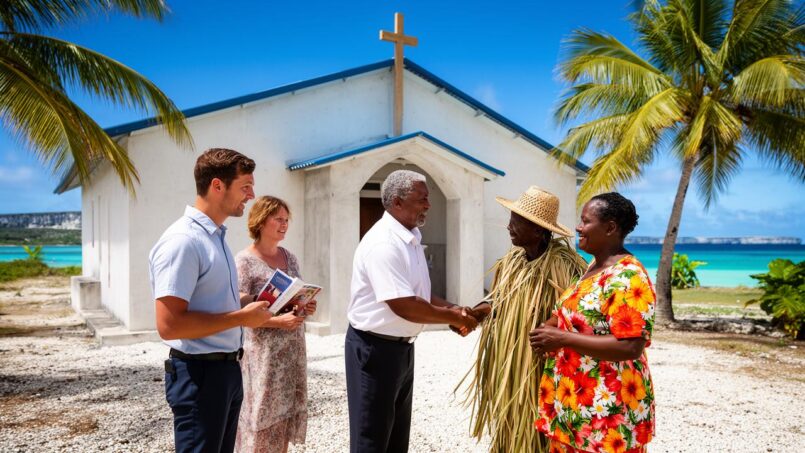
Settling in Nauru, that tiny Pacific island nation, means entering a society where daily life is profoundly shaped by Christian faith, family bonds, and an ancient spiritual heritage. For an expatriate, understanding this religious landscape isn’t a mere folkloric detail: it’s a key to social integration, good relations at work, and sometimes even professional credibility.
Religion in Nauru deeply influences daily life and society. It manifests through prayers before meetings, community gatherings around churches, and is enshrined in the Constitution, which invokes God. Its impact is also tangible in societal choices, such as the organization of the school calendar and debates on sexual and reproductive health.
This guide offers a comprehensive and practical overview of beliefs, customs, and codes to follow, with a simple goal: helping you interact with respect, avoid missteps, and benefit from the central place religion holds in Nauruan life.
A Largely Christian Religious Landscape, But More Nuanced Than It Appears
Nauru is one of the world’s smallest countries by area, yet its religious mosaic is surprisingly dense. Nearly the entire population identifies as Christian, with some older spiritual heritages and tiny minorities of other faiths.
Who Believes What? Key Numbers to Know
Recent censuses show a massively Christian country, but with important nuances among the different churches.
Here is a summary of the main religious groups:
| Religious Group | Share of Population (approx.) | Primary Source |
|---|---|---|
| Nauru Congregational Church | 34.3% | 2021 Census |
| Roman Catholic Church | 33.9% | 2021 Census |
| Assemblies of God | 11.7% | 2021 Census |
| Pacific Light House Church | 6% | 2021 Census |
| Nauru Independent Church | 3.5% (≈ 10% in 2011) | Censuses |
| Baptists | 1.5% | 2021 Census |
| Seventh-day Adventists | 0.7–1.4% | Censuses |
| Other Protestants & Brethren | ≈ 1.5% | 2021 Census |
| No Religion | 1.3–2% | Censuses |
| Hindus | 0.05% | 2021 Census |
| Other Religions (Islam, Judaism, etc.) | < 0.1% each | Pew Estimates |
In practice, two major families dominate: a predominantly Protestant group and a highly influential Catholic community. For an expatriate, this translates into an omnipresence of churches and biblical references in public discourse, whether at official ceremonies, national holidays, or simple neighborhood meetings.
A Constitution That Recognizes God, But No State Religion
The Nauruan Constitution guarantees freedom of thought, conscience, and religion, allows everyone to change their belief, and designates no official religion. However, the preamble explicitly invokes God as “the Almighty and Eternal Lord”, and public officials take oaths swearing by God, with no clear secular alternative.
For an expatriate, this means that religious neutrality of the state is not experienced as a strict removal of religion from public space. On the contrary, reference to God is considered perfectly normal in institutions, without requiring conversion or church membership.
Registered or Not: What It Changes for Churches
Nauru requires religious groups to register with the government to perform certain formal functions such as building official places of worship, organizing religious services as a recognized entity, structured proselytizing, or celebrating legally recognized marriages.
To be registered, a religion must have at least 750 members, own land and a building in the country, and have a resident Nauruan religious leader. In practice, only a few churches meet these criteria.
| Officially Registered Religious Group | Main Prerogatives Linked to Registration |
|---|---|
| Catholic Church | Perform marriages, manage official places of worship, run private schools |
| Nauru Congregational Church | Same, major community role |
| Assemblies of God | Same |
| Nauru Independent Church / Adventists | Registered in some more recent sources |
Smaller groups, like some Baptists or the still-structuring Mormon community, can operate for most activities (worship, Bible studies, mutual aid) even without registration, but may not necessarily be able to celebrate marriages recognized by the state.
For an expatriate, the key point is simple: a church wedding has legal validity only if the church in question is recognized. If you plan to marry in Nauru, this is something to clarify very early with your partner and civil authorities.
Between Christian Modernity and Ancestral Heritage
When talking with Nauruans, you quickly realize that Christian faith has deeply reshaped practices, without completely erasing older traditions.
Animist Roots and Ancestor Worship
Before the Christian missions, the local religion was based on an animist system centered on ancestral spirits and nature-related deities. Figures like Eijebong, Dabanmaroa (goddess of the sea), or Damamak (god of war) were associated with specific places, rocks, lagoons, considered inhabited by these powers.
Traditional society was organized into twelve matrilineal clans, a symbolic division still represented by the twelve-pointed star on the national flag.
Today, few of these beliefs are openly visible in daily life, but they persist in the stories of elders, in certain gestures of respect toward particular places, or in symbolic interpretations of collective hardships. For an expatriate, it is important to avoid mocking them or seeing them as mere “superstitions.” On such a small island, ridiculing these heritages can quickly isolate you socially.
A Local Christianity Marked by Syncretism
The arrival of Protestant and Catholic missionaries from the 19th century onward gradually Christianized the island. But the transition did not happen through total erasure of the old world. A discreet syncretism can still be observed: ancestor veneration may coexist with Christian prayer, and some mourning or rite-of-passage ceremonies subtly incorporate pre-Christian codes.
Nauruans illustrate a syncretism where Christianity coexists with ancestral cultural traditions. This unformalized fusion manifests in social reflexes such as deep respect for elders, the importance attached to clan places and stories, and the spiritual interpretation of hardships like serious illness, accidents, or disasters.
As an expatriate, adopting a posture of listening and respectful curiosity – letting Nauruans decide what they wish to share or not – is the best approach.
The Major Churches and Their Role in the Community
Most expatriates come into contact with at least one local church, whether through colleagues, neighbors, or social activities. In Nauru, Christian communities are simultaneously religious spaces, mutual aid networks, and social hubs.
Nauru Congregational Church: Protestant Pillar
The Nauru Congregational Church, of Congregationalist tradition, is the largest. It oversees seven congregations on the island, each led by a deacon. Historically linked to the London Missionary Society, it gained its autonomy in the mid-20th century.
The church has greatly influenced the structuring of modern Nauruan society: prominent political figures come from it, and it has accompanied major transformations, from the phosphate era to the economic crisis. Its internal democratic functioning, based on highly active laypeople, is reflected in local culture, where community speaking and shared responsibilities are valued.
The Church
Catholics and Other Protestants: A Dense Landscape
The Catholic community, numerically equivalent to the Congregationalist one, depends on the Diocese of Tarawa and Nauru, based in Kiribati. It runs at least one school and is involved in education and social services. Priests and nuns, few but highly visible, participate in the solidarity fabric of the island.
Alongside the two main denominations, other Christian communities contribute to the island’s religious dynamic.
An evangelical charismatic church part of a global Pentecostal movement.
A local Protestant community established on the island.
An evangelical church present in the Pacific region.
A millerite Protestant church emphasizing Christ’s return and Sabbath observance.
Protestant communities characterized by believer’s baptism by immersion.
Small assemblies often targeting expatriates and foreign workers, contributing to religious diversity.
For an expatriate of Christian background, it is generally easy to find a community where you feel comfortable, even if the atmosphere remains more conservative than in many large Western cities.
Dress Codes and Expected Attitudes in Places of Worship
In Nauru, everyday attire can be quite casual, but worship and official events require a minimum of formality. This is especially true in a religious context.
How to Dress for a Service or Ceremony
On the beach, a T-shirt and shorts are fine, provided you cover up as soon as you leave the beach area. Wearing a swimsuit as your only clothing in public space leaves a very bad impression. A sarong or long shorts over a swimsuit are strongly recommended if you are moving around.
For churches, the expectation is clear: modesty and respect. This means clean clothes, not tight-fitting, without provocative messages or commercial slogans.
Expectations can be summarized as follows:
| Situation | Recommended Attire for Expatriates | Clearly Avoid |
|---|---|---|
| Sunday Mass or Service | Shirt or polo, lightweight pants or knee-length skirt, plain sandals | Singlets, mini-shorts, low necklines, swimwear |
| Meeting with Religious Leaders | Neat business casual, shoulders covered, skirt or long pants | Ripped jeans, T-shirts with aggressive slogans |
| Informal Church Visit | Clean clothes covering shoulders and knees | Overly light beachwear |
Carrying a scarf or light shawl in your bag is a good reflex: it allows you to quickly cover shoulders or knees if you are unexpectedly invited to attend a ceremony.
Behavior Inside: The Art of Discretion
The rules are similar to what you find in many Christian churches worldwide, with particular emphasis on respectful silence and restraint.
In practice, you are expected to turn off or set your device to airplane mode before entering, speak in a very low voice only if necessary, and avoid moving around during key moments of the service (readings, collective prayers, communion). Sitting toward the middle or back of the church allows you to observe customs and follow the movement of worshippers.
Photography, especially with flash, is perceived as intrusive. Even outside prayer times, it is better to ask permission before photographing a church interior or a ceremony.
For non-Christian expatriates, it is advisable to observe respectfully. Participation is possible in clearly offered activities such as a song or a moment of reflection. However, avoid mimicking sacramental gestures if they hold no meaning for you. No one expects you to receive communion. It is generally better to remain seated or kneeling in an attitude of silent respect.
Religion, Family, and Community: What Structures Daily Life
Understanding the place of religion in Nauru also means understanding how family and community function, deeply intertwined with faith practices.
Extended Families Under Christian Influence
Nauruan society remains strongly marked by strong family solidarity, often structured around multigenerational households. Descent follows matrilineal lines called ibubwe, but daily authority is often male and senior: older men and elders in general play a significant decision-making role.
Family values, such as mutual aid and respect for elders, are reinforced by Christian ethics, which promote charity and forgiveness. Churches serve not only as places of prayer but also as organizers of support in times of illness, mourning, or economic difficulty, thus fostering social cohesion.
For an expatriate, this means that colleagues or neighbors may attach great importance to participating in their church activities, sometimes more than to events perceived as strictly professional. An invitation to a parish festival, a religious wedding, or a choir rehearsal is not trivial: it is often a sign of integration and trust.
Christian Holidays and the National Calendar
Several religious holidays structure the year and intertwine with civil public holidays. Christmas, Easter (with Good Friday and sometimes Easter Monday and Tuesday off), and others mark a pause where professional life slows down and the church becomes the island’s center of gravity.
In Nauru, national days with a strong identity dimension, such as Angam Day or Independence Day, though not specifically religious, are often accompanied by public prayers and official blessings. The intertwining of religious and civic elements is accepted and rarely contested.
School, Faith, and Secularism “Nauruan Style”
The Nauruan school system is officially secular, but allocates a structured place to religious instruction.
The law states that teaching in public schools is to be non-denominational and secular. However, each week, up to one hour may be devoted to specific religious instruction for students whose parents request it. The major recognized denominations then send their catechists or teachers.
Children not participating in these sessions are entitled to alternative instruction in a separate room. In theory, families can therefore maintain distance from religious education. In practice, the vast majority of families choose to enroll their children in their church’s courses, which reinforces the role of religion as a shared moral framework.
For expatriates with children, a quick clarification with the school is necessary on how these hours are organized and the options available based on your own convictions. Refusing religious instruction does not provoke open hostility, but may be perceived as an anomaly; calmly explaining your position helps defuse misunderstandings.
Sensitive Topic: Religion and Sexual and Reproductive Health
One of the most delicate areas, where religion, culture, and public policy intersect, is sexual and reproductive health.
Organizations like the United Nations Population Fund have identified in Nauru a combination of social stigmas, religious resistance, and cultural practices that hinder access to information and health services regarding contraception, family planning, STIs, or gender-based violence.
Health actors collaborate directly with churches to integrate public health messages into their activities (sermons, youth programs). Pastors now cautiously address sensitive topics like teenage pregnancy or domestic violence within an acceptable theological framework, thus broadening their discourse beyond diet and general well-being.
For an expatriate working in medical, educational, or humanitarian fields, this reality has two major implications. First, it is nearly impossible to promote sensitive health programs by completely bypassing the churches; integrating them as partners is often the only sustainable path. Second, directly addressing issues like abortion, sex outside marriage, or sexual orientation without considering local religious convictions can create massive rejection, to the detriment of the beneficiaries themselves.
Religious Minorities, Refugees, and Practical Tolerance
Officially, international reports highlight the absence of major systematic discrimination based on religion. In reality, the picture is more nuanced.
Muslims, Buddhists, and Other Minorities
Official statistics show that Islam, Judaism, or Hinduism are virtually non-existent among the indigenous Nauruan population (at most a few individuals). However, the presence of the regional processing center for asylum seekers, set up by Australia, has introduced several hundred people to the island, mostly Muslim, but also Buddhist or Hindu.
These refugees or former asylum seekers have gradually obtained residence visas of five to ten years and some are beginning to settle locally, opening businesses or finding employment. Veiled Muslim women are visible in public spaces.
Official discourse emphasizes tolerance for the private religious practice of these minorities, while expressing very clear reservations about building visible mosques or temples. The dividing line is clear: freedom of conscience is respected, but organized public expression of a minority religion still faces strong reluctance.
Christian Groups “Perceived as Foreign”
Even within Christianity, some groups – particularly Jehovah’s Witnesses or The Church of Jesus Christ of Latter-day Saints – have faced mistrust. In the past, their missionaries were sometimes prevented from entering the territory, in the name of preserving family cohesion. Since then, the situation has relaxed, visas have been granted, and small communities have formed.
Representatives of these groups who came to Nauru report no real social harassment, rather a curiosity mixed with reserve.
Representatives of religious groups in Nauru
For an expatriate belonging to a religious minority with little presence in Nauru, this implies a dual dynamic: on one hand, the right to practice one’s faith is not questioned as long as it remains discreet and respectful; on the other, any visible proselytizing or establishment of official structures may encounter obstacles, legal or informal.
Social Codes Related to Religion: What It’s Best to Know Before Arriving
Beyond doctrine, religion permeates many aspects of daily life. Certain behaviors, harmless elsewhere, can surprise or even shock here.
Modesty, Discretion, and Displays of Affection
Nauru is a generally conservative society. Very revealing clothing in public spaces, overt displays of affection between partners, and even more so displays of intimacy between same-sex individuals, can be poorly received.
The law no longer criminalizes homosexual relations, but potential social hostility remains strong enough that discretion is recommended for same-sex couples, especially in connection with influential religious circles.
It is advisable to avoid shocking attire, heavy jokes about sexuality or religion, and overly intimate gestures in public spaces. This caution is especially important during events with strong religious significance, such as church weddings, funerals, or Christmas and Easter celebrations.
Conversation: What Can Be Discussed, What Is Better Left Alone
Nauruans communicate in a rather direct but polite manner. Asking a few questions about religion – like “What church do you belong to?” or “Do you sing in the choir?” – is not taboo; quite the opposite. However, openly challenging your interlocutor’s beliefs, ridiculing the Bible or ancestral spirits, or launching into long anti-religious diatribes will close many doors.
Topics such as money, sex life, intimate family conflicts, or certain illnesses remain sensitive, especially with older, practicing individuals. If your work leads you to address these issues (health, social work, justice), taking the time to build a trusting relationship, possibly by relying on local religious leaders, will often be essential.
Working with Religious Partners: A Must in Certain Sectors
For expatriates involved in education, health, development, or humanitarian work, it is illusory to ignore the structuring role of churches.
Pastors, priests, and lay leaders are opinion shapers. Their support can facilitate the adoption of new practices (vaccination, screening, combating violence against women), while their opposition can block entire programs.
To establish effective dialogue, present your objectives by aligning them with dominant Christian values, such as protecting the most vulnerable, respecting the body as God’s creation, and strengthening families rather than their alleged “destruction.” This language, perceived as non-aggressive and respectful of faith, generally fosters receptivity among religious leaders.
To Conclude: Adopt a Posture of Active Respect
Living in Nauru as an expatriate means accepting entry into a society where religion plays a role that many industrialized countries have lost. This is not a static universe: modernity, the internet, mobility, and economic crises introduce tensions, challenge traditions, and push churches to engage with new topics like health or refugee rights.
Faith, whether Christian or imbued with older traditions, constitutes a shared language and an essential framework of meaning in Nauru. For a foreigner, conversion or renouncing one’s convictions is not necessary. However, to build trusting relationships, it is crucial to inform yourself, listen, adapt your attire and behavior in places of worship, and recognize the structuring role of churches in social organization.
In a country of a few thousand people, where everyone knows everyone, every gesture counts. A simple respectful presence at a service you are invited to, a kind word for a pastor met at a ceremony, or covering your shoulders when entering a church can weigh far more heavily in your integration than any discourse on “intercultural dialogue.” In Nauru, that dialogue often begins on a church pew, in shared silence.
Disclaimer: The information provided on this website is for informational purposes only and does not constitute financial, legal, or professional advice. We encourage you to consult qualified experts before making any investment, real estate, or expatriation decisions. Although we strive to maintain up-to-date and accurate information, we do not guarantee the completeness, accuracy, or timeliness of the proposed content. As investment and expatriation involve risks, we disclaim any liability for potential losses or damages arising from the use of this site. Your use of this site confirms your acceptance of these terms and your understanding of the associated risks.

Cyril Jarnias is an independent expert in international wealth management with over 20 years of experience. As an expatriate himself, he is dedicated to helping individuals and business leaders build, protect, and pass on their wealth with complete peace of mind.
On his website, cyriljarnias.com, he shares his expertise on international real estate, offshore company formation, and expatriation.
Thanks to his expertise, he offers sound advice to optimize his clients' wealth management. Cyril Jarnias is also recognized for his appearances in many prestigious media outlets such as BFM Business, les Français de l’étranger, Le Figaro, Les Echos, and Mieux vivre votre argent, where he shares his knowledge and know-how in wealth management.





