
 Published on and written by Cyril Jarnias
Tucked away in the middle of the Pacific, with only 21 km² of land and barely more than 10,000 inhabitants, the Republic of Nauru intrigues as much as it confounds. This former wealthy “phosphate state,” now economically fragile, is still cited in some expat, investor, and humanitarian circles as a possible destination. But what is the job market in Nauru really worth for a foreigner, and under what conditions can one build a viable professional project there?
For a realistic view, it is essential to rely on factual data: numbers, concrete employment sectors, cost of living, legal framework, and specific constraints of the country, rather than an idealized image.
A narrow and highly dependent micro-economy
With a nominal GDP of about 0.1 billion US dollars and a GDP per capita that varies by source between just under 8,000 USD and over 13,000 USD, Nauru belongs to the category of micro‑states with intermediate income, heavily dependent on a few key activities. The economy experienced stagnation in 2019, growth of 1.2% in 2020, and a still modest increase of 0.6% in fiscal year 2023, with a projection around 1.4 to 2% annual growth in the coming years. In other words, this is far from an economic boom creating mass employment.
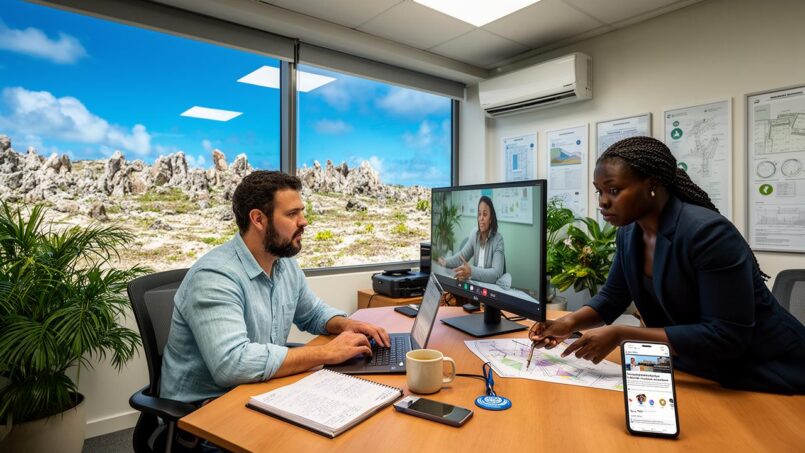
After decades of mining, primary phosphate deposits are nearly exhausted, leaving a devastated landscape in the center of the island. This situation has made much of the interior uninhabitable, now concentrating the population on the coastal fringe.
Today, a few economic pillars dominate:
– the remnants of phosphate-related activities (processing of existing stockpiles);
– the sale of fishing licenses, particularly for tuna in the exclusive economic zone;
– revenues and jobs linked to the Australian Regional Processing Centre (RPC) for asylum seekers;
– public administration, health, education, and basic services.
The result is a narrow labor market, with an official unemployment rate around 13.3%, very pronounced inequalities, and nearly a quarter of the population below the national poverty line. On the ground, job opportunities are limited, including for Nauruans themselves.
Dominant sectors and the weight of the state
The government of Nauru is, by far, the largest employer in the country. A significant portion of the local workforce works in:
– administration and public services;
– health (public hospital and community health centers);
– education;
– activities related to the Australian RPC.
Private industries in Nauru are embryonic and are mainly limited to retail trade, local transport, small construction, a few services, and artisanal fishing. Agriculture is very underdeveloped (dominated by coconut palms) and the exploitation of phosphate residues persists. More marginally, the country has practiced offshore banking and retains a low-tax jurisdiction status, but without offering the infrastructure of a modern financial center.
For expatriates, this means that most existing positions are either directly in the public (or semi-public) sphere, or in contracts linked to international aid, the United Nations, NGOs, RPC service providers, or projects funded by donors like the Asian Development Bank.
Where are the real jobs for foreigners?
Despite the tiny size of the country, several niches exist for foreign workers. But these are micro-niche markets, often reserved for highly specialized profiles, and almost always accessible only after securing a remote contract.
Healthcare: an under-pressure system that recruits internationally
The Nauruan healthcare system relies almost entirely on the public hospital, the Republic of Nauru Hospital (RONH) in Yaren, supplemented by a few district health centers. Services remain basic, with little heavy equipment and a heavy dependence on medical evacuations to Australia (particularly Brisbane) for all complex pathologies.
This structural weakness translates into a chronic need for medical specialists and experienced healthcare personnel. Recent advertisements targeting Nauru include, for example:
| Medical position sought | Type of facility | Nature of the mission |
|---|---|---|
| Anesthesiologist | Hospital / care center | Anesthesia management, operating room |
| Cardiologist | Nauru health team | Monitoring cardiovascular pathologies |
| Emergency Medicine Consultant | Nauru Medical Centre | Emergency and acute care |
| Oncologist | National oncology service | Structuring and directing oncology |
| Urologist | Hospital | Surgery and urological pathologies |
| Pediatric Nurse | Nauru Medical Centre | Pediatric care |
These positions are typically held by expatriates, often on fixed-term contracts, with housing and certain benefits included. The work takes place in a constrained environment (lack of equipment, frequent evacuations, high prevalence of chronic diseases such as type 2 diabetes, obesity, or cardiovascular pathologies), which presupposes a strong capacity for adaptation.
The cost of an air medical evacuation from the country, in Australian dollars, can exceed this amount.
Hospitality, food service, and other services: small teams, a few positions
Tourism remains marginal in Nauru. There are no large resorts or massive flows of visitors. However, a few hotels and restaurants structure a small service economy where positions open to foreigners sometimes appear.
Recent advertisements mention, for example:
| Position in hospitality and food service | Link to Nauru |
|---|---|
| Accountant with hotel experience | Financial management of a Nauru establishment |
| Chef de partie (hot kitchen, Italian and Western specialties) | Strengthening a local kitchen brigade |
| Bartender / Cashier | Service in a bar/restaurant on the island |
This type of position may appeal to profiles seeking an atypical experience in an island environment, but one should not expect salaries comparable to major metropolises, nor long-term career prospects. These are more akin to short assignments or regional stepping stones than “classic” expat positions like those in Singapore or Dubai.
Hospital management, logistics, and support functions
Beyond direct care, the management of healthcare facilities and the systems for evacuation or transfer of patients to Australia generates other needs:
Main functions and positions held in the field of medical management and coordination.
Responsible for the strategic and operational direction of a healthcare facility, ensuring quality of care and resource management.
In charge of coordinating patients, particularly Nauruan patients referred to Australia, ensuring follow-up and logistics for care pathways abroad.
Management of flows of medical supplies, medications, and equipment as a Senior Procurement Specialist, optimizing the supply chain and contracts.
These functions require strong technical expertise (health management, logistics, international negotiation, supply chain) and are aimed almost exclusively at experienced professionals, often already familiar with the Pacific or fragile health systems.
Education, NGOs, United Nations: windows, but very limited
Education and the non-profit sector are mentioned among areas that might host expatriates: teachers, trainers, nature conservation experts, development project staff. However, the volume of positions is minuscule.
Advertisements from the United Nations related to Nauru illustrate this reality well. Several positions have been posted in recent years:
– NDC National Coordinator (UNOPS, Yaren, remote position, retainer);
– Parliamentary Development Consultant (UNDP);
– Child Protection Technical Specialist (UNICEF, volunteering);
– several positions for “UN Country Coordination Specialist” or “Programme Management Officer” based in Yaren.
Most of these announcements have now expired, and Nauru is classified as hardship level “D” (A being the easiest, E the hardest), reflecting the isolation, scarcity of services, and harshness of living conditions. These contracts typically include a hardship allowance and are designed as specific, temporary missions, not long-term settlements.
“Nauru” opportunities… without living there: the wave of 100% remote jobs
One element often blurs the perception of the Nauru job market: the multitude of job offers “linked” to Nauru on certain platforms, even though they are entirely remote and have no real economic connection to the island.
One specialized platform lists over 380 positions associated with Nauru, but these are actually “remote anywhere” jobs – meaning accessible from any country – in various sectors: legal, marketing, IT, security, HR, etc.
Here are some examples of positions listed as available “from Nauru” but which, in practice, correspond to global remote work:
Examples of positions listed from Nauru
| Job Title | Type | Indicative Compensation |
|---|---|---|
| Health Care Attorney (Transactional) | Full-time, 100% remote | 137,000 – 200,000 USD/year |
| Associate in Public Works Construction | Full-time, 100% remote | 127,500 – 185,000 USD/year |
| Senior Manager, Demand Generation | Full-time, 100% remote | 130,000 – 150,000 USD/year |
| Staff Database Administrator | Full-time, 100% remote | 134,133 – 208,254 USD/year |
| MuleSoft Architect | Freelance, 100% remote | 75 – 85 USD/hour |
| Python AI Engineer | Freelance, 100% remote | 30 – 70 USD/hour |
| Governance and Brand Specialist | Full-time, 100% remote | 2,600 – 3,400 EUR/month |
There are also a series of creative or technical positions (Laravel developer, WordPress, front‑end, Shopify, CRO specialist, SEO project manager, graphic designer, motion designer, sales associate, etc.) paid between 15 and 35 USD/hour, always global remote work.
Although the rise of global remote work makes it theoretically possible to live in Nauru while working for foreign companies, the local reality presents major challenges. These include often slow and expensive internet connections, the absence of a true ecosystem for digital nomads, and high housing costs for foreigners, making this combination difficult in practice.
Some players like Mapmelon or Flatio highlight coliving offers with high-speed internet for remote workers, but most sources emphasize that Nauru is not, today, a credible “hub” for digital nomads: rare and expensive flights, limited infrastructure, sometimes unstable connections. On the margins, a remote worker already well-established in their career might choose Nauru for a very particular life experience, but this choice remains the exception.
A deceptive cost of living: relatively low, but high for expatriates
International cost of living comparators rank Nauru below the global average (about 1.56 times cheaper than the global average), and less expensive than countries like the United States, Australia, or Vanuatu. The island thus ranks around 139th out of 197 countries in terms of expensiveness, and would be the 85th “best country to live in” according to a composite index.
However, these figures mask several crucial realities for an expatriate.
Spending structure: housing, food, transportation
A common estimate places the monthly cost of living for a single person, including rent, around 733 USD, and for a family of four at 1,813 USD. Other, higher sources mention a budget between 1,500 and 2,500 USD per month for a single person including rent. Conversely, more detailed calculations yield very low average baskets, based on the local standard of living.
We can summarize some orders of magnitude (monthly data, in US dollars, when available) as follows:
| Profile | Food | Rent + utilities | Transport | Estimated total |
|---|---|---|---|---|
| Single person – “local” estimate (low) | ≈ 262–293 | ≈ 309 | ≈ 24–29 | ≈ 669 |
| Single person – “realistic expat” budget | 400–950 | 400–1,500 | 15–200 | 1,500–2,500 |
| Family of 4 – average basket | ≈ 686–768 | ≈ 549 | ≈ 66–79 | ≈ 1,681–1,813 |
Housing is particularly unstable: the majority of Nauruans live in state-subsidized housing, but foreigners must turn to a few hotels or private accommodations, sometimes listed at very high prices. Sources thus mention:
– a 1-bedroom apartment in the city center for 245–352 USD/month according to some indices;
– but rents can reach 1,500 USD per month for a 1-bedroom in Yaren for an expatriate;
– 3-bedroom apartments around 434–666 USD/month (excluding the very high-end segment for foreigners).
Beyond these averages, the reality is that the supply of housing for non-residents is extremely limited. The two main hotels – the Od’n Aiwo Hotel (40–80 USD/night) and the Menen Hotel (80 USD and up) – capture most of the market. A few private units complete the offering, but there is no real structured real estate market or high-end rental stock.
Other spending items reflect the widespread dependence on imports:
Imported food (canned goods, processed products) remains expensive and dominant, contributing to health problems like obesity and diabetes. For expatriates, services (gym, internet, health insurance, international school) represent a significant budget. Local travel is limited and gasoline costs about 1.02 USD/liter, but international travel is expensive.
Local salaries vs. cost of living
Estimates of average salaries vary widely: some sources mention 613 USD monthly income for most residents, others speak of a net average of 683 USD, or even 2,150 USD according to another dataset, with a salary range from 720 to 4,700 USD per month.
A possible summary is to consider that:
| Salary indicator | Indicative amount (USD/month) |
|---|---|
| Average income of many residents | ≈ 613 |
| Net average salary (source 1) | ≈ 683 |
| Average salary (source 2) | ≈ 2,150 |
| Overall declared range | 720 – 4,700 |
Even taking a “high” average salary of 2,150 USD, the wiggle room remains limited if one adopts an expat lifestyle, with unsubsidized housing, private health coverage, international schooling, and regular travel. On the other hand, coupled with the fact that employment income is not subject to a classic income tax, this can remain attractive for certain highly specialized profiles with advantageous packages.
A very particular legal, fiscal, and migratory environment
Before thinking about “employment,” one must understand the key triad that conditions an expatriate’s installation in Nauru: immigration policy, the tax framework, and labor regulations.
One of the most restrictive immigration regimes in the Pacific
Nauru is reputed to have one of the most restrictive immigration regimes in the region. The Immigration Division, attached to the Department of Justice and Border Control, applies the Immigration Act 2014 and very strict regulations. Most foreigners need a visa, no visa is issued “simply” upon arrival (except in very targeted cases), and the tourist stay is limited to 30 days.
To work, obtaining a visitor visa is not sufficient. The relevant categories are:
Presentation of the main visas allowing work, investment, or residence in Nauru, with their specific conditions.
Authorizes salaried work in Nauru for up to two years, based on a contract and sponsorship by a local employer.
Intended for foreign workers coming to fill skill shortages in Nauruan businesses. Very expensive visa (8,000 USD for one year) for positions deemed ‘critical’.
For entrepreneurs and investors, with an entry fee of around 6,000 USD for one year and a requirement for a business license.
For family members, only under specific conditions.
Added to this is a climate where obtaining complex visas (for example for journalists) is described as very difficult and sometimes tainted by corruption, with exorbitant amounts (several thousand dollars).
Concretely, an expatriate who lands a job in Nauru almost always goes through a sponsorship procedure driven by the employer (ministry, hospital, international organization, company under RPC contract, etc.). It is extremely rare to “come on site and look for work.”
A territorial tax framework, without generalized income tax
On the tax front, Nauru has long been perceived as a tax haven. The current reality is more nuanced: there is no global tax on personal income, but targeted taxation mechanisms (Employment and Services Tax, Business Profits Tax, etc.), with a largely territorial system.
For a salaried expatriate, the main points are:
– remuneration received for work performed in Nauru is deemed Nauruan in origin, even if paid from abroad;
– the employer is required to withhold employment taxes at source, according to scales that provide a broad non-taxable threshold, then a rate of 20% above that, with certain higher rates for non-residents linked to the RPC;
– contributions to the Nauru Superannuation Scheme (NSS) are mandatory: 5% of salary from the employer, 5% from the employee;
– certain business or service income may be taxed separately under Business Tax or Non‑Resident Tax.
Nauru has no double taxation treaty with other countries. Expatriates must therefore manage their tax situation both in Nauru and in their home country, which may continue to consider them tax residents, tax their worldwide income, and require specific declarations. Although the absence of income tax in Nauru is an advantage, it is essential to check one’s status with one’s national tax authority.
Labor law, leave, working hours: a fairly simple framework
Labor standards are less formalistic than in large economies, but several structuring principles are found:
– a standard work week of 36 to 40 hours, generally Monday to Friday, from 8 a.m. to 5 p.m. with a lunch break;
– a limit of 48 hours per week, including overtime, except for specific exceptions;
– paid annual leave: 10 to 20 working days per year in the private sector, 6 weeks in the public sector;
– 10 days of paid sick leave per year for civil servants; in the private sector, it depends on contracts;
– 11 paid public holidays, with a salary premium of 200% for work on a public holiday.
As the market is very small, negotiation of employment conditions mainly takes place at the contractual level and within the power dynamic with an employer that is often unique in its segment (State, large international agency, large RPC-related company). Horizontal or vertical career prospects are also limited.
Creating or developing a business: opportunity or mirage?
For an entrepreneur or investor, Nauru may seem attractive on paper: light taxation, no broad income taxation, a lightly regulated labor market, theoretical access to a citizenship-by-investment program offering a passport and visa-free entry to nearly 90 countries. But here again, economic reality weighs heavily.
The size of the domestic market (10 to 12,000 people), weak purchasing power, the cost of importing, the lack of heavy logistical infrastructure (aside from the new port under development), and the risks of corruption in the awarding of public contracts drastically limit viable business models.
Sectors with potential, even modest, are rather:
Main economic areas offering development and investment opportunities in the local context.
Fishing activities and associated services such as maintenance, logistics, and resource monitoring.
Project development, particularly solar, funded by donors.
Catering, small hotels, maintenance, and local crafts.
Participation in infrastructure, port, or submarine cable projects funded by international institutions.
But obtaining a Business Visa, a business license, and – above all – significant contracts largely depends on the ability to navigate a politico-economic environment reputed to be opaque, with practices of public fund embezzlement and reported instances of police extortion.
Nauru has no mature real estate market, nor a classic land tenure system: most land is held on long-term lease, with a state right of reclamation for rehabilitating mined areas. An ambitious real estate project for expatriates therefore makes very little economic sense today.
Expat life: small community, strong proximity, great simplicity
In practice, the expat community in Nauru is small. There is no structured network of expat clubs, no dedicated neighborhoods, no great diversity of schools or leisure infrastructure. Contacts often go through specialized platforms or forums like ExpatWoman.com.
Daily life is characterized by: the set of usual activities, routines, and social interactions that make up the day-to-day life of an individual or group.
The Cayman Islands offer a generally safe atmosphere with a low level of violent crime. Society is conservative and highly hierarchical, structured around respect for elders and community values. The island culture, centered on family, fishing, and local events, is experienced daily through activities like barbecues, boat trips, sports, or the rare nightlife spots such as ‘The Reef Bar’.
The change of scenery is real, but the question is: for whom does this lifestyle make sense? For an NGO volunteer, a doctor on a mission, a UN specialist on a few-month mandate, an expert in port infrastructure funded by a donor, the answer can be positive, provided one accepts the isolation, the sobriety in terms of leisure, and the constraint of a possible emergency medical departure at any time.
How, concretely, to land a job in Nauru?
For an expatriate, the realistic approach breaks down into several highly structured steps.
1. Target the right sectors and the right channels
Jobs “physically” in Nauru are sought through:
– government announcements (HR Division, Chief Secretary Department) for public sector positions;
– specific hospital or clinic offers for medical profiles;
– calls for applications from the United Nations and associated agencies (UNDP, UNOPS, UNICEF, UNRC) for missions in Yaren;
– a few specialized recruitment platforms that list positions on the island (hotel accountant, chef de partie, hospital manager, procurement specialist, etc.).
Platforms like JOBISLAND or certain international job boards display “Nauru” lists which, often, refer either to positions abroad for Nauruans, or to global remote work. It is therefore necessary to distinguish clearly between what involves residence on the island and what is done remotely.
2. Get a signed offer… before starting any procedures
Testimonies converge: “finding a job in Nauru is not easy” and the implicit rule is simple: you don’t settle in Nauru to look for work; you come to Nauru because you already have a signed contract.
The employer usually manages the visa application (Employment, Business, or Local Business (Employment) Visa) with the Department of Justice and Border Control. Without this institutional support, obtaining a long-term residence permit is almost impossible.
3. Negotiate package, insurance, and living conditions
When negotiating the contract, an expatriate should focus on: working conditions, compensation, health coverage, social benefits, and relocation.
Main elements covered and living conditions for expatriate assignments.
Coverage depending on the type and location of housing. The cost may be borne by the employer.
Covers medical evacuation and care in third countries like Australia, New Zealand, and Fiji.
Annual round-trip airfare to home country covered.
Financial assistance for children’s education at schools abroad if necessary.
Annual leave and possible rotation system, with missions of several weeks or months followed by rest periods off the island.
Salary data being very heterogeneous, it is useful to use cost of living simulators and compare the offered package to what it actually allows locally, factoring in constraints (access to care, isolation, travel costs).
4. Prepare psychologically and logistically
Nauru is not a “mainstream” expat destination. One must accept:
– a limited range of consumer goods;
– an expensive and unreliable internet connection;
– very limited healthcare infrastructure;
– the absence of major cultural life or shopping;
– a certain administrative opacity and risks of minor extortion or dysfunctions within the state apparatus.
A complete personal medical kit, good health preparation (vaccinations, check‑up), a financial reserve for emergencies, and an ability to live in a very community-oriented environment are essential.
In summary: an ultra-niche market, demanding and not very expandable
The job market in Nauru has nothing to do with that of a small tourist country or a regional hub. It is a micro-economy:
The economy of this territory is structured around a limited number of expatriate positions, heavily dependent on international aid and foreign contracts (notably with Australia via the RPC), and relies on fishing licenses. It is characterized by an omnipresent state and an under-pressure administration, where access to public markets presents risks of corruption. Finally, it is extremely vulnerable to external shocks, particularly climate-related: risk of submersion by 2050, threat to tuna stocks, and rising sea levels.
For an expatriate, opportunities exist, but they are essentially of four types:
– medical and paramedical positions reinforcing a fragile health system;
– functions in management, logistics, or project coordination, particularly in health, infrastructure, fisheries, or international aid;
– limited-duration missions for UN agencies and NGOs;
– a few positions in hospitality and accounting, within an embryonic tourism offering.
Some job offers are presented as accessible ‘from Nauru’ but actually correspond to 100% remote positions for foreign companies. These opportunities do not require residing on the island and are part of the global telework trend.
For those who know exactly what they are coming to do – help stabilize a public hospital under pressure, pilot a development program, manage the logistics of medical evacuations, or launch a well-targeted project in a sector supported by donors –, Nauru can constitute a strong, demanding, and deeply unique professional experience. For those looking for a simple “expat job in the sun,” however, the gap between fantasy and reality is likely to be brutal.
Disclaimer: The information provided on this website is for informational purposes only and does not constitute financial, legal, or professional advice. We encourage you to consult qualified experts before making any investment, real estate, or expatriation decisions. Although we strive to maintain up-to-date and accurate information, we do not guarantee the completeness, accuracy, or timeliness of the proposed content. As investment and expatriation involve risks, we disclaim any liability for potential losses or damages arising from the use of this site. Your use of this site confirms your acceptance of these terms and your understanding of the associated risks.

Cyril Jarnias is an independent expert in international wealth management with over 20 years of experience. As an expatriate himself, he is dedicated to helping individuals and business leaders build, protect, and pass on their wealth with complete peace of mind.
On his website, cyriljarnias.com, he shares his expertise on international real estate, offshore company formation, and expatriation.
Thanks to his expertise, he offers sound advice to optimize his clients' wealth management. Cyril Jarnias is also recognized for his appearances in many prestigious media outlets such as BFM Business, les Français de l’étranger, Le Figaro, Les Echos, and Mieux vivre votre argent, where he shares his knowledge and know-how in wealth management.





