
 Published on and written by Cyril Jarnias
Settling in Oman means entering a country where religion is not merely a matter of private faith, but a framework that structures the rhythms of the day, social relations, the holiday calendar, the way of dressing, and even foreign policy. For an expatriate, understanding these codes is not just a matter of politeness: it is the key to truly feeling integrated and avoiding missteps.
Good to know:
This guide explains the specifics of life in a majority-Ibadi country. It details the course of religious holidays like Ramadan, Eid al-Fitr, and Eid al-Adha, as well as expected behaviors in public spaces, the workplace, and mosques. It also specifies how the official policy of religious tolerance applies concretely to non-Muslims.
A Muslim country… but unlike others
Oman is situated at the southeastern tip of the Arabian Peninsula. Modern, peaceful, and renowned for its stability, the country remains deeply attached to its Islamic roots and traditional values: importance of family, respect for elders, modesty in attitude and dress, and a strong sense of hospitality.
Ibadi identity, the backbone of Oman
Unlike most of its predominantly Sunni or Shiite neighbors, Oman is uniquely, a majority-Ibadi country. Ibadism is one of the oldest branches of Islam, predating the Sunni-Shiite split. In Oman, approximately 70% of Muslims are Ibadis according to some estimates, while other sources place Ibadis and Sunnis each around 45% of Muslims, with Shiites representing about 5%. Regardless, it is Ibadism that shapes the national religious identity.
Important:
Ibadism is distinguished by its emphasis on moderation, justice, and personal responsibility. Unlike extremist currents, it rejects the practice of takfir (excommunication). Ibadis consider other Muslims not as apostates, but as ‘ungrateful’ towards God, thus fostering peaceful coexistence between the different schools of Islam.
This religious tradition has strongly inspired the country’s political positioning: a search for compromise, refusal of bloc alignments, a mediator role in regional conflicts, dialogue with all – from Iran to Gulf countries, and including Western actors. For an expatriate, this is felt in a generally tolerant and non-confrontational daily atmosphere.
Religious diversity and the legal framework
Article 2 of the Omani Basic Law states that Islam is the state religion, but the constitution also guarantees freedom of belief and prohibits discrimination based on religion. Approximately 90 to 95% of the population is Muslim; the rest is composed of Christians, Hindus, some Buddhists, Sikhs, and other minorities.
Good to know:
Non-Muslims may practice their religion in officially recognized places of worship or in private. Muscat has churches (Catholic, Protestant, Orthodox), two large Hindu temples, as well as places of worship for Sikhs and Buddhists. All such places must be registered with the Ministry of Endowments and Religious Affairs (MERA).
The same legal framework that protects minorities also sets limits: for example, proselytizing in public is prohibited. Defamation of any religion (Islamic or not) is criminally punishable, including when committed online. For an expatriate, this means one can live their faith (or lack thereof) quietly, but should avoid aggressive religious debates, criticism of Islam or the Prophet, and any visible conversion activities.
How religion structures daily life
In Oman, religious practice is deeply intertwined with the organization of time, the functioning of businesses, the urban landscape, and social customs.
The five daily prayers and Friday
The five canonical prayers – Fajr (dawn), Dhuhr (noon), Asr (afternoon), Maghrib (sunset), Isha (night) – structure the day. The call to prayer (adhan) resonates from minarets in all cities, reminding everyone of this spiritual tempo.
Tip:
Although civil law does not impose prayer on non-Muslims, society adapts to these moments. Shops may close briefly, traffic calms near mosques, and practicing employees may be absent for a few minutes, especially for the Dhuhr and Asr prayers. Friday, the day of congregational prayer (Jumu’ah), is the main day of rest, replacing Sunday. Many offices and businesses then have reduced hours or are closed.
To adapt, an expatriate benefits from:
– integrating prayer times into appointment planning,
– avoiding scheduling crucial meetings during the Friday prayer slot,
– accepting that a colleague may briefly step away to pray.
Studies on prayer in general show that it plays a role in emotional regulation, discipline, and social cohesion. In Oman, this is seen in the importance given to the regularity of prayers and their communal dimension.
Central role of the mosque
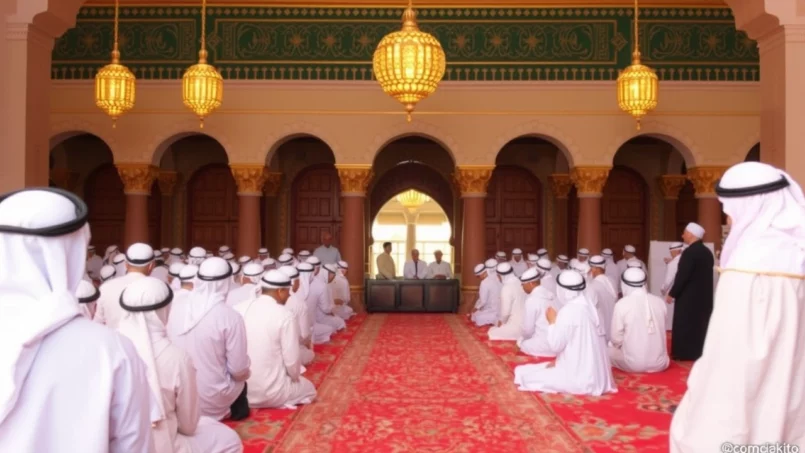
The mosque is not just a place of worship: it is a social gathering point, a space for religious teaching, sometimes even a place associated with life events (children’s first Quran recitations, wedding announcements).
Example:
In Oman, followers of the main schools of Islam (Ibadi, Sunni, and Shiite) often pray together in the same mosques. An emblematic example is the Sultan Qaboos Grand Mosque in Muscat, whose architecture deliberately incorporates elements from all three traditions. This coexistence comes with strict regulation: imams must be registered, Friday sermons are harmonized using texts validated by the Ministry of Endowments and Religious Affairs (MERA), and sermons may not address political subjects.
For a non-Muslim, the mosque is first and foremost a sacred space that requires impeccable behavior: modest dress, quiet voice, respectful movements, no photos of worshippers in prayer, shoes removed at the entrance to the prayer hall.
Ramadan in Oman: what expatriates really need to know
Ramadan is arguably the time when the religious dimension of Oman is most felt in the daily life of expatriates. It is the ninth month of the Islamic lunar calendar, considered one of the holiest. Muslims fast from dawn to sunset: no food, drink, or cigarettes during this period. Ramadan is also a month of intensified prayer, Quranic readings, charity, and community life.
The legal framework: a rule that also applies to non-Muslims
In Oman, respect for the fast is reinforced by legal regulations. Article 277 of the Penal Code prohibits eating and drinking in public during fasting hours, for anyone over 15 years old, regardless of religion. Offenders risk a prison sentence ranging from 10 days to three months.
Concretely, a non-Muslim expatriate or traveler must:
Good to know:
During the month of Ramadan, it is important to respect local practices in public. One should avoid eating, drinking, smoking, or chewing gum between dawn and sunset. Meals should only be taken in private spaces (home, hotel room, closed vehicle) or in discreet areas arranged in some hotel restaurants. Furthermore, loud music is proscribed during the day; legislation and custom favor calm or the broadcasting of Quranic recitations in public places.
This strictness distinguishes Oman from neighboring destinations like Dubai, where non-Muslims eating in certain public spaces is more tolerated.
Atmosphere and hours during Ramadan
The day is slower: fatigue, low energy, heat, and fasting explain a less intense pace. Working hours are officially reduced: five hours daily in the public sector (e.g., 9 a.m.–2 p.m.), six hours per day in the private sector. Many small shops close for longer during the day to reopen in the evening.
Restaurants and cafes outside hotels are, in general, closed during the day. International hotels remain the main refuge for lunch away from view, often behind partitions or in rooms not visible from outside. Supermarkets and shopping malls are open but adapt their hours, with high traffic in the late afternoon and evening.
Example:
Approaching sunset (Maghrib), traffic becomes intense as people rush to get home or to the mosque. Immediately after the call to prayer, families break their fast with Iftar, traditionally starting with dates and water before sharing a more substantial meal. Cities then come alive: souks and markets fill up, while parks and beaches transform into spots for nighttime picnics, illustrating the communal and festive atmosphere of this moment.
For expatriates, it is wise to:
– avoid driving right before Iftar, when traffic becomes hectic;
– plan grocery shopping outside of this time slot;
– accept an invitation to Iftar when offered: it is one of the richest cultural experiences in the country.
Practical tips for expatriates and visitors during Ramadan
Traveling or working in Oman during Ramadan is not impossible, provided you plan well.
Here is a summary table of some concrete effects of Ramadan on daily life and the best ways to adapt:
| Aspect of daily life | Specifics during Ramadan | Tips for expatriates and visitors |
|---|---|---|
| Dining during the day | Street restaurants and cafes closed or behind closed doors | Prefer hotel restaurants, keep snacks/water to consume discreetly |
| Work hours | Shortened day (5–6 hrs), productivity concentrated in the morning | Schedule important meetings for early in the day |
| Driving and traffic | Heavy traffic before Iftar, some drivers less alert | Avoid driving before Maghrib, allow extra time |
| Dress code | Heightened expectation for sobriety and modesty | Opt for longer sleeves and hemlines, avoid tight or overly casual outfits |
| Social life | Intense nighttime activity: Iftar, souks, family visits | Explore night markets, accept invitations, remain flexible |
| Alcohol consumption | Sales halted in specialty outlets, service delayed in hotels | Plan ahead, accept very limited and later consumption |
Delivery apps (like Talabat) continue to operate, which can help organize meals in private. On day trips, bringing water and snacks in a bag, and agreeing with the guide on discreet moments to eat, is generally accepted.
Eid al-Fitr and Eid al-Adha: two major holidays to know
At the end of Ramadan comes Eid al-Fitr, the “Festival of Breaking the Fast.” Later in the year, Eid al-Adha, the “Festival of Sacrifice,” commemorates Ibrahim’s willingness to sacrifice his son on God’s command. These two holidays are national public holidays and have a concrete impact on expatriate life.
Eid al-Fitr: celebrating the end of fasting
Eid al-Fitr begins after the sighting of the new crescent moon. The day before, families clean, buy new clothes, prepare festive dishes, and give the specific alms for the end of Ramadan (Zakat al-Fitr), intended for the needy.
On the morning of Eid, worshippers gather for a large communal prayer (Salat al-Eid) organized in mosques or on vast esplanades. Men often wear an immaculate dishdasha, women elegant abayas, sometimes colorful traditional dresses. The greetings ‘Eid Mubarak’ fly in all directions, and family visits follow one after another. Children receive gifts and money envelopes.
Celebrating Eid
Culinarily, it is an opportunity to savor specialties like shuwa (lamb slowly cooked in an underground oven), large platters of rice and meat (kabsa, mandi, majboos), Omani halwa flavored with saffron and rose water, and of course mountains of dates.
For non-Muslims, Eid al-Fitr is a privileged moment to:
– see a more festive Oman, with traditional attire everywhere;
– take advantage of special offers in hotels and restaurants;
– accept, again, invitations to families or majlis (reception rooms).
Conversely, many services are disrupted: government offices closed, some businesses on minimal service. It’s best to avoid launching a major professional project during the week of Eid.
Eid al-Adha: the festival of sacrifice and solidarity
Eid al-Adha takes place about 70 days after Eid al-Fitr. It coincides with the major pilgrimage to Mecca (Hajj), which many Omanis perform each year. While Mecca remains off-limits to non-Muslims, you will see the echo of this pilgrimage in sermons and the general atmosphere in Oman.
Example:
The central ritual of this holiday is the sacrifice of an animal (Udhiya, often a sheep or goat). The meat is then divided into three equal parts: one for the family, one for relatives and neighbors, and one for those in need. This sharing symbolizes the spirit of personal sacrifice and community solidarity that defines the celebration.
The days of Eid al-Adha are also public holidays and span several days. Practical consequence for expatriates: a large portion of businesses close, administrations stop, and travel logistics (for example for a road trip or weekend in the desert) must be planned carefully.
Here is a comparative summary of the two major holidays to navigate them better:
| Key element | Eid al-Fitr | Eid al-Adha |
|---|---|---|
| Time of year | Immediately after Ramadan | Approx. 70 days after Eid al-Fitr (during Dhu al-Hijja) |
| Main meaning | End of fasting, gratitude, forgiveness | Sacrifice, charity, connection with the Hajj |
| Central ritual | Eid prayer, end-of-fast alms (Zakat al-Fitr) | Eid prayer, animal sacrifice (Udhiya) |
| Impact on work life | Partial business closures | Marked closures of businesses and services |
| Experience for expats | Festive atmosphere, special Iftar buffets in hotels | Relative calm, need to plan travels ahead |
The Sultan Qaboos Grand Mosque: a bridge between faith and discovery
To understand the place of religion in Oman, a visit is essential: the Sultan Qaboos Grand Mosque in Muscat. This is not just the country’s largest mosque, it is also a powerful symbol of the Sultanate’s policy of controlled openness.
A place of worship and a cultural center
Inaugurated in 2001 as “a gift from the Sultan to the people,” the mosque has the capacity to accommodate some 20,000 worshippers, including 6,500 in the main prayer hall and 750 in the women’s prayer hall. Five minarets, recalling the five pillars of Islam, dominate a vast complex of over 400,000 m².
1
The carpet in the mosque’s main hall is one of the largest in the world, woven as a single piece.
But the mosque is more than a postcard: it also houses a library of over 20,000 volumes, an Islamic information center, and serves as a venue for conferences, exhibitions, courses in religious sciences and Arabic. It concretely illustrates the dual Omani objective: to remain faithful to Islam while promoting dialogue.
Visiting conditions for non-Muslims
The mosque is one of the few places of worship in the country accessible to non-Muslims during dedicated time slots. Admission is free, but several rules are non-negotiable:
Important:
Access for non-Muslim visitors is limited to certain hours (generally Saturday to Thursday, mornings). Strict dress code is required: arms and legs covered for all, hair covered for women, with loose and opaque clothing. It is imperative to remove shoes before entering prayer halls and to adopt discreet behavior: no loud conversations, phone on silent, and no intrusive photos of worshippers or staff.
Abayas and headscarves can be rented on-site for insufficiently covered female visitors. It is common for a woman wearing a skirt above the ankle to be denied entry, proof that the rules are applied strictly.
Volunteer or professional guides offer guided tours, often very educational about Islam in general and Ibadism in particular. It is the ideal place to ask questions in a setting designed for interfaith dialogue.
Dress code: modesty as a common language
Whether believer or not, dress code is one of the first areas where one is called to adapt. In Oman, modesty is as much a social norm as a religious value.
What is expected of expatriates in public spaces
The golden rule is simple: shoulders and knees covered, non-form-fitting clothes, non-transparent materials. This principle applies to both men and women, although social pressure is often stronger on the latter.
In major urban centers like Muscat, a ‘conservative chic’ outfit (midi dresses, three-quarter sleeves, tailored trousers) is appropriate for expatriates. Outside the capital, in villages, wadis, or mountain regions, it is advisable to opt for longer sleeves and trousers. Women may keep a headscarf handy if the situation suggests it.
On public beaches, avoid the classic bikini. Omani women generally wear burkinis or covering swimsuits. An expatriate woman choosing a one-piece swimsuit with shorts and a t-shirt or swim leggings follows a respectful compromise. In hotel pools and private beaches, Western swimwear is accepted.
Traditional dress codes, useful references
Traditional attire gives a good insight into local standards of modesty:
Men wear the dishdasha, a long tunic often white, with a kumma (cap) or mussar (turban). For grand occasions, they add a bisht (cloak) and a khanjar (dagger). Women typically wear a dark abaya with a hijab. For holidays, they opt for colorful embroidered dresses, sometimes adorned with jewelry.
No one will ask you to wear a dishdasha or abaya as an expatriate, but buying traditional attire for major holidays or certain formal events can be an appreciated sign of integration.
Behaviors and etiquette with a strong religious tone
Even if all these rules are not written in law, they belong to an “implicit code” deeply rooted in Islamic values and tribal culture.
Greeting, speaking, behaving
The standard greeting is “As-salamu alaykum” (“Peace be upon you”), to which one replies “Wa alaykum as-salam”. Using this phrase, even as a non-Muslim, is a much-appreciated sign of respect. It can be combined with phrases like “sabah al khayr” (good morning) or “misa al khayr” (good evening).
When meeting someone, it is common to take a few moments to ask about their health and family. Rushing into professional matters without this preamble may be perceived as abrupt.
Handshakes are the norm between men. Between people of the opposite sex, restraint is necessary: wait for the Omani person to extend their hand first. If they do not, a nod or verbal greeting (‘salam alaykum’) is sufficient. Forcing physical contact is very poorly viewed.
The body itself speaks: avoid pointing fingers, showing the soles of your feet, raising your voice, or expressing anger in public. Obscene gestures, insults, or loud arguments can even lead to legal complaints.
Hospitality and meals: an almost sacred dimension
Omani hospitality is famous. When offered coffee (kahwa, flavored with cardamom) and dates, it is generally impolite to refuse. Hold the small cup with the right hand, offer it for a refill, and when you no longer wish to drink, shake it slightly or simply say you are satisfied.
When invited, it is customary to remove shoes before entering and to bring a small gift, like dates, sweets, or a souvenir from your country. Meals are often served in a common dish placed on a cloth on the floor; everyone serves themselves with the right hand. Wait for the host to begin eating, avoid getting up abruptly, and do not finish all the food: leaving a little signifies that the abundance was sufficient.
All these habits are embedded in a religious worldview where feeding others, welcoming the stranger, and sharing are meritorious acts in the eyes of God.
Official tolerance and interfaith dialogue
Beyond daily life, Oman has invested much symbolism and resources in promoting an image of a tolerant and open Islam. This is not just a slogan: there are many programs and institutions that testify to it.
The Ministry of Endowments and Religious Affairs (MERA) has for years organized international conferences, exhibitions, interfaith meetings. The project “Tolerance, Understanding, Coexistence: Oman’s Message of Islam” is a traveling exhibition that has been presented over a hundred and thirty times in nearly forty countries, mixing explanatory panels, calligraphy, multilingual films, and objects. Its stated goal is to show an Omani Islam attached to peace, dialogue, and diversity.
In Muscat, the Al Amana Centre, originally a missionary initiative of the American Reformed Church, has transformed into a platform for interfaith dialogue. It organizes study abroad programs, sometimes advises international bodies like the UN, and co-hosts shared scriptural readings between different faiths.
For an expatriate who is Christian, Hindu, atheist, or otherwise, this translates concretely into:
– the possibility of attending conferences or public events related to these themes;
– an environment where displaying a different religious identity does not, in itself, provoke social rejection;
– a reciprocal expectation: tolerance goes hand in hand with restraint (no unsolicited proselytizing, no provocations).
Understanding certain limits: sensitive topics and prohibitions
Religious freedom in Oman exists within a very precise framework. Several red lines must not be crossed:
Openly criticizing Islam, the authorities, or the Sultan; organizing public conversion activities; using the internet to spread offensive remarks towards religion or disturb public order; as well as consuming alcohol in public, appearing drunk, or consuming drugs are taboo behaviors, illegal, or severely punished.
Expatriates must also understand that certain discussion topics – regional politics, sectarian tensions in other countries, criticism of imams – are best avoided in conversations, except with very trusted interlocutors and in private.
Navigating the calendar: Islamic holidays and national days
The Omani calendar combines Islamic holidays, based on the lunar calendar, and some major national dates.
The main religious observances are:
– the month of Ramadan, a time of fasting and prayer;
– Eid al-Fitr, the holiday that concludes it;
– Eid al-Adha, the great Eid of Sacrifice;
– the Islamic New Year (1st of Muharram);
– Mawlid (the Prophet’s birthday), celebrated according to Sunni traditions and sometimes on slightly different dates for Shiites;
– special nights like Lailat al-Miraj (the Prophet’s Night Journey).
November 18th celebrates the country’s independence from Portugal and the anniversary of the late Sultan Qaboos. July 23rd, called Renaissance Day, commemorates his ascension to power in 1970, marking the beginning of the country’s modernization.
These public holidays result in the closure of government offices and a festive atmosphere: parades, fireworks, light decorations, concerts, and events highlight a patriotism that fully embraces its Islamic character.
Expatriates planning vacations, trips home, or professional projects benefit from knowing these dates (often officially announced at the start of the year) to avoid scheduling administrative procedures or major travel during these periods.
To conclude: adopting a posture of active respect
Living in Oman as an expatriate is not simply about “tolerating” the religion of others, it is about learning to navigate an environment where the spiritual dimension permeates public space, laws, rhythms, and ways of behaving.
A few simple principles allow one to feel comfortable:
To integrate respectfully in Oman, it is advisable to observe and emulate local behaviors, such as dress code and greetings. One must accept slowing down during Ramadan and organizing one’s days around this calendar. Express sincere but non-intrusive curiosity by asking questions in appropriate settings (mosque visit, majlis), without provoking controversy. Finally, understand that Omani tolerance is based on a balance: broad private freedom is granted to minorities, but public space is strongly framed by Islamic norms.
In return, Omani society offers a safe, warm, and surprisingly welcoming environment for those who accept this implicit contract. Religion, far from being a wall, can then become a common language – even for those who do not share it – and a privileged entry point for deeply understanding this singular country that is Oman.

Cyril Jarnias is an independent expert in international wealth management with over 20 years of experience. As an expatriate himself, he is dedicated to helping individuals and business leaders build, protect, and pass on their wealth with complete peace of mind.
On his website, cyriljarnias.com, he shares his expertise on international real estate, offshore company formation, and expatriation.
Thanks to his expertise, he offers sound advice to optimize his clients' wealth management. Cyril Jarnias is also recognized for his appearances in many prestigious media outlets such as BFM Business, les Français de l’étranger, Le Figaro, Les Echos, and Mieux vivre votre argent, where he shares his knowledge and know-how in wealth management.





