
 Published on and written by Cyril Jarnias
Moving to a Gulf country can be a source of anxiety, especially when one only knows the **headlines about the region**. However, the reality of expatriate life in Oman is very different from the clichés. The Sultanate regularly ranks among the **world’s safest countries**, with extremely low crime rates, high political stability, and a population renowned for its hospitality.
For a smooth relocation, it is essential to understand the rules of conduct, cultural practices, local laws, the functioning of the healthcare system, the management of road and climate-related risks, as well as residency and work conditions. Comprehensive and practical preparation is recommended.
A very safe country… but one you need to understand
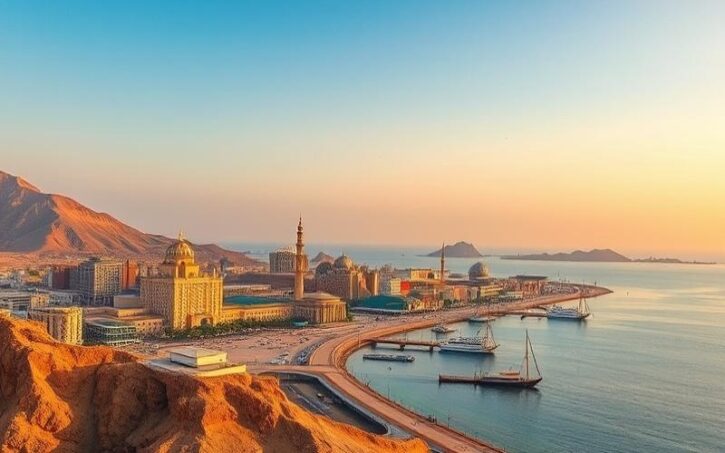
Oman is located on the southeastern edge of the Arabian Peninsula, bordered by the Arabian Sea, the Gulf of Oman, and featuring mountains, deserts, and wadis. This spectacular setting is the backdrop for a state described as one of the **most stable and peaceful** in the Middle East.
The safety index of the capital Muscat, ranking it among the safest major cities in the world.
On the political front, World Bank data on **stability** and **absence of violence** paint the same picture: Oman’s “Political Stability” indicator is clearly positive and above the global average. The regime, monarchical and highly centralized, strongly limits political expression, but the country is not affected by major internal conflicts or endemic organized crime.
This general stability translates into the daily life of expatriates: **fear of assaults, burglaries, or urban violence is almost non-existent**. However, to live peacefully, one must integrate **three key dimensions that are often underestimated**: road risk, the strictness of criminal law (especially regarding alcohol, drugs, morality, and finances), and weather hazards.
Crime, daily life, and police: what expatriates experience
From a crime perspective, available statistics and field reports converge. Levels of **violent theft**, **armed robbery**, or serious assaults are described as “extremely low.” Expatriates report very few criminal incidents, and the rare accounts mainly concern minor events.
Petty crime, although marginal, is concentrated in crowded souks and markets. It mainly takes the form of pickpocketing or opportunistic theft of unattended items. The risk of being a victim is comparable to that in major tourist destinations, but overall lower.
Perception data compiled over several years shows: **trends and significant changes in how individuals perceive various dimensions of their environment**.
– a very low level of concern regarding burglaries, car thefts, or physical assaults,
– a very high feeling of safety for walking alone, day or night,
– a low perceived level of violence related to ethnicity, religion, gender, or orientation.
Positive feelings regarding safety are explained by a dense and visible police presence, high operational efficiency of law enforcement, and perceived limited corruption. The Royal Oman Police (ROP) plays a central role in internal security, traffic regulation, visa management, and emergency response. Reports from expatriates of “baksheesh” or police extortion are rare, and the ROP’s reputation for seriousness is quite good.
A key point to remember for personal safety: the law is strictly enforced. Gestures and behaviors considered offensive – insults, obscene gestures, displays of anger – can lead to prosecution. This strictness, sometimes disconcerting for Westerners, also contributes to the general climate of public order.
Safety in Oman isn’t just about cameras and patrols. Cultural foundations play a big role. **Omani society** is conservative, deeply marked by Islam (predominantly Ibadi), and family-oriented. Values of respect, humility, restraint, and hospitality structure social life.
Expatriates are generally well-received provided they respect this framework.
In Oman, formal politeness is the norm. The common greeting is “As-salamu alaykum,” often followed by questions about health and family. Among men, a handshake is usual, sometimes a hug between close friends. However, in public spaces, any physical contact between unrelated men and women or spouses is prohibited. It is advisable not to spontaneously extend your hand to a person of the opposite sex and to wait for them to take the initiative.
Expatriates must also familiarize themselves with certain **gestural codes**: not pointing at someone, avoiding showing the soles of your feet towards your interlocutor, using your whole hand to indicate direction. It is also expected to **keep your cool**: raising your voice, berating another driver, or losing your temper in public can lead to real legal trouble, not just a warning.
Tips to facilitate integration and show your respect when invited to an Omani home.
Invitations to homes are often accompanied by Omani coffee (kahwa) and dates, symbols of welcome.
It is customary to remove your shoes at the entrance and to accept at least a little of what is offered.
Stubbornly refusing drinks or food can be interpreted as a sign of displeasure.
Bringing a small gift, like sweets or a specialty from your country, is a very well-regarded gesture.
Dress code, religion, and private life: a caution that protects
In public spaces, the general rule is modest dress. Men and women should cover their shoulders and knees, and avoid tight-fitting, transparent, or low-cut clothing. Very short shorts, sleeveless t-shirts, and torn or provocative slogan clothing are frowned upon, especially outside the most cosmopolitan areas.
It is not mandatory to wear a veil or abaya. However, it is recommended to opt for loose clothing covering at least the arms and legs below the knee, especially when traveling alone or in rural areas. It is useful to have a scarf on hand to cover hair in mosques or very conservative places.
In beach resorts or private pools, **Western-style** swimwear is accepted, but it is not tolerated to walk around in a **bikini** outside designated areas. Nudity, even partial (topless for men outside beaches or pools), is prohibited.
The **legal framework** reinforces this system of norms. Certain practices are explicitly forbidden and penalized:
– homosexuality and same-sex sexual relations,
– cohabitation of an unmarried couple, and sharing a hotel room by persons of the opposite sex without proof of marriage,
– cross-dressing or attire considered cross-dressing,
– production, possession, or distribution of pornographic content.
For expatriates, the message is clear: even if some international hotels are less strict in practice, it is safer to behave as if the law were strictly enforced everywhere. This limits the risk of unpleasant surprises in case of a check or dispute.
Rules on alcohol, drugs, and Ramadan: the law above all
Alcohol is permitted but highly regulated. Non-Muslim visitors can consume it in licensed hotels, bars, and restaurants. Non-Muslim residents can apply for a permit to purchase alcohol for private consumption at home. But in all cases, drinking in public outside authorized places, being drunk in the street, or driving under the influence are offenses.
In Oman, the legal blood alcohol limit for driving is zero. This offense is severely punished with heavy fines, license suspension, prison sentences, and can lead to deportation risk for serious cases. Furthermore, insurance may refuse any compensation in case of an accident if alcohol or drugs are involved.
Narcotics, even in tiny quantities, are an even more sensitive subject. The Sultanate applies a **zero-tolerance policy**. Possession, use, or trafficking of illegal drugs results in **very heavy penalties**: long prison sentences, fines, and, for trafficking, the possibility of the death penalty. Some medications containing opioids or codeine derivatives, common in Europe, are classified as controlled substances: it is better to enter with a prescription and boxes in their original packaging.
During Ramadan, it is forbidden for anyone, Muslim or not, to eat, drink, smoke, chew gum, dance, or listen to loud music in public places during the day, under penalty of criminal sanctions. It is advisable to adjust meal and travel times and enjoy a social life that shifts to the evening and night.
Roads, driving, and road risk: the real safety weak point
On paper, Oman’s road network is reassuring: **modern highways**, **well-designed interchanges**, spectacular mountain roads often well-paved. Traffic drives on the right, signage is generally bilingual Arabic/English, and speed limits are clearly marked.
Yet, according to converging views from national statistics and foreign observers, **the road is the main danger for an expatriate in Oman**. The country has long been among the states with the **highest road fatality rates relative to population**.
The official numbers speak for themselves: several hundred deaths per year, thousands of injuries, and serious accidents on average every few hours across the country. The determining factor, **regularly cited by the Royal Oman Police**, is **excessive speed**, which reportedly causes the majority of accidents. This is sometimes compounded by reckless driving (sudden lane changes, not keeping a safe distance), phone use while driving, and fatigue.
Omani authorities have significantly increased speed controls: proliferation of fixed and mobile radars, reduction of tolerance margins, a points system on licenses, and heavy fines. On major roads, such as in Muscat, automatic cameras are installed at close intervals. Although limits there can reach 120 or 140 km/h, the slightest infraction is systematically recorded.
Formal rules are numerous: mandatory seat belt use, prohibition of driving a vehicle in poor condition, obligation to yield to pedestrians, military convoys, or emergency vehicles, prohibition of phone use without a hands-free kit. In practice, an expatriate must primarily adopt four reflexes:
– defensive driving, anticipating the sometimes abrupt behavior of other road users,
– significantly reducing speed after nightfall, especially outside cities,
– being extremely cautious approaching roundabouts and quick exits,
– avoiding driving in adverse weather conditions (heavy rain, sandstorms) if possible.
Stray animals (goats, camels, cattle) represent an underestimated danger, especially in rural and desert areas. They can suddenly appear on the road, and a collision, particularly with a camel, often has dramatic consequences for vehicle occupants.
For travel outside Muscat, a car is almost essential, as the city is not designed for pedestrians and the bus network remains limited. It is prudent, especially for families, to:
– choose a vehicle in good condition, ideally a 4×4 for mountain or desert areas,
– keep water, snacks, a first aid kit, a warning triangle, and a charged phone in the car,
– inform a contact of your itinerary before a long trip or in an isolated area,
– avoid crossing a flooded wadi, even if the water level seems moderate.
In case of an accident, the reflex is to call the ROP at 9999, calmly assess the situation, and, unless there is immediate danger, not to leave the scene before the police arrive. Insurance and accident report procedures are highly codified.
Natural hazards and climate: adapting to an extreme environment
The Omani climate is both a tourist asset and a safety challenge. The country experiences scorching summers, with temperatures often above 40 °C (104 °F) and humidity that can rise sharply on the coast. Dehydration, heatstroke, or heat exhaustion are the main health risks for new, unacclimated arrivals.
At the same time, climate studies identify Oman as particularly vulnerable to extreme events related to warming: tropical cyclones, torrential rains, flash floods, sandstorms, droughts, and even tsunami risks linked to the Makran subduction zone.
Extreme weather episodes in recent decades have caused hundreds of deaths and billions of dollars in damage.
For expatriates, these phenomena remain exceptional events, but not theoretical. Being prepared for them significantly improves the perceived level of safety.
Some practical guidelines can be summarized in the following table:
| Risk type | Typical period / context | Main dangers for an expatriate | Basic good reflex |
|---|---|---|---|
| Extreme heat | Spring–summer, midday | Heatstroke, dehydration, fainting | Hydration, avoid physical exertion, stay in the shade |
| Tropical cyclones | Mostly between May and October | High winds, waves, power outages, floods | Follow weather alerts, stay sheltered |
| Wadi floods | Heavy rains, storms | Cars swept away, roads cut off | Never cross a flooded wadi |
| Sandstorms | All year, especially desert areas | Reduced visibility, respiratory irritation | Slow down, close windows, mask/goggles if needed |
| Regional tsunamis | Major earthquakes in the region | Coastal waves, localized flooding | Follow authorities’ instructions, move away from shore |
The Sultanate has implemented a national multi-hazard warning system, managed by meteorological services and the emergency management center, covering tsunamis, cyclones, and flash floods. Authorities disseminate alerts via media, SMS, social media, and institutional channels. In practice, many expatriates follow local bulletins and rely on their employer for specific instructions in case of a major event.
To effectively protect yourself from climate variations, adopt these daily reflexes: limit outings during the hottest hours, wear light but covering clothing, and bring a sweater for heavily air-conditioned interiors. Protect your airways during dusty episodes. In case of a weather alert, know and follow the procedure: stay home, avoid non-essential travel, and stay informed of the situation’s evolution.
Healthcare system, emergencies, and insurance: securing your coverage
The Omani healthcare system is relatively developed and well-structured. It relies on a public sector, managed by the Ministry of Health, and a rapidly expanding private sector, especially in Muscat. Major cities have modern hospitals, with material standards close to those found in Europe or North America, and often English-speaking staff.
For Omani citizens and nationals of the Gulf Cooperation Council, public healthcare is free. Expatriates, however, primarily use the private sector, except in cases of life-threatening emergencies or treatments unavailable in private clinics. They are then treated in public facilities, but with billing.
Since the introduction of the mandatory Dhamani scheme, private sector employers must provide basic health coverage to their employees, with an annual ceiling. Although sufficient for routine care and some hospital treatments, this insurance has limitations. Therefore, it is common for expatriates to purchase supplementary international health insurance for more extensive protection.
– major hospitalization,
– outpatient care,
– chronic diseases,
– maternity,
– medical evacuation to another country if necessary.
International players (Cigna, Allianz, Bupa, AXA, etc.) and local insurers offer products tailored for expatriates. The key element for a peaceful relocation is to carefully check the exclusions (uncovered pre-existing conditions, waiting periods, per-procedure ceilings) and the network of clinics with direct billing.
Single emergency number in Oman providing access to police, ambulances, and fire services, with state-funded free pre-hospital care.
Muscat and major cities have numerous hospitals, public and private. The table below summarizes some major reference institutions mentioned in sources:
| City / region | Type of facility | Example hospital or medical complex |
|---|---|---|
| Muscat | Public tertiary | Royal Hospital, Sultan Qaboos University Hospital |
| Muscat | Private | Muscat Private Hospital, Badr Al Samaa, Starcare |
| Salalah | Public regional | Sultan Qaboos Hospital – Salalah |
| Nizwa, Sohar… | Public regional hospitals | Nizwa Hospital, Sohar Hospital, Rustaq Hospital, etc. |
Pharmacies and general practitioners are widely available in urban areas, with 24/7 pharmacies in major cities. Some prescription medications in Europe can sometimes be found over the counter, but it is still preferable to seek a doctor’s advice for long-term treatments and not to self-medicate excessively.
Legal framework, finances, and residency: avoiding missteps
Oman offers appreciable advantages for expatriates: no personal income tax, a cost of living often more affordable than in neighboring major capitals, monetary stability with the Omani rial pegged to the dollar, and a fairly clear regulatory framework for real estate investment in certain tourist complexes (Integrated Tourism Complexes) where foreigners can buy and sometimes link this property to a residence permit.
The legal system, inspired by Islamic law and local practices, imposes severe penalties for payment defaults, bounced checks, or commercial disputes, which can include criminal prosecution, travel bans, or asset freezes. It is crucial to assess your payment capacity before any financial commitment.
The administrative status of expatriates is closely tied to their employer. The work visa system is based on a local sponsor – usually the company – who handles procedures with the Royal Oman Police and the Ministry of Labour. The residence permit is linked to the employment contract, and changing employers involves formalities, even a temporary exit from the country if the current employer does not issue the necessary authorizations.
A family reunion visa is available for spouses and children, subject to conditions of professional stability and sufficient income. The procedure is governed by the ROP and requires proper and legalized civil status documents (marriage certificate, birth certificates).
Finally, regarding the digital sphere and freedom of expression, Oman applies significant online surveillance. Specific laws govern cybercrime but can also apply to publications deemed offensive to the state, religion, or society. Publicly criticizing the Sultan, authorities, or national values, including on social media, can trigger criminal prosecution. Generally, refraining from strong political and religious comments in public or online is part of the safety reflexes for an expatriate.
Safety of women, families, and foreign communities
One of the most recurring questions concerns **the safety of women**, especially when traveling alone. Testimonies and reports indicate that a female expatriate can move around and work in Oman with a **very high level of personal safety**, especially compared to other destinations in the region. Some female travelers say they feel comfortable walking alone in the evening in urban areas.
Although risks are generally low, cases of harassment or inappropriate behavior, especially in certain neighborhoods of the capital, can occur. For a female expatriate traveling alone, the best strategy remains to adopt a vigilant attitude, inquire about areas to avoid, and favor group travel or safe transport means when possible.
– dress particularly conservatively,
– avoid isolated areas at night,
– prefer official taxis or ride-hailing apps for late returns,
– observe the behavior of local women to adapt your own codes.
The Omani social structure can complicate direct interactions with local women without an intermediary, a potential factor of isolation for female expatriates. However, neighborhoods like Al Mouj, Qurum, and certain areas of Bousher or Al Khuwair in Muscat, popular with foreigners, offer cosmopolitan communities where expatriates of various nationalities easily build connections.
For families, the context is particularly favorable: **low crime**, **calm political climate**, abundance of outdoor spaces, beaches, and desert for weekend activities, a substantial international school offering in the capital (British, French, American schools), a modern healthcare system. Many companies offer packages including housing, schooling, and insurance, which enhances the perceived “softness” of expatriate life.
Daily transport, taxis, and domestic flights: getting around well
Beyond personal cars, the **transport** ecosystem remains limited but functional. The public company MWASALAT operates **bus lines**, urban and intercity, some connecting Muscat to Dubai. Schedules are fairly reliable, but coverage and frequency are far from what is found in a major European metropolis.
Taxis play a major role in transportation. For the best experience, prioritize vehicles with a meter or use booking apps like OTaxi or the official Mwasalat app for easy and secure booking. It is advisable to avoid unofficial taxis. If you must use one without a meter, always negotiate the fare before departure.
Muscat and Salalah have modern international airports, which also handle domestic flights. **Domestic air transport** is well-regulated in terms of safety, with international monitoring of procedural compliance. However, regional tensions can sometimes lead authorities to issue advisories for certain air routes, particularly related to the conflict in Yemen or tensions in the Strait of Hormuz. Airlines then adjust their flight plans.
In practice, for the vast majority of expatriates, the **main risk remains concentrated on the road between home, work, schools, and activities**, not on airplanes.
The **centralization of emergency calls** around 9999 simplifies life for foreigners. This number connects to police, fire, and ambulance services. Operators then redirect to the relevant services. Other specialized numbers exist (for reporting domestic violence, cybercrime, pollution, power outages, etc.), but for a newly arrived expatriate, knowing 9999 is enough to start.
Adopt a cooperative but cautious attitude. During a check, calmly present your documents (license, vehicle registration, insurance, passport or residence card) and avoid any disrespect. Offering a bribe to avoid a fine is strictly prohibited, as bribing an official is a serious offense.
The obligation to always carry a **valid identity document** (passport or residence card) is another legal dimension to integrate into your routine. In practice, many expatriates carry a copy and keep the original in a safe place, but in case of a **serious check**, authorities may demand the original.
Summary: why Oman is safe, and how to stay safe
If Oman rightly appears as one of the **safest** countries for expatriation, it is not because it lacks **risks**, but because these risks are of a different nature than those encountered in other parts of the world. Violent crime and street delinquency are low. Internal political tensions remain contained. The social environment, very respectful and codified, limits visible excesses.
The threats to take seriously for a foreign resident are rather:
Travelers should be vigilant regarding risks related to the road (speed, reckless behavior, stray animals, flash floods), climate (extreme heat, cyclones, rapid wadi flooding), local law (strict rules on alcohol, drugs, morality, debts, and public expression) and, to a lesser extent, the regional geopolitical context, particularly near the Yemeni border.
In return, the country offers:
– a generally professional and responsive police force;
– a modern healthcare system in major cities, with well-equipped ambulances and a developed hospital network;
– a society largely tolerant of foreigners, as long as they respect local norms;
– modern infrastructure, organized emergency services, and a state heavily involved in natural hazard management.
For a candidate for expatriation, the key to a smooth relocation ultimately lies in a few simple principles: understand and accept the cultural and legal framework, adopt exemplary driving behavior, protect yourself from the heat, properly secure your health coverage and financial commitments, and stay informed of official instructions in case of unusual weather or regional events.
By combining this reasonable vigilance with the Sultanate’s objective advantages, the promise of a peaceful expatriation in Oman is not just a slogan: it corresponds quite accurately to the daily experience of the many foreigners already living there.
Disclaimer: The information provided on this website is for informational purposes only and does not constitute financial, legal, or professional advice. We encourage you to consult qualified experts before making any investment, real estate, or expatriation decisions. Although we strive to maintain up-to-date and accurate information, we do not guarantee the completeness, accuracy, or timeliness of the proposed content. As investment and expatriation involve risks, we disclaim any liability for potential losses or damages arising from the use of this site. Your use of this site confirms your acceptance of these terms and your understanding of the associated risks.

Cyril Jarnias is an independent expert in international wealth management with over 20 years of experience. As an expatriate himself, he is dedicated to helping individuals and business leaders build, protect, and pass on their wealth with complete peace of mind.
On his website, cyriljarnias.com, he shares his expertise on international real estate, offshore company formation, and expatriation.
Thanks to his expertise, he offers sound advice to optimize his clients' wealth management. Cyril Jarnias is also recognized for his appearances in many prestigious media outlets such as BFM Business, les Français de l’étranger, Le Figaro, Les Echos, and Mieux vivre votre argent, where he shares his knowledge and know-how in wealth management.





