
 Published on and written by Cyril Jarnias
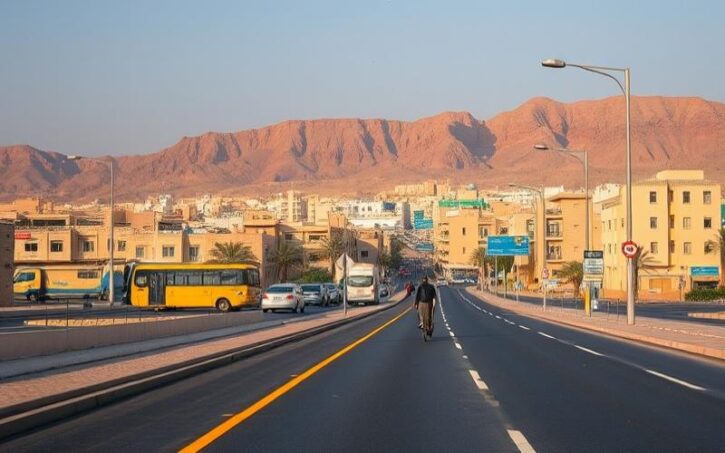
Traveling in Oman captivates with its desert, mountain, and coastal landscapes, but quickly becomes bewildering when it comes to public transportation. The country has one of the best road networks in the world… but very little public transport compared to its neighbors like the United Arab Emirates. Understanding this paradox is essential for planning a trip without (or with minimal) a car.
This practical guide is based on the most recent data to present a comprehensive overview of buses, taxis, ferries, metro and train projects, with concrete details on prices, frequency, and comfort. It allows you to optimize your travel by combining public transport, taxis, and car rentals according to your budget, time, and traveler profile.
A country built for cars, not yet for public transport
Oman has approximately 62,000 km of roads, including nearly 30,000 km of paved roads and nearly 2,000 km of highways. The network is modern, well-maintained, and regularly ranked in the global top 10 for the quality of its road infrastructure. Major arteries like the Muscat Expressway or the Al Batinah Expressway efficiently connect the capital to the borders with the UAE and to major coastal cities.
Yet, the public transport offering remains limited. Buses exist, but the network coverage and frequency are insufficient for getting around exclusively by public transport once you leave the capital. There are no passenger trains, nor an operational metro for now, although ambitious projects are on the table.
In Oman, the widespread use of the car is explained by two geographical and climatic realities. The country is vast and sparsely populated, making the car essential for travel, especially since fuel is cheap. Furthermore, intense heat makes walking difficult during the day. Consequently, the majority of the population, both Omani and expatriate, uses cars daily, and very few rely on public transport.
The government is aware of this car dependency and has set a course with the “Oman National Transport Strategy 2040”: increase the share of public mobility, reduce emissions, and develop more sustainable solutions. But on the ground, for a traveler today, the experience remains that of a system that is “basic, underdeveloped, and not intuitive”.
Understanding the key player: Mwasalat, the national bus company
The heart of modern public transport in Oman is called Mwasalat, the trading name of the former Oman National Transport Company (ONTC). This public company, part of the state logistics group Asyad, manages:
– Urban buses in Muscat, Salalah, and Sohar
– Intercity coaches between major cities
– Several ferry connections
The fleet is substantial: over 100 urban buses, about fifty large coaches, around 320 minibuses, and 6 ferries. In 2023, Mwasalat transported 4.5 million passengers by bus and nearly 240,000 travelers by ferry. The buses are modern, air-conditioned, generally clean, with free Wi-Fi and facilities for passengers with reduced mobility on part of the fleet.
Although the Mwasalat bus network is a public service, its volume remains modest relative to Oman’s population and territory size. Coverage is partial, especially outside major road arteries. For travelers, its primary usefulness concentrates on three types of journeys: urban trips within Muscat, connections between a few major cities, and certain maritime routes.
A phased development plan for Muscat
Muscat’s transport is the subject of a long-term plan structured in three stages:
| Phase | Period | Main Objectives |
|---|---|---|
| 1 | 2015–2018 | Launch bus lines on major axes, regulate taxi activity, improve pedestrian pathways |
| 2 | 2019–2025 | Extend the network, create dedicated lanes, build new bus stations |
| 3 | 2026–2040 | Develop a metro in Muscat and integrate “water taxis” (marine shuttles) |
The first two phases are underway, with a relatively recent set of urban lines and a desire to increase bus usage. The metro, however, remains at the feasibility study stage: authorities emphasize that a solid bus network must be in place before considering a heavy rail system.
Getting around by bus in Muscat: useful, economical, but not always practical
Muscat is the only city in Oman where one can reasonably consider using public transport on a daily basis without a car. The network is still far from European standards, but it is progressing and serves travelers with limited time and budget.
Network and main lines
Mwasalat currently operates about a dozen lines in the Muscat urban area, with nearly 480 stops ranging from the Seeb area in the west to Old Muscat and Al Alam Palace in the east. The served axes cover major residential neighborhoods, shopping malls, the Mutrah/Muttrah waterfront, and the airport.
Two bus stations structure this network:
– Ruwi Bus Station, in the old commercial district of Ruwi
– Azaiba Bus Station, in the west, the starting point for many intercity connections
Among the most useful lines for a visitor:
The bus fare on line A1 costs about 500 baisa to connect Muscat Airport to the city center.
Buses generally run between 6 a.m. and 9–10 p.m., with reduced service on Fridays and holidays. On main arteries, the announced interval often varies between 15 and 30 minutes, but delays of 20 to 30 minutes are not uncommon.
Fares, payment, and zones
The price of urban buses in Muscat depends on distance, but most common trips range between 300 and 500 Baisa (0.3–0.5 OMR), making it the cheapest mode of transport in the country. Another source mentions a range up to 1 OMR, but in practice, most travelers mention amounts around 0.3–0.5 OMR for a standard trip.
Payment is made in two ways:
Payment is primarily made in cash (prefer small bills like 1-rial notes, as large bills are often refused). Some buses also accept cards or an e-wallet, but the terminals may occasionally be out of service.
Mwasalat introduced a digital payment system called “Sayir,” integrated into its mobile app. The principle: you top up a virtual wallet, then validate your boarding and alighting by scanning a QR code on board. If you forget to “tag” when getting off, the maximum fare is deducted, which penalizes the inattentive.
Comfort, safety, and seating for women
Muscat’s urban buses are modern and air-conditioned, sometimes even too cold for some travelers; bring a light layer for long journeys. They have seats reserved for people with disabilities and for women, usually at the front.
For solo female travelers, the unwritten rule is clear: women sit at the front, men at the back. This separation is respected without excessive rigidity and provides a sense of safety, including in the evening. Accounts describe buses as generally safe, with a clientele mostly composed of expatriate workers (India, Bangladesh, Pakistan) and some tourists.
Practical information on bus stops and advice for travelers.
Some stops are marked by characteristic concrete shelters from the former ONTC.
Stops are not always well indicated on the ground, which can make them hard to locate.
Using transportation mobile apps is almost essential for planning your trip and locating stops.
Apps: useful but imperfect
Two digital tools are consistently mentioned:
– The official Mwasalat app, which displays lines, next arrivals, detailed routes, walking time to the stop, and allows purchasing intercity tickets or topping up Sayir.
– Moovit, an international app that aggregates Mwasalat data and provides real-time (or near real-time) directions.
On paper, the Mwasalat app aims to be a “complete mobility solution”, but user reviews are mixed: frequent bugs, sometimes imprecise geolocation, finicky online ticketing, validation machines that don’t always read QR codes. The average rating is around 2.1–2.2 stars on app stores, despite over 100,000 downloads.
It’s better to consider these apps as valuable but imperfect aids. Always keep a time buffer for schedules, especially if you need to catch a flight or a connection.
Intercity buses: traveling between major cities at low cost
Intercity buses are the backbone of public transport outside Muscat. They connect major cities at unbeatable prices, but with significant constraints in frequency and schedules.
A limited but strategic network
Mwasalat coaches (generally white) notably connect:
– Muscat – Nizwa
– Muscat – Sur
– Muscat – Salalah
– Muscat – Dubai (in cooperation or competition with private operators)
– Other cities like Sohar, Salalah, Khasab are also served on some routes
The frequency is the weak point: most routes offer only two or three departures per day, sometimes fewer. A telling example is the Muscat–Nizwa line: two daily buses from Azaiba (lines 53 and 54), with only two returns per day (around 11:40 a.m. and 5:30 p.m.). For the Muscat–Salalah line, the company announces two daily departures for a journey duration of about 13 hours.
Examples of connections and travel times
Some concrete benchmarks for the most used routes by travelers:
| Route | Lines / Operator | Estimated Duration | Notes |
|---|---|---|---|
| Muscat – Nizwa | Mwasalat 53 / 54 | ~3 hrs | Stops at the airport, “Nizwa souq 3” stop near the fort. Delays of 30–60 min reported. |
| Muscat – Sur | Mwasalat 36 / 55 | 3–4 hrs depending on route | Line 36 via Ruwi and the coast (afternoon), line 55 via the desert interior (morning). |
| Muscat – Salalah | Mwasalat 100 | ~13 hrs | Frequent overnight long journey. Option to prefer flying (1 hr flight). |
| Muscat – Dubai | Route 201 Mwasalat or private operators | ~6–8 hrs | Usually 3 daily departures, border formalities at Hatta. |
The buses are described as “reasonably fast and comfortable”, with air conditioning, reclining seats, and luggage compartments. Some operators (notably to Dubai) offer Wi-Fi, USB ports, and numbered seats.
Fares: unbeatable for a budget traveler
One of the major advantages of intercity buses is their price. The amounts given by various sources agree:
– 2 to 3 OMR for most standard intercity trips
– 6 to 7.5 OMR for the long Muscat–Salalah connection
– To Dubai, on the Emirati side, fares are usually expressed in dirhams and vary by operator
Compared to a taxi or car rental, the bus is by far the most economical way to connect two major cities. However, you must accept dealing with limited schedules, mandatory reservations, and potential delays.
Reservations, documents, and practical constraints
For most Mwasalat intercity lines, the procedure is strict:
Tickets are purchased at the station or via the Mwasalat app. Note that some sales points, like the Azaiba center in Muscat, often only accept bank cards (no cash). A passport or work card (‘labour card’) must be presented when purchasing. As the number of seats is limited, advance booking is strongly recommended, especially for long trips and weekend travel.
One detail to know: some travelers mention difficulties buying a ticket online without an Omani SIM card. It is therefore safer to go to the bus station to book your trips in person, especially if your stay is short.
Regarding delays, it’s better to allow a buffer of at least one hour for important connections (flights, appointments). Major lines like Muscat–Sur seem more punctual, while Muscat–Nizwa regularly experiences delays of 30 to 60 minutes.
Alongside the official network operated by Mwasalat, an informal but omnipresent system complements the mobility offering: the collective minibuses, called “micros,” “baisa buses,” or sometimes “collectivos,” as well as shared taxis.
“Micros”: daily transport for workers
“Baisa buses” are small white and orange minibuses that can carry about fifteen passengers. They are seen mostly in Muscat but also in other major cities. Their role:
– Provide the cheapest possible mode of transport for intra-urban trips
– Primarily transport low-wage expatriate workers (India, Pakistan, Bangladesh, etc.)
Their operation is very different from a classic bus:
These buses generally do not have route signs: to know the destination, you must ask the driver or passengers. Stops are flexible: you can hail the bus by the roadside or at a stop, and ask the driver to stop to get off. There is no standard ticket; the fare is negotiated or follows local custom, often costing a few hundred baisa.
For a tourist, it’s both exotic and complex: language barrier (outside Muscat, many drivers speak little or no English), lack of signage, oral operating logic. It’s an option to consider if you are used to informal transport and are traveling light. Otherwise, Mwasalat buses or traditional taxis will be simpler.
Safety recommendations are clear: women should sit at the front. In practice, accounts do not report particular insecurity, but it’s better to respect local social codes.
Taxis in Oman are often used in “collective mode”: a vehicle can pick up several clients going in the same direction, each paying a share of the fare. This system applies:
– In the city, for common trips
– Between nearby towns (for example Muscat–Sur, Muscat–Nizwa, Nizwa–Al Hamra or Birkat al Mouz)
In major Omani cities, shared taxis use informal parking lots as gathering points. In Muscat, a departure for Sur is found near the Wadi Adai roundabout, while those for Nizwa depart from near Burj Al Sahwa. In Nizwa itself, a parking lot near Bank Dhofar serves as a departure point for destinations like Al Hamra, Bahla, or Birkat al Mouz.
The principle is simple:
– The total fare for the trip is fixed (for example 4 OMR for Nizwa–Al Hamra)
– If the vehicle fills up, each person pays only a fraction (1 OMR in the example)
– If you want to leave without waiting, you can pay the full fare to “privatize” the taxi
It’s an interesting compromise when there is no bus or when buses don’t suit your schedule. Again, a minimum of Arabic or a good dose of patience and non-verbal communication greatly facilitates the experience.
Taxis and ride-hailing apps: the simplest solution in the city
Whether we like it or not, in Muscat and other major Omani cities, the taxi remains the simplest and most flexible way to get around without a rental car, especially if you are in a hurry or have luggage.
“Traditional” taxis: orange and white
Official taxis sport the famous white and orange livery. They are driven exclusively by Omanis, the profession being reserved for nationals. You hail them on the street, find them in front of shopping malls, hotels, attractions, or at dedicated stands (airport, Sultan Qaboos Mosque, Ruwi, Mutrah…).
In some sources, these taxis are described as not equipped with meters, requiring negotiation of the fare in advance. Other recent data indicate that all taxis are now supposed to use a taximeter (the “Aber” app), and that if the driver refuses to activate it, the ride would theoretically be free for the customer. In practice, the situation varies by city and vehicle.
Sources on taxis in Oman
To stay pragmatic:
– Always ask for an approximate price before getting in
– If the taxi is equipped with a meter, insist it be turned on
– In case of doubt, prefer ride-hailing apps (less negotiation, price announced upfront)
The order of magnitude for intra-city fares is as follows:
| Type of in-city trip | Indicative fare for a local |
|---|---|
| Short trip in the city center | 1–2 OMR |
| Long trip across Muscat (from one end to the other) | up to 5 OMR |
| Airport – Muscat center (traditional taxi) | around 6 OMR, sometimes more for foreigners |
Foreign visitors often pay more than residents, sometimes almost double. Calmly discussing the price remains the norm, without aggression: raising your voice or gestures of anger are very poorly perceived and can be legally reprehensible.
Company taxis and apps: Marhaba, Otaxi, Tasleem, Yango…
To limit negotiations and benefit from more transparent fares, ride-hailing type apps have multiplied in Oman. The main ones:
Overview of the main ride-hailing apps available in Oman, with their geographical specifics and popularity.
One of the most widespread apps, operating in many cities, including Nizwa.
A more recent player, with a strong presence notably in the Salalah region.
Often mentioned for its competitive fares in Muscat, but with more limited coverage outside the capital.
Oman Taxi, TaxiF, and Careem are other options whose availability varies by area.
These services generally offer:
– Price calculated in advance via the app (often lower than street negotiation)
– Real-time tracking of vehicle arrival
– Payment in cash or by card/in-app
– Possibility to book vehicles for people with reduced mobility or with child seats in some cases
Some specialized services, like OmanTaxi (Ubar Smart Cities), go further with options for multi-stop trips, booking for someone else, real-time trip sharing, or even, in the future, choosing the driver’s gender.
Taxis booked via an app are generally not allowed to pick up clients directly at airport terminals or some hotel entrances. Clients often have to walk a few hundred meters to meet them in an authorized zone.
Typical fares and price structure
Exact fares vary by time of day, city, and type of service (standard, “corporate”, airport). However, authorities publish base rate grids, for example for Muscat, Salalah, or Sohar. As an indication, a possible daytime price structure in Muscat would be:
| Trip component | Muscat (example grid) |
|---|---|
| Pick-up charge | 1–1.5 OMR |
| Price per km | 0.25–0.30 OMR |
| Waiting (per hour) | ~4–4.5 OMR |
Surcharges may apply at night or from certain points (airport, major hotels). At the same time, lower estimates exist for highly regulated taxis (0.30 OMR starting fare, 0.13 OMR per km), showing the diversity of offerings by operator.
Before the ride, don’t hesitate to:
– Make a rough estimate via Google Maps (distance) and the indicative rate grid
– Check that the requested price seems reasonable
– In case of disagreement, use a ride-hailing app
Authorities also encourage customers to note the license plate and driver’s license number, and report abusive behavior to the relevant ministry, which provides a complaint number.
Ferries and maritime connections: Musandam, Masirah and beyond
Oman, with its immense coastline, makes little use of the sea for daily transport, but several connections are essential for reaching isolated regions or islands.
Muscat – Khasab: the major crossing to Musandam
The most emblematic connection is the fast ferry operated by the National Ferries Company (NFC) between Muscat and Khasab, the capital of the mountainous exclave of Musandam on the Strait of Hormuz. This long-distance service avoids a very long road trip through the UAE.
NFC ferries are modern, air-conditioned vessels carrying passengers and vehicles. They offer different seat categories and sometimes cabins. As schedules and fares are variable, it is highly recommended to check the operator’s official website and book in advance, especially during peak seasons.
Other regional lines connect, for example, Shinas to Khasab, or several coastal villages in Musandam (Lima, Dibba), facilitating access to areas almost landlocked by mountains.
Masirah: the ferry from Shannah to Hilf
To reach Masirah Island, known for its wild beaches, turtles, and kitesurfing spots, Mwasalat operates a maritime link between the port of Shannah, on the central coast, and the town of Hilf on the island.
The journey takes about an hour, several daily rotations are provided, and the ferries can carry cars and passengers. Again, online booking is not always smooth, and many travelers simply buy their tickets on site, allowing for a time buffer.
Touristic “water taxi” projects
With the 2040 vision, the ministry also plans to develop “water taxis” in the governorates of Muscat, Musandam, and Sharqiyah. The idea is not to create a daily urban transport network, but rather to connect tourist sites by sea, complementing the dhow (traditional boat) trips already offered for dolphin watching, snorkeling trips to the Daymaniyat Islands, or sunset cruises.
A tender has been launched for this project, but at the time of writing, these services are still in the preparatory stage.
Air as domestic transport: fast but limited
Given the significant distances and the relative slowness of buses on some routes, air travel remains a solution to consider for a few key domestic trips.
Two useful major domestic routes
Currently, the domestic network boils down to two main routes:
– Muscat – Salalah, the large city in the south, with lush vegetation in summer
– Muscat – Khasab, for Musandam
The flight between Muscat and Salalah takes about 1 hour, a fast alternative to the 10-13 hour drive, ideal for short stays. Oman Air and Salam Air operate on this route, with online booking. Other airports like Duqm or Sohar exist but are generally less relevant for classic tourism.
Muscat International Airport is the main hub, capable of handling up to 20 million passengers per year (expandable to 48 million). Salalah International, Khasab, and Duqm complete this setup.
Cost and impact on itinerary
Financially, a plane ticket obviously costs much more than a Mwasalat coach, but it can save an entire day in an itinerary where every day counts. A frequent compromise is to:
– Use the bus for trips like Muscat–Nizwa, Muscat–Sur, etc.
– Use a plane for a one-way trip Muscat–Salalah, then gradually make your way back up by rental car or via private tours
Car rental: essential for exploring the interior
As comprehensive as this guide on public transport is, one fact remains: without a car, a large part of Oman’s wonders remains difficult to access. Remote wadis, mountains like Jebel Akhdar or Jebel Shams, the dunes of Wahiba Sands, or certain beaches are simply not served by buses.
Renting a car is therefore often the most logical, even indispensable, solution. Key points to know:
Major international agencies (Europcar, Enterprise, Budget, Dollar, Avis, Alamo…) are present at Muscat Airport and sometimes in Salalah. Starting prices for a standard car are around 10–15 OMR per day, and about 35 OMR for a 4×4. Local renters may offer rates from 10 OMR, but vehicle quality can be more variable. Insurance like “collision damage waiver” is cheap (about 2 OMR/day), but it’s essential to study the terms carefully. In principle, a national driver’s license is sufficient, but some sources recommend an international license, and renters may require it depending on your country of origin.
For some sites, a 4×4 is not an option but a requirement, sometimes checked by the police, such as:
– Jebel Akhdar
– Jebel Shams (if you leave the main road)
– The dunes of Wahiba Sands
– Some mountain villages (Wakan, remote areas near Nizwa)
For many other tourist sites (Bimmah Sinkhole, Wadi Shab, Sur, Ras Al Jinz, Oman Across the Ages Museum, Nizwa, Bahla, Jabreen, Wadi Bani Khalid), a two-wheel drive car is sufficient, as the road is paved almost to the parking lot.
Accessibility and travelers with disabilities
Oman’s public transport is not yet fully inclusive, but the situation is improving, particularly in Muscat.
Buses, ferries, and airports
Modern Mwasalat buses are increasingly equipped with ramps and low floors, with a reserved space for wheelchairs. Adapted taxis exist but remain rare; it is often simpler to use private companies or go through a specialized tour operator.
Major airports (Muscat, Salalah) offer wheelchair assistance, priority boarding, and specific support through Oman Airports. Most large shopping malls have elevators, reserved parking, and adapted restrooms.
Ferries to Masirah and Musandam are reported to be accessible for wheelchair users, at least in the passenger areas. It is recommended to verify this information with the operator before traveling.
Tourist sites and limitations
In the capital, some places like the Sultan Qaboos Grand Mosque or the Royal Opera House Muscat have infrastructure designed for people with reduced mobility. On the other hand, many historical or natural sites (ancient forts, rocky wadis, sand dunes) remain very difficult to access by wheelchair or for people with mobility difficulties.
Specialized agencies in accessible tourism, however, are beginning to offer adapted tours, with equipped vehicles and accommodations. If this concerns you, it is highly recommended to prepare each stage in detail and prioritize main axes served by bus or taxi, as well as adapted hotels.
Major upcoming projects: train, metro, rapid buses, and “green” mobility
Behind the current landscape, Oman is preparing a profound transformation of its mobility. While most of these projects will not directly concern travelers in the coming years, they give an idea of the country’s trajectory.
A vast railway network in the making
Oman does not yet have a national railway network for passengers. The only operational rails carry tourists for 400 meters to Al Hoota Cave. Yet, the plans are gigantic:
This is the total length, in kilometers, of the planned railway network to connect Oman’s major cities and borders.
The project has seen ups and downs: launched as part of the regional “GCC Railway,” it was halted in 2016 after the fall in oil prices, before Muscat decided to pursue a national network at its own pace. A concrete milestone was set with the Hafeet Rail project, a 238 km line that will connect Sohar Port to Abu Dhabi via the Etihad Rail network, with construction contracted in 2025 to Indian and Chinese groups.
Muscat Metro, BRT, and electric buses
On the urban side, the third phase of Muscat’s plan includes: modernizing infrastructure, developing new public spaces, and improving public transport.
Key initiatives to modernize and integrate Oman’s transport network, improving connectivity and user experience.
Rail link between Ruwi, Mutrah, the airport, and Seeb for fast, efficient service.
Deployment of a high-level bus service network in major cities: Muscat, Salalah, and Sohar.
Enhanced coordination between buses, minibuses, school transport, and park-and-ride facilities.
The whole is part of a “green” mobility strategy. The transport sector accounts for 18% of the country’s CO₂ emissions, of which 60% comes from private cars. The authorities plan:
– The use of biofuels initially
– The deployment of electric buses for short distances (the first Mwasalat electric bus was launched in summer 2024)
– Experiments with hydrogen for longer routes
The official goal is to increase the share of trips made by public transport from 5% to 16% and to make transport and logistics an economic driver by 2040.
How to practically organize your travel in Oman without getting lost
Faced with all this data, how can a visitor organize themselves to make the best use of public transport while accepting its limitations?
For a mostly urban stay
If your itinerary focuses on Muscat, with a possible excursion to Nizwa, Sur, or Salalah by plane:
For travel from Muscat Airport, favor the economical A1 bus to reach the city center. On site, combine transport modes according to your needs: Mwasalat buses, traditional taxis, and ride-hailing apps (like Otaxi or Yango) offer a good budget/time ratio. For excursions to Nizwa and Sur, check in advance the limited schedules of Mwasalat buses (about 2 per day) and book your seats. For a trip to Salalah, evaluate your priorities: the overnight bus (about 13 hours, cost 6 to 7.5 OMR) is economical, while the plane (1-hour flight) is much faster but more expensive.
For a multi-region road trip
If you want to explore mountains, deserts, and coasts:
– Rent a car at Muscat Airport (2WD) and only get a 4×4 for segments that require it (Jebel Akhdar, Wahiba Sands, mountain tracks).
– Possibly use an intercity bus for a long monotonous stretch (Muscat–Salalah) then pick up a car locally.
– In urban areas, sometimes park the car at the hotel and favor taxis or buses to avoid driving in dense zones.
If you’re traveling on a low budget and with time
To limit costs as much as possible:
For long-distance travel, systematically favor public buses, costing 2 to 3 OMR versus tens of OMR by taxi. In urban areas, learn the main lines of the Mwasalat network and use “baisa buses” when you feel comfortable enough. Finally, be prepared to walk more to reach stops or served areas, planning your travel outside the hottest parts of the day.
For vulnerable individuals or people with disabilities
– Contact specialized agencies in advance that can provide adapted vehicles.
– Limit yourself to major cities, well-equipped sites, and bus/ferry connections identified as accessible.
– Favor company taxis and ride-hailing services, which are easier to book and manage than an informal network.
In conclusion: a system still imperfect, but evolving
Public transport in Oman reflects the country’s rapid evolution: very high-level road infrastructure, but a still dominant car culture and a public network struggling to catch up with its delay. For a traveler, this means you cannot approach Oman as you would Europe by train or Japan by subway: motorized autonomy often remains key.
Nevertheless, completely ignoring public transport would mean missing out:
This option offers very low-cost trips, provides an authentic glimpse into the daily life of expatriates and locals, and represents a more sustainable alternative than repeated use of rental cars.
Mwasalat, regulated taxis, and ferry operators structure a mobility foundation that is constantly improving. To this are added ride-hailing apps, which fill some of the gaps by providing fare transparency and ease of use.
To travel in Oman, it is possible to combine several transport modes according to needs: urban buses in Muscat, intercity coaches for major axes, taxis and ride-hailing for local trips, ferries to certain isolated regions, and car rental for off-network areas. This approach allows you to discover the country while respecting your budget and pace.
The coming decade will tell if the ambitions for metro, high-speed trains, and hydrogen buses will truly transform the landscape. In the meantime, this guide gives you the tools to navigate the system as it exists today, between digital modernity and informal practices, brand-new roads and concrete bus stops from another era.
Disclaimer: The information provided on this website is for informational purposes only and does not constitute financial, legal, or professional advice. We encourage you to consult qualified experts before making any investment, real estate, or expatriation decisions. Although we strive to maintain up-to-date and accurate information, we do not guarantee the completeness, accuracy, or timeliness of the proposed content. As investment and expatriation involve risks, we disclaim any liability for potential losses or damages arising from the use of this site. Your use of this site confirms your acceptance of these terms and your understanding of the associated risks.

Cyril Jarnias is an independent expert in international wealth management with over 20 years of experience. As an expatriate himself, he is dedicated to helping individuals and business leaders build, protect, and pass on their wealth with complete peace of mind.
On his website, cyriljarnias.com, he shares his expertise on international real estate, offshore company formation, and expatriation.
Thanks to his expertise, he offers sound advice to optimize his clients' wealth management. Cyril Jarnias is also recognized for his appearances in many prestigious media outlets such as BFM Business, les Français de l’étranger, Le Figaro, Les Echos, and Mieux vivre votre argent, where he shares his knowledge and know-how in wealth management.





