
 Published on and written by Cyril Jarnias
Moving to the Marshall Islands means entering a world where the sea feeds the plate, where the coconut palm is a tree of life, and where sharing a meal is almost more important than paying rent. For an expatriate, understanding this cuisine is about much more than taste: it’s the key to building relationships, earning the respect of the community, and better grasping Marshallese culture.
This guide covers all aspects of the local culinary experience, from markets to restaurants. It explains not only the dishes to try but also the table manners to follow, the social context of meals, and important health and food safety precautions.
Understanding the Food Context of the Marshall Islands
Before talking about grilled fish and pandanus bread, it’s important to understand the food system you’ll be living in. The Marshall Islands are an archipelago of coral atolls with limited resources, poor soil, and little fresh water. This has shaped a resilient, highly inventive culinary culture, but one that is now under pressure.
A Country That Imports Most of What It Eats
About 90% of the national food supply now relies on imported products. In major urban centers like Majuro or Ebeye, over 70% of dietary intake comes from rice, canned goods, flour, and other foreign products. Conversely, some outer islands remain largely dependent on local protein and fruits/vegetables.
More than half of adults primarily consume imported foods, contributing to the fact that almost no one reaches the recommended five daily servings of fruits and vegetables.
This dependency creates several problems: vulnerability to crises (price hikes, logistics disruptions), surge in non-communicable diseases like diabetes, and erosion of traditional practices that once ensured self-sufficiency.
An Ambitious Food Security Policy
In response, the Republic of the Marshall Islands has adopted a national food security policy. The ambition is clear: guarantee the entire population regular access to nutritious, safe, quality, and affordable food by strengthening local land-based production (“green foods”) and marine-based production (“blue foods”).
Several actions have been identified: supporting traditional agriculture (coconut, taro, pandanus, breadfruit), securing and better managing coastal fisheries, improving market infrastructure, and adjusting tax policies to discourage consumption of ultra-processed products high in sugar, salt, or fat.
For an expatriate, this means that by prioritizing local ingredients, you are not just “exploring the country’s cuisine”: you are also participating, on your own level, in a movement of food sovereignty and public health.
The Pillars of Marshallese Cuisine: What You Need to Know
Behind the menus of Majuro’s restaurants, Marshall Islands gastronomy still relies heavily on a few key ingredients, used for centuries and prepared in countless ways.
The Essential Staples of the Local Pantry
In most Marshallese families, four pillars structure meals: fish, coconut, breadfruit, and taro. Added to these are bananas, papaya, pandanus, and various root crops like cassava and sweet potato.
Here is a summary of the main staple foods and their role in the cuisine:
| Food | Primary Culinary Role | Common Forms and Uses |
|---|---|---|
| Fish | Major protein source (approx. 240 lb/year/person) | Grilled, raw (sashimi, salads), stewed in coconut milk |
| Coconut | Flavor and cultural pillar, “tree of life” | Water, milk, cream, oil, grated flesh, coconut sugar |
| Breadfruit | Staple starch, often replaces potato | Roasted, boiled, fried, mashed (masoa), chips, fermented |
| Taro | Nourishing tuber, symbolic | Boiled, in coconut leaf stew, mashed |
| Pandanus | Energy fruit, long preservation | Dried into paste (mokwan, jããnkun), cakes, puddings |
| Rice (imported) | Daily starch, inexpensive | Boiled, porridge, rice balls (chukuchuk) |
| Pork / Chicken | Meats for feasts and family meals | Grilled, curried, Marshallese barbecue |
The massive influx of white rice, easier to store and cheaper, gradually replaced part of the breadfruit consumption starting in the 1930s. This shift toward a higher glycemic index starch is directly linked to the explosion of type 2 diabetes in the country.
“Blue Foods”: The Sea at the Heart of the Plate
It’s hard to overstate the importance of fishing in the Marshall Islands. It is estimated that a Marshallese person consumes an average of 240 pounds of fish per year, and the language has over fifty terms to describe specific fishing techniques.
Oceanic waters offer a wide variety of seafood resources. Daily catches include colorful reef fish like parrotfish, grouper, and snapper, as well as large pelagics such as tuna, wahoo, and mahi-mahi. This is complemented by crustaceans and mollusks like coconut crab, lobster, octopus, and clams. Sea turtle, more rarely consumed, is reserved for special occasions like major traditional ceremonies.
While industrial fishing is strictly regulated (combating illegal fishing, quotas, heavy penalties for violations), sustainability challenges remain: warming waters, local overfishing, maritime rights disputes, etc. As a consumer, prioritizing local fish bought at monitored markets and avoiding species known for ciguatera risk is an essential reflex.
“Green Foods”: Fragile but Strategic Agriculture
Cultivating on an atoll is far from easy. Thin soils, salinity, lack of fresh water: everything seems to conspire against agriculture. Yet, Marshallese people have, for centuries, developed varieties of taro, breadfruit, pandanus, and banana trees adapted to these extreme conditions.
Faced with declining household participation, especially in urban areas, authorities and NGOs are encouraging a revival through the distribution of seedlings and small livestock, training in traditional agroforestry, and promoting ‘zero-waste’ agriculture. The latter aims to create synergies, for example by using fish waste as fertilizer to link agricultural and fishing activities.
For the expatriate, this translates into a supply of local products that is often richer than it first appears, especially on the outer islands or along the road between Laura and Ajeltake, where fruit stands and small family farms are concentrated.
Eating is Sharing: Social Codes and Rituals Around Food
In the Marshall Islands, gastronomy is never separate from social bonds. Understanding the unspoken rules surrounding meals is crucial to avoid awkwardness and, above all, to enjoy the warmth of Marshallese hospitality.
The Logic of Sharing: “We See Each Other’s Food”
Marshallese society is structured by concepts like jowi (mutual aid, lineage solidarity) and bwij (clan). The circulation of resources—food, tools, labor—is not a moral option, it is a social obligation.
A proverb sums up this spirit well: “We see each other’s food.” Historically, when a family cooked, they would call out to passersby to invite them to share the meal. This custom still persists, especially on the more traditional islands.
Refusing an offered dish, or being stingy when hosting guests, can bring shame—an extremely powerful social lever. Conversely, a host is admired for their generosity—to the point that during a *kemem* (the big first birthday celebration), the family’s “wealth” is sometimes measured… by the goods that remain after guests have taken various objects from the house.
Social Anthropology
Basic Table Rules for an Expatriate
At the table, several codes are expected, even from a foreigner. The most important ones are easy to adopt:
Upon arrival, greet the gathering with “Yokwe” and a smile. Wait for the eldest or highest-ranking person to start eating before you serve yourself. Always accept at least a small portion of an offered dish. Only take what you are sure to finish, as waste is frowned upon. Avoid taking the last piece without offering it to others. Preferably use your right hand to receive food as a sign of respect. Adapt: if others are eating with their fingers from a shared dish, do the same; otherwise, use utensils.
It is also frowned upon to eat while walking in a village, talk loudly, argue in public, or turn your back on a seated elder.
Hierarchies, Chiefs, and Ceremonies
Marshallese people have long lived in a highly hierarchical society, with high chiefs (irooj laplap) considered almost sacred. Offering food to the chief is an ancient, highly codified ritual: land administrators organized the collection of baskets of fermented breadfruit or dried pandanus, sometimes buried for preservation for nearly a year.
Today, this dimension remains visible in how meals are served during big celebrations: the pastor or local chief eats first, then come the parents, the celebrated child (in the case of a kemem), the grandparents, and finally the rest of the gathering. For an invited expatriate, simply follow the seating arrangement; you will naturally be shown where to sit.
The Classics of the Marshallese Table
Now let’s get to the heart of the matter: what’s on the plate? Which specialties should you try first when arriving in the Marshall Islands?
Fish and Seafood: From Reef to Grill
It’s impossible to stay in the Marshall Islands without encountering an abundance of fish, often simply prepared to highlight their freshness.
Among the most common preparations:
Discover the emblematic dishes of Marshallese cuisine, where fresh seafood meets the flavors of coconut and local aromatics.
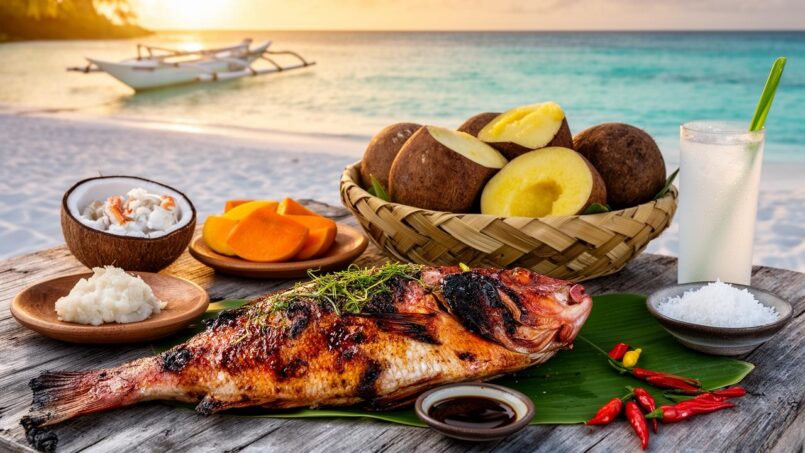
Whole pieces of tuna or snapper marinated in a mix of soy sauce, lime juice, and aromatics, then grilled over coconut husk coals. Sometimes the fish is not gutted.
Slices of raw fish, often tuna, served with soy sauce, lime, onion, or avocado. A casual and relaxed version of Japanese sashimi.
Octopus slow-cooked in coconut milk with onions and garlic until perfectly tender.
The star of feasts, served steamed or roasted, sometimes topped with a rich coconut sauce.
Fillets lightly floured and browned, then cooked in a sauce of coconut milk and tomatoes, illustrating the iconic fish-coconut pairing.
Also included are hybrid dishes like raw fish salads with lime and coconut milk (similar to Polynesian ika mata), or citrusy soups blending fish broth, vegetables, and lime juice.
Breadfruit: The Other “Rice” of the Archipelago
Breadfruit is so central that it has several specialized preparations:
– Roasted whole over embers then opened like a baked potato.
– Boiled and mashed into a purée (masoa), sometimes enriched with coconut milk.
– Fried in slices to make crispy chips.
– Fermented then baked in an underground oven to produce the famous bwiro, a sweet and tangy paste with long shelf life, wrapped in banana leaves.
This starch is very nourishing, rich in complex carbohydrates, and naturally gluten-free. It can easily replace potato or bread in your daily habits while being better suited to the local context.
Rice, Chukuchuk, and Porridges
Even though breadfruit is the historical starch, rice has become an omnipresent staple, consumed at least twice a day in many families. It is found:
– Simply boiled as a side to fish or meats.
– Shaped into rice balls rolled in grated coconut, very popular with grilled fish.
– Cooked into a porridge with pumpkin as a savory porridge often served with fish (rice banke).
This rise of rice, coupled with an abundance of imported sugary products (sodas, candies, cookies), partly explains the increase in diet-related health problems.
Taro, Pandanus, and Other Vegetable Treasures
Taro, another traditional pillar, is enjoyed boiled or in stews of leaves cooked in coconut milk, often accompanied by pork. Taro leaves, rich in nutrients, add a green touch to very starchy dishes.
Pandanus, meanwhile, serves both as food and as a survival resource. Its fruits are cooked, then the pulp is dried and pressed into cakes:
– On some islands, it is called mokwan.
– On others, jããnkun.
These blocks can keep for months. In the past, they were an essential safeguard against lean seasons.
Desserts and Sweets: The Kingdom of Coconut and Pandanus
On the sweet side, the Marshallese palette revolves largely around coconut, papaya, and pandanus:
– Pandanus puddings with coconut milk and sugar, dense and fragrant.
– Marshallese donuts, present at large festive buffets.
– Papaya with coconut cream, a simple but typical dessert.
– Coconut-pandanus cakes, where pandanus paste is incorporated into the cake batter.
Drinks: Coconut Above All
Traditional drinks revolve around the coconut palm:
– Coconut water (ni), refreshing, drunk directly from the fresh nut.
– Coconut lemonade, a mix of coconut water, water, lemon juice, and sugar.
– Coconut toddy (kōrā), the sap of the coconut palm sometimes consumed as is or processed.
In some regional contexts (Micronesia broadly), kava or betel nut may also be offered as a sign of hospitality. Refusing can be misinterpreted; if you do not wish to partake, a very polite and clearly justified refusal (health, religion, pregnancy, etc.) is best.
Majuro: Where to Eat and Where to Buy Your Products
As an expatriate, your home base will often be Majuro. Good news: the capital concentrates the majority of the archipelago’s restaurants, cafes, bars, and supermarkets, offering a surprisingly varied mix of Marshallese, Asian, and Western cuisines.
Quick Overview of Majuro’s Culinary Scene
There are about twenty restaurants and bars in Majuro, from small family eateries to tables in major hotels. The city is shaped by three main influences:
– Pacific flavors (grilled fish, coconut, breadfruit).
– Asian cuisines (Chinese, Taiwanese, Korean, Filipino, Indian).
– American and Western inspirations (burgers, pizzas, fish & chips, theme buffets).
Most expats alternate between these restaurants and home cooking by shopping at supermarkets and markets.
Where to Taste the Local Sea
Several establishments focus on local marine products, often with lagoon views:
| Establishment | Specialties and Main Highlights | Approximate Price Range |
|---|---|---|
| Tide Table (Robert Reimers Hotel) | Burgers, fish & chips, grilled tuna, seafood platters, local products, lagoon view, theme nights (Mexican on Tuesdays) | $$ – $$$ |
| Island Star (Uliga) | Marshallese cuisine and local seafood, daily specials based on the catch | Budget to mid-range |
| RRE Mariculture Lobster Farm | Lobster farm with open-air dining, promoting sustainable fishing | Mid-range to high |
| Toeak Bar & Grill (NAPA building) | Pub food, draft beers, panoramic view of lagoon and city | Budget to mid-range |
These are the places where you’ll best see how local chefs work with the supply constraints: menus that change with the season and catch, combining grilled tuna, reef fish, and sometimes locally farmed lobster.
Cafes, Bars, and “Hybrid” Spots
Majuro also hosts a network of cafes and bars where locals, expats, sailors, and tourists mingle:
Discover a selection of restaurants and cafes offering a unique atmosphere and varied cuisine, from pizzas with ocean views to local dishes.
Located on the ground floor of the former Marshall Islands Hotel. Enjoy pizzas, pool tables, shuffleboard, and ocean views in a relaxed setting. An ideal place to practice Marshallese.
Bar-restaurant in Delap with a large terrace. Karaoke nights, pool tables, and serves pizzas reputed to be among the best on the island, as well as Sino-Western dishes.
Air-conditioned space very popular with locals for breakfast and lunch. A mix of Western and Marshallese dishes (fresh fish, breadfruit, pumpkin), accompanied by homemade pastries.
There is also a constellation of small cafes (Island Café, Akia Café, L2 Store, Lazy Jays Café, Starbox Café, etc.) serving coffee, snacks, and sometimes simple meals.
Where to Eat “Truly” Marshallese
For a more direct connection with home cooking, nothing beats the markets and small local eateries:
To discover Marshallese cuisine on a budget, several options exist. The open-air market near the Marshall Islands Resort has stalls run by women offering homemade dishes like rice balls, prepared pandanus, mashed taro, roasted breadfruit, *bwiro*, fried fish, for about $3 per meal. Frank K’s Restaurant in Uliga is known for its classics: *mã* (breadfruit slices), *bañke kalel* (pumpkin dish), and *jukjuk* (banana and coconut dessert). There are also small food stalls and sidewalk barbecues, especially between Delap and Uliga, serving grilled chicken or fish with rice. Finally, local spots like Tebu Store, NKB Restaurant, Yummy, or Ri-Wut Corner offer typical dishes (rice, fish, meat, chukuchuk).
These places don’t offer fancy menus, but they are at the heart of daily life and local culinary generosity. Service is often in takeaway containers, which you can share at home or on a dock corner.
The Mosaic of Asian and International Cuisines
Majuro also surprises with its density of Chinese and Asian restaurants:
– Won Hai Shien (旺海軒) and Seagull, renowned for their authentic Chinese dishes.
– Alliang Restaurant, China Taste (東北風味餐廳), Oriental Restaurant (東方餐廳), Special Restaurant 蘭姐餐廳, YM Restaurant (雲梅居): broad spectrum of Chinese cuisine.
– Mon-ami: Korean cuisine (bibimbap, barbecue, spicy soups).
– Misko’s, Litaki: Filipino cuisine (adobo, sinigang, etc.).
On the Western side, Enra Restaurant (Marshall Islands Resort) offers an international-local fusion, with Sunday buffets, pasta nights, vegetarian dishes, and frequently a daily special featuring local fish.
For a more “American” meal, also check out Café Pacific and Three Palms on Kwajalein (if you have access to that area) or some local fast-food joints like Yokwe Fast Food.
Budget: How Much Does a Meal Cost in Majuro?
The price ranges observed in Majuro can be summarized as follows:
| Type of Establishment | Typical Offerings | Approximate Price Range |
|---|---|---|
| Street stalls, food stalls, open-air market | Rice + chicken/fish, breadfruit, simple dishes | $5 to $15 USD |
| Mid-range restaurants (Tide Table, Flame Tree, Island Star, Won Hai Shien, etc.) | Plated dishes, grilled fish, curries, pizzas, Asian specialties | $15 to $30 USD |
| High-end / resort restaurants | Buffets, lobster, tasting menus, steak nights, sushi nights | $30 USD and up |
Portions are often generous, so sharing a main dish and adding a few sides can be an economical and friendly option.
Grocery Shopping: Supermarkets, Markets, and Small Stalls
Settling in as an expatriate also means cooking at home. In Majuro, the retail landscape is structured around a few major supermarkets complemented by a dense network of small grocery stores and markets.
Big Box Stores for Dry Goods and Imports
The two major players are:
– Island Pride Supermarket (Delap, with another location in Long Island): wide selection of dry goods, frozen items, beverages, US, Australian, and Asian products; imported wines and beers. Has a wholesale division for bulk purchases.
– Payless Supermarket (Uliga): comparable offerings, also specialized in importing US and Australian products.
Also available:
– EZ Price Mart (Uliga), known for good deals on dry groceries (oils, whole wheat pasta, canned goods).
– Crazy Price Mart (Delap), offering a varied range of foods, often sourced from Australia.
– ACE Mart and Shop N Save: general supermarkets with fresh and imported products.
These stores receive weekly shipments by air and monthly (or bi-monthly) by ship. So you have to get used to a certain seasonality of imported products: some days the fruit and vegetable display is well-stocked, other days it empties quickly. Planning your menus a bit ahead helps avoid unpleasant surprises.
Markets for Fresh and Local Produce
For local fish and vegetables, markets are essential:
Discover the main markets of the capital of the Marshall Islands, where fresh products, local culture, and daily life come together.
Built with Japanese funding, this market offers reef and pelagic fish, including from outer islands. The Marshall Islands Marine Resources Authority also buys from rural fishermen to supply Majuro.
A true cultural and food hub opened in 2017. You’ll find local juices, vegetables, fresh coconuts, and a nice variety of fish in coolers.
Particularly lively on Saturdays when vendors come from neighboring atolls with fruits, vegetables, and handicrafts.
Ideal for discovering homemade Marshallese dishes, roasted breadfruit, taro, *bwiro*, and other local specialties.
Additionally, a multitude of small Asian shops (Cost Price, Formosa, etc.) sell fruits and vegetables, often at good prices, but with labels sometimes only in Chinese or Korean.
A Few Practical Shopping Tips
– For fish, prefer structured markets (MIMRA, MISCO) where the cold chain is more monitored.
– Keep in mind the risks of ciguatera for certain reef fish; don’t hesitate to ask vendors or your Marshallese colleagues for advice.
– For local fruits and vegetables, favor the stalls along the Laura and Ajeltake road, which are plentiful and well-stocked in season (breadfruit, papaya, mini-bananas, pandanus, taro).
– If you live in a shared house with Marshallese or in a very local neighborhood, they will quickly point out which small shops have the best reputation.
Health, Food Safety, and Smart Choices for an Expatriate
The beauty of Marshallese cuisine hides a darker reality: the country is hard hit by nutrition-related diseases. For an expatriate, understanding this context allows adopting habits that respect both your health and that of the community.
Obesity, Diabetes, and Imported “Junk Food”
The transition from a diet centered on breadfruit, taro, and fish to one rich in white rice, refined flour, canned meats, and sugary drinks has been rapid and severe. In some communities, nearly half of adults are type 2 diabetic.
Several structural factors worsen the problem:
– Imported products high in sugar, salt, and fat are often cheaper than fresh local foods.
– Prolonged absence of tax incentives to consume brown rice, whole-wheat flour, or fortified products.
– Low fruit and vegetable intake: the vast majority of the population does not reach five daily servings.
To avoid replicating these patterns, an expatriate can: quickly adapt to local culture, build a solid social network, develop an open mind, and remain aware of their own cultural biases.
For better health, it is recommended to limit consumption of foods like white rice, instant noodles, canned corned beef, and ultra-processed snacks. Instead, prioritize fresh products available at markets, such as fish, breadfruit, taro, bananas, and papaya. For drinks, opt for water, coconut water, or homemade juices over sodas.
Hygiene and Food Safety Rules
The country has adopted a Food Safety Act and, particularly in the maritime sector, applies strict standards for handling, cooking, and storing food. A few useful points to keep in mind at home and in restaurants:
The danger zone for bacterial growth is between 40°F and 145°F. Do not leave perishable foods at room temperature for more than 2 hours (1 hour above 90°F). Cook fish to a minimum of 145°F (155°F for ground fish, 165°F for stuffed products). Keep your refrigerator below 40°F and your freezer below 0°F. Refrigerate and date leftovers promptly, consuming within 2 days. Never use seawater for cooking or cleaning.
Cases of ciguatera are regularly reported after consuming certain reef fish. Inform yourself about at-risk species in your area and be alert for any strange sensations (tingling, reversal of hot/cold sensations, digestive issues) after a meal.
Public Health Initiatives and the Role of Expats
The government and several partners (FAO, WHO, Canvasback Wellness Center, school systems) are trying to shift the diet:
– Project for a health tax on the most harmful products (sugary drinks, fatty snacks).
– Idea of further subsidizing the transport of fresh products from outer islands to Majuro through a maritime freight fund.
– Pilot programs for school cafeterias incorporating more local products.
– Centers like the Wellness Center, founded in 2005 near Majuro Hospital, promoting healthy cooking in the face of the diabetes epidemic.
As an expatriate, supporting these efforts is simple: prioritize restaurants that highlight local products, shop at the market, value traditional dishes with your colleagues rather than always encouraging frozen pizzas and imported fast food.
Human Relations, Language, and Small Gestures That Make a Difference
Exploring local cuisine also means learning a few simple words and codes that will open many doors.
Useful Phrases at the Table
A few Marshallese phrases to remember:
– Yokwe (or Iakwe): hello / hi (literally “love”).
– Kommol: thank you.
– Enno mönä in majel: Marshallese food is delicious.
– To express that you’ve had enough to eat, it is often more polite to thank warmly than to say “I’m full” too early.
Don’t hesitate to ask the name of a dish, a fruit, or a fish: Marshallese are proud of their cuisine and delighted to explain.
Attitude and Posture in Homes
When invited to eat at someone’s home:
Taking off your shoes and hat at the entrance is a sign of respect. It is very appreciated to bring a small gift, like cakes or a souvenir. Refusing to taste a dish without explanation can be seen as an affront; if you have an allergy or dietary restriction, express it delicately. Finally, avoid standing over seated people and sit at their level if invited to do so.
Respect for Elders and Subtle Hierarchy
Elders hold a central place in society. Letting a grandparent or local chief speak first, greeting them with a slight nod, avoiding interrupting them abruptly: these details strengthen your integration.
On the culinary front, this often means that the best pieces—whole fish, coconut crabs, cuts of meat—are served to them first. Accept this logic without taking offense: you will gain faster inclusion in the circle in return.
To Get Started: Some Practical Strategies for Expats
Given the richness and complexity of Marshallese gastronomy, it’s best to proceed in small steps rather than trying to explore everything in one week.
Gradually Introducing Yourself to Local Flavors
An effective approach might look like this:
To get used to the flavors of the Marshall Islands, start with “gateway” dishes at Majuro restaurants, like grilled tuna at Tide Table, fish in coconut milk at Island Star, or chukuchuk as a side at Frank K’s. At home, introduce one or two local products per week: replace some rice with breadfruit, try a taro stew, or buy pandanus at the market for dessert. Finally, rely on mixed restaurants (like Enra or Dar Café) that often offer a milder version of local recipes, closer to Western tastes.
Building Your Shopping Habits
In practice, many expats end up adopting a routine like this:
– A big monthly or bi-monthly stock-up on dry goods, hygiene, and frozen items at Island Pride / Payless / EZ Price.
– One or two visits per week to the MIMRA Fish Market or MISCO for fish and some vegetables.
– Regular stops at roadside stalls for breadfruit, papaya, bananas, coconuts, taro.
For last-minute purchases, favor the small neighborhood convenience stores. It helps to find out which days they receive fresh produce deliveries so you can shop then.
If you have dietary restrictions (allergies, religion, vegetarianism, health), the Marshallese context requires a bit of education. The concept of “vegetarian” is not traditional, and many people spontaneously associate “protein” with “fish“.
A few key points:
– Calmly explain your restrictions, ideally before the invitation.
– Highlight local foods compatible with your diet (banana, papaya, breadfruit, pandanus, taro, coconut).
– Offering to prepare a dish to share yourself during a group meal can be a good compromise.
The important thing is to show that you are not rejecting the culture, but that you have to work around specific constraints.
Conclusion: The Table as a Gateway to Marshallese Society
Discovering local cuisine in the Marshall Islands is not about ticking off a list of “typical” dishes from a travel guide. It is about immersing yourself in a food system in transition, torn between Oceanic heritage, environmental constraints, and the pressure of globalization.
By choosing to:
– frequent markets as much as supermarkets,
– prioritize local fish, fruits, and starches,
– respect the codes of sharing and hierarchy at the table,
– ask questions, say thank you, and taste,
you are not just eating well. You are entering the logic of jowi, that structuring mutual aid that permeates Marshallese life. And you are participating, modestly, in restoring the place of a cuisine that, for centuries, has nourished a people scattered across 29 atolls through the combined strength of the sea, the coconut palm, and sharing.
For an expatriate, this is probably the best way to stop being simply “passing through” and to become, at least a little, part of the country—if only for the time it takes to share a steaming bowl of taro on a mat, facing the lagoon.
Disclaimer: The information provided on this website is for informational purposes only and does not constitute financial, legal, or professional advice. We encourage you to consult qualified experts before making any investment, real estate, or expatriation decisions. Although we strive to maintain up-to-date and accurate information, we do not guarantee the completeness, accuracy, or timeliness of the proposed content. As investment and expatriation involve risks, we disclaim any liability for potential losses or damages arising from the use of this site. Your use of this site confirms your acceptance of these terms and your understanding of the associated risks.

Cyril Jarnias is an independent expert in international wealth management with over 20 years of experience. As an expatriate himself, he is dedicated to helping individuals and business leaders build, protect, and pass on their wealth with complete peace of mind.
On his website, cyriljarnias.com, he shares his expertise on international real estate, offshore company formation, and expatriation.
Thanks to his expertise, he offers sound advice to optimize his clients' wealth management. Cyril Jarnias is also recognized for his appearances in many prestigious media outlets such as BFM Business, les Français de l’étranger, Le Figaro, Les Echos, and Mieux vivre votre argent, where he shares his knowledge and know-how in wealth management.





