
 Published on and written by Cyril Jarnias
Settling in the Marshall Islands means entering an insular world where the sea shapes everything, from history and language to family ties. For an expatriate, speaking Marshallese (Kajin M̧ajeļ) is not just a practical plus: it’s a key to respect, trust, and community life. Even though English is co-official and widely spoken on Majuro or Ebeye, staying confined to the English-speaking bubble means missing out on what truly matters.
For a newcomer, learning Marshallese involves mastering a pronunciation distinct from French or English and finding appropriate resources. This effort must align with local cultural codes based on respect, modesty, and cooperation.
Why learn Marshallese when living in the Marshall Islands
Even though English is enough to handle administrative paperwork in Majuro or order at a hotel, daily life goes beyond that. Marshallese remains the language of the home, village conversations, ceremonies, jokes, and navigation stories passed down orally. Local educational authorities, in fact, advocate for “functional” bilingualism, where Marshallese is fully recognized as a language of instruction, not just a home language.
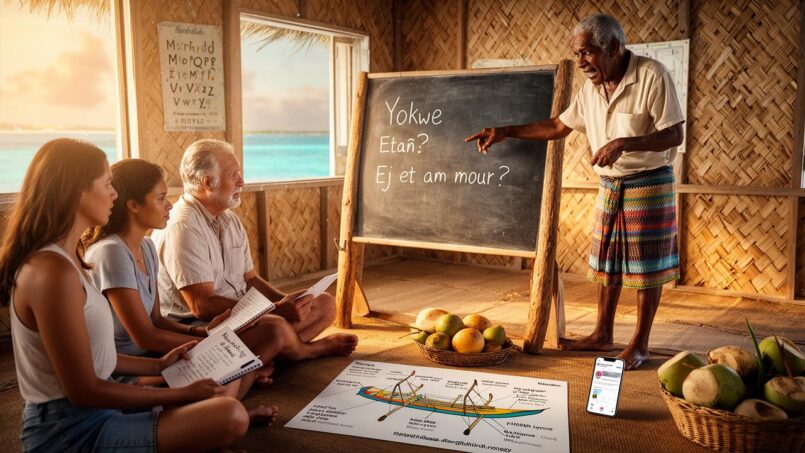
Learning a few phrases already changes how you are perceived. The simple “Io̧kwe” or “Yokwe” — which means hello, goodbye, and love — transforms the atmosphere of an exchange. The effort to speak the language is seen as a sign of respect and “manit” (culture in a broad sense, encompassing values, customs, and way of being).
Importance of language learning
Society is highly communal and matrilineal; kinship and neighborhood ties are central. The expatriate who sticks to English quickly becomes confined to the role of a passing foreigner. The one who tries Marshallese can instead integrate into the logic of “kajoor” (community), “menono” (shared responsibility), and “jebōj” (patience, perseverance).
Finally, language is also a tool of cultural safety: understanding what is said in a village meeting, a sermon, or a warning about the sea or weather (“kōtooj”, the storm season) can have very concrete implications for daily life.
Understanding the linguistic DNA of Marshallese
Even before opening a textbook, it helps to know what you’re dealing with. Marshallese is an Austronesian language, part of the Micronesian subgroup, closely related to Kiribati or Chuukese, and more distantly linked to Samoan, Tongan, Maori, or Tahitian. This explains some commonalities with other Pacific languages: the importance of reduplication, complex pronouns, and close ties between language and navigation.
A language with “light” and “heavy” consonants
For a French speaker, one of the big surprises comes from the consonant system. Each consonant exists in a “light” (palatalized) and “heavy” (velarized or rounded) version. This contrast is phonemic, meaning it changes the meaning of words, somewhat like the difference between “soft” and “hard” consonants in Russian or Polish. Add to that several distinct /l/ and /r/ sounds, a letter N̄ pronounced like “ng” in “morning,” or a J that sounds like “ch,” and you’ll understand why all textbooks insist: you cannot learn Marshallese pronunciation from writing alone.
Do not assign English phonetic values to Marshallese letters. The pronunciation of the same letter can vary depending on its position in the word (beginning, end, between vowels, etc.). The best learning materials therefore provide two guides: a column for the exact phonetic pronunciation and another with a sufficient approximation for beginners to be understood.
Vertical vowels and many allophones
Marshallese does not operate with the classic five vowels a-e-i-o-u as conceived in French. The system is often described as “vertical”: a few phonemic vowels that manifest as a dozen allophones depending on the surrounding consonants. Depending on context, the same vowel can sound like /i/, /e/, /a/, /o/, or /u/. Here again, only regular listening to native speakers allows you to adjust.
A grammar without the verb “to be” or articles
Grammatically, the basic sentence follows a subject-verb-object order. But there is no verb “to be” as in French or English. Saying “she is kind” literally means “she kind.” There are also no definite or indefinite articles: to express the idea of “a/an,” the word “juon” (one) is used.
In Marshallese, verb tenses are indicated by suffixes added to pronouns, not by verb inflections. For example, the pronoun ‘e’ (he/she/it) becomes ‘Ej’ in the present tense and ‘Enaaj’ in the future. Furthermore, nouns do not take endings to mark the plural; context—especially the use of demonstratives—specifies whether a singular or plural entity is being referred to.
Finally, pronouns are very rich: not only are there singular, dual, trial, and plural forms, but also inclusive “we” (you + me + others) and exclusive “we” (me + others, excluding you). For an expatriate, this system may seem exotic, but it is precisely here that a part of the Marshallese view of social relations resides.
Two major dialect chains: Ratak and Ralik
One often speaks of the Ratak (East, “sunrise”) and Ralik (West, “sunset”) dialects. They are mutually intelligible, with differences mainly in vocabulary and pronunciation. The Ralik dialect is considered more standard and serves as the basis for most textbooks, which note Ratak variants as needed. In practice, on Majuro or Ebeye, you encounter both, and for a beginner, the priority is to understand and be understood, not to finely distinguish between variants.
First steps: greeting, introducing yourself, following politeness codes
Marshallese culture places a very strong emphasis on respect, courtesy, modesty, and hierarchy, especially toward elders and “irooj” (chiefs). Learning the language must therefore go hand in hand with learning good manners.
A first set of useful phrases:
| Situation | Marshallese (common form) | Approximate meaning |
|---|---|---|
| Saying hello | Io̧kwe / Yokwe | Hello / love |
| Saying hello to a group | Io̧kwe aolep | Hello everyone |
| Asking “How are you?” | Ej et am mour? / Em̧m̧an mour? | How is your life? |
| Replying “I’m fine” | Em̧m̧an / Elukkuun em̧m̧an | Good / very good |
| Saying thank you | Kom̧m̧ool / Kohhool | Thank you |
| Saying thank you very much | Kom̧m̧ooltata / Kommol tata | Thank you very much |
| Saying goodbye / see you later | Bar lo eok / Bar lo kom̧ | See you later |
Greetings are rarely done alone. You shake hands gently, smile a lot, remove your sunglasses to make eye contact, and slightly tilt your head to show respect, especially toward an elder. In a group, you go around to greet everyone, and take care to introduce people in the correct hierarchical order.
With elderly people, respect is shown through specific language codes. Let them speak first, avoid interrupting them, and always use polite forms and appropriate titles. Using a few words in Marshallese, such as the respectful greeting “Ijōkwe” or “Jouj” to say “please,” demonstrates an understanding and respect for established social rules.
Essential cultural codes for the expatriate learning the language
It’s impossible to separate language and culture in the Marshall Islands. Some rules may surprise a newcomer, but integrating them from the start greatly facilitates interactions.
The head is sacred and should not be touched. Avoid stepping over someone’s legs, standing over a person, or positioning yourself in front of someone of higher status. Always speak in a soft voice, as raising your voice is perceived as aggression. Certain gestures are taboo: whistling at night, clicking your tongue, or making jokes about someone’s mother.
Even the way you sit is codified: on a mat, men sit cross-legged, women with their legs folded under them, thighs covered. You ask where to sit in a house to avoid taking a place on a sleeping mat (“jaki”), where the head rests.
In this context, learning polite phrases—thanking, apologizing, asking tactfully—is a linguistic priority.
| Intention | Marshallese phrasing | Typical use |
|---|---|---|
| Saying “please” | Jouj / Kohhool tata (more emphatic) | Polite request |
| Apologizing / “sorry” | Jo̧lo̧k aō bōd / Jab kohhooltata | Excuse, minor incident |
| Reassuring “don’t worry” | Jab inepata | Response to apologies |
| Saying “you are forgiven” | Ejovxk ah bcd / Ejovk aō bwir | Forgiving a mistake |
An expatriate who masters these expressions is much better equipped to defuse a cultural misunderstanding.
Major categories of resources for learning Marshallese
Marshallese obviously lacks the depth of apps and methods of a global language, but the offerings are far from nonexistent. They can be divided into main types: structured textbooks, audio courses, reference dictionaries and grammars, mobile apps, cultural materials (poetry, stories), and above all, practice with native speakers.
Reference textbooks: “Practical Marshallese” as a cornerstone
For an expatriate serious about the endeavor, a written textbook provides the most solid foundation. The most frequently cited is “Practical Marshallese” by Peter Rudiak-Gould. It is a comprehensive textbook, freely distributed, that has served since 2004 as the official guide for all WorldTeach volunteers in the Marshall Islands and for classes for Americans on Kwajalein.
Its organization is very pedagogical:
| Stage in the textbook | Approximate content | Vocabulary acquired |
|---|---|---|
| Lessons 1 to 25 | Alphabet, sounds, basic phrases, numbers, time, prices | ≈ 250 words |
| Lessons 26 to 50 | Pronouns, tenses, questions, negation, possession | ≈ 500 words |
| Lessons 51 to 102 | Adverbs, comparatives, conditionals, subjunctive, etc. | ≈ 1500 words |
Each lesson fits on two pages, with one main grammar point, a vocabulary section, often dialogues, practical tips, and pronunciation. The lessons follow an order of “usefulness”: what is most needed at the beginning is studied first, allowing a busy expatriate to stop, for example, after lesson 25 with enough to get by in many situations.
The textbook also has the advantage of using the modern standard orthography (that of the major Marshallese-English dictionary by Abo, Bender, Capelle, and deBrum), while noting, where relevant, older forms still visible on signs or in some religious texts.
Audio courses and materials like “FSI” or Peace Corps
For less widely spoken languages, the older courses from the Foreign Service Institute (FSI) or Peace Corps manuals remain top-tier resources, often in the public domain.
A comprehensive guide designed by the Peace Corps for volunteers teaching in the outer islands, structured according to a practical progression suited to the field.
Learning essential expressions for introducing yourself, giving an address, and communicating with a driver in Majuro.
Mastering everyday conversations and daily interactions within a Marshallese host family.
Discovering terms related to the natural environment, weaving, fishing, and copra production.
Acquiring the lexicon needed to navigate and understand transportation between the different islands of the archipelago.
This type of resource places a strong emphasis on pronunciation. The instructions are clear: do not rely solely on writing, work systematically with a native speaker, repeat dialogues and phrase lists until the sounds become familiar. The same philosophy is found in FSI courses, which present conversations at natural speed, recorded by Marshallese speakers, supplemented with structured exercises.
For an expatriate, the benefit is twofold: building oral automatisms (greetings, orders, directions, brief self-explanations) and getting used to the musicality of the language, its pauses and smiles, before launching into long speeches.
Dictionaries and grammars: powerful tools for going further
Beyond a certain level, reference tools become indispensable. The large Marshallese-English dictionary by Abo, Bender, Capelle, and deBrum is unanimously praised for its accuracy, but it can be intimidating for a beginner due to its technicality. Hence the advice from several trainers: save it for later, and initially rely on the more concise glossaries in textbooks like “Practical Marshallese.”
For more flexible online use, several options exist:
| Tool | Type of content | Features |
|---|---|---|
| Marshallese.org | Online dictionary, cultural info | Standard orthography, data by Nik Willson |
| MOD (Marshallese-English Online Dictionary) | Enhanced electronic version of a print dictionary | Revised and expanded in 2009 |
| “Naan” Dictionary | Accessible lexicon with variants | Less comprehensive but more user-friendly |
These tools allow you to quickly check a word heard at the market, during a sermon, or in an office, and to note your findings in a notebook or flashcard app.
Additionally, a “Marshallese Reference Grammar” exists for those who want to analyze the language’s structure in detail (phonology, morphology, syntax). The work is considered very comprehensive but full of linguistic jargon, making it more suitable for teachers, translators, or enthusiasts.
Mobile apps: daily support for the expatriate
Even though Marshallese does not have a Duolingo or Babbel course, a few targeted apps exist and can become good travel companions for an expatriate.
Among them:
| App | Platform | Main function | Strengths for an expatriate |
|---|---|---|---|
| Marshallese M(A)L | iPad | Games and tests in Marshallese | Fun practice, self-paced |
| Beginner Marshallese | Android | “One word a day” with spaced repetition | Daily review, nearly 1000 words |
| English Marshallese Translator | Android | Instant translation EN ⇄ MH (words, phrases, documents) | Quick help, comprehension support |
“Beginner Marshallese” applies a spaced repetition algorithm: the more you get a word right, the less it appears; if you make a mistake, it comes back more often. For an expatriate already busy with a full-time job, the ability to select a few words a day and review them on the bus or before sleeping is valuable.
This translator is not designed for teaching but serves as a safety net to check a technical term, confirm understanding of a sentence with an interlocutor, or decode a written message.
Cultural resources: stories, poetry, videos
To go beyond vocabulary lists, diving into culture is another gateway to the language. Collections like “Marshall Islands Legends and Stories” or projects like the Marshall Islands Story Project gather traditional tales, often at an advanced language level, but very rich in authentic expressions.
Contemporary Marshallese poetry—for example the collection “Iep Jaltok: Poems from a Marshallese Daughter” by Kathy Jetnil-Kijiner—mixes English and Marshallese and directly addresses themes that run through society: nuclear legacy, rising sea levels, diaspora. Even if not everything is immediately comprehensible, spotting a few words, recurring phrases, and discussing them with Marshallese friends creates bridges between language learning and the country’s issues.
YouTube channels like “Ro mōtta ilo aolep laļ ko.” offer commentary on culture and language, sometimes with interviews, recipes, and explanations of good manners. This type of content brings spoken everyday language closer to what the expatriate sees around them.
Pronunciation: why you absolutely must work with native speakers
Everything known about Marshallese phonology converges on one point: learning only through writing leads to approximations that are sometimes incomprehensible. The “light/heavy” consonants, the three /l/ and three /r/ sounds, numerous allophonic vowels, and certain phonotactic constraints (e.g., the requirement that consonant clusters be “homorganic”) demand a trained ear.
Didacticians therefore recommend a clear strategy:
To make effective progress in Marshallese, start with ‘good enough’ approximations to avoid discouragement. Then, regularly record yourself and compare your pronunciation to that of native speakers via audio courses, videos, or conversations. Don’t hesitate to openly ask for corrections: Marshallese people generally appreciate their language being taken seriously and can help you distinguish subtle but important nuances, such as between ‘wot’ and ‘wõt’. Finally, accept that mastery of many sounds will come gradually with practice and repeated interactions.
The phonotactic constraints also explain why some islanders tend to insert a vowel into English consonant clusters (“stop” becomes “estop”). The Francophone expatriate, on the other hand, will need to learn to manage the opposite: avoid adding syllables in Marshallese where there are none, and respect the CV/CVC/VC syllable structure.
Building a realistic learning plan when already living on site
Once settled in the Marshall Islands, time flies between work, social life, and sometimes long inter-island trips. It is therefore useful to build a realistic learning plan that combines self-study, digital tools, and immersion.
A pragmatic approach might look like this:
| Approximate period | Main objective | Preferred means |
|---|---|---|
| 0–1 month | Survival and politeness | Basic phrases (hello, thank you, sorry), Beginner Marshallese, excerpts from “Practical Marshallese,” use of EN–MH translator |
| 1–3 months | Daily routine | Structured work on the first 20–30 lessons of “Practical Marshallese,” Peace Corps dialogues, daily practice with colleagues, neighbors, host family |
| 3–6 months | Simple conversations and overall comprehension | Continuation of the textbook, watching YouTube videos, participating in ceremonies and celebrations, regular questions to native speakers, using marshallese.org to check vocabulary |
| 6–12 months | Varied conversations and cultural registers | Reading stories, poems, attending cultural classes or workshops, deepening pronunciation with a tutor or patient friend |
Experiences of some learners show that with a combination of FSI/Peace Corps courses and practice with native speakers, one can reach a “reasonable level” in a few months. Most complete curricula (like FSI) are designed for 600 to 1200 hours of work, i.e., 6 to 12 months to reach a professional level (B2–C1). For a non-linguist but motivated expatriate, aiming for a B1 autonomy level in one year is a realistic ambition, if one relies on the natural language environment: neighborhood, market, church, celebrations, village meetings.
Learning the language by learning the culture: communication styles and taboos
Speaking Marshallese is not just about stringing together grammatically correct sentences. The communication style itself is highly codified. Exchanges prioritize harmony, narrative detours, and reflective silences. The “bwebwenato” system—these storytelling or discussion sessions where stories, advice, and decisions are shared—is a good example.
An expatriate must interpret indirect signals: a response like ‘We’ll think about it’ is often a polite refusal. A prolonged silence shows respect and reflection, not disinterest. Agreement may be shown by a slight head tilt or a discreet smile, while a lack of reaction may indicate reservation.
Certain topics remain very sensitive: death from illness, domestic or sexual violence, suicides are rarely addressed directly. Conversely, talking about family, church, and community remains safe ground. Learning the language thus also means learning to sense when it is better to ask a question, when it is time to be silent, when a “Western” joke might come across as aggression.
Language, work, and professional integration
In the professional sphere, understanding and speaking Marshallese gives the expatriate a clear advantage, even if official meetings are sometimes held in English. Local employers value candidates who respect cultural codes and fit into the communal logic. Job interviews, for example, do not just assess technical skills: they seek a profile that “strengthens the community fabric.”
To succeed in an interview, favor ‘we’ over ‘I’ and structure your experiences as short stories with a beginning, middle, and end, in line with oral tradition. Show respect by learning a few phrases in Marshallese, using local expressions of thanks, accepting to share a meal during the interview, and being particularly attentive to elders.
In the workplace, hierarchy remains important: interrupting a superior can permanently damage the relationship. An expatriate who at least partially understands informal exchanges in Marshallese can pick up on unspoken cues, ease tension, spot a disagreement before it escalates. Here again, the link between language and a cooperative atmosphere is very direct.
Living the language daily: home, meals, celebrations
Learning the local language is especially rewarding in domestic and festive settings, where English recedes. Being invited to share a meal, participate in a “kemem” (big first birthday party), attend a traditional dance or a storytelling session—all of this takes on another dimension when you grasp at least the gist of what is being said.
At the table, hospitality is paramount: refusing or wasting offered food is frowned upon. Wait for the host to start eating and offer the last piece before taking it yourself. Certain rituals, like consuming betel nut or kava, are codified (e.g., clapping hands before and after drinking). Knowing a few key words like ‘enno’ (good/edible), ‘nana’ (bad), ‘awa in mongai’ (mealtime), and ‘kommol tata’ (thank you very much) is highly appreciated.
In the home, removing your shoes before entering is a basic sign of respect, as is taking off your hat. Offering a small gift—food, tea, a small item from your country—is appreciated as a gesture of cultural exchange, not as an attempt at bribery. Receiving a gift from someone’s hands involves taking it with both hands and thanking them. These micro-rituals, learned alongside the words that accompany them, make the expatriate much more comfortable.
Facing challenges: relative scarcity of resources, phonological complexity, English–Marshallese code-switching
It would be dishonest to claim that Marshallese is as easy to learn as a major European language with abundant documentation. Resources remain limited, especially if you are looking for explanations in French. Most serious teaching materials (textbooks, grammars, dictionaries) are in English, sometimes highly technical. The sound system is demanding, the coexistence of two orthographies complicates things a bit, and the real-life alternation between English and Marshallese can give the illusion that you don’t “need” the local language.
Yet several factors work in the learner’s favor:
Marshallese vocabulary includes many loanwords from English, transformed but recognizable (e.g., ‘jikuuv’ for ‘school’). Locals are described as warm and happy to teach their language to those who show interest. Organizations like the Marshallese Educational Initiative or certain volunteer programs sometimes offer classes. Finally, more and more online resources (dictionaries, blogs, videos) are emerging to support learners.
For an expatriate, the key is to accept that learning will be gradual, that you will sometimes have to juggle between different writing systems, and that the gain will be measured not only in the number of words acquired, but in the quality of the relationships formed.
Concrete tips for a Francophone expatriate in the Marshall Islands
By gathering the best practices that emerge from the experiences of volunteers, teachers, researchers, and members of the diaspora, we can identify some very operational guidelines for an expatriate:
Start by building a survival core: greetings, polite phrases, expressions related to the body and basic needs (eat, drink, sleep, pain, hot/cold). These words are often listed in the first lessons of “Practical Marshallese” and in beginner apps.
It is crucial to work on pronunciation from the start and to get corrected regularly. Actively solicit Marshallese speakers by asking, for example: “Show me how you say it” or “Does that sound natural?” Many Marshallese, especially younger ones, are used to explaining their language to English speakers and will be happy to do the same for a French speaker.
Insert yourself into a “network of ears.” Identify moments when the language is spoken in all its richness: family gatherings, churches, celebrations, markets, boat trips. Even if at first you understand almost nothing, letting yourself be lulled by the sounds, noting a few fragments, and then checking them in an online dictionary or with a friend greatly accelerates familiarization.
To effectively learn a language like Marshallese, it is better to establish a short daily routine of 10 to 20 minutes rather than long, spaced-out sessions. Alternate activities: review vocabulary on an app one day, read a lesson the next, then try to recognize known words in a Marshallese video the following day.
Accept mistakes as part of the process. Studies on the acquisition of “difficult” sounds in a second language show that secondary articulations (like those in Marshallese) are among the longest to master. The priority, especially at the beginning, is to be comprehensible and respectful, rather than perfect.
Finally, talk about your learning journey with those around you. In a society with a “visiting friendly culture”, where people love to gather and chat outside in the evening, saying “I’m trying to learn your language, can you help me?” opens many doors. Often, the neighborhood becomes your best “school,” over evenings, shared meals, and bwebwenato.
Learning Marshallese, a gesture of reciprocity
Over the months, the expatriate who persists in learning the local language discovers that Marshallese is not just a communication tool. It is a concentrate of the islands’ maritime history, navigational wisdom, memory of nuclear tests, songs, proverbs (“The canoe moves forward when everyone paddles together”), and that very specific way of weaving bonds between people and their environment.
In a country where English has often been imposed as the language of modernity, and where some young people in the diaspora lose their Marshallese at school, the reverse step of a foreigner who deliberately chooses to learn the local language carries strong symbolic value. It says: “I recognize that your language deserves to be spoken, understood, transmitted.” It is also a very concrete way of respecting the Marshallese principle of cooperation: everyone brings what they can to the movement of the common canoe.
The symbolic value of learning Marshallese
Learning Marshallese in the Marshall Islands is therefore not about ticking another box on your expatriate resume. It is about accepting to be slightly transformed by a different way of naming the world, and making yourself available to everything that this language—and those who speak it—have to offer.
Disclaimer: The information provided on this website is for informational purposes only and does not constitute financial, legal, or professional advice. We encourage you to consult qualified experts before making any investment, real estate, or expatriation decisions. Although we strive to maintain up-to-date and accurate information, we do not guarantee the completeness, accuracy, or timeliness of the proposed content. As investment and expatriation involve risks, we disclaim any liability for potential losses or damages arising from the use of this site. Your use of this site confirms your acceptance of these terms and your understanding of the associated risks.

Cyril Jarnias is an independent expert in international wealth management with over 20 years of experience. As an expatriate himself, he is dedicated to helping individuals and business leaders build, protect, and pass on their wealth with complete peace of mind.
On his website, cyriljarnias.com, he shares his expertise on international real estate, offshore company formation, and expatriation.
Thanks to his expertise, he offers sound advice to optimize his clients' wealth management. Cyril Jarnias is also recognized for his appearances in many prestigious media outlets such as BFM Business, les Français de l’étranger, Le Figaro, Les Echos, and Mieux vivre votre argent, where he shares his knowledge and know-how in wealth management.





