
 Published on and written by Cyril Jarnias
Choosing to pursue higher education abroad in the Marshall Islands means betting on a unique destination: a Pacific island nation at the heart of global climate issues, where the range of educational offerings remains modest but is connected to a strong regional network (University of the South Pacific) and numerous mobility opportunities to Australia, the United States, or other Pacific countries. For an international student, or a Marshallese student from the islands wishing to study elsewhere, understanding this landscape is essential to building a coherent academic path.
This article covers the national context, the higher education system, campus life, cost of living, visa procedures, regional pathways, and specific scholarships for Marshallese nationals.
A living laboratory facing climate change
The Marshall Islands are a low-lying atoll state scattered across the middle of the Pacific. The capital, Majuro, concentrates most of the economic, administrative, and academic life, while a large part of the population is gradually moving towards the urban centers of Majuro and Kwajalein. It is estimated that more than half of the residents live on the capital atoll, and that about three-quarters of the population are now in these urban areas.
The country, as an atoll state, is particularly exposed to the effects of the climate crisis. Projections indicate rising air and water temperatures, sea level rise, ocean acidification, and intensification of extreme events. These phenomena lead to serious risks of marine flooding, coastal erosion, contamination of freshwater reserves, droughts, and heat stress, directly threatening population health, water resources, and ecosystems such as coral reefs.
Several studies, conducted in partnership with the University of Hawaii, NOAA, the East-West Center, and the Marshall Islands Conservation Society, already show tangible effects: on three studied islands, between a quarter and nearly half of households report health impacts related to climate stress over the past five years. This work feeds into strategic documents such as the PIRCA report for the Marshall Islands, the 2050 Climate Strategy, the National Adaptation Plan, and a future National Climate-Health Plan.
Studying in the Marshall Islands offers a privileged position to observe, document, and understand the effects of climate change on island societies and ecosystems. This environment is particularly stimulating for students and researchers interested in fields such as resilience, migration, public health, water management, coral reef studies, or climate governance.
Overview of higher education in the Marshall Islands
The higher education offering strictly within the Marshall Islands remains limited, but it is part of an effective regional architecture, where several institutions complement each other.
The College of the Marshall Islands (CMI)
The College of the Marshall Islands (CMI) is an independent community college, regionally accredited, located in Majuro. The institution focuses primarily on associate degree programs (equivalent to a two-year degree) in the arts and sciences, business, or information technology. According to standard academic sources, CMI does not offer master’s or doctoral programs.
For students from the Marshall Islands, CMI plays a central role as a stepping stone: a solid associate degree allows them to then join partner universities, especially in Hawaii or other Pacific countries, often with well-established equivalencies (for example, ENG 101 and 102 courses recognized by the University of Hawaii at Hilo).
USP: the regional Pacific university in Majuro
The major centerpiece of higher education in the region is the University of the South Pacific (USP). It is a public research university, structured as an intergovernmental organization, jointly owned by twelve island countries, including the Marshall Islands (member since 1991). The university has its main campus in Suva (Fiji), but also has campuses and regional centers in each of the member countries, including a campus in the Marshall Islands.
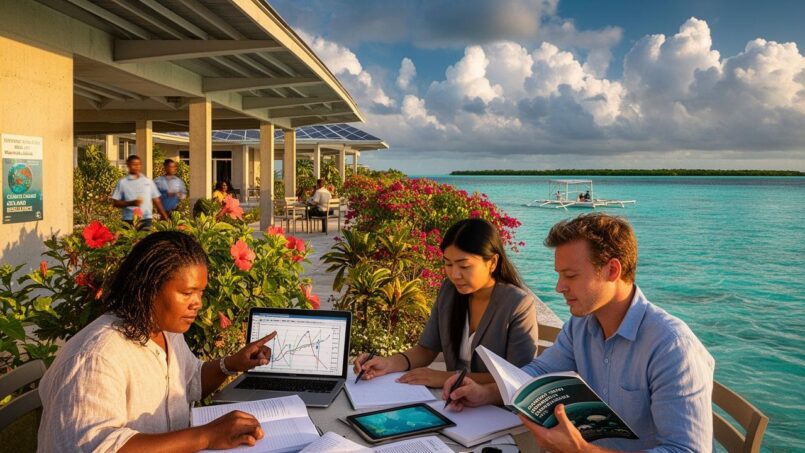
The University of the South Pacific (USP) campus in the Marshall Islands is located in Majuro, on Long Island, by the beach. Although small in size, it has complete infrastructure: a library, science laboratories (biology, chemistry, physics), computer labs, videoconferencing equipment, an academic support service, and a student life office. Its unique setting offers direct access to the beach, the reef (accessible by kayak or fins), a water sports club, sports fields, a gym, and a café.
USP offers a wide range of programs, from upgrading pathways or transition programs (bridging, preliminary, foundation) to bachelor’s degrees, postgraduate diplomas, master’s degrees, and doctorates. The major internal schools cover accounting and finance, management, computing, engineering, mathematics and physics, natural and environmental sciences, law, social sciences, communication, education, Pacific arts, etc. In addition, there is a set of technical and vocational training programs (Pacific TAFE), including preparatory programs for higher education supported by governments.
For international students, enrollment at the University of the South Pacific (USP) can be done with Majuro as the home campus. The course offering is flexible, combining online, blended learning, or in-person formats, depending on the discipline. It is important to note that the language of instruction is English, which requires a good level of proficiency.
Marine and environmental programs: a major asset
USP places strong emphasis on marine and environmental sciences. The Institute of Marine Resources and the Marine Studies Programme have developed, since the late 1980s, certificates, diplomas, and bachelor’s degrees in ocean resource management and tropical fisheries. These programs rely on interdisciplinary approaches, combining marine biology, economics, law, and resource policy. The atolls of the Marshall Islands, with their coral reefs and fisheries issues, are a prime study area.
In parallel, numerous external research projects focus on reefs, sea level dynamics, coastal vulnerability, or paleoclimate reconstruction through corals, conducted in partnership with institutions such as NOAA, USGS, or American and Australian universities. For a master’s or doctoral student, the Majuro campus can therefore be a base for research internships, even if the degree is awarded by USP or a foreign university.
Studying in the Marshall Islands: daily life, budgets, and housing
The financial aspect is a key element in any decision regarding academic mobility. The Marshall Islands are generally ranked among countries where the cost of living is above the global average, largely due to dependence on imports and shipping costs.
Cost of living and international comparison
Available data indicate that the overall cost of living is about 1.3 times higher than the global average, placing the country around 36th–38th rank out of nearly 200 countries. Majuro, the capital, is the most expensive city in the archipelago, with a cost of living index slightly higher than reference cities like Prague, and comparable to some mid-sized European or North American cities.
To give you an idea, here is a summary of estimated monthly budgets for a student living in Majuro:
| Expense category | Estimated monthly range (USD) |
|---|---|
| Housing | 350 – 1,200 |
| Utilities (water, electricity, etc.) | 75 – 150 |
| Internet & mobile | 45 – 90 |
| Groceries | 200 – 450 |
| Local transportation | 50 – 150 |
| Eating out | 60 – 200 |
| Leisure | 30 – 120 |
| Health insurance | 50 – 250 |
| Visa fees & miscellaneous | 10 – 30 |
Depending on lifestyle (shared accommodation, simple housing versus single apartment near the center), a plausible monthly budget ranges from about 900 to 2,600 dollars. Estimates intended for international students mention 1,100 to a little over 2,000 dollars per month for Majuro, including housing.
Local average salaries are significantly lower than those in most students’ home countries, limiting opportunities for well-paid student jobs. It is therefore essential to secure full funding for your studies and daily living expenses from the outset.
Housing and accommodation options
In Majuro, you mainly find one- to three-bedroom apartments, furnished or unfurnished. A furnished apartment typically includes a fitted kitchen, living room, and bathroom. An unfurnished unit often requires purchasing or renting appliances, furniture, linens, and kitchen utensils.
Rents vary greatly. Sources indicate, for a one-bedroom apartment in a central area, amounts ranging from 400 to 800 dollars per month, with better-located or newer units potentially reaching up to 1,500 dollars. On the outskirts or in more distant neighborhoods, more affordable housing exists, sometimes around 300 dollars for very basic units.
There are also options like bunk bed rooms or shared apartments, which can significantly reduce costs, at the expense of simpler comfort. Some educational programs (like the SDA schools in Delap or Laura) offer on-campus housing, organized as small houses or shared apartments, located close to the sea or beaches.
Practical solutions for temporary stays, ideal for a reconnaissance period before long-term settlement.
Offers standard or “deluxe” rooms with air conditioning, small kitchenette, access to a gym, and 24-hour security. Nightly rates.
This type of accommodation is particularly useful for a first month of scouting on site.
Utilities, water, electricity, and internet
Basic utilities operate under specific arrangements that need to be anticipated.
Electricity often relies on a prepaid system: “Cash Power” cards are purchased at shops, hotels, or from the electricity company, then credited to a meter. This allows you to control your consumption, but requires regular vigilance to avoid outages.
Tap water is not considered potable. Some school institutions are equipped with desalination devices to provide safe water for teachers and students, but generally, a budget for bottled water or filtration systems should be planned. Water and sanitation services are billed monthly, often as a flat rate.
Internet access is decent but can be unstable, especially during bad weather. Residential high-speed plans run around 70 dollars per month for speeds around 50–60 Mbps, but more expensive offers exist, as well as more basic subscriptions. Data SIM cards are relatively affordable for small usage, but intensive use (videos, video conferences) can quickly increase the cost.
Local transportation
On Majuro, mobility relies mainly on shared taxis and, to a lesser extent, walking and cycling. The linear road network of the atoll makes the shared taxi system very practical: cars run regularly along the main axis and stop on demand.
Fares are relatively simple and based on distance:
| Typical route | Approximate fare (USD, per person) |
|---|---|
| Downtown trip (Delap–Uliga–Djarrit) | 1.50 – 2.00 |
| From Rita to Rairok | 3.00 |
| Downtown – airport / Ajeltake – Laura | 5.00 |
Daily costs are therefore moderate, but add to the overall budget. For inter-island travel, short flights or maritime connections are necessary, which are not necessarily very frequent or cheap.
Daily life and leisure
Daily life in the Marshall Islands is marked by a strong proximity to the sea and outdoor activities. Around the campuses or schools, there are beaches for swimming, snorkeling, kayaking, paddleboarding, or simply relaxing in a hammock. Local clubs, such as the Majuro Ocean Sports Club, promote Polynesian canoeing, sea swimming, or surfing. On campuses, basketball courts, volleyball courts, singing clubs, or student cafés structure a simple but friendly community life.
Daily reality, however, involves accepting a limited offering of cultural infrastructure (cinemas, large performance halls, shopping malls), a dependence on imports for many products (electronics, brand-name clothing), and restricted access to certain specialized services (healthcare, device repair, etc.). Prices of imported goods can be very high, whether for smartphones, computers, or even processed food products.
Visa procedures for studying in the Marshall Islands
For most international students, arriving in the Marshall Islands requires obtaining a student visa (category S‑1). The country has a specialized service responsible for handling visa applications for people who wish to work, study, or invest, as well as for their families.
General framework
The Marshall Islands has several visa categories (visitor, business, employment, transit, residence, etc.), including the S‑1 student visa. All visas – except for certain diplomatic visas – must be obtained before entering the country. Having a visa generally allows obtaining an entry permit and staying in the country for the duration of that permit, but this authorization is never automatic: the decision to issue, condition, or refuse a visa rests with the Director of Immigration or their delegate.
In case of refusal of entry or stay, the authorities must provide a written justification. It is possible to appeal this decision to the Attorney General. Additionally, a bond system may be required for nationals of certain countries or if the authorities consider there is a risk of overstaying the authorized period.
Conditions for the S‑1 student visa
Any person residing outside the Marshall Islands who wishes to enter to study at a school or academic institution must apply for a student visa before traveling. The maximum duration of this visa is generally one year, renewable depending on the length of studies.
The typically required documents are as follows:
– Official letter of acceptance into a full-time study program at a recognized institution (USP Marshall Islands campus, secondary school, or other academic institution).
– Completed application form and official transcripts.
– Passport valid for at least six months beyond the expected end of studies.
– Proof of payment of tuition fees (or of scholarship coverage).
– Evidence of sufficient financial resources to cover housing, food, transportation, and other expenses.
– Private health insurance valid in the Marshall Islands, with documentary proof.
– Medical and police certificates attesting to the absence of convictions or illnesses incompatible with the stay.
– Vaccination record if required (for example, measles vaccination for those born after 1957).
Authorities recommend starting the process at least six months before the start of the term. The applicant must also demonstrate their intention to return to their home country after completing their studies. Once the visa and entry permit are issued, the student can reside in the Marshall Islands, often with limited permission to work to partially support themselves, depending on the conditions of their permit.
Health constraints and departure fees
The Marshall Islands imposes vaccination requirements for certain visitors. Travelers aged 6 months to 62 years born after 1957 must present proof of measles vaccination or a medical certificate of contraindication. Otherwise, they may be denied boarding or entry into the country.
Also note the existence of mandatory HIV tests for obtaining certain work or residence permits, sometimes including long-term students. Test results from abroad may be accepted under certain conditions.
Finally, passengers departing Majuro by air must pay departure taxes (about 20 dollars for an international flight, 2 dollars for a domestic flight), unless exempted diplomatically.
Specifics for Marshallese students studying abroad
The other side of the coin concerns Marshallese nationals who go abroad to study. This dimension is essential, as a significant part of the population now lives in the United States, and the Marshallese government actively invests in scholarships and support for academic mobility.
The Compact of Free Association with the United States
Under the Compact of Free Association with the United States, Marshallese citizens meeting certain conditions can enter the United States without a visa, study, work, and reside there indefinitely, under the so-called “duration of status” status. In practice, this means that a Marshallese student can enroll in a US university without having to apply for an F‑1 visa, greatly simplifying the process.
This status offers academic and professional opportunities in the United States, but is not equivalent to US citizenship. It excludes persons who acquired Marshallese citizenship through investment or passport purchase. Beneficiaries remain subject to US inadmissibility and removal rules applicable to non-citizens.
National scholarships: MISGLB
The Marshall Islands Scholarship, Grant & Loan Board (MISGLB) is the official body responsible for funding the education of Marshallese citizens. Its mission is to develop and manage scholarship, grant, and loan programs to enable students to access higher education, at home or abroad, and then return to contribute to national development.
The MISGLB awards different types of aid, including direct scholarships (for example, a MISGLB scholarship of 500 dollars referenced in certain lists) and more substantial aid for undergraduate or graduate programs. Exact conditions (required level, priority fields of study, return commitment) vary by call and year.
International scholarships targeting Marshall Islands nationals
Marshallese nationals can also apply for a wide range of international scholarship programs, including:
Main scholarship programs for studying abroad, including full or partial coverage, aimed at students from developing countries and the Pacific.
Full scholarships (tuition, travel, allowance, insurance) for master’s and doctoral degrees in Australia. Priority areas: health, education, environmental and climate management, natural and marine resources, agriculture, cybersecurity, social protection, public policy, and international law.
Scholarships for undergraduate or graduate studies at Pacific institutions (USP, Fiji National University, etc.). Often accessible with an associate degree or foundation certificate (minimum GPA 3.0).
Programs from universities in New Zealand, Canada, Europe, or Asia specifically targeting Pacific island or developing country students.
Within this framework, a Marshallese student might follow a typical path: associate degree at the College of the Marshall Islands or at USP Majuro, then a bachelor’s or master’s degree at USP Laucala or the University of Hawaii, funded by a combination of national (MISGLB) and international (Australia Awards, others) scholarships. For specialized fields like marine biology, the student could then join a research master’s program at the University of Hawaii at Manoa or another specialized university, possibly maintaining field ties with the Marshall Islands.
Link between studying in the Marshall Islands and regional research networks
Even though the Marshall Islands do not have a vast and comprehensive university system, their integration into regional and international research networks is remarkable.
Several institutions carry out projects there: NOAA, Pacific RISA (climate risk management program in the Pacific Islands), the University of Hawaii (Manoa and Hilo campuses), the Marshall Islands Climate Change Directorate, the Marshallese Ministry of Health, the Marshall Islands Conservation Society, local NGOs like Jo‑Jikum or WUTMI, and Australian universities (Melbourne, Monash, ANU), among others.
These collaborations have given rise to projects on: sustainability, technological innovation, social impact, education, environmental research.
Multidisciplinary initiatives studying the impacts of climate change and developing tools for resilience and education in the region.
Quantitative (199 households) and qualitative studies to analyze causes, profiles, and consequences of migration on origin and host communities (Hawaii, Oregon, Washington).
Development of a National Climate-Health Policy and a five-year action plan, with support from the Pacific Community (SPC).
Risk assessment by USGS and the Marshall Islands Conservation Society, including local training and production of technical manuals.
Past climate reconstruction via an NSF CAREER grant, integrating pedagogy with 3D printing and virtual reality for environmental education.
For an international student coming to the Marshall Islands – or a Marshallese student considering an academic career – these projects offer opportunities for internships, master’s theses, and co-supervised doctoral research, even if the degree itself is awarded by a foreign university. Majuro then becomes a privileged study site, at the intersection of natural, social, and political sciences.
Preparing academically and linguistically
Higher education in the Marshall Islands, whether through USP or other institutions, is conducted mainly in English. International students must therefore anticipate language requirements.
The major destination universities for Marshallese students (United States, Australia, New Zealand, Malaysia, etc.) generally require minimum scores on TOEFL, IELTS, Duolingo English Test or other standardized tests. When English is not the student’s first language, admissions are conditional on meeting specific thresholds (e.g., an overall IELTS ≥ 6.5, with no sub-score below a certain level for Australia Awards scholarships).
Some institutions offer conditional admissions or intensive English pathways, where enrollment in the main program is subject to passing a preparatory English course within a specified timeframe. Additionally, USP offers transition programs (foundation, bridging) designed to strengthen students’ academic and language skills before entering a bachelor’s degree.
For Marshallese students wishing to go abroad, it is common that academic English courses taken at the College of the Marshall Islands or USP are recognized by partner universities (for example, ENG 101 and 102 at CMI fulfilling the English composition requirement at the University of Hawaii at Hilo, without needing TOEFL).
Advantages and challenges of choosing the Marshall Islands as a study destination
Settling in the Marshall Islands for higher education is nothing like a stay in a large Western city. It is a unique choice, with specific advantages and very concrete constraints.
Strengths
The main strengths lie in the combination of an exceptional environment and anchoring in strong regional and international networks.
Academically, USP represents a benchmark regional platform, with diverse programs, recognized accreditation, and a solid history in distance learning and support for students from small islands. The relatively modest size of the Majuro campus promotes personalized support, proximity to teachers, and a community life that is often warmer than anonymous.
The Marshall Islands constitute a unique scientific study site for observing the effects of climate change, particularly on reef management, water security, public health, and environmental migration. Conducting research there allows developing original field projects in collaboration with international experts and directly contributing to resilience initiatives.
On a human level, the very widespread use of English (over 98% of the population speaks English) facilitates linguistic integration, while the local Marshallese culture, deeply marked by the sea and community life, offers a profound intercultural experience.
Constraints
The major constraints concern the cost of living, logistics, and infrastructure. Dependence on imports increases the price of everyday items and electronic equipment. Affordable student housing can be simple and sometimes cramped. Access to specialized healthcare is limited, making good health insurance including medical evacuation to better-equipped neighboring countries (Hawaii, Fiji, etc.) essential.
Air connections to Majuro are rare and only pass through a few regional hubs (Honolulu, Guam, Fiji), increasing the cost and complexity of travel. Furthermore, internet connectivity, although improving, remains fragile and may be insufficient for uses requiring high bandwidth.
Finally, one must accept a form of material and cultural simplicity: few mainstream entertainment venues, a limited choice of restaurants, specialized shops, or services. For some students, this simplicity can be an advantage (fewer distractions, more time for studying and exploring nature); for others, it may feel like isolation.
Building your project: some leads
For an international student considering pursuing higher education abroad in the Marshall Islands, the most judicious approach is often to think of the project within a regional rather than strictly national framework.
A realistic strategy might, for example, involve:
To optimize an academic and professional path in the Pacific, start by enrolling at the University of the South Pacific (USP) with the Majuro campus as a base for the first years (foundation, bachelor’s, early master’s), benefiting from controlled costs and a privileged study environment. Then, use USP’s internal exchange programs to study a semester or a year at another regional campus, such as in Laucala (Fiji), to diversify your experience and access larger facilities. Simultaneously, apply for international scholarships (e.g., Australia Awards) to pursue a master’s or doctorate abroad, while keeping the Marshall Islands as a research or internship field. Finally, integrate local networks of NGOs, government agencies, and international partners based in Majuro as soon as possible to gain concrete professional experience.
For a Marshallese student, the pattern can be similar, with the additional possibility of mobilizing MISGLB, benefiting from the Compact with the United States for long-term studies, or combining a local associate degree with a transfer to American or Australian universities.
In any case, it is crucial to:
– Anticipate the cost of living in Majuro well, without underestimating housing and food expenses.
– Carefully prepare student visa procedures if you are not a Marshallese or US citizen.
– Check health insurance conditions, explicitly including repatriation or medical evacuation.
– Work on your English proficiency beforehand, and potentially take advantage of language or academic bridging programs (foundation, bridging) offered by USP or other institutions.
Conclusion
Pursuing higher education abroad in the Marshall Islands is not a “classic” choice like Australia, Canada, or France. It is a bet on a destination that is both vulnerable and strategic, where climate, health, social, and marine issues converge on a small but intensely studied geographic area. It is also a gateway to a whole archipelago of opportunities: the University of the South Pacific, regional scholarships, international scientific networks, and, for Marshallese citizens, privileged access to the US university system.
In exchange for a certain material simplicity and sometimes complex logistics, the student benefits from immersion in a global epicenter of climate change, hands-on learning, and the opportunity to participate in internationally significant projects. This destination deserves serious consideration for those wishing to combine higher education, environmental engagement, and discovery of a unique island culture.
Disclaimer: The information provided on this website is for informational purposes only and does not constitute financial, legal, or professional advice. We encourage you to consult qualified experts before making any investment, real estate, or expatriation decisions. Although we strive to maintain up-to-date and accurate information, we do not guarantee the completeness, accuracy, or timeliness of the proposed content. As investment and expatriation involve risks, we disclaim any liability for potential losses or damages arising from the use of this site. Your use of this site confirms your acceptance of these terms and your understanding of the associated risks.

Cyril Jarnias is an independent expert in international wealth management with over 20 years of experience. As an expatriate himself, he is dedicated to helping individuals and business leaders build, protect, and pass on their wealth with complete peace of mind.
On his website, cyriljarnias.com, he shares his expertise on international real estate, offshore company formation, and expatriation.
Thanks to his expertise, he offers sound advice to optimize his clients' wealth management. Cyril Jarnias is also recognized for his appearances in many prestigious media outlets such as BFM Business, les Français de l’étranger, Le Figaro, Les Echos, and Mieux vivre votre argent, where he shares his knowledge and know-how in wealth management.





