
 Published on and written by Cyril Jarnias
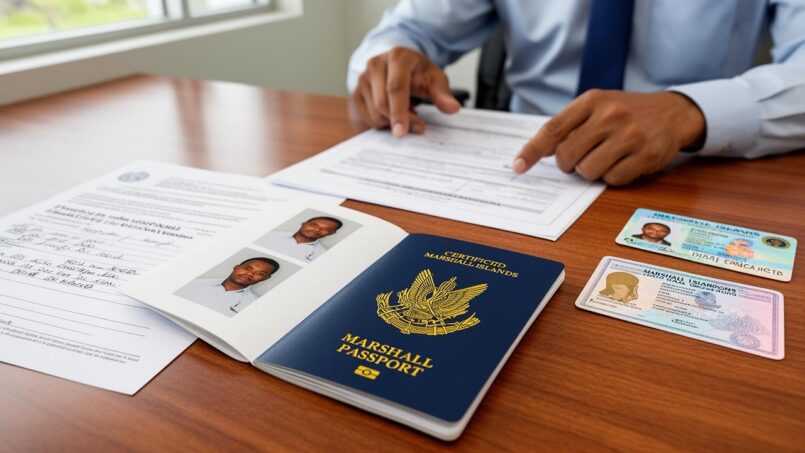
Applying for a passport of the Republic of the Marshall Islands can seem daunting when you live far from Majuro or are encountering Marshallese administration for the first time. Yet, the procedure is relatively clear once you know who to contact, what documents to prepare, and how to avoid the most common mistakes. This guide gathers the available official information in a structured manner to assist Marshallese citizens step by step, whether they reside in the archipelago or abroad, especially in the United States.
Understanding who issues the passport and what it is used for
The passport of the Republic of the Marshall Islands is an official document issued exclusively by the Office of the Attorney General of the Republic of the Marshall Islands. No other administration, whether in Majuro or abroad, has the legal authority to issue or process these passports. The passport division falls under the Civil Division of this Office, with a director, administrative officers, and a Passport Review Panel responsible for overseeing certain sensitive cases, particularly those related to former investment-for-passport programs.
Good to know:
This passport serves as proof of Marshallese identity and citizenship. It is mandatory for international travel, and for many nationals living in the United States, it is essential for obtaining a Social Security number, driver’s license, state ID card, school enrollment, or employment.
The country distinguishes three types of passports, each with its usage and its validity period.
| Passport Type | Cover | Target Audience | Indicative Validity |
|---|---|---|---|
| Regular | Dark blue | Marshallese citizens for private use | 10 years |
| Official | Black | Government officials on official duty | 5 years |
| Diplomatic | — | Diplomats and diplomatic representatives | 5 years |
The regular passport is the one most citizens apply for their personal or professional travel.
Basic requirements: citizenship and eligibility
Before even filling out the form, it is important to understand a fundamental point: only a citizen of the Republic of the Marshall Islands can obtain a passport of the Republic of the Marshall Islands. Proof of citizenship is therefore at the heart of the application.
How Marshallese citizenship is defined
Nationality law is based on the 1979 Constitution and the Citizenship Act of 1984, supplemented by subsequent regulations. Several pathways exist, but not all automatically lead to a passport: citizenship must be legally acquired and, where applicable, conditions for renouncing other nationalities must be met.
Broadly speaking, citizenship can be obtained:
Example:
Marshall Islands citizenship can be acquired in several ways: by birth on the national territory if at least one parent is a citizen (or to avoid statelessness); by descent for a birth abroad if a parent is Marshallese; by registration for individuals with family, customary, or historical ties to the archipelago, under the oversight of the High Court; by ordinary naturalization after ten years of residence, a civic exam, proficiency in the language and customs, proof of good moral character, and generally renunciation of other nationalities; and finally by special naturalization for distinguished services, limited to five persons per year, with dual citizenship permitted by the Cabinet in these specific cases.
Marshallese law is rather restrictive regarding dual nationality. As a general rule, individuals who become citizens by registration or naturalization must renounce their other nationalities, although the Constitution allows exceptions for certain birthright citizens or particular situations (e.g., some women who acquired their spouse’s nationality automatically).
Attention:
For children born abroad to a Marshallese parent, dual citizenship is tolerated until they reach the age of majority. They must then choose a single citizenship within one year of their 17th birthday.
Check your status before applying
Before putting together a passport file, it is wise to clarify your status:
– If you were born in the Marshall Islands with at least one Marshallese parent, you normally meet the criteria for birthright citizenship;
– If you were born abroad to a Marshallese parent, you need to check how your citizenship was registered and whether you have a certificate of citizenship or equivalent documents;
– If you acquired citizenship through naturalization or registration, make sure you have your naturalization or registration certificate and that you have fulfilled any obligations to renounce another citizenship, if applicable.
For many administrative procedures (birth certificate, marriage certificate, etc.), the Registrar’s Office in Majuro plays a central role.
| Civil Status Document | Responsible Authority | Mailing Address | Details |
|---|---|---|---|
| Birth certificate | Registrar’s Office | P.O. Box 546, Majuro, MH 96960 | USD 1 + stamped envelope |
| Marriage certificate | Registrar’s Office | P.O. Box 546, Majuro, MH 96960 | Possible fees + stamped envelope |
| Death certificate | Registrar’s Office | P.O. Box 546, Majuro, MH 96960 | Possible fees + stamped envelope |
These certificates are often required to prove citizenship or a name change. It is therefore advisable to obtain them well in advance.
Where and how to submit a passport application
Regardless of your location, the application ends up at the same place: the Office of the Attorney General in Majuro. There is no system where an embassy directly issues a Marshallese passport. Diplomatic missions can help obtain forms or provide information, but the issuing authority remains in Majuro.
Contact information for the Office of the Attorney General
The official mailing address is as follows:
| Service | Mailing Address | Phone | Fax | Email (as indicated) |
|---|---|---|---|---|
| Office of the Attorney General | P.O. Box 890, Majuro, Republic of the Marshall Islands 96960 | (692) 625‑3244 / 625‑8245 | (692) 625‑5218 | [email protected]* |
The email address is reported in this form in the sources; please verify through official channels if in doubt.
The main office is located in the Marshall Islands Development Bank Building, 5th Floor, at Delap Village, Majuro Atoll. An immigration branch is also present on Ebeye, in the Kwajalein Atoll Local Government Building, but passport authority remains with the Attorney General.
Tip:
For any immigration-related questions concerning entry into or departure from the country (to be distinguished from passport application procedures), you can contact the Majuro Immigration Office.
| Service | Location | Phone | |
|---|---|---|---|
| Majuro Immigration Office | Marshall Islands Development Bank Bldg, Delap | (692) 625‑4572 / 625‑8633 | rmi_majuro@rmi‑immigration.com |
| Ebeye Field Office | Kwajalein Atoll Local Government Building | (692) 329‑6010 / 329‑3010 | rmi_ebeye@rmi‑immigration.com |
Obtaining and sending the application form
The passport application form can generally be downloaded from the government website under a section like “Forms and Resources.” If reliable internet access is unavailable, you can contact an embassy, such as the one in Washington, DC, to have a paper form sent to you.
Once the form is completed, the rule is always the same: it must be sent by postal mail to the Office of the Attorney General in Majuro, even if you reside in the United States or another country. There is no provision to send the application to an embassy for final processing.
Some sources mention a planned online form, but the main procedure remains based on sending the complete application by mail.
Essential documents for your application
The passport application requires a specific set of documents. The absence or irregularity of a single document can delay issuance, or even lead to rejection.
Passport photos: strict technical requirements
Two passport photos in 2×2 inch format are required, with a strictly white background. The applicant’s name must be written on the back of each photo. Beyond these elements, Marshallese authorities adhere to very precise standards regarding photo quality.
The main criteria are as follows:
– The photo must be taken within the last six months;
– It must be in color, printed on high-quality paper, with no visible folds, stains, marks, or scratches;
– The background must be completely white, with no patterns, objects, or shadows;
– The face must be fully visible, forward-facing, covering about 60 to 75% of the image, from the shoulders to the top of the head;
– The expression must be neutral: no wide smile, mouth closed, eyes open and clearly visible, head straight (no tilting or turning).
Good to know:
Some guidelines specify a distance between the top of the head and the edge of the image, or a face length in millimeters. These technical requirements aim to ensure the photo complies with biometric reading systems.
For clothing, it is recommended to avoid colors that are too bright or close to white to ensure good contrast. A dark or black outfit is sometimes advised. Shoulders and the upper chest must be covered.
Glasses should be removed if possible; otherwise, the lenses must not be tinted or reflect light, and the frame must not cover the eyes. Head coverings are only allowed for religious reasons, provided that facial features from the chin to the forehead remain fully visible. In such cases, a specific section of the form must be completed to justify wearing the head covering.
For infants or very young children, it is advisable to photograph them lying down, from above, with a plain white background. No hands, arms, or supports should appear in the photo.
Identity documents and proof of citizenship
The core of the application relies on demonstrating that the applicant is indeed a Marshallese citizen. The following documents are typically required:
Good to know:
To compile a complete application, you must provide: a copy of the previous Marshallese passport (if any); a copy of the I‑94 form (for nationals living or traveling in the United States); a copy of the Social Security card; a certified birth certificate or, failing that, a duly registered baptismal extract. For naturalized or registered citizens, the corresponding certificate is required. In case of a name change, legal documents justifying it (marriage certificate, court order, etc.) are mandatory. An official identification document (driver’s license, other passport) is also required to verify identity.
In some cases, especially for passports from former investment programs, authorities may require additional proof showing that citizenship and the previous passport were obtained legally. The Passport Review Panel then plays a role in in-depth review.
All documents written in a language other than English may require a notarized translation. It is strongly recommended to make copies of all documents before sending them to keep a complete personal file.
The role of the I‑94 for citizens in the United States
Under the Compact of Free Association (COFA) between the United States and the Marshall Islands, Marshallese citizens can live and work indefinitely on U.S. soil under a specific non-immigrant status. Upon each entry into the United States, they receive or are assigned an I‑94 form that records the admission date and entry status.
5
Number of years during which the electronic I‑94 form can be downloaded from the U.S. government website after an entry subsequent to April 30, 2013.
A copy of this I‑94 is required in the Marshallese passport application for applicants residing or located in the United States, as it attests to their U.S. immigration status, a key element for certain rights, such as applying for a Social Security Number or driver’s license.
In case of loss of the I‑94, you can request a duplicate from USCIS by filing Form I‑102. This procedure is fee-based, with an indicated fee of 445 dollars, which can be a significant cost; therefore, it should be anticipated.
Fees to expect and accepted payment methods
The fees were clearly communicated by Attorney General Bernard Adiniwin as of April 5, 2024. They vary according to the age of the applicant and the type of service requested.
| Type of Application / Situation | Amount (USD) | Remarks |
|---|---|---|
| Child passport (12 years and under) | 50 | Validity generally 5 years |
| Passport 13 years and older | 100 | 10-year validity for a regular passport |
| Rush processing fee | 50 | In addition to the base fee |
| Replacement for lost or damaged passport* | 200 | If passport is still valid |
| Passport with extra pages | 150 | For frequent travelers |
– Some details break down these 200 dollars as a cumulative fee of a renewal fee and a penalty.
Attention:
Payments must be made exclusively by check or money order payable to the Secretary of Finance. Sending cash is strictly prohibited for security and traceability reasons. The payment method must be included with the application and sent along with the other documents to the Office of the Attorney General.
It is recommended to verify, at the time of application, whether these amounts have changed, by checking official announcements or contacting the appropriate office.
Concrete steps of the application: from form to issuance
The procedure, in its general form, follows several logical steps.
1. Document preparation
The applicant gathers the following items:
– Fully completed and signed application form;
– Two compliant passport photos;
– Copy of the previous passport, if any;
– Copy of the I‑94 (and, if necessary, copy of the Social Security card for procedures in the United States);
– Proof of citizenship (birth certificate, naturalization certificate, etc.);
– Supporting documents for any name change;
– Check or money order for the correct amount, payable to the Secretary of Finance.
It is advisable to keep a paper or digital copy of every document submitted.
2. Sending by mail to Majuro
The complete application is sent by mail to the official address of the Office of the Attorney General. For applicants located abroad, it may be wise to use tracked or certified mail to have proof of shipment and delivery.
3. Verification and processing by the Office of the Attorney General
Once the application is received, the passport division checks:
– The completeness of the form and the validity of signatures;
– The compliance of the passport photos;
– The consistency and apparent authenticity of the proof of citizenship;
– The correctness of the payment, its amount, and the proper designation of the payee.
For certain profiles, particularly individuals who obtained a passport under former investment programs, the Passport Review Panel may be called upon for a more thorough review, including a check of the original conditions for acquiring citizenship.
In some cases, especially for complex situations, an invitation for an interview or a more detailed document verification may be arranged. The applicant must then appear at the office or designated embassy at the appointed time, bringing the originals of all documents and additional copies.
4. Processing time
Processing times vary depending on the nature of the application and the applicant’s location. For a standard renewal, sources indicate a timeframe of about three to four weeks, including processing and mail time between Majuro and the place of residence.
Tip:
For more complex administrative applications, processing times may be longer. It is therefore recommended not to wait until the last minute and to start the process well before the planned travel date.
5. Passport availability
Once the passport is printed and checks are finalized, the applicant is notified of the document’s availability. Depending on the procedure used, two main options exist:
– In-person collection at a designated office (Majuro, possibly a branch or partner embassy) upon presentation of an ID;
– Return by mail to the address provided, if this option is available and agreed upon initially.
In all cases, the new passport becomes the reference document for travel and identification procedures. Upon renewal, the old passport may be returned canceled or kept by the administration depending on current practices.
Renewal: anticipate to avoid unpleasant surprises
The regular passport is valid for ten years (five years for some passports, notably for children or certain official and diplomatic types). It is strongly recommended to start the renewal process at least six months before the expiration date. Many countries require that the passport be valid for at least six months beyond the planned return date.
The documents required for a renewal are similar to those for a first application, with a few specifics:
Good to know:
For passport renewal, it is mandatory to include the old passport, even if expired. Additionally, a new set of passport photos compliant with current regulations must be provided. Finally, be sure to use the specific renewal form, as it may differ from the first application form.
Authorities stress that you should not wait until the document expires to start the process, especially if you live abroad. Postal delays, additional checks, or the need to obtain supplementary documents (birth certificate, duplicate I‑94, etc.) can extend the timeline.
Some information suggests the existence of an online renewal procedure for adults whose passport was issued after a certain date, provided that no personal data has changed (name, gender, date of birth, etc.). However, postal mail remains the norm cited in official documents.
Special cases: loss, damage, and emergencies
Losing or damaging your passport can quickly become problematic, especially when abroad. The Marshallese system provides specific procedures for these situations, but they come with higher fees.
Lost, stolen, or damaged passport
Replacing a lost or severely damaged passport costs more than a simple renewal. Available information indicates a fee of 200 dollars for a still-valid passport. This amount covers both the cost of a new passport and a form of penalty.
The replacement application generally requires:
– A specific form declaring the loss, theft, or damage;
– An explanation of the circumstances;
– The same identity and citizenship documents as for a first application;
– Payment of the replacement fee.
Good to know:
For Marshallese nationals abroad, U.S. authorities may issue a “travel letter of identity” on letterhead. This document allows travel while awaiting the production of a new passport, but it is not a long-term replacement. Its issuance occurs within the framework of specific consular cooperation.
Rush processing (rush fee)
An additional fee of 50 dollars is provided for expedited processing. Authorities specify that this priority service is mainly intended for serious family emergencies, typically a death or life-threatening illness of a close relative.
Paying the rush fee does not guarantee immediate passport issuance, but it allows the application to be prioritized in the processing queue, provided the file is complete and the supporting documents are deemed satisfactory.
The passport and daily life of Marshallese citizens in the United States
For many Marshallese nationals, the passport is not only used for crossing borders. Under the Compact of Free Association, it is a central element of their status in the United States.
COFA: living and working in the United States with a Marshallese passport
Thanks to the COFA, the majority of citizens can live, study, and work in the United States without a visa, under a special non-immigrant status. They are not U.S. citizens or permanent residents, but they benefit from an unusual freedom of movement and residence for foreign nationals.
To exercise this right, they must:
– Have a valid passport of the Republic of the Marshall Islands;
– Be able to present their I‑94 (paper or electronic version) to prove their admission under COFA status.
The passport and the I‑94 are necessary for:
Good to know:
After your arrival in the United States, several administrative steps are crucial. You will need to obtain a Social Security number (SSN), which is essential for legal employment and many formalities. You will also need to apply for a driver’s license or state ID card. Enrollment in a school or university is another important step. Finally, these documents will be necessary for certain identity verifications, such as domestic air travel.
Social Security number and work authorization
Applying for a Social Security Number is free, and according to indications, processing takes an average of six to eight weeks. It is generally recommended to obtain it before applying for a driver’s license or state ID card.
At the same time, authorities and associations advise Marshallese citizens residing in the United States to apply for an Employment Authorization Document (EAD), even though COFA allows them to work. The EAD serves as a robust federal identity document and facilitates obtaining a REAL ID-compliant driver’s license.
For the EAD, you need:
– Complete Form I‑765;
– Include a copy of the biometric page of the Marshallese passport;
– Include a copy of the I‑94;
– Provide two passport photos.
Good to know:
On Form I‑765, Marshallese citizens must indicate the immigration status “CFA/MIS” and the eligibility category (a)(8). The application is free, but processing can take over six months. Once obtained, the EAD is valid for five years and serves as both proof of work authorization and identity document in many contexts.
Legal assistance and local support
Some organizations, such as the Hawaii Immigrant Justice Center at Legal Aid, offer legal assistance to Marshallese citizens, particularly for matters related to COFA, U.S. immigration documents, and understanding rights. In Hawaii, this center can be reached by phone at (808) 536‑4302.
Understanding the interplay between Marshallese passport, I‑94, SSN, and EAD is crucial for securing your situation in the United States. An expired or lost passport can have knock-on effects on access to these documents and, consequently, on employment, housing, or healthcare.
Traveling with a passport of the Republic of the Marshall Islands: some reference points
Although this guide focuses on how to obtain the passport, it is useful to recall some general rules for international travel.
All visitors entering the Marshall Islands must present a passport valid for at least six months after the end of their stay, have sufficient funds, and possess a return or onward ticket. This requirement also applies, in practice, to many countries that welcome Marshallese travelers.
Good to know:
Thanks to international agreements, holders of a Marshallese passport benefit from facilitated access (visa-free, visa on arrival, or electronic visa) to many countries. The authorized length of stay varies by destination (e.g., 30 or 90 days). It is essential to verify the exact conditions in force in the destination country before any departure.
Holders of Marshallese passports who do not meet the COFA conditions for the United States must, for their part, apply for a regular visa from U.S. authorities. This applies, for example, to certain individuals who acquired citizenship under former passport sales programs or for adoption reasons.
Common pitfalls and best practices
Several errors frequently recur in passport applications and unnecessarily complicate the process.
Among the typical problems are:
– Submitting non-compliant photos (non-white background, smiling, glasses with reflections, unjustified head covering, etc.);
– Lack of clear proof of citizenship (illegible birth certificate, missing naturalization certificate, name inconsistencies);
– An incorrectly completed check or money order (incorrect payee, wrong amount);
– Forgetting the copy of the I‑94 for citizens living in the United States;
– Sending cash instead of a traceable payment method.
To minimize risks, it is advisable to:
Attention:
Before sending, it is crucial to: read all the form instructions carefully, have photos checked by an experienced photographer, contact the relevant authorities for any clarification, and keep copies of all documents and the payment.
Finally, it should be borne in mind that, in some cases, Marshallese authorities must coordinate with U.S. consulates or other international partners, particularly to track changes, extensions, or replacements of passports. This cooperation aims to secure travel documents and combat document fraud.
Summary
Obtaining a passport of the Republic of the Marshall Islands is based on a simple but demanding framework: you must prove your citizenship, comply with strict technical standards (especially for photos and proof of identity), pay the fees in the appropriate form, and send the application to the sole competent authority, the Office of the Attorney General in Majuro.
Good to know:
For citizens established in the United States, the passport is essential beyond travel. Combined with the I‑94 form, it conditions access to the labor market, the issuance of local identity documents, and many public services. It is crucial to monitor its validity, plan for renewal well in advance, and keep it in a safe place.
By carefully preparing your application, anticipating processing times, and staying attentive to the citizenship rules specific to the Marshall Islands, every national can secure their right to a passport and, with it, their freedom to travel, study, work, and maintain ties with their country.

Cyril Jarnias is an independent expert in international wealth management with over 20 years of experience. As an expatriate himself, he is dedicated to helping individuals and business leaders build, protect, and pass on their wealth with complete peace of mind.
On his website, cyriljarnias.com, he shares his expertise on international real estate, offshore company formation, and expatriation.
Thanks to his expertise, he offers sound advice to optimize his clients' wealth management. Cyril Jarnias is also recognized for his appearances in many prestigious media outlets such as BFM Business, les Français de l’étranger, Le Figaro, Les Echos, and Mieux vivre votre argent, where he shares his knowledge and know-how in wealth management.





