
 Published on and written by Cyril Jarnias
Moving to the Marshall Islands is a dream: turquoise lagoons, strong Pacific Islander culture, low crime, a close-knit community where everyone knows everyone. But behind the postcard, the reality is complex. The archipelago is on the front line of the climate crisis, financially dependent on foreign aid, with a fragile healthcare system and a limited job market. For an expat, these elements can be both unique opportunities… and sources of very real risks.
This article provides a balanced analysis of living conditions in the Marshall Islands, covering essential aspects such as climate, cost of living, job opportunities, healthcare, education, safety, visa procedures, and psychological considerations related to expatriation.
A spectacular but extremely vulnerable natural environment
The Marshall Islands consist of 29 coral atolls and a few islands, with only 182 km² of land scattered over more than one million square miles of ocean. Most land sits about two meters above sea level. In other words, the entire country balances on a knife’s edge.
The climate has already warmed by about 0.6 °C since the 1980s, while rainfall tends to decrease. For an expat, this means hotter days, heavy nights, more frequent droughts, and increased pressure on water resources.
Climate change threatens the islands through extreme events (heatwaves, cyclones) and sea level rise (60 cm by 2100 to over 1.80 m by 2150). This rise, combined with saltwater intrusion and erosion, risks making many low-lying islands uninhabitable during the 21st century, especially due to loss of access to drinking water.
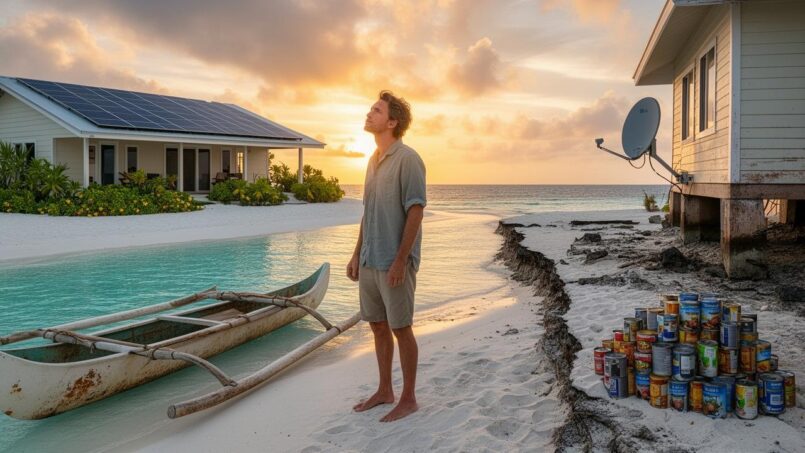
On some atolls, like Wotho in the north, the situation is already nearly untenable: houses flooded at every high tide, runways underwater during storms, wells turned salty, breadfruit rotting on trees, bleached reefs deserted by fish. On a national scale, the most alarming scenarios predict general uninhabitability by mid-century if no major protection is implemented.
For a potential expat, you must therefore accept a paradoxical reality: choosing to live in an exceptional marine environment, but one that is among the most threatened on the planet.
Advantage: a unique living environment for ocean lovers
For those passionate about the sea, sailing, fishing, or diving, the Marshall Islands offer an unrivaled playground. The archipelago is historically known for its traditional navigators, able to read waves and stars to find their way. Daily life is intimately tied to the lagoon and ocean: artisanal fishing, boat trips, swimming… For an expat, this is the chance to live close to an island lifestyle that is still very communal.
Despite climate pressures, a large majority of residents want to stay and fight for the country’s future. In a broad consultation, over 99% of respondents rejected the idea of migration as an adaptation strategy, some even saying, “We will die here.” This determination can be very inspiring for a foreigner seeking meaning, eager to get involved in resilience, conservation, or adaptation projects.
Residents of a region facing climate pressures
Major drawback: a country whose habitability is at stake
The other side of the coin is harsh. Moving to the Marshall Islands means accepting the possibility that, within a few decades, some areas where people live today may be regularly flooded, or that fresh water may become insufficient. Studies by the US Geological Survey predict that starting in the 2030s, some islands could lose their drinking water due to salinization, or even be largely submerged.
For a long-term life plan, with family and children, you must factor in this structural uncertainty: adaptation pathways, even internal or external relocation, are already part of official planning. This is not an abstract risk, but a horizon close enough to weigh on an expatriation project of 10, 20, or 30 years.
A very close-knit, matrilineal society with little openness to emigration
The Marshall Islands have a total population of about 60,000 to 70,000 citizens, with more than two-thirds living on the two main urban centers: Majuro, the capital, and Ebeye on Kwajalein Atoll. These two islands are among the most densely populated areas in the Pacific.
Society is strongly communal and matrilineal: land is passed down through women within clans (bwij), and social organization relies on chiefs (iroij), clan heads (alap), and workers (rijerbal). Family and clan membership structures access to land, resources, and status. Extended kinship ties are extremely important: cousins, uncles, aunts, grandparents are considered close family. A key family milestone is a child’s first birthday (kemem), which is celebrated with large gatherings.
For an expat, entering this dense community fabric can be both a chance and a challenge.
In many Pacific societies, local social networks are stable over decades: friends and family often live close by, mutual support is strong, solidarity plays a crucial role in daily life. Studies on mental health in small island states highlight that this cohesion and “interdependent identity” offer protection against certain stressors, especially climate-related ones: when faced with adversity, responses are collective, rooted in the community.
For an expat, building bonds with local families in a small capital, where meetings are frequent and relationships personal, can limit loneliness and the feeling of anonymity, thereby reducing a major factor of psychological distress abroad.
Drawbacks: culture shock, conservatism, and the expat’s place
The flip side of this collectivism is a certain social conservatism. The influence of Christian missions has deeply shaped norms, especially regarding dress (expectations of modesty, particularly for women), public behavior, and gender roles. Domestic violence and corporal punishment of children remain widespread. Rapid changes (urbanization, women’s increasing roles, exposure to American culture) create tensions, especially for older men who see their traditional status challenged.
For an expat, especially a single woman, it’s important to prepare for potentially uncomfortable situations, such as social pressure regarding clothing, risks of harassment in shared taxis, and cross-cultural misunderstandings. Integration can be complex because, although English has official status, Marshallese is ubiquitous, and many outer islanders speak little English. A significant investment in language and cultural learning is therefore essential for successful integration.
Finally, it must be emphasized that the local population is overwhelmingly opposed to the idea of migrating in response to climate change. For the vast majority of Marshallese, the future lies “right here.” An expat who views the archipelago as a “transitory” place before everyone leaves will have a radically different perspective from that of the locals, which can create a values gap.
Cost of living: more expensive than the global average, but less than major Western countries
To assess the attractiveness of the Marshall Islands, you need to look closely at the cost of living, especially for an expat without access to traditional family networks (customary land housing, resource sharing, etc.).
According to recent aggregated data, the average cost of living in the country is estimated at about 1,508 USD per month for a single person, including housing. This gives the archipelago an index of 105, about 1.3 times more expensive than the global average, and ranking 38th out of 197 countries for price levels.
The table below provides an overview of order of magnitude for different profiles.
| Household Profile | Estimated Monthly Cost (USD, with rent) | Estimated Monthly Cost (USD, without rent) |
|---|---|---|
| Single person (national average) | ~1,508 | ~547 |
| Solo nomad in Majuro | ~2,128 | ~1,119 |
| Couple (2 adults, city average) | ~3,800 | ~2,950 |
| Family of 4 (2 adults + 2 children) | ~5,394 | ~4,289 |
For a “tight budget” lifestyle, some estimates suggest 1,350 USD per month for a single person (including housing), and about 2,775 USD for a family of four. Conversely, a comfortable or even “luxury” standard of living could require more than 4,800 USD per month for a single person, and nearly 10,000 USD for a family of four.
The cost of living in the Marshall Islands is about 40% lower than in the United States.
Advantage: relatively moderate rents compared to other island destinations
For such an isolated archipelago, rents are not exorbitant compared to other tropical paradises. A furnished 85 m² apartment in an “expensive” area can rent for around 600 USD per month, and in a “normal” area around 400 USD. One-bedroom apartments downtown often go for about 750–800 USD, while larger units (three bedrooms) can cost 1,200 to 1,500 USD per month.
In comparison to many capitals or tourist islands in the region, these amounts can seem affordable, especially for expats paid by international organizations or foreign companies.
Drawbacks: low local salaries and dependence on imports
The main problem lies in the gap between this cost of living and local wages. Average net income varies widely by source but ranges between 420 and 1,489 USD per month, with an often-cited average around 1,150 USD. Some analyses indicate that an average salary covers only about one-third of typical monthly expenses, illustrating the economic vulnerability of many local households.
For an expat, two realities coexist, shaping a unique and complex life experience.
A rewarding life abroad, marked by new encounters, a different culture, and professional opportunities.
The need to adapt to a new environment, manage distance, and navigate administrative procedures in another country.
– if paid according to international standards (UN, large NGOs, donors), the cost of living remains relatively manageable, even moderate relative to income;
– if relying on a local salary (e.g., at a small organization or under a local contract), the equation can become tight, especially for a family.
Basic goods are largely imported, driving up prices: a dozen eggs around 7 USD, a kilo of tomatoes at 7 USD, white bread at a little over 3 USD, etc. Tobacco is extremely expensive (a pack of Marlboro near 56 USD), alcohol and certain dairy products or cheeses are also costly. Local fresh produce exists (fish, tropical fruits, copra), but salinization of soils and groundwater is gradually reducing agricultural potential on some islands.
Job market: many skilled positions, but a niche for expats
Despite its small size, the archipelago offers a significant number of skilled jobs, particularly in administration, health, education, engineering, climate and development projects, and international organizations based in Majuro and on Kwajalein Atoll (notably via the U.S. military presence).
A recent analysis lists about 118 open positions in the country, for profiles ranging from doctor to electrical engineer, information systems specialist to climate project coordinator, including lab technicians, nurses, development consultants, financial managers, and teachers.
You can find vacancies within:
– ministries (Health, Culture and Internal Affairs, Finance, Natural Resources, Public Works, etc.);
– public agencies (Auditor General, state-owned enterprises, telecoms, power company);
– international organizations (UN, FAO, UNICEF, IOM, UNDP, UNFPA, ADB, GIZ, etc.);
– companies contracted with the U.S. military on Kwajalein (V2X, Parsons, IT and technical providers).
The following table illustrates some key areas where expats can find opportunities.
| Sector / Field | Commonly Offered Job Types |
|---|---|
| Health | Doctors, nurses, lab technicians, imaging specialists |
| Administration & Finance | Finance directors, accountants, project managers |
| Climate & Environment | Adaptation experts, hydrologists, GCF project managers |
| ICT & Digital | IT managers, webmasters, data analysts |
| Engineering & Infrastructure | Electrical engineers, power plant supervisors, drafters |
| Governance & Law | Assistant attorney general, ombudsman, policy analysts |
| International Organizations | Project coordinators, program assistants, consultants |
| Education & Training | Teachers, technical trainers, ECD specialists |
Advantage: foreign profiles sought in certain sectors
The healthcare system, for example, relies heavily on expat doctors and nurses. Geographic dispersion, difficulties in local training, and emigration of skilled professionals create a structural demand for foreign staff. Similarly, major infrastructure projects (submarine cables, power plants, coastal adaptation) or digital governance attract international specialists in ICT, engineering, public finance, and law.
For a highly qualified expat, there are therefore real opportunities, often better paid than strictly local jobs, with the added appeal of working on the front lines of global issues (climate, oceans, decolonization, environmental justice).
Drawbacks: small market, administrative procedures, and aid dependency
The downside is that the market remains tiny and heavily dependent on foreign aid. Many positions are tied to projects funded by the World Bank, Asian Development Bank, Green Climate Fund, or other cooperation mechanisms. They may be fixed-term, with uncertainties related to funding renewals.
From a legal standpoint, obtaining a job often requires:
– that no Marshallese is available for the position;
– that the employer obtains a work permit from the authorities;
– that the expat then obtains a work visa (category E‑1), usually valid for two years and renewable.
Procedures are centralized in Majuro and can take several weeks. Finally, there is no “retirement visa” or simple passive resident status for non-Americans: long-term residence is generally tied to a work contract or investment.
Healthcare system: moderate cost but very limited means
Healthcare is a crucial factor in evaluating the attractiveness of the Marshall Islands. The country has two major public hospitals: the Leroj Atama Medical Center in Majuro and the Leroj Kitlang Health Center in Ebeye, supplemented by about fifty dispensaries on other atolls. These facilities provide primary and secondary care, with some tertiary care capacity, but most complex cases are evacuated abroad (Hawaii, Guam, Philippines, Taiwan…).
Consultations are low-cost for residents: about 5 USD for an outpatient visit with national insurance, 20 USD without insurance. Hospital admissions are charged around 10 USD (insured) or 110 USD (uninsured). For an expat employed by an institution, local health insurance may cover part of these costs.
The healthcare system faces severe structural limitations: a chronic shortage of doctors, medicine stockouts, outdated equipment, and difficult access for remote island populations. These difficulties contribute to alarming public health indicators, including a life expectancy of about 60 years and very high rates of non-communicable diseases (such as type 2 diabetes, affecting 25 to 50% of adults) and infectious diseases, partly linked to the legacy of nuclear testing.
Advantage: affordable basic care and evacuation possibility for insured expats
For an expat with international health insurance, a realistic strategy is to use local services for routine care (regular check-ups, minor emergencies) and plan for medical evacuation to better-equipped countries for any major intervention. The cost of local care is low, and some companies (AXA, GeoBlue, April International, etc.) cover evacuations, which is essential in an isolated island context.
If your employer offers international health coverage, it can ensure a good level of health security abroad. However, it is essential to inform yourself in advance about medical evacuation protocols and identify the healthcare providers referenced by this contract.
Drawbacks: systemic vulnerabilities and risks for those with fragile health
For people with serious medical histories (cardio, cancer, dialysis, high-risk pregnancies…), the archipelago is a destination to approach with great caution. Access to specialized procedures (complex surgery, advanced intensive care, oncology, highly technical neonatology) remains very limited locally. Medical transport can be hampered by weather, limited airport infrastructure, or financial resources.
From a public health perspective, outbreaks of dengue or other infectious diseases can strain an already fragile system. For an expat, this means never considering the country as a health environment equivalent to that of a developed country.
Education and family prospects: limited offerings but presence of higher education
For expat families, the school question is central. The Marshallese education system follows a 6–2–4 model (six years of primary, two of intermediate, four of secondary), with compulsory schooling until about age 14. The language and framework are inspired by the American system.
The archipelago has nearly 94 elementary schools and 18 secondary schools, most of them public. However, quality and accessibility vary widely, especially between Majuro/Ebeye and the outer islands. Secondary education has never had enough capacity to accommodate all students, and high school dropout rates are high. Scores on standardized tests remain low, particularly at the secondary level, where performance has further declined over the last decade.
The monthly cost of a private kindergarten in Majuro for expats is about 150 USD.
For higher education, the presence of the College of the Marshall Islands (CMI) and a campus of the University of the South Pacific (USP) in Majuro allows for tertiary studies (associate degrees, bachelor’s, MBAs, etc.). These institutions are also major players in teacher training.
Advantage: inexpensive schooling for young children and local university access
For young children, the cost of daycare and kindergartens is moderate compared to Western countries. For teenagers or young adults, the possibility of pursuing higher education locally, then possibly completing it abroad, can be a viable path, especially since scholarships exist for studies outside the archipelago.
Drawbacks: uneven quality, limited capacity, and lack of specialized offerings
However, the quality of secondary education and the availability of international programs remain limited. Data show that less than half of adults have completed high school, and only 9% have a university degree. The system lacks abundant specialized tracks (advanced sciences, arts, multiple foreign languages, etc.), as found in large cities.
For an expat aiming for continuity with European or North American standards, it will often be necessary to turn to hybrid solutions: local schooling up to a certain level, then boarding schools abroad, online schools, or regular returns to the home country. This can generate significant costs and logistical burden.
Infrastructure, connectivity, and daily life
The Marshall Islands are connected to the world by a fiber optic submarine cable (HANTRU‑1) linking Majuro and Kwajalein to a hub in the Federated States of Micronesia and then to Guam. Majuro thus has decent speeds (measurements show over 70 Mbps download in some cases, even over 200 Mbps on mobile), but the archipelago has experienced massive outages, including a three-week cable break in 2017, forcing a switch to very limited satellite service.
The telecom market has evolved with the end of the monopoly of the historic operator NTA and the arrival of Starlink, now offering service throughout the territory with speeds >50 Mbps and low latency. Projects for submarine cables (East Micronesia Cable, Central Pacific Cable) should strengthen network resilience within a few years. However, a digital divide persists with remote islands, where internet access remains sporadic and often depends on small satellite stations.
In daily life in Majuro, you have access to:
– 4G LTE coverage for a large portion of the population;
– limited but existing fixed ADSL or fiber connections;
– Wi-Fi hotspots, internet cafes;
– banking services, a few supermarkets, hotels, and restaurants.
Transport relies on a single paved road in Majuro, with shared taxis and local buses. Roads are narrow, sometimes flooded, with little signage. Gasoline costs between 1.46 and 1.98 USD per liter, comparable to many developed countries. A car remains a relative luxury, with new vehicles ranging from about 12,000 to 35,000 USD depending on the model.
Advantage: rapidly improving connectivity for such a small country
For an expat working remotely or in digital fields, the recent developments (Starlink, redundant cable projects, connectivity programs funded by the World Bank) are encouraging. The possibility of having reliable high-speed internet in Majuro and on Kwajalein significantly improves quality of life and maintaining ties abroad.
Drawbacks: vulnerability of infrastructure and dependence on international projects
Network outages, power cuts, and damage from bad weather (lightning strikes on antennas, flooding) remain realities. The country depends on external funding to modernize its networks, strengthen cybersecurity, or deploy solutions across all 24 inhabited atolls. For a 100% remote teleworker, this means planning for backup options (dual connection, generator, etc.).
Outside the urban centers of Majuro and Ebeye, access to public services (waste collection, water, sanitation) is very limited. Even in these towns, overcrowding can lead to degraded sanitary conditions.
Safety and crime: an overall safe environment
From a security standpoint, the Marshall Islands are considered a low-crime country. Majuro is rated as a “low” threat zone for official U.S. interests, and most indicators show a low risk of theft, violent assault, scams, or kidnappings. The overall safety rating is high (4/5 in some assessments), comparable to countries perceived as very safe.
The most common incidents involve:
Main risks include burglaries (homes, hotels, vehicles), acts of vandalism, alcohol-related brawls in nightlife spots, sexual harassment in shared taxis (especially toward women), and domestic violence often unknown to expats.
The terrorist risk is considered very low, with no known specific threat. The political climate is stable, recent elections passed without notable incident, and demonstrations remain rare and peaceful.
Advantage: little street insecurity, stable political climate
For an expat accustomed to large cities with high crime rates, life in Majuro can seem surprisingly peaceful: few street assaults, no anxiety-inducing security climate, no identified terrorist threat. Relations with foreigners are generally cordial, with no particular hostility toward Westerners.
Drawbacks: human traffic jams, stray dogs, and limited emergency services
Risks are not nonexistent, but they take other forms. Road traffic is dangerous, especially at night, due to:
Driving is exposed to several specific hazards: drunk drivers (especially evenings and weekends), lack of sidewalks on some stretches, and the possibility of animals (dogs, pigs, chickens) or pedestrians suddenly appearing on the road surface.
Packs of stray dogs pose a real danger to pedestrians, with cases of serious attacks. Authorities struggle to manage this issue.
In the event of an accident or assault, the response capacity of law enforcement is limited by lack of vehicles, radios, and training. The emergency number exists, but response times can be long.
For water activities (snorkeling, diving), another specific risk is that of unexploded World War II munitions on some reefs. While not omnipresent, this danger must be taken seriously, especially outside known tourist routes.
Visa procedures, residency rights, and international mobility
Entry and stay rules vary by nationality. Citizens of the United States, some Pacific countries (Federated States of Micronesia, Palau), and Taiwan can enter without a visa for varying periods (unlimited for the former, 90 days for the latter). Citizens of various European countries and a few other states receive free visas on arrival for 90 days.
In all cases, a passport valid for at least six months, a return or onward ticket, and sufficient funds are required. For those not exempt, visas must be applied for in advance: visitor visas (up to three months), business, transit, student, work, or residence visas.
To work in the Marshall Islands, a work permit is required. It is issued to the employer, who must prove that no Marshallese can fill the position. The worker must also obtain a work visa, valid for two years and renewable. The spouse and minor children of the holder can obtain dependent visas.
Procedures often include:
– a detailed form;
– passport photos;
– a police clearance certificate;
– a medical certificate including tests for HIV/AIDS and tuberculosis (mandatory for some residence permits);
– sometimes proof of accommodation and financial means.
For Marshallese, a special arrangement — the Compact of Free Association — allows them to live and work in the United States without a visa, but the reverse is not true: U.S. citizens do not automatically become permanent residents of the Marshall Islands, although they have facilitated entry.
Advantage: clear procedures for formal contracts
For expats employed by established institutions (UN, ministries, donors), the visa and work permit procedures are well-established: the employer generally handles the paperwork, timelines are predictable, and visa categories are clearly defined (E‑1 for work, R‑1 for residence, etc.).
Drawbacks: no easy “lifestyle” status and strict health checks
On the other hand, the Marshall Islands do not lend themselves to a spontaneous expatriation of the “long-term digital nomad” type without local professional ties: there is no generic long-stay visa for retirees or people living on passive foreign income. Tourist stays remain limited to a few months.
Health checks, such as measles vaccination or HIV/TB screening for certain statuses, may be required. Although they may seem restrictive, they are in place due to the fragility of the local healthcare system in the face of epidemic risks.
Mental health, isolation, and psychological adaptation
The psychological aspect is often underestimated by those considering expatriation to an island environment. Yet international research shows that expats have rates of depression and anxiety higher than those of populations in their home countries. Some studies estimate that up to half of expats are at high risk of mental health issues, with loneliness cited as the number one factor by more than 40% of them.
In small Pacific island states, the rapid transition from a communal rural lifestyle to urbanization generates major stress, especially among older men. This upheaval, characterized by loss of bearings, challenge to traditional hierarchies, and an identity torn between local culture and Western influences, contributes to increased anxiety, depression, addictive behaviors, and suicide attempts.
For an expat, these dynamics combine with: the need to adapt to a new cultural environment, managing long-distance relationships, and integrating into a new professional environment.
– extreme geographic remoteness (only a few international entry points: Hawaii, Guam, Fiji);
– the difficulty of temporarily leaving the archipelago in case of personal or family crisis;
– the limited availability of psychologists or psychiatrists locally, and the lack of structured specialized care.
Research on island populations, however, shows a certain resilience in the face of climate shocks, thanks to a cultural acceptance of uncertainty and community-based responses to extreme events. For an expat who manages to build trusting relationships with neighbors, colleagues, church members, or associations, this network can be a powerful protective factor against loneliness.
Online consultations and teletherapy make it possible to access psychological support while abroad, provided you have a reliable internet connection.
Drawbacks: risk of isolation and very limited mental health care
For people with a history of anxiety or depressive disorders, or who rely heavily on a dense urban environment with services (clubs, diverse associations, culture, mental health care), life in Majuro can become difficult after the “honeymoon” phase of expatriation.
Data show that lack of trust and social ties fuels loneliness, which itself increases the perception of stress. In a country where few mental health professionals are present, where stigma can be strong, access to appropriate help is limited. It is therefore essential to prepare a support plan in advance (remote therapist, expat networks, religious or community groups, etc.) and remain vigilant for signs of isolation or distress.
Climate justice, nuclear history, and ethical questions
Choosing to live in the Marshall Islands also means settling in a country marked by a history of colonization, militarization, and American nuclear testing. Between 1946 and 1958, 67 atomic tests were conducted on the Bikini and Enewetak atolls, causing forced displacements, radioactive contamination, cancers, birth defects, and lasting disruption to ways of life.
The archipelago, which emits very few greenhouse gases, is bearing the full brunt of climate change impacts that threaten its territory, culture, and sacred sites. It actively advocates globally for rapid reduction of fossil fuels and for the creation of dedicated funding for “loss and damage.”
For an expat, this dimension raises ethical questions: how to position yourself as a citizen of a high greenhouse gas-emitting country (United States, Europe, Australia…) living in a state already experiencing devastating effects? How to avoid reproducing patterns of cultural or economic domination, while contributing to projects useful for the local population?
The answer is not simple, but it requires a posture of humility, listening, and respect for Marshallese self-determination (the principle that it is up to the people and government of the Marshall Islands to decide their future, whether it involves local adaptation or relocation).
Summary: for which profile does expatriation to the Marshall Islands make sense?
In summary, the Marshall Islands offer a set of sharply contrasted advantages and disadvantages.
On the strengths side:
– a spectacular marine environment and rich island culture;
– a very community-oriented society with strong social capital for those who manage to integrate;
– a generally low crime level and stable political climate;
– real professional opportunities for skilled profiles (health, engineering, climate, governance, ICT, development);
– a cost of living generally lower than in major Western economies, especially if you have an international salary;
– unique experiences at the heart of global climate issues.
On the limitations and risks side:
Remote island territories present critical systemic challenges: extreme vulnerability to climate change threatening habitability, a fragile healthcare system, a narrow job market dependent on external aid, incomplete and non-resilient infrastructure, uneven educational offerings, and a high risk of psychological isolation due to culture shock.
In practice, expatriation to the Marshall Islands seems particularly relevant for:
– professionals already engaged in global health, climate, development, coastal engineering, or digital governance, eager to work at the heart of a “laboratory” for climate adaptation;
– people in good health, without serious medical histories, willing to accept a lower level of services than in the West;
– singles or childless couples, or those with young children for a limited time, able to organize hybrid educational solutions;
– individuals with a strong motivation to immerse themselves in a different culture, learn Marshallese, and engage with local networks (churches, associations, community projects).
It is, however, more difficult for:
– families wanting very high-level secondary schooling entirely on-site;
– people with fragile health or dependent on frequent specialized care;
– retirees seeking a stable “final home” over several decades, without accepting the idea of possible future relocation;
– expats looking for a vibrant urban life, diverse cultural offerings, and great freedom of international travel.
Expatriating to the Marshall Islands is therefore neither a frivolous exotic whim nor a simple choice of “tax or beach paradise”. It is a commitment to a country with an uncertain future but remarkable resilience, where every foreigner who settles becomes, whether they like it or not, an actor in the great equation between climate justice, adaptation, the dignity of island peoples, and the future of our coastlines. For those who accept this responsibility, the experience can be profoundly transformative—provided it is prepared with lucidity, prudence… and a solid capacity for adaptation.
Disclaimer: The information provided on this website is for informational purposes only and does not constitute financial, legal, or professional advice. We encourage you to consult qualified experts before making any investment, real estate, or expatriation decisions. Although we strive to maintain up-to-date and accurate information, we do not guarantee the completeness, accuracy, or timeliness of the proposed content. As investment and expatriation involve risks, we disclaim any liability for potential losses or damages arising from the use of this site. Your use of this site confirms your acceptance of these terms and your understanding of the associated risks.

Cyril Jarnias is an independent expert in international wealth management with over 20 years of experience. As an expatriate himself, he is dedicated to helping individuals and business leaders build, protect, and pass on their wealth with complete peace of mind.
On his website, cyriljarnias.com, he shares his expertise on international real estate, offshore company formation, and expatriation.
Thanks to his expertise, he offers sound advice to optimize his clients' wealth management. Cyril Jarnias is also recognized for his appearances in many prestigious media outlets such as BFM Business, les Français de l’étranger, Le Figaro, Les Echos, and Mieux vivre votre argent, where he shares his knowledge and know-how in wealth management.





