
 Published on and written by Cyril Jarnias
Moving to Guinea-Bissau with your dog or cat is possible, but it requires careful planning. Between the health requirements related to rabies, the often extreme tropical climate, limited veterinary care, and air travel constraints, an expatriation project with an animal demands very thorough preparation.
This comprehensive guide provides the necessary information to organize the departure, arrival, and settlement of your pet in Guinea-Bissau, respecting the current regulatory framework and ensuring the animal’s health.
Understanding the Context: Guinea-Bissau, a Tropical Country with High Rabies Risk
Before even discussing papers or travel crates, it is essential to understand the environment your animal will live in.
Guinea-Bissau has a hot and humid tropical climate almost all year round, with a clear alternation between dry season and rainy season. International health authorities classify the country as a high-risk area for canine rabies, which has direct consequences on import formalities, as well as on how you will need to manage your animal’s contact with the environment.
A Demanding Climate for Animals
The average annual temperature is around 26°C (79°F), with significant peaks between February and May, just before the rains arrive. In Bissau, for example, monthly averages range from about 25.8°C (78.4°F) for the coolest month (January) to nearly 28.8°C (83.8°F) for the hottest (May). Extreme highs have already exceeded 41°C (106°F).
During the rainy season (June to October/November), the coast receives over 2,000 mm of annual rainfall, leading to waterlogged soil, flooding, and high humidity. The dry season (December to May) is dominated by the harmattan, a dry, dusty wind from the Sahara that reduces visibility and dries the air.
This context has direct impacts on pets:
– Significant risk of heatstroke, especially for brachycephalic breeds (Bulldogs, Pugs, Persians, etc.);
– Increased parasite pressure (fleas, ticks, mosquitoes) during the wet season, with the spread of vector-borne diseases (ehrlichiosis, anaplasmosis, heartworm, etc.);
– Dermatological problems favored by heat and humidity (hot spots, yeast infections, allergies);
– Possible respiratory discomfort during episodes of dust or smoke from bushfires.
For an owner arriving from Europe or North America with an animal accustomed to a temperate climate, the transition to a tropical climate can be difficult. It is essential to proceed with gradual adaptation and implement strict preventive measures to ensure the animal’s well-being.
A High-Risk Country for Rabies
International organizations indicate that Guinea-Bissau is considered a high-risk country for canine rabies. In Africa, virtually all human rabies cases are linked to bites from infected dogs. In other words, the virus is actively circulating and vaccination measures are not just a simple administrative formality.
This implies two major things for expatriates with animals:
– On a regulatory level, the authorities of many departure and transit countries impose or recommend reinforced rules (valid rabies vaccination, sometimes serological titer testing) whenever the destination or origin is a high-risk country;
– On a practical level, you must anticipate that any incident (bite or suspicious contact) will potentially require post-exposure prophylaxis for humans, and severe measures for the animal, in a context where access to veterinary facilities and vaccines may be limited.
Administrative Framework for Entering Guinea-Bissau with Animals
Available information on the conditions for importing pets into Guinea-Bissau remains fragmentary. However, several clear points emerge from existing data on the country itself and general recommendations issued by international veterinary authorities when a state does not publish detailed rules.
Known Principles for Animal Entry
Specific data for Guinea-Bissau indicate several basic requirements for dogs and cats:
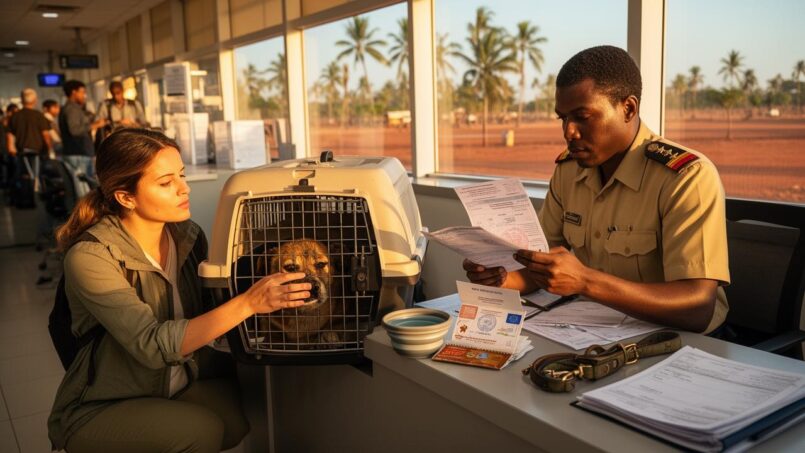
To import a dog or cat, a declaration upon entry is mandatory. The animal must be identified by microchip, have up-to-date rabies protection (vaccine administered between 30 days and one year before arrival), and be accompanied by an international health certificate issued within the week before departure. Upon arrival, you must present a veterinary certificate of good health, the rabies vaccination certificate, an import permit from the Ministry of Agriculture, and a health certificate from the country of origin attesting to vaccination.
For animals from high-risk rabies countries, it is mentioned that a rabies serological test (antibody titer) is required before entry, with the prospect of quarantine potentially up to 90 days, unless the animal arrives from a few specifically exempt states (a specific list of rabies-free or very low incidence countries).
In the absence of detailed available text for Guinea-Bissau, these elements should be considered the minimum standard to meet, while keeping in mind that additional requirements may exist and must be verified on a case-by-case basis with local authorities.
When Official Rules Are Unclear: International Recommendations
The veterinary service of the US Department of Agriculture (USDA APHIS), when published entry conditions are not available for a given country, recommends a cautious course of action:
To travel with dogs, cats, and ferrets, several steps are essential: have proof of up-to-date rabies vaccination, obtain a health certificate issued by an accredited veterinarian, and contact the veterinary authority of the destination country or its embassy/consulate to get the precise entry conditions in writing (vaccines, documents, timelines, import permit, official approval of certificates, etc.). It is crucial never to assume that the absence of information online means there are no rules.
For a departure to Guinea-Bissau, it is therefore essential to get in touch with:
– The Ministry of Agriculture (competent veterinary service);
– The diplomatic representation (embassy or consulate) of the country closest to your place of residence.
It is highly recommended to obtain written responses (official emails, forms) that you can present at the time of boarding and upon arrival.
Microchip: The Essential Identification Before Any Departure
Electronic identification of your animal is the cornerstone of any import file. Without a functional and readable microchip, all other documents lose their value.
What a Microchip Is and Why It Is Crucial
The microchip is a tiny electronic capsule, the size of a grain of rice, implanted under the skin, usually between the shoulder blades. It contains a unique identification number (9 to 15 digits) readable by a specific scanner. The device is passive (no battery) and only emits a signal when scanned by an RFID reader.
This number:
– Links the animal to its veterinary documents and owner;
– Serves as a reference for customs authorities, who must verify that the dog or cat presented matches the health certificate and vaccination record;
– Facilitates re-identification and return of the animal to its owner in case of loss abroad.
Standard frequency in kHz of ISO microchips for animals, ensuring international readability.
Check ISO Compliance and Readability
Before any vaccination or administrative steps, it is essential to:
– Have your veterinarian scan the existing microchip;
– Verify that the number is in a 15-digit format compliant with ISO 11784/11785 standards;
– Confirm that the chip works perfectly and is easily read by the scanner.
If your animal already has a non-ISO microchip (for example, some models with 9 or 10 digits, sometimes at 125 kHz), the safest solution is to implant a second ISO-compliant one without removing the old one. In this case, all microchip references must appear on the veterinary certificates and passports, and authorities must be able to read at least the ISO chip.
If in doubt about the compatibility of an animal identification chip, your veterinarian can consult the ICAR public register. This register lists microchips compliant with ISO standards.
Mandatory Sequence: Microchip First, Then Rabies
For most countries (including those in the European Union, the United Kingdom, Australia, or Japan), the validity of rabies vaccination for travel is conditional on the microchip having been implanted before the vaccine injection. If the vaccination was done before the chip was placed, the animal must be revaccinated after implantation for this new injection to be recognized as the “reference vaccine” for international travel.
For a departure to Guinea-Bissau, even if the country itself does not clearly state this rule, it is strongly recommended to follow this sequence, especially since you may need to transit through the European Union or another highly regulated state.
Rabies Vaccination and Titer Testing: A Required Step
Since rabies is endemic in Guinea-Bissau, vaccinating your animal against this virus is not just an entry requirement, but a key element of its daily protection.
Standard Rabies Requirements
The most common protocols, which are also those adopted in several African countries, provide for:
To import a pet, such as a dog or cat, several conditions related to rabies vaccination must be met. The rabies vaccination must be given at least 30 days before entry into the territory. Although some vaccines are valid for three years, their acceptance for import is limited to a maximum validity of one year, as not all authorities recognize the longer duration. For puppies or kittens under three months of age, entry is generally very restricted or subject to proof that the mother was vaccinated before gestation.
Since Guinea-Bissau is classified as high risk for rabies, departure or return countries (especially for American or European nationals) may require, when you leave or return, enhanced proof of rabies protection, sometimes including an antibody titer test performed in an approved laboratory.
Rabies Serological Titer: Why Do It Even If Not Explicitly Required
The titer test (RFFIT or FAVN) measures your animal’s ability to produce antibodies that neutralize the rabies virus. Many international regulations consider a result equal to or greater than 0.5 IU/mL as adequate protection.
Even though available texts do not state in black and white that Guinea-Bissau requires such a test, several factors argue for anticipating it:
A valid rabies titer is useful if your animal needs to re-enter a country with strict regulations (EU, UK, US, etc.) from a risk zone. It can avoid or shorten quarantines in certain third countries during later travels. This step also reassures health authorities during checks, especially if the rabies situation in the departure or destination country is concerning.
The standard timeline to follow is:
1. ISO microchip implanted; 2. Rabies vaccination; 3. At least 30 days after the injection, blood draw for titer testing; 4. Depending on the country requiring the test, respect a specific waiting period before entry.
It is prudent to keep the original laboratory result and several certified copies, in English or with certified translation.
Other Recommended Vaccinations and Treatments
In addition to rabies, several neighboring African countries require for dogs vaccinations against distemper, hepatitis, parvovirus, leptospirosis, and parainfluenza. For cats, recommended protocols include panleukopenia, calicivirus, and rhinotracheitis. Even though Guinea-Bissau does not publish an equivalent exhaustive list, it is reasonable to base your animal’s preparation on these regional standards.
In several states in the region, standard health certificates also require:
Essential items to provide to certify the health and traceability of the animal before export.
Written confirmation attesting that the animal is in good health and shows no signs of contagious disease.
Proof of treatment against internal and external parasites, performed within 72 hours before export.
Guarantee that the animal has resided permanently in the country of origin and that no rabies cases have been reported there recently outside quarantine zones.
This level of requirement, inspired by countries like Ghana or Côte d’Ivoire, provides a consistent basis for preparing a solid file for Guinea-Bissau.
Veterinary Certificates and Import Permits
The most sensitive part of the file remains the paperwork. A date error, a miswritten microchip number, or an omission can lead to boarding refusal or unexpected quarantine.
The International Health Certificate
The health certificate, often called a “certificate of good health” or “certificate of veterinary inspection“, must be:
– Written and signed by an authorized veterinarian in the country of departure;
– Often countersigned or validated by the official veterinary authority (e.g., USDA APHIS for the United States);
– Issued within a specific timeframe before departure: for Guinea-Bissau, available information mentions a validity limited to the week before travel.
This document must notably specify:
– Complete identification of the animal (species, breed, sex, age, color, ISO microchip);
– Owner’s identity and address;
– Country of origin, final destination, and possibly transit countries;
– Vaccinations received, with dates, products used, and duration of validity;
– Antiparasitic treatments (date, product, route of administration);
– Attestation that the animal is clinically healthy and fit for transport.
The Import Permit Issued by the Ministry of Agriculture
For dogs and cats, available information on Guinea-Bissau explicitly mentions the need to obtain an import permit from the Ministry of Agriculture. Even if forms are not provided in detail, experience from neighboring countries shows that the following documents are often required:
– Copy of the rabies vaccination certificate;
– Copy of the health certificate (or at least the animal’s identification details);
– Full contact information of the owner and possibly the employer (for diplomats or military personnel);
– Details on the date and mode of arrival (airline, flight number, airport, etc.);
In some states, this type of permit is valid only for a single entry and for a period of a few weeks to a few months. It is therefore crucial to plan the arrival date precisely to avoid the permit expiring or still being processed.
Potential Quarantine and Exempt Countries
Collected information mentions that in the absence of specific provisions, animals arriving from a risk country may be subject to quarantine up to 90 days, unless they come from a short list of officially rabies-free states (United Kingdom, Ireland, Australia, New Zealand, etc.).
In practice, the following combination often helps limit this risk:
– ISO microchip in place;
– Valid rabies vaccination;
– Antibody titer above the recommended threshold;
– Complete and recent health certificate;
– Import permit obtained in advance.
However, it remains essential to confirm in writing, with the veterinary authority of Guinea-Bissau, whether quarantine is actually applied, under what conditions (location, cost, duration), and under what criteria it can be avoided.
Air Travel: Cargo, Cabin, and Specialized Companies
Virtually all expatriates will arrive in Guinea-Bissau by air, often via a regional connection (Dakar, Lisbon, Casablanca, etc.). Transporting your animal will depend as much on the country’s rules as on airline policies and the logistical capacities of the airports used.
General Airline Rules
Many international airlines transport animals either in the cabin, in the hold, or as cargo, under conditions. Among the constants found:
Cabin transport of animals is generally limited to dogs and cats. Brachycephalic (short-snouted) breeds are often banned or subject to restrictions due to respiratory risks. The animal must travel in an IATA-approved, ventilated, sturdy, and appropriately sized travel crate. A health certificate less than 10 days old may be required at boarding. Advance reservation for the animal is mandatory, often at least 24 hours before the flight, otherwise it may be refused. Transport is subject to an additional fee, either as a ‘pet fee’ or a cargo tariff.
Some airlines impose weight and size limits for animals allowed in the cabin: the animal must be able to stand up and turn around in its bag or crate, which must fit under the seat. For others, transport in a pressurized and climate-controlled hold is the rule.
Specialized Pet Transport Companies
For complex trips or special situations (diplomatic, military postings, major international moves), using a specialist pet transport company can be wise. Companies like Air Animal Pet Movers, which indicate they have already handled transfers to Guinea-Bissau, or other international players (Jetpets, PetFlyers, The Pet Porters, etc.) can:
Our comprehensive support to ensure safe and compliant transport for your animal, handling all logistical and administrative steps.
We arrange cargo bookings with airlines best suited to the type and size of your animal.
We provide sturdy, secure travel crates compliant with current airline standards (IATA).
We ensure deadlines are met and handle all formalities: veterinary certificates, export/import permits, and checks.
We coordinate complex stopovers to ensure smooth travel and animal well-being throughout the journey.
This type of service comes at a cost, but reduces the risk of issues at boarding or arrival, especially when also managing the move of an entire family.
Example of Typical Airline Data
To illustrate usual requirements, we can summarize some points frequently encountered with carriers:
| Aspect | Usual Requirement |
|---|---|
| Reservation | Mandatory in advance; animal refused without a reservation |
| Check-in time | Animal check-in at least 2 hours before departure |
| Documents | Recent health certificate, proof of rabies vaccination, dedicated animal form |
| Container | IATA-approved crate, well-ventilated, sturdy, lockable, absorbent bedding |
| Cabin weight limits | Animal + crate often ≤ 7-8 kg (varies by airline) |
| Brachycephalic breeds | Often banned or subject to strict conditions |
| Weather conditions | Possible restrictions in extreme heat or cold |
These general rules, already restrictive, add to the health formalities of the destination country.
Access to Veterinary Care in Guinea-Bissau
One of the major weak points for expatriates with animals in Guinea-Bissau is the availability of veterinary services.
Limited Local Offer
A targeted search for veterinary facilities in Bissau indicates, for some specialized databases, an absence of clinics listed for small animal veterinary care in the capital. The fact that no establishment appears on certain international platforms does not mean there are absolutely no veterinarians, but it clearly shows that:
The availability of veterinary care for pets (dogs and cats) is likely limited. Existing facilities are often more focused on livestock, production animals, or official services. It may therefore be difficult to find local veterinarians specialized in, equipped for, handling complex emergencies, performing advanced surgeries, or conducting sophisticated lab tests.
For an expatriate used to a dense network of urban clinics, this scarcity requires thinking in advance about:
– A well-stocked veterinary first aid kit, prepared with your veterinarian before departure;
– An adequate supply of chronic medications if the animal suffers from a long-term condition (heart disease, epilepsy, endocrinopathy, etc.);
– Pet health insurance covering evacuation if necessary, when available.
Drawing Inspiration from Regional Veterinary Services
In other better-documented African countries, such as Namibia or Mauritius, the official veterinary services directorates manage:
– Animal disease prevention and control (including rabies);
– Import and export quarantines;
– Issuance of import and export permits for pets;
– Sale of essential vaccines and medications.
Even if the exact structure of these services in Guinea-Bissau is not detailed, we can reasonably assume the existence of a veterinary services directorate within the Ministry of Agriculture, with similar responsibilities. These are the authorities to contact to find out:
– Exact import conditions for pets;
– Location and potential operation of quarantine stations;
– Availability of rabies vaccines for your boosters on site.
Accommodation and Housing: Finding Pet-Friendly Places
The good news for expatriates wishing to travel with their dog is the existence of a number of pet-friendly accommodations in Guinea-Bissau, particularly in the Bijagós archipelago and around Bissau.
Hotels and Lodges Welcoming Dogs
Several establishments present themselves as dog-friendly beach hotels or, more broadly, pet-friendly. Among the addresses highlighted:
| Establishment | Approximate Location | Notable Feature |
|---|---|---|
| Hotel Ponta Anchaca | Bubaque Island (archipelago) | Beach lodge in a protected archipelago |
| Afrikan Ecolodge Angurman | Rubane Island | Island ecolodge |
| Bubaque Island Hotel | Bubaque Island, beach and airstrip | Easy access by local plane |
Other accommodations, in the city as well as in the archipelago, may accept animals upon request, sometimes with conditions or additional fees. For example:
Discover a selection of hotels and guesthouses in Bissau where your pet is welcome.
Centrally located 5-star hotel offering pet-friendly rooms, a pool, and shuttle service.
Guesthouses offering a garden, terraces, and basic services compatible with having a pet.
Rentals and Apartments for Expatriates with Pets
For a long stay, furnished apartments or rental villas can be a more comfortable option, especially if you have a large dog. Some listings explicitly mention accepting pets, such as:
– Casa Moura, a studio in central Bissau, described as pet-friendly, with garden and parking;
– Entire villas or houses, sometimes listed as “pet-friendly“, with a fenced garden, air conditioning, and equipped kitchen.
It is essential to verify the following conditions before any reservation.
– Written confirmation that pets are accepted, possibly mentioning size or quantity limits;
– Existence of a secure outdoor space (fence, no immediate dangers);
– Internal rules (restricted access to certain rooms, cleaning, liability for damages).
In hotels, certain international practices can serve as a reference, even if not systematically applied in Guinea-Bissau:
– Presence or absence of additional fees per night and per animal;
– Possible availability of bowls, beds, or small welcome ‘kits’ for pets;
– Designated areas for walks.
Climate, Diseases, and Well-being: Adapting Your Pet’s Daily Life
Once settled, the main challenge will be maintaining the health and well-being of your companion in a demanding tropical environment.
Managing Heat and Humidity
The combination of heat + humidity is very taxing for animals, especially dogs that primarily cool themselves by panting. To limit the risk of heatstroke:
– Schedule walks early in the morning or late in the evening, avoid the hottest hours;
– Provide constant access to fresh water and a shaded, well-ventilated area;
– Limit intense exercise during the hot and humid season;
– Consider cooling equipment (cooling mats, fans, air conditioning when available).
Brachycephalic breeds, as well as elderly, obese animals or those with heart or respiratory conditions, require extra caution. Signs of heatstroke (intense panting, excessive salivation, lethargy, vomiting, neurological issues) require emergency care.
Parasites and Vector-Borne Diseases
The heat and seasonal rains promote the proliferation of mosquitoes, ticks, and fleas. Many diseases that remain rare in temperate countries can be common in these latitudes:
– Heartworm disease transmitted by mosquitoes;
– Ehrlichiosis, anaplasmosis, and similar tick-borne diseases;
– Allergic dermatitis from flea bites.
Establishing a solid prevention protocol is an essential step to ensure safety and anticipate risks.
– Regular external parasite treatment (spot-ons, tablets, collars) adapted to local risks;
– Monthly heartworm prevention (in consultation with your departure veterinarian, anticipating a lack of specific products on site);
– Frequent inspection of the coat and skin after outings, immediate removal of ticks.
Water, Diet, and Infectious Risks
During the rainy season, stagnant water can be contaminated by various bacteria (Giardia, Leptospira), potentially causing diarrhea, vomiting, and fever.
To limit these risks:
To protect your pet’s health during travel, it is crucial to provide only potable water (boiled, filtered, or bottled). Avoid letting it drink from puddles, ponds, or any questionable water. Additionally, maintain a high-quality diet by planning, if possible, to import or stock up on the brand your animal tolerates well, as local supply may be irregular or limited.
Stress, Adaptation, and Behavior
Changes in climate, sounds (wildlife, traffic, generators), visuals, and social aspects (stray dogs, farm animals, etc.) can cause significant stress in a newly arrived animal. Possible manifestations include excessive barking, destructive behavior, uncleanliness, escape attempts, or aggression.
Gradual acclimatization is therefore recommended:
– Limit long outings in the first few days, favor a restricted perimeter so the animal can get its bearings;
– Maintain previous routines as much as possible (meal times, playtime, bedtime rituals);
– Use, if necessary and upon veterinary advice, stress management aids (pheromones, calming supplements).
Local Culture and Perception of Animals
Even though no precise data describes in detail the attitude of Guinea-Bissau society towards pets, regional studies on sub-Saharan Africa highlight several trends:
In many rural communities, dogs are primarily hunting aids or guardians, rarely considered ‘family members’ in the Western sense. They are often perceived as potentially dirty or disease vectors, limiting close physical contact. The presence of stray or ‘village’ dogs, without a clearly identified owner, is common. Conversely, in urban areas and the middle class, there is a gradual, more recent rise of the dog as a pet and life companion.
This cultural diversity means that an expatriate with a highly socialized dog will need to:
– Remain cautious in interactions with local animals, to avoid bites and conflicts;
– Understand that certain public displays of affection towards animals may surprise or confuse;
– Ensure not to let their animal roam freely, both for health safety reasons and to respect local customs.
Summary: Organizing Your Expatriation with a Pet to Guinea-Bissau
Expatriating your animal to Guinea-Bissau requires anticipating both the administrative side and the health and climate realities on the ground. A structured approach, in several steps, helps reduce risks.
| Key Step | Main Objective |
|---|---|
| Check microchip | Ensure it is ISO 11784/11785, readable, and correctly registered |
| Update rabies vaccination | Obtain valid protection, respecting timelines before departure |
| Consider serological titer | Prepare for potential returns or transits through countries with strict regulations |
| Complete other vaccinations | Protect against common canine/feline diseases (distemper, parvo, leptospirosis, etc.) |
| Treat against parasites | Prevent fleas, ticks, mosquitoes, and internal parasites before travel |
| Obtain certificate + permit | Gather endorsed health certificate if needed and import permit from Ministry of Agriculture |
| Book transport | Choose airline, mode (cabin/hold/cargo), reserve crate and animal’s spot |
| Prepare for arrival | Identify pet-friendly accommodation, inquire about available vets, plan medications |
In the absence of detailed regulations published for Guinea-Bissau, it is imperative to:
To export an animal compliantly, it is essential to contact the national veterinary authority and the diplomatic representation of the destination country in advance. Also, ask for written and up-to-date conditions regarding required paperwork, possible tests, quarantine periods, and applicable fees. Finally, as a default, it is recommended to meet the strictest standards found in neighboring countries to place yourself in a position of maximum compliance.
Expatriation with a pet in Guinea-Bissau therefore requires rigor, flexibility, and anticipation. In return, with the right precautions and organized veterinary follow-up, it is possible to offer your dog or cat a balanced life in this tropical country, enjoying together the richness of its landscapes and cultures, while staying within the appropriate health and regulatory framework.
Disclaimer: The information provided on this website is for informational purposes only and does not constitute financial, legal, or professional advice. We encourage you to consult qualified experts before making any investment, real estate, or expatriation decisions. Although we strive to maintain up-to-date and accurate information, we do not guarantee the completeness, accuracy, or timeliness of the proposed content. As investment and expatriation involve risks, we disclaim any liability for potential losses or damages arising from the use of this site. Your use of this site confirms your acceptance of these terms and your understanding of the associated risks.

Cyril Jarnias is an independent expert in international wealth management with over 20 years of experience. As an expatriate himself, he is dedicated to helping individuals and business leaders build, protect, and pass on their wealth with complete peace of mind.
On his website, cyriljarnias.com, he shares his expertise on international real estate, offshore company formation, and expatriation.
Thanks to his expertise, he offers sound advice to optimize his clients' wealth management. Cyril Jarnias is also recognized for his appearances in many prestigious media outlets such as BFM Business, les Français de l’étranger, Le Figaro, Les Echos, and Mieux vivre votre argent, where he shares his knowledge and know-how in wealth management.





