
 Published on and written by Cyril Jarnias
Obtaining a Passport in Guinea-Bissau has become an essential step for anyone wishing to travel beyond the ECOWAS region, whether for tourism, studies, professional assignments, or family reunification. The country issues its own passports, with several categories and a set of formalities to be followed, both within Guinea-Bissau itself and through its embassies abroad.
This guide details the steps to obtain or renew a Guinea-Bissauan passport, including the list of required documents, applicable fees, the role of embassies, and procedures in case of loss or theft. The information comes exclusively from official and institutional sources.
Understanding the Country’s Passport in Guinea-Bissau
The passport of Guinea-Bissau is issued by the Republic of Guinea-Bissau to its citizens for international travel. It is the main travel document for leaving the country, except for travel within ECOWAS where a national ID card may suffice.
The passport comes in several categories, each corresponding to a specific user profile. The booklet features a dark green cover displaying the official name of the country, the coat of arms, and the word “PASSAPORTE” for the ordinary passport. The identification page is bilingual, with fields in Portuguese and English.
The authorities include standardized data in a passport such as the document type, its number, the holder’s identity, dates and places of birth and issuance, gender, nationality, residence, and expiration date. This format complies with international standards to facilitate border checks.
Although the provided texts do not explicitly confirm that the Guinea-Bissauan passport is biometric, the regional trend and the technical standards described (biometric data, photo, fingerprints, compliance with ICAO standards) show that Guinea-Bissau is part of the general movement to modernize travel documents.
Who Can Apply for a Guinea-Bissauan Passport?
The right to a passport is linked to Guinea-Bissauan citizenship. Even before considering filing a passport application, it is therefore essential to clarify under which basis you are a citizen of the country. The legislation provides several pathways to nationality, which explains cases of applications both within and outside the territory.
Nationality can be acquired notably by birth, origin, marriage, naturalization, or for “special merit”. In practice, the vast majority of passport holders obtain it by birth or origin, while spouses of Guinea-Bissauan citizens and long-term foreign residents may file for naturalization.
For a foreigner, obtaining citizenship, a prerequisite for applying for a passport, usually goes through naturalization. This path requires legal residence for at least six years. The applicant must prove integration into the local culture and provide a complete dossier including a criminal record, proof of means of subsistence, and civil status documents. Once nationality is obtained, the passport application procedure is identical to that of any other citizen.
Marriage can also open a right to nationality and, by extension, to the passport. The foreign spouse of a Guinea-Bissauan citizen may claim citizenship if the marriage has lasted at least three years and the couple has actually resided in the country for at least one year. After this step, the new citizen follows the same passport application procedure.
The Different Types of Passports in Guinea-Bissau
To prepare your application properly, it is essential to identify the type of passport you are entitled to. The Guinea-Bissauan authorities issue several categories of passports, which do not all grant the same rights.
Ordinary Passport
The ordinary passport is the most common document. It is intended for all citizens who wish to travel for private reasons, whether for tourism, business, family visits, or studies. This is the passport to apply for if you are not performing an official function on behalf of the state abroad.
On the cover of the booklet, the word “PASSAPORTE” is written at the bottom, just below the national coat of arms. Inside, the holder’s personal data is structured according to international standards, allowing simplified and efficient reading by immigration services in visited countries.
Service (Official) Passport
The service passport, sometimes called “official,” is reserved for citizens who perform functions on behalf of the state and must travel abroad for official missions. This may include civil servants, executives of public companies, or agents traveling for conferences, training, or international negotiations.
The issuance of this type of passport is strictly regulated. It occurs upon request from the supervising administration, not from the agent themselves. The use of the document is in principle limited to the missions for which it was issued.
Diplomatic Passport
The diplomatic passport is intended for Guinea-Bissauan diplomats posted abroad and, in some cases, their family members. It is tied to the functions performed and is not a right for every citizen. It allows its holder to benefit from the privileges and immunities provided by international conventions in the countries where they are accredited.
The issuance of this passport is strictly controlled by the authorities, usually upon proposal from the Ministry of Foreign Affairs.
Other Travel Documents
In addition to these categories, Guinea-Bissau may issue, in certain cases, specific travel documents, such as travel documents for refugees or temporary documents used when a citizen abroad has lost their passport and needs to return home. These documents remain exceptional and regulated by diplomatic missions.
Documents Required to Apply for a Passport
The passport application relies on a set of supporting documents aimed at establishing the applicant’s identity, nationality, and residence. The information gathered from the research report provides a fairly complete overview of the requirements.
The following table summarizes the main documents required for a first-time Guinea-Bissauan passport application:
| Type of Document | Primary Role |
|---|---|
| Passport application form | Official support for all information |
| Birth certificate | Proof of citizenship and filiation |
| National ID card (or Cédula) | Proof of identity and nationality |
| Other official identification document | Secure identification if necessary |
| Proof of residence (utility bill, lease, etc.) | Confirmation of place of residence |
| Recent passport-sized photos | Insertion in the passport and archive system |
| Criminal record, if applicable | Background check (certain situations) |
| Guardian’s consent for minors | Legal authorization for children |
| Previous passport (for renewals) | Control and cancellation of the old document |
| Consular card (for residents abroad) | Administrative link with the mission |
Photos must meet specific format criteria, generally close to international standards (light background, clear face, passport-style format). It is advisable to verify these requirements directly with the issuing service (Immigration Service in Bissau or embassy) before going to the counter to avoid rejection on purely technical grounds.
For Guinea-Bissauans residing abroad, compiling the application requires certified copies of specific additional documents (family record book, consular registration certificates, proof of residence). It is imperative to appear with originals and photocopies, as authorities often require both versions.
How to Fill Out the Passport Application Form
The passport application form is the administrative core of the file. It serves as the basis for all checks carried out by immigration services or the consulate. Its completion must be careful, legible, and rigorous.
The form requires several categories of information, which must be filled out completely:
The essential sections to complete in the passport application form to ensure efficient processing.
Given name(s), surname, date and place of birth, country of birth, gender, nationality, occupation, address, phone number, email address, and marital status.
First and last names of the father and mother to strengthen identification and verify filiation.
Clear indication of the type: ordinary passport or, exceptionally, diplomatic or service if authorized.
Specification of whether it is a first application or a subsequent application (expiration, loss, change of data, etc.).
Sections dedicated to married, divorced, or widowed individuals, as well as declaration of loss or theft of a previous passport.
In some forms, a section is reserved for a person attesting to the applicant’s identity.
Instructions generally require the use of a blue or black pen and writing in capital letters to avoid reading ambiguities. Any error, crossing out, or incomplete information may delay processing or lead to rejection of the application. The form must also be dated, signed, and, depending on the place of submission, sometimes countersigned by a consular agent at the time of submission.
Where and How to Submit Your Passport Application
The submission of the application depends on the place of residence of the citizen. Two scenarios arise: application within national territory and application abroad.
Application Made in Guinea-Bissau
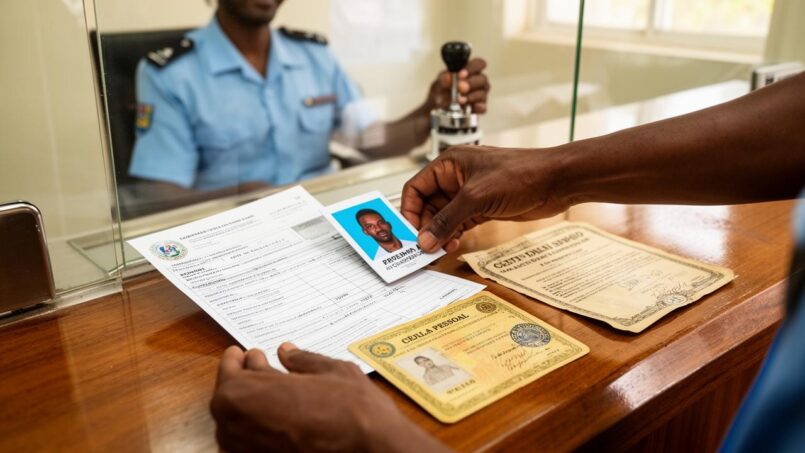
For residents of Guinea-Bissau, the application is made at the Immigration and Passport Service or the relevant department within the Ministry of Justice and Identification. The file must be complete at the time of submission: completed form, identification documents, proof of residence, photos, and proof of payment of fees.
The agent receives and checks the conformity of documents, may ask questions to confirm identity, and then registers the file if everything is in order. An indicative collection date is generally communicated or noted on a receipt.
It is advisable to inquire in advance about the service’s opening hours, submission days, and, if an appointment system exists, how to book one. In some facilities, applications are more readily accepted in the morning, with a cut-off for receiving files at midday.
Application Made Abroad via Embassies and Consulates
Many Guinea-Bissauans live in Europe, Africa, or elsewhere in the world. For them, the passport application goes through the country’s embassies and consulates. The research report mentions several Guinea-Bissauan representations, notably in Lisbon, Paris, The Hague, Rabat, Moscow, Abuja, Algiers, and Havana.
The Embassy of Guinea-Bissau in Portugal is located at Rua de Alcolena, 17-A, in Lisbon. It provides telephone lines and a consular email address, allowing you to contact it beforehand to inquire about opening hours, the need for an appointment, and the updated list of required documents for a procedure.
A table summarizes some key representations:
| Guinea-Bissauan Representation | City | Primary Role for Passports |
|---|---|---|
| Embassy of Guinea-Bissau in Portugal | Lisbon | Submission, renewal, assistance in case of loss |
| Embassy of Guinea-Bissau in France | Paris | Consular services, visas, passports |
| Embassy of Guinea-Bissau in the Netherlands | The Hague | Consular services and information |
| Embassy of Guinea-Bissau in Morocco | Rabat | Consular services and emergency assistance |
| Embassy of Guinea-Bissau in Russia | Moscow | Bilateral relations and consulate |
| Embassy of Guinea-Bissau in Nigeria | Abuja | Services to nationals in the region |
| Embassy of Guinea-Bissau in Algeria | Algiers | Consulate and promotion of bilateral relations |
| Embassy of Guinea-Bissau in Cuba | Havana | Diplomatic relations and consular services |
At these posts, the procedure follows the same logic as in Bissau: the applicant appears in person, submits their form, documents, photos, and proof of payment of fees. In some cases, an interview is arranged to confirm the applicant’s identity and the validity of the provided documents.
An up-to-date consular card is often required for residents abroad. It certifies the citizen’s registration with the diplomatic mission, facilitates file tracking, and allows the embassy to contact its nationals in a crisis.
Fees and Payment Methods
Obtaining a passport has a cost. According to the collected data, the approximate price of a Guinea-Bissauan passport is around 3,525.70 CFA francs (XOF). This amount is an estimate and may vary based on adjustments decided by the authorities, the passport category, or specific fees applied by certain embassies.
At some posts, payments are made by bank deposit into a designated account. For example, banking references indicate the use of Montepio Geral bank, with accounts in the name of the representation. The applicant must make a payment at the counter or by transfer, then present the receipt when submitting their file.
Amount in euros deposited into a bank account for an administrative procedure in Europe, accompanied by a BIC code.
For clarity, the table below groups the orders of magnitude found:
| Cost Item | Indicative Amount | Currency | Remarks |
|---|---|---|---|
| Passport (estimate) | 3,525.70 | XOF | Approximate amount |
| Fees mentioned in European account | 41.43 | EUR | Example of payment via Montepio Geral bank |
| Application form (separate document) | 300 | XOF | Occasional indication for the form |
| Official stamps | 2,000 | XOF | To be affixed to certain documents |
In most cases, proof of payment must be presented at the time of submitting the file. The applicant’s name should appear in the bank deposit reference to facilitate identification. Consular sections often specify that they do not accept checks or credit cards, preferring cash payments (in local currency or dollars/euros depending on the country) or bank deposits.
Processing Times and Passport Collection
Processing times are not uniformly set. They depend on the workload of immigration services, the embassy, periods of high demand, and technical constraints related to printing and shipping booklets.
The sources indicate that manufacturing a passport can take several weeks, or even a few months. At the time of submission, it is therefore essential to ask for an indicative timeframe. Some services mention processing around fifteen working days for standard applications in other contexts, but for Guinea-Bissau, it is wise to allow a margin.
Once approved, the passport must be collected in person upon presentation of an ID. In the case of a renewal, the old passport generally must be handed over to be canceled, in order to prevent the simultaneous circulation of multiple valid documents for the same person.
For nationals abroad, delivery of the passport occurs at the embassy or consulate counter, sometimes with the possibility of return by courier service in certain areas, although this point is not systematically mentioned for Guinea-Bissau. When delivery is by appointment, the date and time are usually indicated at the time of submission or sent by email.
Passport Renewal: Procedure and Precautions
Passport renewal largely follows the same steps as a first application, but with some specifics. The holder must fill out a renewal form, provide a recent photo, prove their identity with current documents, and, most importantly, present their old passport.
During renewal, authorities may collect biometric data, such as fingerprints or a digitized photographic portrait, if not already in the system. This data serves to strengthen the document’s security and reduce fraud risks.
Personal data recorded in biometric passports, such as name, date or place of birth, cannot be freely modified. Any modification is strictly regulated, or even prohibited, unless authorized by a motivated judicial or administrative decision. This rigor is essential to guarantee the reliability of the identification tool and compliance with international standards.
The exact validity period of the Guinea-Bissauan passport is not explicitly mentioned in the compiled documents, but by analogy with regional practices, one can expect a duration of a few years. It is advisable not to wait until the last minute to request a renewal, especially if travel is planned.
Loss, Theft, or Damage: How to React
Losing your passport or having it stolen is a stressful situation, especially when abroad. The available information shows, however, that procedures are in place to handle these incidents.
In the event of loss or theft in Guinea-Bissau, the recommended step is to immediately report the disappearance to local authorities (police station, gendarmerie). This report officially records the loss, reduces the risk of identity theft, and prepares the ground for a replacement application. Next, contact the relevant services to apply for a new passport.
If your Guinea-Bissauan passport is lost or stolen abroad (e.g., Portugal, Netherlands), you must first file a declaration with the local police. Then contact the nearest Guinea-Bissau Embassy or Consulate. The diplomatic mission will guide you on the procedure, which may involve obtaining a replacement passport or a temporary travel document for your return home.
In the passport application form, a specific section is dedicated to cases of lost or stolen passports. It must be filled out accurately, indicating the circumstances of the disappearance, the date, location, and, if possible, the number of the missing document. Producing the police report may be required to finalize the application.
A passport reported lost or stolen immediately becomes permanently invalid. Even if later found, it must no longer be used for travel, to prevent any risk of fraud or use by third parties who may have copied its data.
In case of significant deterioration of the passport (torn pages, burned booklet, damaged cover), it is also recommended to hand it over to competent authorities for evaluation. If the document is no longer fully legible or secure, a replacement will be necessary.
The Role of Embassies and Diplomatic Missions
The Embassies and Consulates of Guinea-Bissau play a key role in issuing and renewing passports for nationals living abroad. They also provide support in emergencies, such as document loss or crisis situations.
Consulates offer a range of essential services to citizens abroad, including notarization of documents, visa issuance, and registration of civil status acts (births, marriages). They also provide crucial information on immigration and travel procedures. These missions allow the state to maintain an administrative link with its expatriate citizens.
In parallel, certain foreign missions mentioned in the research report – such as the American Liaison Office in Bissau or the embassies of third countries – remind that consular services for their own nationals are often located in neighboring countries. This context underscores the importance, for Guinea-Bissauans themselves, of having a valid passport to travel to these countries and access services.
Using Your Guinea-Bissauan Passport: Validity and International Mobility
Once the passport is issued, the question of its use arises. The country’s authorities require all foreign visitors to have a valid passport to enter Guinea-Bissau; conversely, Guinea-Bissauans must present a valid document to cross foreign borders.
Many countries condition entry on a passport valid for at least six months beyond the planned arrival date. Others are satisfied with three months after the planned departure date. In any case, it is prudent to check the requirements of the destination country before traveling.
The Guinea-Bissauan passport allows entry without a prior visa to several countries in Africa, Asia, Oceania, the Americas, and a few European states. Exact data may vary by source, but all confirm these access facilitations.
The most favorable situation concerns ECOWAS countries, within which Guinea-Bissauan citizens do not need a passport to travel. A simple national ID card is sufficient, which is a significant advantage for regional travel.
Several countries outside the region, such as Rwanda, Senegal, São Tomé and Príncipe, Tunisia, Bangladesh, Singapore, Barbados, Ecuador, and some Pacific states, offer visa-free access or visa on arrival/eVisa. Lengths of stay vary, often between 15 and 90 days. A valid passport remains mandatory as the basic document for any travel.
For the most sought-after destinations, such as Schengen Area countries, the United Kingdom, the United States, Canada, Australia, or Japan, a prior visa is still required. The Guinea-Bissauan passport must then be presented as part of the visa application, along with required documents (forms, photos, bank statements, reservations, invitation letters, etc.).
Practical Tips for Securing Your Passport
Given the value of the passport as an identification and travel document, some good practices are essential from its issuance. It is recommended to systematically make a photocopy of the identification page and, if possible, keep a secure digital version. In case of loss, these copies greatly facilitate procedures.
In Guinea-Bissau, identity checks by authorities are frequent. It is essential to inquire before your trip about the obligation to always carry your original passport on you or whether a certified copy is accepted during these checks.
It is also useful to register your trip with the Guinea-Bissau Embassy when possible. This registration allows the diplomatic mission to contact its nationals in a crisis (natural disaster, political unrest, conflicts, etc.) and possibly organize an evacuation or emergency assistance.
Finally, it is important to closely monitor the expiration date of the passport. Many countries refuse boarding or entry when the passport is too close to its expiration date. Renewing your document several months in advance remains the best strategy for stress-free travel.
What to Remember
Obtaining the passport of Guinea-Bissau is a structured process based on three pillars: proof of citizenship, presentation of reliable identity and residence documents, and compliance with procedures set by immigration services and diplomatic missions.
For any procedure (first application, renewal, or replacement), it is crucial to put together a complete file, fill out the form correctly, pay the required fees, and respect deadlines. Embassies and consulates are the central interlocutors for the Guinea-Bissauan diaspora, ensuring the link with the administration.
Once the passport is in hand, this document opens the door to facilitated regional mobility within ECOWAS and travel to many countries offering visa-free access or eVisa/visa on arrival. It also becomes the indispensable support for any visa application to major global destinations.
By understanding the requirements, anticipating delays, and taking care of their document, every Guinea-Bissauan citizen can fully use their passport as a key to access the world, while respecting the security and legality rules imposed by states, starting with their own country.
Disclaimer: The information provided on this website is for informational purposes only and does not constitute financial, legal, or professional advice. We encourage you to consult qualified experts before making any investment, real estate, or expatriation decisions. Although we strive to maintain up-to-date and accurate information, we do not guarantee the completeness, accuracy, or timeliness of the proposed content. As investment and expatriation involve risks, we disclaim any liability for potential losses or damages arising from the use of this site. Your use of this site confirms your acceptance of these terms and your understanding of the associated risks.

Cyril Jarnias is an independent expert in international wealth management with over 20 years of experience. As an expatriate himself, he is dedicated to helping individuals and business leaders build, protect, and pass on their wealth with complete peace of mind.
On his website, cyriljarnias.com, he shares his expertise on international real estate, offshore company formation, and expatriation.
Thanks to his expertise, he offers sound advice to optimize his clients' wealth management. Cyril Jarnias is also recognized for his appearances in many prestigious media outlets such as BFM Business, les Français de l’étranger, Le Figaro, Les Echos, and Mieux vivre votre argent, where he shares his knowledge and know-how in wealth management.





