
 Published on and written by Cyril Jarnias
Settling in Guinea-Bissau means entering a country where people speak just as much with their dishes as with their words. The table tells the story of the Atlantic coast, of the Balanta and Mandinka villages, of Portuguese colonization, and of markets overflowing with fish, tropical fruits, and cashew nuts. For an expatriate, understanding this cuisine also means understanding the country, its social codes, and its daily rhythm.
Good to know:
This guide helps you discover the cuisine of Guinea-Bissau authentically, adopting local habits while preserving your health and your bearings.
A Cuisine of Encounters: West Africa, Portugal, and the Atlantic Ocean
The gastronomy of Guinea-Bissau was built at the crossroads of several influences. The roots are West African: rice, millet, cassava, green leaves, sauces based on peanuts and chili peppers. To this were added four centuries of Portuguese presence, which left tomatoes, onions, certain cooking methods, and recipes like caldeirada de peixe or caldo de cabidela. The whole thing is carried by a terroir of mangroves, rice paddies, and palm groves, where the sea provides fish, crabs, oysters, and shrimp.
The country’s cuisine is anything but a sophisticated gastronomic laboratory. It remains simple, hearty, and deeply rooted in daily life: what matters is not the meticulously plated dish, but the act of sharing it. The emblematic dishes have hardly changed for generations, because they provide the essentials: feeding, gathering, celebrating.
The country’s cuisine
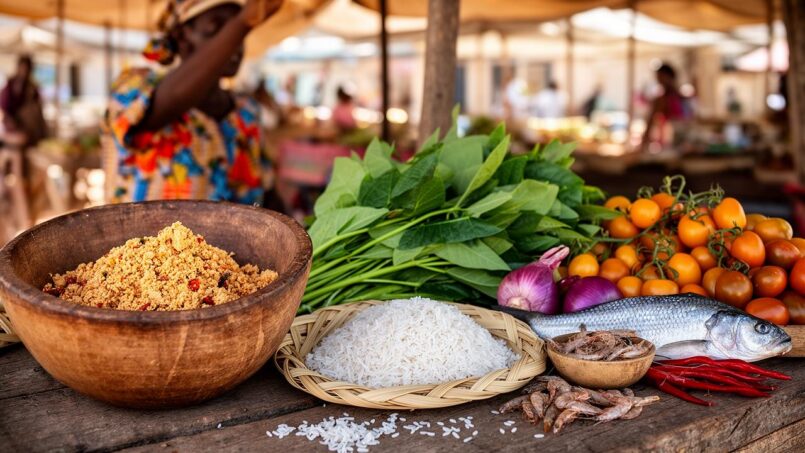
The main characteristics quickly reappear in the culinary landscape: abundance of fish and seafood, ubiquity of rice and cassava, generous use of palm oil, love of chili peppers (malagueta / piri-piri), importance of peanuts (mancarra) and cashew nuts.
The Central Role of Sharing
In the working-class neighborhoods of Bissau as well as in villages, people often eat together from a large dish placed in the center. Everyone serves themselves with their right hand, respecting the portion in front of them. This gesture, far from being merely practical, is a way of signifying belonging to the group. For an expatriate, accepting to eat this way when invited is often perceived as a mark of respect.
Example:
The preparation of caldo de mancarra, a traditional dish, illustrates the collective dimension of cooking. The activity mobilizes the family, and even the neighborhood, around common tasks like grinding spices in the mortar (pilão), watching the large cauldron, cleaning the fish, and sorting the rice. It thus transforms the kitchen into a place of cooperation and sharing, rather than an individual closed space.
Basic Ingredients: What You’ll See Everywhere in the Markets
From your first visits to the Bandim market or neighborhood stalls, a landscape of ingredients becomes clear. Understanding these products will help you decipher the dishes and better communicate with vendors and cooks.
Cereals, Roots, and Starches
The foundation of gastronomy in Guinea-Bissau rests on a few starchy staples that accompany almost every meal.
| Ingredient | Main Use | Common Forms |
|---|---|---|
| Rice | Base of most meals, especially in coastal areas | Plain white rice, jollof, coconut rice, rice with fish |
| Millet | More consumed inland | Porridges, millet couscous, cuscuz |
| Cassava (manioc) | Major starch | Funge (thick porridge), gari, fufu, cassava cuscuz |
| Corn | Complement or substitute | Porridges, xerém (corn mash), corn cuscuz |
| Sorghum | Traditional cereal | Porridges, pancakes |
| Plantain | Side dish or snack | Fried, boiled, or grilled bananas |
Cassava is particularly versatile. It is eaten boiled in pieces, ground into flour to prepare funge — that dense, filling porridge — or transformed into cuscuz, a steamed cake cooked in a special cuscusera. Rice remains the undisputed base, especially in cities, even though the country imports a large portion of it.
Vegetables, Greens, and Fruits
The markets of Bissau and the islands are overflowing with vegetables well adapted to the tropical climate. The most common in everyday dishes are onions, tomatoes, and chili peppers, which form a sort of “West African trinity” at the base of many sauces. Okra (quiabo) gives a slightly sticky texture to soups, while local eggplants, including the small, very fragrant red djagatu, structure many stews.
Good to know:
Green leaves such as cassava leaves, sweet potato leaves, amaranth, baobab, and moringa are commonly used, often cooked in palm oil. Among tubers, you’ll find sweet potato, taro (cocoyam), yam, and a local tuber called tifa.
On the fruit side, the country lives at the rhythm of well-defined seasons: ripe mangoes and papayas, pineapples, coconuts, guavas, citrus fruits, watermelon, jackfruit, cashew apples (caju fruit), and soursop (corossol). Many are eaten fresh, but also used for juices, jams, or simple desserts.
Proteins: From the Sea, the Bush, and the Fields
Being on the Atlantic, surrounded by archipelagos and mangroves, directly translates onto the plate.
| Protein Source | Examples | Culinary Use |
|---|---|---|
| Saltwater fish | Barracuda, grouper, sea bream, mackerel, snapper, tilapia | Grilled, in caldeirada, in caldo, smoked or dried |
| Seafood | Shrimp, crab, mangrove oysters, lobster | Grilled, in seafood rice, as a rice accompaniment |
| Meats | Chicken, goat, lamb, pork (less common), rabbit | Grilled with piri-piri, stewed in stews and maffés |
| Legumes | Beans, peas, cowpeas, peanuts, chickpeas | Stews, akara (bean fritters), peanut sauces |
| Dairy products | Milk, yogurt, whey | Somewhat marginal, more common in Fulani communities |
Saltwater fish, often amazingly fresh in the dry season, clearly dominates the scene. In mangrove villages or on the Bijagós Islands, oysters clinging to the roots of mangroves, traditionally harvested by women at low tide, are a true specialty.
Tip:
Beans and peanuts are important sources of plant-based protein. They are commonly used in the preparation of traditional dishes like soups and stews, helping to enrich the nutritional value of these recipes.
Oils, Spices, and Condiments
The Bissau-Guinean flavor is largely built with palm oil, a deep reddish-orange, highly fragrant oil, often produced artisanally from wild palm trees.
Typical seasonings revolve around:
– malagueta chili pepper (piri-piri), very hot, used fresh, as a paste, or in sauces,
– Guinea pepper (grains of Aframomum melegueta),
– garlic, ginger, cilantro, bay leaf, thyme, parsley,
– lemon or lime, ubiquitous for fish and some marinades,
– salt, sometimes from artisanal salt pans.
In the markets, you’ll find both industrial bouillon cubes, very popular, and traditional spice blends made by women from local leaves and fruits (hibiscus, lemon, palm oil, chili peppers). These homemade seasonings are often considered more flavorful and healthier.
Must-Try Dishes: What You Absolutely Need to Taste
To get your bearings, a few dishes keep coming up in conversation among locals when talking about “real cuisine” in Guinea-Bissau. Understanding them gives you a gastronomic compass.
Caldo de Mancarra: The Peanut Stew, an Emblematic Dish
When people talk about a “national dish,” the name that comes up most often is caldo de mancarra. “Mancarra” is the local word for peanuts, inherited from the Portuguese “amendoim.”
This rich and creamy stew is made from peanut paste (or peanut butter), palm oil, onions, tomatoes, sometimes malagueta chili, with a protein base of chicken, fish, or goat. Seasonal vegetables like cassava, sweet potato, cabbage, carrot, or local eggplant are added. Everything simmers for a long time in a pot, often clay, over a wood fire.
The result: a thick sauce, ocher in color, with a deep, slightly smoky peanut flavor, rarely blazing hot but always well-seasoned. It is almost always served with a mountain of white rice, sometimes with funge or fufu. Caldo de mancarra is typical of Mandinka traditions and is present at religious festivals, family gatherings, and major events.
Jollof Rice (Arroz de Jollof): The Tomato-Sauce Rice for Special Occasions
Impossible to be in West Africa without encountering jollof. In Guinea-Bissau, there is a local version, cooked in a sauce made from tomatoes, onions, and bell peppers, often less spicy than in some neighboring countries. This reddish-orange rice pairs well with pieces of grilled chicken, fried fish, or meat.
Attention:
This is a festive dish, prepared with care, where every cook has their secret (cooking time, spice blend, choice of broth, type of rice). For an expatriate, it often serves as an excellent introduction to local cuisine, offering familiar yet distinct flavors, marked by palm oil and spices.
Caldeirada de Peixe and Other Fish Stews
The weight of Portuguese heritage is visible in the caldeiradas, those large fish stews cooked with tomatoes, onions, bell peppers, sometimes potatoes, and a little white wine. In Guinea-Bissau, they adapt with local fish: grouper, barracuda, sea bream, snapper, tilapia, mackerel.
Caldeirada de peixe is eaten with rice, sometimes bread, and often serves as a “slightly more expensive” dish in restaurants in Bissau or beach resorts. It’s a good entry point for those who are a bit wary of overly spicy dishes: the flavors remain intense, but the chili is not systematically dominant.
Arroz de Coco com Peixe: The Touch of the Bijagós Islands
In the Bijagós archipelago, the marriage of rice and coconut milk is a given. Arroz de coco com peixe consists of rice cooked directly in coconut milk, sometimes with garlic, onion, bay leaf, served with grilled or fried fish, and generously drizzled with lime juice. The texture is very fragrant, creamy, but not excessive, somewhere between a pilaf and a risotto.
This is a dish found in many guesthouses and small restaurants on the islands and along the coast, often presented as a “house specialty.”
Cachupa: The Cousin Shared with Cape Verde
Another legacy of the shared colonial history with Cape Verde: cachupa. It is a long-simmered stew made from corn (often in hominy-style grains), beans, cassava, sweet potato, and possibly meat (pork, beef, chorizo) or fish. Each family has its own version, richer or more frugal depending on means.
This dish illustrates the “patient” cuisine, where time and low heat transform rustic ingredients into a very hearty preparation. For the expatriate, it’s an excellent dish for understanding how Bissau-Guinean cuisine values simple products.
Funge, Funge, and More Funge
Funge (or fungia) is a thick porridge made from cassava flour, sometimes corn, stirred until it achieves a smooth and elastic texture. Served as a ball or a large piece, it accompanies sauces like caldo de mancarra, leaf stews, or palm oil-based sauces.
Its taste is neutral, almost bland, but that is precisely what allows it to absorb and “carry” the powerful sauces. Eating funge with your fingers (right hand only) is an experience you quickly get used to, especially if you are invited to a family home.
Other Specialties to Look Out For
While exploring restaurants and eateries, a few names come up regularly:
– Frango grelhado piri-piri / cafriela de frango: chicken marinated in piri-piri (malagueta chili, garlic, lemon, palm oil) then grilled over charcoal.
– Caldo de cabidela: rice cooked with chicken or rabbit blood, vinegar, and spices, a Portuguese legacy enjoyed on special occasions.
– Funge + leaf sauces: stews of cassava leaves, amaranth, or hibiscus, very representative of villages.
– Caldo (plain): in daily life, this word often refers to a bowl of rice with a bit of sauce (peanut, fish, or vegetables). It’s the simple, affordable formula you find everywhere in street food.
– Bijagós oysters: served raw with lime juice or lightly grilled, typical of the mangroves.
– Lagosta grelhada: Atlantic lobster, grilled with butter/oil, garlic, and lime.
For small hunger pangs or snacking, you’ll come across:
– Mancarra: fresh peanuts boiled in salted water, sold in bags by street vendors.
– Bolacha: fried dough fritters or pancakes, often slightly sweet, very common for breakfast.
– Bolinhos de arroz: fried rice balls, made with leftovers from the day before.
– Beijinhos: small coconut and condensed milk truffles, more festive.
Drinks and Sweets: Between Caju and Bissap
Elaborate desserts remain rare in everyday meals. Most often, you simply finish with a ripe fruit. However, sugary drinks hold an important place.
Among the must-haves:
Traditional and Refreshing Beverages
Discover typical drinks, from seasonal fruit juices to infusions and local wines, which accompany daily life and meals.
Cashew Juice (Caju)
A beverage obtained from the pulp of the cashew apple, very abundant from March to June. It can be consumed fresh, made into juice, syrup, or fermented into cashew wine, a typical alcohol from the region.
Bissap
An infusion of dried hibiscus flowers, ruby red in color, served cold and sweet. A refreshing and slightly tart drink.
Palm Wine
Palm wine drawn from the sap of the palm tree, more common in areas that are not predominantly Muslim. It is consumed fresh or slightly fermented.
Sweet Green or Black Tea
Tea, sometimes flavored with mint, often prepared very sweet, part of convivial moments.
Fresh Fruit Juices
Pressed juices depending on the season: mango, papaya, pineapple, orange. Often sweetened for extra sweetness.
More “European-style” cakes (loaf cakes, cookies, filhós-type donuts, pastries) are mainly found in certain bakeries or pastry shops in Bissau, and for special occasions.
Where to Eat: Markets, Street Stalls, and Restaurants
For an expatriate, one of the best ways to enter the culinary culture is to vary the contexts: from a bowl of caldo bought from a street vendor to a fish dish in a “European-style” restaurant.
Markets: Bandim, Mercados, and Company
The large Bandim market in Bissau is the beating heart of the country’s food supply. In a single area, you’ll find fish from the morning catch, vegetables, fruits, bags of rice, spices, artisanal red palm oil, peanuts, cashew nuts, cassava cakes, as well as stalls serving complete meals on the spot.
| Location | Culinary Specialties | Recommended Time |
|---|---|---|
| Bandim (Bissau) | Fresh fish, rice and sauces, snacks, staple products | Early morning for shopping, noon for hot meals |
| Bissau waterfront | Grilled fish, seafood, evening atmosphere | Late afternoon and evening |
| Caracol (Bissau) | Popular lunch stalls (caldo, grilled chicken) | Noon |
| Bolama Market | Fish, cashew products, fruits | Morning, except Sundays |
Markets are also places for negotiation, but the implicit rule remains the same: discuss prices with a smile, without haggling over a few CFA francs. Payment is made in cash, almost exclusively.
Street Food: Eating Like Everyone Else, on the Cheap
Street food in Guinea-Bissau is nothing like an “Instagrammable food court”: it is modest, very local, and centered on simple dishes.
Example:
In the informal trade, vendors — very often women — generally specialize in selling one or two specific food preparations. The available offerings thus vary depending on the neighborhoods and times of day.
– bowls of caldo (rice + sauce) for 500 to 1,000 CFA,
– small grilled fish over charcoal, served with spicy sauce and sometimes bread or rice,
– grilled piri-piri chicken, cut into portions,
– bolacha in the early morning,
– boiled or roasted peanuts, at any time.
500 to 2,000
A full street meal in Guinea-Bissau typically costs between 500 and 2,000 CFA.
Restaurants: From Simple to “Splurge”
In Bissau, the restaurant offering is more varied than in the provinces. You’ll find:
– small neighborhood restaurants serving rice + sauce, fried fish, grilled chicken,
– establishments influenced by Portuguese cuisine (caldeirada, bacalhau à Portuguesa, bifanas, pastéis…),
– a few more “Westernized” addresses offering pizzas, pasta, burgers, but also yassa or jollof on the menu,
– hotel restaurants, especially seaside ones, specializing in seafood (lobster, shrimp, whole grilled fish).
The budget can vary greatly:
| Level | Meal Budget (excluding drinks) | Type of Experience |
|---|---|---|
| Street / Simple canteen | 500 – 2,000 CFA | Rice + sauce, simple fish or chicken, very basic setting |
| Mid-range restaurant | 3,000 – 7,000 CFA | More varied menu, slightly more comfortable room, sometimes air-conditioned |
| “Splurge” (hotel, seafood) | 10,000 – 25,000 CFA | Lobster, choice fish, polished setting, often for occasions |
Card payments remain the exception outside of hotels and a few high-end establishments. Having CFA cash is essential.
Adapting to the Codes: How to Eat Without Making a Faux Pas
The meal is a highly codified social moment. A few pointers help you integrate.
Basic Table Manners
In a traditional context (family, village, meal in a working-class neighborhood), these customs are generally followed:
Tip:
During a shared meal, it is important to wait for the host to invite you to sit down. Let the elders or the most important person start eating first. If you eat with your fingers, use only your right hand. Only serve yourself from the portion of the dish in front of you, without digging around for the best pieces. If you are offered more food, accept at least a small portion or politely explain that you are full. Finally, finish what you have taken to avoid waste.
Washing hands before and after the meal is almost ritualistic: you will often be brought a bowl of water (sometimes with soap) to rinse. Refusing or neglecting this gesture is frowned upon.
In restaurants, customs are closer to what expatriates know: utensils provided, napkin (not always), bill at the end of the meal. Service can be slow, especially if everything is cooked to order. Taking this time as a moment of sociability rather than a frustration helps a lot.
Hospitality and Invitations
Being invited to eat is an honor. The host has often made a considerable financial effort, especially if a festive dish has been prepared (caldo de mancarra with lots of meat, jollof, fish or chicken in quantity).
Example:
In the context of environmental preservation, daily actions like turning off lights when leaving a room, reducing water consumption, or favoring public transportation are gestures that, although simple, have a significant impact when adopted collectively.
– compliment the cook,
– taste everything, even in small amounts,
– do not criticize the level of doneness or presentation,
– stay a little while to chat after the meal instead of leaving as soon as the plate is finished.
Bringing a small simple gift (fruits, sweets, non-alcoholic drink) is appreciated, without being obligatory.
Constraints, Special Diets, and Realities of the Country
The food reality in Guinea-Bissau is not smooth. The country experiences significant food insecurity linked to political crises, dependence on rice imports, and climatic hazards. This is felt in the way people cook and, sometimes, in the sanitary quality of products.
Vegetarians, Vegans, Gluten-Free: What’s Possible
Local cuisine is centered on rice, cassava, fish, and meat. The idea of not eating animal products for ethical or health reasons is not widespread, especially in rural areas. However, there are degrees of flexibility.
For vegetarians, it’s useful to know how to say in Portuguese:
– “Sem carne, sem peixe” (without meat, without fish),
– then ask: “tem caldo de peixe/carne?” (is there fish/meat broth?), because many vegetable sauces are prepared with fish or meat stock.
You can generally fall back on:
available options.
Example:
In many local restaurants, it is possible to order meat-free dishes. For example, plain rice with a vegetarian tomato sauce, beans cooked in a meatless sauce, or simple funge (a cassava flour dough). Fried plantains are also commonly available as a side. Grilled or sautéed vegetables are less common but available upon request. Finally, for a lighter option or dessert, fresh fruits, peanuts, or cashew nuts are often offered.
For strict vegans, the task is more difficult, because palm oil is not an issue, but animal broth and dried fish “hidden” in sauces are. It is better then to cook at home with raw products from the markets.
Good news, however, for people with gluten intolerance: the rice + cassava base makes the diet naturally very low in wheat. You just need to be wary of fried foods (where wheat flour might be used) and certain biscuits, breads, and pastries. Most main dishes (caldo de mancarra, caldeirada, funge + sauce, grilled fish + rice) are gluten-free.
Halal, Pork, and Other Religious Considerations
Guinea-Bissau is religiously diverse, with a large proportion of Muslims (about 45%), but also Christians and animist practices. Pork is therefore rarely consumed, which makes life easier for Muslim expatriates.
In Fulani (Fula) or Mandinka neighborhoods, meat is often halal, even if the label is not displayed. If it is important to you, you can ask:
– “É halal?” or
– “É para muçulmano?” (is it for Muslims?).
Good to know:
Prepared and certified kosher foods are very rare. In this context, the safest choices are generally limited to fish or vegetarian dishes.
Health, Hygiene, and Food Safety
Risks related to water and food are high in Guinea-Bissau. A few principles greatly reduce problems:
– drink only bottled or treated water (boiled, filtered, or with purification tablets),
– avoid ice cubes whose origin you don’t know,
– favor dishes served very hot, prepared the same day in front of you,
– be wary of raw salads, unpeeled raw vegetables, and runny eggs,
– choose very busy street stalls (high turnover = fresher products),
– wash your hands often or use hand sanitizer before eating.
For fruits and vegetables eaten raw, it is better to peel them yourself (mango, banana, orange) and avoid those with damaged skin.
Seafood requires special attention, especially oysters, mussels, or undercooked shrimp. In a context with uncertain hygiene, it is safer to eat them well-cooked, even if it deprives you of some of the marine pleasures.
Time and Seasons: Eating with the Climate
The culinary calendar follows the dual season: dry and rainy. This matters for what you’ll find on the table.
Tip:
In Guinea-Bissau, the dry season (November to February) is ideal for seafood and citrus fruits, with calm seas and cool evenings perfect for grilling. In the rainy season (July to October), fishing is reduced, but it’s the optimal time for rice, vegetables, green leaves, and tropical fruits like papaya, with increased use of dried fish and legumes.
From March to June, it’s the peak of the cashew season: the fruits carpet the markets, the nuts are harvested, processed, and exported. Cashew juice is everywhere. This cycle greatly conditions the rural economy: the sale of the nuts allows buying rice and other food for the “hunger season.”
Cashew Nuts: From Plantation to Plate
The cashew nut is much more than an appetizer snack in Guinea-Bissau. It is the economic lung of the country: exports of raw nuts represent more than 95% of export earnings and constitute the main source of income for the majority of rural households.
For the expatriate, this sector is noticeable in several ways:
Good to know:
The roasted or boiled cashew nuts sold locally are very fresh. Cashew juice and wine are traditional beverages. Some initiatives are also developing processed products like jams, candies, and sweet mixes based on cashew nuts.
In the markets, asking for local cashew nuts is almost an act of support for the rural economy. You’ll also notice that, culturally, it is often men who control the income from raw nuts, while women manage that from processed products (juice, alcohol, jams).
Practical Tips for Embracing the Local Gastronomy
For an expatriate, the key is to combine curiosity and caution. A few reflexes make adaptation easier:
Tip:
For a successful culinary experience in Guinea-Bissau, it is recommended to learn a few words of Portuguese or Creole to communicate your food preferences (like rice, fish, no chili, or no meat). Start with so-called “intermediate” dishes like jollof, grilled fish, or caldeirada before trying more rustic preparations. Favor vendors or restaurants with a high customer turnover, a sign of local customer trust. Accept invitations to eat while knowing how to politely explain your dietary or health limits. Finally, don’t hesitate to cook at home with products from the markets, drawing inspiration from local recipes while better controlling hygiene and seasoning.
The gastronomy of Guinea-Bissau does not surrender in one dinner: it requires walking through Bandim in the morning, watching women collect oysters from the mangrove roots in the Bijagós, chatting with the caldo vendor who fills your bowl for 500 CFA, listening to the stories associated with caldo de mancarra or festive jollof. By taking this time, eating will no longer be just about feeding yourself, but a way of truly anchoring yourself in your new host country.

Cyril Jarnias is an independent expert in international wealth management with over 20 years of experience. As an expatriate himself, he is dedicated to helping individuals and business leaders build, protect, and pass on their wealth with complete peace of mind.
On his website, cyriljarnias.com, he shares his expertise on international real estate, offshore company formation, and expatriation.
Thanks to his expertise, he offers sound advice to optimize his clients' wealth management. Cyril Jarnias is also recognized for his appearances in many prestigious media outlets such as BFM Business, les Français de l’étranger, Le Figaro, Les Echos, and Mieux vivre votre argent, where he shares his knowledge and know-how in wealth management.





