
 Published on and written by Cyril Jarnias
Guinea-Bissau doesn’t often appear in travel brochures. Yet this small West African country, bordering Senegal and Guinea-Conakry, packs a surprising natural and cultural wealth for anyone who takes the trouble to set foot there. Between the UNESCO-listed Bijagós Archipelago, the wild Atlantic-battered beaches of Varela, Portuguese forts that bear witness to the slave trade, and the colorful carnivals of Bissau, the country offers a range of experiences rare in the region.
The tourist infrastructure is modest and the roads can be difficult, but the country offers remarkable authenticity. Traveling here allows you to discover the traditions of the Fula, Mandinka, Balanta, Papel, and Bijagós peoples, where nature, spirituality, and history are intimately linked.
Bissau, a capital between memory and vibrancy
On the edge of the Rio Geba estuary, Bissau concentrates the country’s political memory and a large part of its cultural life. The city was founded as a Portuguese trading post in the late 17th century, then became the economic heart of the region before the war of independence. It still bears the scars of the 1998-1999 civil conflict, but also the energy of a young population, a lively music scene, and markets overflowing with color.
Bissau Velho, the alleys where history clings to the façades
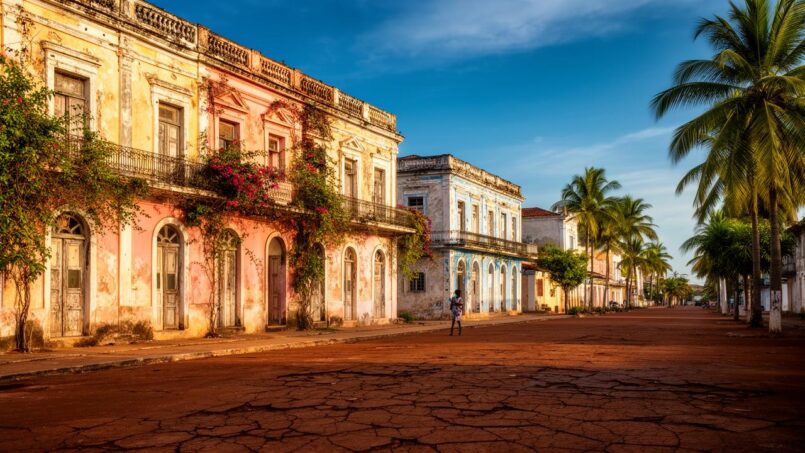
In Bissau Velho, the old quarter, time seems suspended. The cobbled alleys wind between pastel colonial houses, with wrought-iron balconies, façades peeling from humidity and the years, with graffiti and murals adding a contemporary touch to the whole. Under the large banyan trees, fishermen mend their nets, children improvise soccer games, and vendors offer mangoes or cashews, a staple of the national economy.
You’ll also find an old fish market near the port, where the daily ballet of pirogues anchors the neighborhood in its relationship with the sea. Strolling through Bissau Velho is a physical experience of the blend between Portuguese heritage and West African urban life.
Fortaleza de São José da Amura, a symbol of resistance
At the end of Amílcar Cabral Avenue stands the Fortaleza de São José da Amura, also called the Fortaleza d’Amura. Built by the Portuguese between the late 17th and 18th centuries, this fortress was tasked with controlling trade routes and protecting the old Portuguese quarter. Later, it played a central role in the struggle for independence.
The fort, still occupied by the military, houses a museum on the country’s history and the mausoleum of Amílcar Cabral. Interior visits often require permission, but the exterior already offers impressive views of the city and coast.
Presidential Palace, cathedral, and monumental squares
At Praça dos Heróis Nacionais, the Presidential Palace stands out with its white neoclassical façade inherited from the colonial era. It suffered serious damage during the civil war and does not open its doors to the public, but it remains a powerful symbol of political power and the upheavals of contemporary history. Around it, the square and official buildings – National Assembly, Government Palace – give an idea of Bissau’s central role in the country’s life.
Bissau Cathedral, Sé Catedral de Nossa Senhora da Candelária, is distinguished by its red roof and light façade. Built and modified in the mid-20th century, it blends Portuguese Baroque and Neo-Romanesque styles. It is characterized by its colorful stained-glass windows diffusing a soft light and its calming garden. The site also includes the small chapel Nossa Senhora da Conceição, which enhances the spiritual atmosphere of the place.
Around these monuments, several squares and urban gardens – Praça Titina Silá, Praça dos Mártires, Empire Square – serve as places for strolling, impromptu political debates, and gatherings during major national holidays like Heroes’ Day or Independence Day.
Museums, cultural centers, and markets of Bissau
In the heart of the capital, the National Ethnographic Museum occupies a colonial building from 1948. Renovated and reopened to the public, it displays a series of objects that tell the story of the cultures of the country’s various ethnic groups: masks, textiles, musical instruments, pottery, ritual objects. It is a valuable introduction for understanding the codes, symbols, and beliefs encountered later in the villages or islands of the Bijagós. Guided tours are offered in several languages.
The city of Bissau is a dynamic cultural hub, notably home to the National Institute of Arts for contemporary artists, a French-Bissau-Guinean cultural center, and a Brazilian cultural center. These institutions regularly organize concerts, exhibitions, film festivals, plays, and workshops. The year is punctuated by a series of events like gumbe and hip-hop festivals, fine arts exhibitions, and craft weeks, often concentrated in the capital.
Mercado de Bandim, the country’s largest market, is another must-see. You’ll find tropical fruits, fish, cassava, spices, colorful fabrics, kitchen utensils, but also a condensed version of Bissau-Guinean daily life. Among the cluttered stalls, vendors call out, customers bargain, and the smells of grilled fish, rice, and peanut sauce mix. The more compact Mercado Central, and neighborhood markets like Caracol or Bairro Militar, complete this immersion.
To extend the experience, the city has many restaurants where you can taste Creole cuisine, a blend of Portuguese techniques and African products. Fish, seafood, rice, cassava, millet, and cashews dominate the menus. Places like Papa Loca or Chez Hélène are often mentioned for discovering fish in sauce, shrimp stews, or coconut rice in a friendly atmosphere.
The Bijagós Archipelago, a natural and cultural jewel of Guinea-Bissau
Off the coast and at the mouth of the Rio Geba, the Bijagós Archipelago alone concentrates a large part of the country’s tourist potential. Listed as a UNESCO Biosphere Reserve since 1996, this group of about 88 islands and islets is sometimes called the “Polynesia of West Africa.” Here, mangroves, forests, beaches, and animist villages form a world apart.
A UNESCO-listed and still-preserved archipelago
The Bijagós cover some 2,500 km², between mangrove areas, coastal savannas, palm groves, and dry or semi-dry forests. Barely about twenty islands are permanently inhabited, usually with a single village per island. Many others are considered sacred and reserved for spirits according to local animist beliefs.
The archipelago plays a major ecological role: it is home to the largest colony of green turtles in the Atlantic, one of the few populations of marine hippos in the world, several species of sea turtles, a great diversity of migratory birds, and essential breeding grounds for marine life.
Bijagó society itself is remarkable. Of matriarchal tradition, it entrusts women with the management of the economy, the home, and even some aspects of customary law. The baloberas priestesses perform religious functions. Young people undergo initiation rituals called fanado, sometimes spending several months in the forest. Masks, dances, ceremonies, and ritual objects – such as the small portable iran shrines – testify to a very dense symbolic universe.
Getting to the Bijagós and moving between the islands
The main starting point is the port of Bissau. A public ferry makes the weekly trip between Bissau and Bubaque, the archipelago’s administrative capital, in 4 to 5 hours. A private company, Consulmar, offers a regular boat and, in the dry season, faster shuttles, with a trip to Bubaque or Rubane in about 1.5 to 2.5 hours. Tickets are sold at the company’s office near the port.
Motorized pirogues (canoas) provide cheaper but longer and less reliable connections from the old port of Bissau on certain days. Between the islands, travel is almost exclusively by boat, with each trip costing between 5 and 30 euros depending on the distance and vessel. On larger islands like Bubaque, walking and bicycle rental (about 5,000 CFA francs/day) are the preferred modes of transport.
Bubaque, gateway and logistical base
Bubaque, the most populated island in the archipelago, serves as a base for many travelers. The small town has a colorful market, a few bars, a local ethnographic museum, and several accommodations like Cajou Lodge, Mango Lodge, or Casa Afrikana. An iconic beach, Bruce Beach, stretches along a long crescent of white sand, ideal for swimming and relaxing. A horseshoe-shaped cove, more discreet, rewards those who venture a bit farther.
Visitors find boat excursions to neighboring islands, bird or dolphin watching trips, and, as evening falls, a lively atmosphere in certain spots like the Discoteca Online where gumbe, electronic rhythms, and traditional music mix.
To better visualize Bubaque’s role in the archipelago, it is useful to compare some key islands.
| Island / area | Main role | Major tourist features |
|---|---|---|
| Bubaque | Capital of the archipelago, logistical base | Market, ethnographic museum, Bruce Beach, light nightlife |
| Rubane | High-end beach stay | Ecolodge hotels (Ponta Anchaca, Bob’s Fishing Club), beaches, diving, fishing |
| Orango Grande | National park, nature & culture | Marine hippos, Bijagó villages, tomb of Queen Okinka Pampa |
| João Vieira / Poilão | Marine park, sea turtles | Main green turtle nesting site on the East Atlantic |
| Canhabaque (Roxa) | Traditional Bijagó heartland | Heavily ritualistic society, no roads or cars, sacred forests |
Orango National Park, realm of the marine hippos
In the southwestern part of the archipelago, Orango National Park protects a mosaic of forests, mangroves, swamps, and beaches. The main island, Orango Grande, is famous for its population of marine hippos, semi-aquatic animals that move between freshwater lagoons and saltwater inlets. They can be observed, with a guide, on foot or pirogue expeditions, especially during the dry season from October to February, when water sources are concentrated.
The park is also home to the tomb of Okinka Pampa, the last Bijagó queen-priestess, who negotiated with the Portuguese in the early 20th century. Her mausoleum, in the village of Eticoga, is a place of memory and respect for the inhabitants.
The flagship accommodation on Orango Island, Guinea-Bissau, is a gateway to discovering the nature and culture of the Bijagós Archipelago.
The hotel organizes excursions, walks to wetlands, visits to traditional villages, and birdwatching outings.
Explore the rice paddies, forests inhabited by monkeys, and nearly deserted beaches with translucent waters surrounding the property.
João Vieira and Poilão, sanctuary of sea turtles
Even farther south, the João Vieira and Poilão Marine National Park is one of the most important sea turtle nesting sites along the entire Atlantic coast. Created in 2000, it covers nearly 50,000 hectares and encompasses four main islands – João Vieira, Cavalo, Meio, and Poilão – as well as several islets. These lands, covered in sub-humid forests and palm groves, are considered sacred by the Bijagó communities; they remain largely uninhabited, except during certain periods.
Poilão alone accounts for more than 30,000 turtle nests each year. Between the rainy season and the start of the dry season, hundreds of females – especially green, hawksbill, and olive ridley turtles – come here to lay their eggs. At night, the hatching of thousands of small turtles rushing toward the ocean is a rare spectacle. The surrounding waters are also home to dolphins, abundant fish, and rich birdlife.
Accessing this park requires organizing a boat from Bubaque or another island, with a budget of around 50 dollars or ten euros for a one-way trip, and planning at least one or two nights on site. Accommodations take the form of campsites or small ecotourism structures. The management authorities – the IBAP, Institute of Biodiversity and Protected Areas – regulate visits to limit human impact.
Canhabaque, Rubane, Keré, and the other islands
Canhabaque, sometimes called Roxa, is one of the islands where Bijagó tradition remains strongest. You won’t find roads, cars, or a developed port there. About twenty villages house around 3,000 inhabitants organized according to strict customary rules, with long initiation ceremonies for young men. The forests and certain places are strictly sacred. Visitors must be accompanied by guides who know the customs precisely.
Located near Bubaque, Rubane is a sacred island for the Bijagós. It is also one of the archipelago’s most touristy destinations, offering renowned ecolodges like Ponta Anchaca or Bob’s Fishing Club. Activities include diving, sport fishing, kayaking, and relaxing on beaches with clear waters.
Keré is a tiny island between Caravela and Carache, practically uninhabited, hosting a single hotel (Bijagós-Kéré). Other islands like Caravela, Formosa, Uno, Orangozinho, Acunda, or Meio are explored via “island hopping” circuits mixing deserted beaches, birdwatching, snorkeling, and village immersion.
To better understand the diversity of the wildlife encountered in the archipelago, a comparative table can be useful.
| Species / group | Key zones in the Bijagós | Preferred observation periods |
|---|---|---|
| Green turtles | Poilão, João Vieira, Meio | Nesting mainly from rainy season to start of dry season |
| Marine hippos | Orango National Park (Orango Grande, marshes) | Dry season, especially October – February |
| Migratory birds | Mangroves, lagoons, sandy islets | Dry season, approximately December – February |
| Dolphins | Around João Vieira, Poilão, Bubaque | Year-round, with boat trips |
Daily life, arts, and Bijagó ceremonies
Beyond the landscapes, the appeal of the Bijagós lies in encountering a highly codified cultural universe. In the villages, masks hold an important place, notably the famous Vaca Bruto, a bull mask with horns and glass eyes, used in initiation ceremonies. Masked dances, sometimes linked to harvests or village blessings, are spectacular: the dancers, covered in fibers, feathers, or skins, seem to embody the spirits they represent.
The fanado, an initiation ritual, can lead adolescents to spend long months in the sacred forest. These practices are accompanied by unique ritual objects, like the small iran shrines, or sculptures and masks representing marine animals (sharks, rays) or land animals (bulls). Some of this artistic production is for daily use, another part for ceremonial use. It is distinctly different from other African tribal arts, making it a subject of study in its own right.
Visitors are often invited to watch certain dances or learn skills like making traditional Bijagó skirts with village women. It is essential to respect taboos and always ask the customary authorities before entering a sacred space or photographing ceremonies.
Varela, the discreet beach paradise of the north
At the far north of the country, near the Senegalese border, the village of Varela offers a different image of Guinea-Bissau: that of a long, almost deserted beach, turquoise sea, and still very wild nature. Here, far from everything, life flows to the rhythm of fishing, rice farming, and the tides.
An isolated and preserved coastal village
Varela is part of the Cacheu region and is about fifty kilometers from São Domingos, the last large town before Senegal. The road connecting them is difficult: bumpy dirt track, repeated potholes, omnipresent dust in the dry season. The 50–53 km journey easily takes two to three hours, sometimes more, which partly explains the low tourist traffic in the village.
The population’s economy rests on three pillars: artisanal fishing, rice cultivation in the bolanhas, and community gardens.
A local particularity concerns the relationship with marine life: some felupe/jola communities refuse to eat turtle meat, out of respect for the animal and nature. Another illustration of the intimate link between environment and spirituality.
Beaches, mangroves, and lagoons
The main attraction of Varela remains its immense light-sand beach, virtually empty apart from a few fishermen and cows grazing near the shore. You can walk several kilometers north along the coast, almost to the mouth of the Bujejete River, or, for the more adventurous, towards Cap Skirring, the Senegalese beach resort located farther north.
The backshore alternates between coastal groves, forests, mangroves, and lagoons. One of these lagoons, covered in water lilies, attracts pelicans and dozens of bird species. The region is part of the Cacheu River Mangroves Natural Park (Tarrafes do Rio Cacheu), a protected area encompassing vast mangrove forests and exceptional biodiversity. Giant termite mounds, playful monkeys, colorful birds, and sometimes wild pigs make up the scenery.
At sunset, the glowing orb dips into the Atlantic and gives the scene spectacular shades of pink and orange, often described as among the most beautiful in West Africa.
Birdwatching and sharing village life
Guinea-Bissau is home to more than 500 bird species, and the Varela region alone concentrates over a hundred of them. Dawn and late afternoon remain the best times to enjoy them. You can spot, among others, Abyssinian rollers with electric blue feathers or different species of orioles. The mangroves and lagoons serve as refuges and feeding grounds for this abundant birdlife.
Village life offers activities like fishing by pirogue, harvesting oysters in the mangroves, visiting the local market, soccer matches on a makeshift field, and checkers games with local rules. The small mosque and the community garden illustrate how the community organizes itself around water, food, and faith.
Seaside lodges and family atmosphere
Despite the isolation, Varela has a few welcoming accommodations. Casa Aberta KasumayaKu, run by an Italian family, offers comfortable bungalows, cuisine combining European recipes and local seafood – wood-fired pizzas, pasta, fish, and lobsters – as well as wellness activities like yoga, dance, or massage. The establishment operates in strong connection with the village, employing local staff and supporting community initiatives.
Chez Hélène, another spot managed by an Italian, combines a relaxed atmosphere with good food. A bit more secluded, near the beach but far from the village center, the rural hotel Avó Anisa offers an alternative. On the coast also stand the ruins of a large unfinished hotel complex, eroded, like a symbol of the unfulfilled tourist promises of the past.
To better understand the contrast between Bissau, the Bijagós, and Varela, it is useful to summarize the main assets of these three tourist hubs.
| Destination | Major assets | Dominant type of experience |
|---|---|---|
| Bissau | Monuments, museums, markets, cultural life and festivals | Urban, historical, festive |
| Bijagós Archipelago | Biosphere reserve, rare wildlife, animist cultures | Wild nature, cultural immersion, eco-tourism |
| Varela | Long deserted beaches, mangroves, birdwatching | Tranquil beach, observation, slowness |
Bolama, Cacheu, Bafatá and other history-laden stopovers
Beyond the capital, the islands, and Varela, Guinea-Bissau holds a constellation of cities and villages whose interest lies as much in their built heritage as in their role in Atlantic history.
Bolama, former capital of ghostly palaces
On the island of the same name, a short boat ride from the mainland, Bolama was the first capital of Portuguese Guinea until 1941. Since the capital was moved to Bissau, the city has sunk into a kind of torpor, but its colonial buildings, overgrown with vegetation, offer an almost cinematic setting.
Bolama Cathedral, presented as one of the largest in West Africa, was built in the 1940s.
Bolama is also integrated into the Bolama-Bijagós Biosphere Reserve, giving it a dual interest, historical and natural.
Cacheu, slave trade port and memory of slavery
Farther north, on the banks of the Rio Cacheu, the small town of Cacheu was one of the first Portuguese trading posts on the West African coast and a key node in the slave trade. The fortress, built in the late 16th century, still stands, a stone bastion facing the river. Inside, a small museum recalls the town’s role in the history of slavery.
Outside Cacheu, a slave trade memorial, with statues and monuments, pays homage to the millions of Africans torn from their lands. The contrast between the town’s current tranquility, the lively market, and the mangrove-lined river, and the violence of this history, gives the place a deeply emotional dimension.
Cacheu Slave Trade Memorial
Bafatá and the interior lands
A few hours’ drive east of Bissau, Bafatá represents a gateway to the country’s interior. The town is known for its Our Lady of Grace Cathedral, a late Baroque edifice built during the colonial period. Around it, the landscapes gradually transform: savannas, forests, Fula or Mandinka villages dot the road.
In other towns like Canchungo, Gabú, or Bissorã, it is specific buildings that catch the eye: the 19th-century mosque of Gabú characteristic of West African Islamic architecture, the Bissorã cultural center, Canchungo town hall, São José seminary. Each is a milestone for anyone seeking to map the religious, administrative, and educational influences that shaped the country.
Inland natural parks and protected areas
Guinea-Bissau has dedicated nearly 26% of its land territory and about 9% of its waters to protected areas. Beyond the coastal parks and reserves already mentioned, several spaces deserve the attention of nature-hungry travelers.
The Cufada Lagoons Natural Park, the country’s largest freshwater lagoon area (890 km², Ramsar site), is a rich mosaic of habitats. Infrastructure projects, like a thermal power plant, raise concerns about the future of this heritage.
Cantanhez National Park, in the south of the country, protects over a thousand square kilometers of forests, home to monkeys, chimpanzees, antelopes, and varied birdlife. Other parks like Dulombi and Boé, created more recently in the east, contribute to the conservation of interior savannas and forests. Ecological corridors – Tchétche, Salife-Xitole, Cuntabane-Quebo – connect these spaces to facilitate wildlife movement.
The many mangroves of Guinea-Bissau, among the largest in the world, also constitute a major asset for birdwatching, sustainable fishing, and coastal protection.
Festivals, carnivals, and cultural life
Traveling in Guinea-Bissau isn’t just about ticking sites off a map. It’s also, and above all, letting yourself be swept up by a teeming calendar of celebrations, ceremonies, and festivals where music, dance, and popular beliefs take center stage.
Carnivals of Bissau and the Bijagós
The Bissau Carnival is considered the largest cultural event in the country. Every year, around the period before Lent, the city transforms into an open-air stage. Parades march down the main avenues, decorated floats and trucks carry dancers and percussionists, groups from different regions display masks, costumes, and choreographies.
The costumes of the Cacheu Carnival blend natural elements like leaves, shells, horns, and feathers with multicolored fabrics. Some figures draw inspiration from Portuguese heritage, while others represent spirits, animals, or ancestors. The atmosphere is driven by gumbe music, drums, balafons, and songs in Creole or local languages. A notable particularity is the organization of processions on the port, where boats are used to animate the estuary.
In the Bijagós Archipelago, a distinct carnival, more intimate, takes place on islands like Bubaque. It puts more emphasis on local traditions, against a backdrop of beaches, palm trees, and pirogues. The Bubaque Festival, centered on music, attracts artists from all over the country and helps make the village a sort of island cultural capital for a few days.
Music, dance, and rituals
Throughout the year, the Bissau-Guinean music scene unfolds through various festivals and concerts: Movimento Hip Hop Festival, gumbe festivals, events dedicated to the traditional “Tina” style, contemporary dance performances, or tributes to emblematic artists. Many events are hosted in Bissau, often in cultural centers, stadiums, or public squares.
The Kussundé dance, specific to Balanta culture, is performed by dancers dressed in animal skins and feathers, to the rhythm of percussion and sung narratives. Furthermore, in the Bijagós Archipelago, the Vaca Bruto ceremony, where participants wear imposing wooden bull masks with real horns and glass eyes, serves to mark rites of passage and strengthen community cohesion.
The major Muslim religious holidays – Ramadan, Korité, Tabaski – and Christian ones – Christmas, Easter – also give rise to meals, processions, collective prayers. The official calendars emphasize the importance of these holidays, complemented by national celebrations like Heroes’ Day, Independence Day, or the Pidjiguiti Massacre Day, commemorated by a memorial at the port of Bissau.
When and how to visit, between potential and fragility
Guinea-Bissau’s climate is typically tropical, with a clear alternation between the dry season, from November to May, and the rainy season, from June to October. This characteristic strongly influences the possibilities for visiting the main tourist sites.
Seasons, wildlife, and travel conditions
The dry season is the most favorable period for most tourist activities. The roads, even bad ones, are more passable than in the rainy season; boat crossings often benefit from calmer seas; humidity drops noticeably, even if the heat remains. In the Bijagós Archipelago, this period is particularly conducive to observing marine hippos, migratory birds, and discovering villages. The major cruise lines that include the islands in their itineraries schedule their stops at this time.
The rainy season corresponds to the peak turtle nesting period on Poilão Island, offering a unique observation opportunity. However, it comes with torrential rains and rising river waters, which can complicate travel. The mangrove and estuary landscapes then become wilder and more impressive, but rigorous logistical planning is essential to enjoy the trip under these conditions.
To better link seasons, sites, and activities, we can draw up a summary table.
| Approximate period | Main climate characteristics | Particularly favorable sites / activities |
|---|---|---|
| Nov. – May (dry season) | Rare rain, heat, more passable roads | Bijagós (hippos, migratory birds, cruises), Varela (beach), inland towns |
| June – Oct. (rainy season) | Heavy rains, high rivers, humidity | Turtle nesting at Poilão, lush mangroves, more demanding travel |
Tourism still modest, between opportunities and vigilance
Guinea-Bissau does not have a developed tourism industry like some of its neighbors. Infrastructure remains limited, roads often in poor condition, accommodation options simple and concentrated around a few hubs – Bissau, Bijagós, Varela, Quinhamel, Iemberem. This weakness may deter some travelers, but it also guarantees a level of authenticity and tranquility hard to find elsewhere.
The country protects a significant share of its territory through national parks, reserves, and community areas, like that of the Urok islands. The IBAP is central to this policy, seeking to reconcile ecosystem preservation, maintenance of customary practices, and development of small-scale tourism.
Threats exist, however: deforestation, agricultural expansion, heavy infrastructure projects, increasing pressure on fisheries resources. Tourism development itself could become a problem if it led to overexploitation of sites or trivialization of sacred rituals. That’s why many projects promote forms of community tourism, the use of local guides, limiting group sizes, and educating travelers about cultural and environmental realities.
What Guinea-Bissau offers those who take the time
Exploring the must-see tourist sites in Guinea-Bissau means accepting a certain dose of unpredictability. Schedules can change at the last minute, pirogues leave later than planned, tracks transform after a storm. But this somewhat rough setting is also what allows the country to remain itself, without turning into a standardized backdrop for hurried tourists.
In Bissau, exploring forts, palaces, museums, and markets reveals the country’s history, from the slave trade to independence and current political challenges. In the Bijagós Archipelago, the emotion comes from watching a turtle reach the ocean or a marine hippo, as well as from traditional songs and nocturnal masked dances. In Varela, the simple pleasure of a long beach walk, observing rare birds, and sharing a grilled fish meal with local fishermen completes the experience.
The strength of Guinea-Bissau lies there: offering singular experiences, at the crossroads of nature, history, and cultures, without artifice. Provided one ventures there with respect, curiosity, and patience, this small coastal country reveals a tourist heritage far larger than its size on the map or its discretion in travel catalogs might suggest.
Disclaimer: The information provided on this website is for informational purposes only and does not constitute financial, legal, or professional advice. We encourage you to consult qualified experts before making any investment, real estate, or expatriation decisions. Although we strive to maintain up-to-date and accurate information, we do not guarantee the completeness, accuracy, or timeliness of the proposed content. As investment and expatriation involve risks, we disclaim any liability for potential losses or damages arising from the use of this site. Your use of this site confirms your acceptance of these terms and your understanding of the associated risks.

Cyril Jarnias is an independent expert in international wealth management with over 20 years of experience. As an expatriate himself, he is dedicated to helping individuals and business leaders build, protect, and pass on their wealth with complete peace of mind.
On his website, cyriljarnias.com, he shares his expertise on international real estate, offshore company formation, and expatriation.
Thanks to his expertise, he offers sound advice to optimize his clients' wealth management. Cyril Jarnias is also recognized for his appearances in many prestigious media outlets such as BFM Business, les Français de l’étranger, Le Figaro, Les Echos, and Mieux vivre votre argent, where he shares his knowledge and know-how in wealth management.





